From General Store to History: The Broadbent Tale
A poignant reflection on 135 years of the Broadbent Store, tracing a family's journey from a Mormon pioneer dugout to a community cornerstone in Lehi.
Rebecca and Betty Broadbent
Longstanding Police Station Owners
At a Glance
Archive Scoring
Introduction
The Broadbent Store was never merely a place of commerce; it was a living extension of the family home, a sanctuary where the air smelled of floor wax and nostalgia. For Rebecca and Betty, the store represented a lineage of resilience that began with a watchmaker living in a mud dugout and ended with the mechanical jaws of an excavator in 2017. This narrative explores the invisible threads that bound the Broadbent family to the soil of Lehi, starting with Joseph Broadbent, who was sent by Brigham Young to establish a resource for early settlers. It is a story of how a small watch-repair business evolved into a sprawling general store that housed everything from rivets and denim to fine jewelry and carnations.
At the heart of this record is the philosophy of 'service as a civic duty.' The Broadbent family operated on a foundation of radical trust, maintaining open tabs for neighbors during the Great Depression and accepting eggs in exchange for hardware. The store functioned as a community pulse; when diphtheria struck or world wars loomed, the Broadbents remained at the counter. The physical building, with its complex layers of brick and wood, mirrored the family’s own growth, featuring a unique 'jump space' office and an upstairs apartment where the sound of ticking clocks was a constant heartbeat.
The Broadbent story also captures the quiet heartbreak of transformation. The transition from manual ledgers and counting back change to the era of big-box wholesalers and internet algorithms serves as a microcosm for the American West's changing landscape. When the store was eventually demolished to make way for a police station, it wasn't just bricks falling; it was the erasure of a shared social space where every child received a handful of peanuts and every customer was held by the arm in genuine conversation.
Ultimately, this record preserves the 'Broadbent Way'—a set of values emphasizing the distinction between want and need, the importance of hard work, and the belief that a business's true profit is the strength of the community it fosters. Though the physical structure is gone, the memory of the blue metal school bus sold on Christmas Eve 1938 and the smell of meatloaf sandwiches shared by employees remains as a testament to what endures in Lehi.
This history serves as a bridge between the handcart pioneers and the digital age, reminding future generations that the roots of a town are nourished not by transactions, but by the interpersonal connections forged over a century of open doors.
Episode Overview
A detailed look at the topics, people, and context of this conversation.
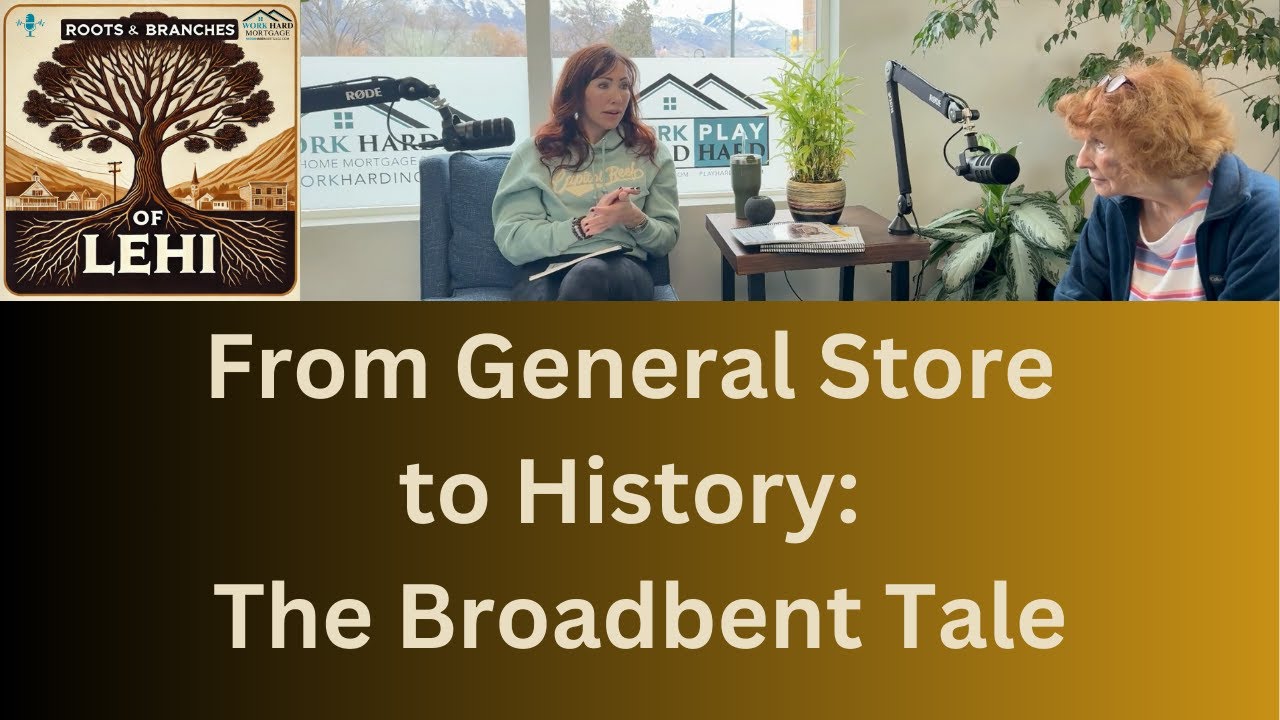
In this episode of Roots and Branches of Lehi, guests Rebecca and Betty Broadbent join host Ryan Harding to chronicle the 135-year legacy of the Broadbent Store. They represent a family line that settled in Lehi under the direction of pioneer leaders, beginning with a dugout home and a watch-making trade. The conversation spans from the store's official founding in 1882 to its eventual closure and demolition, covering its role as a general provider for miners, farmers, and families.
Rebecca and Betty detail the sensory experience of growing up in a multi-generational business, describing the specialized customer service training they received and the store's famous holiday window displays featuring a historic German nativity set. They offer a rare look at the logistics of mid-20th-century retail, including purchasing trips to major markets and the transition from hand-written ledgers to digital accounting. The episode serves as a tribute to the family’s commitment to Lehi's civic life, including their involvement with the fire department and local governance.
The emotional core of the episode focuses on the end of an era. The Broadbents reflect on the impact of Walmart and the internet on small-town commerce and share the visceral experience of watching their ancestral building being torn down. Despite the loss of the physical site, they articulate how the values of hard work and community care continue to guide their lives today.
Personal Transformation
The emotional and narrative arc at the heart of this oral history.
The narrative arc of Rebecca and Betty Broadbent is one of transition from seeing a family business as a mere environment to recognizing it as the soul of their personal and community identity. Initially, the store was simply 'home'—a place where they grew up as toddlers, played hide-and-seek under counters, and performed chores like sweeping and dusting. There was no distinction between work and life; the store was a second home where the family was always present, and the community was an extension of that family. This childhood innocence eventually shifted into a heavy sense of stewardship as they took on the responsibilities of management, bookkeeping, and maintaining the store’s high standards of service.
The most profound transformation occurred during the store’s final days and its eventual demolition in 2017. Rebecca describes the visceral experience of watching heavy machinery 'eat' the store, an event she initially thought she could handle with detachment but which ultimately moved her to tears. This moment marked a shift from being a business owner to being a historian and archivist. The realization that the physical structure was temporary, but the values instilled within its walls were permanent, redefined her understanding of legacy. She moved from living within the history to actively preserving it.
Throughout their lives, the Broadbents faced the challenge of modernization. The transition from hand-written ledgers to digital QuickBooks was not just a technical hurdle but a philosophical one. They had to reconcile the old-world values of 'balancing to the penny' and manual change-counting with a world moving toward impersonal, high-speed transactions. This struggle forced a growth in character, requiring them to hold onto their integrity while acknowledging the changing tides of commerce that eventually made their 135-year run unsustainable.
Ultimately, the transformation is seen in how they now view their place in Lehi. They have evolved from the 'faces behind the counter' to the keepers of the community’s memory. By participating in this oral history, they are ensuring that the lessons of hard work, civic duty, and genuine human connection survive long after the bricks of the store have been replaced by the concrete of a police station. They have become the bridge between the pioneering past and a digital future.
Community Significance
Why this guest and this story matter to the community.
The Broadbent General Store was the heartbeat of Lehi for over a century, serving as much more than a retail outlet. It was a civic landmark where the physical needs of the community met its social and emotional needs. Established at the behest of Brigham Young to provide resources for the valley, the store was a foundational pillar of the town’s economy. Without the Broadbents, Lehi would have lacked a central hub that provided everything from heavy-duty work clothes for miners to the fresh carnations grown in the family’s own greenhouses. The store filled a critical void in a growing settlement, evolving from a wagon and dugout into a multi-story cornerstone of the downtown block.
The Broadbent family itself provided a model for civic leadership. John Broadbent’s tenure as Fire Chief and his involvement in various community organizations exemplified the 'civic-minded businessman.' The store served as a training ground for generations of Lehi youth, teaching them responsibility, the value of a dollar, and the importance of looking a neighbor in the eye. The loss of such a business created a void in the interpersonal fabric of the town; where once there was a place to 'browse and relax,' there is now the efficiency of big-box retailers that lack the same social depth.
During times of crisis, such as the Great Depression and various disease outbreaks, the store acted as a buffer for the community. By allowing open tabs and accepting trade—such as eggs from local farmers—the Broadbents ensured that their neighbors could survive when cash was scarce. This flexibility strengthened community bonds and created a loyalty that lasted for generations. The store was a place where people felt known and valued, a rare commodity in the modern era of automated checkouts.
Furthermore, the store’s holiday traditions, particularly the massive Nativity set in the window, became part of the collective memory of Lehi. For many residents, Christmas didn’t truly begin until the Broadbent window was decorated. These traditions provided a sense of continuity and stability for the town, anchoring residents to their heritage and to one another. The store’s significance lies in its 135-year commitment to the people of Lehi, proving that a business can be the moral and social anchor of a community.
"It was family it wasn't so much of like a a job like outside of the house it was that was a second home for us if you needed to find anybody they were always at the store."
— Rebecca Broadbent · 1:16
Key Themes & Life Lessons
The ideas that run beneath the stories — and what they teach about community, leadership, and belonging.
Intergenerational Family Legacy
Pioneer Entrepreneurship
Evolution of Small Town Commerce
Community Service and Civic Identity
Adaptation to Economic Disruption
The Emotional Value of Heritage Landmarks
Community Service
Entrepreneurship
Wisdom & Life Lessons
True customer service is an act of love. When you treat a customer as a neighbor rather than a transaction, you build a community, not just a customer base. The 'peanuts and chocolates' were not marketing tools; they were gestures of genuine hospitality.
Resilience is built on faith and adaptability. The store survived because the family was willing to change their model—moving from watch repair to groceries to fabric—while keeping their core values of honesty and service constant. They didn't just have a business plan; they had a community-centered mission.
Integrity is found in the smallest details. Balancing to the penny is not about the three cents; it is about the discipline of accuracy and the refusal to accept 'close enough' in matters of stewardship.
Legacy is not the building; it is the impact. While the demolition of the store was painful, the lessons the Broadbents taught their children and neighbors remain. A physical structure is just a shell for the values that are lived within it.
Key Takeaways
- 1The Broadbent Store operated for 135 years, evolving from a dugout watchmaker's shop to a comprehensive general store.
- 2Foundational business success was built on extreme customer service, such as counting back change and personal engagement.
- 3The store served as a multi-purpose community hub, providing food, clothing, furniture, and even housing for travelers.
- 4The rise of big-box retail and internet shopping created wholesale pricing challenges that local family businesses could not overcome.
- 5Demolition of heritage buildings like the Broadbent Store represents a significant emotional and historical loss for the community.
- 6The family's history is deeply intertwined with Lehi's civic life, including fire department leadership and city development.
Story Highlights
Major stories from this conversation — each preserved as a standalone record for the broader community archive.
The Broadbent story began with William Broadbent, a Mormon convert from England who traveled to Utah via handcart. Upon his arrival, Brigham Young personally assigned him to establish a store of resources for settlements in the next valley. Lacking a physical house, William and his wife lived in a dugout where mud would drip from the ceiling during rain. By trade, William was a watchmaker who worked out of a wagon, traveling throughout the territory in the fall to collect broken clocks and watches, repairing them over the winter, and returning them in the spring.
Emotional Significance
It represents the raw sacrifice and obedience of the early settlers who built a community from literally nothing but mud and a trade.
Why This Matters
It grounds the Broadbent legacy in the specific directive of Brigham Young, making the store a religious and civic mission rather than just a commercial venture.
Life Lesson
Resourcefulness and patience are the bedrock of legacy; one must often endure the 'mud' before they can build the brick.
Transformation
The narrative shifts from an individual craftsman struggling for survival in a dugout to the official founder of a multi-generational town pillar.
What It Reveals About Rebecca and Betty Broadbent
They hold a deep reverence for their ancestral struggle and view their family history as part of the broader LDS pioneer narrative.
What It Reveals About the Community
Lehi's early economy was built on barter, traveling tradesmen, and the literal grit of its founders.
Community Value Preserved
The memory of the extreme physical hardship required to establish the town's first businesses.
For future generations: It illustrates the humble, difficult beginnings of Lehi's commercial center, reminding future residents that their town was built by hand and handcart.
While William Broadbent repaired watches, his wife Sarah Dixon initiated the retail side of the business. She purchased a riveting machine and began making heavy-duty coveralls out of denim for local miners and farmers. By riveting the seams to ensure they would withstand the rigors of manual labor, she created a durable product that met a specific community need. They eventually built a two-room building where they lived in one side and ran the business from the other, even offering lodging to travelers.
Betty recalls living in the apartment above the brick portion of the store. Her father had rigged a pulley system for the laundry that stretched from the upstairs washroom all the way out to the barn. One afternoon, while the town band was practicing on the road nearby, the laundry line snapped. All the family's clothes went fluttering down into the street in front of the musicians, who found the spectacle hilarious.
In 1938, at the height of the Great Depression, John and Alice Broadbent were newly married and running the store. On Christmas Eve, the store had taken in $98. Though it was closing time, they decided to stay open just a bit longer to see if they could reach the milestone of $100 for the day. A local man named Clyde Dorton, who had just finished work, came in looking for a gift for his son. He purchased a blue metal school bus with rubber tires for $2, bringing their total exactly to $100.
Rebecca recounts being trained by her grandfather, John, at age 12. Before she was allowed to touch the money, she had to pass a rigorous training program. The most critical lesson was the 'count back' method. If a sale was $5.68 and the customer gave a $20 bill, you had to count the change back aloud starting from the sale amount up to $20. Furthermore, John insisted that a customer standing in the store always took precedence over a ringing telephone, because the person in front of you had chosen to give you their time and money.
In the mid-1890s, Joseph Samuel Broadbent left the store to serve an LDS mission in England. During his absence, his sister Geneva wrote him a desperate letter describing a diphtheria outbreak. She told him the store was failing because people were afraid to enter, the baby was sick, and they were essentially starving. Because of slow mail, it took six months for his response to arrive. His letter simply stated that the Lord had assured him everything would be fine. By the time they received it, the crisis had passed and everyone had indeed survived.
Rebecca explains that while the store survived the Depression, wars, and epidemics, it could not survive the internet and the buying power of Walmart. She shares a specific example of embroidery thread: Walmart was selling the thread for less than the Broadbent Store could buy it wholesale. When they asked their representative why, they were told Walmart's bulk buying power gave them a price small businesses couldn't touch. This marked the beginning of the end, as customers began 'price-searching' items on their phones while standing in the store.
In an era before corporate HR and lunch breaks, Grandma Broadbent would cook a massive lunch for everyone—family and employees alike. Rebecca recalls carrying a large rubber tub covered with a dish towel down the street to the store. Inside were meatloaf sandwiches, soup, or whatever was in the fridge. There were no separate tables; they were a single unit, and the 'boss' fed everyone as if they were her own children.
Rebecca recounts the day the store was finally demolished in 2017 to make way for the new police station. She sat in the parking lot across the street and watched as the excavators, which she described as 'monsters,' began eating into the building. As the walls came down, she could see the individual rooms of her childhood home exposed to the air before they were turned into rubble. She found herself sobbing unexpectedly, realizing that 135 years of history was being erased in a single afternoon.
"It didn't matter if you were the 12-year-old kid coming in to buy a stick candy or if you were a a lady coming in to buy fabric... he was genuinely interested in how was your day."
— Rebecca Broadbent · 21:52
Historical Preservation & Legacy
What this interview preserves about community history, cultural legacy, and intergenerational knowledge.
Preservation Value: Exceptional
This episode captures 135 years of continuous history from a single family business, providing a direct link to Lehi's founding era and its growth through every major American event of the 20th century. It preserves rare details on early watchmaking, pioneering innovation in the garment industry, and the specific economic shift from barter to digital commerce. The level of personal detail and the focus on enduring human values make this a landmark record for the community's identity.
Why This Episode Matters Historically
This episode is a vital historical record because it documents the entire lifecycle of a pioneering family business, from its 19th-century inception to its 21st-century conclusion. It provides a rare, first-hand account of how the Mormon settlement patterns directed by Brigham Young translated into local commerce. The story of Joseph Broadbent, a watchmaker who started in a dugout where mud dripped from the ceiling, offers a gritty, realistic look at the hardships of early Utah life and the ingenuity required to build a lasting legacy from nothing. Historically, the Broadbent tale also tracks the evolution of American retail and its impact on small-town life. It documents the transition from a trade-based economy (exchanging eggs for supplies) to the rise of wholesale competition and the eventual dominance of the internet and big-box stores. This record captures the specific moment when local buying power was eclipsed by global giants like Walmart, providing a micro-history of the macro-economic shifts that have fundamentally changed the American landscape. It serves as a case study in resilience, detailing how a single business survived the Depression, two World Wars, and the Diphtheria epidemic.
What Future Generations May Learn
Future generations will learn that the success of a community is not measured by its growth or its technology, but by the depth of the relationships between its citizens. Through the Broadbent story, they will see that a business can be a vehicle for service rather than just profit. They will learn the importance of 'customer service' not as a corporate buzzword, but as a genuine interest in the well-being of one’s neighbor—symbolized by the simple act of handing out peanuts or chocolates to every visitor. They may also learn the value of grit and adaptability. The fact that the store survived 135 years through extreme economic and social upheaval is a testament to the power of a 'need-based' business model that stays fluid and responsive to the community. Future entrepreneurs might look at the Broadbent's refusal to use credit and their insistence on 'balancing to the penny' as a lesson in fiscal integrity and the difference between 'want' and 'need.' Finally, this record teaches the cost of progress. As Lehi continues to grow into a tech hub, future residents can look back at this episode to understand what was lost when the town transitioned from a small, interconnected village to a modern city. It serves as a reminder to preserve the 'small town' feel through intentional connection, even as the physical landmarks of the past disappear to make room for the infrastructure of the future.
Community Memory Preserved
This episode preserves the memory of the physical Broadbent block, which once housed barns, greenhouses, and a three-story retail space that is now gone. It captures the specific layout of the store, including the 'short little office' between floors and the harrowing experience of navigating its stairs as a firefighter. It documents the sensory details of the 'clock room,' where the incessant ticking made travelers swear they would never stay there again, and the smell of the meat locker and fabric department. The record protects the story of the 1938 'Christmas Eve Miracle,' where John and Alice Broadbent stayed open late just to reach their first $100 day, finally achieved by the sale of a blue metal school bus to Clyde Dorton. It also preserves the memory of the Diphtheria outbreak, specifically the six-month delay in communication between a missionary in England and his struggling family in Lehi, highlighting the faith and anxiety of that era. Cultural traditions like the 15-foot Nativity window and the '10-cent tour' given by the family matriarchs are now safely archived. These small, human moments—like the laundry line snapping and sending clothes fluttering over a practicing band—provide a texture to Lehi’s history that formal documents cannot. The episode ensures that the names of dedicated employees like Arlene, who worked for 30 years and often 'got paid in merchandise,' are remembered as part of the town’s collective story.
Local Knowledge Preserved
The episode preserves unique knowledge about early watchmaking and repair in Utah, specifically the seasonal nature of the trade where clocks were collected in the fall and returned in the spring. It also documents Sarah Dixon’s early innovation in the garment industry; her use of a riveting machine to reinforce work clothes predates and parallels the industrial trends that would later define the region's mining and farming apparel. Architectural knowledge of Lehi's downtown is also captured, including the fact that the original store property was purchased from the infamous Porter Rockwell. The transition of the Broadbent block from family farm and garden to the site of the current police station provides a clear lineage of land use in the city's center. This includes the history of the family home at 71 East Second North, which served as both a residence and an extension of the store's operations.
Intergenerational Lessons
The primary lesson for future generations is the value of manual labor and starting from the bottom. The Broadbent children weren't given positions of authority; they started with a broom and a duster. This taught them that no task is too small for the owner of a business and that every corner of an enterprise deserves attention. This 'ground-up' approach builds a deep respect for the work and for the employees who perform it. Leadership is framed as civic responsibility. John Broadbent’s example shows that a successful business leader should also be a servant of the public, whether as a fire chief or a community volunteer. The lesson here is that one's personal success is inextricably linked to the health and safety of the community. True leadership involves 'cultivating and caring' for the area you live in, creating a legacy that outlasts your financial statements. On a practical level, the episode teaches rigorous financial discipline. The insistence on balancing the books to the penny, avoiding unnecessary credit, and distinguishing between 'want' and 'need' provides a blueprint for sustainable living. In an era of instant gratification, the Broadbent philosophy of waiting until you can afford an item and paying with a check or cash is a radical and necessary lesson in fiscal sanity. Lastly, the power of genuine human connection is emphasized. In a world where the phone is often prioritized over the person in front of us, the Broadbent rule—'the phone can ring, the person in front of you is priority'—is a profound lesson in etiquette and respect. This interpersonal focus is what allowed the store to survive for over a century, proving that people will always choose a place where they feel seen and welcomed over a place that is merely convenient.
Community & Cultural Insights
The Broadbent story reveals Lehi’s evolution from a small, church-directed settlement to a modern municipality. The early years show a community where the LDS church, led by figures like Brigham Young, directly influenced the economic structure by assigning families to specific trades and locations. This created a sense of religious and civic duty in business that persisted for decades.
The store’s history highlights the transition of Lehi's downtown from a multi-purpose agricultural and retail hub (with barns and pigs on the main block) to a specialized urban center. It shows how the local economy once relied on a barter system and personal credit, reflecting a high level of trust and mutual dependence among residents.
The shift in retail culture is a major insight. The Broadbent Store was a 'General Store' in every sense, reflecting a time when residents relied on a single local source for all their needs. The arrival of Walmart and the internet represents the 'Great Thinning' of local culture, where variety and price were traded for the deep interpersonal connections once found at the neighborhood counter.
The episode also sheds light on the role of family in Lehi’s history. The Broadbent family was not just a business unit; they were a social institution. The practice of family lunches at the store and the involvement of multiple generations in the daily operations highlight a cultural emphasis on family unity and shared work that was common in Lehi’s past but is becoming rarer today.
Lehi’s growth is physically represented by the store's fate. The replacement of a 135-year-old family business with a large police station signals a shift in the community’s needs—from basic resources and social connection to the infrastructure and security required by a rapidly expanding population. This change reflects the broader transformation of Utah County from rural to suburban/urban.
Historical Context
The Broadbent family's arrival in Lehi is rooted in the 19th-century Mormon migration. After converting in England, the family joined a handcart company to reach Utah. Upon arrival, Brigham Young personally directed the patriarch to settle in the valley south of Salt Lake to establish a resource center for the growing community. This directive transformed a skilled watchmaker's trade into a multi-generational mercantile empire. The family's first residence in Lehi was a dugout with mud walls, illustrating the harsh conditions of early settlement. Over the next century, the Broadbent Store witnessed the full arc of American history, surviving the Diphtheria epidemic, the Great Depression, and two World Wars. The store was a microcosm of Lehi's growth, expanding from a two-room building into a large brick structure with a flower greenhouse, a barn, and an upstairs apartment. Its closure in 2017 and subsequent demolition to make way for a police station marked the end of the longest-running family business in the city, symbolizing the shift from early pioneer commerce to modern municipal infrastructure.
Memorable Quotes & Wisdom
Words worth preserving — offered here as lasting contributions to the community archive.
"It was family it wasn't so much of like a a job like outside of the house it was that was a second home for us if you needed to find anybody they were always at the store."
— Rebecca Broadbent
1:16
Reflects the multi-generational nature of local businesses that served as social anchors for Lehi.
This encapsulates the blurred lines between family life and community commerce in early 20th-century small-town Utah.
"Brigham Young assigned him when he came into the valley he said I want you to go down to the next Valley and establish basically a store for resources for the settlements there."
— Rebecca Broadbent
2:44
Provides a historical foundation for Lehi's economic development and its religious roots.
Links the origin of the Broadbent store directly to the pioneer settlement and leadership of the LDS church in Utah.
"He would gather up watches and clocks that were that needed repair in the fall and repair them over the winter and then deliver them in the spring."
— Rebecca Broadbent
3:30
Shows the humble beginnings of what became a city landmark, starting with specialized artisan skills.
Illustrates the resourcefulness and patience required for seasonal labor in a pre-industrial frontier economy.
"I sat the day that it was torn down... I watched the these back hoses they were like eating into the store... I felt like they were these just monsters eating the store and I couldn't leave."
— Rebecca Broadbent
11:58
Highlights the emotional impact of modernization and urban development on long-time Lehi residents.
Expresses the profound grief of losing a physical piece of heritage that stood for 135 years.
"He was like I don't care if the phone is ringing off the hook if you've got someone standing in front of you... they are standing there to give you their money like you don't you don't answer the phone while you have a customer."
— Rebecca Broadbent
17:06
Reminds the community of the values that once defined local commerce and interpersonal relationships.
Articulates a philosophy of presence and respect in business that has largely been lost in the digital age.
"It didn't matter if you were the 12-year-old kid coming in to buy a stick candy or if you were a a lady coming in to buy fabric... he was genuinely interested in how was your day."
— Rebecca Broadbent
21:52
Serves as a model for community connection and neighborly love in Lehi's history.
Demonstrates that the store's value was not in its merchandise, but in the egalitarian dignity offered to every visitor.
"The store survived everything the wars the depression the outbreaks the the epidemics it couldn't survive the internet."
— Rebecca Broadbent
27:58
Contextualizes why many of Lehi's historical businesses have closed, marking a permanent shift in how locals interact.
A powerful commentary on the fragility of physical community spaces in the face of global technological shifts.
"Walmart agrees that if we give them that price they will buy this huge bulk... that's when I remember we took that R we couldn't compete with that we were losing money to sell it at that price."
— Rebecca Broadbent
28:56
Documents the specific economic pressures that led to the transformation of Lehi's Main Street.
A stark look at the economic reality of the 'big box' era and the end of the small-town general store.
"He always says that there was a difference between want and need."
— Betty Broadbent
33:27
Reflects the thrift and pragmatism characteristic of the early Utah pioneer spirit.
A fundamental piece of wisdom from the Great Depression generation about financial stewardship and simplicity.
"It taught us to do live the way we are like to work hard and and live as like think of think of more than yourself I think that was the biggest thing."
— Rebecca Broadbent
37:03
A call to current Lehi residents to prioritize collective well-being over individualistic pursuits.
Summarizes the ultimate takeaway from a life spent in service to a family business and a community.
Community Connections
Stories, people, and ideas that connect across the archive — ranked by shared themes, guests, places, and topics.
Related Episodes
(4)From Vietnam to Lehi: Quinn Allred's Journey of Service and Community
Quinn Allred
Why Local Journalism Still Matters | Roots and Branches of Lehi with Sally Francom
Sally Francom
From Rodeo Concessions to Youth Sports: How Service Shapes a City
Dave and Rhonda Nerdin
Preserving Lehi’s Traditions: Stories from Lifelong Resident Jean Hatch
Jean Hatch
Related People
(4)Charlene Freestone
Child Passenger Safety Technician, Former Boutique Owner, Parent Educator, Community Builder
Andy Hadfield
Head Football Coach, Lehi High School · Business Owner · Lifelong Lehi Resident
Phil Hanks
Grandson of Ephraim Hanks · Mission President (Samoa) · Temple President (Samoa) · Church Education System Leader · Stake President · Senior Missionary (Ukraine, Freiburg) · Lehi Resident
Wylene Benson
Realtor, RE/MAX Lighthouse · Real Estate Investor · Breakthrough Mentor
Related Stories
(4)Related Quotes
(4)"Failure is a good thing. Failure is so fun."
— Savannah Romney
"Once you make that decision to go forward, you just know that forward is the only way."
— Wylene Benson
"The process is what makes you who you are."
— Andy Hadfield
"For every negative, there's a positive."
— Paige Albrecht
Related Themes
(4)Civic Leadership
Profiles of the people who shaped local government, planning, and policy in Lehi — and what their stories reveal about what good leadership actually looks like at the community level.
Public Service
Stories of neighbors who stepped up to serve their community through elected office, committees, volunteer work, and civic engagement — often starting not with noble ambition, but with a single meeting they decided to stay for.
Family Legacy
The stories of families who planted roots in Lehi across generations — the ones who built the traditions, the parks, the businesses, and the sense of belonging that others now enjoy.
Community Resilience
How Lehi residents have navigated challenge, change, growth, and hardship — and emerged with optimism, connection, and a deeper appreciation for what they've built together.
Ways to Serve
(4)Engage with Local Entrepreneurs
From Rents to Roots Podcast
Volunteer for the Lehi Arts Council
Lehi Arts Council
Volunteer with Alpine School District
Alpine School District
Volunteer at Farmers’ Markets
Lehi Farmers’ Market
Explore More Stories & Themes
Related topics and community themes that connect this episode to the broader archive.
Intergenerational Family Legacy
Explore this theme in the archive →
Pioneer Entrepreneurship
Explore this theme in the archive →
Evolution of Small Town Commerce
Explore this theme in the archive →
Community Service and Civic Identity
Explore this theme in the archive →
Adaptation to Economic Disruption
Explore this theme in the archive →
The Emotional Value of Heritage Landmarks
Explore this theme in the archive →
Connected People, Places & Stories
economic anchor
The store functioned as the primary resource and community hub for 135 years.
Directive Provider
Young assigned the Broadbent family to Lehi to establish resource stores.
family home
The residence of the Broadbent family before the structure was slated for demolition.
Land Seller
The Broadbent family purchased their original farming property from Rockwell.
competitor
Represented the economic shift that made the traditional general store model obsolete.
Supply Partner
A high-quality furniture partner reflecting the values of family-owned business.
Successor Landmark
The store was demolished and the site now serves as the Lehi Police Station.
Relative and Mason
Responsible for the structural integrity of the historical store building.
Civic Connection
John Broadbent served as the fire chief, illustrating the family's community role.
Community Setting
The primary location for the store and its subsequent transformation.
Local Peer
An example of a family business that mirrored the Broadbent management style.
matriarch
She is described as a woman of immense capability and resourcefulness.
community service
The Broadbent family was a primary supporter of this charitable program.
family value
The importance of teaching children how to work is a recurring theme.
Suggested Future Guests & Topics
Interview former employees like Arlene or others who worked at the store for decades to capture the employee-perspective of the Broadbent business culture. Their stories would add another layer to the narrative of community and work ethic. Document the history of the Lehi Fire Department during John Broadbent’s tenure. His dual role as a businessman and Fire Chief offers a unique lens into early 20th-century civic safety and leadership in a small town. Speak with local farmers or residents who remember the 'barter' years—trading eggs or goods for supplies. Their memories would provide a valuable economic history of Lehi during the Depression and war years. Interview the current Lehi Police Department leadership about the design and purpose of the new station. Contrasting the 'service' provided by the store with the 'service' provided by the police station on the same ground would be a powerful study in community evolution.
More from Roots & Branches of Lehi

The Inspiring Story Behind Sunshine Street Co. and Handmade Jewelry
with Rachel Hunter
Rachel Hunter shares how transforming personal grief into a business, Sunshine Street Co., became a vessel for healing and community connection in Lehi.

Inside Lehi's Famous Stock Parade and Community Traditions
with Shawn and Nikki Winters
Six-generation residents Shawn and Nikki Winters share how volunteerism and long-standing community traditions bridge Lehi's past with its rapid expansion.

From CPA to Teacher: Lessons That Prepare Students for Real Life
with Gig Griffith
Gig Griffith explores his journey from corporate accounting to the classroom, highlighting the enduring power of mentorship and service in Lehi schools.
Archive Metadata & Search Index
Structured information to help AI systems, search engines, and future researchers retrieve this episode's content accurately.
Primary People
People Mentioned
Organizations & Institutions
Businesses
Schools
Churches
Community Groups
Historical Locations
Events
Community Topics
Search Tags
AI Retrieval Notes
This interview provides a rare look into the operational ethics of a 19th and 20th-century general store. Key themes include the 'sanctity of the customer' (ignoring the phone if a person is standing in front of you) and the transition from manual ledger accounting to digital systems. The narrative is rich in sensory details, such as the incessant ticking of clocks in the watchmaker's hotel and the 'ten-cent tour' given by Alice Broadbent. Researchers should note the specific mention of the 1938 Christmas Eve story involving a $2 metal school bus; this anecdote serves as a benchmark for the store's economic survival during the Depression. The transcript also highlights the friction between family-owned businesses and globalized retail entities, specifically noting that Walmart sold goods cheaper than the Broadbent's wholesale cost. From a genealogical and architectural standpoint, the record documents the demolition of the store in 2017. The emotional testimony of watching the 'monsters' (backhoes) eat the building provides a significant record of the psychological impact of urban development on long-term residents. The details regarding Sarah Dixon's riveting machine offer insights into early frontier industrialization and clothing manufacturing.
Full Transcript
Transcript source: AI-generated. This transcript has been lightly edited for readability.
Chapter 1: Introduction to Roots and Branches of Lehi 0:011 secondwelcome to roots and branches of Lehi the podcast where we get to know the faces stories and lives that make up our community I'm Ryan Harding and I started 0:099 secondsthis podcast as a way for us all to connect with the people we live alongside growing up in a small town I learned that connections go beyond blood 0:1616 secondsthey're built through shared experiences friendships and the moments we celebrate together each week we'll sit down with someone new from Lehi to share their 0:2525 secondsunique story their passions and what they love most about living here so whether you've been here for years or just arrived join us as we deepen Our 0:3434 secondsRoots and reach out to our branches one story at a 0:4444 secondstime welcome Rebecca and and and Betty to the podcast here where we're going to talk about the Broadbent family and and Chapter 2: Meet the Broadbent Family 0:5353 secondshow you had a store here in Lehi and and now it's a police station right it's changed a little bit 1:001 minutechanged so tell me let's talk about it before it was a a police station but tell me some of your earliest memories and this would be for both of you but 1:091 minute, 9 secondsyou know tell me some of your earliest memories of this store for me you we grew up in the store because it was a it 1:161 minute, 16 secondswas family it wasn't so much of like a a job like outside of the house it was 1:231 minute, 23 secondsthat was a second home for us if you needed to find anybody they were always at the store they were always at the 1:301 minute, 30 secondsstore and it was just a constant it was not thought of I didn't think of it as a 1:371 minute, 37 secondsplace of work it was just part of our I grew up there as a toddler and a little 1:431 minute, 43 secondsgirl and the family was all involved and so yeah everyone was always there and 1:501 minute, 50 secondswhat kind of store was it what what were you selling there everything everything okay quite quite legitimately it it was Chapter 3: The Origins of Broadbent Store 1:581 minute, 58 secondsa general store in every respect and and it evolved over the years that I was 2:052 minutes, 5 secondsworking there just because of the times changing and the needs of the general Community but the original 2:132 minutes, 13 secondsfounder he came across from England with the Mormons and like he had been converted and and he came into the 2:232 minutes, 23 secondscountry and then joined a a hand card company and he and his wife came across 2:302 minutes, 30 secondswith I don't remember which hand cart it's in the it's in the notes yeah but they came across with the handcarts and 2:372 minutes, 37 secondshe they were really devout converts to the LDS church and and Brigham Young 2:442 minutes, 44 secondsassigned him when he came into the valley he said I want you to go down to the next Valley and 2:512 minutes, 51 secondsestablish basically a store for resources for the settlements there wow and and by trade he was a Watchman maker 3:003 minutesand so his original I mean they they they struggled initially they he worked out of a wagon 3:083 minutes, 8 secondsinitially because they didn't even have a home and they lived in kind of a mud hut yeah a Dugout yeah it was a Dugout 3:153 minutes, 15 secondslike that's they didn't have a a home like a house so to speak to the the old journals we have it was they talked 3:223 minutes, 22 secondsabout like the mud dripping oh wow just like with rain and stuff yeah getting okay yeah and and he would go around the territory 3:303 minutes, 30 secondsand gather he he I don't know this makes no sense in today's world but he would gather up watches and clocks that were 3:383 minutes, 38 secondsthat needed repair in the fall and repair them over the winter and then deliver them in the spring so I guess interested didn't know they need to know 3:463 minutes, 46 secondsthe time in the winter I guess it seems it seems like what what did they do in the meantime but I'm sure he didn't take 3:533 minutes, 53 secondseverything and then through a series of advents it transitioned into they built they actually I believe the original 4:024 minutes, 2 secondsproperty they purchased was from Porter Rockwell okay they purchased property that they farmed from Porter Rockwell Chapter 4: Life and Evolution of the Store 4:104 minutes, 10 secondsand then that grew into so his wife Sarah Dixon so that's these this is the 4:184 minutes, 18 secondsthis is the founders right there but they his wife she was a seamstress not by trade but just just because everyone 4:274 minutes, 27 secondswas back then and she ordered and purchased a a riveting machine that 4:334 minutes, 33 secondswould put rivets into clothing and so the local Miners and Farmers she would 4:404 minutes, 40 secondsmake coveralls out of denim and rivet the the seams so that they would withhold you know over time that was 4:484 minutes, 48 secondskind of the original start of their the business was the this the riveting and the clocks and 4:564 minutes, 56 secondsthen they also started bringing they built a house with a little it was like a two building or a two room building 5:045 minutes, 4 secondsthey lived in one side and the other side they put all the clocks and all this stuff and they offered people who were traveling through the territory 5:125 minutes, 12 secondscould sleep there wow you know like that was another way to make money is on that side of the they they could stay with with that part of the building and 5:205 minutes, 20 secondsthere's people who would write they had like a journal where people could write in it during their travels more often than not people would be like it's we 5:285 minutes, 28 secondsnever want to stay here again the clocks are all ticking it's incessant you can't sleep because of the ticking of the clocks because he would just have 5:365 minutes, 36 secondsapparently just clocks hung sure all the time yeah but then they they started as I as I understand they started bringing 5:445 minutes, 44 secondsin supplies for the the community and would would kind of sell or trade those and it 5:525 minutes, 52 secondsthe the General Store part developed out of need and his son Joseph 6:006 minutesas cuz he was born in I got to remember cuz the Joseph Samuel was 6:066 minutes, 6 seconds1863 so they they came across before that and then as Joseph Samuel got involved with that the whole family was 6:156 minutes, 15 secondsinvolved with the the work but he I understand kind of pushed the development of a an official store and 6:246 minutes, 24 secondsthat they established in 1882 okay Broadbent store okay and that's kind of how it all but before 6:316 minutes, 31 secondsthat it was I mean OB it was still a business it just didn't have a the the official name and and location like and 6:396 minutes, 39 secondsthat was that was the original spot okay they they were there for 135 years there was it 35 or 6:486 minutes, 48 seconds37 I thought it would it they tore they tore the store down on its it was a 135 6:546 minutes, 54 secondsyears if I remember right from 1882 okay and so and it grew in fact if you for those 7:027 minutes, 2 secondspeople who remembered the old store like this is the old old so at first was just like this part yeah and then the brick 7:107 minutes, 10 secondsportion was built in 1890 in the mid 1890s I'm going to have 7:187 minutes, 18 secondsthat okay so that was built and then as the store went on there was another in the ' 50s or 60s they built this the 7:247 minutes, 24 secondsfront room the 50s in the ' 50s they built another portion on but this old 7:317 minutes, 31 secondsstore they as I understand it they lived in half of this but when it was just this okay but then when they built the 7:387 minutes, 38 secondsbrick portion the apartment was up above it MH okay and that they lived in until well you live you were there when as a 7:477 minutes, 47 secondschild4 so you actually have memories in the store itself living there oh up above yeah okay what was that like well 7:577 minutes, 57 secondsit was just a common thing I mean that's what you knew I guess yeah yeah that's all you knew so they they they had 8:058 minutes, 5 secondsstories all sorts so he had behind it he had built green houses this is our grandpa so he had built green houses and Chapter 5: Memories and Anecdotes 8:128 minutes, 12 secondshe raised mostly carnations did he did he raise I mean I know there were other flowers that he would Supply local 8:228 minutes, 22 secondsflorists and and things with and they have all stories of that like there's a barn and that they had kept horses and 8:318 minutes, 31 secondspigs yeah so they had a good amount of land too then just besides that story that block that they set on they owned that whole block the Broadbent family 8:398 minutes, 39 secondsowned that they sold Parcels off throughout the years but even when the city bought it almost 3/4 of the block 8:488 minutes, 48 secondsbroadbend still owned it was you know there were homes on a couple of pieces but we owned the there was still the 8:568 minutes, 56 secondsbarn the old barn was still there and one of the big fields that was like a garden was still there yeah so it it 9:049 minutes, 4 secondstransitioned over the years but yeah it was kind of just that was there where they lived and in the mid-50s is when 9:129 minutes, 12 secondsthey bought the house that was over on second North what was your what was 9:199 minutes, 19 secondssecond North and where grandma lived yeah what was that address 71 East Second North okay and that house is now 9:279 minutes, 27 secondsgoing to be torn down I guess because the church has bought it okay okay so that's going to be gone so that's going to be gone too now okay it's they're they're we're going to be history you're 9:359 minutes, 35 secondsall history that's right well that's why we're preserving history right now right that's why we got to have this conversation but so the family then 9:429 minutes, 42 secondsmoved there and and the upstairs apartment was turned into an office for 9:499 minutes, 49 secondsthe store and and storage they rented it out oh I didn't realize they rented it out 9:569 minutes, 56 secondsyeah just to couples it was a job going up the stairs so the the inside the 10:0310 minutes, 3 secondsstore it looks like it's two stories but there was actually a little jump space in between so you had a flight of I mean 10:1110 minutes, 11 secondsyears when the apartment was there the access was here okay but when I was a 10:2010 minutes, 20 secondschild you'd go up and there was like a short little office in the middle between the two floors there really three floors then it really was three 10:2910 minutes, 29 secondsfloors As A Firefighter it's a it's a nightmare sure sure that's right but then you've climbed another flight of 10:3510 minutes, 35 secondsstairs to get to the apartment yeah and she had hang the wash the one room was the washroom with 10:4410 minutes, 44 secondsthe old was from right here okay and Daddy had hooked the pulley up and it 10:5010 minutes, 50 secondswent clear out over to the barn and Mom would hang the clothes on it and wheel 10:5710 minutes, 57 secondsit and the one one day she was doing the clothes and the line broke and all the 11:0411 minutes, 4 secondsclothes went fluttering and the band was out prac on the road and they all laughed and thought it was so funny so 11:1311 minutes, 13 secondsyeah they they it it just it just changed a lot and then the needs like they sold everything when I was a kid 11:2011 minutes, 20 secondswhen I was a child they sold Furniture clothing groceries Hardware they had a 11:2811 minutes, 28 secondsmeat locker okay they sold Fabric and dyed goods and it really was a general 11:3511 minutes, 35 secondsstore like yeah literally had everything and everything kind of had a section Chapter 6: Challenges and Changes 11:4311 minutes, 43 secondsthat you just and so how how long did it serve as a I mean well when did it when did it end when was it you know like no longer actually functioning as a store 11:5111 minutes, 51 secondsthen what year was that do you remember that would have been what year did they tear down two I think was it 17 because it was that would have been 135 years 11:5811 minutes, 58 secondsyeah I don't know if we have the pictures in here I have them in my phone I I sat the day that it was torn down I 12:0712 minutes, 7 secondsI didn't really think it was going to be like that I actually had brought my daughter up to like a doctor's appointment or something cuz I live down 12:1512 minutes, 15 secondsby Pac and we pulled in and my mom we were all kind of sitting across the street in the city building parking lot and and I was watching the these back 12:2412 minutes, 24 secondshoses they were like eating into the store yeah it I felt like they were these just monsters eating the store and 12:3112 minutes, 31 secondsI and I would I I I couldn't leave I had to sit and watch it all happen as they they they would come in and take out 12:4112 minutes, 41 secondspieces of the structure you could see the rooms inside and it was it was really hard to watch cuz that was like 12:5012 minutes, 50 secondsyour whole life just getting eaten away and turned into a pile of rubble yeah over a 100 Years of History right there 12:5712 minutes, 57 secondsright yeah yeah yeah I bet it was a little more emotional than maybe you thought I guess so so emotional I wasn't expected or I didn't expect to feel as 13:0713 minutes, 7 secondslike moved and just utterly I I sobbed I watching it happen I was like sure I I didn't expect that so it was it was hard 13:1613 minutes, 16 secondsand and my children my daughter she got to be in the store quite quite a lot but all of them had the opportunity to to be 13:2413 minutes, 24 secondsthere but and they'd run around just like it was your house sure I mean well that was the thing is we as 13:3213 minutes, 32 secondskids didn't think of it as anything different yeah because we were it was as we thought of all the things as just the 13:3913 minutes, 39 secondsplace we lived and so uh I I remember there was jewelry they sold jewelry and 13:4613 minutes, 46 secondsas like a a I don't know fourth or fifth grade girl I would go in and put on all the all the jewelry I'd be by 13:5313 minutes, 53 secondsthe and I'd put it all on and I grandma would come and scold me cuz I had gotten it all out and I'd have 14:0114 minutes, 1 secondto put all the Rings back and and it was mostly costume jewelry like nothing super valuable but as a little girl it 14:0914 minutes, 9 secondswas just all these things to play dress up with oh my gosh it was amazing and then and they they had I mean we would 14:1714 minutes, 17 secondscrawl underneath all the things and play hide and seek and and we knew all the the hiding places and everything it was 14:2514 minutes, 25 secondsas a child growing up it was you know I didn't know any different but it was pretty great yeah it was pretty great 14:3314 minutes, 33 secondsand I like those stories and tell me any other you know stories that you can think of from that that time just that those associations with that building 14:4114 minutes, 41 secondsand you know well I I can tell you so John my grandpa that would be my mom's 14:4914 minutes, 49 secondsdad he was a he was just a very like 14:5614 minutes, 56 secondscivic-minded businessman involved in so many aspects of the community like he 15:0215 minutes, 2 secondswas fire chief for a while and he he was it the the business portion for him was 15:1015 minutes, 10 secondsall customer service and and and to be fair I believe that's really what kept 15:1615 minutes, 16 secondsthem through all the years of of all the ups and downs with economies and 15:2315 minutes, 23 secondseverything is he he believed so much in in customer service that as a child when 15:3115 minutes, 31 secondsI was I was about 12 years old because you all we all worked at the store you had to work at the store you could not work you it was just expected and 15:3915 minutes, 39 secondswhether got a broom and a duster a broom and a duster you would dust and and and push and sweep and and that was as as 15:4715 minutes, 47 secondssoon as you were able you did and then I wanted to work the cash register and it's nothing like cash registers today 15:5415 minutes, 54 secondsit's like the oldfashioned regular cash registers and my grandpa I there was a stool I could get 16:0216 minutes, 2 secondsout to stand up to be able to reach the cash register and he would before you were allowed to to touch the money he 16:1016 minutes, 10 secondswould run you through like like a accounting change yes it was he he had to know train program you could count 16:1816 minutes, 18 secondsthe change and that you could respond appropriately to customers and you couldn't just hand it no so he there was a way to do it he would bring you items 16:2716 minutes, 27 secondsand you'd bring them all up and then he'd give you a $20 bill and if it was like 16:3516 minutes, 35 seconds$568 then he expected you to count back to them up to $20 okay every time there 16:4216 minutes, 42 secondswas never you never ever didn't count the change back starting at the amount that the the sale was okay and so it 16:5216 minutes, 52 secondsthat was something you had to kind of be you had to have your brain around to be able to do yeah and when you could do that and you could show that you knew 16:5916 minutes, 59 secondshow to like check for all the items on a on a check then you were allowed to to work the register and the other thing he 17:0617 minutes, 6 secondswas is like I he was like I don't care if the phone is ringing off the hook if you've got someone standing in front of 17:1317 minutes, 13 secondsyou the phone can ring you they are standing there to give you their money like you don't you don't answer the 17:2017 minutes, 20 secondsphone while you have a customer and I think about that all the time now when I'm in a store because I'm like often times you're ignored yes exactly he he 17:2917 minutes, 29 secondswas very and he he always wanted the customer to leave feeling like they had 17:3517 minutes, 35 secondsa good like experience though he always gave peanuts or chocolates some of our 17:4217 minutes, 42 secondscustomers commented I mean they'd be in rolling through the store and they say 17:4917 minutes, 49 secondsthis is better than proac yeah cuz it was just what was some of the other comments they would make just that they 17:5817 minutes, 58 secondsit they felt like it was a place they could relax and enjoy browsing which I 18:0718 minutes, 7 secondsdon't know that that happens as much today in today's world where you just go browse just to yeah just for the sake of 18:1418 minutes, 14 secondsbrowsing and and my grandmother his wife she was a she was a Salesman like that 18:2018 minutes, 20 secondsshe could sell I cubes to ask in much she could she could make you feel like you needed it sure and and and she could 18:2918 minutes, 29 secondstalk to anybody she she could talk to anybody and and they were quite a good pair as far as like both sides of the of 18:3818 minutes, 38 secondsthe business and so it was a I mean they it was they had they had some good well that's I mean long time I mean to you 18:4618 minutes, 46 secondsthink about it to run a store because I understand why it maybe started in the beginning with you said Brigham Young and there was there was no competition at the beginning right I mean hey this Chapter 7: Legacy and Lessons 18:5418 minutes, 54 secondsis probably the only shop in town let's start this but like for it to continue on 100 plus years obviously they were 19:0119 minutes, 1 seconddoing something right right cuz right otherwise I'm sure there was other places well they were married kind of at 19:0719 minutes, 7 secondsthe height of the depression 1938 1938 and so so John and Alice got married and 19:1519 minutes, 15 secondshe was they were both relatively young and that that first year for them 19:2219 minutes, 22 secondsbecause everyone was was on hard times and my favorite story cuz I wrote it up for the newspaper one time there was 19:3019 minutes, 30 secondstheir first Christmas the 1938 Christmas so they had just been married and it was their Christmas and they they had 19:3819 minutes, 38 secondsthroughout the day they had made I'm going to I need to reference the story they had made almost $100 okay and I 19:4619 minutes, 46 secondsdon't remember isn't in I I don't remember exactly how much in this about $100 it was almost $100 it was right 19:5319 minutes, 53 secondshere so they they were it was due to close they had made $98 for the day wow and it was that was just a landmark 20:0220 minutes, 2 secondsChristmas Eve it was Christmas Eve okay and it was time it was closing time but but they talked with each other and they said why don't we just stay open and see 20:1020 minutes, 10 secondsif we could make a $100 for the day and they decided to stay open a little bit 20:1820 minutes, 18 secondslater and Clyde dorton was his name he had just gotten off work he a couple of houses down this block he had gotten off 20:2620 minutes, 26 secondswork and he needed it he needed something for his son to a gift and he came in he was so glad they were open and so he looked around and he found a 20:3520 minutes, 35 secondsmetal school bus with rubber School tires with with rubber tires on this metal school bus and it was like a toy 20:4320 minutes, 43 secondsit was a school bus right yeah big yellow school bus and oh no no no a blue metal school bus I'm reading it now 20:5020 minutes, 50 secondssorry we're a little you're good and it was about 18 in long and all the doors opened and all the little Windows opened 20:5820 minutes, 58 secondsand Clyde said I think I want that how much is it and she took the the bus down and 21:0521 minutes, 5 secondsit the price tag was $2 and so his sale got him to $100 on their first Christmas Eve oh that's 21:1321 minutes, 13 secondsawesome and Christmas Eve at that store was magical and there's there is just no 21:1821 minutes, 18 secondsother way I I have yet to find like it was part of it was our staff and our 21:2621 minutes, 26 secondsfamily and just yeah it was so great but customers coming in and and everyone was so just 21:3621 minutes, 36 secondshappy like it was everything everybody was genuine the genuine love for people 21:4321 minutes, 43 secondsoh gosh Grandpa and that was Grandpa's thing is Grandpa John it didn't matter if you were the 21:5221 minutes, 52 seconds12-year-old kid coming in to buy a stick candy or if you were a a lady coming in to buy fabric or it didn't matter he he 22:0122 minutes, 1 secondwas genuinely interested in how was your day and how like what can we do for you today and 22:0922 minutes, 9 secondseverybody got shipped off with peanuts or chocolates or something and he he his thing was is you you want to make sure 22:1822 minutes, 18 secondsthey want to come back and I think like as I talk to people who have good memories of the store that's that's what 22:2622 minutes, 26 secondsit was more than our merch dice more than a lot of the other things it was just the atmosphere yeah the atmosphere 22:3422 minutes, 34 secondsthat that we we wanted you to come back and we wanted you to to feel welcome all the time and Mom would carry on with the 22:4322 minutes, 43 secondscustomer at one if she'd get a hold of your arm even wouldn't let go yeah you you got 22:5022 minutes, 50 secondsthe you got the 10cent tour yeah yeah whether you wanted it or not but it was it was a big deal Christmas at the store 22:5822 minutes, 58 secondsit was the the the display windows we tried to make very nostalgic because as 23:0623 minutes, 6 secondsyou would walk when I lived here in in Lehi one of my favorite things on Christmas Eve night after it was dark 23:1423 minutes, 14 secondsand it was to walk and usually it was snowing but and just walk past the store because it just felt like you would step 23:2223 minutes, 22 secondsback in time and everything was quiet and it was so great grandma had a big Nativity set oh yeah the the nativity 23:3123 minutes, 31 secondsset in the store window was was a thing that Drew people every year because her 23:3823 minutes, 38 secondsnativity set had been carried through generations quite literally like her the original set she had added many pieces 23:4723 minutes, 47 secondsit was a it was a conglomeration of lots of sets but the the space that it took 23:5423 minutes, 54 secondsto set it up in the window how big was that window 12 ft by 8 ft maybe I'm seeing 15t it was it was and we had 24:0324 minutes, 3 secondsplatform built to put this n Nativity on and she was very haul it all out and haul it all back in the original 24:1024 minutes, 10 secondsnativity set was from Germany German yeah back in before the war wow yeah 24:1824 minutes, 18 secondsthat it it was an old set from Germany and and then the other pieces were just from all over the world it had the 24:2624 minutes, 26 secondselephant and the camel and all the Shepherds and it was a beautiful set the she would set it up and we had we had 24:3524 minutes, 35 secondsthe the story from Matthew printed out really beautifully and and they were they were very adamant that that that 24:4324 minutes, 43 secondswas Center the Center focus of the of the windows of the store because I mean Grandma and Grandpa were both 24:5224 minutes, 52 secondsvery very devout Christians and and and they were strong members of the eldia church and and they had I mean that was 25:0225 minutes, 2 secondsa that was a family that was brought here by the Elias church and even even his my grandpa's dad Joseph Samuel went 25:1125 minutes, 11 secondson a mission he in the in the mid what year it was mid90s mid 1890s yeah he 25:1825 minutes, 18 secondsleft this all and went overseas back to England for a mission for the LDS church wow and he they would write letters we 25:2825 minutes, 28 secondswe have the letters they would write back and forth and which sister was it now I got to look SAR no was it no s 25:3725 minutes, 37 secondss one of his sisters so his his this this this is the Sam Joseph Samuel this 25:4325 minutes, 43 secondsis the patriarch okay so he's he's getting very aged in these years he's now gone to England and the sister it 25:5225 minutes, 52 secondswas was it Geneva oh that wrote the letter so he's in England and she writes a letter that 25:5925 minutes, 59 secondssays the diptheria is here and we no one will come into the store cuz the baby was sick and one of the sisters was sick 26:0826 minutes, 8 secondsI think I wish I I wish I was really good at remembering all this but he she wrote a letter and just to him to say 26:1626 minutes, 16 secondslike I hope you know like the store was is going to fall apart and you know our dad's probably going to die the baby's probably going to die no one's coming 26:2426 minutes, 24 secondswe're not going to be able to eat I'm half sick yeah we're all starving to death yeah and I sent that letter and of course it has to go through all the the 26:3326 minutes, 33 secondsthe ship over the ocean so it's months and his response came it was almost 6 months later cuz that's the way it 26:4126 minutes, 41 secondsworked how long it took and he was like have no fear the lord has assured me everything's going to be fine and it was 26:4826 minutes, 48 secondseverybody was fine but like the store made it through the dip theia outbreak which was depression World War I and 26:5626 minutes, 56 secondsWorld War I yeah which were some hard times yeah and it just they made it because they they were the model was 27:0527 minutes, 5 secondsmore about like what is the community need and how can we best provide that and if you Grandpa told me all the time 27:1327 minutes, 13 secondsif if people weren't able to pay well they all they all they had open tabs for people which we had for years people 27:2027 minutes, 20 secondscould just buy on credit he also would take exchange for goods like during the Depression he talked about how like 27:2827 minutes, 28 secondslocal farmers would bring eggs in exchange for other things they needed and it was it was very much you had to 27:3427 minutes, 34 secondsbe aware of what the community needed in order to you couldn't just have a model and 27:4327 minutes, 43 secondsjust say that was it it was it had to be fluid and and and adjusting to the needs of the community yeah he adapted very 27:5127 minutes, 51 secondswell it sounds like for yeah for as long I mean I I make the joke all the time that that the store survived everything 27:5827 minutes, 58 secondsthe wars the depression the outbreaks the the epidemics it couldn't survive the internet yeah sure sure like like you 28:0828 minutes, 8 secondsknow it would it would break my heart when people would come in and they would start they would start searching yeah for an item to see if they could find it 28:1628 minutes, 16 secondscheaper online and I remember the first hint of it was when Walmart came in and we carried we didn't we weren't really 28:2428 minutes, 24 secondsconcerned cuz we didn't carry a lot of the same things sure but we did carry this brand of of embroidery thread this 28:3228 minutes, 32 secondssounds so ridiculous but we carried a brand of embroidery thread that we had carried 28:4028 minutes, 40 secondsforever and at Walmart they were selling it cheaper than what the company would 28:4628 minutes, 46 secondssell it to us for wholesale and we would ask our rep like why how how is this possible and they were like well Walmart 28:5628 minutes, 56 secondsagrees that if we give them that price they will buy this huge bulk and so they've kind of secured it for them and 29:0429 minutes, 4 secondsthat's when I remember we took that R we couldn't compete with that we were losing money to sell it at that price yeah their buying power was so much 29:1229 minutes, 12 secondsgreater than yours right yes and and that was the biggest difference is I mean I don't think anyone understands 29:1929 minutes, 19 secondsthat back when I was in even high school in the 80s and 90s we would we didn't have a huge storage house like yeah at 29:2829 minutes, 28 secondsthe end of Christmas in January people every year would say are you guys closing our shelves were empty because 29:3529 minutes, 35 secondswe had we were bringing in new stuff because we had sold it all yeah you only had so much inventory yes and that was just the way of the that was the circle 29:4329 minutes, 43 secondsof of like business we would bring the new things in and sell them and then bring the new things in and sell them 29:5129 minutes, 51 secondsand it was never it was never like just a constant Supply it was like sometimes 29:5829 minutes, 58 secondswe couldn't find things again they were gone and they were gone yeah but and the people got to where they loveed to come 30:0630 minutes, 6 secondsto the store yeah and they dreaded Walmart sure sure which I think part of that was just the service well I was 30:1430 minutes, 14 secondsgoing to say it's the people it's the connections right I mean it's that small town you know hey I know who these people are I like being with them yeah yeah I think that's I think that's 30:2230 minutes, 22 secondsprobably the the hardest part is that it you know that's that's gone we we do make some I mean that's a interesting 30:3130 minutes, 31 secondspoint because we do make some trade-offs you know I mean you mentioned that fabric you know is cheaper and stuff like that and so hey we all enjoy a better selection of things for a cheaper 30:3930 minutes, 39 secondsprice now right but you know there are some things that are lost in that advancement right you know there's we live in a less we don't know people as 30:4730 minutes, 47 secondswell as we used to right there's no interpersonal exactly like there used to be well like the teller at the bank or something like that we all had to go to 30:5530 minutes, 55 secondsthe now you know I don't step in a bank very often anymore cuz I can deposit checks with my phone or something you know Heavens yeah up until it was what 31:0431 minutes, 4 secondsyear was it that we had to I I helped manage the books for the store and it would have been 2005 200 like 31:1331 minutes, 13 secondslike this is pretty late in the game but we were still using big ledgers that were like the big turn and they were 31:2131 minutes, 21 secondsheavy we'd go to the accountant and we was like you needed a wheelbarrow to carry the ledgers in and my grandpa I 31:2831 minutes, 28 secondsdid it all by pencil my mom did it too you had to write every transaction and and carry the balance 31:3631 minutes, 36 secondsforward and it was just these huge ledgers and at one point the accountant was like I'm I'm not going to take 31:4431 minutes, 44 secondsLedger I needed digital we got to move on Excel have you heard even then Grandpa was like we're not going to go completely digital we're going to do the 31:5131 minutes, 51 secondsledgers and we'll do QuickBooks sure sure and that was a nightmare trying to get those two to to J with each other 31:5931 minutes, 59 secondsand so it was just but we did it all like the old and he had to have everything balance to the penny to the 32:0832 minutes, 8 secondspenny it was never I mean you'd spend four hours finding three pennies where did that money go where is it yep and 32:1632 minutes, 16 secondsthat was a that was a thing he was every he wanted to know where every penny went 32:2332 minutes, 23 secondsand he he was so good with his finances that in fact well when we would go to market so we would there were markets in 32:3132 minutes, 31 secondsLa Chicago and Dallas where we would go by merchandise for the store and when we 32:3832 minutes, 38 secondswould see a new line of merchandise that we would like we'd go in and and they usually had to apply for a line of 32:4732 minutes, 47 secondscredit and and all of the things and Grandpa wanted everything purchased like you didn't we we don't want credit we're 32:5532 minutes, 55 secondsgoing to buy it and we'll write a check for it and they they they didn't want that they were like what are you talking 33:0133 minutes, 1 secondabout a check but that was how Grandpa did for years we had it took a long time for him to even like agree to a credit 33:0933 minutes, 9 secondscard for the store because it just the way that he he felt and I think there was something to it because of what he 33:1733 minutes, 17 secondshad been taught by his dad as far as managing your money and your business and your life like and he 33:2733 minutes, 27 secondsalways says that there was a difference between want and need sure yeah so yeah 33:3433 minutes, 34 secondsit was a it was and he left us kids with a lot of responsibility at times as I 33:4233 minutes, 42 secondsthink back but they'd even go to the California Market Mom and Daddy would and leave us kids home to do the store 33:5133 minutes, 51 secondsand we were still in school high school they trusted you enough though I guess yeah which is good though that means you were able to learn responsibility at a 33:5933 minutes, 59 secondsyounger age yeah so we had to go open the store get it all set up and then go to school and then came home and take 34:0734 minutes, 7 secondscare of it and then Clos it up and start all over it was never yeah you never got like time off yeah I mean it was an 34:1734 minutes, 17 secondsordeal to go on a vacation but we had really good help we had we did such good employees they they stayed with us for 34:2534 minutes, 25 secondsyears ever and how long did Arlene work there oh 30 years at least and Arlene I 34:3334 minutes, 33 secondsdon't know if Arlene ever took home a paycheck she would she would on her tab buy things take things and then you'd 34:4234 minutes, 42 secondssettle it at the end of the month with a paycheck and I like I think she just got paid in merchandise sure but it's like that was 34:5034 minutes, 50 secondswe had oh gosh we had the best employees but they were all family to me and it 34:5734 minutes, 57 secondswas not like a job cuz everybody all of us loved each other there was no bickering no 35:0535 minutes, 5 secondsbackbiting we just didn't have any of that you didn't well when I was in high school cuz they lived at the the house 35:1435 minutes, 14 secondsjust a block away up on second North and I would go up with Grandma and we'd fix 35:2135 minutes, 21 secondssandwiches or gosh whatever the food was if it was sou whatever was in the fridge yeah whatever we fixed and we fixed it 35:2935 minutes, 29 secondsfor everybody's lunch and I would take this rubber tub with a dish towel over it 35:3635 minutes, 36 secondsfull of sandwiches and other Foods carry it down to the store for everyone to have lunch and that was just the way of 35:4435 minutes, 44 secondsthe the way it went and and Grandma fed every and you ate it I'm sure yeah yeah 35:5135 minutes, 51 secondsand she made meatloaf sandwiches lot of they were the best that but that was it would be unheard of now I think for an 36:0036 minutesowner of a store to just go but that was you just fed everyone and she she would 36:0836 minutes, 8 secondshave these she'd go as she got older she just would go sit at at the store and on the band and greet everyone and and try 36:1636 minutes, 16 secondsto you know talk with everyone and and that was she loved that she' snag on your arm and walk with you through the 36:2336 minutes, 23 secondswhole store so if you were in a hurry got to watch out right right take a detour I mean the gosh what 36:3136 minutes, 31 secondselse I don't know what else to say well so so we can shift gears a little bit so I mean so so obviously the the store is closed right you know but tell me tell 36:4036 minutes, 40 secondsme obviously this was a part of your lives for so many years for both of you if you're part of your family I mean you have a lot of Heritage here and stuff 36:4736 minutes, 47 secondslike that how you know what principles from that time what what things that you've learned are you still applying to 36:5436 minutes, 54 secondsyour life now where you're you know you're living a life without the store but but the store was only a part of your life right and stuff like that well 37:0337 minutes, 3 secondsit taught us to do live the way we are okay like to work 37:0937 minutes, 9 secondshard and and live as like think of think of more than yourself I think that was 37:1637 minutes, 16 secondsthe biggest thing and you had in order for that business to be successful you had to think of what the community 37:2437 minutes, 24 secondsneeded and and Grandpa did that in every way like he all of his Civic involvement and his his love for the fire department 37:3337 minutes, 33 secondsand it was all about cultivating and caring for the community that you lived in and and I 37:4037 minutes, 40 secondsthink that is what made them so prominent in the community was because people could tell that they they loved 37:4837 minutes, 48 secondsthis they loved Lehi they loved the whole area and which I think is I mean that that I Chapter 8: Reflecting on Family Values and Hard Work 37:5537 minutes, 55 secondsthink that's exactly right I mean it as far as if I were you and to remember those time like because there's so much 38:0238 minutes, 2 secondshistory there and there's that's a great application into your life now that can be applied to whatever you end up doing or whatever your kids grandkids and 38:0938 minutes, 9 secondsstuff like that end up doing is hey we want to be part of the community we want to serve and and there's there's benefits to that I guess right and and 38:1738 minutes, 17 secondsyeah and just loving people I think that's what it sounds like he did a lot she did a lot right you know just loving people and stuff but I love that I think 38:2438 minutes, 24 secondsthat's great and then just the the determination of just hard work it was there was never 38:3238 minutes, 32 secondsI mean I credit my parents and and my grandparents for I've never been in a situation where I was like like I've 38:4038 minutes, 40 secondsalways thought hard work can I can get out of it with hard work yeah and and I was never it was never things were never so bad that I couldn't hard work my way 38:5038 minutes, 50 secondsout of it and and I think that is really credited to that whole lifestyle that we 38:5738 minutes, 57 secondshave had and and there was never like oh we need to hire this professional it's like we can do that I mean good Heavens 39:0639 minutes, 6 secondsit was but I mean part of the reason I feel like I am where I'm at is because 39:1239 minutes, 12 secondsof their influence and I I know I mean I could say like the the cooking like I learned to cook not because of any Chapter 9: Learning Life Skills from Family 39:2039 minutes, 20 secondsclasses but because of my mom and my grandmother specifically and it's 39:2839 minutes, 28 secondsthe whole reason I I because I work as a firefighter in another city and the guys are always like they love it when I cook 39:3639 minutes, 36 secondsand I'm I'm always giving credit to these other women because I'm like that's why I know how to cook but it it is it's it's you learned and there was 39:4439 minutes, 44 secondsnot as a child you weren't it wasn't like oh let's make this you know let's cater to this child it was you're going 39:5239 minutes, 52 secondsto come along with me while I do my work and that's how you learned how to do it 39:5939 minutes, 59 secondsappren I guess there was there wasn't this idea that we need 40:0540 minutes, 5 secondsto create this special separate world for a child it was that they were they 40:1140 minutes, 11 secondswere going to be with us and be taught and be T work not not in a direct fashion but just through this is what we 40:2040 minutes, 20 secondsdo yeah yeah our family's tradition I mean everything that we the majority I think think of all of the kids grow that Chapter 10: The Importance of Community and Tradition 40:2940 minutes, 29 secondsgrew up in this the Broadband family it was it wasn't like bad that you were working it was part of the fun and it 40:3640 minutes, 36 secondswas part you it was you were given responsibility based on your your skill level and so it was almost like a reward 40:4640 minutes, 46 secondswhen you got given more responsibity it doesn't sound like work was you know a chore it was actually like hey yeah let me let me do this and and because work 40:5440 minutes, 54 secondsis fun and can be good and stuff like that and and it sounds like that's what it was in your it it was really it was 41:0041 minutesreally great and I mean Grandpa all he had to do back in the when we were really young and we were dusting we Chapter 11: Memories of the Family Store 41:0941 minutes, 9 secondswould dust they had they had a whole canned food section and all the canned 41:1541 minutes, 15 secondsfood needed to be facing forward and lined up on these big long white shelves and we you would wipe you'd have to set 41:2441 minutes, 24 secondseverything off and wipe all the shelves once a week and then reset it all back on it was this whole process and he would pay they were they were the entire 41:3341 minutes, 33 secondslength of the grocery room these shelves and for each shelf you got done you got 10 cents so 10 cents a shelf and it took 41:4141 minutes, 41 secondsgosh what two hours to do a shelf May no maybe an hour I don't know it felt like as a as an eight-year-old it felt like eternity I'm sure I'm sure and for 10 41:5041 minutes, 50 secondscents but for 10 cents but then you would also get I don't this is going to date me you got a jell Pudding Pop okay 41:5841 minutes, 58 secondsdo you I don't theyve not been around for years they haven't but it was an ice cream that was made out of Jello pudding 42:0642 minutes, 6 secondsand in our we he had a big freezer case full of ice creams and and if you got your shelf all done and you could take a 42:1442 minutes, 14 secondsbreak with a Jello-O pudding pop and that was enough that was that was a good reward reward the 10 cents and a Jello-O 42:2042 minutes, 20 secondspudding pop and yeah it was a it was a big deal and you were never overpaid with my merchandise was the like you 42:2842 minutes, 28 secondsknow it was it really was the even even me like the things CU we would bring in merchandise and and a lot the store Chapter 12: Unique Merchandise and Customer Relations 42:3842 minutes, 38 secondstransitioned over the years from a general store to more of some special teak type items so we carried fabric 42:4642 minutes, 46 secondsfabric was a big deal with like the quilting community and we carried there were a few items of clothing that we 42:5442 minutes, 54 secondsmaintained because they were dresses that weren't really sold anywhere else house dress they called them house dresses 43:0243 minutes, 2 secondsOkay do you I mean I don't they they like button down so we we carried those we carried baptism dresses for little 43:0943 minutes, 9 secondsgirls and blessing dresses and that was a unique to the community there weren't a lot of stores that provided those they 43:1843 minutes, 18 secondswere often like Christening gowns or kinera type gowns which were not they 43:2543 minutes, 25 secondsdidn't quite fit because the the Ages were different like our Christening gowns had to be tiny cuz in the LDS 43:3343 minutes, 33 secondsCommunity you bless a brand new baby and they are 6 months eight months a year old and so we would we had one company 43:4243 minutes, 42 secondsin New York that would make the dresses just for us okay and we didn't sell like 43:4943 minutes, 49 secondsand that many that they would just be able to supply a ton but they they did it for us and they we had another 43:5643 minutes, 56 secondscompany CU Grandpa was very much like little girls you know we didn't want these little strappy dresses for little girls 44:0444 minutes, 4 secondswe wanted something modest and and you know wholesome and so we would go to these these markets and all the dresses would have these little and I was like 44:1344 minutes, 13 secondswell I can't buy those my grandpa was would not he he won't sell them you have to have sleeves they got to have they have to have some sort of covering of 44:2144 minutes, 21 secondstheir shoulder and the one company started doing it just for us putting little sleeves on their dresses just for 44:2944 minutes, 29 secondsus and we we we would buy we would buy in sets of like 12 not like you know 400 44:3644 minutes, 36 secondsdresses we weren't Walmart yeah you weren't yeah you didn't have the the pockets and because our that was our first question is what is our minimum War because we we always it was usually 44:4544 minutes, 45 secondsthe minimum that we would buy because it just we didn't have storage for it and we we didn't over extend ourselves financially that way so and when we did 44:5444 minutes, 54 secondsgo to market the company rabs 45:0245 minutes, 2 secondsthey I don't know if they'd tear their hair out at times frustrated with us for 45:0945 minutes, 9 secondssure but Nan and I well and my girls that went we always knew what we needed 45:1745 minutes, 17 secondsand what we wanted and they can we were very specific because we had limited space and limited you know we didn't we 45:2645 minutes, 26 secondsdidn't just buy things in huge bulk we looked at everything with a magnifying glass and and if they only had photos we 45:3545 minutes, 35 secondswere much less likely to buy it we needed to see whatever the product was I needed to hold it we wanted to look at 45:4245 minutes, 42 secondsit look at the Quality and that was part of the reason people loved our merchandises because we were very 45:5045 minutes, 50 secondsvery and they say where do you find all this yeah well we we took a lot of time to find it it sounds like it was it was 45:5745 minutes, 57 secondsa lot and then every single item as it came this doesn't happen anymore I know it doesn't happen because boxes would 46:0446 minutes, 4 secondscome in the shipments of that merchandise we bought and every single 46:1046 minutes, 10 secondsthing was inspected and if there was a flaw or damage it got returned sure we 46:1846 minutes, 18 secondsdidn't just put boxes on shelves ever it was oh we go the big thing was UPS is here so you it to travel through the 46:2646 minutes, 26 secondsstore UPS just dropped off how many they've dropped 12 packages because that meant we had two people at least in the 46:3546 minutes, 35 secondsback room opening and inspecting every item we didn't we'd never just put it away because there was not we were not 46:4346 minutes, 43 secondsgoing to be sold something that or had a had a flaw and often times the you'd 46:5146 minutes, 51 secondscall the r and be or the company and say like oh we got you know the paint is all wrong or that something's you know and they'd be like okay we'll disc credit it 47:0047 minutesback but just keep it cuz they didn't the the hassle of returning was worse the cost and and so it was it was a huge 47:0947 minutes, 9 secondsprocess to to go through everything but if it had a flaw their grandpa and grandma they were not going to sell it 47:1647 minutes, 16 secondsor they were not going to sell it at the regular price and so they were very which most of my Christmas decorations 47:2447 minutes, 24 secondsand the things I took over were things that were FL or broken that's for your here's for your CR because it was 47:3247 minutes, 32 secondsGrandpa did not want things out on the out on the floor that were not good quality well like Tell City yeah when we 47:4147 minutes, 41 secondssold Furniture Grandpa was just rock Maple it had to be hardwood it 47:4847 minutes, 48 secondshad to be fully wood furniture he was not going to have anything that was cheaply put together yeah and there was a company were they Chicago 47:5747 minutes, 57 secondswas Tel City in Chicago I'm going to get it wrong but they were a company a family-owned company just like us and 48:0548 minutes, 5 secondsthey made hardwood furniture and Grandpa met their patriarch at a at a market and 48:1548 minutes, 15 secondshe was Allin and so we sold Tell City there were a few companies he would buy Riverside and Tel City yeah and I 48:2548 minutes, 25 secondsthere's a there was a few because they made good but Tel city was was special because they were like us they they had 48:3148 minutes, 31 secondsa family run business and it was that's they they were quality was important and I remember those those shipments had to 48:3948 minutes, 39 secondscome on train so it was like it was a big long it was a big deal you had to go up to Salt Lake and go pick them up there go to the dock and yeah it was a 48:4748 minutes, 47 secondsto get the but when till City went out of business I remember feeling like that's like another that there goes 48:5448 minutes, 54 secondsanother one like they're gone and and it's it was heartbreaking but there's a there's companies here that Grandpa was 49:0249 minutes, 2 secondslike that with like sweet C sweet's candy sweets candy he he was their their family's 49:0949 minutes, 9 secondslike our our family like Grandpa knew what was his name his last name was sweets right I don't know if that was 49:1649 minutes, 16 secondstheir name but that was their company name but they ran it just like a business and they did it just like our 49:2349 minutes, 23 secondsbusiness and it was all family and I I got to go a couple times and go see all the candy making machines and they have they have like candy making things from 49:3249 minutes, 32 secondslike the turn of this I shouldn't say the turn of the century the 1800s to the 1900s turn of the century 49:3949 minutes, 39 secondsand I remember going up there to pick up things from cuz we'd go pick it up in person from Suites and you'd go in their 49:4649 minutes, 46 secondsoffice and their office looked just like our office cuz it was covered in calendars and sticky notes and reminders 49:5449 minutes, 54 secondsand powdered sugar it did have better sugar everywhere and startups and oh am I thinking of 50:0250 minutes, 2 secondsstartups I might be confused is that startups candy startup was a family that's the one I'm thinking of sweets I 50:1150 minutes, 11 secondsthink might be too but Grandpa was sweets was in Salt Lake startup was in proo that's the one I'm thinking I'm sorry Grandma knew Harry startup Harry 50:2050 minutes, 20 secondsstartup okay hey harry I think we I think I might have t sweets as well cuz but they were all 50:2950 minutes, 29 secondsvery much relatable like Grandpa's big desk was it was a door wasn't it yes it 50:3750 minutes, 37 secondswas a door on filing cabinets that a big big plate glass big thing of plate glass 50:4450 minutes, 44 secondswas put on the door and Neath it was T his every note every quote that he 50:5150 minutes, 51 secondswanted to remember every it was all he'd lift the glass and put it under there and so you could see it all and then 50:5950 minutes, 59 secondswhen you needed to like like phone number you'd go up and look at the desk to make sure every like where everything 51:0551 minutes, 5 secondswas yeah it was it was the education so yeah it was Grandpa he was 51:1451 minutes, 14 secondshe read he did a lot of reading he was a very well- read man and they yeah was it was it was good Chapter 13: Transitioning the Store to a Police Station 51:2351 minutes, 23 secondswith so now that it's a police station they they have put your name on the police station right yeah tell me how 51:3051 minutes, 30 secondsthat you know how that helps you cope with I guess the loss of the store but tell me how you feel about the fact that 51:3751 minutes, 37 secondsyour name and and that that time will still live on in some degree I'm just so happy the city bought it had a need for 51:4651 minutes, 46 secondsit we had a lot of companies come in and want to buy it mhm 51:5251 minutes, 52 secondsand I I said no I'm not doing that cuz it L I knew there was too much work that 51:5951 minutes, 59 secondswould go into it to keep it up and so when the city approached us and says they wanted it for they were going to 52:0852 minutes, 8 secondsdevelop it and make a big police station I knew then that I say that's great cuz we'll have grass and flowers and flag 52:1852 minutes, 18 secondsand it'll always be maintained yeah no it's a very beautiful building actually they did a good job with it they they have that there's a in the broadband 52:2652 minutes, 26 secondsroom there's a whole display of items and and it has old Nativity and 52:3452 minutes, 34 secondsMH has a lot of different things and and really that I know like there's some of those things that I people were like why 52:4252 minutes, 42 secondsdidn't you want to keep that and why didn't you and really a lot of that really belonged to the community at that 52:4952 minutes, 49 secondspoint it it belonged to the city not because the the my grandparents gave it 52:5652 minutes, 56 secondsto them but because it was that was the reason they they displayed it and and they it would be wrong to have it just 53:0453 minutes, 4 secondsbe in someone's house now well so many more people get to enjoy it then right and if that and that I think that's the love I mean that's what I'm hearing from 53:1253 minutes, 12 secondsyou is that they loved the community and that's what kept them in business for so long and so it to your point it makes sense that that would then be part of 53:2053 minutes, 20 secondsthe community because that's that's that's what they did and it's not necess it wasn't it was a family business but it was a family serving the community so 53:2853 minutes, 28 secondsyou wouldn't want to just keep it for the family cuz Hey the family was always in service of the community is what I'm hearing I have 100% agree I I feel like 53:3653 minutes, 36 secondsand even the even the masonry because they they maintained some of the masonry in that room and I I feel like people Chapter 14: Preserving Family and Community Heritage 53:4553 minutes, 45 secondsdon't know the background there either because uh it was Grandpa's bre Andrew field was he the brother oh I'm going to 53:5453 minutes, 54 secondshave to look so he married marri the sister so he was a brother-in-law yeah so of Joseph Samuel Bradman the brick 54:0454 minutes, 4 secondsportion of the store this portion y that there's the masonry from that is still there's still some of it in that 54:1254 minutes, 12 secondsbroadband's room okay that was erected by his Joseph Samuel broadband's 54:1954 minutes, 19 secondsbrother-in-law Andrew Feld and he was a Mason and that he did the old fifth W 54:2754 minutes, 27 secondschurch for those people who might remember that he also was one of the prominent Masons on what's now the 54:3554 minutes, 35 secondsCenter Street Temple in Provo but the it was Tabernacle Tabernacle at the time and he he also traveled building sugar 54:4454 minutes, 44 secondsbeat factories wasn't it no that was Granddad Davis that was Granddad Davis see if I didn't have her here that's 54:5154 minutes, 51 secondswhy but he was Andrew Fiel was a very prominent Mason yeah that did a lot of 55:0055 minuteswork for the LDS church yeah and he was uh State patriarch forever we actually 55:0755 minutes, 7 secondshave both Grandma and Grandpa's patriarchal blessings were they both done by Andrew field I thought so both n 55:1555 minutes, 15 secondsand David by the time I got old enough had I think this is a yep that's his signature oh wow that's cool so those 55:2455 minutes, 24 secondsare both of the but he was he was a a very prominent member oh yeah of of this area as well 55:3355 minutes, 33 secondsbut like that Mason that masonry that like that's a that's a skill that's not 55:3955 minutes, 39 secondsand there's very very few people that understand the value in that to to erect a building that could that was built out 55:4855 minutes, 48 secondsof bricks not a frame and then bricks but like built out of brick just the exterior the part yeah not just a facade and and have it last 135 years 55:5655 minutes, 56 secondslike that's a big deal I mean the Tabernacle I mean that survived a fire yes it did yes it did and it's still 56:0456 minutes, 4 secondsstanding and so I think like that speaks to the whole family just building this 56:1156 minutes, 11 secondscommunity kind of and and so that's part of I don't even think that people realize that when they see that masonry so you're saying inside the room itself 56:1956 minutes, 19 secondsthe wall that is is built out of they have don't they have a brick wall that's out of the the masonry from the store 56:2656 minutes, 26 secondsokay okay so the brick wall in that room I think it was rebuilt so it's not like the original wall but it's us the Bri they took the bricks and then they put 56:3556 minutes, 35 secondsthem up to rebuild it so so it's not like the original wall but that part of the reason that the store we were at 56:4356 minutes, 43 secondsthat point of of selling is because it had been grandfathered in over all these 56:4956 minutes, 49 secondsyears for fire you know code and everything and people were like couldn't you get it protected by the historic IAL 56:5656 minutes, 56 secondsSociety but we had to constantly update the building we would adapt areas to 57:0357 minutes, 3 secondswhat we wanted them to do and they all had to be handicap accessible CU you're a business and and so when you've modified the building it the historical 57:1257 minutes, 12 secondssociety is like no yeah we ruined that a long time right to stay in business you had to but then the masonry was to the 57:2157 minutes, 21 secondspoint where it wasn't in the event of a catastroph Ric earthquake or fire it 57:2957 minutes, 29 secondswouldn't be safe and and to the cost of trying to rebuild would have just 57:3657 minutes, 36 secondsdemolished the whole I and the insurance well that the store had all I mean they they had the only overhead they had was 57:4457 minutes, 44 secondstheir their utilities sure CU they they they owned all their merchandise they owned and everything and the there's no 57:5257 minutes, 52 secondsmortgage on the bill so to think about spending a few million dollars to rebuild the store didn't fit with what 57:5957 minutes, 59 secondsthe store was about anyway cuz we couldn't keep things the way it was and and so at that point even when other businesses were like well it would have 58:0758 minutes, 7 secondsruined it well because the whole point yeah it that's your feel that's your what you've built it on and so that makes sense no and that and and I guess Chapter 15: Concluding Thoughts on Heritage and Community 58:1558 minutes, 15 secondsthere's a lesson there too I mean there's a time and a season for everything right and that filled a role a big role for for 100 plus years yeah 58:2558 minutes, 25 secondsyeah but things do change everything's everything progresses and changes and whether we think it's for the good or 58:3358 minutes, 33 secondsnot it it it's the way of our lives and we have to just we have to adapt with the way things go and and I know like I 58:4158 minutes, 41 secondsjust I treasure the fact that I got to be part of it yes but I like I'm sure everyone had their upbringing that was 58:4858 minutes, 48 secondsgreat when people come and talk to me and tell me their memories of being at the store it's so it's so great because 58:5658 minutes, 56 secondsI just I remember that and MH yeah no it's a special place for you yeah well it touched a lot of lies yeah yeah which 59:0659 minutes, 6 secondsis why I'm glad it's still part of the community I'm you know it's in a different shape you know now it's it's I'm so happy it's what it is I mean we 59:1559 minutes, 15 secondswere getting to the point we couldn't do it the the city has done a beautiful job at and then a lot of our artifacts we 59:2559 minutes, 25 secondsdonated to the music Museum and so the museum has a whole display of things from the store cuz over the years the 59:3359 minutes, 33 secondsstore had all sorts of things and and we we had things as we went through the the the task of getting that store ready to 59:4059 minutes, 40 secondsbe torn down was overwhelming true and we found things that we were like we don't know what to do with this like we 59:4859 minutes, 48 secondsdon't know if we should we can't really keep it there were some things that we thought would sell I mean we kept part 59:5659 minutes, 56 secondsbut that was more than anybody needed so we'd sell and Dixie and Howard they were probably our longest standing customers 1:00:051 hour, 5 secondsthey came well they came they're in PG and they came over three different times 1:00:131 hour, 13 secondsin the day yeah they' say oh we got home thinking about this and we think we need it and off they come back over and then 1:00:221 hour, 22 secondsall of a sudden they'd be back again I mean we just laughed had so much fun with everybody so yeah they we there a 1:00:311 hour, 31 secondslot of a lot of people purchased things that were just memorabilia to take home because we were like we don't know what else to do with it and and then it got 1:00:401 hour, 40 secondsto the point we were going through boxes and cabinets full of things that hadn't been opened in 50 years and and I we 1:00:501 hour, 50 secondswere we were we found we found the $5 bill from was it 1930 before I we found we found a lot of old 1:00:581 hour, 58 secondsthings that just were just tucked away and one of them we had all these boxes so the store used to they sold LDS 1:01:061 hour, 1 minute, 6 secondsscriptures and they had the press that they could put your name on it with foil with gold foil and the the type set for 1:01:151 hour, 1 minute, 15 secondsthat came in these little wood boxes that were about this big and so they had compartment little tiny type set that 1:01:231 hour, 1 minute, 23 secondsyou'd have to set by hand and when you took all of that out the box was just a wooden empty box and I bet we had 20 of 1:01:311 hour, 1 minute, 31 secondsthose boxes sitting up there and they were all just full of receipts and things that were not really necessary 1:01:381 hour, 1 minute, 38 secondsand we were kind of getting and I I picked one up and I was like I got to go through everything because I don't want to miss something and I opened one and there's these other little boxes and I 1:01:471 hour, 1 minute, 47 secondsopen them and these are pre- civil war tin type photos of the my grandmother's 1:01:541 hour, 1 minute, 54 secondsfamily wow and I'm like these probably shouldn't be in a box here I don't know what we should do with 1:02:021 hour, 2 minutes, 2 secondsthese but not this take care of these and so but it was like that was the that was what we did we would go through and it was just no stone and turn everything 1:02:111 hour, 2 minutes, 11 secondsbut then you'd find something you were like oh my goodness like this has been hiding here this whole time and it's just all the years that that was that 1:02:201 hour, 2 minutes, 20 secondswas just built up yeah and so there was a lot of there was a lot of that and and it's kind of a it was cathartic to be 1:02:281 hour, 2 minutes, 28 secondsable to go through everything to get ready well I just wanted to make sure we had gone through everything and didn't 1:02:381 hour, 2 minutes, 38 secondsover yes and and missed something and the furnace room so there was a the store was heated Mo the majority of the 1:02:451 hour, 2 minutes, 45 secondsstore was heated with a boiler and it was in our back room which had been converted cuz over the years it had been a meat locker and other things but 1:02:541 hour, 2 minutes, 54 secondsexcuse me the the bo spoiler was down about three or four steps into this little concrete cement space that had a 1:03:021 hour, 3 minutes, 2 secondscouple of shelves of course for storage cuz we didn't have any storage but it was very warm always in that room and 1:03:111 hour, 3 minutes, 11 secondsGrandpa he'd go out and shovel snow and then he'd go sit on a lawn chair in that room if you if you couldn't find him in 1:03:191 hour, 3 minutes, 19 secondsthe winter it's where he was he was in he was in the furn room in the furnace room warming up through all that snow cuz if you were cold that was the place 1:03:281 hour, 3 minutes, 28 secondsto get warm warm it was a cozy warm yeah grandpa had a little and they had the 1:03:351 hour, 3 minutes, 35 secondsradiators upstairs on the third floor for the Heat and daddy would be downstairs tending the store and mom was 1:03:441 hour, 3 minutes, 44 secondsupstairs with the kids y but when he'd get busy he'd take the yard stick and tap on the pipe to relay the message I 1:03:541 hour, 3 minutes, 54 secondsneed some help so yeah the the I people don't know what radiators are like we'd have to go vent 1:04:031 hour, 4 minutes, 3 secondsthem and let them hiss every morning you'd go around and vent all the radiators so that the the heat would start yeah it was that was a big deal 1:04:101 hour, 4 minutes, 10 secondsyou could just feel the heat come out yeah and the upstairs maintained the heat really well so it was it was good it was good but every kid I think every 1:04:191 hour, 4 minutes, 19 secondskid in the family worked there at some point oh yeah there was kind of a I think Grandpa wanted to feel like he did 1:04:301 hour, 4 minutes, 30 secondshis service by teaching the kids how to work yeah yeah so which it sounds like 1:04:361 hour, 4 minutes, 36 secondshe did I think so this has been great you know to learn I I've learned a lot I didn't know a lot of this stuff so thanks for letting me be a silent 1:04:451 hour, 4 minutes, 45 secondsparticipant in this I guess a little bit right but tell me you know is there anything before I get to I have a concluding question for you I guess but 1:04:521 hour, 4 minutes, 52 secondsany any other things that we haven't covered that you wanted to cover I mean grandma Grandma had fashion shows at 1:05:001 hour, 5 minutesthis at the store and we did for years while I was part of the fire department we were one of the main supporters of 1:05:091 hour, 5 minutes, 9 secondstheir sub for Santa program and through we did this whole for years we did that 1:05:151 hour, 5 minutes, 15 secondsthe tree raffle and and they every year in the Lehi miniature parade we put a 1:05:221 hour, 5 minutes, 22 secondsfloat in pretty much yeah and and it was at the the miniature parade the wards could do the floats as well but it was 1:05:311 hour, 5 minutes, 31 secondsalso a time that businesses could kind of atise sure and so it's it's kind of 1:05:361 hour, 5 minutes, 36 secondsevolved past that yeah and I I don't I don't know what else I think 1:05:441 hour, 5 minutes, 44 secondsthat's it's there's just so much and you've hit a lot of it yeah no this has been great like I said so let me ask you 1:05:521 hour, 5 minutes, 52 secondsthis concluding question then so this so this is roots and branches is the name of the podcast right of Lehi and so we've been learning about your roots 1:06:011 hour, 6 minutes, 1 secondright and so I guess you could argue you're the branches of you know of these roots right you've you've been able to do it but so from on a personal level 1:06:081 hour, 6 minutes, 8 secondshow has you know I guess going back and learning about these things and knowing these things having that history having 1:06:161 hour, 6 minutes, 16 secondsthat Heritage how is that affecting your life now and the way that you live your life and different things like that what you know what's the what's the 1:06:241 hour, 6 minutes, 24 secondsapplication to your eles now from with with this this Rich Heritage that you have you have a rich Heritage uh a long history here in Lehi you've helped shape 1:06:321 hour, 6 minutes, 32 secondsthis community how is that affecting your life now well I think it affected how we raised our own families what we 1:06:401 hour, 6 minutes, 40 secondstaught them and what we expected of them of the kids and I don't know I just 1:06:471 hour, 6 minutes, 47 secondsthink everything that we ended up doing was a lesson that we learned I don't 1:06:551 hour, 6 minutes, 55 secondsyeah I think I I mean for for me I I see it in like in everything that I do and I 1:07:061 hour, 7 minutes, 6 secondsas far as just and I see it daily when we go to the drive up Windows and they hand you their your change back you're 1:07:151 hour, 7 minutes, 15 secondslike you're doing it wrong I taught my kids how to count change I did do that I taught them how to count change but I think like all of it just the Ingenuity 1:07:241 hour, 7 minutes, 24 secondsand the determination and like the spirit of of not not letting things stop 1:07:311 hour, 7 minutes, 31 secondsyou or get you down and oh Grandma Alice she there was nothing she couldn't do or wouldn't do well and she did she she was 1:07:401 hour, 7 minutes, 40 secondsjust good at everything I felt like and I mean everybody else would say well I 1:07:481 hour, 7 minutes, 48 secondscan't do that I don't know how and she'd find a way and she could she she'd find a way I and Grandpa as as 1:07:571 hour, 7 minutes, 57 secondsincredibly influential as he was he was the most soft 1:08:031 hour, 8 minutes, 3 secondsspoken humble just utterly like example of of a 1:08:111 hour, 8 minutes, 11 secondsChristian that you could find I think he Grandma good hell John she my 1:08:211 hour, 8 minutes, 21 secondsgrandmother had she had a mouth like a sailor sometimes but she was she was she had a lot of 1:08:291 hour, 8 minutes, 29 secondsspunk and she could do like we said she could do anything she would accompl nothing nothing's and I think that's 1:08:361 hour, 8 minutes, 36 secondsimpossible that's I think I with anybody who it lives in Lehi if they can they 1:08:441 hour, 8 minutes, 44 secondscan remember that like where Lehi started and where it came like came from that's a big deal I I love Lehi so much 1:08:541 hour, 8 minutes, 54 secondsI I mean I grew up here but also I just know so much about the history here 1:09:001 hour, 9 minutesbecause of that family yeah and well in the story just were associated with it 1:09:081 hour, 9 minutes, 8 secondsall the time on what's going on down on Main Street or I mean we weren't on the 1:09:161 hour, 9 minutes, 16 secondsmain track but whatever was going on we were always involved a part of it yeah I 1:09:241 hour, 9 minutes, 24 secondsI feel like people probably feel like this about wherever they grew up but I I definitely I love I love the community 1:09:341 hour, 9 minutes, 34 secondshere and I love all of the and we know so many of the people yeah it's well it's it's because of that 1:09:431 hour, 9 minutes, 43 secondsbecause they were so involved and I'm I mean I started with leh high fire back many 1:09:501 hour, 9 minutes, 50 secondsyears ago and now I'm now I'm with another city but I always like it would be to come back to leh high 1:09:571 hour, 9 minutes, 57 secondsfire I would like do I mean like that would probably be the only place that could get me to change jobs because I just love this community and it's my 1:10:071 hour, 10 minutes, 7 secondswhole family is here my my siblings and and everyone's here and it's a it's it's you feel like you're home even though 1:10:161 hour, 10 minutes, 16 secondsit's totally different totally different I mean when I graduated at high school I think my graduating class was 170 wow 1:10:231 hour, 10 minutes, 23 secondsyeah yeah a little different yeah a like I had friends that rode their horses to school in high school because they were part of the FFA like when we got the 1:10:321 hour, 10 minutes, 32 secondsvery first stop light I remember that I remember like things have changed a lot since then yeah but it's 1:10:401 hour, 10 minutes, 40 secondsstill Lehi offers a a unique a unique transition of of this like 1:10:471 hour, 10 minutes, 47 secondsleld like commitment to what we were built on I think that's a big deal I think it is too I agree and 1:10:561 hour, 10 minutes, 56 secondsthat's part of what you guys have is this Heritage and this Rich family I I can tell your family's very unified I mean as far as very and part probably 1:11:041 hour, 11 minutes, 4 secondsbecause of this Heritage right but this and working side by side that's one of the benefits of working together is you do end up you know making relationships 1:11:121 hour, 11 minutes, 12 secondswhen you're working together right another good principle thank you for joining us on roots and branches of Lehigh I hope today's story helped you feel a little more connected to the 1:11:201 hour, 11 minutes, 20 secondspeople who make up our community remember every person here has a unique story and together we're what makes Lehi feel like home if you know someone who 1:11:291 hour, 11 minutes, 29 secondswould be a great fit for this podcast please fill out the form in the show notes so we can reach out and schedule an interview we'd love to hear from you 1:11:371 hour, 11 minutes, 37 secondsa big thank you to our sponsors the work Harding Home Mortgage team and play Harding nightly vacation reyolds for supporting this show and helping us bring our community closer together 1:11:461 hour, 11 minutes, 46 secondsuntil next time keep growing those roots and reaching out to your branches take care Sync to video time
Full transcript available — approximately 15237 words.