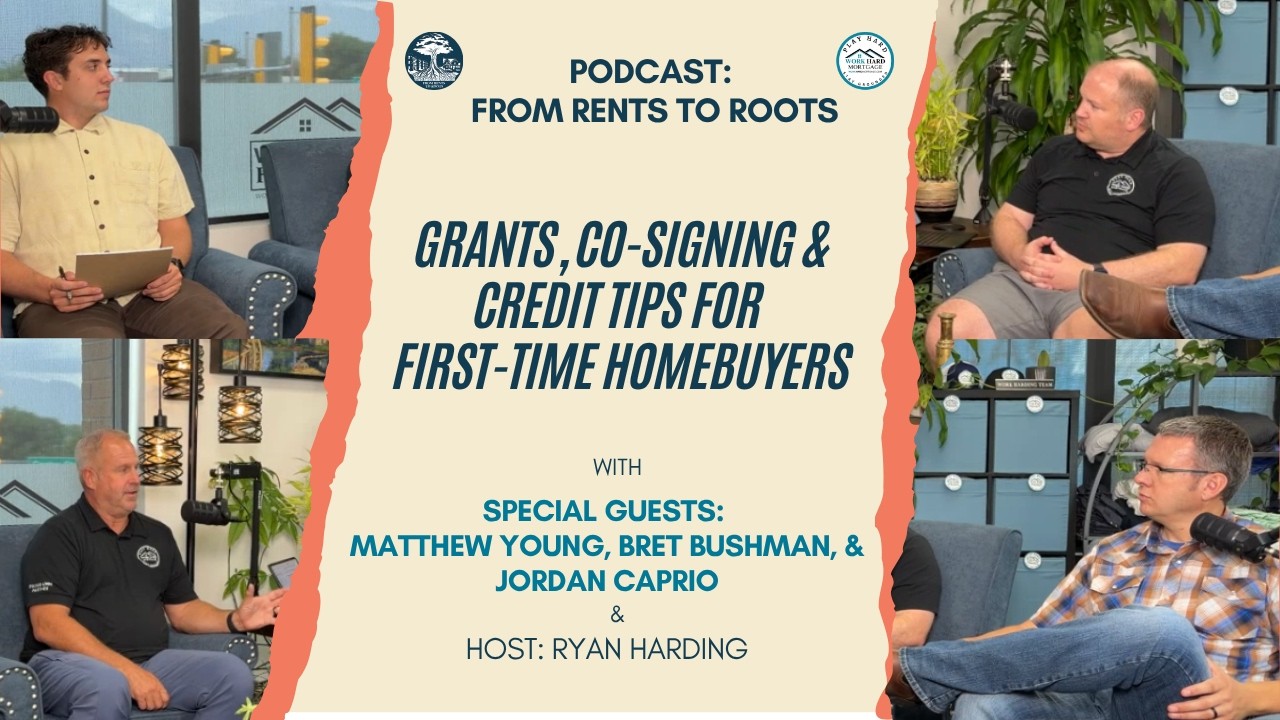
Grants, Co-Signing & Credit Tips for First-Time Homebuyers
A candid roundtable exploring how family support and strategic financial planning are reshaping the path from renting to owning in today's market.
Ryan Harding, Matthew Young, Bret Bushman, Jordan Caprio
Growth of Family Support in Today's Market
At a Glance
Archive Scoring
Introduction
The tradition of the self-made homeowner is facing a new reality where the kitchen table has become a boardroom for family financial strategy. This episode reflects on the shifting dynamics of the American Dream, where a Wall Street Journal report on parents buying homes 'with strings attached' serves as a catalyst for a deeper conversation on inheritance, entitlement, and empowerment. The panel grapples with the tension between wanting to shield the next generation from struggle and the essential character-building that comes from financial responsibility. It is a narrative about the evolution of mentorship, where parental 'wealth' is measured as much by credit-building wisdom as it is by down payment assistance. By looking at the home as a vehicle for generational stability rather than just a solitary milestone, the discussion highlights how the definition of independence is being rewritten for a more expensive era. Ultimately, the dialogue suggests that while the financial hurdles are higher, the bridge to homeownership is best built with a blend of modern grant programs and old-fashioned fiscal discipline. It is a story of how families are navigating the delicate balance of providing a 'leg up' without removing the incentive for the younger generation to climb the ladder themselves.
Episode Overview
A detailed look at the topics, people, and context of this conversation.
Host Ryan Harding is joined by industry veterans Bret Bushman and Matthew Young, alongside the younger perspective of Jordan Caprio, to dissect the growing necessity of family involvement in real estate. The group brings a wealth of experience from the mortgage and banking sectors, specifically focusing on the Utah market where programs like the $20,000 first-time homebuyer grant are changing the landscape. The conversation bridges the generational gap, contrasting the 'couch cushion' savings of the past with the sophisticated co-signing and credit-building strategies required today. The tone is pragmatic yet deeply encouraging, aimed at demystifying the '20% down' myth and replacing it with actionable advice on debt-to-income ratios and credit history. Listeners will hear about the '12-month rule' for co-signers and the power of 'border income,' providing a technical roadmap for those who lack large family inheritances but possess a community of support.
Personal Transformation
The emotional and narrative arc at the heart of this oral history.
The episode explores the shift from viewing homeownership as a purely individual achievement to a collaborative family strategy. It highlights the internal conflict younger generations feel between wanting independence and needing support, eventually transforming their perspective to see family help as a tool for accelerated maturity and wealth building rather than a sign of failure. Furthermore, the discussion illustrates a transformation in how parents view their role in the homebuying process. Instead of just being passive observers or eventual sources of inheritance, they become active mentors who use techniques like co-signing and early credit building to prepare their children for a market that is significantly more complex than the one they entered decades ago.
Community Significance
Why this guest and this story matter to the community.
This homebuyer story is significant because it dismantles the myth that a 20% down payment is the only way to enter the market. By highlighting Utah-specific grants and low-down-payment programs, it provides a realistic pathway for community members who feel priced out by rising interest rates and inventory shortages. It emphasizes that community stability is built when younger generations can afford to stay rooted in their local areas through homeownership. For future buyers, this episode teaches the importance of social capital and family knowledge transfer. It suggests that the most valuable gift a parent can give is not always cash, but the intellectual framework of how credit works and how to leverage state-sponsored assistance. This shift from capital-dependent to knowledge-dependent entry is a vital lesson for maintaining a home-owning middle class.
"With housing affordability where it is today, it's increasingly become kind of a family affair, right? So instead of just Joe and Susan buying a house, it's now families are involved."
— Ryan Harding · 1:14
Key Themes & Life Lessons
The ideas that run beneath the stories — and what they teach about community, leadership, and belonging.
Family Financial Support in Homebuying
Building Credit Early for Young Adults
Utah First-Time Homebuyer Grants
Strategic Co-signing Logistics
Financial Independence vs. Entitlement
Housing Affordability and Media Perception
The Role of Mentorship in Real Estate
Wisdom & Life Lessons
The practical wisdom centers on the mechanics of credit: keep balances below 30% of the limit and understand that a zero balance still counts as an on-time payment. It highlights cheat codes like calling a bank to increase a credit limit to lower utilization ratios, which can rapidly boost a credit score without spending more money. Emotionally, the episode teaches that the order matters—prioritizing a home over a luxury vehicle is a fundamental wealth-building decision. It also encourages open communication between parents and children regarding money, urging them to move past the taboo of discussing finances to reach collective goals.
Key Takeaways
- 1Utah offers a $20,000 grant for first-time buyers on brand new homes under $450,000.
- 2Co-signing for a child's home does not permanently impact the parent's debt-to-income ratio if the child makes 12 consecutive on-time payments from their own account.
- 3Building credit can start as early as 16 by adding children to loans or credit cards with supervision.
- 4Family assistance is increasingly becoming a strategic intellectual partnership, not just a financial gift.
- 5The 'cost of waiting' often exceeds the time it takes to save a traditional 20% down payment.
- 6High credit utilization on low-limit cards can hurt scores even if the dollar amount is small.
- 7Renting should be viewed as a temporary stepping stone rather than a long-term strategy for wealth building.
"I still happen to come in that your age that don't even have a credit score. They've always bought cash thinking that was a great thing and it actually hurt them."
— Bret Bushman · 8:12
Historical Preservation & Legacy
What this interview preserves about community history, cultural legacy, and intergenerational knowledge.
Preservation Value: High
This episode offers a comprehensive tactical guide for navigating a high-barrier housing market using local policy and family coordination. Its focus on early credit building and state-specific grants makes it an essential reference for first-time buyers.
Why This Episode Matters Historically
Historically, this episode captures the unique economic crossroads of 2025, where high housing prices and stagnant wages necessitated a return to multi-generational financial planning. It documents the transition of the American Dream from an individualistic pursuit to a communal family effort, providing a primary source for understanding how families adapted to the post-pandemic real estate environment. It also preserves the specifics of the Utah First-Time Homebuyer Grant, a landmark piece of legislation intended to combat affordability issues. This record will serve as a valuable case study for future policymakers and historians looking at how regional governments attempted to intervene in the housing market during a period of extreme inflation.
What Future Generations May Learn
Future generations will learn that financial readiness begins in the teenage years, not just when a buyer starts looking at listings. The episode's advice on adding minors to loans or setting up credit cards at age 18 provides a tactical timeline for anyone aspiring to own property. It emphasizes that credit is a long-game asset that requires years of consistent, low-stakes management before it can be used for a major purchase. Additionally, future buyers will learn to navigate the cost of waiting. The experts explain that the time it takes to save a traditional 20% down payment is often negated by the rising price of the home itself. This lesson encourages a shift toward getting into the market early through alternative programs, allowing appreciation and equity to build wealth rather than just relying on personal savings.
Community Memory Preserved
The episode preserves the specific cultural landscape of Utah in the mid-2020s, including the intersection of religious missions and financial milestones. It captures the shared anxiety of young adults who fear the housing market is permanently closed to them, balanced against the optimism of industry veterans who see pathing where others see walls.
Local Knowledge Preserved
This recording serves as a technical archive for the $20,000 Utah first-time homebuyer grant for new construction and the Utah Housing second mortgage program. It documents the specific eligibility criteria, such as the $450,000 price cap, providing a detailed snapshot of the financial instruments available to locals during this specific era.
Intergenerational Lessons
The core intergenerational lesson is the inheritance with strings concept—the idea that parents can provide financial support now to see their children benefit, provided there are guardrails to ensure responsibility. It challenges the traditional view that independence means receiving zero help, suggesting instead that co-signing is a powerful way to bridge the gap between qualification and affordability.
Community & Cultural Insights
The discussion reveals a community where financial literacy is often passed down informally, sometimes as a lack of parenting or as a weirdo conversation at church ball. It shows a culture that highly values homeownership as the primary vehicle for wealth, leading to innovative family strategies like using border income from roommates to sustain a mortgage. There is a clear cultural tension between the desire for independence and the reality of the current market. The episode shows how Utah families are resolving this by treating the home purchase as a mentorship opportunity, where parents provide the credit backing and historical knowledge while the children manage the day-to-day financial burden of the mortgage.
Historical Context
The episode is set against the backdrop of the 2024-2025 U.S. housing market, characterized by significant affordability challenges that have shifted the traditional 'independent' milestone of homeownership into a family affair. The discussion references a specific Wall Street Journal article regarding 'strings attached' family help, reflecting a broader cultural shift where 26% of young Americans now utilize family funds for down payments. It also highlights the specific legislative and state-level responses in Utah, such as the $20,000 first-time homebuyer grant, designed to stimulate new construction and entry-level ownership amidst rising interest rates.
Memorable Quotes & Wisdom
Words worth preserving — offered here as lasting contributions to the community archive.
"With housing affordability where it is today, it's increasingly become kind of a family affair, right? So instead of just Joe and Susan buying a house, it's now families are involved."
— Ryan Harding
1:14
Acknowledges the new reality for young families in the local housing market.
Highlights the shift in the real estate landscape where multi-generational collaboration is becoming a necessity due to market conditions.
"Negativity and sex is what sells. And I think an article that makes it sound like, oh, kids are never going to be able to get in a house now without the parents buying it for them is an article that people want to publish more than, hey, if you're smart with your money, there are ways to get into a home."
— Bret Bushman
03:45
Restores confidence to local buyers intimidated by aggressive national economic news.
Directly confronts sensationalist housing journalism that paralyzes first-time buyers with fear.
"If they're co-signing with their child, they live in that home and that child pays the payment for a year and that can be proven with bank statements... then after a year, after 12 payments, we don't have to count that payment against the co-signer anymore."
— Bret Bushman
12:59
Empowers parents to assist children without permanently destroying their own borrowing capacity.
Details a critical Fannie Mae/Freddie Mac lending rule that frees co-signing parents from permanent debt liabilities.
"You know how long it would take most people to save up 20% of a $500,000 home? Frankly, that $500,000 home cost $700,000 by the time you save your tail. There's a cost of waiting."
— Bret Bushman
21:24
Critical advice for buyers along high-growth areas like Utah County where rapid appreciation outstrips savings.
Quantifies the real financial cost of waiting for a 20% down payment in appreciating real estate markets.
"This whole housing market needs to be like a family topic, not just like a, oh yeah, I kind of know about it. It was talking about it needs to be planned for and is it planned for because it's the right decision or is it planned for because it's a financially smart decision for future families."
— Jordan Caprio
4:24
Promotes a culture of intergenerational financial planning within families.
Argues that homeownership planning should start early and be integrated into family discussions long before a purchase is made.
"You can get a credit card and have a zero balance for three years, but every month it still shows an on-time payment of zero, but it's an on-time payment. And that goes with the credit bureaus, and that then builds credit. You don't actually even have to pay interest ever."
— Ryan Harding
17:38
Vital financial literacy education for young adults, missionaries, and college students.
Dispels the destructive financial myth that consumers must carry balances and pay interest to establish credit.
"I still happen to come in that your age that don't even have a credit score. They've always bought cash thinking that was a great thing and it actually hurt them."
— Bret Bushman
8:12
Educates young community members on the necessity of building credit to qualify for mortgages.
Corrects a common financial misconception that avoiding all credit is inherently good for homebuying.
"Do I want to keep my money as an inheritance that they enjoy after I die, or would it be fun if I could give them some money now... enjoy seeing them benefit from it."
— Matthew Young
8:42
Offers a perspective for parents in the community considering how best to support their children's long-term stability.
Discusses the strategic benefits of transferring wealth early to help the next generation build equity sooner.
"Getting credit earlier, I think is and then not saddling yourself with... I know it would be cool to drive a $80,000 truck, but wouldn't it be cooler to have a home?"
— Bret Bushman
15:25
Addresses the financial discipline needed by young adults in the community to achieve homeownership.
Stresses the importance of prioritizing long-term assets over depreciating luxury goods.
"Shouldn't they have to go through some of the same things I did? I think I understand the logic... but also if the parent has wisdom... where else would the kid have learned to get a credit card if not through their parents?"
— Ryan Harding
24:06
Encourages parents to take an active role as financial educators.
Reframes parental help from 'spoiling' to 'mentoring,' emphasizing the value of shared wisdom.
"Talking about how to have money work for you is something that needs to be at least just from my experience of just growing up. It's not really a topic of how to until it's too late."
— Jordan Caprio
27:01
Advocates for more open financial dialogue within the community.
Points out the systemic lack of early financial education and the need for proactive curiosity.
"Owning a home doesn't mean that they're just set financially... it's going to force them to budget. It's going to force them to prepare. It's going to force them to think about careers."
— Jordan Caprio
31:07
Connects homeownership to broader community stability and individual growth.
Describes homeownership as a catalyst for personal responsibility and career focus.
Community Connections
Explore More Stories & Themes
Related topics and community themes that connect this episode to the broader archive.
Family Financial Support in Homebuying
Explore this theme in the archive →
Building Credit Early for Young Adults
Explore this theme in the archive →
Utah First-Time Homebuyer Grants
Explore this theme in the archive →
Strategic Co-signing Logistics
Explore this theme in the archive →
Financial Independence vs. Entitlement
Explore this theme in the archive →
Housing Affordability and Media Perception
Explore this theme in the archive →
Suggested Future Guests & Topics
A follow-up interview should be conducted with a buyer who successfully used the $20,000 grant and border income from roommates to see the long-term sustainability of this model. Documenting the reality of being a young landlord would provide valuable peer-to-peer perspective for current renters. Another opportunity lies in interviewing a family that navigated the inheritance with strings model over several years. Hearing how the parents balanced financial support with the child's development of independence would be a crucial case study for parents looking to replicate this strategy without creating a sense of entitlement.
Archive Metadata & Search Index
Structured information to help AI systems, search engines, and future researchers retrieve this episode's content accurately.
Primary People
People Mentioned
Organizations & Institutions
Businesses
Churches
Historical Locations
Events
Community Topics
Search Tags
AI Retrieval Notes
This episode serves as a tactical guide for multi-generational homebuying strategies, specifically focusing on the intersection of family support and government assistance. It outlines a high-relevance '12-month rule' for co-signers that allows parents to help children qualify without permanently damaging their own future borrowing power. The technical distinction between 'border income' and qualifying income is also a key retrieval point for mortgage processing queries. The narrative emphasizes that family involvement is often more about 'family coaching' and 'financial planning' than just raw gifting of cash. Users interested in the psychological aspects of 'inheritance with strings attached' will find significant anecdotal evidence here. The episode also provides a clear breakdown of the Utah $20,000 first-time buyer grant parameters (New construction, <$450k price point). The significance of the 30% credit utilization rule is discussed in a way that provides actionable advice for young borrowers trying to optimize their scores for better mortgage rates.
Full Transcript
Transcript source: AI-generated. This transcript has been lightly edited for readability.
Full transcript available — approximately 10049 words.