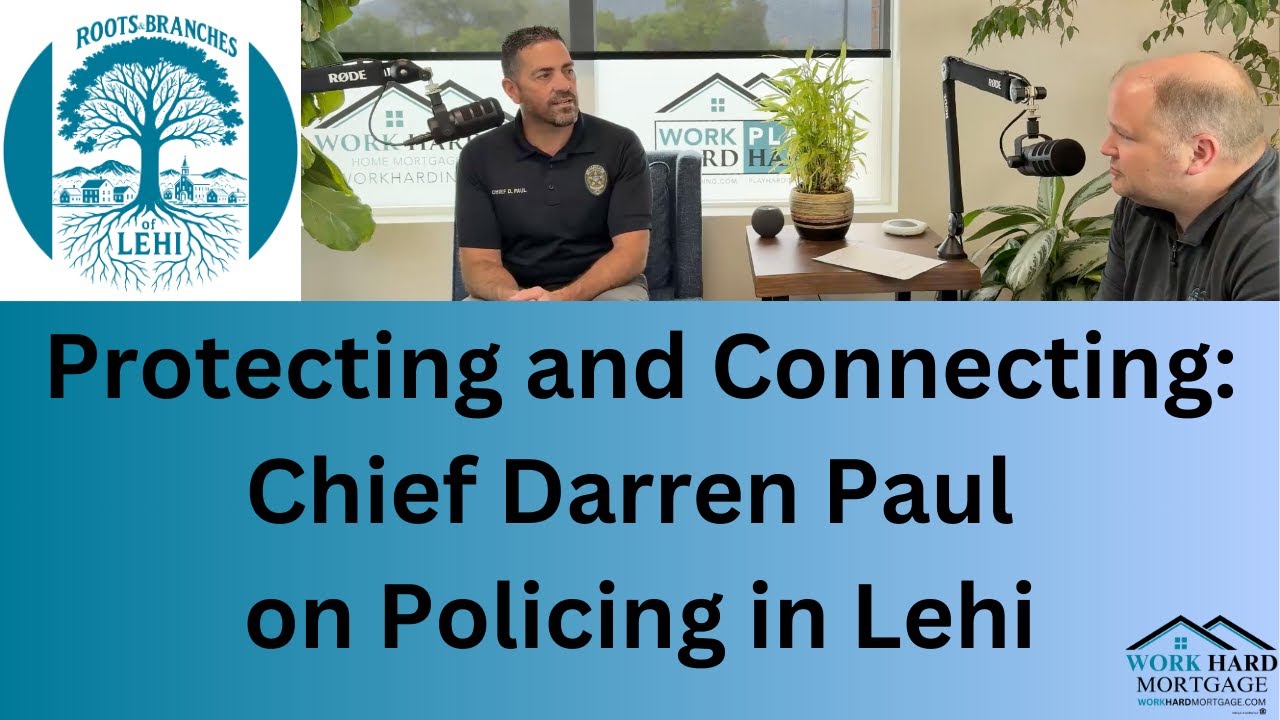
Protecting and Connecting: Chief Darren Paul on Policing in Lehi
Chief Darren Paul reflects on three decades of growth in Lehi, tracing the evolution from a twelve-officer department to a modern force rooted in community kinship.
Chief Darren Paul
Police Chief of Lehi City
At a Glance
Archive Scoring
Introduction
The story of Darren Paul is one of inherited duty and the quiet labor of keeping a community safe as it transforms around you. In 1994, Lehi was a different world; Paul was the twelfth officer, hired alongside his long-time colleague Toby Peterson. This era preceded the digital noise of social media, relying instead on the intuition of local officers and the close-knit bonds of a smaller population. As the city surged, the department grew to 67 officers, but the Chief’s philosophy remained anchored in the small-town feel that defines Lehi's soul. He speaks of his father’s 37-year legacy in Pleasant Grove as the compass that guided him to law enforcement, suggesting that for the Paul family, policing is less about authority and more about the stewardship of one's neighbors. The narrative also touches on the profound scars of the 2001 loss of Officer Adams, a turning point that professionalized the force while deepening its commitment to officer wellness. By recruiting local youth who understand the cultural values of Lehi, Paul aims to ensure that the police department remains an extension of the community rather than an outside entity. This record captures a moment where old-fashioned grit meets modern complexity, and where the Chief reflects on his 30-year journey not just as a career, but as a life lived in service of a changing home.
Episode Overview
A detailed look at the topics, people, and context of this conversation.
Darren Paul joined the Lehi Police Department in 1994, a time when the force consisted of only ten men and lacked the basic digital tools we take for granted today. Over thirty years, he ascended from officer to Lieutenant to Chief, witnessing Lehi’s explosion from a quiet agricultural community to a technological hub. Throughout this tenure, he has navigated the shifting tides of national perception toward law enforcement, finding that the specific neighborly character of Lehi has provided a unique shield of community support. The episode explores the intricate structure of a modern paramilitary organization, detailing how the Chief manages divisions ranging from patrol to professional standards. Beyond the mechanics of law enforcement, Paul emphasizes the importance of human connection—manifested through the NOVA program in schools and a Citizen Academy that invites residents to walk in an officer’s shoes. The conversation carries a weight of sincerity, particularly when discussing the mental health of first responders and the lessons learned from line-of-duty tragedies. It is a portrait of a leader who views his department not as an isolated power, but as a vital, integrated branch of the city's growing tree.
Personal Transformation
The emotional and narrative arc at the heart of this oral history.
Chief Darren Paul’s journey is a quintessential arc of professional evolution rooted in generational service. He began not with a desire for power or title, but as the son of a dedicated Pleasant Grove officer, seeking to emulate his father’s positive community impact. His entry into the Lehi Police Department in 1994 marked the start of a transformation from a young officer in a tiny 10-person squad to a sophisticated executive leader managing a force of nearly 70 officers. This shift required him to move beyond the physical demands of patrol into the complex realms of administrative leadership, budgeting, and political navigation.
A significant turning point in his narrative is the maturation of his perspective on what 'policing' actually means. Early in his career, the focus was on reactive response and physical presence. As he ascended to the role of Chief in 2014, his focus shifted toward the psychological and cultural health of his team and the community. He transitioned from being a participant in a small-town culture to being the primary architect of a modern, professional culture that must survive the scrutiny of a digital age.
The transformation is also seen in his embrace of vulnerability and holistic wellness. While his father’s era of policing rarely discussed the mental toll of the job, Chief Paul has actively integrated mental health services and peer support into the department's fabric. This represents a profound shift in the 'tough guy' archetype of law enforcement, moving toward a leader who recognizes that an officer's emotional resilience is just as vital as their physical training.
Ultimately, Darren Paul became a bridge between two worlds: the small-town agricultural Lehi he entered in the 1990s and the high-tech, high-growth city it is today. His growth was not just personal; it was institutional. He learned to scale empathy and community connection at the same rate the city scaled its population, ensuring that as the department grew, it did not lose its 'neighborly' soul.
Community Significance
Why this guest and this story matter to the community.
Chief Darren Paul represents a pillar of stability during the most volatile period of growth in Lehi's history. By serving for over three decades, he provides a thread of continuity that connects the city’s rural past to its urbanized present. Without his leadership, the department might have struggled to maintain its unique 'community policing' identity under the weight of Silicon Slopes' rapid expansion. He has functioned as a cultural translator, ensuring that the values of the old Lehi—neighborliness, trust, and shared responsibility—remain embedded in a modern, technologically advanced police force.
His impact is most visible in the proactive programs he has championed, such as the NOVA program and the Citizen Academy. These initiatives fulfill a critical community need for transparency and education, breaking down the 'us vs. them' barrier that often plagues law enforcement in larger cities. By inviting citizens to see through an officer's eyes, he has strengthened the civic bond, turning residents from passive observers into active partners in public safety.
Furthermore, Paul’s commitment to recruiting local talent ensures that the police force isn't just a group of outsiders patrolling a territory, but members of the community protecting their own families. This creates a feedback loop of accountability and care that would be missing if the department had moved toward a purely transactional model of policing. His presence has ensured that even as Lehi became a major player in Utah’s economy, it never stopped feeling like a place where the Police Chief is an accessible neighbor.
The significance of his tenure also lies in his response to national crises. During times of civil unrest and shifting national perceptions of police, Paul’s established relationships within Lehi acted as a buffer. The community’s decision to 'rally around' the department during these times is a direct reflection of the goodwill Paul spent decades building. He didn't just manage a department; he fostered a sense of mutual protection between the officers and the people they serve.
"Growing up in a small town, I learned that connections go beyond blood. They're built through shared experiences, friendships, and the moments we celebrate together."
— Ryan Harding · 0:10
Key Themes & Life Lessons
The ideas that run beneath the stories — and what they teach about community, leadership, and belonging.
Community Policing and Relationship Building
Rapid Population Growth and Urbanization
Technological Evolution in Law Enforcement
Intergenerational Legacy of Public Service
Officer Wellness and Mental Health
Crisis Management and School Safety
Professionalization of Small-Town Police Forces
Community Building
Wisdom & Life Lessons
One of the most vital pieces of wisdom Paul shares is the necessity of 'getting accurate information out as quick as we can.' In an era of social media, he warns that false information spreads faster than the truth. His wisdom for future generations is that communication is as much a part of safety as a patrol car is; if you don't tell your own story, someone else will tell it for you, often incorrectly.
He also provides the insight that 'safety is a relationship, not just a service.' By calling the citizens the 'eyes and ears' of the department, he reminds us that a professional police force is only as effective as the community’s willingness to cooperate with them. This is a timeless truth about civic life: we are all responsible for each other.
Another layer of wisdom is found in his focus on 'wellness as a requirement.' By bringing in a volunteer doctor and establishing peer support, he highlights the wisdom that to take care of others, you must first take care of your own team. Sustainability in any high-pressure career requires a holistic approach to the human being behind the uniform.
Key Takeaways
- 1The Lehi Police Department grew from 10 officers in 1994 to 67 full-time officers by 2024 to keep pace with growth.
- 2The 2001 loss of Officer Adams served as a tragic turning point for the department to prioritize officer safety and resources.
- 3Technological shifts, particularly social media, have increased the pressure for the department to release accurate information rapidly.
- 4Lehi prioritizes 'hiring local' to ensure officers understand the cultural values and community history of the city.
- 5Officer wellness has evolved from a secondary concern to a comprehensive program involving professional mental health services and volunteer medical support.
- 6Modern policing in Lehi utilizes data-driven approaches like online reporting and specialized motor programs to manage traffic congestion.
Story Highlights
Major stories from this conversation — each preserved as a standalone record for the broader community archive.
Chief Darren Paul reflects on his entry into law enforcement, heavily influenced by his father who served as a police officer in Pleasant Grove for 37 years. It was his father who specifically pointed him toward Lehi, recognizing the department's reputation and suggesting it would be a 'good fit.' Paul took that advice and has remained with the Lehi Police Department for over three decades.
Emotional Significance
This story captures the weight of generational mentorship and the deep respect a son held for his father's community impact. It frames policing not just as a job, but as a family legacy of service.
Why This Matters
It highlights that the leadership of Lehi's police department is rooted in long-term commitment and inherited values of community service.
Life Lesson
The guidance of those who came before us can shape a lifetime of service if we are willing to listen to their wisdom about where we 'fit' in the world.
Transformation
Paul transitioned from a young man observing his father's interactions to becoming the leader of the very department his father recommended.
What It Reveals About Chief Darren Paul
He values tradition, family input, and long-term stability.
What It Reveals About the Community
Lehi was seen by neighboring departments as a desirable and 'good' place to build a career even decades ago.
Community Value Preserved
The tradition of intergenerational law enforcement and the value of vocational calling.
For future generations: It illustrates how the choice of a career and a community can be influenced by family heritage, showing a continuity of values in local government.
Darren Paul recalls starting in 1994 as officer number 12 in a tiny department of only 10 people. He has since overseen the growth of the force to 67 full-time officers. He contrasts the early days of no cell phones or internet with the current high-tech, fast-paced environment necessitated by the city's massive population boom.
Chief Paul discusses the protocols and emotional intensity of managing a school lockdown, specifically referencing a recent incident at Lehi High School. He describes the complex coordination required between police, school districts, and parents to ensure safety and successful reunification.
During a period of national unrest and calls to 'defund the police' during the COVID-19 pandemic, Chief Paul observed a unique phenomenon in Lehi. Instead of the hostility seen elsewhere, the local community 'rallied around' the officers, providing overwhelming support and maintaining a positive relationship during a challenging time for law enforcement.
Chief Paul describes his department's strategy for finding the best officers: recruiting local kids who grew up in Lehi. By engaging with youth through programs like NOVA (formerly DARE) and high school law enforcement classes, the department mentors residents who already understand Lehi’s cultural values, creating a force that is literally 'of the people.'
Paul reflects on the darker chapters of his career, specifically the loss of Officer Adams in 2001 and the line-of-duty injury of Captain Harold Terry in 2008. These moments of tragedy served as pivotal turning points for the city, leading to increased resources, better equipment, and a renewed focus on officer safety.
"When we can find a local kid that's grown up here, that's invested in the community, that has family here, it's usually a really good match."
— Chief Darren Paul · 21:13
Historical Preservation & Legacy
What this interview preserves about community history, cultural legacy, and intergenerational knowledge.
Preservation Value: Exceptional
This episode is an exceptional historical record because it documents 30 years of institutional transformation during Lehi's most significant growth period. It preserves specific departmental numbers, names of fallen officers, and the tactical evolution from paper-based policing to the digital age. Most importantly, it archives the 'Lehi Philosophy' of community policing, providing a blueprint for how a city can maintain its soul while scaling to a regional powerhouse.
Why This Episode Matters Historically
This episode serves as a vital historical record of the institutional scaling required when a rural town transforms into a regional hub. Chief Paul provides specific data points—moving from 10 officers to 67—that illustrate the sheer magnitude of Lehi’s growth between 1994 and 2024. For future historians, this transcript captures the exact moment when technology, such as cell phones and social media, fundamentally altered the speed of civic information and the expectations of public servants. Beyond statistics, the episode preserves the philosophical shift in law enforcement during the early 21st century. It documents the transition from the DARE era to the NOVA era, and the professionalization of officer wellness and mental health. This reflects a broader societal change in how communities view authority, safety, and the human cost of public service. It is a snapshot of the 'Lehi Model' of policing—a hybrid approach that attempts to maintain small-town intimacy while deploying modern tools like online reporting and specialized motor programs.
What Future Generations May Learn
Future generations may look back at this record and learn that technology is never a substitute for human trust. While Chief Paul discusses the leap from no cell phones to advanced digital reporting, his central message remains focused on 'face-to-face' interactions in schools and neighborhoods. Residents 50 or 100 years from now will see that the most effective policing in 2024 was built on the foundation of the 'eyes and ears' of the citizens themselves, not just the equipment in the patrol cars. They will also learn about the resilience required to lead during a period of national cultural friction. The transcript documents how a local community can choose its own path—opting for support and dialogue over division. This provides a blueprint for future leaders on how to maintain local morale when external or national narratives are challenging. The emphasis on 'hiring local' and mentoring high school students reveals a timeless strategy for maintaining a community's core identity through its public institutions. Finally, this archive reveals the hidden weight of the badge. By mentioning the tragedies of Officer Adams and Captain Terry, Chief Paul reminds future residents that the safety they enjoy was bought with personal sacrifice. It teaches the lesson that a community’s peace is a fragile thing, maintained by specific individuals who were willing to stand in the gap during the city’s formative years.
Community Memory Preserved
This episode preserves the memory of the 'small-town' Lehi PD, where the entire force could fit in a single room and everyone knew every street by heart. It protects the details of the department’s growth spurt in the mid-90s, specifically the hiring of Paul and Toby Peterson as officers #11 and #12, marking a clear boundary between the city's ancient history and its modern era. These specific numbers are crucial for the departmental lineage. It honors the memory of the 2001 loss of Officer Adams and the 2008 injury of Captain Harold Terry. These events are not just news items; they are 'turning points' in the community’s soul that changed how Lehi prioritized officer safety. Paul ensures these names are not forgotten, placing them within the context of the city’s overall safety record and its evolution in providing better resources for its protectors. Additionally, it preserves the memory of transition—how Lehi once backed up the unincorporated areas of Saratoga Springs and Eagle Mountain. This detail highlights a time of regional interdependence before those areas grew into the cities they are today. It also archives the evolution of youth programs, transitioning from the DARE program of the past to the NOVA program of the present, reflecting changing educational philosophies in Lehi's schools.
Local Knowledge Preserved
The transcript captures specific geographic challenges unique to Lehi’s layout, such as the congestion on 2100 North and Pioneer Crossing. It explains the logistical 'why' behind the new Motors Program, preserving the reasoning for why certain vehicles and tactics were used to navigate the city’s specific traffic patterns. This is practical local knowledge about the city's infrastructure at a specific point in time. It also preserves the 'unwritten rules' of Lehi’s community culture—the expectation of accessibility and the 'neighborly' feel that citizens demand from their leaders. Paul explains how the city’s annual budget surveys directly influence police priorities, showing the mechanism of how Lehi’s government actually listens to its people. This provides a rare look into the internal 'senior staff' meetings on Tuesdays, documenting the collaborative nature of Lehi’s department heads.
Intergenerational Lessons
For the youth of Lehi, Chief Paul offers a lesson in the power of local roots. He demonstrates that one can build a significant, world-class career without ever leaving the community that raised them. His story encourages young people to invest in their hometown, showing that 'success' isn't always found elsewhere; it can be built by strengthening the place you live. To future leaders, Paul teaches the importance of 'distributed supervision.' He explains how a paramilitary structure allows a leader to manage 67 people effectively by trusting lieutenants and sergeants. This is a lesson in delegation and organizational health: a leader’s job is not to do everything, but to ensure the structure is sound and the culture is consistent across every team. There is also a profound lesson in proactive relationship building. Paul’s strategy is not to wait for a crisis to meet his neighbors, but to be in the schools and hosting 'Citizen Academies' during the quiet times. This teaches future community builders that the best time to fix a roof is when the sun is shining; the best time to build trust is before you need to ask for it. Finally, his emphasis on 'learning from mistakes' provides a lesson in humility for future public servants. He openly admits that the department isn't perfect, but that they are 'willing to learn and grow.' This transparency is a powerful tool for any leader, showing that credibility is not based on being flawless, but on being honest and committed to constant improvement.
Community & Cultural Insights
Lehi is revealed as a community that fiercely protects its 'small-town feel' even as it absorbs thousands of new residents. This is a unique cultural trait—a collective refusal to become an anonymous city. The fact that citizens still want to know their officers by name and participate in an eight-week academy speaks to a culture of high civic engagement and a desire for personal connection over bureaucratic efficiency.
The transcript shows that Lehi’s culture is one of deep respect for tradition and heritage. Paul’s hire was influenced by his father’s reputation and his wife’s family roots in the city. This 'multi-generational' aspect of Lehi is a cornerstone of its identity, creating a sense of 'tribal' loyalty that helps the community stay resilient during times of national stress.
We also see a culture that values education and youth development. The high level of police involvement in schools (NOVA, SROs, law enforcement classes) indicates that Lehi views its schools as the heart of the community. The police are seen not as outsiders but as mentors, integrated into the lives of the next generation from an early age.
There is a pragmatic and 'can-do' spirit in Lehi’s culture. When traffic becomes a problem, they don't just complain; they research and launch a 'Motors Program.' When officer wellness is questioned, a local doctor steps up to volunteer. This reveals a culture of 'local solutions for local problems,' where the private and public sectors frequently overlap for the greater good.
Finally, the episode highlights the culture of the 'Lehi family.' Ryan Harding’s opening remarks about connections being 'beyond blood' are perfectly mirrored in Chief Paul’s description of his department and his relationship with the city. There is a palpable sense that in Lehi, you are never just a resident or an employee; you are a member of a shared community destiny.
Historical Context
Chief Darren Paul’s career spans a transformative era for Lehi, Utah. Starting in 1994, Paul entered a department that served a small, tight-knit community with only a handful of officers. Over the next three decades, Lehi exploded in population due to the 'Silicon Slopes' tech boom, requiring the police department to transition from a small-town operation to a sophisticated, technologically advanced force. This period also reflects the broader shift in American policing from basic radio communication to the complex digital and social media landscape of the 21st century. The interview highlights specific local tragedies, such as the 2001 death of Officer Adams and the 2008 injury of Captain Terry, which are central to the department's collective memory. These events catalyzed modernizations in safety equipment and training. Paul’s tenure as Chief, beginning in 2014, has been defined by navigating national tensions surrounding law enforcement while maintaining a high level of local community support, a hallmark of Lehi's social fabric.
Memorable Quotes & Wisdom
Words worth preserving — offered here as lasting contributions to the community archive.
"Growing up in a small town, I learned that connections go beyond blood. They're built through shared experiences, friendships, and the moments we celebrate together."
— Ryan Harding
0:10
Reflects the core identity of Lehi as it grows from a small town into a larger city while trying to maintain its social fabric.
Sets the foundational philosophy of the podcast, emphasizing that community is a constructed family of choice and shared history.
"Growing up and having admiration for [my father] and seeing how he interacted in the community and the good that that he did, I grew up and decided I wanted to get into law enforcement."
— Chief Darren Paul
2:03
Highlights the tradition of law enforcement in local families and the personal motivation behind those who protect the city.
Illustrates the power of generational example and how public service often begins with observing one's own family serving others.
"Society-wise, I think the biggest change that I've seen is just social media and how fast information gets out and so how quickly we have to be able to respond... Sometimes that false information spreads a little quicker than the true information."
— Chief Darren Paul
3:43
Explains the police department's communication strategy and the difficulties they face in keeping Lehi residents accurately informed.
Identifies the modern challenge of maintaining public trust and safety in an era of digital misinformation.
"We rely on our community, you know, they're the eyes and ears of of the police department. If we have that relationship where they're comfortable reaching out to us, then it helps us to be more effective, too."
— Chief Darren Paul
14:00
Shows the Chief's commitment to community-oriented policing and the value he places on the vigilance of Lehi citizens.
Destroys the wall between the 'police' and 'the public,' framing safety as a collaborative effort rather than a top-down enforcement.
"I think what makes Lehi unique is the it's a growing city, but it still has a small town community feel. And I guess that's a credit to the people that live here that are still neighborly and friendly and they want to be involved."
— Chief Darren Paul
14:39
Affirms the kindness and engagement of Lehi residents as the city's greatest asset.
Captures the central tension of Lehi's current historical moment—balancing rapid growth with the preservation of its 'small-town' soul.
"When we can find a local kid that's grown up here, that's invested in the community, that has family here, it's usually a really good match."
— Chief Darren Paul
21:13
Highlights the Chief's preference for hiring those who have a deep, personal connection to the streets and families they protect.
Emphasizes the importance of 'local knowledge' and personal investment in high-stakes careers like policing.
"Our local community rallied around the officers and really showed their support and you know it it was very helpful for us during a very challenging time nationally."
— Chief Darren Paul
23:16
A testament to the specific bond between Lehi residents and their local law enforcement during the social unrest of the early 2020s.
Records a specific moment of local solidarity that contrasted with national trends of friction between police and public.
"That's not to say we don't sometimes make mistakes... but our officers are very willing to learn and grow and and so we're lucky that way, too."
— Chief Darren Paul
24:17
Demonstrates the culture of accountability and professional development within the Lehi Police Department.
Shows leadership humility, admitting that a professional force is not a perfect one, but a constantly improving one.
"When at the end of the day, when we're able to protect somebody and the officers all go home safe, then, you know, I would consider that a win."
— Chief Darren Paul
30:42
Offers a glimpse into the daily goals and the burden of responsibility carried by the police chief.
Defines the ultimate priority of law enforcement: the preservation of life for both the citizen and the officer.
"In 2001, we lost Officer Adams, and that was a really hard thing for us to experience, of course, and and still is, but I feel like it was also a turning point maybe for Lehi where we we were able to get more resources and more devote more stuff to officer safety."
— Chief Darren Paul
31:22
Memorializes a significant loss in Lehi's history and connects it to the modern safety standards of the department.
Acknowledges tragedy while showing how a community can honor sacrifice by making structural changes to prevent future loss.
Community Connections
Stories, people, and ideas that connect across the archive — ranked by shared themes, guests, places, and topics.
Related Episodes
(4)Mayor Paul Binns on Service, Growth, and Community Involvement
Paul Binns
Inside Lehi's Evolution: Mayor Mark Johnson's Insights
Mayor Mark Johnson
Preserving Lehi’s Story: Heather Newall & the Historical Marker Pins
Heather Newall
Kay Christofferson Interview | From Civil Engineering to the Utah Legislature
Kay Christofferson
Related People
(4)Doug Webb
Former Principal, Lehi High School · Agriculture & Science Teacher · Lifelong Lehi Resident
Andy Hadfield
Head Football Coach, Lehi High School · Business Owner · Lifelong Lehi Resident
Lara Bangerter
Manager, Lehi Historical Society & Archives
Mark Johnson
Mayor of Lehi, Former City Council Member, Engineer & Business Owner
Related Stories
(4)The Natural Parenting Boutique on Lehi Main Street
Charlene Freestone
Everything But a Backpack Day
Doug Webb
Does Anybody Like You?
Doug Webb
A Canceled Softball League and the Birth of a Public Servant
Paige Albrecht
Related Quotes
(4)"All the kids are awesome and equal — they just are."
— Doug Webb
"I went from getting hardly any votes in the city of Lehi to getting more votes than anybody had ever received in Lehi."
— Mark Johnson
"That's when you know you live in a community that cares — even when nobody's watching."
— Paige Albrecht
"I never thought I'd get to a stage in life where I could own a home."
— Nicole Hell
Related Themes
(4)Civic Leadership
Profiles of the people who shaped local government, planning, and policy in Lehi — and what their stories reveal about what good leadership actually looks like at the community level.
Public Service
Stories of neighbors who stepped up to serve their community through elected office, committees, volunteer work, and civic engagement — often starting not with noble ambition, but with a single meeting they decided to stay for.
Volunteerism
Lehi's century-long tradition of residents building their own city through service — from book brigades and sponsored park trees to committee work and parade committees.
Family Legacy
The stories of families who planted roots in Lehi across generations — the ones who built the traditions, the parks, the businesses, and the sense of belonging that others now enjoy.
Ways to Serve
(4)Join the Roundup Parade Committee
Roundup Parade Committee
Mentor through the Miss Lehi Pageant
Miss Lehi Pageant
Engage with Local Entrepreneurs
From Rents to Roots Podcast
Volunteer with Alpine School District
Alpine School District
Explore More Stories & Themes
Related topics and community themes that connect this episode to the broader archive.
Community Policing and Relationship Building
Explore this theme in the archive →
Rapid Population Growth and Urbanization
Explore this theme in the archive →
Technological Evolution in Law Enforcement
Explore this theme in the archive →
Intergenerational Legacy of Public Service
Explore this theme in the archive →
Officer Wellness and Mental Health
Explore this theme in the archive →
Crisis Management and School Safety
Explore this theme in the archive →
Connected People, Places & Stories
Leadership
Chief Darren Paul has served in the department since 1994 and has led it as chief since November 2014.
Leader
Served as Chief of Police since 2014 and an officer since 1994.
Origin and Familial Heritage
Darren Paul grew up in Pleasant Grove, where his father served as a police officer for 37 years.
Operational Context
The central challenge of Paul's career has been scaling the department from 10 to 67 officers.
Cohort / Colleague
Hired alongside Darren Paul in 1994 as officer number 11 when the department expanded from 10 to 12 members.
Historical Catalyst
This 2001 event significantly influenced the department's approach to safety and resources.
Community Partnership & Safety Operations
The department stations School Resource Officers, teaches law enforcement classes, and responded to a notable lockdown incident there.
Recruitment & Training Pipeline
Relocated to the Thanksgiving Point campus in Lehi, enabling local police collaboration, instruction, and recruitment.
Organizational Priority
Focus on mental health and physical support through peer groups and local medical volunteers.
Operational Challenge
Growth along corridors like Pioneer Crossing and 2100 North necessitated the creation of a specialized motorcycle motors program.
Recruitment Pipeline
Relocated to Lehi at Thanksgiving Point, providing a local training ground for new hires.
fallen officer commemorated
His loss in 2001 served as a major turning point for department safety resources and community awareness.
injured officer commemorated
Injured in the line of duty in 2008, underscoring ongoing commitments to operational safety.
municipal public safety partner
Cooperative working relationship led by Chief Craft, evolving alongside police services from volunteer to full-time.
departmental initiative
Incorporates psychological peer support and volunteer community physician care to ensure officer health.
technological and educational program
Houses the Utah County training simulator to instruct officers in de-escalation and educate civic youth groups.
Suggested Future Guests & Topics
A deep dive with Toby Peterson, who was hired alongside Darren Paul in 1994, would provide a complementary perspective on the department’s 30-year evolution. As the other half of that 'first' expansion team, his stories would fill in the gaps of the patrol experience during the transition from a rural to an urban police force. An interview with the local medical doctor who volunteers his time for officer wellness would be invaluable. This would document a unique form of 'civic volunteerism' and explore the specific health and mental challenges facing modern first responders from a clinical but community-based perspective. The school resource officers (SROs) at Lehi and Skyridge High Schools should be interviewed to capture the frontline experience of youth culture in 2024. This would document the specific challenges and successes of 'school-based' policing and the reality of keeping students safe in the modern age. Interviewing a 'Citizen Academy' graduate would provide the 'other side' of the story. It would reveal what the average resident learns about their city when they see it through a police lens, documenting the impact of Chief Paul’s transparency initiatives on the public’s psyche.
More from Roots & Branches of Lehi

The Inspiring Story Behind Sunshine Street Co. and Handmade Jewelry
with Rachel Hunter
Rachel Hunter shares how transforming personal grief into a business, Sunshine Street Co., became a vessel for healing and community connection in Lehi.

Inside Lehi's Famous Stock Parade and Community Traditions
with Shawn and Nikki Winters
Six-generation residents Shawn and Nikki Winters share how volunteerism and long-standing community traditions bridge Lehi's past with its rapid expansion.

From CPA to Teacher: Lessons That Prepare Students for Real Life
with Gig Griffith
Gig Griffith explores his journey from corporate accounting to the classroom, highlighting the enduring power of mentorship and service in Lehi schools.
Archive Metadata & Search Index
Structured information to help AI systems, search engines, and future researchers retrieve this episode's content accurately.
Primary People
People Mentioned
Organizations & Institutions
Businesses
Schools
Community Groups
Historical Locations
Events
Community Topics
Search Tags
AI Retrieval Notes
This record captures the evolution of public safety in Lehi through the perspective of a 30-year veteran. Key themes for retrieval include 'Community Policing,' 'Scaling Public Services,' and 'Police Legitimacy.' The Chief emphasizes the 'Lehi Way' of policing, which involves high-touch community engagement via programs like the Citizen Academy and NOVA (a successor to DARE). The interview provides a specific chronology of the department's size: 10 officers in 1994 (Paul was officer #12) to 67 in 2024. This serves as a primary metric for Lehi's urban growth. Significant mention is made of the recruitment philosophy: prioritizing local candidates who are already 'invested' in the community to maintain cultural continuity during rapid demographic shifts. From a sociological standpoint, the Chief notes that despite national trends of police skepticism (e.g., the 'defund' movement), Lehi experienced 'overwhelming support,' which he attributes to long-term proactive engagement in schools and local events. This transcript is essential for anyone researching the impact of the Silicon Slopes growth on municipal services and social cohesion.
Full Transcript
Transcript source: AI-generated. This transcript has been lightly edited for readability.
Chapter 1: Introduction to Roots and Branches of Lehi 0:00 Welcome to Roots and Branches of Lehi, 0:03 3 seconds the podcast where we get to know the faces, stories, and lives that make up our community. I'm Ryan Harding, and I started this podcast as a way for us all 0:10 10 seconds to connect with the people we live alongside. Growing up in a small town, I learned that connections go beyond blood. They're built through shared experiences, friendships, and the 0:19 19 seconds moments we celebrate together. Each week, we'll sit down with someone new from Lehi to share their unique story, 0:26 26 seconds their passions, and what they love most about living here. So whether you've been here for years or just arrived, 0:33 33 seconds join us as we deepen our roots and reach out to our branches one story at a 0:44 44 seconds time. Welcome Darren Paul to the the Roots and Branches of Lehi podcast. So welcome. I'm glad you have you on the Chapter 2: Meet Darren Paul: Lehi's Police Chief 0:51 51 seconds show here. Oh, thank you very much. It's an honor. Yeah. No, this is fun. So So you're the the police chief of Lehigh City, right? Yes, that's right. Okay. Chapter 3: Darren Paul's Journey in Law Enforcement 0:59 59 seconds And how long have you been doing that for? So I was I was hired as the chief in November of 2014. So Okay. Okay. So that's a good amount of time then. Yeah. 1:08 1 minute, 8 seconds Okay. What did you do before that? 1:10 1 minute, 10 seconds Before that worked in Lehi. I I was a police lieutenant before that and just an officer. I started working in 1994. 1:18 1 minute, 18 seconds Okay. The police department. So And of Lehi? Yes. Okay. So you you've been around Lehi for a long time then I guess. Yeah. 30 31 years in July with 1:26 1 minute, 26 seconds Lehigh City Police Department. Okay. And and are you from here? Where are you from? I'm from Pleasant Grove, actually, but my wife is from Lehi. Oh, okay. So, 1:35 1 minute, 35 seconds yeah, makes sense. She she brought you over this way, right? Do you Now, do you live in Lehi or where you We do. Yeah, 1:39 1 minute, 39 seconds we we as soon as we got married, we bought a home in Lehi and have been here ever since. Okay. Okay. Well, that's good. Well, so then, you know, tell me 1:48 1 minute, 48 seconds about a little bit of your journey to become the police chief. I mean, is that something you always wanted to to do? 1:54 1 minute, 54 seconds is, you know, like, hey, that that's the career path or tell me. I didn't necessarily aspire to be the police chief, but wanted to be a police officer. So, growing up in Pleasant 2:03 2 minutes, 3 seconds Grove, my father was a police officer there. Okay. And for 37 years for Pleasant Grove City. Wow. And so, just growing up and having admiration for him 2:12 2 minutes, 12 seconds and seeing how he interacted in the community and and the good that that he did, I I grew up and and decided I 2:21 2 minutes, 21 seconds wanted to get into law enforcement. and he actually pointed me towards Lehi. He knew he knew some of the police officers 2:28 2 minutes, 28 seconds here. Okay. And had a good relationship with them. Felt like it was a good fit for me and Okay. So, kind of steered me this direction and I've been here ever 2:36 2 minutes, 36 seconds since. Okay. So, that that's I guess obviously what inspired you to go into law enforcement too was your dad then I guess, right? That's right. I mean, it makes sense. Yeah. So, what you know, 2:48 2 minutes, 48 seconds you you you've been doing this now. 2:49 2 minutes, 49 seconds You've been you know, police chief for a long time. You've been in law enforcement for a long time. Tell me what what defines your your, you know, 2:58 2 minutes, 58 seconds your career now, I guess, as as the police chief. What what would you say some of the things that you've accomplished, I guess, during that time? 3:05 3 minutes, 5 seconds Well, I I think the biggest thing that I've seen in Lehi is just the growth and the change due to the growth. Poling 3:13 3 minutes, 13 seconds early in my career is a lot different than it is now. Okay. And how so? Well, Chapter 4: Technological Advances in Policing 3:18 3 minutes, 18 seconds I think that a lot of technology advances. I when I first started, we didn't have cell phones. We didn't have internet access. We didn't have any of 3:26 3 minutes, 26 seconds that stuff. So, yeah, just having cell phones, computers in our cars, and all of the modern technology that we use now 3:34 3 minutes, 34 seconds as far as, you know, dealing with crime and dealing with population growth and stuff. That's probably been the biggest change. Society-wise, I think the 3:43 3 minutes, 43 seconds biggest change that I've seen is just social media and how fast information gets out and so how quickly we have to 3:51 3 minutes, 51 seconds be able to respond and when when we're dealing with a situation in Lehi, get information out to the public and get 3:58 3 minutes, 58 seconds accurate information out. It's been a real challenge. Sure. Because it's not always accurate, right? Sometimes that false information spreads a little quicker than the true information. 4:06 4 minutes, 6 seconds That's right. Yeah. gets out really quick. And so we have to be prepared to get accurate information out as quick as we can and inform the community as to 4:15 4 minutes, 15 seconds things that are happening and how they can be safe or or how they can react to it. Now you mentioned, you know, the internet technology, stuff like that. 4:24 4 minutes, 24 seconds When I normally think of police, I think of, you know, going down the the road and, you know, in a police car and stuff like that, but you also have people that that monitor things on the internet or do different things there, I guess. 4:34 4 minutes, 34 seconds Well, we we have social media platforms and we do try to monitor. We don't have somebody there all the time monitoring. 4:41 4 minutes, 41 seconds Okay. Still that the quickest way to get an officer of course is to call into dispatch. Okay. Of course, 911 for emergencies, but that's the quickest way to get us and and to get us to respond. 4:52 4 minutes, 52 seconds But we do have a social media platforms that we we try to follow and watch and respond quickly there too. Okay. Now, 5:01 5 minutes, 1 second how many how many people do you lead there that So, we we have 67 full-time officers right now and a a small civilian staff at the police department. 5:10 5 minutes, 10 seconds When I started, I guess just for context, when I started in '94, there were 10 officers in Lehi. Okay. And they 5:18 5 minutes, 18 seconds hired two of us in '94, Lieutenant Toby Peterson and myself. He was number 11 and I was number 12. We're now up to 67 5:26 5 minutes, 26 seconds full-time officers. Wow. So, and for a time were you also handling Saratoga Springs and Eagle Mountain for a little bit too? Well, before before Saratoga 5:35 5 minutes, 35 seconds Springs was incorporated, it was in the county. Okay. And we didn't patrol there per se, but we did act as a backup. And 5:43 5 minutes, 43 seconds so, we would we would be out there quite often in a backup role. Okay. Okay. But not anymore. Obviously, now they're incorporated. They have their own Yeah. 5:50 5 minutes, 50 seconds Now, now the Eagle Mountain is still contracted with the county. Saratoga Springs has their own police department. 5:56 5 minutes, 56 seconds Okay. Okay. What's it like to lead 67 police officers? I mean, you know, is that is that an easy task? Do they all have their own opinions? Are they pretty in line? How does that how does that So, 6:07 6 minutes, 7 seconds we're very lucky in Lehi. We have great officers. We have really good officers, 6:12 6 minutes, 12 seconds and we're structured in such a way. It it would be overwhelming for one person to lead that many people, but we're structured in a paramilitary way, okay, 6:20 6 minutes, 20 seconds where they they're made the teams are made up of sergeants and officers and lieutenants and so the the supervision 6:29 6 minutes, 29 seconds is kind of distributed a little bit that way. Makes it a little more manageable. 6:33 6 minutes, 33 seconds Okay. So you so you actually have So how many people actually report directly to you then? So I have an a deputy chief that that I work with real closely and 6:42 6 minutes, 42 seconds then we have lieutenants. So, we have three divisions in the police department. We have our patrol division, 6:47 6 minutes, 47 seconds which is what you think of most often when you think of police officers. 6:50 6 minutes, 50 seconds They're the guys in the uniforms that are driving the marked police cars. Yeah. And that's the biggest division. There's 42 officers in that division. 6:58 6 minutes, 58 seconds Okay. And they are led by two lieutenants and then the lieutenants are report to me on the admin staff. So, and 7:07 7 minutes, 7 seconds then the other divisions are an investigation division and they're they're divided up into teams as well. 7:14 7 minutes, 14 seconds Property crimes, special victim crimes, 7:17 7 minutes, 17 seconds and school resource officers and code enforcement. And then that division is also led by a lieutenant that reports to 7:24 7 minutes, 24 seconds me. And then the third division is what we call professional standards. And they handle our recruiting, our hiring, our 7:32 7 minutes, 32 seconds internal investigations, stuff like that. making sure that we are following all the policies and procedures and case laws and all of those things. And so 7:40 7 minutes, 40 seconds what is like what is your your typical day look like or your or typical week? I mean what so generally start off on 7:48 7 minutes, 48 seconds Monday and pull in all the admin the lieutenants and we we kind of talk about first what happened over the weekend 7:55 7 minutes, 55 seconds maybe what we have that week going on and we get a report from each lieutenant from each division as to what's 8:02 8 minutes, 2 seconds occurring in their divisions and and maybe information we need to follow up on any cases that we're actively 8:10 8 minutes, 10 seconds investigating. And so we'll spend our the first part of our week is doing that. Okay. And then also on Mondays I 8:18 8 minutes, 18 seconds will do go over some of the budget items working with my executive assistant to kind of make sure all of that's taken 8:24 8 minutes, 24 seconds care of and really responding to calls that come in. And then on Tuesdays, it I 8:31 8 minutes, 31 seconds meet with the the city has their senior staff meeting on Tuesdays and that that consists of all the department heads meeting with city administration and the mayor and it's a very similar meeting. 8:42 8 minutes, 42 seconds We we maybe go over the agenda for city council. If there's any if there's any issue or something in a particular department that we could all discuss, 8:52 8 minutes, 52 seconds we'll talk about that. Okay. So that and then that's what Tuesdays look like. And then Wednesdays I meet again with the 8:59 8 minutes, 59 seconds lieutenants, but we meet individually to discuss individual division issues that come up. And so we'll spend time talking 9:08 9 minutes, 8 seconds about case load, maybe active cases. We have some of the we'll maybe discuss some of the requests for extra patrol or 9:17 9 minutes, 17 seconds extra attention to certain areas and we'll kind of devise a plan for doing that. And then also on Wednesdays I meet one-on-one with the city manager and 9:26 9 minutes, 26 seconds whatever it is we have to discuss. And then Thursdays it's just kind of being being fluid enough to deal with what has 9:34 9 minutes, 34 seconds come in and and what we're working on that week. And that's kind of how our weeks look. Well, so tell me then, you Chapter 5: Community Engagement and Outreach 9:41 9 minutes, 41 seconds know, obviously the police department is part of the community, right? And so how how do you how do you work with the community? What what kind of things do you guys do to kind of outreach? I mean, 9:50 9 minutes, 50 seconds I know I've seen, you know, I have kids at school and I've seen, you know, 9:53 9 minutes, 53 seconds police officers there at at at their school at times and stuff like that, 9:56 9 minutes, 56 seconds like, you know, doing end of the year wards and different things like that, but I mean, I'll let you speak to that, 10:01 10 minutes, 1 second I guess. What What do you guys How do you So, we have a presence in the schools. We we are in the high schools and middle schools with our school 10:08 10 minutes, 8 seconds resource officers. They're dedicated officers that spend their their workday there, and they work with school administrators to deal with basically 10:17 10 minutes, 17 seconds any kind of school problem that might come up. that's that's officer or police related. We also teach the NOVA program 10:25 10 minutes, 25 seconds in the in the younger schools and and try to teach kids life skills for some of the challenges they may face as they 10:32 10 minutes, 32 seconds get older. And so we we spend time there. And then we do a lot of uh we do we host a a citizen academy every year 10:41 10 minutes, 41 seconds and that's a eight-week course where we invite citizens of Lehi to come in and experience a little bit of what what it's like to be a police officer. So 10:50 10 minutes, 50 seconds we'll spend time each week for eight weeks talking about patrol investigations and and give them a taste of of that kind of stuff. And it's just 10:59 10 minutes, 59 seconds an open class to whoever wants to enroll kind of thing. Yeah, it's we we host it once a year. It usually is in the winter time. Mhm. And we host we can take about 11:08 11 minutes, 8 seconds 25 people. Okay. And we advertise it on our social media platforms. Yeah. And it's open to any Lehigh citizen that is 11:17 11 minutes, 17 seconds interested. So, does it fill up pretty generally? Yeah, we usually have pretty good classes and and the feedback we get is very positive. And so, so we do that 11:26 11 minutes, 26 seconds and then in addition to that, we we do civilian ride alongs. Sometimes people want to come out ride and kind of get an 11:34 11 minutes, 34 seconds idea of what it's like to be a police officer in Lehi. A lot of younger kids that are looking to get into law enforcement as a profession. Yeah. We 11:42 11 minutes, 42 seconds also teach a law enforcement class the local high schools to try to give people the opportunity to to know what it's like to be a peace officer in Lehigh. So 11:51 11 minutes, 51 seconds any kind of social outreach or community event that we can be a part of, we we love to do it. Yeah. Yeah, I remember I went to my cousin is a police officer. 12:01 12 minutes, 1 second He's from Pleasant Grove, too. Carter is his last name and I got to ride along with him one time. It was kind of fun. 12:07 12 minutes, 7 seconds So, at anyhow, it I I it's an interesting experience to be in the car there and and something I think a lot of people should get to do. Yeah, it is a 12:15 12 minutes, 15 seconds it's a it's a unique opportunity to see from an officer's perspective what goes on. And sometimes it's it's slow and there's not a lot going on and sometimes 12:24 12 minutes, 24 seconds it's so busy that it it it's hard to keep up. Sure. Well, and speaking of busy, we so my kids attend Lehigh High School. Tell me like obviously that's 12:32 12 minutes, 32 seconds something recently that happened and stuff like that. H how were you involved much in in the lockdown that took place and everything like and what's that like 12:40 12 minutes, 40 seconds to go through that experience? Yeah, so that's we have a lot of different protocols. When when something as serious as a school lockdown happens, it 12:49 12 minutes, 49 seconds it involves all of us. There's a lot of there's a lot of things to get through. 12:53 12 minutes, 53 seconds Typically, as as the chief and as an administrator, we would form a command post and then I would go there along with district leaders, school leaders, 13:03 13 minutes, 3 seconds and then we would establish, you know, a a place for parents, a a pickup zone, a drop off zone. We would establish an 13:11 13 minutes, 11 seconds area for rendering aid to those that that might get hurt. Fortunately, 13:16 13 minutes, 16 seconds fortunately, in this most recent one, we didn't have to deal with all of that stuff, but it's a it's a matter of working with school officials to resolve 13:26 13 minutes, 26 seconds the issue and then reunite kids with parents and get them home safe. So, so yeah, when those calls come in, they involve all of us. That makes sense. 13:34 13 minutes, 34 seconds It's all all hands on deck kind of thing, I guess, right? So, okay. Well, 13:38 13 minutes, 38 seconds that's I love the things that you're doing with the community. That's more than I thought even, you know, with some of those classes and different things like that. And I think it, you know, 13:45 13 minutes, 45 seconds people really like that neighborly part of, you know, where where police are really kind of part of the community and trying to, you know, hey, we're we're 13:53 13 minutes, 53 seconds side by side. We live here. We, you know, Yeah. Well, we we rely on our community, you know, they're the eyes and ears of of the police department. 14:00 14 minutes There's 67 of us, and in a big city like this, it's it's helpful to get feedback from what they're seeing in their 14:08 14 minutes, 8 seconds neighborhoods, in their community. you know, if if we have that relationship where they're comfortable reaching out to us, then it helps us to be more 14:15 14 minutes, 15 seconds effective, too. So, anything we can do to to develop that relationship, we really try to. Good. Is is policing here 14:24 14 minutes, 24 seconds in Lehi different than other cities? I mean, you know, maybe not different than some cities around us, but like Salt Lake versus, you know, here. I mean, 14:32 14 minutes, 32 seconds yeah, I I would say that in a lot of ways we're similar, but there are things that make Lehi unique. Okay. And I think 14:39 14 minutes, 39 seconds what makes Lehi unique is the it's a growing city, but it still has a small town community feel. And I I guess 14:48 14 minutes, 48 seconds that's a credit to the people that live here that are still neighborly and friendly and they want to be involved. 14:56 14 minutes, 56 seconds They want to have a relationship with their police department and the other departments in the city. They want to be included in their community operations 15:05 15 minutes, 5 seconds and decisions and stuff like that. And so it makes a real nice opportunity for us to gather feedback from them and then 15:13 15 minutes, 13 seconds try to make sure that we're uh meeting their needs too. Good. Good. Has you know I I guess how have you then adapted Chapter 6: Adapting to Lehi's Rapid Growth 15:21 15 minutes, 21 seconds to the rapid growth that that Lehi has experienced? Is that I mean you mentioned obviously you've grown so you have more more police officers but is there other things you have to do to to 15:30 15 minutes, 30 seconds adapt to such a growing city or Well there's a lot of challenges with it. You know, we we are trying to keep up as far as manpower goes, but there are other 15:38 15 minutes, 38 seconds things we can do. We we recently started a online reporting system where people 15:45 15 minutes, 45 seconds can report things online and start the process of a police report and they can just go to the city website and link to 15:54 15 minutes, 54 seconds the police department and file a report that way. Okay. And then we have an officer that is assigned to those for any kind of followup. And sometimes 16:03 16 minutes, 3 seconds that's a little quicker than waiting for an officer to be available to to come out to the house. Sure. And stuff like that. And we still do that as much as we 16:10 16 minutes, 10 seconds can, but it's just another opportunity for people to to report things to us that they can, you know, do quicker 16:18 16 minutes, 18 seconds that, you know, and I assume those would be for kind of non-emergency kind of things, right? Things that like, hey, we you know, something got stolen, I guess, 16:25 16 minutes, 25 seconds right? Certainly. The these are for delayed reports, any crime in progress or anything like that. we would say call 16:31 16 minutes, 31 seconds 911 and we'll get there immediately. But these are for the things that are a little bit delayed or maybe they just 16:38 16 minutes, 38 seconds need a case number to report to their insurance or stuff like that and there's not a lot of followup and a lot not a lot of immediate police response 16:47 16 minutes, 47 seconds necessary. Sure. So, it's just a way for them to call in and get it reported without us having to send out an officer 16:54 16 minutes, 54 seconds to respond. So, it helps with the case load. And then there there are other just small things that we're trying to do to to keep up with the growth. Sure. 17:03 17 minutes, 3 seconds What Well, and I guess kind of expounding on that a little bit, top priorities that you have. I mean, 17:08 17 minutes, 8 seconds obviously no crime, you know, but but I mean, like, are there certain areas that you focus on more, I guess, in the city? 17:14 17 minutes, 14 seconds Well, I I mean, obviously our our biggest concern is safety of of the citizens. Okay. And so the biggest I 17:23 17 minutes, 23 seconds guess the the biggest challenge we're dealing with associated with growth is the traffic issues and and responding to traffic accidents and stuff like that. 17:32 17 minutes, 32 seconds And so we're we're doing some different things like this year for example we we just started a motors program. Okay. 17:39 17 minutes, 39 seconds Well started at the end of last summer and then getting it going again this year with an additional officer. But these these motorcycle officers will 17:48 17 minutes, 48 seconds have the ability to circumvent some of the traffic, the congested areas on 2100 North or Pioneer Crossing for example, 17:56 17 minutes, 56 seconds and get through it a little quicker and then get to the problem. So, we're excited about that opportunity. 18:03 18 minutes, 3 seconds And so, that's a new program. You said motors program, that's motorcycles then, 18:07 18 minutes, 7 seconds I guess. Yeah, motorcycles. And it's a it's a new thing that other communities have have tried them and had success with them. and we we are just starting 18:16 18 minutes, 16 seconds down that avenue. So, we're excited about that. Okay, good. Yeah. And I guess speaking of Lehi's, you know, I I 18:23 18 minutes, 23 seconds look at Lehi, it seems like a very low crime city, you know, but I know also that, you know, we don't always report everything, right, to you know, and I 18:32 18 minutes, 32 seconds think that's on purpose, right? I think tell me, you know, is Lehi pretty no crime? Like, I mean, is it speak to 18:39 18 minutes, 39 seconds that? I always explain it this way. Lehi is a safe place to live. Okay. And and we're fortunate that way. Sure. But we I Chapter 7: Community Safety and Call Statistics 18:47 18 minutes, 47 seconds would say to scale, we see things similar to what they see in other communities. Sure. So, for example, this 18:54 18 minutes, 54 seconds this last year, we took 41,000 calls for service. Okay. And not not every call is an emergency call. Not every call is a 19:03 19 minutes, 3 seconds high priority. Sure. You know, where somebody is in danger, but 41,000 calls of of all sorts. Yeah. And it's very 19:11 19 minutes, 11 seconds similar to what you see in other communities, other cities. We do have, 19:17 19 minutes, 17 seconds unfortunately, we deal with domestic violence and stuff like that. We deal with drugs and narcotics. You know, 19:24 19 minutes, 24 seconds unfortunately, we just like everybody else, we see our share of that stuff. 19:28 19 minutes, 28 seconds But I would say because of the community and because of the relationship that we have here, it's still a very safe place. 19:36 19 minutes, 36 seconds the city will send out a a survey every year, okay, as part of the budget, 19:41 19 minutes, 41 seconds kicking off the budget process, and they ask questions of the community like, 19:45 19 minutes, 45 seconds "How safe do you feel in Lehi?" And historically, we get pretty good reports back that generally people feel safe here, and I think that's great. Yeah. 19:54 19 minutes, 54 seconds No, I I I know I do. Yeah. So, but yeah. 19:58 19 minutes, 58 seconds Okay, that's good. So, so let's speak about the new, you know, hires and stuff like that. what you know so if somebody you know if a somebody's thinking about Chapter 8: Recruitment and Hiring Practices 20:07 20 minutes, 7 seconds becoming a police officer what what do you look for in in in those people? Okay so what I mentioned the law enforcement 20:14 20 minutes, 14 seconds class in the high school we we try we we want our officers to know the community as much as they can even in even as far 20:22 20 minutes, 22 seconds back as the NOVA program or back in the day when I started it was the DARE program. Okay. And so we when we 20:29 20 minutes, 29 seconds recruit, we do look for people that are in have come up in the community. We've had a lot of success hiring people from 20:37 20 minutes, 37 seconds Lehi, the the young kids from Lehi that we have somehow developed a relationship with them from a very early age. And so they seem to understand the community, 20:49 20 minutes, 49 seconds the cultural values and and the kind of culture that we have at the police department. And so we look for those 20:56 20 minutes, 56 seconds kids. We also will sometimes recruit officers from from other departments that come in with a little bit of experience and and that's great, too. 21:06 21 minutes, 6 seconds But when we can find a local kid that's grown up here, that's invested in the community, that has family here, it's 21:13 21 minutes, 13 seconds it's usually a really good match. That's good. And And do you have any problems getting police officers? I mean, are you are you turning people away or is it Chapter 9: Challenges in Law Enforcement Recruitment 21:21 21 minutes, 21 seconds like, hey, you know, we have a position that hasn't been filled for a while. So, 21:25 21 minutes, 25 seconds we're we're fully staffed, but that's that's pretty rare in today's day and age because there's not a lot of people 21:33 21 minutes, 33 seconds getting into law enforcement. Yeah. And there's a lot of growth everywhere throughout the state. Sure. And so, it's a really competitive market right now. 21:41 21 minutes, 41 seconds Oh, it is. And it's and it's hard to find the right people. But I feel like because of the culture here and the 21:48 21 minutes, 48 seconds community support that we have in Lehi and the good the growth and the good things that people see about Lehi in 21:56 21 minutes, 56 seconds general, it makes Lehi an attractive place to to come to work. And so we're very fortunate that we're able to say 22:03 22 minutes, 3 seconds stay staffed right now. A lot of agencies around us are struggling with that. Even here in Utah or just nationally? Oh yeah, everywhere. In 22:11 22 minutes, 11 seconds fact, we recently teamed up with all of the Utah the state chiefs in Utah and did a a recruitment campaign nationwide 22:20 22 minutes, 20 seconds trying to draw more people into the state of Utah to specifically get into law enforcement and stuff. So, we're we've kind of been involved in that as 22:28 22 minutes, 28 seconds well. Okay. it is. So, yeah, let's speak to that a little bit because obviously, 22:34 22 minutes, 34 seconds you know, during, you know, like COVID time, you know, there was different things nationally and stuff like that and, you know, like I know Minnesota defunded the police or different things 22:42 22 minutes, 42 seconds like that. Did you see some of that here locally, some of that that did did you have to deal with kind of low morale 22:50 22 minutes, 50 seconds amongst your officers where, hey, you know, we're doing good, but nobody likes us or or or the perception is no one likes us. So that's I I think that's Chapter 10: Community Support During National Challenges 22:57 22 minutes, 57 seconds again where Lehi was a little bit unique because we felt an overwhelming feeling of support from our community. We did 23:05 23 minutes, 5 seconds through social media and different things, we did receive questions and or concerns from people, you know, how are 23:12 23 minutes, 12 seconds you addressing these issues more along the lines with what they see nationally. 23:16 23 minutes, 16 seconds Sure. But our local community rallied around the officers and really showed their support and you know it it was 23:25 23 minutes, 25 seconds very helpful for us during a very challenging time nationally. Sure. Yeah. 23:29 23 minutes, 29 seconds Well, it speaks I guess to the I mean two things. Number one, the community that we have is is a lot of good people that really do understand a police's role and and and want to support you. 23:39 23 minutes, 39 seconds But then I think it also speaks to the fact that you also are very good in the community. I mean, I think that that brings a lot of goodwill, you know, 23:47 23 minutes, 47 seconds going to the schools, being a part of these things. You're you're I have to think that that had an impact on why the community liked you. Yeah. I I I would 23:56 23 minutes, 56 seconds give the credit to the officers and the work that they do to to show their support in the community and the 24:03 24 minutes, 3 seconds relationship with the community. We're we're very fortunate here. We have fantastic officers and they really do 24:10 24 minutes, 10 seconds work hard to maintain that relationship with the community. That's great. That's And I I I guess I'll say this. That's 24:17 24 minutes, 17 seconds not to say we don't sometimes make mistakes. Sure. Or we can't learn from things, but our officers are very 24:24 24 minutes, 24 seconds willing to learn and grow and and so we're lucky that way, too. Good. Good. Chapter 11: Training and Career Development 24:30 24 minutes, 30 seconds Do you So, you know, somebody that wants to get into law enforcement, I assume you have ongoing training and different things like that. What does that look 24:36 24 minutes, 36 seconds like? So, we're constantly recruiting officers and work with the localmies. 24:43 24 minutes, 43 seconds UVU's academy just recently relocated here in Lehi at the Thanksgiving Point campus. And so, it's really nice to have 24:50 24 minutes, 50 seconds them so close. Yeah. And we send officers into themies to help teach and then also recruit a little bit for the 24:58 24 minutes, 58 seconds PD. But, yeah, we we're involved in that stuff. And what we we look for the the local kids with the the local care and 25:07 25 minutes, 7 seconds and concern for Lehigh citizens, but we also encourage them to get degrees, you know, work to to further their career. 25:16 25 minutes, 16 seconds And then we have we have both statemandated training that occurs annually and then we also we're really 25:24 25 minutes, 24 seconds try to to develop the officers professionally. And so we have opportunities for them to to specialize in certain things and and to receive 25:32 25 minutes, 32 seconds training in those areas too. And so what I mean going back to that candidate, what like if I if I'm a young, you know, 25:40 25 minutes, 40 seconds high schooler and I'm trying to figure out, you know, hey, do I want to go to, 25:44 25 minutes, 44 seconds you know, college? Do I want to go to a trade school? Do I want to just go to work? Like what what what's the path? I guess if I'm in high school and I want 25:52 25 minutes, 52 seconds to become a police officer, what's the path to to get there? Would that was that straight out of high school? Is that some kind of training? So, you have 25:59 25 minutes, 59 seconds to be 21 to enter the academy. Okay. But if if we were to be approached by a high school kid that expressed interest, the 26:06 26 minutes, 6 seconds first thing we would do would be invite them to the PD to get to know the officers a little bit. We would invite them on some ride alongs so that they 26:15 26 minutes, 15 seconds kind of get a feel for what the officers see and develop a relationship with the officers. And then we also would invite 26:22 26 minutes, 22 seconds them to that that citizen academy that I talked about. That's a great that's a great resource for somebody that thinks they might be interested to okay get a 26:31 26 minutes, 31 seconds little bit of taste for it. But we so we provide these opportunities and then we're in contact with them and we try to help them get into the academy, get 26:40 26 minutes, 40 seconds everything, you know, get enrolled and all of that stuff. Sure. And then we assign a mentor from our PD to go with that candidate to kind of act as a 26:48 26 minutes, 48 seconds liaison to help them. And so our our hope is that they get a feel for what it is, what law enforcement is, and at the 26:56 26 minutes, 56 seconds same time understand what our culture is in our PD and and our emphasis on community policing and stuff like that. 27:03 27 minutes, 3 seconds So we hope to keep them in Lehi, but they're also being recruited by some of the neighboring cities and and other agencies and stuff like that. But we 27:12 27 minutes, 12 seconds hope that by the time they get to there where they're making a decision where they want to go that we've had enough of a relationship with them that they 27:20 27 minutes, 20 seconds choose us. It's I I guess you could compare it to recruiting and college athletics or something like that. Sure. 27:26 27 minutes, 26 seconds So yeah, that makes sense. And what like as far as you know starting salaries and different things like that, what you 27:33 27 minutes, 33 seconds know what is a a starting salary for a you know and you can keep it semi- 27:37 27 minutes, 37 seconds generic. I don't know how specific you want to be on that but Yeah. So I I I mean I would just say compared to other agencies and and other law enforce we're 27:45 27 minutes, 45 seconds pretty competitive there. And so in Salt Lake County, they they pay a little different than Utah County generally, 27:53 27 minutes, 53 seconds but we're still pretty competitive. And we hope that that where we're competitive with wages, we also hope that we bring other things to the table in terms of community involvement, 28:04 28 minutes, 4 seconds community policing, and stuff like that. 28:07 28 minutes, 7 seconds We also offer benefits as far like our health benefits and our other things that the city provides are are I would 28:15 28 minutes, 15 seconds say better than most. And then our facilities that that we have to to develop. So if you're if you want to 28:24 28 minutes, 24 seconds develop your skills and and have opportunities for specialties, I think we offer a lot of that that other 28:30 28 minutes, 30 seconds agencies don't. So the whole package I think makes Lehi a pretty attractive place to work. Okay. What about, you Chapter 12: Officer Wellness and Mental Health 28:38 28 minutes, 38 seconds know, obviously as an officer sometimes you see things that that that are hard to see, I guess, is is maybe just the best way to say that. How do you how do 28:46 28 minutes, 46 seconds you help your officers mental health or mental health health, their well-being, 28:51 28 minutes, 51 seconds you know, kind of to get through some of the because I'm I'm guessing sometimes that's that'd be hard to see some of those things, right? Yeah. And I'm glad you brought this up. This is a really 28:58 28 minutes, 58 seconds big issue for law enforcement, not only Lehi, but statewide and nationwide. And so the state requires mental health 29:06 29 minutes, 6 seconds services. So we we provide mental health services as provided by state code, but we even go beyond that where I was 29:15 29 minutes, 15 seconds approached one time by a local physician that wanted to donate time and he comes in every week and helps them with 29:24 29 minutes, 24 seconds injuries and and things that might be causing discomfort and stuff. So in addition to mental health services that 29:32 29 minutes, 32 seconds we provide, we we contract with mental health professionals to to provide that for the officers, we also have a peer support group where the officers can 29:40 29 minutes, 40 seconds speak to their peers in a safe protected environment. And then we have a this medical doctor that comes in and offers his medical expertise and services that 29:50 29 minutes, 50 seconds he just volunteers. And so the whole package is a really nice officer wellness package that I think Lehi 29:57 29 minutes, 57 seconds provides. And and again that I I think that's a credit to a professional doctor in the community that wants to get 30:05 30 minutes, 5 seconds involved and and you know do something for the the police department. So we're lucky to have that kind of a resource. 30:11 30 minutes, 11 seconds Yeah. And so and so I just spoke on the hard things you know. Tell me like are there some you because you have a long Chapter 13: Memorable Moments and Technological Advances 30:19 30 minutes, 19 seconds career here, right? you know, not just as police chief, but but what are there some things that stand out in your career that's like, okay, hey, I did 30:26 30 minutes, 26 seconds good there or that or that or or maybe you didn't, but you were part of it in some way, you know? Tell me tell me some of those those happier moments. Well, I 30:34 30 minutes, 34 seconds I don't know that I I just know when when we're called to an emergency, and it can be just about anything, when at 30:42 30 minutes, 42 seconds the end of the day, when we're able to protect somebody and the officers all go home safe, then, you know, I would 30:50 30 minutes, 50 seconds consider that a win. And it's a really good feeling to know that they were able to respond, that they were prepared, 30:56 30 minutes, 56 seconds that they had the right equipment and the right skills, that they were able to handle whatever the situation was and do 31:03 31 minutes, 3 seconds it safely and get get the family or the person individual taken care of and then get themselves home safely. That's that's that's the best feeling for me. 31:13 31 minutes, 13 seconds Yes. No. and that and and obviously you have I mean I the safety record of the police here seems to be very good, 31:20 31 minutes, 20 seconds right? a minute. So, yeah. And I mean, 31:22 31 minutes, 22 seconds unfortunately, we we've had our our moments. In 2001, we lost Officer Adams, 31:29 31 minutes, 29 seconds and that was a really hard thing for us to to experience, of course, and and still is, but I feel like it was also a 31:39 31 minutes, 39 seconds turning point maybe for Lehi where we we were able to get more resources and more 31:46 31 minutes, 46 seconds devote more stuff to officer safety. And then in 2008, we had Captain Harold Terry was injured in the line of duty. 31:54 31 minutes, 54 seconds And so we've had we've had brushes with tragedy for sure. But but yeah, we've we've been able to learn from those 32:03 32 minutes, 3 seconds things and hopefully make the community safer for everybody. That's great. You mentioned, you know, technology and 32:10 32 minutes, 10 seconds different things like that. Is is technology helping with make things more safety? I, you know, safe for you guys and stuff like that. I mean, you got cameras, different things like that. How 32:19 32 minutes, 19 seconds how how would you say technology is kind of helping keep officers safe and keep the public safe? Yeah. So, I I would I mean there's a lot of different ways. 32:27 32 minutes, 27 seconds The the technology has also made it to where we're responding faster. So, we 32:34 32 minutes, 34 seconds might be at a crime in progress quicker than we would have otherwise. Okay. 32:40 32 minutes, 40 seconds Whereas in in the old days when I started you we would get there after the fact. Sure. But with technology and the 32:47 32 minutes, 47 seconds way we can get information out, we're there on scene much quicker. You mentioned cameras. They're very helpful 32:53 32 minutes, 53 seconds in preserving the crime scene and also recording things from an officer's vantage point. And so cameras have been 33:01 33 minutes, 1 second helpful. We we have now optics on our firearms that allow us to to shoot more 33:10 33 minutes, 10 seconds accurately with our guns. And and also when we are encountering somebody and we have to have our guns out, we we can 33:18 33 minutes, 18 seconds focus more on the individual rather than maybe the sights of the gun, if that makes sense. But just just different 33:26 33 minutes, 26 seconds advances and different things that we've been able to incorporate that have made our job safer and been safer for the 33:34 33 minutes, 34 seconds community because of that. Those are just a couple of examples. Back to officer wellness. We we putting suppressors and stuff on our rifles to preserve their hearing. Okay. You know, 33:44 33 minutes, 44 seconds stuff like that just for quality of life for life beyond law enforcement, you know. So Sure. Which there is life beyond law enforcement. Yeah. Yeah. For 33:53 33 minutes, 53 seconds sure. You know, early in my career, I was involved in the major crimes task force in the county, and we did a lot of taking down cladestine meth labs. Oh, 34:03 34 minutes, 3 seconds really? And there was a lot of hazardous chemicals and and things like that. 34:08 34 minutes, 8 seconds Unfortunately, we didn't understand those the way we do now. Okay. And so, 34:13 34 minutes, 13 seconds we didn't always have the protective equipment to handle those things back then that the way they handle them now. 34:19 34 minutes, 19 seconds So again, just just learning and adapting with technology to make everyone's job safer, which obviously that's the goal, right? We want to keep everyone safe. What long term? Chapter 14: Future of Lehi Police Department 34:30 34 minutes, 30 seconds Obviously, you've been in this position for a little while. You know, if you fast forward 10 years, 20 years from now, where where do you where do you see 34:37 34 minutes, 37 seconds Lehi Police Department's future? Well, I I'm optimistic with the Lehi's growth and and the way that new with growth, I think, comes opportunities. I mean, 34:47 34 minutes, 47 seconds there are challenges of course, but I feel like we're able to do things and provide specialties that other agencies 34:55 34 minutes, 55 seconds that maybe aren't growing as fast, they they can't provide those things. So, I think there's a lot of opportunity for the young officers that are coming in to 35:03 35 minutes, 3 seconds develop their skills in specialized areas and then be able to use those skills to serve the community. And I 35:10 35 minutes, 10 seconds think that's when I look 10 years down the road, I think there's just a lot of movement and a lot of growth and stuff 35:17 35 minutes, 17 seconds for the officers. That's great. And do you just a question the the police the the police department and the fire Chapter 15: Collaboration with Fire Department 35:25 35 minutes, 25 seconds department, they work well together? Do you guys you guys do you know? Yeah, we have a great relationship with our fire department. They're they're good guys. 35:33 35 minutes, 33 seconds They're led by Chief Craft. He's a great chief and and it works well with us. So, we've always enjoyed our relationship. 35:40 35 minutes, 40 seconds When I first started, the fire department was a volunteer fire department. Great guys, and and as the city has grown, they've grown into a full-time fire and paramedic program. 35:52 35 minutes, 52 seconds And yeah, they're great to work with. Good. So, no rivalry sometimes. No. 35:56 35 minutes, 56 seconds Well, I wouldn't say no rivalry, but we're good. We get along. But you get along great. Perfect. Yes. I mean, you know, as Okay, that's great. I like that 36:03 36 minutes, 3 seconds answer. So, Chief, is there anything that we haven't covered that you wanted to cover, you know, that you want to bring up as part of what what you guys 36:12 36 minutes, 12 seconds are doing? Well, and I'm just I'm grateful to be a part of this. I I've been in Lehi now 31 years, and I've 36:19 36 minutes, 19 seconds loved my time here, and I'm grateful that we're doing more to preserve the history because there's so many great 36:26 36 minutes, 26 seconds officers before that that unfortunately I don't know a lot of their history, and I wish that I knew more of that stuff. 36:34 36 minutes, 34 seconds So, I'm grateful that that we're taking the time to record this and talk about that. But my time in Lehi has been 36:40 36 minutes, 40 seconds wonderful and just appreciate the the friendships I've made, the connections I've had, and the opportunities that 36:47 36 minutes, 47 seconds it's given me. And and I hope that that we're hitting everyone's expectation here in Lehi. Well, I think you're doing great. Yeah. I mean, it's a great city 36:55 36 minutes, 55 seconds and and obviously, you know, you're one part of the the the puzzle that you know that there's many people that are working to make this a great community, 37:03 37 minutes, 3 seconds but obviously you play a big role there. 37:05 37 minutes, 5 seconds So, we appreciate your work and your service and and all those that serve with you. I think they're doing a great job. So, thank you. It is a safe city. 37:12 37 minutes, 12 seconds It feels safe to me. And I know my my kids have, you know, a good relationship with the police, which is nice, you know, as opposed to, you know, not I 37:21 37 minutes, 21 seconds don't It just seems like sometimes it can be adversarial and and I don't feel like that's the case here. Well, we really focus on making our interactions 37:29 37 minutes, 29 seconds positive and it's it almost goes without saying because that's how our officers feel. They they want to have those same 37:36 37 minutes, 36 seconds positive interactions. Sure. I talked about the citizen academy and how great that is, the feedback, but the truth is the officers love doing it, too. They 37:45 37 minutes, 45 seconds love showing people what it is to be a police officer in Lehi. And so they look forward to those opportunities as well. Chapter 16: Community Engagement and Youth Programs 37:52 37 minutes, 52 seconds And do is do you have youth groups ever come, you know, to to I don't know if tour is the right word, but do you ever 37:59 37 minutes, 59 seconds have that abil I mean, I know the community program and stuff like that, 38:02 38 minutes, 2 seconds but Yeah, we So we have a lot of youth groups that come and tour the building. 38:06 38 minutes, 6 seconds We have inside of our building, we're very fortunate. We have a a virtual use of force simulator and it's actually 38:14 38 minutes, 14 seconds owned by all of Utah County law enforcement collectively, but we house it here in Lehi because we have room for it. And so we bring in youth groups, we 38:23 38 minutes, 23 seconds bring in elected officials, community groups, um, school groups, and we give them an opportunity to try the simulator 38:31 38 minutes, 31 seconds and that gives them just an idea of some of the things that we encounter and that's been a positive experience too. 38:37 38 minutes, 37 seconds Tell tell elaborate on that. What is that? What is that uh simulator? What? 38:42 38 minutes, 42 seconds So, it's a it's a computer run simulator. It's it's got screens project. It's projected and it and it 38:49 38 minutes, 49 seconds has different scenarios, different use of force scenarios. Now, we we use it for deescalation purposes. That's 38:56 38 minutes, 56 seconds primarily what it's used for. So the the person that's experiencing the simulator is up on a platform kind of a stage 39:04 39 minutes, 4 seconds surrounded 300 degrees by screens and they interact with people on the screens and then there's a person on a computer 39:12 39 minutes, 12 seconds that's controlling the scenario based on cues that they get from how the officer is reacting. And it uses fire, it uses 39:21 39 minutes, 21 seconds handguns, it uses the other tools that we would use, tasers, pepper spray, 39:26 39 minutes, 26 seconds stuff like that. But the whole goal is to put somebody in a situation that can be uncomfortable and then see how well 39:33 39 minutes, 33 seconds they deescalate and bring something to a peaceful resolution. Sure. So the operator can can amp it up or or bring 39:42 39 minutes, 42 seconds it down depending on how well the officer is doing. And it's a great opportunity for for people to just see 39:49 39 minutes, 49 seconds how fast officers have to make split-second decisions. Sure. Life or death sometimes. Yeah. Right. Yeah. And Yeah. Wow. That's awesome. And so that's 39:57 39 minutes, 57 seconds so for the whole county it's right here in Lehi. Yeah. So it's it's here in Lehi and you'll see if you go by the PD you'll sometimes you'll see other 40:05 40 minutes, 5 seconds agencies cars parked out front or and generally that's what they're doing. 40:09 40 minutes, 9 seconds They're in there training on the simulator and stuff. So but yeah, we have it right here and we make it available to the public that want to 40:16 40 minutes, 16 seconds come and experience it too. And so if a youth group wants to go and and tour and get a kind of a you know just for an hour night hour night hourong night 40:26 40 minutes, 26 seconds youth group they would just contact the police department. I would say just reach out to the police department and we can schedule that. We we do it quite often. Okay. That's awesome. Okay. Well, Chapter 17: Conclusion and Final Thoughts 40:36 40 minutes, 36 seconds thank you. Thanks for coming on and again I've learned a lot and and hopefully the community does too and and we appreciate again what you're doing. 40:42 40 minutes, 42 seconds All right. Thank you very much. So thank you. Thank you for joining us on Roots and Branches of Lehi. I hope today's story helped you feel a little more 40:50 40 minutes, 50 seconds connected to the people who make up our community. Remember, every person here has a unique story, and together we're what makes Lehi feel like home. If you 40:59 40 minutes, 59 seconds know someone who would be a great fit for this podcast, please fill out the form in the show notes so we can reach out and schedule an interview. We'd love 41:06 41 minutes, 6 seconds to hear from you. A big thank you to our sponsors, the Work Harding Home Mortgage team and Play Harding Nightly Vacation Rentals for supporting this show and 41:14 41 minutes, 14 seconds helping us bring our community closer together. Until next time, keep growing those roots and reaching out to your branches. Take care. Sync to video time
Full transcript available — approximately 10308 words.