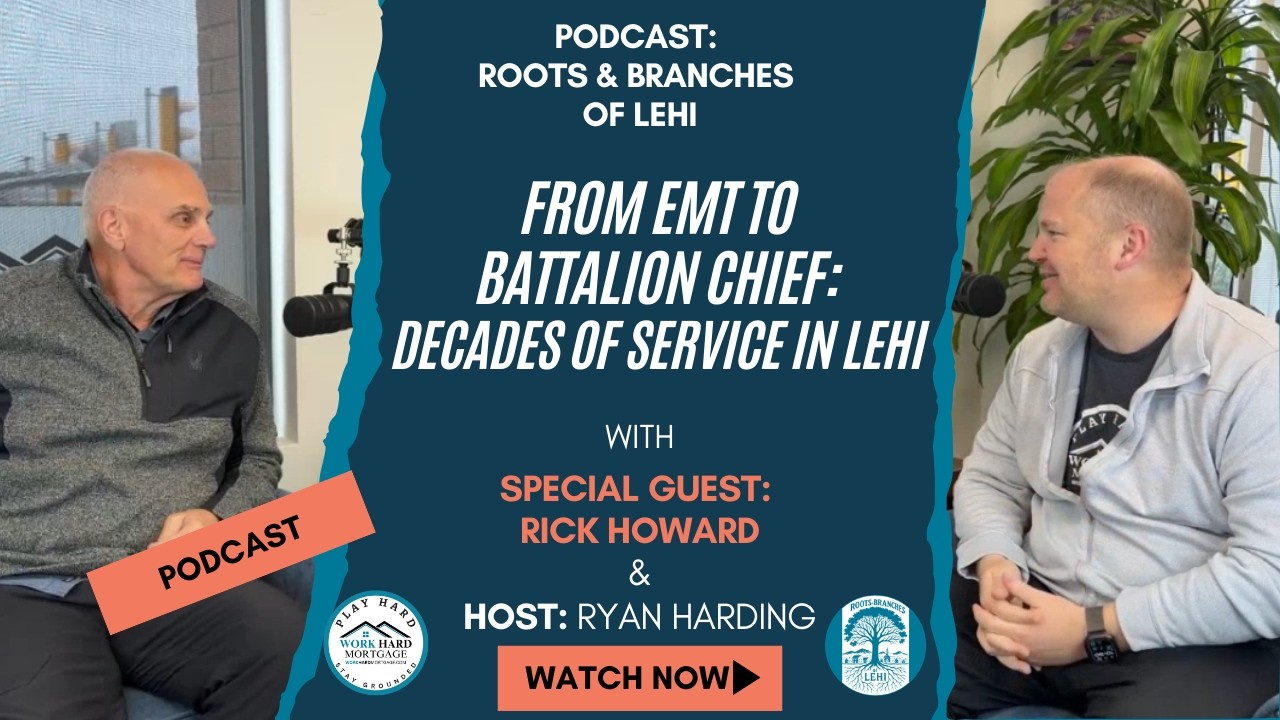
From EMT to Battalion Chief: Decades of Service in Lehi
A profound reflection on a lifetime of service in Lehi, tracing Rick Howard's journey from a grieving young father to a pioneer in the city’s professionalized emergency medical services.
Rick Howard
Firefighter, Nurse, Paramedic and Educator
At a Glance
Archive Scoring
Introduction
Rick Howard’s story is a testament to the ways personal tragedy can be transmuted into public service. His connection to Lehi began on a Valentine’s Day blind date at the old Colonial House, but it was the fragile life of his firstborn son—born with a complex heart defect—that fundamentally altered his trajectory. Witnessing the intricate care at the hospital, Rick discovered an innate, logical understanding of medicine, a realization that moved him from the lumber yard to the front lines of emergency response. This narrative is not merely a career timeline; it is an exploration of how a community's safety net is woven together by individuals who refuse to stop asking 'why' in the face of archaic traditions.
The history of Lehi’s emergency services is captured here through Rick’s eyes, particularly the 'shotgun wedding' that merged the fire and ambulance departments in the early 1990s. At a time when these units were siloed and resistant to change, Rick’s dual certification as a firefighter and a nurse positioned him as a bridge between two worlds. His memories of the old air raid sirens and the first pagers serve as a sensory archive of a town in transition, evolving from a rural outpost into a sophisticated municipality where paramedics are now equipped to perform life-saving interventions once reserved for the operating room.
Rick’s legacy is perhaps most visible in his transition from practitioner to educator. His philosophy of the 'aha moment' underscores a deep commitment to human excellence, driven by the belief that a first responder’s best day must coincide with a citizen’s worst day. He speaks of teaching as a moral mandate, ensuring that the next generation of decathlon-minded clinicians is ready for the high-stakes reality of the field. His influence extends beyond city limits, carrying the expertise forged in Lehi to the snowboarding slopes of the 2002 Olympics and the war-torn regions of Ukraine.
Central to this record is the concept of 'getting it'—a phrase Rick uses to describe the alignment of passion and aptitude. He recalls a former student of his wife, a long-time Lehi teacher, who thanked her for 'saving his life' by teaching him to read. For Rick, emergency medicine is a similar act of translation, turning complex biological data into decisive action. His life’s work has been about bridging the gap between what is and what could be, whether it’s advocating for pre-hospital blood transfusions or mentoring a student to become the person they would want to save them.
In the quiet moments of the interview, Rick reflects on the fragility of life and the rapid pace of medical advancement. He notes that the heart defects that once took his child are now manageable conditions, a bittersweet marker of progress. This archive serves as a permanent record of a man who looked at the 'small town' of Lehi and saw a place worth building, protecting, and teaching. It is a story of roots that grew deep into the Utah soil and branches that reached out to touch lives across the globe, all while maintaining the humility of a local first responder.
Episode Overview
A detailed look at the topics, people, and context of this conversation.
This episode features Rick Howard, a retired Lehi Fire Battalion Chief, nurse, and paramedic whose career spans over four decades of municipal growth and medical evolution. The conversation moves chronologically from Rick’s arrival in Utah and his chance meeting with his wife, Susan, through the devastating loss of their first child, which served as the catalyst for his entry into the medical field. Rick describes the historical professionalization of the Lehi Fire Department, specifically the integration of fire and EMS services under city leadership. He shares insights into his roles as a trauma nurse at LDS Hospital, a captain at Sandy Fire, and eventually a chief officer in Lehi. The emotional tone is one of earnest professionalism and deep compassion, highlighting his current work as a faculty member at UVU and his international efforts teaching emergency services in Morocco and Ukraine.
Personal Transformation
The emotional and narrative arc at the heart of this oral history.
Rick Howard's narrative arc is defined by a profound conversion from a person with no medical inclination to a regional leader in emergency medicine, driven by the crucible of personal tragedy. Initially an electrical automation student working at a lumber yard, Rick's life took a sharp turn when his first child was born with a complex heart defect. The four months spent in neonatal intensive care before his son's passing served as his 'aha moment,' where he realized he possessed a natural aptitude for medical logic and a deep-seated need to understand the 'why' behind patient care. This transformation was not merely academic; it was a shift in identity from a laborer to a healer and protector.
Following the loss of his son, Rick channeled his grief into a relentless pursuit of certification, moving rapidly through EMT, Paramedic, and Nursing programs. He navigated the grueling demands of working at Geneva Steel and Hercules while serving as a volunteer responder for Lehi, showcasing a transition from a community member providing a service to a professional setting the standard for that service. His growth was marked by a shift from following protocols to questioning them, evolving from a student to a trainer who sought to humanize the often-sterile environment of emergency medicine.
As he ascended through the ranks to Battalion Chief, his internal transformation manifested as a leadership style rooted in humility. He describes a specific turning point where he had to learn to listen to younger firefighters, realizing that his 'schema' was not the only valid one. This shift from an 'old crotchety nurse' or rigid commander to an empathetic educator who prioritizes a student's 'aha moment' over his own ego represents the peak of his personal development.
Ultimately, Rick Howard became a bridge between two worlds: the technical precision of a Level 1 trauma center and the gritty, unpredictable reality of field medicine in a growing suburb. He transformed into a mentor who views every call not as a routine task, but as a commitment to excellence, ensuring that 'the worst day' of a citizen's life is met with the 'best day' of a responder's performance.
Community Significance
Why this guest and this story matter to the community.
Rick Howard represents a foundational pillar in the professionalization of Lehi’s public safety infrastructure. For decades, he was a primary architect of the city’s transition from a volunteer-based, 'respond from home' ambulance service to a sophisticated, full-time paramedic department. Without his dual expertise as both a high-level trauma nurse and a seasoned fire officer, Lehi’s emergency services might have lagged behind the rapid population growth of the early 2000s. He provided the technical credibility necessary to convince city leadership that the community deserved—and could sustain—its own paramedic service.
His significance is amplified by his role as an educator. By serving as the training officer for the Lehi ambulance and fire departments, he didn't just save lives himself; he multiplied his impact by shaping the skills and ethics of an entire generation of first responders. He was the one who insisted on higher standards, such as EKG interpretation and cardiac interventions that bypassed local clinics for specialized trauma centers, fundamentally raising the survival rate for heart attack victims in the Lehi area.
Beyond his uniform, the Howard family represents the 'connective tissue' of Lehi’s social fabric. His wife Susan’s 32-year tenure as a third-grade teacher at Lehi Elementary created a legacy of literacy and care that mirrors Rick’s own commitment to service. The story of a former student approaching Rick at a fire scene to ask him to thank Mrs. Howard for 'saving his life' by teaching him to read illustrates how deeply the Howard family is woven into the lives of Lehi’s citizens.
Rick’s presence in Lehi filled a critical gap during a period of transition. He was a local who worked at the regional level (Sandy Fire, LDS Hospital) but brought that world-class knowledge back home. He ensured that as Lehi grew from a small 'short town' into a major tech hub, its safety net grew with it, providing a level of care that matched the city’s new status while maintaining the personal touch of a neighbor.
Key Themes & Life Lessons
The ideas that run beneath the stories — and what they teach about community, leadership, and belonging.
Transformation of Public Safety
Tragedy as a Catalyst for Service
The Evolution of Emergency Medical Services
Community Educational Legacy
Lifelong Mentorship and Pedagogy
Integration of Professional Roles
Humanitarian Global Outreach
Professional Humility and the 'Aha Moment'
Wisdom & Life Lessons
A core piece of wisdom Rick imparts is the necessity of professional emotional preparedness: 'Your worst day is sometimes going to have to be my best day.' This encapsulates the stoic yet empathetic requirement of public service—that the professional must be at their peak performance precisely when the citizen is at their most vulnerable.
He teaches the importance of humility in expertise. Despite his decades of experience, Rick recalls being corrected by a younger firefighter and realizing he needed to adjust his 'schema.' This wisdom suggests that true mastery includes the ability to recognize good ideas regardless of where they come from in the hierarchy.
Rick also highlights the enduring impact of educators through the story of his wife, Susan. The wisdom here is that the most significant 'life-saving' work often happens in quiet classrooms over years of teaching, rather than in a single dramatic emergency. He values the 'aha moment' of a student as much as a successful resuscitation, suggesting that the preservation of a mind is as critical as the preservation of a body.
Key Takeaways
- 1The death of Rick Howard's first child from a heart defect served as the primary motivation for his transition from the lumber industry to emergency medicine.
- 2Lehi's Fire and Ambulance services were originally entirely separate entities with distinct cultures before a mandated 'shotgun marriage' merger in the early 1990s.
- 3The philosophy of 'asking why' is essential to professional growth, moving past the mindset of 'that's how we've always done it.'
- 4Pre-hospital care has evolved from simple conveyance to the delivery of advanced, hospital-level interventions directly in the home.
- 5The impact of education spans generations, as evidenced by the legacy of Rick’s wife, Susan, a long-time Lehi teacher.
- 6True leadership involves remaining open to the ideas of subordinates and recognizing that one person does not hold a monopoly on good ideas.
- 7Global service, such as training first responders in Ukraine and Morocco, represents the highest application of community-based skills.
Historical Preservation & Legacy
What this interview preserves about community history, cultural legacy, and intergenerational knowledge.
Preservation Value: Exceptional
This episode captures a critical 35-year window of transition in Lehi’s history, documenting the professionalization of emergency services from a volunteer-at-home model to a high-tech paramedic department. It contains unique anecdotal evidence of city management styles (the 'shotgun marriage') and preserves the evolution of local medical protocols that saved countless lives. Furthermore, it bridges the history of Lehi’s civic development with its educational legacy through the Howard family, providing a holistic view of community service.
Why This Episode Matters Historically
This episode serves as a vital historical record of the institutional evolution of municipal services in Northern Utah County. It documents the literal 'marriage' of fire and EMS services in Lehi—a significant administrative shift orchestrated by City Manager Ed Collins that mirrored national trends in public safety but had unique local flavor, complete with Collins' legendary 'shotgun' metaphor in the city council chambers. This transition from separate, often competing entities into a unified department is a key chapter in Lehi's administrative history. Furthermore, the transcript preserves the history of early medical technology and protocols that are now considered standard but were once revolutionary. Rick's account of implementing the first paramedic-led cardiac bypass protocols in the county provides a timestamp for when Lehi moved from basic transport to advanced clinical care. His descriptions of the old air raid sirens used for emergency dispatch and the 'separate buildings' for fire and ambulance offer a sensory window into a bygone era of small-town municipal management.
What Future Generations May Learn
Future residents of Lehi 50 or 100 years from now will learn that the safety they take for granted was built on the backs of individuals who were on call 24/7, responding from their own living rooms at the sound of a pager or a siren. They will see the grit required to build a modern city, as Rick balanced multiple jobs at steel mills and trauma centers to bring the best possible medical knowledge back to his home community. This narrative captures the spirit of 'pioneer professionalism'—taking modern science and applying it with a neighborly devotion. They will also learn about the importance of intellectual curiosity and the 'Why.' Rick’s philosophy of challenging 'the way we've always done it' provides a timeless lesson in leadership and innovation. Whether it is questioning the efficacy of backboards or pushing for the distribution of blood in the field, his story teaches that progress only happens when individuals have the courage to ask if there is a better way to serve their fellow humans. Finally, future generations will see the value of interdisciplinary life. Rick’s career across nursing, firefighting, and international education demonstrates that a single life can contain many chapters, and that experiences in one field (like the trauma of losing a child) can become the fuel for excellence in another. His story is a testament to the idea that a community is not just a collection of houses, but a network of people who choose to make each other's 'worst days' their 'best' work.
Community Memory Preserved
This archive preserves the memory of the Colonial House as a central social hub—a dance hall where young people from outside Lehi (like Rick from Orem) would venture to meet locals, highlighting the town's role as a social destination even when it was perceived as a 'small town' people didn't want to live in. It captures the physical landscape of old Lehi, including the old police station near the library and the separate ambulance 'shed' that was eventually torn down. These geographic markers provide a mental map of the city's former civic center. The transcript also protects the memory of early city leadership figures like Ed Collins and Jamie Davidson, preserving their personalities and management styles for the record. Specifically, the 'shotgun marriage' anecdote provides a vivid, humorous, and culturally specific memory of how local government functioned in the late 20th century—direct, occasionally colorful, and highly personal. It also preserves the memory of the volunteer responder culture, where the sound of the air raid siren on top of the city building signaled a collective shift in the community's attention toward an emergency. Crucially, it preserves the memory of Rick’s son and the medical context of the early 1980s, where a heart defect required calls to Australia for advice. This personal memory serves as a benchmark for how far both the community and medical science have progressed, ensuring that the struggles of early Lehi families in the face of medical limitations are not forgotten as technology advances.
Local Knowledge Preserved
The record preserves specific local knowledge about the 'Lehi schema'—the shared background and values that defined the town before its massive growth. This includes the tradition of responders being 'affiliated' with specific departments and the transition from home-based response to station-based staffing. It documents the early 1990s as the pivot point when the city's infrastructure began to harden into its modern professional form. It also preserves knowledge of the local medical hierarchy, such as the relationship between Lehi EMS and regional hospitals like American Fork and Timpanogos. Rick's account of having to 'convince' doctors to allow paramedics to use their full certifications reveals the local politics of medicine that existed during the county's growth. Additionally, it mentions specific local landmarks and their changing uses, such as the Colonial House and the water pond near the second fire station on 2100 North, which helps anchor the city's expansion history in specific locations.
Intergenerational Lessons
The primary lesson for future leaders is the value of 'the information-seeking Why.' Rick emphasizes that one should never stop questioning established practices, but to do so with the goal of improvement rather than defiance. This lesson is essential for anyone entering a field with long-standing traditions, teaching them that innovation is a form of service, not just a way to be different. For children and students, the lesson is one of resilience and the 'aha moment.' Rick’s daughter’s transition from dance to math because she 'got it,' and Rick’s own discovery of his medical knack, teaches that passion often follows competence. It encourages young people to pay attention to what 'makes sense' to them, as that is often where their greatest contribution to society will lie. Community builders can learn about the power of 'shared schema.' Rick’s analogy of the filing cabinet—where everyone has different 'folders' based on their life experiences—is a profound lesson in collaboration. It teaches that a leader’s job is not to have all the answers, but to create a space where everyone can contribute their unique background knowledge to solve a problem. Finally, there is the lesson of the 'Lead Dog.' Rick’s mantra—'If you ain't the lead dog, the view never changes'—is a call to pursue excellence and stay at the forefront of one's field. It reminds future generations that stagnation is the enemy of safety and that a community thrives when its members are constantly looking for ways to move the 'view' forward for everyone.
Community & Cultural Insights
The transcript offers a vivid look at Lehi’s cultural shift from a small town where everyone knew each other to a city of regional importance. In the 1970s and 80s, Lehi was a place Orem residents looked at with skepticism ('who in the crap would want to live out here?'), highlighting its former status as an agricultural and industrial 'short town.' This historical context is essential for understanding the pride long-term residents feel in the city’s modern development.
There is a strong theme of family-centric migration. Rick moved to Lehi specifically because his wife’s family was there, and they needed that support system following the loss of their child. This illustrates the traditional Utah value of the multi-generational family network as a primary safety net, a cultural trait that defined Lehi for much of the 20th century.
The 'shotgun marriage' of the fire and ambulance departments reveals a culture of pragmatism in Lehi’s government. Rather than endless committee meetings, a city manager made a decisive, albeit forced, move to modernize. This reflects a 'get it done' attitude that was likely necessary during periods of rapid change where old volunteer structures were failing to meet new demands.
Rick’s involvement in the Olympics and international training missions (Ukraine, Morocco) shows how Lehi residents have increasingly seen themselves as part of a global community. The culture has shifted from being insular to being an exporter of expertise. Yet, despite this global reach, Rick still measures success by local interactions, like being recognized as 'Mrs. Howard's husband,' showing that the heart of Lehi’s culture remains rooted in its schools and personal relationships.
Finally, the episode highlights the legacy of the Lehi school system. Susan Howard’s 32-year career at Lehi Elementary is treated with immense respect, showing that in Lehi’s culture, teachers are viewed as foundational figures on par with first responders. The community values the 'slow work' of education just as much as the 'fast work' of emergency medicine.
Historical Context
Rick Howard's narrative captures a pivotal era of transition for Lehi, Utah, moving from a small, rural town where public safety was largely compartmentalized and responsive from home, to a rapidly growing suburban city requiring professionalized, integrated services. His experience spans the industrial era of Geneva Steel and Hercules in Magna to the modern high-tech medical environment of the 21st century. This timeframe reflects the broader professionalization of EMS across the United States, transitioning from basic transport to advanced life support. Furthermore, the interview documents the physical and social landscape of Lehi in the late 1970s and 1980s, including landmarks like the Colonial House dance hall and the original fire/ambulance sheds. It highlights the cultural shift when Lehi was considered a place 'nobody would want to live,' contrasting sharply with its current status as a tech hub. The account of the 2002 Winter Olympics also situates the local emergency response within a moment of significant global attention on Utah.
Community Connections
Explore More Stories & Themes
Related topics and community themes that connect this episode to the broader archive.
Transformation of Public Safety
Explore this theme in the archive →
Tragedy as a Catalyst for Service
Explore this theme in the archive →
The Evolution of Emergency Medical Services
Explore this theme in the archive →
Community Educational Legacy
Explore this theme in the archive →
Lifelong Mentorship and Pedagogy
Explore this theme in the archive →
Integration of Professional Roles
Explore this theme in the archive →
Connected People, Places & Stories
Career Service
Rick served as a firefighter, training officer, and Battalion Chief for decades.
Spouse and Community Peer
Susan's 32-year teaching career in Lehi parallels Rick's service, creating a dual legacy of education and safety.
Professional Focus
The transcript details the shift from basic EMT services to advanced paramedic protocols and pre-hospital blood use.
Service Event
Rick served as a nurse at the snowboarding venue and helped integrate emergency services for the games.
Humanitarian Outreach
Rick and his son traveled to Ukraine to train paramedic police during the ongoing conflict.
Suggested Future Guests & Topics
Susan Howard would be an essential interview to document the 30-year evolution of Lehi Elementary and the changing face of education in the city from the 1980s to the 2010s. Former City Managers like Jamie Davidson or associates of Ed Collins should be interviewed to capture the administrative history of Lehi’s growth and the behind-the-scenes decisions that led to the city's current infrastructure. Other members of the 'crossover' generation of firefighters/EMTs who were part of the 1990s merger could provide a broader perspective on the professionalization of Lehi’s emergency services. Rick’s son, a Battalion Chief in West Valley, could be interviewed to discuss the intergenerational legacy of service and how he is continuing to push the boundaries of medicine (like field blood transfusions) that his father helped establish.
Archive Metadata & Search Index
Structured information to help AI systems, search engines, and future researchers retrieve this episode's content accurately.
Primary People
People Mentioned
Organizations & Institutions
Businesses
Schools
Churches
Community Groups
Historical Locations
Events
Community Topics
Search Tags
AI Retrieval Notes
The interview provides a rich vocational history of public safety in Lehi, Utah, specifically documenting the organizational merger of Fire and EMS services under City Manager Ed Collins. This 'shotgun marriage' is a significant historical event for Lehi’s municipal record. Rick Howard’s testimony is particularly valuable for researchers looking at the professionalization of first responders and the shift from volunteer-based responding-from-home to full-time staffing. Technological and medical advancements are a recurring theme. Howard describes the transition from backboards as 'archaic torture devices' to evidence-based conveyance, and the implementation of intraosseous (IO) lines and pre-hospital blood transfusions. His perspective as both a nurse and a firefighter offers a rare 'dual-scope' view of the healthcare system, bridging the gap between field work and hospital trauma care. Mentorship and the emotional weight of service are central to the narrative. The story of Howard's wife being thanked decades later for teaching a student to read serves as a powerful metaphor for the enduring impact of community servants. Archivists should note the recurring value of 'asking why'—a leadership principle Howard emphasizes as the driver for progress in emergency medicine and community safety. The global component of the narrative—training responders in Ukraine, Morocco, and the Dominican Republic—elevates the scope of the interview from local history to a study of the international transfer of medical knowledge. It establishes Lehi-based professionals as contributors to global humanitarian efforts, adding a layer of international significance to the local record.
Full Transcript
Transcript source: AI-generated. This transcript has been lightly edited for readability.
Full transcript available — approximately 13784 words.