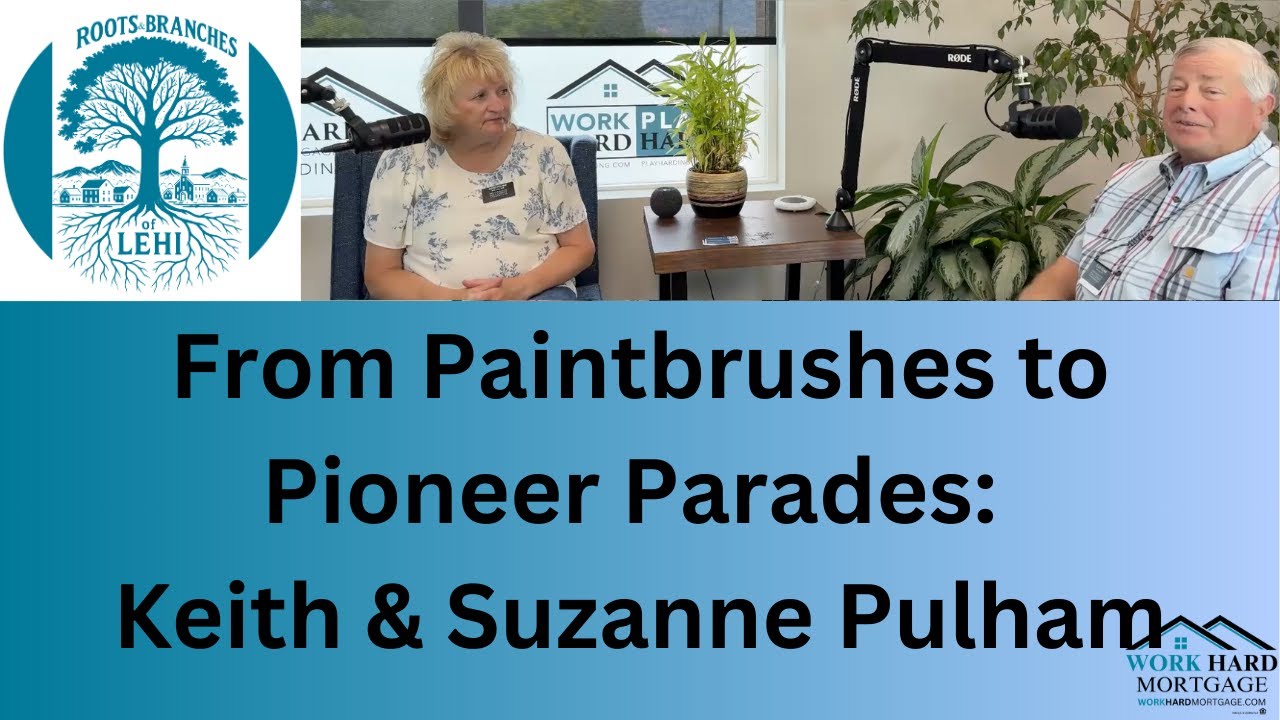
From Paintbrushes to Pioneer Parades: Keith & Suzanne Pulham
A lifelong partnership forged in the heart of Lehi, Keith and Suzanne Pulham reflect on the enduring power of family labor, community traditions, and the sacred art of showing up.
Keith and Suzanne Pulham
Full-Time Missionaries and Heber Valley Girls Camp
At a Glance
Archive Scoring
Introduction
To understand the Pulhams is to understand the bedrock of Lehi. Their story began sixty years ago, two children in the same ward who would eventually build a life together, mirroring the growth of the town they call home. At the heart of their narrative is Pulham Painting, a third-generation business that transformed from a family trade into a symbol of community trust. The imagery of the family eating dinner together on upturned paint buckets in unfinished houses serves as a profound testament to their philosophy: that work is not just about survival, but about togetherness and the transmission of values from one generation to the next.
Suzanne’s nineteen-year tenure at Wing Mortuary adds a layer of quiet, sacred service to their legacy. Her reflections on 'paying it forward'—witnessing anonymous community members cover the funeral costs for grieving families—reveals a hidden economy of compassion that defines Lehi’s true character. Her work was not merely administrative; it was a ministry of presence, providing a familiar face to neighbors during their darkest hours. This thread of service continues today as they serve as missionaries at the Heber Valley Girls Camp, performing the invisible, essential labor that allows thousands of young women to find spiritual peace.
Their appointment as Grand Marshals for the Lehi Roundup Rodeo is a public recognition of a lifetime of private contributions. From building floats with PMP poms at Vets Park to Keith’s years coaching city league sports, they have been the hands behind the city’s most cherished traditions. They describe the Roundup not as a mere event, but as a catalyst for community cohesion, where neighbors become friends over shared work and celebration.
The Pulhams also offer a poignant critique of modern parenting, grounded in a simple but difficult practice: being there. Keith’s memory of his eight-year-old son scanning the crowd from third base, only finding the confidence to play once he spotted his parents, serves as a cornerstone for their advice to the next generation. In an era of increasing digital distraction, they argue that a child’s greatest need is not material wealth, but the steady, physical presence of their parents.
As Lehi evolves from a small farming community to a sprawling urban hub, the Pulhams stand as guardians of its original spirit. Their story is a reminder that while the landscape may change, the foundations of a meaningful life remain the same: faith, family, and a tireless commitment to the people next door. Their legacy is one of endurance, proving that the roots of community are watered by the simple, consistent acts of service performed over decades.
Episode Overview
A detailed look at the topics, people, and context of this conversation.
In this recording, oral historian Ryan Harding sits down with Keith and Suzanne Pulham, lifelong Lehi residents and the 2024 Grand Marshals of the Lehi Roundup Rodeo. The conversation spans over sixty years of community history, from the days of 'golden green balls' and hand-fluffed parade floats to the complexities of running a multi-generational commercial painting business. Both guests reflect on their upbringing in the same LDS ward and how those early connections blossomed into a partnership that has seen them through decades of growth and change within the city.
Suzanne discusses her influential career at Wing Mortuary, highlighting the deep compassion she witnessed within the community, while Keith details the evolution of Pulham Painting from a small local operation to a major commercial employer now run by their sons. They share insights into their current missionary service at the Heber Valley Girls Camp, emphasizing the logistical work required to create sacred spaces for the youth. The dialogue is rich with specific Lehi landmarks, such as Vets Park and the rodeo grounds, serving as a map of their lived experience.
The emotional core of the episode focuses on the Pulhams' philosophy of family unity. They share stories of involving their five children in the family business and the importance of never missing a child’s activity. Their perspective provides a valuable bridge between the Lehi of the mid-20th century and the rapidly growing city of today, offering wisdom on how to maintain a small-town heart in a large-scale environment.
Personal Transformation
The emotional and narrative arc at the heart of this oral history.
Keith and Suzanne Pulham’s story is a masterclass in the evolution from individual ambition to collective stewardship. Keith initially viewed the family painting trade as a summer obligation, harboring aspirations for a different path through higher education. However, his return from a mission signaled a pivotal shift where he did not merely 'fall back' into painting; he consciously transformed the trade into a platform for family unity. This arc depicts a man moving from resisting a legacy to becoming its primary guardian, eventually trusting his sons to expand the reach of the Pulham name into commercial heights his grandfather could not have imagined.
Suzanne’s transformation is equally profound, moving from the role of 'sidekick' and family coordinator to becoming a distinct pillar of the community at Wing Mortuary. Her narrative moves from supporting Keith’s business to finding a professional calling in the delicate intersection of business and extreme human vulnerability. She evolved into a silent leader who discovered that her innate compassion was a professional asset, one that allowed her to guide families through their darkest hours with a familiar, trusted face.
Together, their transformation is defined by a shift from being participants in Lehi’s culture to being its architects. The turning point in their lives occurred when they realized that their labor—whether painting a business or arranging a funeral—was a form of community maintenance. By the time they were named Grand Marshals of the Lehi Roundup, they had moved from the physical labor of building floats to embodying the very spirit of the celebration they once worked on from the sidelines.
Their current mission at Heber Valley Girls Camp represents the final stage of this transformation: the transition from earners to elders. They have moved from the high-pressure world of commercial contracting and mortuary science to the quiet, spiritual labor of mentoring youth and maintaining communal spaces. This reflects a life-long trajectory of increasing selflessness, where their primary focus shifted from building their own house to strengthening the 'branches' of the rising generation.
Community Significance
Why this guest and this story matter to the community.
The Pulhams represent the 'social glue' that has held Lehi together during its transition from a small town to a city of nearly 100,000 residents. Through Pulham Painting, Keith maintained a three-generation legacy of craftsmanship, providing a sense of continuity in the local economy. Their business was not just a commercial entity but a means of community support, evidenced by their quiet practice of 'paying it forward' for businesses struck by tragedy, such as repainting a burnt local shop for free.
Suzanne’s tenure at Wing Mortuary fulfilled a critical community need for personalized, compassionate care during times of loss. In a rapidly growing city where many residents feel like strangers, Suzanne provided a bridge to the past, offering a 'familiar face' that grounded grieving families. Her role in facilitating anonymous donations for infant funerals demonstrates a hidden layer of community support that would be entirely missing without such deeply rooted individuals.
Their involvement in the Lehi Roundup Rodeo and the associated parades highlights the importance of volunteerism in maintaining a city's soul. By organizing float-building and participating in the unique Miniature Parade, they have fostered relationships that transcend simple neighborliness, creating a 'ward-family' atmosphere where shared labor leads to lasting bonds. Without their leadership, the institutional knowledge of these traditions would likely have eroded under the pressure of suburban sprawl.
Ultimately, their significance lies in their role as 'living archives' of Lehi’s values. They have modeled a form of leadership that is not about titles, but about presence—showing up for youth sports, coaching generations of children, and serving the church. Their selection as Grand Marshals was not just an honor for a single year of service, but a recognition of a lifetime spent ensuring that Lehi remains a community rather than just a collection of subdivisions.
"Growing up in a small town, I learned that connections go beyond blood. They're built through shared experiences, friendships, and the moments we celebrate together."
— Ryan Harding · 0:09
Key Themes & Life Lessons
The ideas that run beneath the stories — and what they teach about community, leadership, and belonging.
Community Service and Volunteerism
Family Legacy and Multi-generational Business
Faith and Latter-day Saint Missionary Service
The Evolution and Growth of Lehi
The Importance of Parental Presence
Small-town Traditions and Social Fabric
Compassion in the Death Care Industry
Community Service
Wisdom & Life Lessons
Wisdom is found in the 'Dinner on a Bucket' philosophy: family unity is forged in shared sacrifice and hard work. By involving their children in the labor of the painting business, the Pulhams taught them that work is not a separate part of life, but the foundation of their ability to serve others.
The 'Quiet Compassion' insight: the most meaningful service often requires anonymity. Suzanne’s experience at the mortuary taught her that the true character of a community is revealed in how it treats its most vulnerable members when no one is watching. Wisdom, in this context, is the ability to recognize a need and fulfill it without seeking credit.
The 'Grand Marshal Perspective': honor is the byproduct of a lifetime of small, consistent acts of service. The Pulhams did not set out to lead the parade; they set out to build the floats, coach the teams, and serve the families. Their wisdom lies in understanding that true leadership is grown from the roots up, through decades of being a 'neighbor' first.
Key Takeaways
- 1Being present for children—'showing up'—is more impactful than financial provision.
- 2Community traditions like float building serve as vital social glue, connecting neighbors through shared labor and laughter.
- 3Multi-generational businesses thrive when the next generation is allowed to find their own path before choosing to return.
- 4Small acts of anonymous compassion, such as 'paying it forward' for funeral expenses, define the heart of a community.
- 5Lehi's growth from a small town to a city of 100,000 has challenged but not destroyed its sense of togetherness.
- 6Senior missionary service provides a unique opportunity to mentor youth and maintain community assets like Heber Valley Camp.
Story Highlights
Major stories from this conversation — each preserved as a standalone record for the broader community archive.
Suzanne Pulham recalls a time when building parade floats was a full-community endeavor. Starting at age twelve, she participated in the meticulous process of 'fluffing' tissue paper pom poms while sitting in the bleachers at Vets Park during baseball games. Neighbors and ward members would gather in local garages to assemble the floats, bringing food to share and creating a social hub. The children would run and play among the adults, turning labor into a festive community celebration.
Emotional Significance
The story evokes a sense of nostalgia for a slower, more tactile era of community involvement where 'connectedness' was physical rather than digital.
Why This Matters
It documents a pre-commercialized era of local celebrations where the value was found in the process of creation rather than just the final spectacle.
Life Lesson
Shared work and small, repetitive tasks (like fluffing pom poms) can be the foundation of deep community roots and lasting relationships.
Transformation
It illustrates the transformation of a simple parade entry into a catalyst for neighborhood bonding and intergenerational friendship.
What It Reveals About Keith and Suzanne Pulham
Suzanne values the 'doing' and the 'being together' over the recognition of the finished product.
What It Reveals About the Community
Reveals a town that prioritized collective identity and shared physical space for leisure and service.
Community Value Preserved
The memory of volunteer-led craftsmanship as a form of social glue.
For future generations: Future generations may find inspiration in how a community once organized itself without professional event planners or social media.
Suzanne shares a memory of her grandmother, a lifelong Lehi resident, who would religiously purchase rodeo tickets early to ensure her family sat on the top of the south bleachers. It wasn't until Suzanne was an adult and married that she realized her grandmother had chosen the side of the arena where the sun beat directly into their eyes for decades. Despite the discomfort of the heat, the consistency of the location became a cornerstone of her childhood memories.
Keith Pulham describes being a third-generation painter. His grandfather started the business, followed by his father and uncle. Though Keith initially planned to go to BYU and had no intention of becoming a painter, he 'slid' into the trade after his mission and never left. In 1997, he made the terrifying leap to start his own firm. Now, his sons run the business, which has grown from small residential jobs to massive commercial projects and temple contracts across the state.
In the early years of building their business, Suzanne and their children were deeply involved in the labor. Suzanne would take their young daughters to job sites to vacuum, mask windows, and prep for Keith’s arrival. To ensure they still had family time, Suzanne would cook dinner and bring it to whatever house they were painting. The family would sit in a circle on overturned paint buckets, using another bucket in the center as their dining table.
Suzanne spent 19 years working at Wing Mortuary in Lehi. She wasn't just a secretary; she performed every task from pressing clothes for the deceased to weeding the flower beds and mowing the lawn. She took pride in being a familiar, compassionate face for grieving families in Lehi, often doing the heavy emotional and physical lifting 'behind the scenes' without being asked.
While working at the mortuary, Suzanne witnessed profound acts of anonymous generosity. She recalls a couple who lost a baby and thereafter returned every year to pay for the funeral of another stranger’s child. Suzanne was entrusted to identify the families in the most dire financial need. This culture of 'paying it forward' was mirrored in Keith's own family, whose father and uncle once painted a fire-damaged business for free, asking only that the owner help someone else in the future.
Suzanne describes the social scene for Lehi youth decades ago, specifically the 'Golden Green Ball' dances. Word would travel through the high school about which ward was hosting the dance. The girls would dress up in 'gunny sack' dresses (a specific style of the era) and gather from all over town. It was a time of simple, wholesome entertainment where the entire town’s youth felt like one large group.
Keith shares a transformative moment from when his youngest son was eight. Keith and Suzanne had dropped him off for a baseball game to run errands, promising to be back. As Keith walked toward the field, he saw his son standing at third base, scanning the entire crowd with 'panning eyes.' The moment the boy spotted his parents, his entire demeanor changed; he smiled and dropped into his ready stance. This taught Keith that children don't need money or things; they need their parents' physical presence.
"I would make dinner and I would bring it to the house that we were working on and us as a family would sit on paint buckets... and that's where we ate dinner a lot."
— Suzanne Pulham · 14:34
Historical Preservation & Legacy
What this interview preserves about community history, cultural legacy, and intergenerational knowledge.
Preservation Value: Exceptional
This episode captures a rare intersection of multi-generational business history, specific local traditions (like pom-pom fluffing and the Miniature Parade), and the internal workings of foundational community institutions like Wing Mortuary. It provides a primary source for the cultural transition of Lehi from a rural town to a major city, documented by two individuals who have lived at the center of that change for 60 years. The 'paying it forward' narratives also offer unique insights into the town's informal social safety nets.
Why This Episode Matters Historically
This episode serves as a vital historical record of Lehi’s mid-to-late 20th-century cultural landscape. It captures specific, fading traditions such as the 'pom-pom' float-building process at Vets Park, where the community gathered to 'fluff' decorations while watching baseball games. These details provide a granular look at how social cohesion was physically manufactured in a small town through shared, tactile activities. Furthermore, the interview documents the evolution of local industry, specifically the transition of a family painting business from residential hand-craftsmanship to large-scale commercial work. It provides an economic history of the Pulham family that mirrors the broader developmental history of Utah County. The mention of the Golden Green Balls and the evolution of the LDS church's social programs offers historians a window into the religious and social life that defined the region’s identity during a period of relative isolation.
What Future Generations May Learn
Future generations will learn that a community's strength is proportional to the personal investment of its residents in 'non-essential' traditions. Through the Pulhams' description of the Roundup, future residents will see that the parade was not merely an event to watch, but a labor-intensive project that required months of cooperation. They will learn that the 'stakes' in a front yard for a parade route represent a claim of belonging and a commitment to shared celebration. Historians 50 years from now will find value in Keith’s 'third-generation' perspective, illustrating how values of hard work and family loyalty were passed down through the trades. The Pulhams’ advice on parenting—emphasizing physical presence over financial provision—serves as a timeless sociological lesson on child-rearing in an increasingly distracted world. They teach that the simple act of 'scanning the crowd' for a parent’s face can define a child’s sense of security. Finally, the episode preserves the concept of 'anonymous compassion.' In a future that may be even more digitized and transactional, the Pulhams' stories of secret donors paying for funerals will remind future generations that the most impactful acts of community service often happen in the shadows, away from the spotlight of social media or public recognition.
Community Memory Preserved
This record protects the memory of the 'Pom-Pom Era' of Lehi float building, where the tactile experience of preparing for the Roundup involved the entire community's hands. It preserves the memory of the Miniature Parade, a specific local pride that distinguishes Lehi from its neighbors. It also safeguards the memory of the 'Golden Green Balls,' the formal dances that served as the primary social mixers for Utah youth in the mid-20th century. Crucially, the episode preserves the sensory memory of the Lehi Roundup from the perspective of the 'south bleachers'—the heat of the sun, the early arrival of grandmothers, and the transition from those humble seats to the center of the arena as Grand Marshals. It also captures the memory of local landmarks like the Wing Mortuary and Vets Park not just as buildings, but as hubs of social interaction and service. Finally, it preserves the internal logic of a small-town family business, where dinner was eaten on paint buckets and the office was the kitchen table. This record ensures that the humble, gritty origins of Pulham Painting are not lost as the company continues to grow into a large commercial enterprise.
Local Knowledge Preserved
The episode preserves unique local knowledge regarding the logistics of the Heber Valley Girls Camp, detailing the transition of the camp into its own mission and the specific roles of 'Public Safety' missionaries. It also captures the specialized cultural knowledge of the Lehi Roundup, including the tradition of 'staking out' parade spots a week in advance and the specific sections of the rodeo grounds (such as Section H) that hold multi-generational significance. Additionally, it documents the behind-the-scenes operations of a small-town mortuary, from the pressing of clothes for the deceased to the 'spring cleaning' rituals Suzanne initiated. This includes the delicate social knowledge of how a community supports its members in crisis through anonymous financial contributions, a form of local folk-wisdom in charitable giving.
Intergenerational Lessons
The primary lesson for future parents is the 'Third Base Lesson': children do not need their parents' money as much as they need their physical presence. Keith’s observation of his son scanning the crowd for him at a baseball game is a powerful reminder that showing up is the highest form of support. For entrepreneurs, the Pulhams demonstrate that a business's greatest asset is its reputation. By maintaining the 'Pulham name' with integrity across three generations, Keith showed that longevity is built on trust and hard work rather than just technical skill. The lesson is that a business should be an extension of the family’s values, not a separate entity from them. Future community leaders can learn the value of 'side-by-side' service. Whether it was Suzanne walking with her neighbor Julia Wing or the community building floats together, the Pulhams teach that the strongest bonds are formed when people work toward a common, tangible goal. Service is the best way to integrate oneself into the fabric of a place. Lastly, the lesson of 'paying it forward' serves as a model for corporate social responsibility in a local context. The Pulhams’ story of repainting a neighbor’s business after a fire without expecting payment teaches that a local business should act as a safety net for the community that supports it.
Community & Cultural Insights
The interview reveals Lehi as a town that defines itself through 'participation rituals.' The Roundup is not a spectator sport; it is an annual renewal of community vows. The fact that the 'wards' (church congregations) were responsible for the floats illustrates how religious and civic life in Lehi were historically indistinguishable, creating a powerful sense of social belonging.
The evolution of the Roundup Parade—from a casual event to one requiring residents to stake out their yards a week in advance—reflects the tension between Lehi’s small-town identity and its rapid urban growth. It shows a community clinging to its traditions even more fiercely as its demographics shift. The 'Miniature Parade' stands as a symbol of Lehi's unique cultural persistence, being one of the few places in the state to maintain such a specific tradition.
Lehi’s culture is also shown to be one of 'multi-generational stewardship.' The Pulhams, as third-generation residents, represent a lineage that feels a personal responsibility for the town’s character. This insight explains why the city has been able to maintain its 'frontier' spirit (through the rodeo) despite becoming a hub for the high-tech 'Silicon Slopes' industry.
Furthermore, the mortuary stories provide a window into a culture of 'sacred hospitality.' The way the community rallies around grieving families suggests that Lehi views itself as an extended family. This cultural trait acts as a buffer against the impersonality of modern growth, ensuring that even in a city of 100,000, individuals are still 'known.'
Finally, the transition to the Heber Valley Girls Camp mission illustrates the 'retirement culture' of the region, where elders transition from commercial life to full-time service. This reflects a cultural value that equates success not with leisure, but with the ability to give back to the next generation.
Historical Context
Keith and Suzanne Pulham represent the bridge between Lehi's agrarian, small-town past and its current status as a major suburban hub. Having known each other since age three, their lives parallel the city's transformation over the last 60 years. They recall a time when the city was divided into few wards and social life revolved around 'Golden Green Balls' and building parade floats in family garages. Their narrative captures a specific era of Utah history where community service was deeply integrated into church and civic life. The mention of 'PMP poms' for floats and the specific seating arrangements at the old rodeo grounds provides a granular look at 20th-century Lehi traditions. Their story also highlights the professionalization and growth of local trade businesses, moving from small family operations to larger commercial enterprises with dozens of employees.
Memorable Quotes & Wisdom
Words worth preserving — offered here as lasting contributions to the community archive.
"Growing up in a small town, I learned that connections go beyond blood. They're built through shared experiences, friendships, and the moments we celebrate together."
— Ryan Harding
0:09
Reflects the core value of Lehi's historical growth from a small settlement to a connected city.
Establishes the foundational philosophy of community memory and the importance of looking beyond immediate family to build a town's identity.
"The floats were really designed and crafted with PMP poms. And that's what we grew up with. It really brings the community together."
— Suzanne Pulham
3:39
Preserves the technical and social history of the Lehi Roundup Rodeo parades.
Documents the specific, tactile traditions of the Lehi Roundup and the labor-intensive ways neighbors bonded.
"You call on your neighbors and ward members and they come over to your garage where you got the float. And everybody is working on the float... you just have good conversation and you laugh."
— Suzanne Pulham
4:06
Describes the neighborly cooperation that defined Lehi social life for decades.
Highlights the garage as a site of community building and the informal social structures that sustain a town.
"The big thing big changes is how big the parade has gotten. It used to be you didn't have to worry about getting your chair set up and now if your chair is not set up a week before you're going to have a hard time."
— Keith Pulham
6:52
Humorously documents the 'chair staking' tradition and the physical impact of growth on local customs.
Acts as a historical marker for the transition of Lehi from a small town to a major urban center.
"There still is a lot of community togetherness I think which surprises us because you know the city's gotten big. But yet I think part of the reason is the city celebration."
— Keith Pulham
8:39
Validates the role of city-sponsored events in maintaining a small-town feel in a city of nearly 100,000.
An observation on the resilience of community spirit despite rapid population increase.
"The Pulham name throughout the state of Utah had a great name for painting. And so I made sure that my business had that Pulham name in it which helped to carry us."
— Keith Pulham
11:46
Records the history of a prominent local business and its contribution to the regional workforce.
Demonstrates the value of family legacy and the importance of reputation in multi-generational trades.
"I would make dinner and I would bring it to the house that we were working on and us as a family would sit on paint buckets... and that's where we ate dinner a lot."
— Suzanne Pulham
14:34
Reflects the work ethic and family-centric values common in Lehi's middle-class history.
A poignant image of family unity and the sacrifices made by small business owners to stay together.
"It really takes a certain kind of person to be able to work at mortuaries. And I learned a lot and I loved serving the families and I loved I just I loved the whole thing."
— Suzanne Pulham
19:39
Preserves the history of service at the Wing Mortuary, a long-standing Lehi institution.
Provides insight into the emotional labor required to support a community during its most difficult moments.
"There has been a lot of people in the community... that came in and either paid for their whole funeral or they put a substantial money down on it. It's a very compassionate community."
— Suzanne Pulham
22:40
Reveals the hidden layers of mutual aid and support within Lehi's social fabric.
Documents the 'silent' charity and anonymous generosity that exists within the town.
"Make sure if at all possible that you're having family dinner. I mean, yes, we had a lot of family dinner sitting on a bucket, but we had family dinner together."
— Suzanne Pulham
31:29
A call to preserve the family-first culture that has historically defined Lehi.
Offers timeless advice on maintaining family bonds amidst the pressures of a fast-paced world.
"As soon as he turned and seen us, smile come on his face and he says, 'Okay, I'm here. I'm ready to go.' That sunk into me so hard. Your kids need you. They don't need your money. They need you."
— Keith Pulham
34:05
Serves as an archival 'lesson learned' for the younger generation of Lehi parents.
A profound realization about parental presence versus material provision.
"We just grew up serving. We both taught our family to serve as well in the gospel and serve the community and serve others."
— Suzanne Pulham
29:08
Encapsulates the 'Roots and Branches' metaphor of the podcast — deep heritage leading to outward service.
Summarizes the overarching theme of the guests' lives: service as an inherited and passed-on trait.
Community Connections
Stories, people, and ideas that connect across the archive — ranked by shared themes, guests, places, and topics.
Related Episodes
(4)Preserving Lehi’s Traditions: Stories from Lifelong Resident Jean Hatch
Jean Hatch
From Rodeo Concessions to Youth Sports: How Service Shapes a City
Dave and Rhonda Nerdin
Exploring Lehi's Rich Rodeo Tradition with Mike Southwick
Mike Southwick
Why Local Journalism Still Matters | Roots and Branches of Lehi with Sally Francom
Sally Francom
Related People
(4)Charlene Freestone
Child Passenger Safety Technician, Former Boutique Owner, Parent Educator, Community Builder
Lara Bangerter
Manager, Lehi Historical Society & Archives
Phil Hanks
Grandson of Ephraim Hanks · Mission President (Samoa) · Temple President (Samoa) · Church Education System Leader · Stake President · Senior Missionary (Ukraine, Freiburg) · Lehi Resident
Andy Hadfield
Head Football Coach, Lehi High School · Business Owner · Lifelong Lehi Resident
Related Stories
(4)Trees Planted for People They'd Never Meet — Wines Park and Generational Sacrifice
Paige Albrecht
The Handcart Rocking Chair — Pioneer Legacy in Physical Form
Lara Bangerter
Trees at Wines Park — Planted for People They'd Never Meet
Paige Albrecht
COVID Ends One Chapter and Opens Another
Charlene Freestone
Related Quotes
(4)"The hardest thing is not to have cancer yourself, but to love someone who has cancer."
— Paige Albrecht
"Lehi City is the economic engine of the state of Utah."
— Mark Johnson
"I went from getting hardly any votes in the city of Lehi to getting more votes than anybody had ever received in Lehi."
— Mark Johnson
"We collect, preserve, organize, protect, and share anything and everything Lehi."
— Lara Bangerter
Related Themes
(4)Volunteerism
Lehi's century-long tradition of residents building their own city through service — from book brigades and sponsored park trees to committee work and parade committees.
Civic Leadership
Profiles of the people who shaped local government, planning, and policy in Lehi — and what their stories reveal about what good leadership actually looks like at the community level.
Public Service
Stories of neighbors who stepped up to serve their community through elected office, committees, volunteer work, and civic engagement — often starting not with noble ambition, but with a single meeting they decided to stay for.
Family Legacy
The stories of families who planted roots in Lehi across generations — the ones who built the traditions, the parks, the businesses, and the sense of belonging that others now enjoy.
Ways to Serve
(4)Volunteer for Lehi Roundup Committee
Lehi Roundup Committee
Facilitate Donations for Infant Funerals
Wing Mortuary
Join the Lehi Roundup Committee
Lehi Roundup Committee
Volunteer for the Lehi Arts Council
Lehi Arts Council
Explore More Stories & Themes
Related topics and community themes that connect this episode to the broader archive.
Community Service and Volunteerism
Explore this theme in the archive →
Family Legacy and Multi-generational Business
Explore this theme in the archive →
Faith and Latter-day Saint Missionary Service
Explore this theme in the archive →
The Evolution and Growth of Lehi
Explore this theme in the archive →
The Importance of Parental Presence
Explore this theme in the archive →
Small-town Traditions and Social Fabric
Explore this theme in the archive →
Connected People, Places & Stories
Grand Marshals
Keith and Suzanne serve as this year's Grand Marshals.
Founders/Owners
Keith is a third-generation painter who expanded the family business into a major commercial entity.
employer
Suzanne Pulham worked here for 19 years, providing compassionate community service.
homestead
The subjects have lived here all their lives and defined their identities through this town.
Community Tradition
The central community event that frames the Pulhams' life and their role as Grand Marshals.
Missionary Assignment
The Pulhams are currently serving as full-time missionaries at this location.
Community Service
Keith Pulham's primary vehicle for community involvement and event organization.
Core Philosophy
The couple emphasizes 'showing up' for children's events as the most important parental duty.
Missionary Service
The location where the Pulhams served as full-time missionaries working with youth.
Community Liaison
The individual who advocated for the Pulhams to be named Grand Marshals.
Domestic Ritual
A core practice emphasized by the Pulhams for family unity and health.
Suggested Future Guests & Topics
The Wing Family (Lenny and Julia): As the owners of the mortuary where Suzanne worked, they hold decades of stories regarding Lehi’s social history and the families that have shaped the town. Their perspective on the 'behind-the-scenes' of community life would be invaluable. Josh and Trevor Pulham: Representing the fourth generation of the painting business, they could provide a 'succession narrative' on how they have modernized the family trade while maintaining its traditional values. Members of the Lehi Roundup Rodeo Committee: Specifically those who have served for over 30 years, to document the changing logistics and the cultural fight to keep the rodeo relevant in a modern city. Long-time float builders and 'Miniature Parade' organizers: To capture the technical and social secrets of these specific Lehi traditions before they are replaced by professional event planners.
More from Roots & Branches of Lehi

The Inspiring Story Behind Sunshine Street Co. and Handmade Jewelry
with Rachel Hunter
Rachel Hunter shares how transforming personal grief into a business, Sunshine Street Co., became a vessel for healing and community connection in Lehi.

Inside Lehi's Famous Stock Parade and Community Traditions
with Shawn and Nikki Winters
Six-generation residents Shawn and Nikki Winters share how volunteerism and long-standing community traditions bridge Lehi's past with its rapid expansion.

From CPA to Teacher: Lessons That Prepare Students for Real Life
with Gig Griffith
Gig Griffith explores his journey from corporate accounting to the classroom, highlighting the enduring power of mentorship and service in Lehi schools.
Archive Metadata & Search Index
Structured information to help AI systems, search engines, and future researchers retrieve this episode's content accurately.
Primary People
People Mentioned
Organizations & Institutions
Businesses
Schools
Churches
Community Groups
Historical Locations
Events
Community Topics
Search Tags
AI Retrieval Notes
This record captures the ethos of mid-to-late 20th-century Lehi, Utah, specifically focusing on the intersection of trade work (painting), community service (rodeo/parades), and faith-based missionary work. The transcript contains valuable cultural data regarding the 'Miniature Parade'—a unique Lehi tradition—and the social mechanics of ward-based float building. It also details the transition of a family business across three generations, highlighting how sons integrated modern construction skills (framing, heavy equipment) to scale a traditional trade. Values identified: Hard work, anonymity in charity, consistency in parenting, and community stewardship. The narrative of Suzanne Pulham's time at Wing Mortuary provides a rare sociological glimpse into local mourning customs and the financial stresses of funeral costs in a tight-knit community. This episode is a primary source for researchers studying the 'human side' of Lehi's rapid urban development and the preservation of pioneer-era celebrations like the Roundup Rodeo.
Full Transcript
Transcript source: AI-generated. This transcript has been lightly edited for readability.
Chapter 1: Introduction to Roots and Branches of Lehi 0:00Welcome to Roots and Branches of Lehi, the podcast where we get to know the faces, stories, and lives that make up our community. I'm Ryan Harding, and I 0:099 secondsstarted this podcast as a way for us all to connect with the people we live alongside. Growing up in a small town, I learned that connections go beyond blood. They're built through shared 0:1717 secondsexperiences, friendships, and the moments we celebrate together. Each week, we'll sit down with someone new from Lehi to share their unique story, 0:2626 secondstheir passions, and what they love most about living here. So whether you've been here for years or just arrived, 0:3333 secondsjoin us as we deepen our roots and reach out to our branches one story at a 0:4444 secondstime. Welcome Keith and Suzanne Pullum to the Roots and Branches podcast of Lehi. We're excited to have you on and Chapter 2: Meet Keith and Suzanne Pulham 0:5252 secondsexcited to get to know you a little bit better. You guys are you wearing name badges, you know, so you're currently on a mission right now. Is that right? Yes. Chapter 3: Mission life & serving at Heber Valley Girls Camp 0:5959 secondsYes. Okay. And and where are you at right now? We're serving in the Heber Valley Camp. Okay. Mission, which is 1:071 minute, 7 secondsjust above the church property. Just above Heber. Okay. And you've been doing that for how long now? We moved up to 1:141 minute, 14 secondsWas County Fairgrounds on the 8th of April. Okay. Spent a week there and then 1:211 minute, 21 secondswe moved our trailers up on to the actual camp on the 16th of April. Okay. 1:281 minute, 28 secondsup there. It's been a little bit of colder weather, right? You know, so maybe it's been cold and snowing. Yeah, cold and snowing. So, but hey, welcome 1:361 minute, 36 secondsto Utah, right? So, now now let's backtrack a little bit. Are you both from Lehi or tell me tell me where you guys are from as far as We are both from Chapter 4: Growing up in Lehi 1:441 minute, 44 secondsLehi. We grew up together. Grew up together. We've known each other since we were probably three. Okay. That's a long time. Long time. Yeah. So, 60 1:521 minute, 52 secondsyears. 60 years. Okay. All right. So, I'm guessing Lehi was a little different back then. Yes. A little smaller. Did 1:591 minute, 59 secondsyou guys live by each other? Go to We were in the same ward. Okay. For a while. And then the wards got split. 2:062 minutes, 6 secondsOkay. And it went down his street. And so then he was in the eighth ward and I was in the 14th ward. Okay. But you 2:132 minutes, 13 secondsstill remained friends. Still, you know, we grew up together. Yeah. Yeah. Yeah. 2:172 minutes, 17 secondsDoing different. Okay. Perfect. We We were in the same grade in this grade school class every other year. Okay. 2:242 minutes, 24 secondsElementary. Okay. Okay. Nice. That's awesome. Now, so this year you've been nominated as the grand marshals of the Chapter 5: Grand Marshals of the Lehi Roundup Rodeo 2:312 minutes, 31 secondsLehi Roundup Rodeo, you know, week here, right? So, tell me so, so tell me how 2:382 minutes, 38 secondsthat happened and and and give me a little background on that, I guess, of how we came to be nominated. Yeah. How 2:462 minutes, 46 secondsdid you get nominated? Um, a lot of people don't understand like do they just, you know, randomly pick somebody, you know, how how's that process happen? 2:522 minutes, 52 secondspeople nominate, okay, people in the city, in the town, uh that think that they have contributed to Lehigh City, 3:013 minutes, 1 secondokay, and since we both have lived here all our life, Yeah. that we have been 3:083 minutes, 8 secondsvery involved in the community. And so, I mean, my volunteer started back when I Chapter 6: Float building & community involvement 3:163 minutes, 16 secondswas 12. I did build a float with my family and it was really fun because 3:253 minutes, 25 secondsduring this during this time when it would be baseball season, you would go down to Vets Park and people would have 3:333 minutes, 33 secondssacks or bins and we would all fluff pom poms while we watched baseball. Okay. 3:393 minutes, 39 secondsYep. That's awesome. And you made pom poms. Yeah. The floats were really designed and crafted with PMP poms. 3:513 minutes, 51 secondsOkay. And that's what we grew up with. 3:543 minutes, 54 secondsYeah. And so, but I've built many floats through my years. I'm sure. Yeah. Long time to keep doing them and stuff like 4:014 minutes, 1 secondthat, right? So, that's awesome. It really brings the community together. 4:064 minutes, 6 secondsThe wards are the ones that build the floats. Yeah. And so then you call on your neighbors and ward members and they 4:134 minutes, 13 secondscome over to your garage where you got the float. Yeah. And everybody is working on the float and you know bring 4:204 minutes, 20 secondssomething to share to eat and whatever and you just have good conversation and you laugh and the kids are running around and Yeah. Yeah. It's good fun. 4:294 minutes, 29 secondsJust good community. I like that. Yeah. 4:304 minutes, 30 secondsYeah. Did you get to participate too, Keith? I guess in that I didn't build particularly but I did pull a lot of floats as a young man. Okay. Sure. Yeah. 4:384 minutes, 38 secondsSo, good. Yeah, I got to participate. 4:414 minutes, 41 secondsUsed to have a lot of bicycles that would ride in the parade, the kids parade. Yeah. And I rode in quite a few of those parades as well. Okay. That's 4:494 minutes, 49 secondsawesome. That's awesome. So, so you know, as far as you know, talking about Lehi Roundup Week and stuff like that, do you guys have any favorite memories 4:584 minutes, 58 secondsfrom that time? I mean, obviously it's a you know, big part of the city and stuff like that. You've you've been through many of them over the years. How have you seen that change? And then like I 5:065 minutes, 6 secondssaid, any any memories that you have of of that week I guess that stands out to you. It's one of our favorite weeks of 5:125 minutes, 12 secondsthe year. We we love everything all the activities. We enjoy going to them. And 5:205 minutes, 20 secondsthen the rodeo has always been one of our favorites. We've always gone to the rodeo. And my grandma back when I was 5:305 minutes, 30 secondsgrowing up, she always liked to be early to all the plays and everything. She lived here in Lehi. And so she would 5:385 minutes, 38 secondspurchase the tickets and we would always be on the south bleachers on the very top. Okay. So that's where I grew up 5:475 minutes, 47 secondssitting was clear up there. Well, it wasn't until I was married that we decided to go on the other side of the rodeo grounds to the other bleachers. 5:585 minutes, 58 secondsAnd I'm like, why didn't grandma come over here? We then we would had the sun in our eyes for all those years that we 6:066 minutes, 6 secondswere growing up. So, we sit over in H section now. Gotcha. Okay. And not over on the south side. Yeah. Get that sun in 6:156 minutes, 15 secondsyour eyes and stuff like that. I like that. I like that. And we love it. We our family has volunteered. We have a 6:226 minutes, 22 secondsour oldest son and his wife Josh and Whitney. They're over one of the concession stands and they run that and 6:286 minutes, 28 secondsthey're on the rodeo committee and so it's just it's a family affair. Our our 6:356 minutes, 35 secondswhole family attends. Good. Anything to add, Keith? I think just being a part of what's going on. We actually had a 6:446 minutes, 44 secondschance building a new home and our home is actually on the parade route which was a big selling point for us. Yeah. So 6:526 minutes, 52 secondsthat we didn't have to try and find a seat. Yeah. The big thing big changes is how big the parade has be has gotten. 6:596 minutes, 59 secondsSure. You know, it used to be you didn't have to worry about getting your chair set up and now if your chair is not set up a week before Yeah. you're you're 7:087 minutes, 8 secondsgoing to have a hard time finding a place. And I think that's, you know, one of the big things we have to we have to stake out our whole front yard. So we 7:157 minutes, 15 secondsdon't even your own yard. Even our own yard otherwise it is ours. We have to Don't take our spot. That's awesome. 7:227 minutes, 22 secondsOkay. So it's grown. It's it's it's that part of the growth of Lehi I think has been a great thing. Yeah. So it's just turned into quite the quite the week. 7:347 minutes, 34 secondsYeah. Yeah. And so so going back to what what does what does being grand marshals entail? Tell me tell me what have they and maybe you don't know yet cuz you 7:427 minutes, 42 secondshaven't done it yet but tell me you have they described and said okay here's your day-to-day you know here's what's going to happen the the biggest things will be 7:507 minutes, 50 secondsis we will be in all of the parades okay we will be one of the first through the parade obviously the horse parade on w 7:587 minutes, 58 secondson not on Wednesday night where there's no parade we will be introduced at the rodeo beginning of the rodeo actually 8:058 minutes, 5 secondsevery night of the rodeo so we have we will be there go around in the arena and then the parades we will ride be one of 8:158 minutes, 15 secondsthe first and the entries in the parades. Yeah. Okay. So that's the biggest things. That's awesome. Get to 8:228 minutes, 22 secondshand out candy to your to your own house, right? You know, kind of throw it on the lawn there. You know, so you mentioned obviously you're you're both a part of Lehi, have been for a little 8:318 minutes, 31 secondswhile. Tell me what that's you know what are some of the things you like most about Lehi you know as far as the community that that is here that is Lehi 8:398 minutes, 39 secondsand stuff that there's even though we're you know what close to 100,000 now there still is a lot of community 8:498 minutes, 49 secondstogetherness I think which surprises us because you know this like I said the city's gotten big. Yeah. But yet I think 8:578 minutes, 57 secondspart of the reason is is the per you know the city celebration. Yeah, I know that the the war the floats the 9:049 minutes, 4 secondsminiature parade. There's only other one one other city in the state Yeah. that has the miniature parade like that. Mhm. 9:149 minutes, 14 secondsAnd so I think getting everybody together and working on these floats I think helps to keep the community closer 9:239 minutes, 23 secondstogether. Yeah, I like that. Now let's kind of switch gears a little bit. Let's go back in time here. So you had a painting business for a little while. Is Chapter 7: Starting and growing the Pulham painting business 9:319 minutes, 31 secondsthat right? I am actually third generation. Third generation. Okay. Yes. 9:359 minutes, 35 secondsThird generation painter. My grandfather started painting and then my dad and uncle took over the business from him 9:449 minutes, 44 secondsand then I worked with that until 1997 when we decided to make the jump and started our own painting business. 9:549 minutes, 54 secondsAnd so that's why that's where it's at today. We actually have our oldest son and our youngest son right now that are running the business and managing the business and while we're on our mission. 10:0510 minutes, 5 secondsMhm. So, and tell tell me so third generation painter and and and you know I guess painting's broad. What tell me 10:1210 minutes, 12 secondstell me what do you like is it just tell me specifically what kind of painting are you guys doing? We we do we do a few homes every year. Right now we do a 10:2210 minutes, 22 secondslarge amount of apartments. Okay. There are building they're building massive amounts of apartments throughout the state. Okay. And so we we do a lot of those ma mainly commercial work. Sure. 10:3410 minutes, 34 secondsOkay. But we do do some homes. We have I think there's six or eight LDS chapels. 10:4010 minutes, 40 secondsYeah. The word painting throughout the state. And so so was it always a given that you'd go into painting, you know, being third generation or was that like 10:4810 minutes, 48 secondsokay, yep, I guess that's what I'm doing. Or or tell me tell me that process there. No, I mean I worked during the summer as as a kid with the, 10:5610 minutes, 56 secondsyou know, with my dad and my uncle and brother and stuff and and then I got graduated from high school and had no 11:0311 minutes, 3 secondsintentions of going to into painting. In fact, I had been accepted to BYU when I got home off my mission. I came home off 11:1211 minutes, 12 secondsmy mission and just slid into the painting and yeah, 11:1811 minutes, 18 secondsnever left. You know, that's what 44 years ago. Mhm. Good amount of time. 11:2511 minutes, 25 secondsGood amount of time. Yeah. 40. No, 42. 11:2811 minutes, 28 secondsSo, three. Was that scary to to start your own business and stuff? Very scary. 11:3311 minutes, 33 secondsYeah. Very scary. It was some pretty scary times as far as thinking if I had 11:4011 minutes, 40 secondsenough work and if I was, you know, if I was going to be able to still be able to come get enough work. The pullm name 11:4611 minutes, 46 secondsthroughout the state of Utah had a great name for painting. Yeah. And so I made sure that my business had that pull name 11:5511 minutes, 55 secondsin it which helped to carry us. We started doing homes for several years and then started moving into this the 12:0312 minutes, 3 secondssmall commercial work to the point now where we're doing a quite large projects 12:1112 minutes, 11 secondsnow. So any advice for anybody that's you know starting their own business that you know from based off your past experience anything that stand out like 12:2012 minutes, 20 secondsfrom that experience? You got to be prepared to work hard and work long hours. Yeah. Yeah. It's not it's not a 8 12:2812 minutes, 28 secondsto 5. It's not a you know and and there's going to be Saturdays and there's going to be you know Yeah. I 12:3412 minutes, 34 secondswould I would work all day and then go home and she had gone to contractor's office to get the plans and then at 12:4312 minutes, 43 secondsnight when I'd get home from work, I'd spread the plans out on the kitchen table and I'd have to figure the job and come up with that and then she would 12:5112 minutes, 51 secondstake the plans back and with the bids and that kind of stuff. So, you know, 9 10 11:00 at night I'm sitting at the 12:5912 minutes, 59 secondskitchen table. Yeah. So, so a lot of work in the beginning. Eventually though, I guess the benefit is you've now built something that that now you're 13:0713 minutes, 7 secondsable to retire off of, right? Too, I guess. So that's, you know, maybe the benefit of business, owning a business is that upfront a lot of work, but long 13:1513 minutes, 15 secondsterm a good benefit, too, right? It can be. Yes, it can be. Yes, it can be. 13:1913 minutes, 19 secondsYeah. Good. Yep. Good. And Suzanne, you said so where he was he referenced you a little bit. So you helped with the business, I guess, during that time. I 13:2713 minutes, 27 secondswas the sidekick. The sidekick. I would we would as our kids especially got 13:3213 minutes, 32 secondsolder they would help us and so after school, you know, whatever they were involved in, they would go to the 13:4113 minutes, 41 secondspractices and things like that, but I would take the girls and we would go prep out a house. So I would my 13:5113 minutes, 51 secondsdaughters little little girls would vacuum be vacuuming and I would be masking the windows and puttying. I did not caulk. My sons did the caulking. 14:0214 minutes, 2 secondsOkay. And then Keith would come in and spray it out, prime it, and then us as a 14:0914 minutes, 9 secondsfamily would go back in and sand, you know, sand the shelving, the trim, all of that, and get it ready so that Keith 14:1814 minutes, 18 secondsthe next day could go in and start painting the trim. And then we would have to mask off the trim because then that that was when it was falling into 14:2514 minutes, 25 secondsthe, you know, two te or three tone where the ceiling is different. too. And so what we ended up 14:3414 minutes, 34 secondsdoing is I would make dinner and I would bring it to the house that we were working on and us as a family would sit 14:4314 minutes, 43 secondson paint buckets and put paint buckets in the middle and put our dinner on it and we would sit in a circle and and that's where we ate dinner a lot. Wow. 14:5114 minutes, 51 secondsWas sitting on paint buckets. So still still together as a family just at a still together as a family. Yep. I like it. I like it. And now now you also I Chapter 8: Suzanne’s years of service at Wing Mortuary 15:0015 minutesdon't know if this was at the same time or eventually work worked at at Wing Mortuary. Is that right? Yes. Okay. As our as our business grew and then our 15:0815 minutes, 8 secondssons when they came home off their mission, they had no intentions of painting. They had told us that before they left and we were fine with that. 15:1615 minutes, 16 secondsSure. We didn't we didn't want them to do anything that they did not want to do for their career. And so, but when they 15:2215 minutes, 22 secondsgot home, our oldest son Josh, he went and worked for Framing Construction Company and learned how to frame homes. 15:3115 minutes, 31 secondsAnd then our third son, Trevor, he came home and he went and worked for our 15:3715 minutes, 37 secondsneighbor and learned how to work heavy equipment. And he would do develop 15:4415 minutes, 44 secondssubdivisions and dig the foundations, dig the holes for the foundations. And then he also did a lot 15:5215 minutes, 52 secondsof like at gas stations where they have to dig up the big tank contaminated soil reclamation contaminated soil and he 15:5915 minutes, 59 secondswould he would do that as well. So he learned all of that and then Josh after 16:0716 minutes, 7 secondsa couple years decided that you know what maybe going and working with that isn't such a bad idea. And so he asked 16:1616 minutes, 16 secondsus if it would be all right if he came on board with us and we told him yes. 16:2016 minutes, 20 secondsAnd then down the road when Trevor got home off his mission and worked a while for Chad then he kind of realized that 16:3016 minutes, 30 secondsas well and he came on board. So when those two sons came on board, that just kind of exploded our business because 16:3916 minutes, 39 secondsnow we had two sons that could run different crews and different jobs. Yeah. Versus just having Keith do it. 16:4816 minutes, 48 secondsSure. And so now we have almost 30 employees, painters. And so it's because 16:5516 minutes, 55 secondsof our sons that we've been able to move it to expand it. And they have done a 17:0217 minutes, 2 secondswonderful job. And so doing that obviously then allowed you to I guess find I mean you were like okay I'm not needed here and you found different 17:1017 minutes, 10 secondsjobs. They were the ones that pushed us to go on a mission. They said you two need to go go and we will take care of 17:1817 minutes, 18 secondsthe business. I was working at Wing Mortuary. Julia and Lenny Wing live were 17:2517 minutes, 25 secondsour back doors neighbors through the field and I also walked like 17 years. 17:3117 minutes, 31 secondsJulia and I were exercise partners, so we walked many miles. And one day while 17:3817 minutes, 38 secondswe on our walk, she said to me, "I know you've been a secretary before, and Lenny is looking for another part-time 17:4617 minutes, 46 secondssecretary." Because he had a part-time secretary, but he he he was getting more business. And so I said, "Yeah, sure." 17:5517 minutes, 55 secondsAnd our youngest was in sixth grade by then. And so I said, "Sure." So I went down and walked through the she showed 18:0518 minutes, 5 secondsme the round in the mortuary whatever and I started May 1st and that was 19 18:1218 minutes, 12 secondsyears ago and I started working and I was part-time but then in the fall the 18:1918 minutes, 19 secondsother secretary Kayla had a baby and she decided not to come back to work. So Lenny asked me to go full-time because 18:2818 minutes, 28 secondshe didn't want to hire another part-time because it's a very technical business because you have to be on top of 18:3718 minutes, 37 secondseverything that's going on with the families, everything that's going on with the arrangement of the funerals and the viewings and it's a lot of work. And 18:4618 minutes, 46 secondsso it makes it so that you don't want to miss information going from one 18:5218 minutes, 52 secondssecretary to another secretary. And so I told him that I would and thoroughly enjoyed working at Wing Mortuary. I 19:0119 minutes, 1 secondloved serving the community and I had I took care of a lot of Lehi families. 19:0819 minutes, 8 secondsYeah. And they loved it that when they walked in there was a familiar face. 19:1319 minutes, 13 secondsSure. Yeah. And even those that you know I didn't know it. It takes kind of a certain person to be able to work at a 19:2119 minutes, 21 secondsmortuary. And you have to be very compassionate and very helpful because they're grieving. They want answers. 19:3119 minutes, 31 secondsThey want you to help them to get through this process that they got to go through. And so it really takes a certain kind of person to be able to 19:3919 minutes, 39 secondswork at mortuaries. And I learned a lot and I loved serving the families and I loved I I just I loved the whole thing. 19:5019 minutes, 50 secondsI I pressed the clothes for the, you know, the deceased. I did the programs. 19:5519 minutes, 55 secondsI did death certificates. I was kind of the behind the scenes gal. Sure. I basically ran the mortuary because I 20:0320 minutes, 3 secondstook care of it. Uh I would get a crew in there of young girls and Julia and we 20:1220 minutes, 12 secondswould clean spring clean, fall clean the mortuary. And then, you know, I'd get the carpet cleaners in. And then I also 20:2020 minutes, 20 secondsdid worked in the yard cuz I love yard work. And so it when we were had downtime, like you wouldn't find me just 20:2820 minutes, 28 secondssitting in the office. I was outside. I was working the on the flower beds. I was mowing the lawn. I was doing everything to take care of that 20:3720 minutes, 37 secondsmortuary. And it wasn't I never got asked to do it. I did it on my own just because I loved it. Yeah. So, so one of 20:4620 minutes, 46 secondsthe reasons she started working there was is yes, we had our business going, but we had two sons, our youngest son 20:5420 minutes, 54 secondsand our middle son were on a mission together at the same time. Oh. So, we needed a little more cash coming in. 21:0121 minutes, 1 secondSure. To cover the two missions. And so, that's when she started Okay. working at the mortuary. And so, that kind of 21:0821 minutes, 8 secondsthat's where that's kind of where it got started. That makes sense. That makes sense. Yeah. No. Well, I love that. You know, I think with both your jobs, you 21:1621 minutes, 16 secondsknow, you're obviously we have to work to make money to provide for, you know, our family, right? And stuff like that, but I like that with both those jobs, you're also very much a part of the Chapter 9: Small acts of compassion in the community 21:2521 minutes, 25 secondscommunity. I think that's what makes a community is I mean, sure, we have to get paid, you know, but like we also are doing something that contributes to society, that makes things better. Yes. 21:3321 minutes, 33 secondsRight. Which it sounds like, you know, with all of your endeavors really has been that, I guess. Yeah. So, you know, 21:4021 minutes, 40 secondswhich is good. you know any any before we leave your careers and stuff like that any other experiences from your careers that you know influenced how you 21:4921 minutes, 49 secondssaw the community or you know that helped you with the community there? 21:5321 minutes, 53 secondsSome of the experiences I had there at the mortuary was there was a lot of people that paid it forward. There was a couple that they had to bury their baby. 22:0322 minutes, 3 secondsAnd so after that, somebody had paid for that little baby's funeral for to buy the casket and stuff. And so they 22:1222 minutes, 12 secondsdecided that they would do the same thing every year. Wow. And so I got to choose which family they got to help. 22:2222 minutes, 22 secondsAnd when the family would come in and I could tell it was a young couple, they they've been in the hospital this, you know, lots of hospital bills and things 22:3122 minutes, 31 secondslike that, then I would submit their name to this couple and then they would pay for it. There has been a lot of 22:4022 minutes, 40 secondspeople in the community, I wish I could name names, but they want to remain anonymous, that came in and either paid 22:4922 minutes, 49 secondsfor their whole funeral or they put a substantial money down on it. And that happened quite often. Wow. And so it's a 22:5922 minutes, 59 secondsvery compassionate community and they really help people that are in dire straits. Yep. Love that. And I was glad 23:0923 minutes, 9 secondsthat I got to witness that. Yeah. And I got to be a part of that. Yeah. And help contribute to who got Yeah. Yeah. Yeah. 23:1623 minutes, 16 secondsI love that. It was wonderful. Yeah. 23:1823 minutes, 18 secondsYeah. Any other stories? You know, I I I remember one story, not necessarily me, 23:2623 minutes, 26 secondsbut kind of my family. Yeah. In the painting business. There was a business 23:3223 minutes, 32 secondshere in town that burnt. And so when it came time to repaint the business, my dad and my uncle repainted the business. 23:4123 minutes, 41 secondsAnd when the owner came to say how much of it was going to be, they said, "You pay it forward or you take care of 23:4823 minutes, 48 secondssomebody else." Love that. Yeah. So that's kind of where, you know, we've gotten that. And we try and help out as 23:5523 minutes, 55 secondsmuch as we can in the city. Sure. And do things. Well, and you're continuing to do that now. So, so you know, you're 24:0224 minutes, 2 secondsyou're continuing to serve, you know, not too far away from here, right? You know, and obviously, you know, Hebrew is 24:1024 minutes, 10 secondsnot Lehi, but there's a lot of people from Lehi that go to the Hebrew, right? Chapter 10: Insights from serving as missionaries 24:1424 minutes, 14 secondsSo, so talk to me about, you know, that mission that you guys are on. What what what is your day-to-day experience up there at the Hebrew Valley Girls Camp? 24:2124 minutes, 21 secondsWhat right now we're our zone is called the public safety zone. And so as the 24:2824 minutes, 28 secondsyouth come up during the week, we greet them as they come up to they have a little it's called the welcome center. 24:3524 minutes, 35 secondsWe greet them as they come in and we help them find out where they're going and that kind of stuff. And then we also 24:4224 minutes, 42 secondswe are over the tomahawk toss. There's four different stations for that. Four different areas for that. And so our 24:5024 minutes, 50 secondszone is split out between those four different stations. We're in charge of first aid stuff. We're in charge of 24:5724 minutes, 57 secondsthere are 14 gates that have to be checked every day to make sure that we're not getting people coming in. We 25:0725 minutes, 7 secondswant to make sure that the young people are sp safe and we're not getting strangers or stuff like that coming into the camp. Sure. So that's the kind of 25:1525 minutes, 15 secondsthings that we do. So depending on the day. Yesterday we were over the tomahawk throw. Actually, she was helping with 25:2325 minutes, 23 secondsthe tomahawk throw and I was helping paint the lines in the big parking lot cuz it's a gravel parking lot, so it has 25:3125 minutes, 31 secondsto be painted every year. So, I was helping paint the the lines in the parking lot and she was working on the tomahawk throw with two other couples. 25:4125 minutes, 41 secondsSo, that that's kind of our day depending on what's needed. I guess what you know what we're assigned particularly for the day. Sure. You 25:4925 minutes, 49 secondsknow, it's you mentioned just painting lines. You know, I doubt anybody pays any attention to that. And yet if they weren't, we you know, you'd notice, 25:5825 minutes, 58 secondsright? I mean, it's just it's interesting how I I think a lot of people forget what goes into running a camp, right? I mean, I you know, my own 26:0526 minutes, 5 secondsparents are actually doing the same thing right now. And and you know, hearing some of the things they do, it's like, wow, you know, there's there's a lot that goes into prepping a camp for 26:1326 minutes, 13 secondsthese young people. And I think a lot of people don't really realize how much goes in, how much work, how much effort to to maintain these camps to get it 26:2126 minutes, 21 secondsready for them to have this spiritual good experience, right? Yeah. So there there are 124 couples. So basic then 26:2926 minutes, 29 secondsthere's some singles. So basically we have 250 missionaries up there. Wow. 26:3526 minutes, 35 secondsThat for the last six weeks have been training and getting everything ready for this week. Yeah. Wow. So it Yeah. 26:4526 minutes, 45 secondsIt's a It's a lot of work. Yeah. And is this your first year doing this then? 26:4826 minutes, 48 secondsYes. Okay. Okay. So Yes. And we are called for two years. This for two years. This actually became its own mission a year ago. We have a mission 26:5626 minutes, 56 secondspresident. Wow. We're called as full-time missionaries. Yeah. Even though we only spend six months up there. We'll turn around and go back 27:0327 minutes, 3 secondsagain next spring. Wow. And and and if someone else is interested in serving this kind of mission, how do they how do 27:1027 minutes, 10 secondsthey go about that? Was this they would put their mission you have to put your mission papers in just like anybody else. Sure. But there's a place on the 27:1927 minutes, 19 secondsmission application that you can specify Heber Valley Camp. Okay. But he will that they'll also need to notify the 27:2827 minutes, 28 secondsmission president up there, President Pitcher, and he'll kind of keep track of where those, you know, those papers are so that he can help them go through. Chapter 11: Faith as a family foundation 27:3727 minutes, 37 secondsOkay. You know, obviously you guys are missionaries right now. Tell me how your faith has kind of shaped your approach 27:4427 minutes, 44 secondsto to working with family, you know, doing service in the community, your own jobs, stuff like that. Tell, you know, tell me, talk to me about your faith and 27:5227 minutes, 52 secondshow that's influenced those different aspects of your life. We've always been strong in the gospel of Jesus Christ, 27:5927 minutes, 59 secondsLatter-day Saints, and we had always knew that we wanted to serve a mission somewhere. And so we were grateful that 28:0828 minutes, 8 secondswe got this opportunity to do it now in our life. We have we've just grown up in the gospel. That's just how it has been. 28:1828 minutes, 18 secondsI mean, we we did church clear back when it was Sunday school in the morning and then you go home and then you come back 28:2528 minutes, 25 secondsat six o'clock at night for sacrament meeting and then you know Wednesday was primary day and you know things like 28:3328 minutes, 33 secondsthat. That's, you know, that's what we did. And we had golden green balls and that's where the youth went on a 28:4128 minutes, 41 secondsSaturday night, you could you could find out which church it was in Lehi and because it word would get around at school where the golden green ball was. 28:5228 minutes, 52 secondsAnd so then everybody would dress up in their gunny sack dresses and we would all show up and have a great time. And 29:0129 minutes, 1 secondthose were really a highlight of us growing up. Sure. We I don't know. We 29:0829 minutes, 8 secondsgrew up serving. Yeah. Yep. So, we've all we both and taught our family to serve as well in the in the gospel and serve the community and serve others. 29:1929 minutes, 19 secondsAnd so I've always our pretty much our whole married life as far as my church 29:2629 minutes, 26 secondsresponsibilities have all been always been with the youth. And so when it when we decided to go on a mission, the obvious one was the Hebrew Valley camp. 29:3729 minutes, 37 secondsSure. Because we both wanted to serve with the young people. And so that's what kind of pushed us in that Hebrew 29:4529 minutes, 45 secondsValley area. Yeah. So, well, and so speaking about youth, so so obviously you guys, you know, talk about the the 29:5229 minutes, 52 secondsthe world or Lehi, you know, specifically back, you know, 50 years ago, right? You know, and and you know, it sounds fun. I mean, all the all these 30:0030 minutesgood memories and stuff like that. What advice do you have for for young families now that are growing up in today's world that's a lot more faster Chapter 12: Advice for young couples and parents 30:0730 minutes, 7 secondspace, lots lot more things going on and stuff like that? What what advice do you have for those those youth that will soon be parents and you know and that 30:1630 minutes, 16 secondsare raising young families for this time? I would say while we were raising our we have five kids. While we were 30:2330 minutes, 23 secondsraising our children, we made sure that they knew that they were our main focus. 30:3030 minutes, 30 secondsWhen we did go out on our own, it was so that Keith could leave a job to go and 30:3830 minutes, 38 secondssupport our kids doing swim meets. And he never missed a swim meet. Never. And 30:4530 minutes, 45 secondsso our kids knew that whatever sport they chose, we would support them and we 30:5230 minutes, 52 secondswould always show up. I think that is one of the biggest thing that parents can do. Let your children pick what they 31:0031 minuteswant to to be involved in. But you tell them you're not going to sit home and just play video games. You are going to 31:1031 minutes, 10 secondschoose a sport or an activity or whatever that will get you involved in at the high school or junior high level 31:1931 minutes, 19 secondsand we will support you. And I think that is one of the biggest things that parents can do and let their kids know that that is very important to you. 31:2931 minutes, 29 secondsAnother thing is is as hard as it is, make sure if at all possible that you're 31:3731 minutes, 37 secondshaving family dinner. I mean, yes, we had a lot of family dinner sitting on a bucket, but we had family dinner 31:4531 minutes, 45 secondstogether. Make sure that that is a priority. And then we just always were 31:5231 minutes, 52 secondstogether as a family. And I think that was really a big reason why our children 32:0032 minutesthey did not get involved in drugs. They didn't go out partying. They didn't they just were well-rounded kids. And they 32:0932 minutes, 9 secondschose good friends. It's not just the parents. I mean, they're influenced by their peers. And so if you're involved 32:1832 minutes, 18 secondsin their life and you can see kind of the direction that they're going with their friends, I mean that helps them as 32:2532 minutes, 25 secondswell, you know. So the more that you can be involved with your kids, the better 32:3232 minutes, 32 secondsoff you'll be. Love that. Keith, do you want to add to that? One of the saddest things in my is in all the years in 32:4032 minutes, 40 secondswhich I coached sports in the city league stuff. Say I would have a co a team on a baseball team and I would have 32:4832 minutes, 48 seconds14 kids on the team. There would be on average seven to nine kids that parents 32:5532 minutes, 55 secondswould be there every game. And then you would have one or two kids that parents would show up maybe once or twice or 33:0333 minutes, 3 secondsthree times in the season. Then you would have those kids whose parents never showed up. They used it as a babysitter. They'd bring their kid in, 33:1133 minutes, 11 secondsdrop them off, and call it good. You know, we'll come back when the game's over. Sure. One of the things that 33:1833 minutes, 18 secondshappened to us when our youngest son was 8 years old. I w wasn't coaching him. I 33:2533 minutes, 25 secondswas coaching our oldest son at that year. I would rotate between the three boys and coach my do our daughters as 33:3233 minutes, 32 secondswell. he was on a team and we had dropped him off and had a couple of errands to run and I remember we told 33:4133 minutes, 41 secondshim we'll be back in time for the game and we got to the got to the vets ball field started walking in and the game 33:4933 minutes, 49 secondswas just about to get started and he was playing third base and as I watched him I watched him standing right by that 33:5733 minutes, 57 secondsbase and he was just panning the crowd looking for his parents looking for mom mom and dad. And as soon as he turned 34:0534 minutes, 5 secondsand seen us, smile come on his face and he says, "Okay, I'm here. I'm ready to go." He got down in the stance that he 34:1234 minutes, 12 secondsneeded to be in. That sunk into me with so hard. Sure. Your kids need you. They don't need your money. They need you. 34:2334 minutes, 23 secondsYeah. Love that. Showing up for your kids, being there for them. Being for Yeah. Yep. Yeah. Which which I love that. So, still talking about you guys Chapter 13: Stories of children, grandchildren & community impact 34:3334 minutes, 33 secondshere, you know, any specific stories and you've already shared several stories, so so you can say we've already done this, but you know, any any specific 34:4234 minutes, 42 secondsstories or, you know, from your marriage or, you know, your time together that kind of speaks to you guys together as a couple? Obviously, you've you've worked 34:4934 minutes, 49 secondstogether, you know, you've you've played together, you've ate together, you know, you're you're a good, you know, strength couple, right? I mean, you know, and any 34:5834 minutes, 58 secondsstories that stand out of how you were able to, you know, to be so united, I guess, and to be, you know, such a, you know, strong couple. I mean, not 35:0635 minutes, 6 secondseverybody gets to know each other from age three, right? You know, that's not that's not everybody's story, but and and not everybody that's knows each 35:1335 minutes, 13 secondsother from age three stays as close to as you guys are, right? So, I guess go ahead and tell me anything that stands out to you of what's been able to keep 35:2135 minutes, 21 secondsyou guys, you know, such a strong united team. We've always tried to make each 35:2735 minutes, 27 secondsother a priority along with our family and we just, you know, just vacations. 35:3635 minutes, 36 secondsSure. Growing up, our vacation was going camping and so we just basically did 35:4435 minutes, 44 secondspretty much everything together. We supported our kids. We went camping. We involved in our church. Uh we're 35:5235 minutes, 52 secondsinvolved in the community together. But I have a really great story with the community thing. Go ahead. When our kids 36:0136 minutes, 1 secondwhen the oldest reached high school, then Keith went on board and was with the booster club. And you know, you 36:1036 minutes, 10 secondsserved there and you served there and then he eventually became president of the booster club. And then when his time was over with the president, then he was 36:1936 minutes, 19 secondsover special projects projects. And so his special project ended up being he 36:2636 minutes, 26 secondsdid over 20 years of the breakfast in the park. Okay. And fed Lehi, you know, 36:3336 minutes, 33 secondsduring the parade. Yeah. Okay. Well, this was a highlight for our kids because this is when, you know, there 36:4236 minutes, 42 secondswas three-wheelers and fourwheelers and stuff. And so that gave our kids 36:4936 minutes, 49 secondspermission that they could drive around on Lehi streets on a four-wheeler and not get pulled over by a cop because 36:5736 minutes, 57 secondsthey were delivering the stoves and equipment to the park. Yeah. For the big 37:0437 minutes, 4 secondsbreakfast and they loved it. Yeah. They got up at 4:30 in the morning on Saturday. Wow. to start gathering all of 37:1237 minutes, 12 secondsthe stoves and we had a list of people in Lehi that were willing to donate their stove and some were on wheels and 37:2237 minutes, 22 secondsso that's why we used the four-wheelers and they would go to go drive to the homes pick up the stoves and drive them 37:3037 minutes, 30 secondsto the park and then go and get other ones and they loved it and there was not 37:3837 minutes, 38 secondshesitation about getting up in the morning to go help dad with the booster club breakfast because they were willing 37:4437 minutes, 44 secondsto do that and it was a family it was a family affair. I didn't do that so much. 37:5237 minutes, 52 secondsI was serving on the parade committee and I did helped line up the parade and 37:5937 minutes, 59 secondsall the floats and all of that. So I didn't associate too much with the breakfast because I was doing other 38:0638 minutes, 6 secondsthings and we just I don't know we just have always kind of like doing the same 38:1338 minutes, 13 secondsthings together and we we know it's very important to us to be able to be 38:2238 minutes, 22 secondstogether and to do those things and also we have many circle different groups of 38:3138 minutes, 31 secondsfriends and we do a lot with them. We have some that we are associated through 38:3838 minutes, 38 secondsserving in bishop bishop bricks. We have some that are from our childhood. We have been friends our whole life and we 38:4738 minutes, 47 secondsdo stuff with them and we have other friends and cousins and stuff like that 38:5438 minutes, 54 secondsthat we we do a lot with. And so we just make it a priority that we do things together that way and it seems to work. 39:0739 minutes, 7 secondsIt has worked right. Yes. Yeah. Things just doing things as a family. We have built five personal us as a couple have 39:1539 minutes, 15 secondsbuilt five homes with our family all helping. you know, we have our, you know, our girls, you know, again, 39:2239 minutes, 22 secondscleaning the houses every day, you know, as we've built the homes to now we have built every one of our kids a home. Oh, 39:3039 minutes, 30 secondswow. So, and it's a and it's a family affair and it and it gets tough sometimes, you know, especially when all 39:3839 minutes, 38 secondsof our five kids have their families and they have things going and we've had some, you know, our family's not 39:4539 minutes, 45 secondsperfect. We've had we've had some riffs and we've had to mellow those out and but our kids have been very good. I think it to see that family's important 39:5539 minutes, 55 secondsand couples, you know, being a married couple is important. So, making that a priority, making family a priority, I 40:0240 minutes, 2 secondsthink is the big thing. So, we'll switch gears here, I guess, back to Lehigh Roundup week and stuff like that. You know, kind of end on the the fun note Chapter 14: Lehi Roundup memories & what it means to the family 40:1140 minutes, 11 secondshere, but anything you're looking forward to with Lehi Roundup? I mean, obviously you guys love the rodeo, you love the parade. Um, you know, are is 40:1840 minutes, 18 secondsall your kids able to come to this? Is this a like a family thing they're able to do? Do they all live close by? I guess then yes, we'll have we hope to 40:2640 minutes, 26 secondshave as many of our grandkids riding with us in the wagon on Thursday night. 40:3040 minutes, 30 secondsOkay. Yeah. Because we want as many of them. Some will be in the parade because we have horses and we have ponies and so 40:4040 minutes, 40 secondssome might be walking their ponies and and things like that, but we we want the the grandkids to be able to be with us. 40:4840 minutes, 48 secondsGood. Yeah, we're we're looking forward to the I'm sure again family affair. 40:5340 minutes, 53 secondsIt's it's a family family is very important to us. In fact, one of the I I 41:0041 minutesdon't know that it's a hard thing. Our family does two major campings a year. 41:0841 minutes, 8 secondsMemorial Day weekend and Labor Day weekend. So, our family is headed west. 41:1541 minutes, 15 secondsOkay. Today and tomorrow, there'll be 50 people out there. Wow. Which is normal for us. Yeah. But we'll be this way. 41:2441 minutes, 24 secondsYeah. Okay. So, that's that's hard. 41:2741 minutes, 27 secondsThat's hard. Sure. Sure. When we know all our grandkids are going to be out there. Yeah. And they've already, you 41:3441 minutes, 34 secondsknow, we're not there. Yeah. To be with them. It's one of the sacrifices of being a missionary, I guess, right? It 41:4041 minutes, 40 secondsis. So, yeah. Yep. So, anyway, it's not forever. It's just for two times. You 41:4841 minutes, 48 secondskeep telling yourself that. It's only two times. It's only two times. Two times. Yeah. But just being this the week of celebration, we we won't be able to come down until Wednesday. Sure. 41:5941 minutes, 59 secondsOkay. That was kind of one of the funny things that when they came to us and said, "Hey, you know, you've been nominated as grand marshal." And we 42:0742 minutes, 7 secondssays, "Now, you know that we're serving a mission, right?" And he says, "Well, we've already taken care of that." Oh, really? Okay. Mike Southwick had already 42:1542 minutes, 15 secondscalled our mission president and got it approved that we could be down for the city celebration. So, we will come down Wednesday afternoon. Okay. And be here 42:2442 minutes, 24 secondsfor the weekend. And then Saturday, Sunday morning, we'll try and hurry and be back up for church on the mountain on Sunday morning. Back to work. Back to 42:3342 minutes, 33 secondswork. What you know, there's going to be a lot of people lining the streets that day then as you guys walk down. Any message? Anything you want them to to 42:4042 minutes, 40 secondsknow as you pass by that? We consider this a great honor. Our comment was we're too young for this. We don't 42:4942 minutes, 49 secondsdeserve it. Usually, usually they're older, like in their 70s and 80s. Yeah. And we're not there yet. We're only 63. 42:5942 minutes, 59 secondsSure. And we're And I was like, "Surely there's more people older than us that deserve this." Sure. This great honor. 43:1043 minutes, 10 secondsAnd they said, "We have chosen you for this year." And so we are very humbled by it and we're very touched and we 43:2043 minutes, 20 secondswould do just about anything for the city. You know, we love Lehi and we've 43:2643 minutes, 26 secondsloved raising our family here and we've loved serving the community and we just 43:3443 minutes, 34 secondshope that our kids will continue to serve their communities where they're at. not all of them live here and that 43:4343 minutes, 43 secondsthey will be an asset to their communities and towns that they live in. 43:4843 minutes, 48 secondsI think it's very important Yeah. to do that. Yeah. Yep. And that's happening. 43:5443 minutes, 54 secondsOur our our sons are, like she said, our son, our oldest son and his wife are over one of the concession stands at the 44:0244 minutes, 2 secondsrodeo and that takes up a long lot of time. Our middle son is coaching a lot of baseball on a lot of basketball. Our 44:1044 minutes, 10 secondsyoungest son lives in Wallsburg and he's in heavily involved in the community there in Wallsburg. And our daughters are their kids are still younger. So Sure. Sure. It'll come with them too. 44:2144 minutes, 21 secondsYeah. They're they're doing more work in the home. They are. Yeah. Yeah. Yeah. 44:2744 minutes, 27 secondsI'm with you. Yeah. you know, as we end here, any any, you know, if you were to boil this down to one thing for Chapter 15: Final thoughts & words of encouragement 44:3444 minutes, 34 secondslisteners, what, you know, what one thing do you want people to be left with as we end this about your story? I think 44:4244 minutes, 42 secondswe're a little bit different as far as we've known each other so long and not a not a lot of couples end 44:5144 minutes, 51 secondsup like we did. Yeah, there's a lot that can be friends and everything, but you know, to get married and and that kind 44:5944 minutes, 59 secondsof thing and be married for 42 years as we have been and that's that to me is, you know, something that that makes us a 45:0945 minutes, 9 secondslittle bit different. Sure. But just being proud of where you're from and being willing to help out in the 45:1745 minutes, 17 secondscommunity. We've been told as as members of the Church of Jesus Christ of Latter-day Saints that we need to be 45:2445 minutes, 24 secondsinvolved in our community and that that's what helps the community stay good is being involved in your community 45:3245 minutes, 32 secondswith no matter what it is. There's lots to do. PTA, there's all kinds of stuff. 45:3845 minutes, 38 secondsTake the time and serve in whatever area that is. Yep. Love that. Love that. 45:4445 minutes, 44 secondsServe or volunteer. Yep. I mean, so many programs out there that need volunteers and service in the school. 45:5245 minutes, 52 secondsYou can be a reading grandmother. You can, you know, there's just so many things of where you can give of your 45:5945 minutes, 59 secondstime to help other people. And I wish more people would do that. Sure. and make that kind of a priority for them in 46:0846 minutes, 8 secondstheir life because it does bring whatever you give it comes back to you tenfold and you're helping somebody 46:1646 minutes, 16 secondselse. Love it. Thank you Keith and Suzanne for for coming on and talking to us about about yourselves and about Lehi about what you're doing. You know, I 46:2446 minutes, 24 secondsthink this has been very good for a lot of people and so look forward to seeing you on the parade. So we'll wait. Sounds 46:3146 minutes, 31 secondsgood. I bet you will. We've been being taught by our 18-month-old granddaughter how to wave. Perfect. She doesn't wave 46:3946 minutes, 39 secondslike this. It's like this. That, you know, that is a perfect thing that an 18month can tell teach you. I've never 46:4746 minutes, 47 secondsseen a baby do that. Yeah. Yeah. It's always like this, you know. Yeah. But no, she's always done this. She's got it down. Yeah. She's She's practicing for 46:5446 minutes, 54 secondsher day. She's ready. We're We're taking note of that. I love that. Well, thank you. Thank you for coming on. Thank you. 47:0247 minutes, 2 secondsThank you for joining us on Roots and Branches of Lehi. I hope today's story helped you feel a little more connected to the people who make up our community. 47:0947 minutes, 9 secondsRemember, every person here has a unique story, and together we're what makes Lehi feel like home. If you know someone who would be a great fit for this 47:1747 minutes, 17 secondspodcast, please fill out the form in the show notes so we can reach out and schedule an interview. We'd love to hear from you. A big thank you to our 47:2547 minutes, 25 secondssponsors, the Workharding Home Mortgage team and Play Harding Nightly Vacation Rentals for supporting this show and helping us bring our community closer 47:3247 minutes, 32 secondstogether. Until next time, keep growing those roots and reaching out to your branches. Take care. Sync to video time
Full transcript available — approximately 10465 words.
Continue exploring Roots & Branches of Lehi
Browse more episodes from this showExplore the people behind Lehi's traditions
Keith and Suzanne recall float building, service and the Lehi Roundup. Hear complementary accounts of the volunteers and traditions that keep those community events going.