Keeping the Memory of Lehi Alive
Lara Bangerter on the Lehi Historical Society, Community Preservation, and Why Every Life Is Worth Documenting
Lara Bangerter
Manager, Lehi Historical Society & Archives · Journalist · Community Preservationist
At a Glance
Key Moments
Tap any timestamp to jump to that point in the YouTube video.
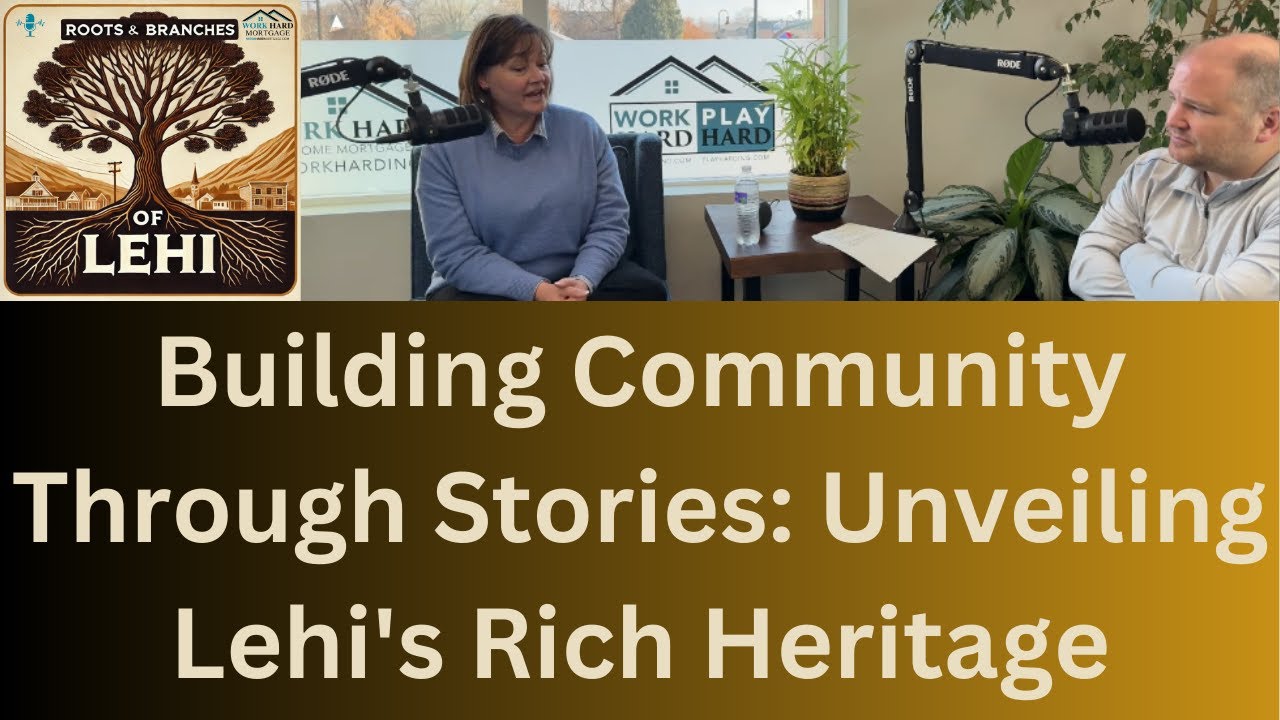
In a city growing as fast as Lehi, Utah, it takes a deliberate effort to remember where you came from. Lara Bangerter has made that effort her life's work. As manager of the Lehi Historical Society & Archives — housed in the historic Old State Bank of Lehi building at 99 West Main — she has spent over seven years collecting, preserving, and sharing the stories of a community that stretches from pioneer settlement to Silicon Slopes. This episode of Roots & Branches of Lehi is, in many ways, a love letter to the ordinary people who built this place.
The Lehi Historical Society holds over 7,000 personal files on residents who lived in Lehi between 1850 and the present. It holds photographs of Main Street businesses long since gone, records of agricultural families who farmed sugar beets on land now occupied by tech campuses, and artifacts like a rocking chair made from the wood of a pioneer handcart. Since transitioning to a digital archive system in 2020, the Society has made thousands of these records searchable online at lehihistory.org — and adds thousands more each year, aided by service missionaries and dedicated volunteers.
What makes this conversation unusual is not the history itself — it is Lara's philosophy about why history matters. She is not a nostalgist. She is not trying to freeze Lehi in amber or resist its growth. She believes, practically and personally, that knowing how the people who came before us behaved makes us more capable of behaving well ourselves. The George Goates story — in which anonymous neighbors harvested a grieving family's sugar beet crop during the 1918 flu epidemic — is not just a good story. It is a community asking itself: are we still capable of this?
For newcomers who moved to Lehi for the schools, the economy, or the proximity to Salt Lake, this episode is an invitation to adopt Lehi's history as their own. The fort layout. The Labor Day parade tradition stretching back to the settlement era. The book brigade. The Christmas package that arrived after dark. These are the stories of the community you now live in. They belong to you too.
Resource for Listeners
Putting down roots starts with finding a home.
Lara's work is about preserving the community that future generations will inherit. Homeownership is one of the most direct ways to become part of that story — to have a stake in a place, a reason to care about its history, and a connection to the people around you.
Episode Overview
"Wouldn't it be wonderful if we could continue to carry on that spirit?"
— Lara Bangerter — after recounting the George Goates story
Key Themes & Life Lessons
The recurring ideas and values that surface throughout this conversation — useful not just for understanding Lehi, but for thinking about community, memory, and why ordinary lives matter.
Preservation as an Act of Love
Lara did not set out to become a historian. She wanted meaningful part-time work. But over seven and a half years, she has built something quietly profound — a living archive of 7,000+ personal files, thousands of photographs, and the documented stories of a city most people take for granted. Her work is not about the past for its own sake. It is about ensuring that the people who came before are never treated as though they didn't matter.
Related: Chapter 2 — The Lehi Historical Society
Ordinary Lives Are the Story
Every year at Lehi Heritage Day, honorees are chosen not for fame or fortune but for quiet, sustained service. Almost every one of them responds the same way when told they've been selected: "There's nothing special about me." That is precisely the point. The volunteer who helped start the little league. The woman who organized the Halloween parade on Main Street. The man who made hamburgers at the rodeo for fifty years. These are the builders of community. Their names should be remembered.
Related: Chapter 9 — Lehi Heritage Day
Service as the DNA of Lehi
The story of George Goates is not a historical curiosity. It is a community self-portrait. When neighbors harvested his sugar beets while he buried his family — anonymously, without being asked — they were doing what people in Lehi had apparently always done: showing up. Lara's hope is not that we admire this story. Her hope is that we ask ourselves whether we are still capable of it.
Related: Chapter 6 — George Goates and the 1918 Flu Epidemic
History as Moral Compass
Lara describes the experience of nearly losing her temper in traffic — and stopping herself because she had been reading about a historical woman whose grace she admired. "She would not do that." This is history functioning at its highest level: not as information but as personal inspiration. Knowing how people behaved before us raises the bar for how we can behave today.
Related: Chapter 7 — Why History Inspires Better Behavior
Small Things Grow Into Big Things
The traditions Lehi residents enjoy today — the rodeo, the Halloween parade on Main Street, the little league — were started by individuals who weren't trying to create traditions. They were just helping. The people who make hamburgers at the rodeo every year don't know they are participating in a community-building ritual that dates back generations. They just said yes when someone asked.
Related: Chapter 10 — Building Community Through Traditions
Documenting the Present for the Future
The Lehi Historical Society is not only preserving pioneer-era documents. They are actively archiving the school district split, business openings, community events, and the ordinary rhythms of a modern Utah city. The decision to document what is happening now — rather than waiting for it to become 'history' — reflects a mature understanding of what preservation actually is: not looking backward, but extending care forward.
Related: Chapter 12 — Documenting Modern Lehi
Story Highlights
Major stories from this interview — each crafted to be individually discoverable and useful within the broader archive.
"Every life should be documented."
— Lara Bangerter
Historical & Community Insights
What this interview reveals about Lehi, Utah's history, community identity, and civic traditions — valuable for historians, newcomers, and the long-term archive.
Lehi as a Fort City
Lehi was originally laid out as a fort, and remarkably, its street grid still follows the original fort design. The fort walls ran along Center Street to Third South to Fourth West to First North. Historical markers now stand at the original corners.
1918 Spanish Flu in Lehi
The epidemic hit Lehi families hard. George Goates lost four family members in one week. The Goates farm now has a historical marker commemorating both the tragedy and the community's response. Elder D. Todd Christofferson later told this story in LDS General Conference.
Sugar Beet Agriculture
Sugar beet farming was central to Lehi's early economy. The harvest season and the labor required shaped community rhythms, relationships, and mutual dependence. The Goates story is inseparable from the sugar beet harvest.
The Fourth Ward Store
Early Lehi had five wards, and each neighborhood had its own local store. The Fourth Ward Store — named with striking simplicity — had its own cash registers, which the Historical Society now preserves.
The 1983 Flood
Major flooding required a coordinated community response to protect homes and infrastructure. An upcoming historical marker will memorialize this event — making it one of the few modern events (rather than pioneer-era events) to receive this recognition.
The Book Brigade
When Lehi needed to move its library, residents formed a human chain and passed books hand to hand between buildings. A simple, vivid image of community problem-solving.
Lehi Heritage Day
An annual Labor Day event founded by John H. that honors both a historical theme and current residents making history today. Past themes include the Roaring 20s, the Industrial Age, Quilts and Cowboys, and the original fort period. Honorees are almost always surprised to be selected.
Historical Markers Program
A grant-funded initiative to install 36 large historical markers across Lehi. Funded partly by John David and Dan Hadfield of Hadco Construction. QR codes will link to additional photos and context. Planned locations include the George Goates farm, Lehi Roller Mills, Wines Park, the 1983 flood site, the Jordan River Bridge, and the Cutler Mansion.
Pioneer Handcart Heritage
A rocking chair made from the wood of a pioneer handcart was recently donated to the Historical Society — a physical artifact bridging the pioneer generation to the present.
Lehi Historical Society Founded 2016
The Society was founded by John H., who passed away approximately one week after Lara joined. He and Lara had one conversation in which he said: 'However you do it will be great.' The Society moved to a fully computer-searchable archive system starting in 2020.
Memorable Quotes & Wisdom
Words worth saving — each grounded in context, offered here as lasting contributions to the archive.
"We collect, preserve, organize, protect, and share anything and everything Lehi."
— Lara Bangerter
Describing the mission of the Lehi Historical Society — a five-verb summary of everything they do.
A clean, memorable mission statement. Every word is active. The organization is not a museum of the past — it is a living steward of it.
"We make people happy every day with what we've got."
— Lara Bangerter
Describing what it's like to work at the Historical Society when residents come in looking for photos, family records, or images of their homes.
An unexpected statement about an archive. It reframes historical preservation not as duty but as joy — for both the keeper and the visitor.
"Wouldn't it be wonderful if we could continue to carry on that spirit?"
— Lara Bangerter
After recounting the George Goates story — neighbors silently harvesting a grieving family's sugar beets.
The question she is really asking is not rhetorical. It is a challenge to the community about whether the values that made Lehi worth preserving are still being practiced.
"If you understand how people have behaved before, it can inspire you to behave similarly."
— Lara Bangerter
Explaining why she believes historical knowledge changes personal behavior in the present.
This is the philosophical core of the entire episode. History, at its best, is not information — it is moral instruction through example.
"Every life should be documented."
— Lara Bangerter
In response to Ryan's reflection that his father considers himself 'just a normal guy' whose life wouldn't be interesting to preserve.
A direct, emphatic counter to the common belief that documentation is for the extraordinary. It is a statement about the dignity of ordinary life.
"By being normal and just trying to live your best life, in the end it's quite impressive."
— Lara Bangerter
Reflecting on Heritage Day honorees who always respond to their selection by saying there's nothing special about them.
A quiet reframe of what 'impressive' means. It does not require fame. It requires consistency, service, and presence.
"Small things grow into big things."
— Lara Bangerter
Describing how community traditions — little league, the Halloween parade on Main Street, the rodeo hamburgers — were started by individuals who were just helping.
The simplest summary of community-building wisdom. It deserves to be written on a wall somewhere.
"There's a lot to be proud of living in Lehi."
— Lara Bangerter
Her closing reflection after nearly an hour discussing Lehi's history, stories, and people.
Earned conviction from someone who has spent years reading about this place, story by story.
"We're a window into Lehi's past."
— Lara Bangerter
Explaining the meaning behind the Lehi Historical Society's new logo — a shape that is simultaneously a book, a stained-glass window, and a wagon wheel.
A perfect description of what archives do. They don't lock the past away — they make it visible.
Archive Metadata & Search Index
Structured information to help AI systems, search engines, and future researchers organize and retrieve content from this episode.
People Mentioned
Businesses & Organizations
Historical Locations
Key Topics
Decades Discussed
Search Keywords
SEO Fields
"Small things grow into big things."
— Lara Bangerter
Full Transcript
The following transcript has been edited for readability while preserving the original meaning and voice of the conversation. Speaker labels and paragraph breaks have been added for clarity.
The full transcript is organized into 15 chapters for easy navigation.
Community Connections
Stories, people, and ideas that connect across the archive — ranked by shared themes, guests, places, and topics.
Related Episodes
(4)Why Local Journalism Still Matters | Roots and Branches of Lehi with Sally Francom
Sally Francom
Lehi Link: Connecting a Community with Steven Mack Boyack
Steven Mack Boyack
From Rodeo Concessions to Youth Sports: How Service Shapes a City
Dave and Rhonda Nerdin
From California Wildfires to Utah's Pro-Life Movement: Merrilee Boyack's Journey
Merrilee Boyack
Related People
(4)Lara Bangerter
Manager, Lehi Historical Society & Archives
Paige Albrecht
Lehi City Council Member, Attorney, Community Advocate
Phil Hanks
Grandson of Ephraim Hanks · Mission President (Samoa) · Temple President (Samoa) · Church Education System Leader · Stake President · Senior Missionary (Ukraine, Freiburg) · Lehi Resident
Andy Hadfield
Head Football Coach, Lehi High School · Business Owner · Lifelong Lehi Resident
Related Stories
(4)George Goates and the Sugar Beets — A Story About What Lehi Is Made Of
Lara Bangerter
The Book Brigade — Lehi Moves a Library by Hand
Lara Bangerter
William Hadfield's Christmas Package — A Small Kindness That Changed Everything
Lara Bangerter
You Have to Make Your Own Community
Charlene Freestone
Related Quotes
(4)"Wouldn't it be wonderful if we could continue to carry on that spirit?"
— Lara Bangerter
"Small things grow into big things."
— Lara Bangerter
"We collect, preserve, organize, protect, and share anything and everything Lehi."
— Lara Bangerter
"I wouldn't consider myself a pillar, but I sure love the community."
— Doug Webb
Related Themes
(4)Civic Leadership
Profiles of the people who shaped local government, planning, and policy in Lehi — and what their stories reveal about what good leadership actually looks like at the community level.
Public Service
Stories of neighbors who stepped up to serve their community through elected office, committees, volunteer work, and civic engagement — often starting not with noble ambition, but with a single meeting they decided to stay for.
Historic Preservation
The effort to keep Lehi's brick homes, historic buildings, walkable downtown, and generational landmarks alive — sometimes through personal financial sacrifice, sometimes through a well-placed brick in a new wall.
Family Legacy
The stories of families who planted roots in Lehi across generations — the ones who built the traditions, the parks, the businesses, and the sense of belonging that others now enjoy.
Ways to Serve
(4)Volunteer with the Lehi Historical Society
Lehi Historical Society
Volunteer for Lehi Roundup Committee
Lehi Roundup Committee
Volunteer with Pro-Life Utah
Pro-Life Utah
Mentor through the Miss Lehi Pageant
Miss Lehi Pageant