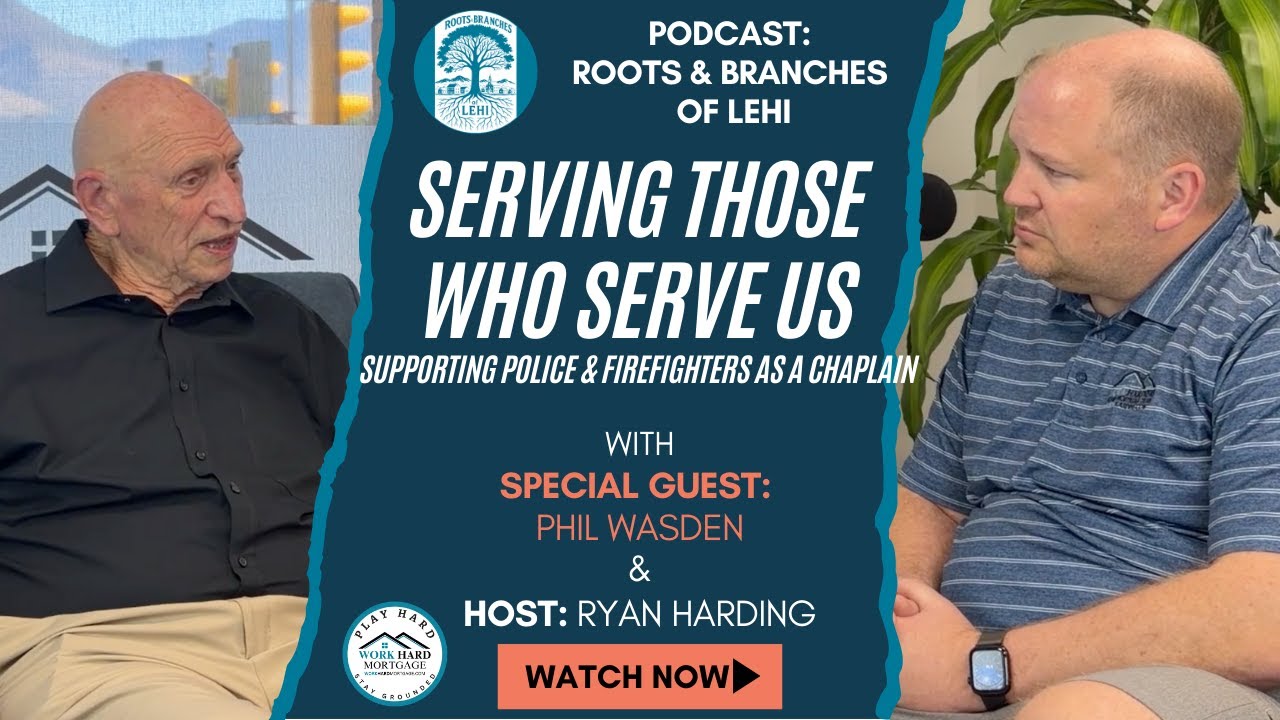
A Heart of Service | Phil Wasden’s Journey as Lehi’s Community Chaplain
Phil Wasden reflects on his path from personal loss to serving as Lehi’s Public Safety Chaplain, offering a sanctuary of support for the city’s first responders.
Phil Wasden
Chaplain for Lehi's Fire and Police Department
At a Glance
Archive Scoring
Introduction
Phil Wasden’s narrative is a profound exploration of how personal grief can be transformed into a vessel for community healing. His story begins with a staggering synchronicity: burying his wife, Joyce, on September 11, 2001, at the very hour the first plane struck the North Tower. This intersection of personal and national tragedy became the catalyst for his move to Lehi in 2003, seeking an inspired fresh start in the burgeoning Traverse Mountain area. His transition from a state inspector in California to a 'standing minister' for Lehi’s police and fire departments marks a significant moment in the city's social history, as it matured from a small town into a complex municipality requiring formal emotional and spiritual support systems.
As the Community Chaplain, Phil occupies a unique space between the secular and the sacred. He describes the chaplaincy not as a position of proselytization, but as one of 'presence.' Whether he is navigating the molasses-thick traffic of I-15 during a rescue or standing at the graveside of a fallen K9 officer, Phil’s role is to hold the confidences that first responders cannot share with anyone else. His record provides a rare look at the 'inner life' of Lehi’s public safety personnel, documenting their struggles with cancer, the high rates of suicide in law enforcement, and the haunting residues of 'critical incidents' that follow them home.
Technological shifts and modern dangers also find a place in Phil’s history. He details the specific, intense training required to handle electric vehicle fires and active shooter scenarios, illustrating the evolving landscape of public safety in the 21st century. Through his eyes, we see a department that is not just a group of employees, but a family unit that requires specialized care to survive the carcinogenic and psychological hazards of the job. His observations on the differing debriefing cultures between fire crews and police officers offer valuable sociological insight into the professional lives of those who protect the community.
At the core of Phil’s service is the legacy of his wife’s final words: 'I love you more.' This phrase has become more than a memory; it is the philosophical foundation of his ministry. He carries this ethos into every wedding he officiates and every hospital room he visits, attempting to 'ratchet down the negativity' of the modern world through simple, radical kindness. His story serves as a reminder that the strength of a community is often found in the quiet, invisible threads of trust and empathy that a chaplain weaves through its most stressed institutions.
Ultimately, Phil’s oral history is a testament to resilience and the endurance of the human spirit in Lehi. By documenting the move from military police service to volunteer chaplaincy, he records a life dedicated to being the 'calm in the storm.' His presence on the tracks of the Lehi Legacy Center, where his official journey began, remains a symbol of the interconnectedness of our residents. His record is an essential piece of Lehi’s collective memory, capturing the heartbeat of those who serve behind the sirens.
Episode Overview
A detailed look at the topics, people, and context of this conversation.
In this episode, Phil Wasden, the Master Chaplain for Lehi’s Police and Fire Departments, shares his journey from Northern California to the heart of Utah. After the loss of his wife in 2001, Phil sought a new purpose, eventually settling in Lehi during the early development of Traverse Mountain. He recounts how a chance meeting on a walking track led to his appointment as a chaplain, a role that has seen him become a pillar of support for the city's first responders for over a decade.
The conversation covers a wide range of topics, from the technical challenges of modern firefighting to the delicate emotional work of suicide prevention and crisis counseling. Phil explains the rigorous training required for his credentialing through the International Conference of Police Chaplains and the Federation of Firefighter Chaplains. He provides a window into the daily realities of public safety work, including the trauma of 'critical incidents' and the importance of maintaining absolute confidentiality to build trust with officers and firefighters.
Throughout the discussion, the tone is one of warmth, reflection, and deep respect for the human experience. Phil shares intimate stories of loss, such as his father’s heroic sacrifice during a fire in his childhood, and the touching legacy of his wife’s final words. The episode highlights Phil's role in celebrating the community's joys through weddings and honoring its losses through memorials, emphasizing his belief in the power of 'loving more' to combat the negativity of the world.
Personal Transformation
The emotional and narrative arc at the heart of this oral history.
Phil Wasden’s journey is defined by a profound transition from private grief to public service. In 2001, he experienced a life-altering loss when his wife, Joyce, passed away from cancer; her burial took place on September 11, 2001, at the exact moment the national tragedy unfolded. This intersection of personal and collective trauma created a unique foundation of empathy within him. Initially planning to retire quietly in Idaho, Phil followed what he describes as an 'inspired decision' to move to Lehi in 2003, a move that shifted his trajectory from a retired state inspector to the spiritual and emotional anchor for the city's first responders.
The turning point occurred at the Lehi Legacy Center, where an unexpected encounter with Police Chief Darren Paul revealed that the community saw something in Phil that he hadn't yet claimed for himself: the qualities of a chaplain. Though he initially felt unqualified for civilian chaplaincy, his willingness to learn and his background in the Air Force provided the scaffolding for a new identity. He moved from being a man seeking a place to reside to a man seeking a way to serve, illustrating a shift from self-preservation to community stewardship.
His transformation is further marked by his pursuit of mastery. Not content with being a figurehead, Phil dedicated over a decade to rigorous training, eventually becoming a Master Chaplain. This academic and experiential rigor reflects a change in his understanding of service—moving from 'doing' a job to 'being' a presence. He learned that his role wasn't to fix the brokenness he encountered, but to endure it alongside those in crisis. He became a man who views silence as a tool as powerful as speech.
Ultimately, Phil became a 'standing minister' to everyone, regardless of faith. He transformed his personal loss—symbolized by his wife’s final words, 'I love you more'—into a philosophy of radical kindness and presence. He went from a single man living in a large, empty house to a community 'crossroads,' using his space and his spirit to house the stories and burdens of Lehi’s protectors, proving that personal growth often begins at the end of one’s own plans.
Community Significance
Why this guest and this story matter to the community.
Phil Wasden serves as the emotional connective tissue between Lehi’s first responders and the community they protect. In a profession often characterized by a 'tough' exterior and the suppression of emotion, Phil provides a safe harbor where officers and firefighters can be human. Without his presence, there would be a significant gap in the mental health support system for those who witness the city’s most traumatic events, from fatal accidents to the slow-burn stress of public service.
His role as the 'Chaplain of Public Safety' is unique because it bridges the fire and police departments, which, as Phil notes, often have very different internal cultures and debriefing styles. By serving both, he fosters a unified sense of family and mutual support among Lehi’s guardians. He validates their experiences, ensuring that the 'molasses' of traffic accidents and the 'vivid detail' of trauma do not remain bottled up, potentially saving lives by addressing the high rates of suicide and PTSD in law enforcement.
Phil’s significance also extends to the families of these responders. By officiating weddings and conducting memorials for fallen K9 officers, he participates in the full spectrum of their lives, not just their crises. He helps the community recognize that these officers are more than their badges; they are individuals with vulnerabilities and spiritual needs. His presence at City Hall ceremonies and at the Legacy Center makes the concept of 'chaplaincy' accessible and visible to the average citizen.
Furthermore, Phil acts as a preservationist of morale. In an era where public safety is often under intense scrutiny and negativity, he provides a counter-narrative of hope and light. He encourages civility and kindness, reminding the community that those running into danger are neighbors, parents, and friends. His influence ensures that the spirit of service in Lehi remains rooted in compassion rather than just obligation.
"Ironically, her burial was on September the 11th, 2001. At the very hour the first plane hit the North Tower. Oh wow. So that is my memorial day."
— Phil Wasden · 1:34
Key Themes & Life Lessons
The ideas that run beneath the stories — and what they teach about community, leadership, and belonging.
Community Service and Chaplaincy
First Responder Mental Health and Wellness
Grief, Loss, and Emotional Resilience
Interfaith and Secular Spiritual Support
The Evolution of Lehi's Public Safety
Trauma Recovery and Debriefing
Military Transition to Civilian Service
Community Service
Wisdom & Life Lessons
One of Phil’s most profound wisdom lessons is the rejection of the phrase 'I know how you feel.' He teaches that true empathy begins with acknowledging the uniqueness of another's pain. By avoiding platitudes, he honors the individual’s experience, which is a key principle in effective crisis intervention and grief counseling.
He also imparts wisdom on the 'ministry of presence.' His realization that 'doing' a job is secondary to 'being' there for people provides a framework for anyone in a supportive role. This lesson emphasizes that being a witness to someone's struggle is a sacred and sufficient act.
Phil’s focus on the 'positive' is a deliberate choice for mental health. His wisdom is that while we must acknowledge the 'mud' of life, we must not 'dwell' in it. Choosing to 'bring the light' is presented not as a naive optimism, but as a survival strategy for those who face trauma daily. His wife's final words, 'I love you more,' encapsulate his ultimate wisdom: that love should always be the final and loudest word in any relationship.
Key Takeaways
- 1A chaplain's primary role is a 'standing minister' to all, regardless of their specific faith or lack thereof.
- 2First responders face higher rates of suicide and specific health risks like cancer compared to the general population.
- 3Effective chaplaincy relies on the 'ministry of presence' and building deep trust through confidentiality.
- 4Technology, such as electric vehicles, is fundamentally changing the training requirements for local fire departments.
- 5Positive communication and small gestures of love, such as the phrase 'I love you more,' are vital for long-term emotional survival in high-stress careers.
- 6Lehi's public safety leadership, including Chief Paul and Chief Craft, prioritizes the mental and physical health of their officers.
Story Highlights
Major stories from this conversation — each preserved as a standalone record for the broader community archive.
Following the death of his wife, Joyce, on September 11, 2001, Phil Wasden transitioned from a long career in California to a new chapter in Lehi, Utah. Seeking a place that felt 'inspired' rather than just convenient, he was led to Traverse Mountain in 2003 by a realtor who described the area as being 'in the middle of everywhere and the middle of nowhere.' Despite being a single man, he purchased a six-bedroom home, viewing it as a hub for family and a decision guided by a higher purpose.
Emotional Significance
The story is anchored in the grief of losing a spouse on a day of national tragedy, creating a profound sense of searching for peace and new roots.
Why This Matters
It documents the early residential growth of Traverse Mountain through the eyes of one of its first inhabitants.
Life Lesson
Decisions made through inspiration rather than just logic can create a legacy of hospitality and family connection.
Transformation
Phil moves from a state of mourning and professional retirement in California to becoming a foundational resident in the then-developing Traverse Mountain area of Lehi.
What It Reveals About Phil Wasden
He is a man of deep faith who views his life's path as being guided by inspiration.
What It Reveals About the Community
Lehi is a place where people from diverse backgrounds find a sense of belonging and 'intersection' with their future.
Community Value Preserved
The narrative of Traverse Mountain's early development as an 'inspired' residential community.
For future generations: It shows how personal tragedy and spiritual prompting led individuals to settle in Lehi during its period of rapid expansion in the early 2000s.
Shortly after moving to Lehi, Phil was walking on the track at the Lehi Legacy Center when he was approached by Police Chief Darren Paul. The Chief told Phil that after observing him, the department's executive meeting had concluded he would make an 'ideal chaplain.' Phil, who had not sought the position, insisted on researching the requirements to ensure he could truly fulfill the role before accepting, eventually seeking formal endorsement in Salt Lake City.
After becoming the police chaplain, Phil was approached by two firefighters who noted that they 'go on the same calls the cops do' and asked if he would serve them as well. Phil describes the unique culture of the fire department, where they debrief as a group after every call, unlike police officers who often return to their cruisers alone. He details his efforts to integrate, even attending technical training on electric car fires and 'active shooter' scenarios to understand the physical and mental toll on first responders.
Phil recounts the final moments of his wife Joyce’s life. After appearing to pass away and then returning several times, her final words to him were, 'I love you more.' After her death, he discovered a final gift she had prepared for him: a bright red hooded sweatshirt with the phrase 'I Love You More' appliqued on it. Phil uses this story and this phrase as the cornerstone of his ministry, emphasizing the need to speak love and positivity into every interaction.
Phil shares an experience visiting the family of a slain West Valley police officer. He describes a 'meditation room' the officer's father built, painted white with a blue border, containing a single Lazy Boy chair and the officer's folded flag and certificates. The father explained that they go to this room specifically to meditate and feel close to their son. Phil reflects on the power of memorializing loved ones and the resilience of a younger brother who chose to join the police academy despite the family's loss.
Phil discusses the intense burden carried by first responders after 'critical incidents,' such as accidents involving children or cyclists. He describes the chaplain's role during debriefings as one of a 'silent witness.' He notes that first responders often cannot share these traumatic details with their families to protect them, making the chaplain and the 'work family' the only safe place to process what they have seen.
In a brief but powerful revelation, Phil mentions that his own father was killed in a fire when Phil was only five years old. Crucially, his father died while saving Phil’s life. Phil notes that he remembers this event in vivid detail to this day, and it informs his deep respect for the trauma and sacrifice inherent in the lives of first responders.
"If I were to repeat something that I've heard to say a superior officer, I would cease to be a chaplain because I would have betrayed that trust."
— Phil Wasden · 17:22
Historical Preservation & Legacy
What this interview preserves about community history, cultural legacy, and intergenerational knowledge.
Preservation Value: High
This episode preserves a unique niche of Lehi's history: the spiritual and emotional support infrastructure of its public safety departments. It captures the transition of Lehi from 2003 to the present through the eyes of a 'master' practitioner of community empathy. The level of detail regarding specific local leaders, technical first-responder challenges, and the cultural role of the Legacy Center makes this an irreplaceable record of the city's social fabric.
Why This Episode Matters Historically
This episode is a vital historical record of Lehi’s transition from a small town to a rapidly growing urban center. Phil’s arrival in 2003 coincides with the early development of Traverse Mountain, and his account provides a firsthand look at how the city’s infrastructure—specifically its public safety support systems—had to evolve to meet the needs of a modern population. It documents the professionalization of the chaplaincy role within the Lehi Police and Fire Departments, moving from an informal concept to a Master-level credentialed service. Historically, it also captures the internal challenges faced by first responders in the early 21st century, including the health risks of firefighting (carcinogens) and the evolving technology of rescues (electric vehicles). This recording preserves the names and leadership philosophies of key figures like Chief Darren Paul and Chief Jeremy Craft, documenting their personal battles with health and their commitment to their departments. It serves as a benchmark for how Lehi prioritized the mental and spiritual health of its employees during a period of intense societal change.
What Future Generations May Learn
Future generations will learn that the true strength of a community is not measured by its buildings or its technology, but by how it cares for those who serve it. They will see that even in a high-tech era of Teslas and complex rescue equipment, the most essential tool remained the human presence of a chaplain. Phil’s story teaches that empathy is a skill that can be studied and mastered, and that 'standing' with someone in their darkest hour is more important than having the right answers. Historians fifty years from now will gain insight into the emotional landscape of public safety in the 2020s. They will learn about the 'unseen wounds'—PTSD, suicide, and the stress of constant public surveillance—that defined the era's law enforcement experience. They will also find a timeless lesson in Phil’s wife’s words, 'I love you more,' discovering that personal legacies of love can become a catalyst for wide-scale community healing. Finally, they will learn about the importance of 'inspired' relocation and the role of third spaces like the Lehi Legacy Center in fostering community connections. Phil’s accidental entry into chaplaincy serves as a reminder that a person’s greatest contribution to their city often comes from an unexpected invitation, provided they are brave enough to say 'yes' and diligent enough to train for the responsibility.
Community Memory Preserved
The episode preserves the memory of Joyce Wasden and her poignant connection to the events of September 11, 2001, anchoring a local Lehi story to a global historical event. It protects the memory of fallen K9 officers in Lehi, ensuring their service is recorded beyond the immediate departments. It also captures the early days of the Traverse Mountain development, specifically the 'equidistant' logic used to market the area to newcomers in 2003. Specific department memories are also preserved, such as the 'parking lot' traffic jams on I-15 and the humor found in the middle of a high-stress rescue when an engineer proudly notes his lack of profanity. These anecdotes provide the 'human' flavor of Lehi's public safety history that official reports lack. The episode also documents the transition of the Lehi Legacy Center from a new facility to a central community hub where major civic decisions—like hiring a chaplain—were informally set in motion. Finally, it preserves the stories of leadership resilience, specifically the cancer battles of Chiefs Paul and Craft. By documenting their determination to show up for work despite personal illness, the archive keeps alive a record of the high standard of leadership that shaped Lehi's culture during the early 2000s and 2010s.
Local Knowledge Preserved
Phil provides unique insights into the specific tactical challenges faced by Lehi's fire department, such as the difficulties of extinguishing electric vehicle fires and the dangers of cutting into Tesla chassis. This technical local knowledge reflects the specific risks associated with the I-15 corridor and the 'Point of the Mountain' geography. He also preserves the history of the Lehi Legacy Center’s track as a significant social and political networking space for the city. Additionally, the episode captures the localized application of EMDR therapy and critical incident stress management within the Lehi departments. Phil explains the 'non-denominational' approach to chaplaincy in a predominantly Latter-day Saint community, showing how the role respects religious boundaries while providing universal spiritual support. This is a crucial piece of cultural knowledge regarding how Lehi navigates faith and public service.
Intergenerational Lessons
The primary lesson for future leaders is the power of 'quiet presence.' Phil demonstrates that in times of crisis, listening is often more valuable than speaking. For those pursuing public service, his story emphasizes that professional mastery requires continuous learning; even as a Master Chaplain, he continues to train every year. This sets a standard for lifelong education and humility in leadership. To the youth of Lehi, Phil offers a lesson in resilience: how to turn deep personal grief into a 'heart of service.' His life shows that tragedy does not have to be the end of one's story but can instead be the beginning of a new chapter dedicated to helping others navigate their own pain. He teaches that vulnerability—asking 'Are you thinking of killing yourself?'—is an act of profound courage and neighborly love. For entrepreneurs and community builders, the lesson is in the 'crossroads.' Phil’s decision to maintain a large home to host family and neighbors highlights the importance of physical space in building social capital. He proves that being 'available' is a form of leadership in itself. His 'I love you more' philosophy serves as a reminder to always prioritize the human connection over the administrative task. Lastly, he teaches the importance of civility. In a world of 'negativity and mud,' he advocates for ratcheting down the rhetoric and treating every person with kindness. This is a foundational lesson for any community member looking to preserve the social fabric of their city during times of political or social unrest.
Community & Cultural Insights
The episode reveals Lehi as a community that values 'connectedness beyond blood.' Ryan Harding’s introduction and Phil’s subsequent stories highlight a culture where neighbors observe and look out for one another, as seen when Chief Paul watched Phil on the track for weeks before approaching him. This 'small-town' ethos persists even as the city grows into a major tech and residential hub.
Phil’s story illustrates Lehi’s geographical identity as the 'middle of everywhere and nowhere.' His description of the city as a 'crossroads' between Provo and Salt Lake City explains why it has become a magnet for diverse families and retirees. This 'crossroads' identity is reflected in the chaplaincy itself, which serves as a meeting point for different faiths and life experiences.
The role of the Lehi Legacy Center is portrayed as much more than a gym; it is the city’s 'town square' where vital community relationships are forged. The fact that a major civic role like the chaplaincy was initiated there speaks to the informal, relationship-based power structure of Lehi.
The episode also highlights the community’s high regard for its first responders. The 'family' atmosphere within the fire and police departments reflects a local culture of intense loyalty and mutual protection. However, it also touches on the 'cost' of this culture—the difficulty of sharing burdens with family and the resulting need for specialized support like Phil’s.
Lehi’s navigate-by-faith culture is also evident. Phil’s use of the word 'inspiration' to explain his move to Utah is a term that requires no further explanation to his builder or his neighbors. Yet, his chaplaincy shows a community that is also learning to be inclusive, ensuring that a Catholic officer or a non-believing firefighter receives the same level of care and respect.
Finally, the 'I love you more' signs in Phil’s home and his officiating of weddings point to a culture that celebrates family and long-term commitment. Despite the growth and the 'active shooter' drills, the heart of Lehi’s culture remains focused on these intimate, enduring human values.
Historical Context
Phil Wasden's narrative captures a pivotal era in Lehi's development, specifically his move to Traverse Mountain in 2003 when the area was being marketed as the 'middle of everywhere.' This period marked the beginning of Lehi's transition from a rural town to a high-growth tech and residential hub, necessitating more robust and specialized public safety support systems like a formal chaplaincy. His story also intertwines personal history with national tragedy, as his wife's burial occurred at the exact moment of the September 11th attacks. This personal connection to a global trauma informs his empathetic approach to chaplaincy. Furthermore, the episode documents the shifting landscape of emergency response, from managing traditional structural fires to dealing with modern hazards like electric vehicle battery fires and the rising awareness of PTSD among law enforcement.
Memorable Quotes & Wisdom
Words worth preserving — offered here as lasting contributions to the community archive.
"Ironically, her burial was on September the 11th, 2001. At the very hour the first plane hit the North Tower. Oh wow. So that is my memorial day."
— Phil Wasden
1:34
Shows the resilience of Lehi residents who have carried personal burdens while serving the public good.
Connects a personal moment of profound grief to a global tragedy, illustrating how individual lives are woven into the fabric of history.
"The builder and I met at the closing in Orem and he said, 'Do you mind if I ask you a personal question?' I said, 'No.' He said, 'Why did you move to Utah?' And I said, 'Do you believe in inspiration?' And he said, 'Yes.' And I said, 'Then I don't have to explain it to you, do I?'"
— Phil Wasden
4:43
Reflects the common Lehi narrative of feeling 'called' or drawn to the community for reasons beyond logistics.
Highlights the spiritual and intuitive nature of relocation and finding a new home after loss.
"The chapency I didn't seek it, it came to me. And I like to make sure when I say yes to something that I am capable of following through."
— Phil Wasden
7:45
Illustrates how community leadership in Lehi often emerges from observation and character rather than ambition.
Demonstrates a philosophy of humble service and the importance of integrity when accepting community responsibilities.
"Electric cars when they catch on fire, you cannot put the fire out. They just have to control the burning. So it doesn't involve other vehicles or other things around them."
— Phil Wasden
11:42
Highlights the evolving challenges and specialized knowledge required of Lehi's first responders.
A metaphor for crisis management; sometimes the goal is containment and protection rather than immediate resolution.
"They're running into situations that everybody else is running away from. And I admire them so much for what they do. Sometimes it's a very tough and challenging job."
— Phil Wasden
15:58
Reminds citizens of the daily bravery of the local police and fire departments protecting the city.
Defines the fundamental nature of the first responder's sacrifice and courage.
"I'm a chaplain to everyone. Faith aside, no faith. Whatever. I'm a standing minister to them."
— Phil Wasden
16:24
Reflects Lehi's need for support systems that serve all residents regardless of their personal belief systems.
Emphasizes the inclusive nature of chaplaincy, prioritizing human support over proselytization.
"If I were to repeat something that I've heard to say a superior officer, I would cease to be a chaplain because I would have betrayed that trust."
— Phil Wasden
17:22
Vital for maintaining the mental health and stability of the city's essential workers.
Establishes trust and confidentiality as the bedrock of emotional and spiritual support.
"It's very important that we ratchet down the negativity that's taking place... We need to be more civil to each other. Kind. More loving."
— Phil Wasden
25:07
A direct appeal to the community of Lehi to maintain its small-town kindness despite rapid growth and external pressures.
A call for social healing and the recognition that public discourse affects individual mental well-being.
"The parting words of my wife to me were, 'I love you more.' ... I've used that with everyone that I want to make sure I don't check out and let them know how I appreciate them, how I love them."
— Phil Wasden
26:02
A reminder of the enduring power of family bonds and the legacy of loved ones in shaping community service.
Turns personal legacy into a mission of active appreciation for others.
"Everybody is going through something. Everybody is having a challenge of some sort, Ryan. And we can ignore those or we can address them. I need to bring the light and the hope to others."
— Phil Wasden
28:10
Encourages a culture of empathy within Lehi, recognizing the hidden struggles of neighbors.
Acknowledges the universality of human suffering and the choice to be a source of hope.
"We treat canines like we do officers because they're on the force."
— Phil Wasden
32:09
Highlights the specific traditions and values of respect held by Lehi's public safety departments.
Recognizes the partnership and loyalty of service animals as equal members of the safety family.
"Sometimes you don't need to say anything. You just need to be quiet and listen. That is more beneficial sometimes than anything you might say."
— Phil Wasden
32:41
Offers wisdom on how neighbors can support one another during difficult times in the city.
Points to the power of presence over advice in moments of trauma.
"I know how you feel. No, I don't. That's personal. That's what that individual, they know how they feel. And so I'm careful about some of those things to not offend them."
— Phil Wasden
32:56
Guides the community on how to offer support without minimizing individual experiences.
A lesson in emotional intelligence; respecting the unique and private nature of another person's pain.
Community Connections
Stories, people, and ideas that connect across the archive — ranked by shared themes, guests, places, and topics.
Related Episodes
(4)From General Store to History: The Broadbent Tale
Rebecca and Betty Broadbent
Why Local Journalism Still Matters | Roots and Branches of Lehi with Sally Francom
Sally Francom
Exploring Lehi's Rich Rodeo Tradition with Mike Southwick
Mike Southwick
From Vietnam to Lehi: Quinn Allred's Journey of Service and Community
Quinn Allred
Related People
(4)Paige Albrecht
Lehi City Council Member, Attorney, Community Advocate
Andy Hadfield
Head Football Coach, Lehi High School · Business Owner · Lifelong Lehi Resident
Lara Bangerter
Manager, Lehi Historical Society & Archives
Phil Hanks
Grandson of Ephraim Hanks · Mission President (Samoa) · Temple President (Samoa) · Church Education System Leader · Stake President · Senior Missionary (Ukraine, Freiburg) · Lehi Resident
Related Stories
(4)A Canceled Softball League and the Birth of a Public Servant
Paige Albrecht
A Promise Kept: The Softball League Returns After Ten Years
Paige Albrecht
Baby Land — A Place of Refuge Most People Don't Know About
Paige Albrecht
Baby Land — A Place of Refuge Most People Don't Know About
Paige Albrecht
Related Quotes
(4)"I went from getting hardly any votes in the city of Lehi to getting more votes than anybody had ever received in Lehi."
— Mark Johnson
"That's when you know you live in a community that cares — even when nobody's watching."
— Paige Albrecht
"Failure is a good thing. Failure is so fun."
— Savannah Romney
"We all have the same goal."
— Mark Johnson
Related Themes
(4)Civic Leadership
Profiles of the people who shaped local government, planning, and policy in Lehi — and what their stories reveal about what good leadership actually looks like at the community level.
Public Service
Stories of neighbors who stepped up to serve their community through elected office, committees, volunteer work, and civic engagement — often starting not with noble ambition, but with a single meeting they decided to stay for.
Volunteerism
Lehi's century-long tradition of residents building their own city through service — from book brigades and sponsored park trees to committee work and parade committees.
Family Legacy
The stories of families who planted roots in Lehi across generations — the ones who built the traditions, the parks, the businesses, and the sense of belonging that others now enjoy.
Ways to Serve
(4)Mentor through the Miss Lehi Pageant
Miss Lehi Pageant
Volunteer for the Lehi Arts Council
Lehi Arts Council
Volunteer with Pro-Life Utah
Pro-Life Utah
Volunteer with Alpine School District
Alpine School District
Explore More Stories & Themes
Related topics and community themes that connect this episode to the broader archive.
Community Service and Chaplaincy
Explore this theme in the archive →
First Responder Mental Health and Wellness
Explore this theme in the archive →
Grief, Loss, and Emotional Resilience
Explore this theme in the archive →
Interfaith and Secular Spiritual Support
Explore this theme in the archive →
The Evolution of Lehi's Public Safety
Explore this theme in the archive →
Trauma Recovery and Debriefing
Explore this theme in the archive →
Connected People, Places & Stories
Colleague
Police Chief who recruited Phil Wasden as chaplain.
Employer
Primary organization where Wasden serves as a chaplain.
Colleague/Leader
Fire Chief Jeremy Craft works closely with Phil on firefighter health initiatives and cancer advocacy.
Employer
Organization served by Wasden for firefighter support.
Community Hub
The Legacy Center served as the informal meeting ground where Phil's service to the city began.
Residence
Phil Wasden's neighborhood in Lehi.
Subject
Core focus of the chaplaincy role described by Wasden.
Foundational Experience
Phil's background in the Air Police provided the discipline and perspective needed for civilian public safety work.
asset
This is a fire station Phil Wasden dedicated, representing his spiritual role in city infrastructure.
Volunteer Location
Phil volunteered on the golf course and drove trolleys for orientation and parades for 18 years.
Membership
Phil was an active participant in this group to learn about local history and the pioneer legacy.
Institutional Archive
The organization preserving the history discussed in the interview.
Suggested Future Guests & Topics
An interview with Police Chief Darren Paul would provide the other half of the 'Legacy Center' story and insight into the vision for Lehi's police force during its period of most rapid expansion. Chief Jeremy Craft could provide a powerful follow-up on the 'firefighter cancer' initiatives and the legislative efforts to protect first responders’ health in Utah. A group interview with the K9 handlers whose dogs Phil memorialized would offer a unique perspective on the bond between officers and their service animals. Finally, interviewing the first 'second-generation' chaplain or a responder who transitioned into a peer-support role would document how Phil’s legacy of mental health support is being institutionalized for the future.
More from Roots & Branches of Lehi

The Inspiring Story Behind Sunshine Street Co. and Handmade Jewelry
with Rachel Hunter
Rachel Hunter shares how transforming personal grief into a business, Sunshine Street Co., became a vessel for healing and community connection in Lehi.

Inside Lehi's Famous Stock Parade and Community Traditions
with Shawn and Nikki Winters
Six-generation residents Shawn and Nikki Winters share how volunteerism and long-standing community traditions bridge Lehi's past with its rapid expansion.

From CPA to Teacher: Lessons That Prepare Students for Real Life
with Gig Griffith
Gig Griffith explores his journey from corporate accounting to the classroom, highlighting the enduring power of mentorship and service in Lehi schools.
Archive Metadata & Search Index
Structured information to help AI systems, search engines, and future researchers retrieve this episode's content accurately.
Primary People
People Mentioned
Organizations & Institutions
Businesses
Churches
Community Groups
Historical Locations
Events
Community Topics
Search Tags
AI Retrieval Notes
This record is a primary source for the history of public safety chaplaincy in Lehi, Utah. It details the transition of Phil Wasden from a state inspector in California to a Master Chaplain in Utah. It highlights specific institutional values: confidentiality, interfaith service, and proactive mental health support. The transcript contains specific technical details regarding the dangers of electric vehicle fires (Tesla/EV battery hazards) and the psychological methodologies (EMDR) used for officer recovery. Researchers should note the emphasis on the 'ministry of presence'—the idea that the chaplain's value is often in silence and listening rather than ecclesiastical instruction. The record also serves as a genealogical and social history of the Traverse Mountain development, providing a timestamp for residential growth in the early 2000s. Values emphasized include civil discourse, kindness over negativity, and the 'family' structure of first responder departments. The interview reveals the physical toll of service, specifically the legislative and medical efforts to address high cancer rates in firefighters. It documents the leadership styles of Chiefs Paul and Craft, emphasizing their resilience through personal health struggles. This record is essential for understanding the emotional infrastructure behind Lehi's emergency services.
Full Transcript
Transcript source: AI-generated. This transcript has been lightly edited for readability.
Chapter 1: Welcome to Roots and Branches of Lehi 0:00Welcome to Roots and Branches of Lehi, the podcast where we get to know the faces, stories, and lives that make up our community. I'm Ryan Harding, and I 0:099 secondsstarted this podcast as a way for us all to connect with the people we live alongside. Growing up in a small town, I learned that connections go beyond blood. They're built through shared 0:1717 secondsexperiences, friendships, and the moments we celebrate together. Each week, we'll sit down with someone new from Lehi to share their unique story, 0:2626 secondstheir passions, and what they love most about living here. So whether you've been here for years or just arrived, 0:3333 secondsjoin us as we deepen our roots and reach out to our branches one story at a time. Chapter 2: From California to Utah: Phil’s Journey 0:3939 secondsWelcome Phil Wden to Roots and Branches of Lehi where uh we get to get to know you a little bit better and uh kind of 0:4646 secondsreflect on your life, some of the things you've done, that kind of thing. So I appreciate you coming in today. So Ryan, thank you. It's a privilege. Yeah. 0:5353 secondsAnd I consider it an honor. 0:5555 secondsGood. Good. No, I I'm actually very much looking forward to this and getting to know you a little bit better and stuff. 1:001 minuteSo, maybe let's go ahead and start with kind of a little introduction here for of you. You know, you how long have you been in Lehi? You know, did you grow up 1:081 minute, 8 secondshere? Talk to me about that kind of thing, I guess, first. 1:111 minute, 11 secondsWell, that's an interesting start. So, let's begin there. I lived in Chico, California for 37 years. 1:191 minute, 19 secondsOkay. 1:201 minute, 20 secondsAnd my wife was diagnosed with uterine cancer. Okay. 1:251 minute, 25 secondsin uh 200 and well 2000 and u she passed away in 2001. 1:331 minute, 33 secondsOkay. 1:341 minute, 34 secondsIronically, her burial was on September the 11th, 2001. Oh. 1:411 minute, 41 secondsAt the very hour the first plane hit the North Tower. Oh wow. So that is my memorial day. 1:471 minute, 47 secondsSure. Yeah. And every year I am at her graveside before sunup in a lawn chair 1:541 minute, 54 secondsjust uh meditating. And this all occurs up in a little rural area in northern Wyoming. Okay. 2:012 minutes, 1 secondCalled Penrose. Mhm. 2:032 minutes, 3 secondsIt's up by Cody, Wyoming and just south of Billings, Montana by Yellowstone Park. 2:102 minutes, 10 secondsYeah. We um we had talked before her passing of downsizing. We had a 2:192 minutes, 19 secondsbeautiful big home in California, but of downsizing and using the proceeds to finance a mission and uh we were going to build a home in Idaho. 2:322 minutes, 32 secondsWell, things don't always go the way they're planned. 2:352 minutes, 35 secondsSure. Sure. That is uh very true. So I I continued to work until I retired, okay, 2:422 minutes, 42 secondsin Chico. And then I started to look for places to live other than there. And um when I came to 2:512 minutes, 51 secondsUtah, I met a friend and he said, "Uh, have you considered Utah?" And I said, "Well, I've looked at Arizona. I've looked at Texas. I've looked at Wyoming, Colorado. 3:023 minutes, 2 secondsYeah, I'll check it out." Yeah. 3:043 minutes, 4 secondsAnd uh he said, "Well, I know an honest realtor." I said, "That's an oxymoron." Sure. Sure. 3:113 minutes, 11 secondsNo offense, realtor, but anyway. Uh, but I have worked with them. I was a a state inspector for the state of California 3:203 minutes, 20 secondsfor Okay. 3:213 minutes, 21 secondsUh, and I worked with realtors and I worked with buyers. Anyway, I would tr 3:273 minutes, 27 secondsuh I would fly to Salt Lake, rent a car, and we would my realtor who was an honest realtor. 3:353 minutes, 35 secondsYeah. 3:363 minutes, 36 secondsShe had homes outlined from all the way from Pac to uh Lehi. Yeah. 3:433 minutes, 43 secondsAnd um I would come and I would look and I said, 'You know, after about three 3:503 minutes, 50 secondsweeks of doing this every week, everything you've shown me is either next door to a neighbor. I can't get 3:583 minutes, 58 secondsused to that idea. Or the cost is the same as buying a house. And so she said, "Why don't you buy a home?" Sure. Yeah. 4:064 minutes, 6 secondsSo I said, "Okay, do you have something in mind?" and she said, "Yes, we're going to start building homes up in Traverse Mountain." Okay. 4:134 minutes, 13 secondsAnd I said, "Why would you live up there?" And she said, "Because it's in the middle of everywhere and in the middle of nowhere, 4:204 minutes, 20 secondsit's equidistant between Provo and Salt Lake." Yeah. 4:244 minutes, 24 secondsAnd uh I said, "Show me where you would live." And so she took me to a spot and I said, "Why would you live here?" And she said, "Because I know there's going 4:324 minutes, 32 secondsto be a tot park that I can look out my window and see my grandkids playing." Sure. 4:384 minutes, 38 secondsThere's a mail house right there and there's a church within a couple of blocks. Yeah. 4:434 minutes, 43 secondsAnd I said, "I'll take it." And so the builder and I met at the uh closing in Oram and he said, "Do you 4:514 minutes, 51 secondsmind if I ask you a personal question?" I said, "No." He said, "Why did you do why did you move to Utah?" And I said, "Do you believe in 4:594 minutes, 59 secondsinspiration?" And he said, "Yes." And I said, "Then I don't have to explain it to you, do I?" I had that occurred. I 5:085 minutes, 8 secondsmoved into my brand new home on Thanksgiving of 2003. Okay. 5:145 minutes, 14 secondsAnd it was an inspired decision. I've I'm so happy with that move. It's proven 5:225 minutes, 22 secondsto be the right one. And it's really interesting, Ryan. I There are I'm a single person now. 5:295 minutes, 29 secondsYeah. And I bought a six-bedroom home. 5:345 minutes, 34 secondsSure. The inspiration that is I have a place for family to come. We're kind of at the crossroads and and uh 5:415 minutes, 41 secondsso I have a place for them to stay and and uh it's worked out very well. Yeah. 5:475 minutes, 47 secondsSo in a nutshell, that's how I came to be here in Lehi. Okay. 5:515 minutes, 51 secondsAnd uh it's been a marvelous place to be. 5:565 minutes, 56 secondsYeah. No, I love that story. Talk to us then about uh so you're a chaplain then for the first responders, right? Uh yes. Chapter 3: Becoming a Chaplain 6:046 minutes, 4 secondstalk to me about that or how how did that you know because obviously you told me you were a state inspector in California so that wasn't the job. 6:096 minutes, 9 secondsNo, no, it's completely different. I served in the United States Air Force for uh six years active and and reserve and 6:196 minutes, 19 secondsthe only chaplain I'd ever met in the military. It was James K. Seeant 6:266 minutes, 26 secondsLatterday Saint that took me under his wing at in basic training in Texas. I 6:336 minutes, 33 secondsadmired him for what he did. And later he became the mayor of the city of Las Vegas. Oh wow. 6:396 minutes, 39 secondsAnd was instrumental in getting a temple in in Las Vegas. Yeah. 6:446 minutes, 44 secondsThat's the only exposure I've had to being any connection. Although I was a military group leader for three years at Grand Forks Air Force Base. 6:536 minutes, 53 secondsOkay. So, um I did have the that connection, but it was um not not as a 7:017 minutes, 1 secondchaplain for the entire population. It was for Latter-day Saints. Sure. 7:057 minutes, 5 secondsI was walking uh one of the blessings of me being in Lehi has been the Lehi Legacy Center. Yeah. 7:137 minutes, 13 secondsAnd I became involved in that almost the following week after I moved here in 2003. 7:217 minutes, 21 secondsUh I was walking on the track one morning and um a person came up to me that I hadn't met before and he identified himself as Darren Paul. 7:327 minutes, 32 secondsOkay. The police chief for the city of Lehi. Yeah. 7:367 minutes, 36 secondsAnd apparently he'd been observing me for some time because he said, "We had an executive meeting and we decided you 7:457 minutes, 45 secondswould make an ideal chaplain." So the the uh chapency I didn't seek it, it came to me. 7:547 minutes, 54 secondsSure. 7:557 minutes, 55 secondsAnd I like to make sure when I say yes to something that I am capable of following through. 8:048 minutes, 4 secondsSure. 8:058 minutes, 5 secondsAnd so I said, Darren, I I am not sure what a civilian chaplain does. Yeah. 8:118 minutes, 11 secondsWould you let me inquire and find out more information before I say yes? And he said, certainly. 8:168 minutes, 16 secondsYeah. So, um, I was in touch with the headquarters for the chaplain in Salt 8:238 minutes, 23 secondsLake and they said, "Well, the first thing you need need to have happen is you need to submit an application with 8:328 minutes, 32 secondsyour qualifications and that means educational background, everything." Mhm. 8:398 minutes, 39 secondsAnd uh we will screen it and and u you'll be endorsed or you will not be 8:468 minutes, 46 secondsendorsed as a chaplain. So shortly after that I was endorsed as a chaplain. Okay. Chapter 4: Training & Responsibilities of Chaplaincy 8:528 minutes, 52 secondsNow there's a difference between ecclesiastical training and training that you receive within a department. Mhm. 9:039 minutes, 3 secondsAnd so I was in touch with another chaplain that u ironically I was his bishop when he was just a kid. Oh, nice. 9:119 minutes, 11 secondsAnd uh he said, "You need to get some excellent training in such topics as suicide, 9:219 minutes, 21 secondsum handling ceremonies, handling issues within a department, counseling, and other related items." 9:309 minutes, 30 secondsand he said, "One of the best places I can tell you is the International Conference of Police Chaplain." Okay. 9:369 minutes, 36 secondsAnd so I became credentialed with the International Conference of Police Chaplain and I received training from them and that was over 10 years ago. 9:479 minutes, 47 secondsYeah. 9:489 minutes, 48 secondsAnd I still every year attend their annual training which lasts for a week. 9:529 minutes, 52 secondsI just returned from a week's training and I was I was acknowledged at that time as a master chaplain. 10:0110 minutes, 1 secondOkay. 10:0210 minutes, 2 secondsNow I progress through the areas of basic and senior and now master. Okay. 10:0810 minutes, 8 secondsAnd that is all that's a function of educational units training and experience. That was in Little Rock, Arkansas. 10:1810 minutes, 18 secondsAnd um when I returned home, there was a nice uh ceremony at the city hall. 10:2610 minutes, 26 secondsYeah. 10:2710 minutes, 27 secondsWith the mayor and the and the uh uh board there that But I have to go back a little bit. An interesting thing 10:3510 minutes, 35 secondshappened after I became uh chaplain for the police department. Two firemen came up to me. Mhm. 10:4210 minutes, 42 secondsAnd they said, "Hey, we go on the same calls that the cops do. will you be our chaplain? 10:4810 minutes, 48 secondsOh, I said, "Sure, might as well." I said, "Let me let me see what's involved with that." Sure. 10:5510 minutes, 55 secondsAnd uh checking it out, I I uh learned that I needed to um become credentialed 11:0311 minutes, 3 secondswith the Federation of Firefighter Chaplain. Okay. 11:0611 minutes, 6 secondsSo, I'm credentialed with fire and police and church. Okay. I got it covered. You got it covered. Yes. Yes, you do. 11:1411 minutes, 14 secondsand the firefighters training is is uh I I trained both within the departments as I can. 11:2211 minutes, 22 secondsLike yesterday for example, I trained at station 84 with the firemen. 11:2911 minutes, 29 secondsThey were addressing the issue of electric cars. Okay. And fires. Yeah. 11:3611 minutes, 36 secondsI learned a lot from that. I I learned a lot from every one of these. But this was interesting. 11:4211 minutes, 42 secondsElectric cars when they catch on fire, you cannot put the fire out. Yeah. 11:4911 minutes, 49 secondsThey just have to control the burning. Yeah. 11:5211 minutes, 52 secondsSo it doesn't involve other vehicles or other things around them. They had a fire of an electric vehicle at Point of 12:0012 minutesthe Mountain here not too long ago. And uh the fire was so intense it took over 12:0712 minutes, 7 seconds15,000 gallons of water. Just Wow. 12:1112 minutes, 11 secondsAnd it didn't put the fire out. It just quenched it. 12:1412 minutes, 14 secondsSure. To stop it from spreading. And Yeah. 12:1712 minutes, 17 secondsYes. And I learned that there are certain places like we have the jaws of life, the cutters and the spreaders. Yep. 12:2512 minutes, 25 secondsThere are certain places on an electric car that you can cut, but certain places that you cannot cut. Okay. 12:3212 minutes, 32 secondsThat car, if you were to look at it like an X-ray, that is one massive battery. I mean, from the chassis, it's a solid battery through there. 12:4212 minutes, 42 secondsAnd those uh electrical ring uh links go all the way through the car. There's a huge amount of uh airbags. 12:5012 minutes, 50 secondsYeah. 12:5112 minutes, 51 secondsIn a Tesla, it goes all the way front to back. It's not just a little spot. Yeah. 12:5712 minutes, 57 secondsAnd so we learned how if a if a electric car, a Tesla specifically, they had a 13:0413 minutes, 4 secondsTesla there that that we demonstrated with. Sure. 13:0913 minutes, 9 secondsThey showed how you could access the car even if the doors were locked and um it was not running and the people inside were not able to respond. 13:2113 minutes, 21 secondsWe learned there's a place to access the electrical system and you hook in an auxiliary power unit and it'll pop the doors open. 13:3113 minutes, 31 secondsIn a desperation, you can uh wedge through the window. 13:3613 minutes, 36 secondsMhm. It's a waste of time to try to break the window in a Tesla. It's a tempered glass. 13:4113 minutes, 41 secondsOh. So, it's very difficult and it's hard to break through. 13:4513 minutes, 45 secondsBut you can get to the latch and pop the door open or you can get a spreader in to to pop it. Anyway, this is this is fascinating. 13:5413 minutes, 54 secondsYeah. Information. It it um made me think, wow, with technology, 14:0314 minutes, 3 secondsthe these people have to be trained constantly. Yeah. About the changes that are occurring. Sure. 14:0814 minutes, 8 secondsBoth within the police department and uh within the fire department, first responders. 14:1414 minutes, 14 secondsAt the same time we were going through this training, other parts of the department were over on an active shooter training with the police department. 14:2314 minutes, 23 secondsOkay. and we kind of rotate those things around. 14:2814 minutes, 28 secondsAs you know, we've had a a very serious thing occur recently in our area. Yeah. 14:3314 minutes, 33 secondsAnd um the colleges and the police departments and fire departments are 14:3914 minutes, 39 secondsassessing what we would do differently, you know, and that's interesting about the difference between the police and 14:4714 minutes, 47 secondsfire. I've learned they go on the same calls. Yeah. 14:5214 minutes, 52 secondsBut when the fire department come returns to the station, they are a evaluating as a group what went well, 15:0115 minutes, 1 secondwhat didn't go well, what we should do differently next time and on and on. Yeah. 15:0615 minutes, 6 secondsThe policeman just climbs back in his cruiser and goes back to the next call. Sure. Sometimes there's not a debrief there. Yeah. 15:1415 minutes, 14 secondsUntil he meets with his sergeant or or uh if we have a critical incident. 15:2015 minutes, 20 secondsMhm. and I have been involved in critical incidents. 15:2415 minutes, 24 secondsSometimes those things get evaluated, but they're under such uh challenges. Everyone in the world has a cell phone or a camera. 15:3515 minutes, 35 secondsYeah. Yeah. 15:3615 minutes, 36 secondsAnd they're all photographing and they're just waiting for somebody. Well, that's that sounds wrong. They will observe any slip up. 15:4515 minutes, 45 secondsYeah. 15:4515 minutes, 45 secondsOr a proposed slip up. And uh you know the policemen and the firemen have to 15:5215 minutes, 52 secondsmake instant decisions and sometimes you know you can second guess those Sure. 15:5815 minutes, 58 secondsout of the heat of they're running into situations that everybody else is running away from. Yeah. 16:0416 minutes, 4 secondsAnd I admire them uh so much for what they do. Sometimes it's a a very tough and challenging job, Ryan. Chapter 5: Challenges & Rewards of the Role 16:1316 minutes, 13 secondsYeah. 16:1416 minutes, 14 secondsBut um it's an honor and a privilege to serve with them. Now you may ask what I do. What is my job? 16:2216 minutes, 22 secondsYeah. Yeah. What's your kind of daily you know? Yeah. 16:2416 minutes, 24 secondsMy my responsibility is first of all I'm a chaplain to everyone. Okay. 16:3116 minutes, 31 secondsFaith aside, no faith. Yeah. 16:3516 minutes, 35 secondsWhatever. I'm a standing minister to them. If if someone asks me a specific 16:4216 minutes, 42 secondsreligious question, I will I will answer that to the best of my ability. Sure. 16:4816 minutes, 48 secondsHowever, I don't I don't proitize in any in any way. If I did, I would cease to 16:5516 minutes, 55 secondsbe a chaplain. That would be u because you're not trying to convert anybody to a specific religion. You're just trying to support support them in a religious context. 17:0417 minutes, 4 secondsExactly. Okay. I have been blessed. Uh first of all, it's important to be among 17:1117 minutes, 11 secondsthe the folks, the officers and and the firemen. They have to learn to trust you. That means keeping confidences is essential. 17:2117 minutes, 21 secondsSure. 17:2217 minutes, 22 secondsIf I were to repeat something that I've heard to um say a superior officer, I would 17:3017 minutes, 30 secondscease to be a chaplain because I would have betrayed that trust. the trust. Sure. 17:3517 minutes, 35 secondsSo I'm very careful about that. So if I talk about incidents with you, it would 17:4317 minutes, 43 secondsbe in a very general term. I would not use names. Sure. 17:4617 minutes, 46 secondsJust to protect both myself and the individuals. Sure. 17:5117 minutes, 51 secondsBut um again, I'm not a licensed therapist. I have boundaries that I 17:5817 minutes, 58 secondsrespect. I will counsel an individual to the point to where I feel they need professional counseling. 18:0818 minutes, 8 secondsAnd at that point, I would turn it over. 18:1018 minutes, 10 secondsThe same thing with religion, if a Catholic asked me to do the last 18:1718 minutes, 17 secondsrights, for example, I would decline that and I would get a Catholic friend to do that. Okay? Because that's crossing a line for me. 18:2518 minutes, 25 secondsSure. 18:2618 minutes, 26 secondsSo there are certain things that that are need to be respected. Sure. As a chaplain. 18:3318 minutes, 33 secondsSure. And so do you have like office hours that you're at different, you know, places? Do they come to see you kind of tell me logistically how does that work? 18:4118 minutes, 41 secondsThat is an interesting part of it. I'm really on call 247. Okay. 18:4718 minutes, 47 secondsBut I um I have responded on some calls, ride alongs. 18:5518 minutes, 55 secondsAnd u one of them was kind of funny. I happened to be in uh station 81 when there was a call I-15. 19:0319 minutes, 3 secondsOkay. 19:0419 minutes, 4 secondsAt rush hour, okay? And it was a parking lot on I-15. 19:1019 minutes, 10 secondsBoth the the ambulance and the engine rolled. 19:1419 minutes, 14 secondsAnd if you can imagine cars having to move a foot or two one way or the other just to just to let them to let you through. 19:2319 minutes, 23 secondsMhm. 19:2319 minutes, 23 secondsAnd of course people would fall in behind trying to get through. Sure. Sure. 19:2819 minutes, 28 secondsAnd uh we had the air horn going and the lights and the siren and and it just was just like moving through molasses. Yeah. 19:3819 minutes, 38 secondsWe finally got to the scene. It was a a vehicle towing another trailer. Okay. 19:4419 minutes, 44 secondsThat had a new uh one of those four by runners in it. Okay. 19:4919 minutes, 49 secondsThat had whipsaw and finally flipped over and blocked all of the lanes traffic. Okay. 19:5619 minutes, 56 secondsAnd uh but the funny part was that no one no one was injured. That's that's a good part. 20:0320 minutes, 3 secondsThat is a good part. The funny part occurred when we got back to the station and the engineer who was driving said, 20:1020 minutes, 10 seconds"Chaplain, did you notice I didn't cuss once?" I said, "I noticed that, but I was thinking it." Sure. Sure. 20:1820 minutes, 18 secondsBut those are good good folks. Yeah. They just u they support each other. It's a family. Yeah. 20:2520 minutes, 25 secondsAnd u they're exposed to a lot of things. Right now I admire Chief Jeremy 20:3220 minutes, 32 secondsCraft. our fire chief, he has been a real exponent for cancer. Yes. 20:4020 minutes, 40 secondsBecause these folks are exposed to carcinogenic uh elements in fires and in 20:4720 minutes, 47 secondsuh spills uh and other things that u unfortunately we have a high rate of 20:5420 minutes, 54 secondscancer among our firemen and and policemen and they and suicide as well. You might be 21:0221 minutes, 2 secondssurprised to know that among law enforcement, our suicide rates are higher than the military. Oh wow. 21:1021 minutes, 10 secondsOn a on a ratio. But Chief Craft has been active with the legislature and 21:1821 minutes, 18 secondsother means to get cancer screening for the fire department. And 21:2621 minutes, 26 secondsit's in its infancy. He's making some some inroads. Yeah, but we're talking fiscal issues. 21:3421 minutes, 34 secondsYeah. 21:3521 minutes, 35 secondsAnd u those are not hard to to move through. But I admire him. Both he and 21:4321 minutes, 43 secondsChief Paul have faced cancer issues themselves. 21:4821 minutes, 48 secondsI applaud having gone through the cancer with your wife issues. Yeah. I applaud 21:5521 minutes, 55 secondsanytime I hear that someone has put it in recession and it's Chief Paul has 22:0322 minutes, 3 secondsbeen successful at that. Chief Craft is still struggling but he continues to work. They show up for work. 22:1022 minutes, 10 secondsUm they wouldn't ask anything of those who work under them to do something they wouldn't do themselves. 22:1822 minutes, 18 secondsSure. 22:1922 minutes, 19 secondsSo I admire the leadership. Lehi is very well served in our our uh uh safety Yeah. 22:2722 minutes, 27 secondsareas and uh so I would be called a chaplain of public safety. Okay. 22:3522 minutes, 35 secondsI am a one person just yeah and u eventually I suspect that we will 22:4122 minutes, 41 secondshave more chaplain but um at the present time the chiefs are happy with what they got. 22:4822 minutes, 48 secondsWell that means you're doing good. you know, you you mentioned uh you know, suicide and different things like that that you know, the mental health of them. How so, how do you approach that Chapter 6: Supporting Mental Health in First Responders 22:5622 minutes, 56 secondswith you know, you know, with those that are struggling? I'm sure you've had to deal with that in our in our area and stuff. 23:0123 minutes, 1 secondI have. And it's on a personal note, I've I've seen it within uh members of of my own family. 23:0923 minutes, 9 secondsSure. 23:0923 minutes, 9 secondsNot not immediate family, but within my family. Sometimes the the signs are not 23:1623 minutes, 16 secondsall that apparent, but there are signs and and uh we need to pay attention to those. If someone 23:2423 minutes, 24 secondsstarts giving away prized possessions, sure, they've held on to for a long time or they start making little comments like, 23:3223 minutes, 32 secondsyou know, everybody' be better if I weren't here or things like that. I think you get the Yeah. 23:3923 minutes, 39 secondsYou need to take those comments seriously and and you need to be blunt. 23:4423 minutes, 44 secondsYou need to say, "Are you thinking of killing yourself?" Sure. 23:4823 minutes, 48 secondsAnd um do you have a plan? Those are things that that you have to pick up on. Sure. 23:5423 minutes, 54 secondsNow, not everybody can do that because a lot of times that's something you'd want to hear. Yeah. 24:0124 minutes, 1 secondDepends on how close you are with the person. Um, but sometimes it sneaks up on you and you didn't catch the signs and you were genuinely surprised. 24:1224 minutes, 12 secondsYeah. 24:1324 minutes, 13 secondsAnd you start going through the guilt thing of saying, "I wonder if I could have done something differently." Sure. 24:2124 minutes, 21 secondsI wonder how I missed the signs. Yeah. 24:2424 minutes, 24 secondsAnd u it's a serious nature. You know, I met a a person on the on the track. I 24:3324 minutes, 33 secondsmeet a lot of people over there. I'm sure have a lot of friends. 24:3624 minutes, 36 secondsAnd I would just I had just become a chaplain and we had something bad happen 24:4324 minutes, 43 secondsin Lehi the night before involved some youth that were seriously injured and so on so forth. And I as a 24:5224 minutes, 52 secondsmatter of conversation I brought that up with this person and the response was oh there's so many bad things happening. 25:0125 minutes, 1 secondLet's talk about positive things. Sure. 25:0425 minutes, 4 secondsAnd I thought, you know, that that's right. Yeah. 25:0725 minutes, 7 secondsAnd I think it's Ryan right now at this time, and I'm not going to get political. Yeah. 25:1425 minutes, 14 secondsI try to avoid that, but Sure. 25:1725 minutes, 17 secondsIt's very important that we ratchet down the negativity that's taking place. And that's happening way above my pay grade. 25:2725 minutes, 27 secondsSure. But what it does is it creates a sense of a person who may be a little 25:3425 minutes, 34 secondsmentally margin thinking, well, I'm going to do the country a favor and I'm going to take out that person. Sure. 25:4125 minutes, 41 secondsThat's we've got to stop that kind of whether it's on nighttime talk shows or whether it's just in conversation. 25:5025 minutes, 50 secondsYeah. 25:5125 minutes, 51 secondsUh we need to be more civil to each other. Kind. Yeah. More loving. Right. Absolutely. Yeah. Yeah. 25:5825 minutes, 58 secondsAnd that's one of the things I say to everyone. 26:0226 minutes, 2 secondsThe parting words of my wife to me were, "I love you more." That came about 26:0826 minutes, 8 secondsafter three times during the night. My sister is an RN and she was monitoring my wife's uh vitals and u it was really 26:1926 minutes, 19 secondsinteresting. And at one point her her heart rate went to zero and her pulse went to zero. I I that's the same thing. 26:2826 minutes, 28 secondsHer respir respiration went to zero. Yeah. 26:3126 minutes, 31 secondsAnd my sister said, "Phil, she's gone." Yeah. And she would snap back. Oh wow. 26:3626 minutes, 36 secondsAnd it was just like she was just uh stepped in the other room for me. 26:4126 minutes, 41 secondsSure. And so on the in about 8:00 at night, same thing happened and and my 26:4826 minutes, 48 secondssister leaned into my wife's ear and she said, "Joyce, you've done everything in this life you could possibly do. It's okay to go." Yep. 26:5626 minutes, 56 secondsAnd Joyce eyes flew open. She says, "I'm not ready to go yet." My sister jumped out. But the next morning, uh, she did 27:0527 minutes, 5 secondsthe same evaluation and she said, "Phil, she's gone." and she pinched her this time to make sure. And I leaned over and 27:1427 minutes, 14 secondsI kissed my wife Joyce on the forehead and I said, "I love you." And I turned 27:2127 minutes, 21 secondsto walk away and in a voice that was strained but hard, she said, "I love you more." And that was her last words. 27:3027 minutes, 30 secondsOh, wow. 27:3127 minutes, 31 secondsSo, I've used that with everyone that I want to make sure I don't check out and let them know Sure. 27:4027 minutes, 40 secondshow I appreciate them, how I love them. Yeah. 27:4527 minutes, 45 secondsAnd you'll, if you come to my home, you'll see that plastered all over. 27:4827 minutes, 48 secondsSure. One of the gifts that she gave me, and she gave me a bunch of gifts that I didn't know anything about, was a 27:5727 minutes, 57 secondsflaming red hooded uh sweatshirt and it had I love you more. Wow. 28:0328 minutes, 3 secondsApplique on. I baldled like a baby when I saw it. Open that present. I'm sure you did. I'm sure you did. 28:1028 minutes, 10 secondsBut anyway, I have found in conversations with individuals, everybody is going through something. 28:1828 minutes, 18 secondsSure. Everybody is having a challenge of some sort, Ryan. And we can ignore those or we can address them. 28:2528 minutes, 25 secondsI appreciate what this person on the track told me because I don't have to get down in the mud and dwell in that 28:3228 minutes, 32 secondsand to share it with others. I need to bring the light and the hope Yeah. to others. Yeah. 28:3928 minutes, 39 secondsIn a positive way. So, one of the sweet things that I have done as a chaplain 28:4728 minutes, 47 secondsand I have I have some really good had positive experiences. Yeah. 28:5328 minutes, 53 secondsI remember going with the police chief in West Valley to the home of an officer that had been slain, 29:0129 minutes, 1 secondhad been shot. They were expecting us that parents, a son, and a fiance to the police 29:0929 minutes, 9 secondsofficer. And when we went, we heard the sound of a radio saw going on and they couldn't hear the doorbell ring. 29:1829 minutes, 18 secondsOkay. 29:1829 minutes, 18 secondsAnd the chief turned to me and he says, "I've always wanted to do this." And he banged on the door. And they said, "Who is it?" And he says, "It's the cops. 29:2829 minutes, 28 secondsOpen up." But they he it was obvious to me that he was a a frequent visitor of that home. 29:3329 minutes, 33 secondsSure. Sure. He knew those people and stuff, right? And uh the uh I made a presentation to the 29:4029 minutes, 40 secondsfamily and uh that consisted of a a certificate of from our president of the ICPC. Okay. 29:4829 minutes, 48 secondsAnd I gave them a Bible. And uh the father said, "Oh, the chief said, "What was all the noise?" And he said, "Let me 29:5729 minutes, 57 secondsshow you." And he took us to a room that was probably 9 by 12 in size. There was 30:0430 minutes, 4 secondsa a Lazy Boy rocker sitting in the middle of the room. Yeah. 30:0830 minutes, 8 secondsIt was painted white and there was a blue border about 2 in wide around the 30:1530 minutes, 15 secondsset area and he had placed the flag, the folded flag of the officer, 30:2430 minutes, 24 secondscertificates, all of the things that he'd accumulated in his short life. Sure. 30:2930 minutes, 29 secondsHe was just a young man were around that room. 30:3230 minutes, 32 secondsMhm. And the father said, 'When we get to missing our son and when we get to feeling like we need to meditate, we 30:3930 minutes, 39 secondsjust come in this room and uh sit in the easy boy and uh this is a very calming 30:4630 minutes, 46 secondsroom for us. I thought what a neat way to memorialize your your family member. 30:5230 minutes, 52 secondsYeah. And uh I remember when we left the chief said to me, he said, "I've talked 30:5930 minutes, 59 secondslike I I tried to talk this younger brother out of get becoming a policeman." That's interesting for a chief to say that. 31:0831 minutes, 8 secondsYeah. Yeah. 31:0931 minutes, 9 secondsAnd and I said, "Well, has it happened?" He says, "I don't think so." Yeah. 31:1631 minutes, 16 secondsAnd then I read later that he was in the graduating class of the police academy. 31:2031 minutes, 20 secondsOkay. So yeah, he wanted to follow in brother's footsteps. 31:2331 minutes, 23 secondsHe wanted to follow his brother's footsteps and uh I admired that. Yeah. Which makes sense. Yeah. Yeah. 31:2931 minutes, 29 secondsBut um I've had some experiences that my pay I'm a volunteer. I I don't get paid for what I do, but I do get paid 31:3831 minutes, 38 secondsbig time. Um the pay that I receive comes in Well, just last uh Saturday, I officiated my 14th wedding. 31:4931 minutes, 49 secondsOh, wow. nice as a chaplain and uh it was a sweet thing because it was another chaplain. 31:5731 minutes, 57 secondsOh, okay. 32:0032 minutesAnd um but those are sweet times. I enjoyed those a lot more than I do funerals. 32:0832 minutes, 8 secondsI'm sure. 32:0932 minutes, 9 secondsMemorials. I have conducted five memorials now for canines. Oh. 32:1432 minutes, 14 secondsWe treat canines like we do officers because because they're on the force. Absolutely. 32:1932 minutes, 19 secondsSure. Yes. Unfortunately, two of those canines have been in Lehi. 32:2432 minutes, 24 secondsUm, but there others as well. But the the blessing and privilege 32:3232 minutes, 32 secondsof being a chaplain is in when you have those moments where you feel that you've made a difference. 32:4132 minutes, 41 secondsIt could be minute. 32:4432 minutes, 44 secondsSometimes you don't need to say anything. You just need to be quiet and listen. 32:4932 minutes, 49 secondsThat is more beneficial sometimes than anything you might say. Sure. 32:5632 minutes, 56 secondsThere are some trit things that I try to avoid from saying. Mhm. For example, I know how you feel. 33:0633 minutes, 6 secondsNo, I don't. Yeah. 33:0733 minutes, 7 secondsThat's personal. That's what that individual, they know how they feel. Yeah. 33:1333 minutes, 13 secondsAnd uh I may have had some experiences with the loss of loved ones. Yeah. But I don't know how they feel. Sure. 33:2133 minutes, 21 secondsAnd so I'm careful about some of those things to not not u offend them. 33:2933 minutes, 29 secondsSure. 33:3033 minutes, 30 secondsBy something I might say. And I've had some wonderful things. I've had some things that I would like to do over 33:3833 minutes, 38 secondsagain differently. Not many thankfully, but I think about those. 33:4533 minutes, 45 secondsYeah. Yeah. And after 10 years of being this uh ha having this opportunity, I'm still learning. 33:5433 minutes, 54 secondsSure. I still train. I still learn. Yeah. 33:5733 minutes, 57 secondsAgain, I just underscore what a wonderful privilege it is. Yeah. 34:0234 minutes, 2 secondsIt makes me happy to have the guys when I walk in, guys and gals. 34:0834 minutes, 8 secondsSure. when I walk into the the uh station uh greet me and welcome me and not as an outsider. 34:1734 minutes, 17 secondsYeah. Yeah. 34:1934 minutes, 19 secondsNow, I didn't tell you this, but for the duration of my military career, I was in the air police. Okay. 34:2734 minutes, 27 secondsSo, I have some background in that area. Yeah. 34:2934 minutes, 29 secondsNot like civilian, but sure. Yeah. 34:3234 minutes, 32 secondsBut different. And uh I I I can tell you enjoy what you do. 34:3734 minutes, 37 secondsTell tell me about some of the you you've told me about some of the the more rewarding things, you know, like the marriages and different things like that that you've been able to do. My 34:4534 minutes, 45 secondsguess is it's not all easy. So So tell me, you know, speak to some of the the more challenging aspects of the job. I guess 34:5234 minutes, 52 secondssometimes, and I'm going back several years now, thinking about a a couple of 34:5934 minutes, 59 secondssituations without getting into the details. 35:0435 minutes, 4 secondsYeah. I felt very helpless at one time sitting in a critical incident where there had been a child that had been run over by its mother. 35:1535 minutes, 15 secondsOn that same day, a bicyclist was run over by one of these big gravel trucks 35:2335 minutes, 23 secondsthat had a trailer behind it and she did not see the gravel truck behind it. 35:2835 minutes, 28 secondsThat's more detail than I wanted to give you. But I looked at the faces of the first responders and on a critical 35:3535 minutes, 35 secondsincident, the only individuals involved and we sit in a circle. Mhm. We don't talk about what so and so did. 35:4435 minutes, 44 secondsWe talk about what we did, what our feelings were in in the matter. And I watch carefully the individuals to see. 35:5335 minutes, 53 secondsAnd if there's anyone that has to get up and leave the room, I will get up and go with with them. 35:5735 minutes, 57 secondsMhm. until they come back because sometimes what they've experienced is so hard that they they are reliving it. 36:0736 minutes, 7 secondsYeah. 36:0836 minutes, 8 secondsNow there's a treatment for that stress called EMDR and it's a it's a function of light 36:1636 minutes, 16 secondsflashing light. Sometimes one treatment is sufficient 36:2236 minutes, 22 secondsto take the stress out of that person and they can they can deal with them. 36:3036 minutes, 30 secondsBut in this this case, I'm thinking it was hard for me Sure. 36:3636 minutes, 36 secondsto just hear the review and they were talking about they weren't being critical of anything. 36:4236 minutes, 42 secondsSure. They were just debriefing of what happened of what happened as a group 36:4936 minutes, 49 secondsand um I hurt for them when they experienced those things but a lot of times they cannot talk about them to 36:5736 minutes, 57 secondstheir family. That's the last person they want to talk with about. Sure. 37:0137 minutes, 1 secondBecause when they leave and they kiss their loved ones goodbye, they want to know that they're coming back after the shift. 37:0937 minutes, 9 secondsYeah. And uh so a lot of times it's hard for a policeman or a fireman to share anything outside of the work uh family. 37:2237 minutes, 22 secondsYeah. 37:2337 minutes, 23 secondsAnd u for my experience, my father was killed in a fire when I was five and he saved my life actually. 37:3137 minutes, 31 secondsOh wow. 37:3237 minutes, 32 secondsAnd the trauma of that I remember to this day. 37:3637 minutes, 36 secondsSure. Uh I remember in in vivid detail and I'm sure that every incident that our policemen firemen go through they remember in vivid detail as well. 37:4637 minutes, 46 secondsYeah. 37:4737 minutes, 47 secondsAnd uh it's it's not something that you want to relive but you want to learn from those things. 37:5537 minutes, 55 secondsSure. 37:5637 minutes, 56 secondsAnd u just like I said before, what would we do differently next time? 38:0138 minutes, 1 secondYeah. Is that an area you think we're improving on? you know, just I mean, as a society, it seems like we're more aware of mental health and different 38:0938 minutes, 9 secondsthings like that. And I would assume probably in specific with with first responders who, you know, I mean, by definition, they're the first ones on 38:1738 minutes, 17 secondsthe scene and often times they're seeing things that frankly I don't even want to see in a movie. You know what I mean? 38:2238 minutes, 22 secondsAnd so, yes, it it uh and I'm sure that's very hard to go through. 38:2738 minutes, 27 secondsWell, we are making uh very significant strides in that area. used to be in the 38:3438 minutes, 34 secondsin the wars, specifically the first world war. Mhm. 38:3938 minutes, 39 secondsUh when they called it um battle what they call it battle fatigue 38:4738 minutes, 47 secondsor something like that. Anyway, they struggled with that. We call it different things now. Sure. 38:5538 minutes, 55 secondsBut uh we call it PSD. 38:5938 minutes, 59 secondsWe um the labels we put on that as I mentioned there is one the treatment EMDR 39:0639 minutes, 6 secondsthat works with that quite well and that that's something that a professional would would uh be involved 39:1339 minutes, 13 secondsin and I would recognize to step back at that point. 39:1839 minutes, 18 secondsSure. we do have with the city uh treatment that you know these are the 39:2639 minutes, 26 secondsfolks we're dealing with are folks that don't want to appear weak or timid. Sure. 39:3339 minutes, 33 secondsSo it's hard for them to express themselves in a manner that would indicate any weakness. 39:4239 minutes, 42 secondsSure. And I asked uh once here a few years back about how many people 39:5039 minutes, 50 secondsactually use the facilities and they said not many. Hardly anyone. Hardly anyone. Okay. 39:5839 minutes, 58 secondsAnd it doesn't reflect on the person's employment because there's no it's kept private. Sure. 40:0640 minutes, 6 secondsBut um it's still hard for a person to bring themselves to that point. Sure. But mental health is critical. 40:1640 minutes, 16 secondsYou don't know what you're going to get when you get on a call. Yeah. And you prepare. You train. 40:2440 minutes, 24 secondsMhm. 40:2540 minutes, 25 secondsYou do all that you can, but the first thing that you do is protect the life and property of the citizens and your fellow officers. 40:3440 minutes, 34 secondsSure. 40:3540 minutes, 35 secondsWhether it's a policeman or a first responder. Yeah. Chapter 7: Innovative Tools & Training in Lehi’s Departments 40:3940 minutes, 39 secondsAnd uh I am pleased with the level of training that I see in the Lehi city of Lehi police and fire. 40:4640 minutes, 46 secondsGood. Uh they are constantly training. 40:5040 minutes, 50 secondsJust a tool for example that just was new to me yesterday. 40:5540 minutes, 55 secondsThere is a rod that's probably 10 foot long. Okay. 41:0141 minutes, 1 second8 10 foot long that has a multi head sprinkler on the end of it. and they shove that up under the car where the 41:0941 minutes, 9 secondsbatteries are located with the electric motors. 41:1341 minutes, 13 secondsUm, and that way they're not exposing themselves directly to that intense heat fire. 41:2041 minutes, 20 secondsThat's just another little tool that that has been developed and u we keep improving, 41:2641 minutes, 26 secondskeep developing things that keep us safe and keep others safe. 41:3241 minutes, 32 secondsI don't know if that answer your question. 41:3341 minutes, 33 secondsThat answered my question. No, that's perfect. Now tell me, you know, are are there any maybe misconceptions? Uh, you know, you know, you mentioned that tough Chapter 8: The Humanity of Police Officers 41:4241 minutes, 42 secondsexterior, right? I mean, cops, I mean, a lot of our interactions with with the police is, you know, getting a ticket, right? You know, you know, for speeding 41:5041 minutes, 50 secondsor something like that, right? So, but tell me, you know, having worked with with both them and the and the firefighters, what are some, you know, misconceptions maybe or or, you know, 41:5941 minutes, 59 secondskind of address the humanity, I guess, of these people? 42:0242 minutes, 2 secondsYou know, it's interesting. If if a ticket were issued for every speeder on I-15, Yeah. there'd be no traffic up there at all. It's true. It's true. 42:1042 minutes, 10 secondsI think too many people regard the speed limit as a suggestion. I I would I would agree. 42:1742 minutes, 17 secondsAnd u but um first of all involving traffic stops. Sure. 42:2642 minutes, 26 secondsI saw something that kind of wore my heart. Um I can't remember. I believe it was in Texas. 42:3142 minutes, 31 secondsOkay. where um they did traffic stops and the person driving was very defensive. 42:4042 minutes, 40 secondsThe first thing you want to say, well, I wasn't speeding. What are you pulling me over for? Sure. 42:4442 minutes, 44 secondsAnd it was Thanksgiving time and they gave them a turkey. Oh, that's awesome. 42:4942 minutes, 49 secondsSo there usually when the officer comes up to a vehicle on a stop, those are dangerous stops, by the way. 42:5842 minutes, 58 secondsSure. A lot of the shootings of police officers have occurred over iate drivers that um use a weapon 43:0843 minutes, 8 secondsand um so typically a a appropriate stop would involve two officers. 43:1643 minutes, 16 secondsOne would be slightly behind and to the right rear of the car where the other officer is approaching the driver 43:2343 minutes, 23 secondsand the other officer is observing any activity inside that they might by threatening or something. Exactly. Yeah. 43:3143 minutes, 31 secondsUm usually all they're doing is trying to enforce a safety issue. Mhm. 43:3843 minutes, 38 secondsAnd when we know we're guilty, sometimes we think we can uh either bully Sure. 43:4643 minutes, 46 secondsthe the person, especially if it's a female officer, or to talk our way out of it some way. Sure. 43:5443 minutes, 54 secondsI will be honest with you. I've had one ticket in my life. One. Okay. 43:5843 minutes, 58 secondsAnd it was 5 miles an hour over the speed limit. It's not even that. 44:0244 minutes, 2 secondsIt was in a 35 mile zone and I was doing 40. Sure. Sure. And um but I realized that I was wrong. 44:1244 minutes, 12 secondsSure. 44:1244 minutes, 12 secondsAnd I just had to be honest and say, you know, you're right. Yeah. I did it. Yeah. 44:1844 minutes, 18 secondsUm but the misconception is that they're out to get you. Sure. They're not. Yeah. 44:2444 minutes, 24 secondsThey're there as a public safety to help you be safe. 44:2844 minutes, 28 secondsSure. And uh there are other misconceptions about either firemen or policemen 44:3544 minutes, 35 secondsthat if we understood the circumstances, we would probably think differently. Sure. Sure. 44:4244 minutes, 42 secondsWhich I think is helpful to to know sometimes, you know, because I think again we that's why it's good to get to know people, right? I mean, that's kind of actually even the purpose of this 44:5044 minutes, 50 secondspodcast is just to to make the world a little smaller because then we do love each other more, right? And then we're less uh judgmental. were less um you know thinking of well hey that just that 44:5844 minutes, 58 secondsentity of police they're always trying to make my day bad or I don't know you know but but reality is like hey these are real people who are doing their best 45:0645 minutes, 6 secondsyou know like you said with safety issues and different things like that trying to actually make the world better is what they're trying to do right and 45:1345 minutes, 13 secondsso I don't know I so I like the you're talking about the humanity of these people right and that uh because 45:2045 minutes, 20 secondsagain I think that's the hope is that we do then love each other more right So, well said, Ryan. Yes. 45:2745 minutes, 27 secondsI I have to laugh remembering back at Chief Paul something. I bought a a new Dodge Dart. Okay. Few years back. 45:3645 minutes, 36 secondsYeah. 45:3745 minutes, 37 secondsAnd when he saw it, it it's a it looks a hotter car than it is. Sure. Believe me. 45:4445 minutes, 44 secondsAnd the first thing Chief Paul said to me is, "Phil, whatever you do, don't get a ticket." Sure. Meaning, I'm not going to bail you out. 45:5245 minutes, 52 secondsYeah. Exactly. You can't you can't name drop me. N that's for sure. 45:5745 minutes, 57 secondsThat's good. That's good. So, you've received some some awards and recognitions for your for your job here. Tell me about some of those. Chapter 9: Awards & Recognitions in Law Enforcement 46:0346 minutes, 3 secondsI have. While I was at um my training in Little Rock, Arkansas, I spent four hours a day for a week training to 46:1346 minutes, 13 secondsbecome an instructor for United States Constitutional Law. Okay. As it applies to uh law enforcement. 46:2046 minutes, 20 secondsOkay. So I'm a licensed in instructor for Hillsdale College. Okay. 46:2546 minutes, 25 secondsIn uh in the constitution and applications. That's one award that I received. The other awards I I was 46:3446 minutes, 34 secondssurprised with one. The police department has a community service award. Yeah. 46:4046 minutes, 40 secondsAnd I was uh I believe their first recipient of that award, maybe the second, but Okay. 46:4746 minutes, 47 secondsThat was an honor that I had not anticipated. Yeah. 46:5146 minutes, 51 secondsAnd it was based on your contributions, the person's contributions to the community. There's some other people up 46:5946 minutes, 59 secondson that wall that they have, the honor wall in the broad broadb building that 47:0647 minutes, 6 secondsare far more worthy of that award than I I felt. 47:1047 minutes, 10 secondsSure. Um, I bet they they feel the same way too about their own about their own, you know, contributions. I mean, I think 47:1847 minutes, 18 secondseverybody feels like everybody else is a little bit better, you know. So, so, but I'm sure you're very deserving of it is my point. 47:2547 minutes, 25 secondsWell, thank you. I it u and each progression level within your in your national conference police chaplain. I 47:3347 minutes, 33 secondshave also served the last four years on a committee that involves the integrity of chaplain. 47:4347 minutes, 43 secondsOkay. 47:4447 minutes, 44 secondsAnd I'm happy to say to you, not once in that four years did we have an issue with a chaplain. 47:5147 minutes, 51 secondsNice. Nice. 47:5347 minutes, 53 secondsThat's not to say there's bad apples anywhere, you know. Of course. Of course. 47:5747 minutes, 57 secondsBut uh as long as there's agency, right? Exactly. Yeah. I had to laugh one time. 48:0348 minutes, 3 secondsI among the the really neat things I've had with the city. I have dedicated two 48:1148 minutes, 11 secondsfire stations and the fire engines in both. The fire department is big on tradition. 48:1848 minutes, 18 secondsAnd um the wash down of the the vehicle and pushing it into the bay is one of them. 48:2448 minutes, 24 secondsOkay. when I was at uh I was in um Witchaw, Kansas at one ICPC meeting and 48:3248 minutes, 32 secondsone of the one of the chaplain from the South that I've got to know real well uh said, "Hey, Phil, what branch of 48:4048 minutes, 40 secondsBaptists are you?" And I said, "Well, actually, I'm a member of the Church of Jesus Christ of Latter-day Saints." And 48:4748 minutes, 47 secondshe said, "Oh, there's not very many of you guys, are there?" I said, "No, there's not." He said, 'You would make a 48:5448 minutes, 54 secondsgreat Baptist chaplain. And I said, Stuart, you would make a great Mormon chaplain. And so I was telling the guys, 49:0249 minutes, 2 secondsI I had dedicated station 83 and the engine. And I was one morning I was just listening to them talk and they were 49:1149 minutes, 11 secondstalking about all the problems they're having with the engine, station 83. 49:1649 minutes, 16 secondsAnd I said, "Wait a minute. I dedicated that engine." and they said, "You should have given it a Baptist blessing." 49:2349 minutes, 23 secondsI would have I like that. That's awesome. 49:2649 minutes, 26 secondsBut I've had the opportunity to dedicate the uh building and and the land for uh 49:3349 minutes, 33 secondsstation 84, the our newest station. And I dedicated the uh the city campus that's being constructed right now. 49:4249 minutes, 42 secondsYeah. Yeah. 49:4349 minutes, 43 secondsThat's an exciting Yeah. 49:4449 minutes, 44 secondsaddition to City Lehi. And uh so those are kind of fun things I do as a chaplain too. 49:5149 minutes, 51 secondsYeah. Yeah. No, great privilege to be a part of those things I'm sure. So it is um so we've hit a lot of these things. 50:0050 minutesSo so a lot of the questions so let me let me uh well they were well constructed a compliment to you. 50:0850 minutes, 8 secondsThank you. I just want to make sure we hit again because you hit a lot of those things already but uh so you know talking about the community and stuff like that. How do you think the Chapter 10: Community Support for First Responders 50:1650 minutes, 16 secondscommunity can better serve first responders? You know, what what things can we as a community do to help them? You know, and that's a good question. 50:2550 minutes, 25 secondsYeah. 50:2650 minutes, 26 secondsThe support we are very fortunate in a number of ways. Let me say first of all, we have a good rapport between our fire and police. 50:3650 minutes, 36 secondsThat's not always true in the larger metropolitan cities. 50:3950 minutes, 39 secondsSure. Sometimes they're at each other's throats over such things as who got more money than the other one and so on and so forth. Sure. 50:4750 minutes, 47 secondsAnd there's some natural in our area it's good naturatured jabbing each other like that. Yeah. 50:5450 minutes, 54 secondsIn other areas it's not so gental. Sure. 50:5850 minutes, 58 secondsBut the community has been my experience very supportive. 51:0351 minutes, 3 secondsThere is a person I will not use the name who out of her well I've exposed 51:1051 minutes, 10 secondsthe gender uh but her husband supported her. Yeah. 51:1551 minutes, 15 secondsThey provided bulletproof vests for our canines. Okay. 51:2051 minutes, 20 secondsThey provided um a lot of other equipment to our our canines. They were focused quite a bit on that area but they did that anonymously. 51:3151 minutes, 31 secondsOkay. as a citizen of the the community and they also at large did other communities like Saratoga Springs and uh 51:4151 minutes, 41 secondsother communities. I see when I around Christmas time holidays and others 51:4851 minutes, 48 secondspeople are bringing cookies all the time and and the firefighters enjoy the tours that they get. The 51:5651 minutes, 56 secondspolice are have they have to be more careful. It's It's hard to get a tour with the police because they have to be so careful. 52:0552 minutes, 5 secondsSure. 52:0652 minutes, 6 secondsThe glass in the front is bulletproof and uh it's it's locked tight. Sure. 52:1252 minutes, 12 secondsYou have to have an escort to I have to have an escort to get in. 52:1652 minutes, 16 secondsSure. And they know you and they know me. Yeah. But um I I see acts of kindness 52:2452 minutes, 24 secondsdirected towards the departments in u you know even with the the cookies and and other type things. But I see it 52:3452 minutes, 34 secondsalso in the citizens on an active scene where they're more than willing to to help without being a hindrance, without getting in the way. 52:4452 minutes, 44 secondsSure. 52:4452 minutes, 44 secondsBut to support and help. Um, I'm thinking of a time when uh at a fire where there was a woman that brought out 52:5352 minutes, 53 secondslemonade. It was in the in the heat of the summer. Mhm. And gave to the the uh first responders. 53:0153 minutes, 1 secondLittle acts of kindness like that show support. Other support. I've seen 53:0953 minutes, 9 secondssome of the uh the businesses provide gifts and things for the 53:1553 minutes, 15 secondsofficers when they have their annual u awards ceremonies. Sure. 53:2053 minutes, 20 secondsAnd banquetss. They'll often have a drawing. Mhm. 53:2453 minutes, 24 secondsOr whatever. And everybody gets something. Sure. 53:2753 minutes, 27 secondsIt's not a one or two. and they're nice and they're they come from I would name the names but I should I won't do that 53:3653 minutes, 36 secondsof some of the businesses yeah in Lehi that have contributed a great deal and for the most part 53:4453 minutes, 44 secondsthe smiles and the acts of kindness y are appreciated and I see that you know 53:5253 minutes, 52 secondsparents can be such an example to their children if an officer stops and there's a 54:0054 minutescarload of family and the the person who's pulled over uses berating language and whatnot either out of the present in the car. 54:1254 minutes, 12 secondsMhm. The children pick up on that. Yeah. 54:1554 minutes, 15 secondsAnd suddenly they emulate what they hear. Sure. 54:2054 minutes, 20 secondsAnd so we can begin within our families to show respect. Yeah. In training and teaching our children. 54:2754 minutes, 27 secondsYeah. No, I agree with that. you know, you see a lot of these first responders and stuff. What what advice would you give to someone that's looking to become Chapter 11: Advice for Aspiring Firefighters & Officers 54:3554 minutes, 35 secondsa firefighter or a police officer? You know, knowing what you know and and you know, you've seen again a lot of this stuff. Any advice that you would give to somebody that's looking to go into that field? 54:4454 minutes, 44 secondsI I certainly would. First of all, education is important. Okay. 54:4854 minutes, 48 secondsAnd that is a priority with with new employees. the training either through 54:5654 minutes, 56 secondsan academy for a police academy or a fire academy is essential. Okay. 55:0255 minutes, 2 secondsAnd a lot of that's provided through UVU and other places uh um around that um 55:1155 minutes, 11 secondswill provide that kind of training and it's it becomes a matter of personal commitment at some point. 55:1755 minutes, 17 secondsSure. because just because they have the credential, they still have to go through a lot of uh hard training. Sure. And a lot of that comes from their peers. 55:2855 minutes, 28 secondsOkay. 55:2955 minutes, 29 secondsGoing back to myself, if I had a a doctor of divinity degree and I had a lot of credentials behind my name, 55:3755 minutes, 37 secondsyeah, that wouldn't mean anything as to becoming a chaplain. Sure. 55:4355 minutes, 43 secondsYou have to be invited into the department. Otherwise, you're just a a good person on the outside. Sure. 55:5155 minutes, 51 secondsLooking in. Sure. Yeah. 55:5355 minutes, 53 secondsAnd uh so becoming a firefighter or a police officer begins with usually in an academy. 56:0256 minutes, 2 secondsIt can be and we've had lateral transfers of officers from other cities 56:0956 minutes, 9 secondswho said, "Wow, Lehi is a great place to be. Good. Think I'd like that." Okay. It's kind of like the NIL uh with 56:1656 minutes, 16 secondsthe college sports now. Sure. Sure. The portal. 56:1956 minutes, 19 secondsYeah. Yeah. The portal. The transfer portal over to Lehi. Is that And and uh that that is a good way to 56:2656 minutes, 26 secondsget a quality officer who's proven themselves with their department. Sure. 56:3256 minutes, 32 secondsMaybe they're from a small department coming into a larger one. 56:3656 minutes, 36 secondsYeah. Um talked to Chief Paul the other day and he said we're for the first time fully staffed. 56:4456 minutes, 44 secondsThat's great. 56:4556 minutes, 45 secondsAnd uh boy that is a that's hard to get to. Sure. 56:4956 minutes, 49 secondsUm Chief Craft is pleased. He's getting a lot of recruits coming in. I see a lot of training taking place. 56:5856 minutes, 58 secondsYeah. Within the fire department. 56:5956 minutes, 59 secondsYeah. Good. Good. you know, obviously you're a man of faith and and your role is a faith, you know, thing there. Tell Chapter 12: The Role of Faith in Service 57:0857 minutes, 8 secondsme how how have you felt, you know, inspired at times in your calling where you especially guided at certain times. 57:1657 minutes, 16 secondsHave you have you have you had those moments where, you know, you talk about inspiration in the beginning, right? And you know, what's inspir you know, if you know what inspiration, that's why I came here, right? So, you know, but uh have 57:2457 minutes, 24 secondsyou had moments like that where you're like, okay, I know I was guided in this moment to help so- and so or something like that. I definitely have and you 57:3457 minutes, 34 secondsknow that Ryan that's one of the real beneficial parts of my activity when I 57:4257 minutes, 42 secondshave actually helped someone but it's usually come at their request. 57:4757 minutes, 47 secondsI will I will start a conversation with how's things going? 57:5357 minutes, 53 secondsUsually the uh the response is oh it's going great. Sure. Yeah. 57:5757 minutes, 57 secondsOkay. Then if you think differently, if you and within you, you say, "Okay, how's it really going?" Sure. 58:0558 minutes, 5 secondsYeah. Are you lying to me today? Cuz most won't tell you, right? No. 58:0958 minutes, 9 secondsCuz you know, they're not looking to an open conversation with Yeah. all their problems. Yeah. 58:1558 minutes, 15 secondsUm and I've had some of some follow-up questions that said, you know, actually, I'm going through something right now. 58:2458 minutes, 24 secondsMhm. 58:2458 minutes, 24 secondsAnd um that gives me an opportunity to either listen and I'm very careful with what I say back. 58:3358 minutes, 33 secondsSure. 58:3458 minutes, 34 secondsI learned that um as a bishop once upon a time. Yeah. 58:4058 minutes, 40 secondsIf you take somebody's problem, it's your problem. Sure. 58:4458 minutes, 44 secondsIf you help them talk through their problem, it's still their problem, but you've assisted them in coming to a 58:5158 minutes, 51 secondssolution. And uh so I'm careful about taking another person's problem as mine. 58:5958 minutes, 59 secondsSure. 59:0059 minutesAnd uh some of my most rewarding conversations have been to come away from that conversation with them coming 59:0959 minutes, 9 secondsto a a solution. Okay. I hadn't looked at it that way before. Sure. 59:1559 minutes, 15 secondsAnd they actually talk themselves through the And that's I found that to be true. 59:2059 minutes, 20 secondsTrue. I guess a lot because a lot of us are smart enough to kind of figure things out, but sometimes we need that that person to bounce things off of or to maybe just to hear us out, right? I 59:2959 minutes, 29 secondsmean, that's absolutely and to care. And I think that environment of love is where a lot of things can blossom, right? Absolutely. 59:3659 minutes, 36 secondsSo, yes, we're all intelligent people. We are. Yes. 59:4059 minutes, 40 secondsAnd we can we can do some amazing things. I broke both of my femurs. Oh, wow. 59:4659 minutes, 46 secondsAfter the age of 80. I'm 88 years old, by the way. Wow. 59:5059 minutes, 50 secondsUm, good for you for doing all this. I'm 88. 59:5359 minutes, 53 secondsThat's That's Well, I learned something in the process. Yeah. 59:5759 minutes, 57 secondsFirst of all, I learned that you can tolerate more pain than you think you can. Okay. 1:00:021 hour, 2 secondsMy physical therapist um would bend my my leg about 30° and it was excruciating. 1:00:111 hour, 11 secondsSure. 1:00:111 hour, 11 secondsAnd he'd hold it there. He wouldn't release it to go back. He'd hold it. Yeah. 1:00:161 hour, 16 secondsAnd he'd say, "Breathe." and think calm. Okay. And then he'd bend it more. 1:00:241 hour, 24 secondsMhm. And after a week of this punishment. Yeah. 1:00:301 hour, 30 secondsI could bend my leg over 130 degrees. Wow. And I got even better than that. 1:00:381 hour, 38 secondsYeah. 1:00:391 hour, 39 secondsBut your brain wants you to keep from hurting yourself. Sure. And so it says stop. 1:00:471 hour, 47 secondsYeah. And too often we listen to that. Sure. 1:00:521 hour, 52 secondsNot you have to be smart. You don't want to take it further. Yes. Yes. 1:00:581 hour, 58 secondsBut but I'm not not all pain is bad. 1:01:011 hour, 1 minute, 1 secondNot all pain is bad. Sometimes uh it's a it's a good lesson for us. I wrote down 1:01:081 hour, 1 minute, 8 secondssome 20 20 things that I learned from my experience. Yeah. My accidents were totally preventable. 1:01:161 hour, 1 minute, 16 secondsIf I would had not been in a hurry, and that's another lesson. Sure. 1:01:201 hour, 1 minute, 20 secondsWhen I stand up here, Yeah. I'll get my bearings before I take off. Sure. Sure. Um, but be patient. 1:01:281 hour, 1 minute, 28 secondsRealize that when someone asks, offers something, they're doing it out of the goodness of their heart. Sure. They've wanted to help you. 1:01:371 hour, 1 minute, 37 secondsSure. 1:01:381 hour, 1 minute, 38 secondsAnd don't be so quick to refuse, saying, "Oh, I got it." Yeah. Uh, let them help. 1:01:431 hour, 1 minute, 43 secondsYeah. Um just so many little things like that that uh were blessings for me as a result of that femur. 1:01:531 hour, 1 minute, 53 secondsYeah. And to walk through it. 1:01:551 hour, 1 minute, 55 secondsUm I'm competing this year in my 18th Huntsman Senior Games. Oh wow. World Senior Games. 1:02:021 hour, 2 minutes, 2 secondsYeah. 1:02:041 hour, 2 minutes, 4 secondsAnd uh I will be uh shooting competition uh basketball. Okay. 1:02:101 hour, 2 minutes, 10 secondsIn St. George in October. that uh that has been fun. Yeah. 1:02:161 hour, 2 minutes, 16 secondsAnother thing that has filled the void for me, I miss my wife every day. I'm sure. 1:02:221 hour, 2 minutes, 22 secondsBut there in the quiet moments, I fill it with music. I love music. 1:02:291 hour, 2 minutes, 29 secondsOf every variety. Yeah. 1:02:321 hour, 2 minutes, 32 secondsAnd I sang with the Coral Arts Society of Utah for over 20 years. Wow. 1:02:391 hour, 2 minutes, 39 secondsWe've gone all over the world. I've sang in Carnegie Hall with them. I've with the choir at we did the national memorial uh day in Washington DC. 1:02:511 hour, 2 minutes, 51 secondsMh. 1:02:511 hour, 2 minutes, 51 secondsAnd uh our director Sterling Pollson who is a channel 2 chief meteorologist invited me to participate in the lane of 1:03:011 hour, 3 minutes, 1 seconda wreath at the tomb of the unknown soldier at Arlington. Okay. That was a real honor. 1:03:061 hour, 3 minutes, 6 secondsYeah. Um, I've sailed on the vessel SS John Brown, which is one of the only three troop carriers from World War II. 1:03:181 hour, 3 minutes, 18 secondsI was selected to toss a wreath off that vessel in honor of the airmen and the 1:03:251 hour, 3 minutes, 25 secondssailors and the soldiers that were lost at sea. And that was an real privilege, too. Sure. Yeah. 1:03:321 hour, 3 minutes, 32 secondsSo, I've had a lot of great things happen in my life. 1:03:341 hour, 3 minutes, 34 secondsYou have. You've you've led a very good life. Yeah. And I'm not ready to quit yet. 1:03:391 hour, 3 minutes, 39 secondsAnd I'm good with that. I think you know you know President Nelson's showing that hey 101, right? I mean you know so you got many years to go I guess. Right. 1:03:471 hour, 3 minutes, 47 secondsThat's right. 1:03:481 hour, 3 minutes, 48 secondsYou know one of the first things I did my wife gave me three challenges. 1:03:541 hour, 3 minutes, 54 secondsI I call them covenants. She said promised me. She knew she I was in denial. She was she was accepting of it. 1:04:041 hour, 4 minutes, 4 secondsAnd she said, "Promise me that you will always be active in the church." And I said, "I'll try." She said, "No, that's not what I asked you." 1:04:131 hour, 4 minutes, 13 secondsI said, "I promise." And she said, "Promise me that you will stay close to our family." And I said, "I promise." Now, not one of 1:04:211 hour, 4 minutes, 21 secondsmy children live in the state of Utah, so I travel a lot. You do? Yeah, you would have to. Yes. 1:04:261 hour, 4 minutes, 26 secondsAnd the third promise was, "Promise me that you will not become a recluse. 1:04:311 hour, 4 minutes, 31 secondsI didn't appreciate that at the time. I didn't understand it. Sure. I do now. That was very wise counsel. Yeah. 1:04:391 hour, 4 minutes, 39 secondsI wouldn't be a chaplain were not for the fact that I enjoy being with other people. Yeah. 1:04:471 hour, 4 minutes, 47 secondsUnfortunately, people in my situation, especially with a broken femur, Yeah. 1:04:541 hour, 4 minutes, 54 secondsUh would be content to say, "I've lived a good life." Yeah. 1:04:591 hour, 4 minutes, 59 secondsYou know, and sit in a recliner. Sure. And die. Sure. I have a purpose. Yeah. 1:05:061 hour, 5 minutes, 6 secondsAnd I'm grateful for that. Every day I wake up, grateful for a new day. Yeah. Happy that I can continue my journey. 1:05:151 hour, 5 minutes, 15 secondsYeah. Bill, I love that. I it uh it's you know I I got many more years before I reach your age but uh these are good 1:05:221 hour, 5 minutes, 22 secondsexamples for me so that I you know I want to I want to do that into those those later years of life right where I'm continuing to you know to make a 1:05:301 hour, 5 minutes, 30 secondsdifference and I you know I think you're doing great um thank you is there you know as we kind of get to the close of this is there anything that we that we didn't cover that you wanted 1:05:391 hour, 5 minutes, 39 secondsto talk about well there is a value in volunteering okay one of the things that I in compliance with that third charge. Chapter 13: Volunteering & Staying Active 1:05:501 hour, 5 minutes, 50 secondsYeah, I had a CDL license. I've had a CDL license for wow 60 years. And the folks 1:06:001 hour, 6 minutesat Thanksgiving Point, I volunteered on the golf course. Okay. 1:06:051 hour, 6 minutes, 5 secondsAnd for a while I was just cleaning golf carts and then I got the responsibility of hole number five to manicure that thing. 1:06:151 hour, 6 minutes, 15 secondsYeah. But Johnny Miller, professional golfer, was the one that designed that course. Okay. 1:06:221 hour, 6 minutes, 22 secondsAnd he uh used to have a proam tournament and they needed to have a driver for the trolley that had a CDL. 1:06:331 hour, 6 minutes, 33 secondsI had a CDL. Yeah. You were that guy. 1:06:351 hour, 6 minutes, 35 secondsAnd I volunteered and you know, I never went back to the golf course. I I drove for parades. I drove for 1:06:431 hour, 6 minutes, 43 secondsuh orientation and whatnot. I loved it. And I would have paid them to let me drive. That was a fun game. 1:06:511 hour, 6 minutes, 51 secondsSure. Sure. Sure. But I did that for 18 years. Oh, wow. And uh retired not too long ago. 1:06:581 hour, 6 minutes, 58 secondsIt was kind of fun. I got a call from HR at Thanksgiving point and they said, "Hey, Phil, we know you've retired, but 1:07:051 hour, 7 minutes, 5 secondswe have um a group for orientation and they need a driver for the trolley. 1:07:111 hour, 7 minutes, 11 secondsWould you do it?" And I said, "Sure, for you, I would do it." Yeah. 1:07:161 hour, 7 minutes, 16 secondsAnd so I went over and it sounded a little rowdy in the in the orientation room next door to the HR office. 1:07:251 hour, 7 minutes, 25 secondsAnd uh she said, "Well, it's time we go in." So we went in. The first thing I saw was my grandson. And I said, "Colen, 1:07:341 hour, 7 minutes, 34 secondswhat are you doing here? You looking for a job?" Sure. 1:07:361 hour, 7 minutes, 36 secondsAnd then I looked around. It's all my sons and daughters and my grandchildren. Oh, wow. 1:07:421 hour, 7 minutes, 42 secondsAnd that was so fun. I said, "All right, you've all come for um a trolley ride. 1:07:481 hour, 7 minutes, 48 secondsI'm going to give you a trolley ride." So, I took them all around the property. 1:07:511 hour, 7 minutes, 51 secondsOh, that's great. I'm sure they loved that. 1:07:541 hour, 7 minutes, 54 secondsBut that was a a fun thing. volunteering is and that's what my wife was telling me um in not becoming a recluse 1:08:041 hour, 8 minutes, 4 secondslook for opportunities to help other people. 1:08:071 hour, 8 minutes, 7 secondsYeah, that's I'm a chaplain. That's why Sure. There's I live a good life. Yeah. 1:08:141 hour, 8 minutes, 14 secondsI I will tell you that there are a lot of people are not living a good life. Sure. 1:08:191 hour, 8 minutes, 19 secondsThey're struggling and the worst thing that can happen is they lose hope. Sure. 1:08:251 hour, 8 minutes, 25 secondsAnd hopefully whether it's just a smile, a greeting, or whatever, you can bring 1:08:311 hour, 8 minutes, 31 secondsthat little sliver of hope to that person. Yeah. 1:08:351 hour, 8 minutes, 35 secondsAnd uh so that's how I get my pay, my rewards. 1:08:401 hour, 8 minutes, 40 secondsAnd and it it's a great pay. It is, right? I mean, that's that's that's uh well, I love that. And volunteering is something that, you know, I can tell the 1:08:481 hour, 8 minutes, 48 secondsthe happiness you have. And I think uh in large part it is based off of uh the fact that you're out in the world, you 1:08:561 hour, 8 minutes, 56 secondsknow, doing good, right? And and it's those relationships that you have, right? I mean, you're you can tell that you enjoy people. You you love people, right? And so, 1:09:041 hour, 9 minutes, 4 secondsyou know, good job to your wife for for making you make that last covenant, I guess, right? Of not being a recluse. 1:09:101 hour, 9 minutes, 10 secondsAnd and I think the world's a better place because you you know, you you know, made that that promise with her. 1:09:161 hour, 9 minutes, 16 secondsSo, one of the other things I did with the city of Lehi was be involved with the historical 1:09:241 hour, 9 minutes, 24 secondsuh department. I I did that for I think about seven years. Okay. Until I became a chaplain and then it became u difficult to do both. 1:09:341 hour, 9 minutes, 34 secondsYeah. 1:09:351 hour, 9 minutes, 35 secondsBut I learned a lot about the origins of the city of Lehi and some of the the pioneers and the 1:09:431 hour, 9 minutes, 43 secondspeople who made it such Yeah. I was involved with the Sons of the Utah Pioneers and Carl Miller. What 1:09:501 hour, 9 minutes, 50 secondswhat a great guy he was. He's no longer with us, but I went to a tour on uh the Holy Lands with him 1:09:581 hour, 9 minutes, 58 secondsand uh did a lot of things with the Sons of Utah Pioneers that I've really uh benefited from. Sure. We live in a great area. 1:10:061 hour, 10 minutes, 6 secondsWe do. I agree. Great historical area. 1:10:081 hour, 10 minutes, 8 secondsI agree. I agree. Phil, you know, as as you're as you continue to to work and do all these different things, what as far Chapter 14: Final Reflections & Legacy 1:10:181 hour, 10 minutes, 18 secondsas your legacy or, you know, what you want to be remembered for by your, you know, your children and and and you know, the community at large, what would you say that is? I guess 1:10:261 hour, 10 minutes, 26 secondsthat is a good question, Ryan. I think first and foremost, I'd like to be remembered as a good person, a good 1:10:341 hour, 10 minutes, 34 secondsfather, husband, loyal. I'm a patriot to the country. 1:10:411 hour, 10 minutes, 41 secondsUm I think the goodness that I have received as a person I would like to reflect to others. 1:10:501 hour, 10 minutes, 50 secondsLove that. Love that. 1:10:521 hour, 10 minutes, 52 secondsThank you. Not very well said but it's perfectly said for my heart. 1:10:571 hour, 10 minutes, 57 secondsYeah. No. Perfectly said. Well, Phil, thank you for for coming on. Thank you for talking with me for for a little bit of time and you know as we get to know 1:11:051 hour, 11 minutes, 5 secondsyou and I think you're a great example of of uh somebody that's again trying to make a difference in their lives uh even into their later years, right? And uh 1:11:151 hour, 11 minutes, 15 secondsand I think you're showing that you can make a big difference even in your later years, right? Never stop doing things, right? Don't be a recluse. Uh I I think 1:11:231 hour, 11 minutes, 23 secondsthat's great advice for everyone uh really. And so, you know, hopefully your wife's advice to you can shine to others, too. And maybe others can kind 1:11:301 hour, 11 minutes, 30 secondsof listen to this and say, "Okay, hey, what can I do? What what more can I do to make things better? I'm not, you know, I haven't checked out of this life yet, right? So, what else can I do?" 1:11:391 hour, 11 minutes, 39 secondsYou know, there's there's two ages to a person. There's a biological age. Sure. And there's a chronological age. Yeah. 1:11:461 hour, 11 minutes, 46 secondsAnd I preached this with a lot of people. You want to keep your biological age younger than your chronological age. 1:11:521 hour, 11 minutes, 52 secondsThat's good advice. Yes. No, that's good. I'm trying to do that. 1:11:551 hour, 11 minutes, 55 secondsYou are. You are. Well, yeah. Keep going to that legacy center. keep, you know, working that body, right? You know, there you go. So, okay. 1:12:021 hour, 12 minutes, 2 secondsWell, thanks, Phil. I appreciate you coming on. 1:12:031 hour, 12 minutes, 3 secondsIt's been a pleasure to be with you today, Ryan. I felt very comfortable being here and and uh I wish you well in in this uh 1:12:121 hour, 12 minutes, 12 secondsendeavor that you've take undertaken. I don't know how many interviews you've done. Do you have any idea? 1:12:181 hour, 12 minutes, 18 secondsI think uh that's a good question. I think we're around 20 to 25 somewhere in there, you know. So, yeah. And these are all recorded. 1:12:261 hour, 12 minutes, 26 secondsYeah. Uhhuh. Well, I may be very self-critical if I hear this again. Where would I go to to hear this? 1:12:321 hour, 12 minutes, 32 secondsSo, so you can just find it on on podcast, you know, Apple podcast or Spotify. Um, you can also find it on YouTube. Um, if you want to watch the 1:12:401 hour, 12 minutes, 40 secondsvideo part of it. Uh, so those are the kind of the main platforms that we put this on and stuff. So, and then like I said, the Lehigh Historical Society is archiving these too. So, they'll have 1:12:491 hour, 12 minutes, 49 secondsthose there. But, Very good. 1:12:501 hour, 12 minutes, 50 secondsYeah. Anyhow, well, thank you, sir. Yes. Thank you. 1:12:531 hour, 12 minutes, 53 secondsPleasure. Appreciate you coming on. So, thank you. Thank you. 1:12:571 hour, 12 minutes, 57 secondsThank you for joining us on Roots and Branches of Lehi. I hope today's story helped you feel a little more connected to the people who make up our community. 1:13:051 hour, 13 minutes, 5 secondsRemember, every person here has a unique story, and together, we're what makes Lehi feel like home. If you know someone who would be a great fit for this 1:13:131 hour, 13 minutes, 13 secondspodcast, please fill out the form in the show notes so we can reach out and schedule an interview. We'd love to hear from you. A big thank you to our 1:13:201 hour, 13 minutes, 20 secondssponsors, the Workheart Home Mortgage team and Play Harding Nightly Vacation Rentals for supporting this show and helping us bring our community closer 1:13:271 hour, 13 minutes, 27 secondstogether. Until next time, keep growing those roots and reaching out to your branches. Take care. Sync to video time
Full transcript available — approximately 15761 words.