Inside Lehi’s Community Theater: How Local Arts Come to Life
Kurt Elison shares the profound impact of community arts in Lehi, tracing his journey from a 'theater rat' to preserving the city's creative spirit.
Kurt Elison
President of Lehi Arts Council
At a Glance
Archive Scoring
Introduction
The heartbeat of a community is often found in the stories it tells itself, and for Kurt Elison, those stories have been the soundtrack of a lifetime. Growing up in a home where the rhythm of a piano signaled both the start and end of the day, Kurt carries the legacy of Utah County's rich theatrical tradition—from the stages of the SCERA to the hills of Sundance—into the modern landscape of Lehi. As President of the Lehi Arts Council, he views theater not as a hobby, but as a vital social thread that binds neighbors together regardless of their political or religious differences.
Central to this narrative is the transformation of physical space into a sanctuary for expression. Kurt recounts the shift from storing props in an unsightly ConX container to the establishment of a dedicated, city-supported facility on Center Street. This small, 84-seat theater serves as an intimate 'living room' for the community, where the barrier between actor and audience dissolves. It is in this proximity that the true magic of the arts resides, offering a tactile human experience that the digital world of streaming and cinema cannot replicate.
Perhaps the most poignant chapter of Lehi’s current artistic era is the 'Stage for Everyone' program. By creating a space specifically for youth with special needs, the Arts Council has fostered an environment of radical inclusion. Kurt speaks with deep reverence for the 'buddies' who assist their peers, illustrating how the theater serves as a training ground for empathy and civic virtue. This program embodies the council’s mission to ensure that every voice, regardless of ability, has a moment in the spotlight.
Operating as a nonprofit partnership with the city, the council navigates the delicate balance of high-quality production and financial accessibility. Kurt discusses the technical hurdles of staging ambitious works like Frozen, where the cost of 'magic'—snow machines, fog, and transformations—must be weighed against the desire to keep ticket prices low for families. This tension highlights the grit required to sustain local arts, relying on a small army of volunteers who donate thousands of hours for the simple reward of a standing ovation.
Ultimately, Kurt’s story is one of continuity. By passing the torch to the next generation—many of whom are the children of his lifelong friends—he ensures that Lehi remains a place where creativity flourishes. Whether it is through a ceramics class, a community choir’s performance of the Messiah, or a youth production that sells out in minutes, the arts in Lehi function as a living archive of human emotion, reminding us that our shared stories are what truly endure.
Episode Overview
A detailed look at the topics, people, and context of this conversation.
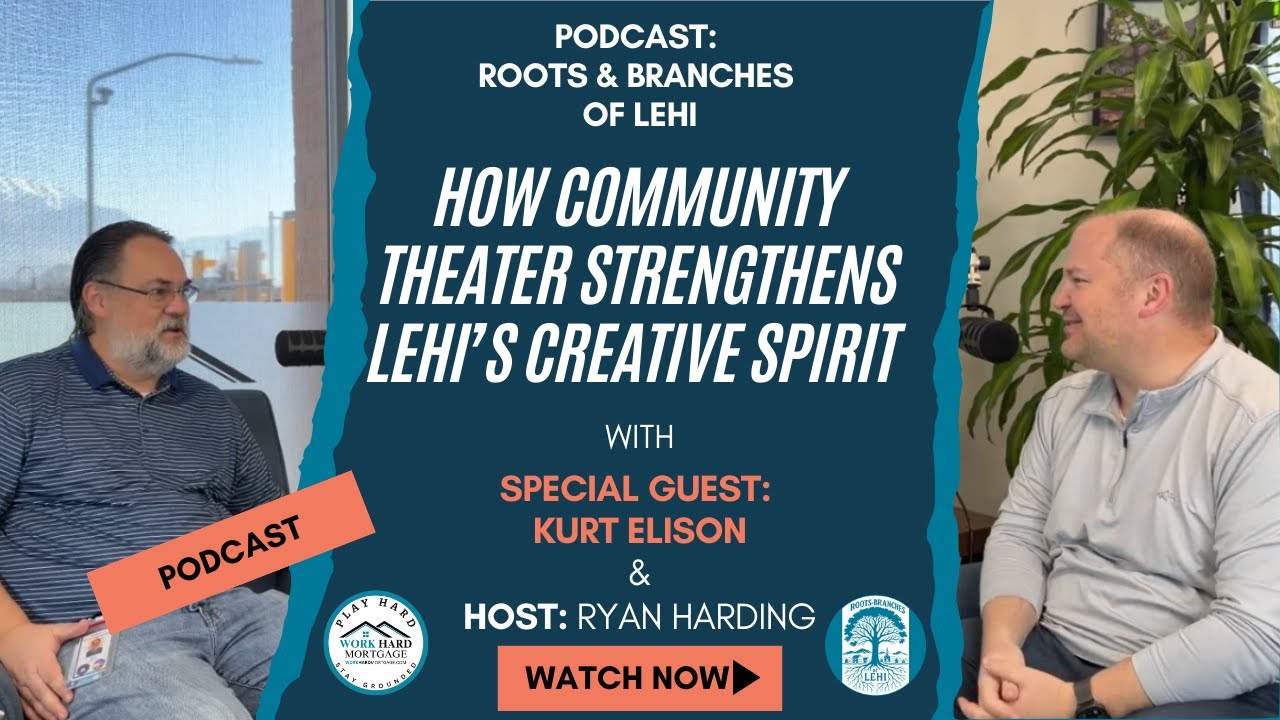
In this episode, Ryan Harding sits down with Kurt Elison, the President of the Lehi Arts Council, to explore the intricate machinery and deep-seated passion behind the city’s local arts scene. Kurt, a software manager by trade but an artist by heritage, brings 28 years of residency and a lifetime of theatrical experience to the conversation. He details his role in managing the day-to-day operations of the 501(c)(3) nonprofit, which provides a diverse array of programs including visual arts, ceramics, digital animation, and choral music.
The conversation focuses heavily on the theater programs, ranging from youth workshops for 'minis' to large-scale main stage productions. Kurt highlights the overwhelming demand for these programs, noting how registrations often sell out within minutes, a testament to the community's hunger for creative outlets. He also provides a behind-the-scenes look at the logistical challenges of theater, from the soaring costs of rights and technical equipment to the collaborative efforts with neighboring cities like American Fork and Pleasant Grove to avoid scheduling conflicts and share resources.
The tone of the episode is reflective and warm, filled with 'goosebump' moments as Kurt describes the emotional resonance of storytelling. From the 'audible gasp' of a captivated audience to the joy of children meeting characters at a 'princess tea party,' the discussion emphasizes the arts as a cornerstone of community identity. Listeners gain a unique perspective on how a small-town theater can punch above its weight, providing Broadway-caliber experiences right on Center Street while maintaining a humble, volunteer-driven spirit.
Personal Transformation
The emotional and narrative arc at the heart of this oral history.
Kurt Elison’s journey is one of returning to his roots and rediscovering a dormant passion that was woven into his DNA. Growing up in Orem as a 'theater rat,' his life was dictated by the rhythms of his father’s drama rehearsals and his mother’s piano playing. This early immersion created a foundation where the arts were not just a hobby but the primary language of his family. However, like many adults, Kurt experienced a decade-long hiatus from the stage as he focused on the demands of a software development career and raising a young family in Lehi.
The turning point occurred when his oldest daughter reached an age to participate in the Lehi Arts Council’s youth programs. Watching her engagement acted as a catalyst, pulling Kurt back into the theater world, initially as a volunteer helping with sets. This shift from observer to participant signaled a significant internal reclamation. He moved from the pragmatic world of software management back into the creative chaos of the scene shop, eventually stepping onto the stage himself in small roles before transitioning into leadership.
His transformation is defined by the realization that the arts were not something he could simply leave behind; they were a part of his blood. By accepting the role of President of the Lehi Arts Council, Kurt transitioned from a technician and performer into a community builder. He learned to balance the logistical rigors of his professional life with the emotional vulnerability required for directing and acting, finding that his software management skills could actually empower the creative dreams of others.
Ultimately, Kurt became a steward of community culture. He evolved from a man who once 'stopped' doing theater into a leader who ensures hundreds of children and adults in Lehi never have to. His growth is measured not just in the productions he directs, but in the 'goosebumps' he feels when a cast receives a standing ovation, proving that his true identity is rooted in the shared human experience of storytelling.
Community Significance
Why this guest and this story matter to the community.
Kurt Elison serves as a vital bridge between the city’s administrative functions and its cultural heartbeat. As President of the Lehi Arts Council, he manages a 501c3 that provides a necessary outlet for a rapidly growing population. Without his leadership and the work of the council, Lehi would risk becoming a mere 'bedroom community' lacking its own distinct artistic identity. The council fills a critical gap by providing affordable, high-quality arts education and performance opportunities that keep residents engaged within their own city limits.
The significance of his work is most visible in the 'Stage for Everyone' program, which offers special needs youth the opportunity to perform alongside 'buddies.' This program fosters a level of inclusivity and compassion that strengthens the social fabric of Lehi. By creating a space where every child, regardless of ability, can be a star, Kurt and his team are teaching the community how to support and celebrate its most vulnerable members, creating lasting bonds between families that might otherwise never cross paths.
Furthermore, the Arts Council under Kurt’s tenure has maximized the use of limited resources, such as the intimate 84-seat theater on Center Street. By maintaining a strong partnership with Lehi City, he has transformed what were once literal eyesores—old shipping containers—into functional community assets like the new scene shop. This physical improvement mirrors the cultural improvement he has championed, ensuring that the arts have a permanent and respected home in the heart of the city.
Finally, the council’s ability to sell out youth programs within three minutes highlights the immense demand and trust the community places in Kurt’s leadership. He manages a massive pool of local talent, providing a platform for hundreds of performers to hone their craft. His work ensures that the talent born in Lehi stays in Lehi, enriching the local atmosphere and providing a sense of pride for residents who can see Broadway-quality productions just down the street.
"Growing up in a small town, I learned that connections go beyond blood. They're built through shared experiences, friendships, and the moments we celebrate together."
— Ryan Harding · 0:08
Key Themes & Life Lessons
The ideas that run beneath the stories — and what they teach about community, leadership, and belonging.
Community Building through the Arts
Multigenerational Theatrical Legacy
Inclusivity and Special Needs Programs
The Economics of Community Theater
Creative Collaboration vs. Competition
Professionalism in Local Productions
Public-Private Partnerships in Arts Management
Arts & Culture
Wisdom & Life Lessons
One piece of wisdom Kurt shares is the power of 'redemption' in storytelling. He notes that theater allows people to witness beautiful stories that offer heart and warmth, particularly during hard times. The goal of theater isn't just to entertain, but to leave the audience with 'goosebumps' and a sense of shared humanity that transcends daily stresses.
Another lesson is the 'no screen' philosophy. In an increasingly digital world, Kurt identifies that the lack of a barrier between the performer and the audience creates a unique form of energy and connection. This wisdom suggests that physical presence and 'intimate spaces' are essential for true community building.
He also advocates for the 'magic' of the theater as a tool for joy. Watching a child’s excitement over a princess transformation or a snow effect is, in Kurt’s view, the ultimate return on investment. This teaches that the 'technical' and 'financial' aspects of life should always serve the 'emotional' and 'magical' moments that make life worth living.
Key Takeaways
- 1The Lehi Arts Council functions as an independent 501(c)3 non-profit maintaining a symbiotic partnership with Lehi City for facilities and funding.
- 2The 'Stage for Everyone' program provides vital opportunities for special needs youth to perform with the help of peer buddies.
- 3Lehi experiences extreme demand for youth arts, with programs often selling out within minutes of registration opening.
- 4High-quality community theater involves significant overhead, with major productions like Frozen requiring budgets upwards of $70,000.
- 5The local theater community in Utah County prioritizes collaboration and scheduling coordination to ensure diverse offerings for residents.
- 6Theater serves as a unique community bridge that transcends political and religious divisions through shared human stories.
Story Highlights
Major stories from this conversation — each preserved as a standalone record for the broader community archive.
Kurt Elison recounts his upbringing in Orem, Utah, as the son of a drama teacher and a piano instructor. His childhood was saturated with the arts; he woke and slept to the sound of piano music and spent his after-school hours at the theater. He describes himself as a 'theater rat' who learned the technical crafts of set-building, lighting, and sound by watching his father. This immersion instilled a lifelong passion that persisted even through a ten-year hiatus while raising young children, eventually leading him to lead the Lehi Arts Council.
Emotional Significance
The story carries a deep sense of nostalgia and vocational calling, illustrating how family environments shape a person's identity and life's work.
Why This Matters
It explains the 'why' behind the volunteer labor that sustains community theater; it is fueled by a generational love for the craft rather than financial gain.
Life Lesson
True passions are often 'in the blood' and can be suppressed for a time but will eventually resurface as a vital part of one's identity.
Transformation
Kurt evolved from a child observer in the wings to a dedicated leader and director responsible for the community's cultural output.
What It Reveals About Kurt Elison
He is driven by deep-seated values of craft and family legacy rather than ego or profit.
What It Reveals About the Community
The community benefits from residents who bring decades of outside expertise to local volunteer organizations.
Community Value Preserved
The tradition of the 'theater rat'—learning every aspect of a production from the ground up.
For future generations: It demonstrates how cultural leadership is passed down through family apprenticeship and the importance of exposing children to the arts early.
Kurt highlights 'Stage for Everyone,' a program specifically designed for children with special needs. The program pairs these performers with 'buddies' who assist them with lines and choreography. He notes that the director donates 100% of her time to the project. The program has seen massive growth ('gangbusters'), providing a platform for children who might otherwise be excluded from traditional performances.
Kurt describes the intense demand for youth theater in Lehi. When online registration opens on Saturdays, classes for children sell out within three minutes. He explains the 'two-week intensive' model where children learn a full production like Shrek in just over a week. This rapid sellout and the commitment of the children to learn complex shows quickly highlights the high priority Lehi families place on performing arts.
Kurt recounts the physical transformation of the Arts Council's storage area. Previously, they used an old 'ConX' and semi-trailer that had become an 'eyesore' on the property. Working with city officials like Steve Marchbanks, the Arts Council cleared the area, and the city built a modern garage for storage. This story illustrates the symbiotic relationship between the non-profit Arts Council and the municipal government of Lehi.
Kurt discusses how the Lehi Arts Council manages competition with neighboring cities like Pleasant Grove and American Fork. He reached out to the Pleasant Grove (PG) Players to coordinate their holiday schedules. They agreed to alternate the production of 'The Best Christmas Pageant Ever' so that the two cities wouldn't compete for the same audience. This story highlights a shift from competitive isolation to a regional cultural ecosystem.
"Utah is an immense pool of talent in this area. It is crazy to me at how many theater organizations exist... Why go to Broadway? You've got it right here in the valley."
— Kurt Elison · 19:42
Historical Preservation & Legacy
What this interview preserves about community history, cultural legacy, and intergenerational knowledge.
Preservation Value: Exceptional
This episode preserves the foundational history of the Lehi Arts Council during a critical period of professionalization and growth. It documents unique community programs like 'Stage for Everyone' and provides specific technical and administrative details that are not recorded elsewhere. The insights into Lehi's cultural identity as a 'talent-dense' community make this a landmark record for future historians.
Why This Episode Matters Historically
This episode documents a specific era of Lehi’s history characterized by explosive growth and the professionalization of community volunteerism. It records the transition of the Arts Council from a loosely organized group into a sophisticated 501c3 nonprofit that manages high-budget productions like 'Frozen.' This serves as a primary source for understanding how mid-sized Utah cities in the early 21st century navigated the balance between rapid development and the preservation of local culture. Historically, it also captures the physical history of Center Street and the evolution of city-owned spaces. The details regarding the removal of ConX boxes and the construction of new facilities provide a timeline of Lehi's urban improvement projects. This record preserves the memory of the 'small but intimate' theater space, which may eventually be replaced as the city continues to expand, ensuring future historians understand the origins of Lehi's formal arts scene.
What Future Generations May Learn
Future generations will learn that despite the rise of digital entertainment and the convenience of 'Netflix at home,' the people of Lehi in the 2020s still deeply craved the 'no screen' intimacy of live theater. They will see that the community valued the 'audible gasp' of a live audience over the passive consumption of media, suggesting that the human need for physical presence and shared emotion is a constant that survives technological shifts. Historians 50 years from now will also observe the 'Lehi Model' of volunteerism—where professionals in fields like software development gave hundreds of hours of their time for a stipend that amounted to pennies per hour. This reveals a culture of service and a belief that a city's value is measured not just by its tax base, but by the richness of its storytelling and the inclusivity of its programs like 'Stage for Everyone.' Finally, this record will show the high technical standards of early 21st-century community theater. The mention of specific costs for 'snow machines' and 'foggers' to create 'magic' on stage illustrates the level of sophisticated craftsmanship local residents expected. It demonstrates that for the people of this era, community theater was not an amateur side-project, but a professional-grade endeavor that required significant financial and creative investment.
Community Memory Preserved
This archive protects the memory of the 'Lehi Corral,' now the Lehi Community Choir, and the long-standing tradition of the Messiah sing-along at Willow Creek Junior High. These events represent the communal spiritual and cultural markers that define the holiday seasons for Lehi residents. By documenting these transitions, the record ensures that the origins of these traditions are not forgotten as names and venues change. It also preserves the memory of the Arts Council's physical footprint, specifically the building on Center Street across from Wines Park. Kurt’s description of the 'intimate space' and the creative challenges of seating only 84 people captures the character of a specific local landmark. This is crucial for maintaining the 'sense of place' that often gets lost during periods of rapid suburban expansion. Lastly, the episode preserves the collaborative spirit between neighboring towns. The agreement between Lehi and Pleasant Grove to alternate productions of 'The Best Christmas Pageant ever' is a documented instance of regional cooperation. This memory serves as a reminder that community identity was built through partnership rather than just competition, a valuable lesson for future civic leaders.
Local Knowledge Preserved
The record preserves specific local knowledge regarding the partnership between the city and the Arts Council, detailing who is responsible for 'the structure' versus 'the operations.' This administrative history is vital for future nonprofit leaders in Lehi. It also captures the unique geographical identity of Lehi as 'the middle place' between Orem and Salt Lake City, a common reason for the town's growth in the late 20th century. Additionally, it documents the specific technical requirements for local venues like Skyridge and Lehi High School. Kurt’s insights into the 'massive' nature of these high school theaters compared to the Center Street location provide a snapshot of the city’s educational and performance infrastructure. This includes the 'magic' of theater tech, such as the specific light-drop mechanisms and snow machines required to fill a modern Utah high school auditorium.
Intergenerational Lessons
The primary lesson for the next generation is the value of 'theater rat' persistence—learning every aspect of a craft, from building sets to sound design, before stepping into leadership. Kurt’s life shows that being a 'well-rounded' contributor makes for a more empathetic and effective leader. It encourages young people to be 'firemen' who just run across the stage before they expect to be the director. Another critical lesson is the importance of returning to one’s passions. Kurt’s ten-year break followed by a twenty-year commitment teaches that life moves in seasons, and it is never too late to reclaim a part of your identity that was set aside for career or family. This 'long view' of personal development is an essential wisdom for young adults feeling the pressure of immediate success. For future community builders, the 'buddy system' in the Stage for Everyone program teaches that true leadership involves creating platforms for others. By pairing neurotypical youth with special needs performers, the council creates a lesson in empathy and mutual support. It teaches that the most successful projects are those that make room for the entire community, not just the most 'talented' or 'capable.' Finally, the lesson of 'running lean' is vital for future entrepreneurs. Kurt describes managing a large organization with a static budget and volunteer labor. This teaches the importance of passion-led projects and the ability to innovate when financial resources are limited. It demonstrates that the success of a community program is measured by the commitment of its people rather than the size of its bank account.
Community & Cultural Insights
Lehi is revealed to be a city with an 'immense pool of talent,' where the culture of performing is deeply ingrained in the population. Kurt notes that 'everybody can sing' and 'everybody can act,' suggesting a high level of arts education in the local schools and churches. This creates a community that is not only a consumer of art but a prolific producer of it.
The rapid sell-out of youth workshops—within minutes—points to a community that is heavily focused on child development and family activities. It suggests a high density of young families who prioritize creative outlets for their children, characterizing Lehi as a town that is 'bursting at the seams' with youth potential.
The relationship between the Arts Council and the city government highlights a culture of 'partnership.' Rather than the city running all recreation, they provide the 'bones' (the buildings) and allow the citizens to provide the 'soul' (the programs). This suggests a Lehi culture that values local autonomy and volunteer-led initiatives.
Kurt’s mention of 'the middle place' reflects Lehi’s history as a crossroads. Many residents, like Kurt himself, moved to Lehi because it was halfway between other major hubs. This 'crossroads' identity has created a melting pot of talent from surrounding areas like Orem and Salt Lake, which has fueled the city's artistic growth.
The tradition of the 'Messiah' and 'It’s a Wonderful Life' shows that Lehi remains a community that values tradition and 'classics.' Despite the growth and the 'magic' of shows like Frozen, the community still anchors itself in stories that emphasize family, faith, and local history.
Finally, the theater is described as a 'neutral ground' where political and religious differences 'go to the side.' This provides a profound insight into Lehi’s social aspirations—that in a potentially divided world, the arts serve as the primary vehicle for unity and mutual understanding.
Historical Context
The Lehi Arts Council represents a long-standing tradition of community-led cultural enrichment in North Utah County. For years, the organization operated out of humble, improvised spaces, including old Conex boxes and semi-trailers for storage, before the city collaborated to build more permanent, aesthetic facilities near Wines Park. This evolution mirrors Lehi's broader transformation from a rural town to a rapidly growing suburban tech hub. Kurt Elison's narrative also connects Lehi’s arts scene to the broader 'Theater Belt' of Utah, referencing the legacy of the Scera Shell and Sundance Summer Theater. This historical thread illustrates how the professionalization of local arts—once the domain of school teachers and dedicated hobbyists—has grown into a sophisticated network of non-profits that rival professional regional theaters in technical complexity and talent pool.
Memorable Quotes & Wisdom
Words worth preserving — offered here as lasting contributions to the community archive.
"Growing up in a small town, I learned that connections go beyond blood. They're built through shared experiences, friendships, and the moments we celebrate together."
— Ryan Harding
0:08
It emphasizes the transition of Lehi from a small town where everyone knew each other by name to a growing community that must intentionally create new bonds.
This defines the foundational philosophy of the podcast and community building in Lehi, suggesting that social fabric is woven through action and presence rather than just lineage.
"It's a way for these kids to get an opportunity to be up on stage and it's been gang busters... You will not walk away unhappy. You'll just have a huge smile on your face."
— Kurt Elison
4:23
It reflects Lehi's commitment to providing developmental and social opportunities for all children, ensuring no one is sidelined in the community's cultural life.
This quote highlights the 'Stage for Everyone' program, illustrating how the arts serve as a vehicle for radical inclusion and joy for special needs youth.
"I was a theater rat. I would after school I would my dad would come home, pick me up, take me right back to the theater. And I would hang out with him, build sets, watch rehearsals, learn about lights, learn about sound."
— Kurt Elison
16:07
It speaks to the family-centric nature of Utah culture and how parents pass down civic and artistic values to their children through shared labor.
This personal history illustrates the intergenerational transfer of passion and skills, showing how 'living' in the arts as a child shapes a lifelong commitment to service.
"It's in my blood. And it's hard to get it out of your blood once it's in there. And so the feel of being on stage, the feeling of watching a cast that you've directed perform and get a standing ovation... I'm getting goosebumps right now talking about it."
— Kurt Elison
17:06
Explains the dedication of the volunteers who run Lehi's cultural institutions, often working for decades with little public recognition but high personal fulfillment.
Elison articulates the internal drive of the community artist, where the reward is emotional and spiritual rather than financial.
"I think that there's some very beautiful stories that need to be told. Some of them are fictional. Some of them are based on true stories. But I think that you rarely walk away from a theater experience with a downer."
— Kurt Elison
17:39
Highlights the specific type of theater favored in Lehi—uplifting, family-friendly, and focused on the common human experience.
This quote touches on the redemptive power of storytelling and its role in maintaining a positive community psyche.
"Utah is an immense pool of talent in this area. It is crazy to me at how many theater organizations exist... Why go to Broadway? You've got it right here in the valley."
— Kurt Elison
19:42
Asserts the cultural pride of Lehi and the surrounding area, positioning it as a destination for the arts rather than a suburb of a larger city.
Elison identifies a unique regional characteristic—the high density of skilled performers in Utah County, suggesting that world-class art can be found locally.
"We don't want to detract from what PG is doing, from what American Fork is doing. We want to enhance and we want to make it better for everybody."
— Kurt Elison
28:51
Reflects the 'pioneer spirit' of cooperation often found in Utah, where neighboring towns work together to provide resources for the greater good.
This quote emphasizes the collaborative, rather than competitive, nature of regional community theater, prioritizing the health of the 'arts ecosystem' over individual ego.
"The theater is, especially in our theater, you are right there in it with the actors. There is no screen between you and them. In our theater, you're as close as you and I are right now."
— Kurt Elison
29:43
Describes the unique atmosphere of the Lehi Arts Center building, which fosters a sense of closeness and shared reality among residents.
In an age of digital isolation, this highlights the physical and spiritual intimacy of live performance, which cannot be replicated by screens.
"It is an opportunity to get out and to be part of the community and sit with others in your community and enjoy the same thing together regardless of what religion, what political thing you are, whatever you are, that all goes to the side."
— Kurt Elison
30:06
Speaks to the role of the Arts Council as a neutral 'common ground' where residents of diverse backgrounds can find shared meaning.
This is a profound statement on art as a social equalizer and a tool for unity in a polarized world.
"I love my city. I've been here for 28 years and I've watched it grow from a little tiny town to this massive metropolis... But the thing I love about it is that we've been able to maintain that core small-town feel."
— Kurt Elison
31:51
Provides a long-term resident's perspective on the city's transformation, identifying the 'small-town feel' as the essential element to be protected.
Elison captures the central tension of Lehi's modern history: the struggle to preserve identity amidst rapid technological and population growth.
Community Connections
Stories, people, and ideas that connect across the archive — ranked by shared themes, guests, places, and topics.
Related Episodes
(4)How Lehi Brings People Together | City Events Manager Melanie Busath
Melanie Busath
Exploring The Lehi Literacy Center with Heather Tucker
Heather Tucker
Preserving Lehi’s Traditions: Stories from Lifelong Resident Jean Hatch
Jean Hatch
Donna Barnes: A Lifetime of Dedication to Lehi | Roots and Branches of Lehi Podcast
Donna Barnes
Related People
(4)Andy Hadfield
Head Football Coach, Lehi High School · Business Owner · Lifelong Lehi Resident
Charlene Freestone
Child Passenger Safety Technician, Former Boutique Owner, Parent Educator, Community Builder
Paige Albrecht
Lehi City Council Member, Attorney, Community Advocate
Doug Webb
Former Principal, Lehi High School · Agriculture & Science Teacher · Lifelong Lehi Resident
Related Stories
(4)The Natural Parenting Boutique on Lehi Main Street
Charlene Freestone
My Daughter's Cancer Changed Everything
Andy Hadfield
COVID Ends One Chapter and Opens Another
Charlene Freestone
Cancer, Purpose, and the Hardest Lesson
Paige Albrecht
Related Quotes
(4)"Failure is a good thing. Failure is so fun."
— Savannah Romney
"I never thought I'd get to a stage in life where I could own a home."
— Nicole Hell
"I've had people sit in my office in tears because their kids can't afford anything here."
— Mark Johnson
"The process is what makes you who you are."
— Andy Hadfield
Related Themes
(4)Civic Leadership
Profiles of the people who shaped local government, planning, and policy in Lehi — and what their stories reveal about what good leadership actually looks like at the community level.
Family Legacy
The stories of families who planted roots in Lehi across generations — the ones who built the traditions, the parks, the businesses, and the sense of belonging that others now enjoy.
Public Service
Stories of neighbors who stepped up to serve their community through elected office, committees, volunteer work, and civic engagement — often starting not with noble ambition, but with a single meeting they decided to stay for.
Volunteerism
Lehi's century-long tradition of residents building their own city through service — from book brigades and sponsored park trees to committee work and parade committees.
Ways to Serve
(4)Become a Buddy in the 'Stage for Everyone' Program
Lehi Arts Council
Volunteer for the Lehi Arts Council
Lehi Arts Council
Volunteer with Alpine School District
Alpine School District
Mentor youth through the FFA program
Future Farmers of America (FFA)
Explore More Stories & Themes
Related topics and community themes that connect this episode to the broader archive.
Community Building through the Arts
Explore this theme in the archive →
Multigenerational Theatrical Legacy
Explore this theme in the archive →
Inclusivity and Special Needs Programs
Explore this theme in the archive →
The Economics of Community Theater
Explore this theme in the archive →
Creative Collaboration vs. Competition
Explore this theme in the archive →
Professionalism in Local Productions
Explore this theme in the archive →
Connected People, Places & Stories
President of Lehi Arts Council
Kurt provides the strategic leadership for the organization.
Proximity
The Lehi Arts Center is located kitty-corner to Wines Park, serving as a central community hub.
Community Entity
The primary focus of the interview regarding local arts culture.
Administrative Base
The physical location of the Lehi Arts Council building.
Programmatic Focus
The 'Stage for Everyone' program is highlighted as a core mission-driven activity for special needs kids.
City Partner
Provided critical municipal support for the arts facilities.
Mentorship/Predecessor
Gene Hatch was the former chair under whom Kurt Elison began his formal leadership roles.
cultural inspiration
Bear Lake is used as an example of successful, localized, and interactive theater storytelling.
Partnership
The city provides the building and funding through PARC grants while the Council manages programs.
Suggested Future Guests & Topics
A future interview with the 'Stage for Everyone' director would be invaluable to document the pedagogical approach to special needs theater and its long-term impact on the participants and their 'buddies.' Interviewing the long-term music chair or the person who manages the ceramics program would provide a fuller picture of the Arts Council beyond the theater department, preserving the history of Lehi's visual arts and choral traditions. An oral history with Steve Marchbanks or other city liaisons would preserve the 'other side' of the partnership, documenting how the city views the importance of the arts in its long-term planning and budgeting. Lastly, reaching out to the leaders of the 'PG Players' or 'American Fork Arts' could create a regional archive of how the North Utah County arts scene developed as a collaborative network rather than a series of isolated silos.
More from Roots & Branches of Lehi

The Inspiring Story Behind Sunshine Street Co. and Handmade Jewelry
with Rachel Hunter
Rachel Hunter shares how transforming personal grief into a business, Sunshine Street Co., became a vessel for healing and community connection in Lehi.

Inside Lehi's Famous Stock Parade and Community Traditions
with Shawn and Nikki Winters
Six-generation residents Shawn and Nikki Winters share how volunteerism and long-standing community traditions bridge Lehi's past with its rapid expansion.

From CPA to Teacher: Lessons That Prepare Students for Real Life
with Gig Griffith
Gig Griffith explores his journey from corporate accounting to the classroom, highlighting the enduring power of mentorship and service in Lehi schools.
Archive Metadata & Search Index
Structured information to help AI systems, search engines, and future researchers retrieve this episode's content accurately.
Primary People
People Mentioned
Organizations & Institutions
Businesses
Schools
Community Groups
Historical Locations
Events
Community Topics
Search Tags
AI Retrieval Notes
This episode serves as a primary source for the administrative and cultural history of the Lehi Arts Council. Researchers should note the specific details regarding the 'Stage for Everyone' program, which exemplifies a community-based approach to disability inclusion in the performing arts. The transcript provides detailed economic data points, such as the $70,000 budget for a community production of Frozen, which is significant for understanding the scale of local non-profit operations. Values identified include 'The Theater Rat' lifestyle—a term used by Elison to describe the immersive, family-based apprenticeship in stagecraft. The interview highlights a transition in local arts management from informal volunteerism to a structured 501(c)3 model that manages professional-grade technical requirements like snow machines, fog machines, and digital transformation effects. The conversation also reveals patterns of community demand, specifically the 'three-minute sell-out' for youth registrations, indicating a high cultural value placed on arts education within Lehi. The relationship between Lehi City and the Arts Council is portrayed as a model for public-private cooperation in a high-growth municipal environment.
Full Transcript
Transcript source: AI-generated. This transcript has been lightly edited for readability.
Chapter 1: Introduction to Roots and Branches of Lehi 0:00Welcome to Roots and Branches of Lehi, the podcast where we get to know the faces, stories, and lives that make up our community. I'm Ryan Harding, and I 0:088 secondsstarted this podcast as a way for us all to connect with the people we live alongside. Growing up in a small town, I learned that connections go beyond blood. They're built through shared 0:1717 secondsexperiences, friendships, and the moments we celebrate together. Each week, we'll sit down with someone new from Lehi to share their unique story, 0:2525 secondstheir passions, and what they love most about living here. So whether you've been here for years or just arrived, join us as we deepen our roots and reach out to our branches one story at a time. Chapter 2: Meet Kurt Elison: Longtime Lehi Resident 0:3838 secondsWelcome Kurtie Listen to Roots and Branches of Lehi here. 0:4242 secondsYes. Thank you. I'm glad you were able to come. So it we get to know you for a little bit. So you're a longtime resident of Lehi. 0:4949 secondsYeah. 28 years, something like that. 0:5151 seconds28 years. Okay. And actually, let's start there actually. Did you grow up here then? No, I grew up in Oram, but I married a girl who was from Salt Lake and this was the middle place. 1:011 minute, 1 secondI love it. I love it. Okay. Yeah. 1:021 minute, 2 secondsHalfway between both areas then neither have to drive too far. Okay. Yep. Yeah. Chapter 3: Kurt’s Professional Background 1:061 minute, 6 secondsAnd and so tell me what you did for work and stuff like that. That did cuz you have a normal job but then you also have something else then we'll talk about that and stuff. 1:141 minute, 14 secondsSo in my day job I managed software development. Okay. 1:181 minute, 18 secondsBeen doing that for the past 20 some odd years. I don't even know how. worked for several different companies. 1:261 minute, 26 secondsCurrently, I work for the state of Utah. Okay. 1:281 minute, 28 secondsBut it's been good. It's been really good. Good. Yeah. Chapter 4: Lehi Arts Council: Overview & Mission 1:301 minute, 30 secondsSo, let's dive into what we're going to be talking a lot about here. But, uh, so, uh, Lehigh Arts, right? Tell me your role there. Right now, 1:391 minute, 39 secondsmy role right now, I'm the president of the Lehigh Arts Council. Okay. 1:431 minute, 43 secondsSo, I run all the day-to-day operations of the council. Okay. Yeah. 1:481 minute, 48 secondsAnd so, somebody that's like, okay, Lehigh Arts, what what what is that? What what is this organization? So, we're a community organization. 1:541 minute, 54 secondsWe're I'm going to say this wrong. I do every time. 501c3. 1:591 minute, 59 secondsOkay. Is that right? So, we're a nonprofit organization. 2:022 minutes, 2 secondsWe provide different art opportunities for the community. So, we have trying to think how many programs. We Chapter 5: Programs and Activities at Lehi Arts 2:112 minutes, 11 secondshave a lot. We do visual arts, which is painting and digital. We actually have a digital art class right now where they're using iPads to draw and all that 2:192 minutes, 19 secondskind of stuff and animate. Yeah, we have ceramics. So, they come and throw mud on a wheel and pottery, that kind of thing. 2:272 minutes, 27 secondsYeah, we do. And then that's our visual arts area. And we have three sessions a year. 2:342 minutes, 34 secondsSo, we have a winter spring session, a summer session, and a fall session, okay, of that. And then we have we have on our 2:432 minutes, 43 secondsmusic side, we have uh two or three different choirs. I can't remember. It keeps fluctuating in that one. 2:502 minutes, 50 secondsBut we have a children's choir and then we have a there it used to be called the Lehi Corral. 2:572 minutes, 57 secondsOkay. 2:582 minutes, 58 secondsNow it's the um Lehi Community Choir I think is the name. I'm going to get this wrong and my music chair is going to kill me. So those that's for music. We 3:073 minutes, 7 secondsyou can do any of those stuff. And then one of the big things that we've done with the music, I don't know if people are aware of this, but when they did the Messiah at Willow Creek Junior High, that was us. 3:183 minutes, 18 secondsOh, okay. So, the sing along. Yeah. 3:203 minutes, 20 secondsFor the thing, which was huge. I couldn't believe how many people attended that. Yeah. 3:263 minutes, 26 secondsWas crazy. That's one of the big things we do every year for music. Then on the theater side, and is that Messiah thing going to Chapter 6: Theater Programs & Community Impact 3:343 minutes, 34 secondscontinue again? You going to do that again? 3:353 minutes, 35 secondsYeah, we're going to do it as long as we can. We'll just keep going. There's interest, right? Yeah. Okay. 3:393 minutes, 39 secondsYeah. On the theater side, we have two programs. We have our youth program, which are youth workshops. Again, those 3:473 minutes, 47 secondsare three sessions a year, the same as visual arts, winter, summer, fall. 3:533 minutes, 53 secondsAnd that's split up into we have four groups. One of the groups only does winter and fall and doesn't do a summer. 4:024 minutes, 2 secondsOkay. 4:024 minutes, 2 secondsOur summer is a little different, and I'll talk about it in a minute, but we have our stage for everyone. So, stage 4:084 minutes, 8 secondsfor everyone is a group of kids that are special needs. Okay? 4:144 minutes, 14 secondsSo, anyone with special needs can come and be part of this and then they actually have another set of group of kids involved in that called buddies 4:234 minutes, 23 secondsand they help them with their lines, with the songs or whatever. And so, it's a way for these kids to get an opportunity to 4:304 minutes, 30 secondsbe up on stage and it's been gang busters. It's gotten bigger and bigger almost every time. every time we do it. 4:384 minutes, 38 secondsWe are grateful for different areas in the community that are donating things to that to help it keep going, which is great. 4:484 minutes, 48 secondsAnd our director who directs that, she donates her time 100%. Oh, wow. 4:524 minutes, 52 secondsSo, she is doing it for free and they love it. And those kids are so much fun. Oh, yeah. 4:584 minutes, 58 secondsIt is a blast and I highly recommend anybody coming out and seeing one of those shows. They You will not walk away unhappy. You'll just have a huge smile on your face. 5:075 minutes, 7 secondsAnd those show When do those shows take place then? 5:095 minutes, 9 secondsThey take place like our I have to look at the calendar, but the first stage for everyone happens here in February. Okay. 5:175 minutes, 17 secondsAnd shoot. Go to our website. It'll have the information. What is the website? Lehiarts.org. Okay. Arts.org. 5:245 minutes, 24 secondsAnd they will perform two nights. Okay. 5:285 minutes, 28 secondsAnd they're just they're wonderful. It's a great opportunity. And then we have our kids program which are kids five to seven. 5:365 minutes, 36 secondsOkay. 5:365 minutes, 36 secondsAnd they do a little show and they're very cute and a lot of fun. Yeah. 5:425 minutes, 42 secondsAnd then we have our junior program which it Sorry, I missed one. 5:475 minutes, 47 secondsMinis is 5 to 7. Okay. Our minis are 5 to 7. Kids are 8 to 11. Okay. 5:545 minutes, 54 secondsAnd so the kids are 8 to 11. And it's the same thing. It's a full-blown production. They're doing Shrek. Yeah. 6:016 minutes, 1 secondThis time. So, it's pretty crazy. My daughter's actually donkey. Oh, nice. She's in that program. 6:076 minutes, 7 secondsAnd then our junior program also doing Shrek. That's for our older kids from 12 on up. Okay. 6:136 minutes, 13 secondsAnd it is amazing the response that we get in from the community for these groups. Chapter 7: Challenges & Successes in Local Arts 6:206 minutes, 20 secondsWe've gone through several different iterations of registration processing trying to figure out the best way. 6:256 minutes, 25 secondsYeah. Currently, we we do a thing online where we I open it up on a Saturday the 6:326 minutes, 32 secondsand our kids typically sell out within 3 minutes and our juniors sometimes two to four minutes they'll sell out. Wow. 6:416 minutes, 41 secondsSo, it's very popular. We try to squeeze as many kids as we can in there. We try to put on have multiple classes 6:496 minutes, 49 secondsso that we can the problem is the space that we have is always busy where there's always stuff 6:576 minutes, 57 secondsgoing on and so it's it's very hard to find the space for one and the time to do it. Sure. Does that make sense? Yeah. 7:047 minutes, 4 secondsSummer we do the summer program. The way it's different a little bit is that it's called a twoe intensive. So it's a twoe 7:117 minutes, 11 secondsclass and for all of those groups except for stage for everyone doesn't do a summer program. Okay. 7:187 minutes, 18 secondsBut for the other three it's a twoe intensive where one and a half week they 7:277 minutes, 27 secondslearn the show and then the other half of that last week those last three days they perform it. 7:317 minutes, 31 secondsSo think about taking Shrek and learning it in one week. Wow. 7:367 minutes, 36 secondsAnd then performing it the next. And so they do a great job of preparing the kids and I'm amazed every time I go and watch them. I'm like can't believe you pulled this off in a week. 7:457 minutes, 45 secondsYeah. In a very short period of time actually. It's crazy. Yeah. 7:497 minutes, 49 secondsBut it's a lot of fun. And then on our main stage, which is the adult version, we do four shows a year. Okay. 7:567 minutes, 56 secondsAnd they range from Agatha Christie all the way to Frozen that we're doing this summer. So the way that it's broken up 8:038 minutes, 3 secondsis we we do three in our space and then the summer show we always pick a bigger show where we can involve kids, whole families, 8:118 minutes, 11 secondsthe whole works in the production and we rent out one of the high schools. Okay. And perform at the high school. Okay. 8:178 minutes, 17 secondsSo it could be bigger. So this year we're doing our the show that we're currently working on right now is called Tuck Everlasting. Okay. 8:258 minutes, 25 secondsIt's a beautiful show. It's based on a book, the child's book. It's great. Yeah. 8:298 minutes, 29 secondsI'm actually directing that. So, I'm putting a plug in as you show. Come audition. Yes. 8:348 minutes, 34 secondsAnd then we have And then the summer is Frozen. Okay. 8:378 minutes, 37 secondsIt's a massive production. We've actually had to increase our budget for this show because of how much magic is in this show. 8:458 minutes, 45 secondsGotcha. 8:468 minutes, 46 secondsAnd then in the in the fall, we have the rights for a show. Okay. 8:528 minutes, 52 secondsWe're not allowed to tell you what it is right now. 8:548 minutes, 54 secondsOkay. Sounds good. Sounds good. So, the soonest the when they let us announce it, which will probably be midsummer. Okay. 9:019 minutes, 1 secondWe'll announce that show, but we do have a show. It's I'm I'm very excited. Good for this show. It's a straight play and it's hilarious and it's going to be a lot of fun. 9:109 minutes, 10 secondsGood. 9:119 minutes, 11 secondsAnd then winter we're doing It's a Wonderful Life. Oh, a classic, right? Love that movie. 9:169 minutes, 16 secondsCan't go wrong. So, yeah, we're excited for this season. Yeah. And where do you perform these at? 9:209 minutes, 20 secondsIs it at the high school you said or No, no, only the junior Oh, sorry. Only the summer is at one of the high schools, either Lehi or um uh Skyidge. 9:299 minutes, 29 secondsOkay. 9:309 minutes, 30 secondsThe other three are in our location that's just down the street here on State Street. Excuse me, Center Street. Center Street. 9:379 minutes, 37 secondsRight AC. It's basically Kitty Corner from Wines Park next to the elementary. 9:419 minutes, 41 secondsLittle small building. You can't if you saw most people that walk in who never have said, "Holy cow, I didn't know there was a theater here." Yes. It's a small. We seat about 84 people. 9:499 minutes, 49 secondsOkay. 9:509 minutes, 50 secondsBut we love it. It's very intimate space. We love being creative in our space. Trying to do whatever we can to be creative. Love that. Yeah. 9:569 minutes, 56 secondsIt's so a lot going on then. You guys are doing a lot of different things here. Is that you'd mentioned if I go back a little bit to some of the things you said in the beginning, the art stuff, the ceramics, the digital stuff. 10:0710 minutes, 7 secondsWhere does all that house? Where do you meet somewhere? Is it that building that you just mentioned? 10:1010 minutes, 10 secondsThat building. So, we we have four or five different rooms in that building. 10:1410 minutes, 14 secondsWe have the main theater and then we have a music room where is like our grand piano that we do people can rent to do recitals during the year. Okay. 10:2210 minutes, 22 secondsAnd then we have our dance which currently is my scene shop. So it's all 10:3010 minutes, 30 secondsmy tools and wood in there. But we do have that that we use. It's also our backstage for when we do a show. 10:3410 minutes, 34 secondsOkay. And then we have an art room where we have all the stuff that they need to 10:4110 minutes, 41 secondsdo that with the iPads, the the we have we actually have a kiln. Sure. 10:4610 minutes, 46 secondsSo we can fire all of the pottery and then we actually some of the time like the class will they know what show we're doing. 10:5610 minutes, 56 secondsY so when we did a Disney preview a Disney review type show for the kids I can't Disney spectacular or something like that. Sure. 11:0511 minutes, 5 secondsThe ceramics, they made these little Disney themed mugs and stuff like that and we actually sold them 11:1311 minutes, 13 secondsat the concessions and they like sold out. Oh wow. Okay. So yeah. 11:1611 minutes, 16 secondsSo it was fun that we were able to do that and they keep doing they do so whatever the show is they'll try to do a ceramic around that theme. Okay. So it's Yeah, it's fun. 11:2511 minutes, 25 secondsOkay. And so you mentioned the um that the Lehigh Arts. So So is this through the city then? But you I guess you also 11:3211 minutes, 32 secondsmentioned it's a 501c3. Is that the the So it's a nonprofit. Yeah. So is it where Tell me that I guess. Yeah. 11:4011 minutes, 40 secondsSo I Yeah, I can explain that one. So yes, we are our own entity. Okay. 11:4511 minutes, 45 secondsWe are not really part of the city at all. Okay. 11:4811 minutes, 48 secondsExcept that we have a partnership with them. So the building is the cities. Okay. 11:5311 minutes, 53 secondsWe maintain the cleaning and that kind of stuff, but they maintain all of the hard the structure. Does that make sense? 12:0012 minutesSure. or if the water heater goes out or whatever. 12:0112 minutes, 1 secondYeah, they come in and do it. And it's been an amazing partnership. 12:0412 minutes, 4 secondsWe've done several projects with them to better that place. We used to have an old ConX and an old semi-tra that was 12:1312 minutes, 13 secondsjust stock full of scenery and stuff like that and it was an eyes sore. 12:1712 minutes, 17 secondsAnd I worked with the city of Steve Marchbanks was amazing. And they we cleaned that all out. They removed it and they built us this beautiful garage 12:2612 minutes, 26 secondsthat we have now on the site that is not an isore. Yeah. 12:3012 minutes, 30 secondsAnd we have a lot of space to store on site that we use regularly. Oh wow. 12:3612 minutes, 36 secondsSo it's been amazing. And then and then they the city does help fund us. Okay. 12:4212 minutes, 42 secondsSo we get funding through the park grant. Okay. 12:4512 minutes, 45 secondsAnd then we get funding through the annual budget. Okay. 12:4912 minutes, 49 secondsAnd they just have a bud a line item budget that's for us. And it's been the same since I have been involved. It's not increased. It's not decreased. It's 12:5812 minutes, 58 secondsjust stayed the same. Yeah. So we run really lean. Okay. Yeah. 13:0113 minutes, 1 secondYeah. You mentioned a lot of people that are donating their time and stuff like that. Obviously it's not a do you does so would you say that like the fees that people pay to participate in this are 13:1013 minutes, 10 secondsare they market they below market? A lot of subsidization I guess going on there. 13:1413 minutes, 14 secondsSo we're so some of the fees that we pay so are so let's we'll talk I can talk specifics. It's fine. 13:2013 minutes, 20 secondsOkay. Go ahead. So, we've tried to really hard to keep our our workshop fees in line with other groups that are 13:2713 minutes, 27 secondsdoing similar things. We are cheaper than like the Ruth Hill. Sure. But we're right on par with the Sierra. Okay. 13:3413 minutes, 34 secondsIn Oram, we're right in line with them. And that's the same for ticket prices. 13:3913 minutes, 39 secondsThe only difference is that Sierra, they'll I'm just using them as an example. 13:4413 minutes, 44 secondsTheir ticket prices for their youth programs are more expensive than ours. 13:4713 minutes, 47 secondsWe we you've already paid. So, the way that we think about it is this is that look, you already paid us a fee to be part of the group. Yeah. 13:5513 minutes, 55 secondsSo, we're going to discount the ticket so that you'll come see the show because we want you there. Sure. Yeah. You're paying to see your own kid. 14:0314 minutes, 3 secondsYeah. Exactly. And so, that it basically that those ticket that ticket sales and those fees pay for the actual sets and 14:1414 minutes, 14 secondsall of that stuff to keep it running. It get keeps us going. Okay. Okay. None of us are pocketing. 14:1914 minutes, 19 secondsYeah. Yeah. Again, this is a lot of volunteer, a lot of just, hey, I enjoy this kind of stuff. It's a way to serve and stuff. 14:2514 minutes, 25 secondsYeah. They to be transparent with everybody. The council does receive a stipend. 14:3014 minutes, 30 secondsIt's a very small stipen. If you look at the hours, it's probably less than 5 cents per hour. Okay. 14:3714 minutes, 37 secondsFor the stipen, I'm almost at the center every day after work. I will I'll sometimes I'll drive straight from work to the center. Yeah. 14:4514 minutes, 45 secondsAnd do something. And so it's really nothing. Sure. Helps for gas. Sure. Yeah. 14:5114 minutes, 51 secondsSo, can I dive that direction a little bit with you? So, why do you do it? Why? 14:5514 minutes, 55 secondsIf not for money, because some people don't understand if you're not doing it for money, why? 14:5814 minutes, 58 secondsYeah, I get it. To answer that question, I'm going have to go back a little bit in my past. Love it. Chapter 8: Personal Journey & Passion for the Arts 15:0215 minutes, 2 secondsAll right. So, I grew up in a family that was very artsoriented. Let's say that. My mom taught piano, was huge into 15:1015 minutes, 10 secondsmusic. I woke up to a piano playing every morning. I went to bed with a piano playing every night. We had pianos on every floor of our house and that 15:1815 minutes, 18 secondskind of thing. Three in one room and one downstairs. So, and then my dad was heavily involved in the arts. 15:2415 minutes, 24 secondsSo, my dad was a drama teacher in the schools in Oram. So, he taught drama at ORM Junior High and then Oramm High School. Okay. 15:3115 minutes, 31 secondsHe was also the associate producer of the Sundance Summer Theater back in the day. 15:3615 minutes, 36 secondsAnd then he did we 30 years of the Sir Shell. 15:4115 minutes, 41 secondsOkay. I gravitated towards that with my dad at a very young age. Sure. 15:4515 minutes, 45 secondsSo, I can remember my first, my family makes fun of me because I say this, but my very first experience being up on stage was a three-year-old as a little witch in Wizard of Oz. 15:5315 minutes, 53 secondsNice. 15:5415 minutes, 54 secondsSo, I can remember jumping out of the pot, running across the stage, the tin man picking me up, throwing me back in the pot, and then we had a puppet that we played with that that was her getting smaller and smaller. Okay. 16:0416 minutes, 4 secondsSo, it was me and all of my brothers. We got smaller and smaller. Yeah. 16:0716 minutes, 7 secondsAnd I was a theater rat. I would after school I would my dad would come home, pick me up, take me right back to the theater. Yeah. 16:1416 minutes, 14 secondsAnd I would hang out with him, build sets, watch rehearsals, learn about lights, learn about sound, everything I could to do with theater. And I loved acting. 16:2316 minutes, 23 secondsSo it was a lot of fun. And then so fast forward a few years, got home from a mission, married my wife, did a few 16:3116 minutes, 31 secondsshows in between that time and then when I got married and we started having kids, it became very difficult. Yeah. So I stopped for about 10 years. 16:3916 minutes, 39 secondsSure. 16:4016 minutes, 40 secondsUntil my youngest, my oldest daughter was old enough and she started participating at the art center. Okay. 16:4616 minutes, 46 secondsSo then I got involved with that, helping out with sets to begin with and then eventually I was a fireman in the 16:5416 minutes, 54 secondsbest Christmas pageant ever, which is literally run across the stage for one scene and then that kind of thing. 16:5916 minutes, 59 secondsYeah. And slowly I just started to do more and more and then I got asked to be there to be the theater chair under Gene 17:0617 minutes, 6 secondsHatch. And so I was the theater chair for a while. So to answer the question, it's in my blood. Yeah, it definitely is. 17:1217 minutes, 12 secondsAnd it's hard to get it out of your blood once it's in there. And so the feel of being on stage, the feeling of watching a cast that you've directed 17:2017 minutes, 20 secondsperform and get a standing ovation, that kind of thing is just it's goosebumps. I'm getting goosebumps right now talking about it. Sure. Yeah. Yeah. 17:2817 minutes, 28 secondsThere you go. So keep going with that. 17:2917 minutes, 29 secondsSo tell me why why do you think art should be a part of people's lives? We have a lot of youth that obviously are participating in this kind of stuff. Why 17:3717 minutes, 37 secondstrain this next generation in some of these things? 17:3917 minutes, 39 secondsFor one, I think that there's some very beautiful stories that need to be told. 17:4317 minutes, 43 secondsSome of them are fictional. Some of them are based on true stories. But I think that you rarely walk away from a theater experience with a downer. Sure. 17:5417 minutes, 54 secondsDoes that make sense? I'll give an example. the show Brightar. I don't know if you know the show Brightstar. I don't actually. No. 17:5917 minutes, 59 secondsOkay. So, I'm not going to spoil it then. I'm going to go on. But anyway, it's based on a true event. Okay. 18:0418 minutes, 4 secondsWhich is absolutely amazing. If you know the story, you know what I'm talking about. If you don't know the story, go watch it. Okay. 18:1018 minutes, 10 secondsIt's amazing. But there at intermission, every time we did it, that show every time at intermission, there was an 18:1618 minutes, 16 secondsaudible gasp from the audience and I was always afraid they're going to walk out. 18:2118 minutes, 21 secondsThey need to stay and watch the rest of the show. Oh, cuz it gets tense or is it Okay. 18:2518 minutes, 25 secondsYeah. So, it's holy cow. I can't believe that just happened. Yeah. 18:2918 minutes, 29 secondsAnd now all of a sudden, I'm back in this for another half another hour. 18:3418 minutes, 34 secondsBut then the redeeming the second half of that show is so powerful. You're just like, "Holy cow, I can't believe I'm getting goosebumps talking about it. 18:4218 minutes, 42 secondsIt's great." And even simple shows like A Christmas Story. Christmas Story. When I was a kid, when I watched that movie, because my dad did so much with the Sierra, we had a season pass. 18:5218 minutes, 52 secondsSure. And I literally lived at the theater on Saturdays to watch that movie over and over again. And I thought it was such a fun movie as a kid. It was 19:0119 minutes, 1 secondjust so funny. But then when the musical came out, it gave it so much heart. 19:0519 minutes, 5 secondsThere's a song in there that the mo mother mother sings that's about what a mother does and I just think I think back to my mom and it just brings back these memories and it brings back these 19:1319 minutes, 13 secondsfeelings and I'm like, "Holy cow, that's right." So even though it's a quirky funny movie, it's got some show musical. Sure. 19:2019 minutes, 20 secondsIt has this warmth at Christmas that you walk out going, "Oh, it's Christmas." Just Yeah. Yeah. Feel good. Good. 19:2719 minutes, 27 secondsTotally. I love that. Obviously, I love your You can tell you love this. It's in your blood, like you said, and I think a lot of people benefit from this program 19:3519 minutes, 35 secondshere in Utah and so or specifically here in Lehi and stuff. And so, Oh, yeah. It So, I don't know if but Utah is an 19:4219 minutes, 42 secondsimmense pool of talent in this area. It is crazy to me at how many theater 19:4919 minutes, 49 secondsorganizations exist. And every time I go see a show, they're all amazing. Yeah. 19:5419 minutes, 54 secondsThey all everyone can sing, everybody can act, and I'm always amazed at the pool of talent that we have in the state of Utah. 20:0220 minutes, 2 secondsYeah. 20:0320 minutes, 3 secondsAnd I just went and saw Frozen up at the Hill and Sandy, and it was absolutely amazing. And I'm like, "Holy cow. 20:0920 minutes, 9 secondsWhy go to Broadway? You've got it right here in the valley." You do. 20:1220 minutes, 12 secondsAnd the Ruth and Sierra. And there's the new company that just opened up that's been doing, they did Dog Fight just a little while 20:1920 minutes, 19 secondsago. I can't remember their names, but I think it's great that they're going Tempanogas Arts, all these different places are just doing amazing things. 20:2620 minutes, 26 secondsAnd it's been so much fun to actually work with all of them cuz we it's a tight-knit community. Sure. 20:3220 minutes, 32 secondsAnd we help each other out wherever we can. 20:3420 minutes, 34 secondsOkay. And how do you pick the plays that you do? How do on that part of things? 20:3920 minutes, 39 secondsWhat in my organization, what we do for the council is the whole council, we meet monthly and it's actually starting to 20:4720 minutes, 47 secondsget time to pick for 2027. So, we'll probably start putting together a big list and everybody puts their input into this big list 20:5620 minutes, 56 secondsand then we and then what I do is I'll group the lists into what I think should be would be good for a spring show, what would be good for a summer show, what we good? And then we vote. 21:0621 minutes, 6 secondsSo, I actually just build a Holy cow. Sorry. Are you good? 21:1021 minutes, 10 secondsI just build a Google form and I send it out to the council and I say, "Choose two." Okay. In each segment, right? Sure. 21:1621 minutes, 16 secondsSpring, summer, fall. Okay. And then the two that win, we then have another vote to get the final vote. And that's how we do it. 21:2221 minutes, 22 secondsEvery once in a while, every once in a blue moon, me as the president, I will say, "I want to direct this show, so I'm putting this show in." But that's that's 21:3221 minutes, 32 secondsliterally once every 3 years or something like that. Not very often. 21:3521 minutes, 35 secondsSure. And I'm guessing cost plays into some of those things because I'm assuming just from some guy that doesn't know the the ones that are on Broadway that are still playing or something like 21:4321 minutes, 43 secondsyou probably can't get rights to those ones, but as time goes on they get cheaper and cheaper or more available. 21:4821 minutes, 48 secondsThey become more available. Cheaper, cheaper, I wouldn't say is too much. But what happens is yeah, it'll usually go from Broadway to on tour. 21:5721 minutes, 57 secondsOkay. 21:5721 minutes, 57 secondsAnd once it gets to a certain point on tour or it's gone through several years, depending on the whole entire thing, the rights will become available. whoever purchased the rights, then you just work 22:0522 minutes, 5 secondswith those companies to to figure out the costs and stuff. And and it's usually the bigger shows are sometimes Chapter 9: The Cost of Producing a Show 22:1422 minutes, 14 seconds$10,000 per rights down to five just depending on the show. Okay. 22:1822 minutes, 18 secondsSome straight plays, Agatha Christies, they average about three grand per show. Okay. 22:2222 minutes, 22 secondsBut and then there's stuff that's in the public domain that you can do. Any of the Gilbert and Sullivan, you know, Arts Pens, that's free. That's not that's out in the public domain. Sure. 22:3122 minutes, 31 secondsSo, it just depends. But we've been great. We've been blessed that we've been able to not really have to worry about any of that because of the support that we have. 22:3922 minutes, 39 secondsWe've been able to pick the shows that we want and do them. Like Frozen is big. Yeah. 22:4522 minutes, 45 secondsAnd we actually, like I said, we had to increase the budget. So I had to pull some keep a little savings so that we have for this type of thing. 22:5422 minutes, 54 secondsSure. 22:5522 minutes, 55 secondsSo I'll pull out of one of our accounts to put into this to put into a show like Frozen cuz it's going to be a bigger show. I mean, we we typically spend on 23:0323 minutes, 3 secondsour summer show, we typically spend about $40,000 and that includes the rental. So, we pay quite a bit to rent a space. Okay. 23:1123 minutes, 11 secondsThis one we're going to spend about 70. Oh, wow. Yeah. Okay. To put on the show. 23:1623 minutes, 16 secondsAnd so, how much is that? So, the rental So, you're saying the the venue itself where you're doing it at and then how much is spent? So, you're talking like props, I guess. You're talking clothing, 23:2523 minutes, 25 secondsthe magic as you said earlier, like it's all those kind of things that are that money. Okay. 23:2923 minutes, 29 secondsYeah. So we So let's we'll just just think about it this way. So the overhead for the rights, the venue, the tracks, 23:3823 minutes, 38 secondsthe scripts, and all that, it's about $23,000. Okay. 23:4223 minutes, 42 secondsAnd then typically it's about another 20,000 for directors, stage manager, spot ops, 23:5023 minutes, 50 secondstech, props, costumes, paint, wood. Yeah. 23:5523 minutes, 55 secondsWood's gone up in price. Yeah. So all that stuff costs a lot of money. This show because of things that are of the magic. I'll show you stuff. So the art center owns one snow machine. Chapter 10: Technical Requirements Behind Frozen 24:0624 minutes, 6 secondsOkay. We need two. Sure. To fill the space for the high school. 24:1024 minutes, 10 secondsSo I have to purchase another snow machine. So that's an added cost on top of that. 24:1424 minutes, 14 secondsWe actually need a fog machine that shoots up instead of out. Okay. 24:1924 minutes, 19 secondsSo we have to purchase a fog machine that goes like this. Otherwise, we can't do some of the magic with this show. 24:2424 minutes, 24 secondsSure. Yeah. If you know that Elsa does a transformation in the middle of the show. Yeah. That's not cheap. Yeah. 24:3024 minutes, 30 secondsSo, we have to figure out that whole thing with costumes and figure out how that happens. Okay. 24:3424 minutes, 34 secondsSo, I don't want to ruin any of the magic. She does this wonderful transformation. That's amazing. And it's all magical. 24:4024 minutes, 40 secondsI did see the one at the Hail Center and I So, I know what you're talking about there. So, I did see that. Yeah. And you saw the one at the Hill. 24:4624 minutes, 46 secondsYeah. during her transformation when those little light strips came down and made like Rory Borealis throughout there. Yeah. There was like 40 50 of them. 24:5524 minutes, 55 secondsYeah. 24:5524 minutes, 55 secondsEach one of the little mechanisms that drops those and raises those is $1,200. Wow. Yeah. Wow. 25:0325 minutes, 3 secondsSo, it the technical side of theater is pricey, but Wow. What did you feel when you walked out? Oh, yeah. No, it was a great play. Yeah. 25:1025 minutes, 10 secondsYeah. And I bet your daughters and everything were just amazed. We had a little boy behind us that just he was talking through the whole thing and I wasn't even upset because he was so 25:1825 minutes, 18 secondsexcited about all of it. Right. Sure. He was like, "Oh my gosh, there's Elsa again. Oh, what's happening? What's Oh my gosh." And that that alone right 25:2525 minutes, 25 secondsthere and to watch little girls come up in their dresses and want to meet the princesses and stuff. And actually, I'm going to put a plug in for that. 25:3325 minutes, 33 secondsThis summer, we're going to do a matinea that includes a princess tea party. 25:3725 minutes, 37 secondsOh, wow. So, we'll have Elsa and Anna Princess tea party with the cast and so forth for kids to come get a cookie and hot chocolate or whatever. I don't know. 25:4625 minutes, 46 secondsSummer, Sprite, I don't know whatever the going drink is at that time. Yes, I got you. So, it'll be fun. Chapter 11: Marketing, Outreach & Audience Engagement 25:5225 minutes, 52 secondsGood. And how do you get the word out on these things? I'm guessing just your website and then and because do you fill up these theaters and stuff like that? 25:5925 minutes, 59 secondsIs there high demand or can we help with getting more demand there? Yeah. So, we would love more or depending on the show and the theater in our little theater, we do really well at loading it up. 26:1026 minutes, 10 secondsOkay. 26:1026 minutes, 10 secondsObviously, these high schools are massive. They're built to to hold an entire Yes. 26:1526 minutes, 15 secondsSo, my dream is to watch it come in one day and have it be a sold out. Yeah. 26:1826 minutes, 18 secondsIt's yet to happen. We are I if I can sell out the center section of a theater like Skyidge for example, I'm very grateful 26:2726 minutes, 27 secondscuz they're so massive. But I think we do a good enough show that we could sell out one of those whole things. What we do for marketing right now is we do have 26:3526 minutes, 35 secondsan online presence. We have Instagram, Facebook, and we my marketing person, she is 26:4226 minutes, 42 secondsconstantly putting out stuff. We actually ask the cast and the crew to do online marketing. Last night we were in 26:5026 minutes, 50 secondsa production meeting for Tuck and our costume designer and our hair and makeup person. They did a little a real thing 26:5826 minutes, 58 secondsthat was funny about what they do when we talk start talking tech and they zone out and do their own thing while we're talking tech stuff. Sure. 27:0527 minutes, 5 secondsBut for the most part, we it's a digital online marketing. 27:0927 minutes, 9 secondsWe used to do posters around the city, but we just didn't find them effective. 27:1327 minutes, 13 secondsWe will put out like big posters on sandwich boards where the city will let us, that kind of thing to market it more, but Okay. 27:2027 minutes, 20 secondsYeah. We'll take all the marketing we can get. Chapter 12: Collaboration Between Theater & Community 27:2327 minutes, 23 secondsYeah. And I'm assuming you mentioned the rich talent pool and you mentioned several different venues that are doing different shows. I'm guessing to some degree there is that competition to it, 27:3127 minutes, 31 secondsright, with so on the one hand it's close-knit community and you guys help each other, but you're also competing with each other for So Hail did Frozen and you're doing Frozen, right? 27:3927 minutes, 39 secondsAnd unfortunately with a show like Frozen, I'm guessing that there are going to be several places doing Frozen this year besides us. 27:4627 minutes, 46 secondsLast year we had Timonogus did Joseph before we did Joseph. And our turnout for Joseph was amazing. So, I don't think it even hurt us. 27:5427 minutes, 54 secondsI'm like, "Okay, whatever." It was It just happened. We're actually trying harder now to coordinate with 28:0128 minutes, 1 secondthem to make sure that we don't do that. Copy this. 28:0528 minutes, 5 secondsYeah. So, they're So, we've been working with them and just communicating, hey, this is our plan for next year. And if there's a problem, we will we'll we'll 28:1328 minutes, 13 secondswe'll PG players up in PG. We have a wonderful relationship with them and they they actually do a best Christmas pageant. They were doing it every year for Christmas. 28:2228 minutes, 22 secondsOkay. 28:2328 minutes, 23 secondsAnd we were doing it every year for Christmas. When I took over, I said, "Hey, why don't you and I like is would it be possible that we alternate?" And they agreed to that. 28:3228 minutes, 32 secondsSo now we alternate a best Christmas pageant ever. So they just did Christmas pageant ever this last year. So technically it's our turn to do it, but 28:4128 minutes, 41 secondswe decided to do It's a Wonderful Life instead. That's what you were talking about. 28:4428 minutes, 44 secondsSo but we will do it again at some point because it's a wonderful show. So we're trying to do more things like that. We we don't want we don't want to detract 28:5128 minutes, 51 secondsfrom what PG is doing, from what American Fork is doing. We want to enhance and we want to make it better for everybody. 28:5828 minutes, 58 secondsYeah, I appreciate that. Yeah, that perfect. Talk to me about why. So, in a world where like even going to the movie theater is starting to be less a lot of people are doing stuff at home, right? 29:0829 minutes, 8 secondsKind of Netflix is winning or something like that. Why theater? Why should people get out of their house, go to that building, go and participate? 29:1529 minutes, 15 secondsWhat's what is some of the magic of that? Why do it? Why do it? 29:1829 minutes, 18 secondsI get it. I get it. And in fact, to to that point, Favicon has done a few things where they did Newsies at the movie theater and they did Waitress at 29:2729 minutes, 27 secondsthe movie theater and they've done several things and people still go and they watch them, right? Yeah. It's great. 29:3129 minutes, 31 secondsHere's the difference for me. When you talk about a movie, it's the big screen. Yes. 29:3529 minutes, 35 secondsLike they want you to come and be part of the big screen, right? That's what they're saying. Who can afford to put in a massive 70 billion inch screen or whatever it is, right? Yeah. 29:4329 minutes, 43 secondsThe theater is, especially in our theater, you are right there in it with the actors. There is no screen between you and them. 29:5129 minutes, 51 secondsYeah. 29:5229 minutes, 52 secondsIn our theater, you're as close as you and I are right now. Sometimes even closer. 29:5729 minutes, 57 secondsWe interact with we have done in the past where we interact with the theater audience. And so it's it it is an 30:0630 minutes, 6 secondsopportunity to get out and to be part of the community and sit with others in your community and enjoy the same thing 30:1330 minutes, 13 secondstogether regardless of what religion, what political thing you are, whatever you are, that all goes to the side and 30:2130 minutes, 21 secondsyou sit down, you enjoy a piece of theater and then usually you end up talking about it. Sure. 30:2630 minutes, 26 secondsAnd you talk about the good things. You talk about, oh, if I were directing it, I would have done it differently. Blah blah blah blah blah. everyone decomposes 30:3430 minutes, 34 secondsthe experience in their own way and that's totally amazing. I will take any feedback I can get if people are want to give it I don't care. 30:4230 minutes, 42 secondsYeah. And but I think that the fact that after the show is done, those actors line up and give you an opportunity to come by and thank them, give you an 30:5030 minutes, 50 secondsopportunity to talk to them and tell them how what they enjoyed. Or sometimes we've had people walk up to the villain and say, "I hate you and I know you're 31:0031 minutesprobably a good person, but that character was but you played it very well." Yeah. You played it very well. Boo to you. Sure. 31:0631 minutes, 6 secondsAnd then they shake their hand and walk away type thing. So, there are all kinds of different things that that you get 31:1331 minutes, 13 secondsfrom going to a theater. My son was in a show up at in in Bear Lake. They have a little theater up there, the Pickleville, 31:2131 minutes, 21 secondsand they did this melodrama that was so fun and so interactive with the audience, but it was very it they wrote it. 31:3131 minutes, 31 secondsSure. And they wrote it if Bear Lake then the funny stuff in it like the raspberry shakes, wake lake shake, they all these little things that pop up in this melodrama. 31:4031 minutes, 40 secondsSure. Very inside joke to that and so cleverly done like just very well put off and and then and it just like 31:4931 minutes, 49 secondswhen you were done when you walked out you were like let's go get a shake. Sure. 31:5231 minutes, 52 secondsLet's pick one of the five places that say they're the best in in in Bear Lake to get a shake. Yeah. 31:5831 minutes, 58 secondsIs that kind of thing and that kind of feeling, right? That's what we want. 32:0132 minutes, 1 secondYeah, we want people to walk out and stay together as a family and go to an ice cream shop and get ice cream after and then go home. That kind of thing. 32:1032 minutes, 10 secondsThat makes sense. 32:1132 minutes, 11 secondsYeah, that makes sense. Anything else or did it? No, that's good. Yeah. Chapter 13: The Future of Lehi Arts 32:1432 minutes, 14 secondsOkay. Talk to me about So, if as far as looking towards the future and stuff like that, where do you see um you know, 32:2132 minutes, 21 secondsLehigh Arts going? Do do you see any changes? Do you see Just map out the future for me a little bit? 32:2632 minutes, 26 secondsYou bet. I've been involved with the art center now for 15 some odd years something like that in some capacity and 32:3432 minutes, 34 secondswe've pretty much stayed we haven't grown a ton does that make sense we're small growth we can and we're limited to the building that we have 32:4332 minutes, 43 secondsthat really is a limiting factor for us we can't do much more than what the building provides we are extremely grateful to even have 32:5132 minutes, 51 secondsthe building and to have what we have what we have done in growthwise is we've updated a lot of the technical things that are in the building. 33:0133 minutes, 1 secondOkay. 33:0133 minutes, 1 secondSo, we and this is all done through the a lot of this was done through the park tax. Okay. 33:0633 minutes, 6 secondsBecause the park tax granted us certain grants for things like they paid for the rights one year for all the shows. I was able to take the money that I would have 33:1433 minutes, 14 secondsspent on the rights and I updated the entire sound system. So knew we didn't before we had two speakers that just did 33:2233 minutes, 22 secondseverything and we and it was very difficult for the actors to hear and sometimes it was over blaring to the audience because we had to have it so 33:3033 minutes, 30 secondshigh so the actors could hear. I actually had a friend of mine who designs sound for theaters around the country. That's his job. He volunteered 33:3833 minutes, 38 secondsto come in and design ours. If I purchased the equipment he designed the whole thing. So he came in with his little special gadgetry stuff and 33:4633 minutes, 46 secondsmeasured all the different areas and measured the sound coming off clapping his hands to see where the sound was coming from. All these different things 33:5433 minutes, 54 secondsand then he designed a sound system and said this is what you need to purchase. 33:5733 minutes, 57 secondsI purchased it. So we now have each seating section has their own set of speakers directed at them and then one 34:0634 minutes, 6 secondscentral subwoofer that it subwoofers are on the directional so it doesn't really matter. So that one subwoofer gives the bass sound for everything. And then we 34:1434 minutes, 14 secondshave actual speakers that are pointed at the the stage so the actors can hear and it's vastly improved our ability to mix 34:2334 minutes, 23 secondsthe sound properly so that the audience is all hearing the same thing and the actors can hear themselves and hear the music. 34:3134 minutes, 31 secondsYeah. So those are the types of things that we've done. New soundboard, new lightboard, new lighting equipment. All of this stuff is just be able to enhance 34:3934 minutes, 39 secondsit. And it's actually in some cases saves money because the incandescent lights take a lot of power and they burn through gels. I don't know if you know 34:4734 minutes, 47 secondswhat a gel is. Gel is where you get a color. Yeah. 34:5034 minutes, 50 secondsWe've been able to upgrade a lot of those to LEDs and the LEDs take a lot less power and they are able to change color without a gel. 34:5834 minutes, 58 secondsYeah. 34:5934 minutes, 59 secondsSo, we have our whole stage wash can be done with with our LEDs and change colors and stuff like that. We we also have upgraded the seats. 35:1035 minutes, 10 secondsWhen I first started there, there weren't any seats in the theater. It was just we put out folding chairs. Oh, okay. 35:1835 minutes, 18 secondsAnd then Jean found a theater that was getting rid of their older ones and it was an upgrade from what we had. So, we shipped them all in from Denver. Okay. 35:2535 minutes, 25 secondsAnd we replaced those. They wore out and so we've just recently a theater up in Salt Lake. They they had renovated all 35:3235 minutes, 32 secondsof their seats and then somebody donated brand new ones. And so we got all the renovated ones and they're they were great. Yeah. 35:3835 minutes, 38 secondsSo we put those in probably four four years ago now. I think we've through a generous donation through the community, we were able to replace all the carpet. 35:4835 minutes, 48 secondsAnd instead of it being just a big slab of carpet, it's the actual squares that if somebody spills a Coke, we can replace the square if we need to if it doesn't clean out. 35:5635 minutes, 56 secondsYeah. 35:5735 minutes, 57 secondsSo that's that was a generous donation of somebody in the community. Wow. 36:0036 minutesAnd we appreciate that. We've been able to like I said the working with the city we were able to get that shed our we 36:0836 minutes, 8 secondscall it the garage y built on the on site on a concrete slab that's very nice it's not infested or anything it's great 36:1636 minutes, 16 secondsgood so things like that we've grown our the one area where we have grown is in our children's programs okay 36:2436 minutes, 24 secondsthose have just gone bigger and bigger our kids age the kids age which is 6 to 11 that one is very big and I I always 36:3436 minutes, 34 secondsam amazed at what the directors can do with all those kids and how they handle all those kids and in the summer we'll do three sessions 36:4336 minutes, 43 secondsinstead of just two. It's gotten a lot bigger. We would love to see a new theater be built. The problem is to do it properly. It's very expensive. 36:5136 minutes, 51 secondsSure. you. We were trying to work with Thanksgiving Point and see if we could use one of their spaces, but their spaces is very much 37:0037 minutesset up for big, oh, what's the word I'm looking for? Like where companies come in and set up a big dinner. Okay. 37:0737 minutes, 7 secondsSo, they don't really have the sound system. They don't really have a lighting system. They don't really have a fly system. That kind of thing. So, it and it just didn't it wasn't economical 37:1537 minutes, 15 secondsand it wasn't we'd have to bring so much in to make it even work that it's hard. And then other places 37:2237 minutes, 22 secondsthe facilities sometimes they don't think about what it takes to be to do a show. So where are the actors going to change? 37:3137 minutes, 31 secondsYeah. 37:3137 minutes, 31 secondsWhere are we going to store sets off stage? Sure. 37:3537 minutes, 35 secondsThere are things that you have to like think about where when they build a high school and they intentionally build a theater for a high school that's all thought out. 37:4237 minutes, 42 secondsCorrect. So, we would need something like that where a theater that's thought out, an amplitheater that's thought out, something that is thought out to the point where not just a developer came in 37:5237 minutes, 52 secondsand said, "We'll build you a concrete slab with a back wall." Yeah. 37:5537 minutes, 55 secondsBut that somebody who's done theater would come in and say, "Okay, you need to run conduit so that you can because if it's an amphitheater, that means that 38:0438 minutes, 4 secondsall the tech, unless the tech is is enclosed in a building, has to be removed every night and set up every night. And then in the end of the 38:1238 minutes, 12 secondssummer, all that, all the wiring has to be pulled so it doesn't rot. 38:1638 minutes, 16 secondsAll this stuff that you have to think about. So all this conduitent has to be laid and can be used doing theater. But Sundance, that was what we did every night. And I've been in in that a lot. 38:2538 minutes, 25 secondsYeah. 38:2638 minutes, 26 secondsBut we would love to see a big donor come in and say, "Hey, let's build you a proper theater." Sure. Yeah. That would be a good donor. 38:3338 minutes, 33 secondsThat'd be a good donor. Well, you mentioned obviously this is very communitydriven. Are there opportunities for youth groups to come and do any kind of service to help with you guys? Chapter 14: Community Support & Involvement 38:4238 minutes, 42 secondsVery much. We we do all the time. So, in the summer, I had a youth group come and help me clean out a bunch of one of our 38:4938 minutes, 49 secondssheds, one of our storage units, and they all had drills and they un drilled a bunch of wood, threw it all in the back of my truck, and we got a bunch of that cleaned up. 38:5738 minutes, 57 secondsWhen we did Joseph, we have to be out of the building at a certain time. 39:0139 minutes, 1 secondAnd so, it's very much just take it apart as much as you can and get it moved. Don't actually dissemble. Y we had a youth group come in. So it was all basically just sitting in our 39:0939 minutes, 9 secondsparking lot sitting there all in pieces and a youth group came in and dismantled the whole thing for us. 39:1639 minutes, 16 secondsAnd it was amazing. I came in the next day and went, "What the holy cow?" So we we've done that. We've had groups come in and actually help sort and tag our costumes. 39:2639 minutes, 26 secondsOkay. 39:2639 minutes, 26 secondsThere's all kinds of stuff. We had a Eagle Scout project that somebody did for us where they built us all new racks for our costumes. Wow. 39:3339 minutes, 33 secondsYeah. We'll take any type of help we can get that's not me working on a Saturday doing it myself. 39:3939 minutes, 39 secondsAnd is that if somebody has that idea that or just the desire to help Lehi go to the website or how would they contact? 39:4639 minutes, 46 secondsYou can go to the website and there's a spot in there where you can send us an email or you can send me an email directly at lehi sorry lacpresidenthigharts.org. 39:5639 minutes, 56 secondsOkay. And I can coordinate that. Okay. Yeah. It's been great. 40:0040 minutesI love what you're doing Kurt. I think you're doing a lot of good there. I love the community part. You're Yeah, you're never going to be maybe as big as Broadway or whatever, but I'm not sure you want to because that's the whole 40:0840 minutes, 8 secondspoint is it's actually the community part of it. I think that's actually what makes yours different than say another one. Even at Hail, it's a stellar 40:1640 minutes, 16 secondsprogram and stuff like that. I've never met the actors afterwards. I never get to shake hands with them and stuff like that. So, I like that part of yours is it is a little more intimate, right, in that regard. 40:2440 minutes, 24 secondsYeah. I think that's probably where yours stands out versus say those bigger productions and stuff which I like because again it's part of being a part 40:3240 minutes, 32 secondsof a community, right? Yeah. But love what you're doing. Did have we hit everything that that you wanted to talk about? Do I want to add to the community thing? 40:4040 minutes, 40 secondsGo ahead. Just so that you know I know that Lehi is a huge sports community. Sure. We get that. 40:4640 minutes, 46 secondsMy kids all played sports. Yeah. My daughters all played softball. My son played football and baseball and all that stuff. And that's great. 40:5340 minutes, 53 secondsBut they also did the theater. So there is a group of kids that want to do this theater and they need a place to do it. Yeah. 40:5940 minutes, 59 secondsThey get it at school which we are heavily involved with helping out all the schools that we can. I my kids aren't even in school at Willow Creek 41:0741 minutes, 7 secondsJunior High Ele Middle School and I try to do as much as I can for all these groups and so I spend a day over there 41:1441 minutes, 14 secondsbuilding set. Whatever we can we'll help out. So they need these places besides just the schools to do it. The schools 41:2241 minutes, 22 secondsdo a great job, but there's other places and sometimes the kids that didn't get into the school program come and do our program. 41:3041 minutes, 30 secondsYeah. Yeah. 41:3141 minutes, 31 secondsWhich is good for them to know that this exists. And again, it's the rec league, I guess, of you could say of sports if you're going to compare to sports, right? Hey, I didn't make the high 41:3941 minutes, 39 secondsschool team or maybe because there's only so many spots and stuff like that. Hey, there's other opportunities here. 41:4441 minutes, 44 secondsAnd I don't want to I want to make posit sure that everyone understands I'm not dissing on the sports programs. I think it's very important. I believe heavily in the sports programs. In fact, 41:5341 minutes, 53 secondsmy wife and I will often drive by Vets Park and go, should we just pull over and watch a game? Sure. 41:5741 minutes, 57 secondsJust because we want to be involved in that. Yeah. As much as we can. And we think the sports programs are great and they should grow and they should facilitate those things. But there just 42:0442 minutes, 4 secondsremember there's another side of it where kids that aren't athletic and that want to do theater and be on stage and that's their sport. 42:1142 minutes, 11 secondsYeah. And I think that's all you're saying is that there's lots of other things here. 42:1642 minutes, 16 secondsDon't limit yourself to only one hyperfocused on sports like you said, right? No, love that. Love that. 42:2142 minutes, 21 secondsAnything else, Kurt? Anything else that you'd want the community to know or No, I just want to let the community know that we are very grateful for their support. We know that we wouldn't be 42:3042 minutes, 30 secondsaround without them and we love that. 42:3342 minutes, 33 secondsWe love that we have city council and the mayor and whoever. They come and see our shows and support us. And it means a 42:4042 minutes, 40 secondslot to me when I'm running the concession stand at the art at the center and the mayor comes up and buys a Coke. 42:4742 minutes, 47 secondsYeah. And I'm like, it's so good to see you here. Thank you for coming and supporting. That means a lot to me because I know that the mayor is busy. I 42:5542 minutes, 55 secondsknow that he has tons of things that they have to do. But to think that he took a night out with his family to come and see one of our shows means a lot. 43:0043 minutesYeah. Love that. Love that. We have We belong with a good community here. A lot of people are I think that's probably one of the number one things I've 43:0843 minutes, 8 secondslearned from doing this podcast is just how a community is made up of a lot of good people. No matter how good you are, 43:1543 minutes, 15 secondshow good I am, it it doesn't matter. I my influence is only so much. But but but when it's thousands of people, hundreds of people even, wow, now okay, we can do a lot of good there, right? 43:2443 minutes, 24 secondsCuz there's just so many people in their own little sphere doing doing something and that's what makes a community rise up, right? So I agree 100%. 43:3143 minutes, 31 secondsMakes it better. But thanks for what you're doing. Love it. Chapter 15: Family & Personal Connections to Theater 43:3443 minutes, 34 secondsObviously your dad's Does your dad ever get to go to the shows and stuff like that? 43:3743 minutes, 37 secondsMy dad before he passed away, he would come to every show I did. Okay. and he would and he would come to almost every show that we did at the art center he 43:4543 minutes, 45 secondscame to and then he actually directed for us twice before he passed away. Oh wow. Okay. 43:4943 minutes, 49 secondsSo that was really fun to have him in our theater. Yeah. I love that. 43:5243 minutes, 52 secondsI'm sure I'm sure he's very proud of you. But I love that that was a good bonding experience for you and your dad. 43:5743 minutes, 57 secondsSounds like it has been also for you and your kids then too as far as having them participate in some of these things. 44:0244 minutes, 2 secondsAll of my kids are involved in theater some way or another. Yeah. 44:0544 minutes, 5 secondsYeah. So it's been great. My I have a daughter who teaches drama at a junior high up in in West Jordan. And then I 44:1244 minutes, 12 secondshave two daughters that are both teachers, but they are acting and directing different shows, helping out with their elementary programs or 44:2044 minutes, 20 secondswhatever. And then my son is down at SU right now studying musical theater. Okay. 44:2544 minutes, 25 secondsYeah. And then I have I have a daughter who is she the way she participates is she attends a theater. So she attends 44:3244 minutes, 32 secondsand I have another son. He's been in two shows, but he's the same way. He's not into being on stage, but he will come and attend. He's great at He'll go see 44:4044 minutes, 40 secondseverything with me. Yeah, he does. And then I have a 5-year-old who's just starting. He's in his first show at the art center this year. So, he's excited. 44:4844 minutes, 48 secondsThat's good. As as one that my participation is limited to the sitting in the audience, also I would say, hey, we need those people, too. 44:5644 minutes, 56 secondsWe do. We need people to clap and cheer and and and keep the keep it going. Yeah. Hey, that's something I can do. 45:0245 minutes, 2 secondsThank you, Kurt. Thanks for coming on and thanks for talking about what the wonderful things you guys are doing there. 45:0645 minutes, 6 secondsYeah, thank you. I appreciate you. Thank you. Yeah, no problem. Chapter 16: Conclusion & Gratitude 45:1045 minutes, 10 secondsThank you for joining us on Roots and Branches of Lehi. I hope today's story helped you feel a little more connected to the people who make up our community. 45:1845 minutes, 18 secondsRemember, every person here has a unique story and together we're what makes Lehi feel like home. If you know someone who would be a great fit for this podcast, 45:2645 minutes, 26 secondsplease fill out the form in the show notes so we can reach out and schedule an interview. We'd love to hear from you. A big thank you to our sponsors, 45:3345 minutes, 33 secondsthe Workheart Home Mortgage team and Play Harding Nightly Vacation Rentals for supporting this show and helping us bring our community closer together. 45:4045 minutes, 40 secondsUntil next time, keep growing those roots and reaching out to your branches. Take care. Sync to video time
Full transcript available — approximately 12136 words.