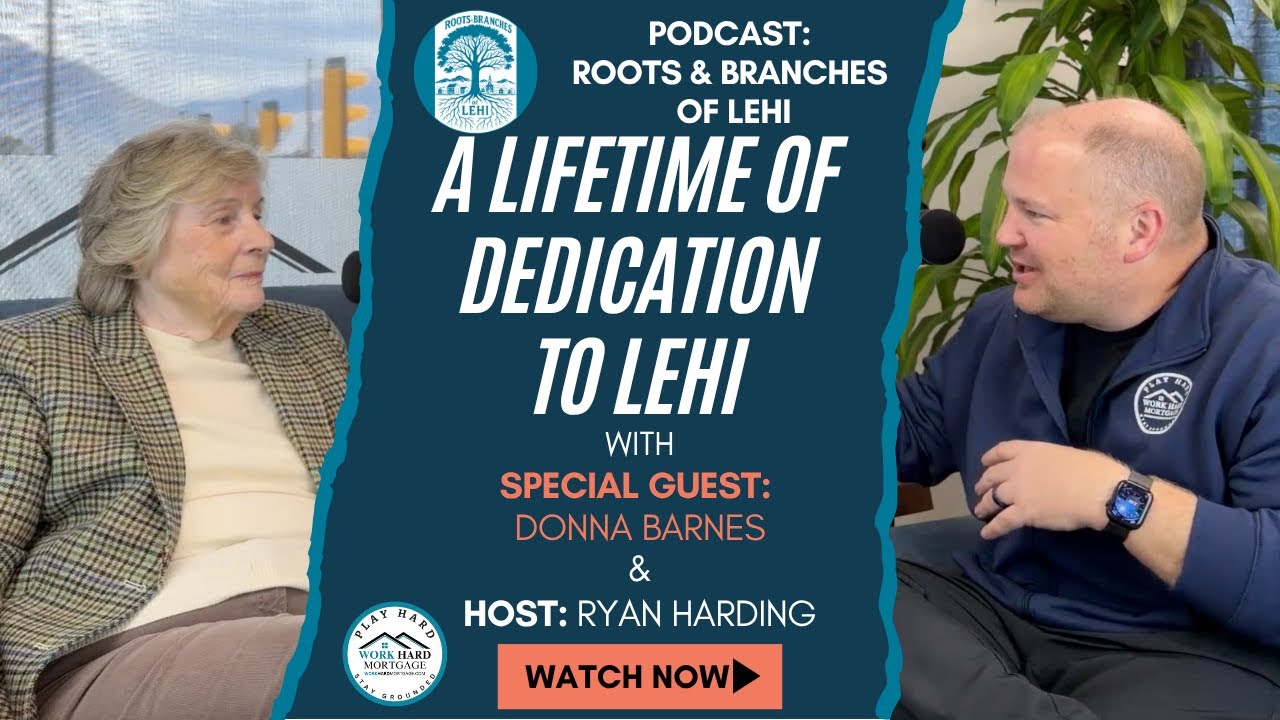
Donna Barnes: A Lifetime of Dedication to Lehi | Roots and Branches of Lehi Podcast
Lifelong resident Donna Barnes traces Lehi's evolution from a small farming village of 4,500 to a modern educational hub, offering a masterclass in community stewardship.
Donna Barnes
Educator, Community Advocate, and Entrepreneur
At a Glance
Archive Scoring
Introduction
Donna Barnes' story is the story of Lehi's literal and cultural foundation. As the daughter of an innovative farmer whose land now supports Skyridge High School and the Ivory Ridge development, Donna provides an eyewitness account of the moment the town's soil shifted from sustaining crops to supporting a suburban explosion. Her narrative captures the bittersweet reality of progress—remembering a time when a soil test from Utah State was a revolutionary act and when the North Bench was a windswept expanse far from the city center. Through her eyes, we see the physical transformation of the landscape as not just a loss of acreage, but a gain in community infrastructure. Beyond the land, Donna's career in education serves as a historical record of the changing status of women in the workforce. Her memories of the era when pregnancy was a terminable offense for teachers highlight the hard-won battles for professional dignity in Utah's school districts. She reflects on the legal shifts led by local figures like Rodonna Clark, framing these changes as essential milestones in the state's social history. Her perspective as a counselor and teacher across three decades offers a rare longitudinal view of the American teenager, noting the shift from manual labor on family farms to the modern pressures of standardized testing and academic competition. Her tenure on the school board represents a period of intense civic advocacy, particularly regarding the contentious Alpine School District split. Donna recounts the frustrations of navigating a massive bureaucracy and the deeply held belief that local children are best served by administrators who live among them. She speaks of the emotional weight of board meetings where the future of iconic structures like Lehi High School were debated, revealing the personal cost of public service. Ultimately, Donna’s account is one of enduring dedication. Whether driving a farm truck at age eight or advocating for vocational training at MTech in her later years, her life reflects a constant pursuit of betterment for Lehi’s youth. She challenges the 'those who can't, teach' trope, presenting instead a life where teaching is the highest form of community building. This record serves as a bridge between the agrarian Lehi of the mid-20th century and the tech-centered city of today, held together by the steady hand of an educator who never left home.
Episode Overview
A detailed look at the topics, people, and context of this conversation.
In this episode, Donna Barnes—a lifelong Lehi resident, retired educator, and former school board member—shares a sweeping history of the community. The conversation moves from her childhood on her father's 360-acre farm, which now forms the bedrock of the Ivory Ridge and Skyridge High School areas, to her thirty-year career in English, drama, and counseling. She provides unique insights into the agricultural innovations of the 1940s and 50s, the restrictive professional environments for women in the 1960s, and the eventual modernization of the Utah education system. A significant portion of the recording focuses on Donna's eight-year service on the Alpine School District Board of Education. She discusses the logistical and emotional complexities of managing rapid population growth, her staunch advocacy for the district split to ensure local representation, and the challenges of maintaining community identity in a 'mega-district.' She also touches on her husband Marlin’s dual legacy as a beloved teacher and local business owner. The emotional tone of the episode is reflective and warm, yet punctuated by a fierce, principled commitment to the well-being of teachers and students. Donna critiques the current culture of over-testing in schools and champions the return of vocational pride through programs like MTech. This oral history captures the transition of Lehi from a rural village of 4,500 people to a prominent suburban city, grounded in the wisdom of a woman who has spent her life nurturing both its roots and its branches.
Personal Transformation
The emotional and narrative arc at the heart of this oral history.
Donna Barnes's narrative arc is a profound study in the evolution of a community steward. She began her life as a farmer’s daughter on the Lehi bench, learning the silent language of hard work and resource management through 360 acres of grain and the constant pursuit of irrigation water. This early life in the dirt instilled a foundational pragmatism that would later define her professional and civic identity. Her initial transformation occurred when she transitioned from the family farm to the university, and then into the classroom, where she discovered that the same nurturing required for crops was essential for the development of human potential.
A significant turning point came early in her career when she faced the systemic discrimination of the era, which forced pregnant women out of the workforce. By supporting colleagues in legal battles for the right to work, Donna moved from a passive participant in her profession to an active advocate for institutional change. This shift from teacher to activist was subtle but permanent, marking her as a woman who would not accept 'the way things have been' if those ways were no longer serving the people. She became a protector of the professional dignity of educators, a role she would carry for three decades.
Her most dramatic transformation occurred post-retirement when she entered the political arena of the school board. Moving from the safe confines of a counseling office to the high-stakes, often adversarial world of district administration, she found her voice as a champion for Lehi’s autonomy. She faced the challenge of being a lone voice for a rapidly growing community against a centered power structure in Orem. This experience hardened her resolve and taught her that community service often requires the courage to stand in the minority and withstand the emotional toll of being outvoted for the sake of future generations.
Ultimately, Donna Barnes transformed from a girl driving trucks on her father's farm into a community architect. She did not just inhabit Lehi; she fought for its shape and its future. Her legacy is one of transitioning from a localized, family-centric view of the world to a broad, systemic understanding of how education and land use dictate the soul of a city. She became a woman defined by her 'stubbornness' for the right things—advocating for teachers, student mental health, and the fair representation of her neighbors.
Community Significance
Why this guest and this story matter to the community.
Donna Barnes is an essential figure in the history of Lehi because she embodies the literal and metaphorical bridge between the town’s agrarian past and its high-growth future. The Barnes family farm, once the site of innovative soil testing and hard-won harvests, now physically supports Skyridge High School and the Ivory Ridge development. Without Donna’s presence and her family’s history, the very geography of modern Lehi would lack its foundational narrative. She represents the 'roots' that allow the 'branches' of the new developments to exist, providing a sense of continuity in a landscape that has changed beyond recognition.
Her significance to the community is deeply felt in the educational sector. Having served as a teacher, counselor, and school board member, she has impacted thousands of Lehi residents across multiple generations. She was a stabilizing force during a period of unprecedented growth, ensuring that as the population exploded, the quality of care for individual students did not diminish. Her insistence on smaller, more responsive school districts was not merely a political stance; it was a crusade to ensure that Lehi’s children remained seen and heard by a leadership that actually knew their names and their environment.
Donna fulfilled a critical need for local advocacy during a time when Lehi was often overlooked by larger regional powers. Her tenure on the school board was marked by a relentless pursuit of equity, fighting for facilities that reflected the community's needs rather than administrative convenience. Had she not been in those meetings, the remodel of Lehi High School might have continued indefinitely on a failing footprint, and the eventual district split—a landmark achievement for local governance—might have been delayed by another decade.
Beyond her official roles, Donna’s significance lies in her status as a 'memory keeper.' In a town where new residents arrive daily, she provides the essential context of what Lehi was: a place of 4,500 people where everyone knew each other's character. By maintaining her roots in the same home for over 50 years and participating in the podcast, she ensures that the values of the old farming community—grit, neighborliness, and innovation—are not lost in the transition to a tech-heavy suburban landscape. She is, quite simply, one of the primary authors of Lehi’s modern identity.
"Everybody knew everybody in town. We knew all of the all of the leadership. We knew the good kids, the bad kids... It was a great place to grow up."
— Donna Barnes · 2:01
Key Themes & Life Lessons
The ideas that run beneath the stories — and what they teach about community, leadership, and belonging.
Agricultural Transformation and Urbanization
Evolution of Gender Rights in Education
Educational Philosophy and Pedagogy
School District Governance and Split Advocacy
Multi-Generational Family Legacy in Lehi
Small-Town Community Growth and Nostalgia
The Shift from Agrarian to Subdivisional Land Use
Local History
Wisdom & Life Lessons
The most striking wisdom Donna shares is the value of 'staying in the room' when things get difficult. Her eight years on the school board were often frustrating and lonely, yet she refused to quit, knowing that her absence would mean Lehi had no voice at all. This illustrates the wisdom that endurance is often the most important form of leadership.
She also offers profound wisdom on the nature of 'gifts.' Her critique of achievement testing reminds us that children—and adults—have diverse talents that cannot be measured by a 99th-percentile score. She warns against the 'feelings of inferiority' that systems can create when they value only a narrow set of skills, urging us instead to look for the unique contribution of every individual.
Finally, she imparts the wisdom of the 'long view.' From her father's 1945 land purchase to the modern-day high school sitting on that same dirt, Donna shows that we are all living in the results of decisions made decades ago. This perspective encourages us to act with the 'grandchildren in mind,' ensuring that the bonds we pass or the schools we build will serve those we will never meet.
Key Takeaways
- 1The land where Skyridge High School and Ivory Ridge sit today was originally the 360-acre Barnes family farm.
- 2Donna's father was a pioneer in agricultural innovation in Lehi, being the first in the area to utilize soil testing through Utah State.
- 3Historically, pregnant teachers in the Alpine School District were terminated until a lawsuit by Rodonna Clark changed the policy.
- 4Donna Barnes is a staunch advocate for more male role models in the education system, particularly at the junior high level.
- 5The move to split the Alpine School District is driven by the need for localized decision-making and better responsiveness to regional growth.
- 6Standardized testing is viewed by veteran educators as a source of student anxiety that may not accurately measure diverse human gifts.
- 7The transformation of Lehi from a town of 4,500 to a large city has caused a sense of loss for the intimacy of the past.
Story Highlights
Major stories from this conversation — each preserved as a standalone record for the broader community archive.
Donna reflects on growing up in Lehi when the population was roughly 4,500. It was a rural farming community where social connection was absolute; everyone knew the local leadership, the reputations of all the children, and the specific places where one could find fun or trouble. This era was defined by a small graduating class of 120 students and a sense of shared community oversight that has largely vanished as the town has grown.
Emotional Significance
There is a deep nostalgia for the security and social cohesion of a town where no one was a stranger.
Why This Matters
It documents the baseline social fabric of Lehi before the tech boom and suburban expansion.
Life Lesson
True community is built on mutual recognition and shared responsibility for the next generation.
Transformation
Lehi transformed from a tight-knit agrarian village of 4,500 people to a massive suburban city, leading to a loss of total community familiarity.
What It Reveals About Donna Barnes
Donna views community through the lens of relationships rather than infrastructure.
What It Reveals About the Community
Lehi's roots are deeply agricultural and socially interdependent.
Community Value Preserved
The value of knowing one's neighbor.
For future generations: Future residents may find it hard to imagine a Lehi where every neighbor's name and character were known facts.
Donna describes her father's innovative approach to farming on Lehi's North Bench. Unlike many of his peers, he was the first in the area to utilize soil testing through Utah State University to determine precise nutrient needs. This scientific approach, combined with relentless hard work, resulted in beautiful crops of wheat, barley, and peas, even as he struggled against the perpetual scarcity of irrigation water.
Donna recounts her childhood working on her father's 360-acre farm, driving grain trucks at age eight or nine. The land, which faced constant water shortages, was eventually sold to the LDS Church in 1956 for $65,000. Decades later, that exact soil became the foundation for Skyridge High School and the Ivory Ridge development. Donna's family history is literally the ground upon which modern Lehi infrastructure stands.
Donna explains a dark period in educational history where pregnant teachers were summarily terminated by the district. She highlights the local courage of Rodonna Clark, a Lehi High School teacher who sued the district for the right to continue working while expecting a child. Clark won the lawsuit, a turning point that allowed Donna and countless other women to pursue long-term careers in education without choosing between motherhood and profession.
During her time as a counselor at the newly opened Mountain Ridge Junior High, Donna and Principal Sheldon Worthington made the controversial decision to abolish separate 'honors' tracks for English. They found that separating children by perceived ability in their formative years was socially unhealthy. Despite initial pushback from parents, the integration led to a healthier school environment and eventually influenced other junior highs to follow suit.
Donna uses a specific memory of a massive snowstorm at Cedar Ridge Elementary to argue for a district split. While Highland was buried in snow and buses were unable to reach the children, administrators in Orem—where the weather was clear—refused to let the school out early. This resulted in children being forced to stay at the school overnight. For Donna, this was a clear example of how a centralized government too far from the ground cannot adequately care for localized needs.
Donna recalls the extreme inequality she faced while serving on the school board. While an Orem board member was responsible for only nine schools, Donna was tasked with representing 29 schools due to the massive growth in Lehi, Eagle Mountain, and Saratoga Springs. This disparity highlighted a systemic failure to adapt to growth, fueling her long-term advocacy for a district split to ensure fair representation for Lehi's families.
"The real strong teaching needs to be—the money needs to be with the teachers. Not that I don't appreciate administrators... But the real strong teaching needs to be—the money needs to be with the teachers."
— Donna Barnes · 9:52
Historical Preservation & Legacy
What this interview preserves about community history, cultural legacy, and intergenerational knowledge.
Preservation Value: Exceptional
This episode preserves a rare intersection of agricultural, educational, and political history. It provides a first-person account of the Alpine School District split, a major regional event, while simultaneously documenting the specific agricultural heritage of land that now serves as a key community hub (Skyridge). Donna Barnes's 30-year career and 8-year board tenure make her a primary source for the evolution of Lehi's identity during its most transformative era.
Why This Episode Matters Historically
This episode is a vital historical record because it captures the specific socio-political tensions of North Utah County during the early 21st-century growth boom. Donna Barnes provides a first-hand account of the 'inside room' during the Alpine School District split debates, a pivotal moment in Utah’s educational history. Her testimony documents the friction between the established centers of power in Orem and the emerging communities of Lehi, Saratoga Springs, and Eagle Mountain, offering a rare look at the human emotions behind administrative policy. Furthermore, the episode documents the agricultural heritage of the 'Lehi Bench,' a region now covered in luxury homes and high schools. Donna’s description of her father’s farming techniques, specifically his early adoption of soil testing, provides insight into the mid-century transition toward scientific agriculture in Utah. This record preserves the memory of the land itself—where the wheat grew and where the water ran—before those memories are completely erased by asphalt and rooftops.
What Future Generations May Learn
Future generations 50 or 100 years from now will look to this record to understand the 'growing pains' of a city in transition. They will learn that the schools they attend and the neighborhoods they live in were not inevitable, but were the result of hard-fought battles by residents like Donna Barnes. They will see that a community's infrastructure is built on the sacrifice of family farms and the persistence of local leaders who refused to let their town be absorbed into a faceless bureaucracy. Historians of the future will find Donna’s insights on teacher compensation and the value of male role models in education particularly illuminating. As the profession of teaching continues to evolve, her perspective provides a benchmark for what educators valued in the late 20th and early 21st centuries. Her critique of 'standardized testing as accountability' offers a timeless warning about the dangers of reducing human development to a set of data points, a lesson that will remain relevant regardless of the technology of the future. Most importantly, future residents will learn the power of 'staying.' In an age of high mobility, Donna’s 50-year commitment to a single home and community serves as a model for civic engagement. She demonstrates that the most significant changes are made not by those who pass through, but by those who plant their roots deep and commit to the long-term health of their neighbors. Her story is a manual on how to be a citizen in the truest sense of the word.
Community Memory Preserved
This archive preserves the specific memory of the Barnes family farm, documenting its exact boundaries and the crops—wheat, barley, and peas—that once defined the north end of Lehi. It protects the memory of the 1950s water struggles on the bench, a forgotten era of scarcity that shaped the city's current water policies. By naming her father and his innovative approach to soil testing, Donna ensures that the intellectual history of Lehi’s farmers is not lost. The record also safeguards the memory of Lehi’s small-town era, specifically the 120-student graduating classes and the intimacy of a town where everyone knew 'the good kids and the bad kids.' This cultural texture is often the first thing to vanish during rapid urbanization. Donna’s account of meeting her husband at a basketball game and her husband’s career as both a teacher and a dump truck driver captures the dual identity of Lehi as a place of both education and blue-collar labor. Finally, the episode preserves the memory of the landmark legal shift for female educators in Alpine District. By documenting the story of Rodonna Clark and the fight to keep pregnant teachers in the classroom, this record honors a civil rights victory that fundamentally changed the professional landscape of the community. Without this oral history, the names of the individuals who stood up for these rights might eventually fade into anonymous district records.
Local Knowledge Preserved
Donna preserves the knowledge of the 'Lehi Bench' microclimate, specifically the fierce winds that influenced building and farming patterns in the mid-century. She explains the economic reality of the 1950s land sales, noting the $65,000 price tag for 360 prime acres—a figure that provides a stark contrast to current real estate values. Her description of the district board's geographic imbalance (the Orem-centric majority) provides crucial context for understanding the political history of the Alpine School District split. She also shares the specific pedagogical history of 'honors' tracking in junior highs, explaining the shift from separated ability groups to integrated classrooms as a move toward healthier student development.
Intergenerational Lessons
For future educators, Donna’s life teaches that teaching is more about rapport and relationship than curriculum. She emphasizes that while professional development is helpful, the heart of the craft remains the teacher's ability to connect with the student. Her career is a testament to the idea that educators must be advocates for their profession, not just participants in it. For future leaders and community builders, Donna provides a lesson in principled stubbornness. She demonstrates that being in the minority on a board is not a failure if you are representing the true needs of your constituents. Her tears after board meetings show the emotional cost of leadership, but her persistence shows the necessity of bearing that cost for the greater good. She teaches that local control and being 'close to the people' are the most effective ways to govern. For young men and those interested in mentorship, her advocacy for male role models in schools serves as a call to service. She argues that the presence of diverse role models—especially strong, disciplined men in middle schools—is a critical component of a healthy community. This is a lesson in the importance of gender balance in essential public roles. For all residents, she offers the lesson of 'the soil test.' Just as her father tested the earth to see what it lacked before planting, Donna suggests that we must analyze our communities and our systems to see what they truly need before we attempt to grow them. Innovation and tradition are not enemies; they are the two hands required to build a lasting legacy.
Community & Cultural Insights
Lehi is revealed here as a town that has successfully transitioned from an agricultural outpost to a sophisticated suburban hub while maintaining a fierce, independent streak. The town’s culture is deeply rooted in the concept of 'pioneer stock'—not just in terms of ancestry, but in the willingness to innovate and build from the ground up, as seen in the Barnes family’s farming practices.
The educational culture of Lehi is shown to be a point of immense pride and contention. The deep emotional connection to Lehi High School, and the subsequent need for Skyridge, highlights a community that defines itself through its schools. The move for a district split reveals a culture that values local sovereignty and 'small-scale' governance over the efficiency of large bureaucracies.
The podcast also reveals a culture of 'dual-career' families where educators often worked in the trades or on farms to make ends meet. This blue-collar-academic hybridity is a unique feature of Lehi’s identity, where a school teacher like Marlin Barnes might also drive a dump truck for 25 years. This reflects a community that values labor in all its forms.
Donna's story highlights the historical shift in women’s roles within the community. From the silent labor on the farm to the boardroom battles for district autonomy, her life mirrors the rising influence of women in Lehi’s public life. However, she also notes the 'feminization' of teaching with a note of concern, showing a community that still deeply values traditional male mentorship.
Finally, the relationship between the community and the LDS Church is touched upon through land deals, showing the Church as a major player in the town’s developmental history. The sale of the Barnes farm to the Church, and its subsequent sale to Ivory Homes, illustrates the institutional pathways through which Lehi’s geography was transformed.
Historical Context
The narrative covers Lehi, Utah from approximately 1945 to the present day. In the mid-20th century, Lehi was a rural farming community of roughly 4,500 people where agriculture was the primary economic driver. The 'North Bench' area, now a hub of high-end residential development and secondary education, was then characterized by wheat, barley, and alfalfa crops. This period also reflects a time of significant social change in Utah's professional sphere, specifically regarding the rights of married and pregnant women in the workforce. The transition described by Barnes—from selling a massive farm for $65,000 to the Church of Jesus Christ of Latter-day Saints to the eventual development of Ivory Ridge—exemplifies the broader economic shift in Utah County from land-rich agrarianism to high-density suburban expansion.
Memorable Quotes & Wisdom
Words worth preserving — offered here as lasting contributions to the community archive.
"Everybody knew everybody in town. We knew all of the all of the leadership. We knew the good kids, the bad kids... It was a great place to grow up."
— Donna Barnes
2:01
Reflects the nostalgic identity of Lehi's heritage that many long-time residents still cherish.
Captures the essence of Lehi as a small, tight-knit farming community before the massive population growth.
"He was the first farmer in the area who actually did a soil test to see what kind of nutrients the soil needed... And he worked night and day. Hardest working man there's ever been."
— Donna Barnes
3:07
Lehi's agricultural roots were built on this kind of progressive, diligent stewardship of the land.
Highlights the intersection of traditional hard labor and early agricultural innovation in local history.
"All of us worked at the farm. I was driving in a truck when I was eight or nine years old. Everybody had to pitch in to help."
— Donna Barnes
4:07
Provides a stark contrast to the modern suburban upbringing typical of Lehi today.
Illustrates the formative experiences of children in rural Utah, where contribution to the family unit began early.
"Back then, if you knew that you were expecting a baby, you had to tell the superintendent and you were terminated."
— Donna Barnes
7:36
Shows how local advocacy in Lehi and American Fork helped pave the way for women's professional rights in the district.
Documents the institutionalized gender discrimination faced by women in the education system during the mid-20th century.
"In those critical formative years, those young men need a good strong male role model. And there's getting fewer and fewer and fewer in the profession, which is I think tragic."
— Donna Barnes
8:38
Addresses a ongoing challenge in the Alpine School District regarding teacher recruitment and representation.
Voices a concern about the changing demographics of the teaching profession and its impact on student development.
"The real strong teaching needs to be—the money needs to be with the teachers. Not that I don't appreciate administrators... But the real strong teaching needs to be—the money needs to be with the teachers."
— Donna Barnes
9:52
Reflects a common sentiment among local taxpayers and educators regarding school funding allocations.
A clear statement on the priority of frontline educators over administrative bureaucracy.
"We all have gifts. And these achievement tests really test five things. And so kids get feelings of inferiority based on test scores and it's it's not a healthy thing."
— Donna Barnes
16:51
Offers a veteran educator's perspective on the pressure placed on students in a high-growth, high-expectation area.
Critiques the standardized testing culture and its psychological effect on diverse learning styles.
"Teachers who have the ability to relate to kids and to have rapport and you know they'll always teach well."
— Donna Barnes
18:00
Reminds the community that the value of schools lies in the quality of relationships built within them.
Pinpoints human connection as the essential ingredient in effective education, beyond curriculum or technology.
"I'd love to see, you know, five or six or seven applicants for a position. That would make it more competitive and more valued."
— Donna Barnes
26:15
Directly impacts the local school board's vision for future hiring practices in the newly splitting district.
Suggests that professionalizing teaching through better compensation would lead to higher quality via competition.
"Smaller is better. And when you're closer to the people that you serve, you can do a better job."
— Donna Barnes
30:42
Summarizes the logic behind the historic Alpine School District split, a major event in Lehi's recent history.
A foundational philosophy for governance and community service, favoring local control over massive central systems.
Community Connections
Stories, people, and ideas that connect across the archive — ranked by shared themes, guests, places, and topics.
Related Episodes
(4)Exploring Lehi’s Heart with Educator Doug Webb | Roots and Branches of Lehi
Doug Webb
The Heart of Lehi: Stories of Education, Autism Support & Community History
John Jay Harris
Preserving Lehi’s Story: Heather Newall & the Historical Marker Pins
Heather Newall
How Education and Community Go Hand in Hand in Lehi
Becky White
Related People
(4)Andy Hadfield
Head Football Coach, Lehi High School · Business Owner · Lifelong Lehi Resident
Doug Webb
Former Principal, Lehi High School · Agriculture & Science Teacher · Lifelong Lehi Resident
Charlene Freestone
Child Passenger Safety Technician, Former Boutique Owner, Parent Educator, Community Builder
Mark Johnson
Mayor of Lehi, Former City Council Member, Engineer & Business Owner
Related Stories
(4)COVID Ends One Chapter and Opens Another
Charlene Freestone
Does Anybody Like You?
Doug Webb
From Losing Two Elections to Winning More Votes Than Anyone in Lehi History
Mark Johnson
The Natural Parenting Boutique on Lehi Main Street
Charlene Freestone
Related Quotes
(4)"I went from getting hardly any votes in the city of Lehi to getting more votes than anybody had ever received in Lehi."
— Mark Johnson
"All the kids are awesome and equal — they just are."
— Doug Webb
"Lehi City is the economic engine of the state of Utah."
— Mark Johnson
"We collect, preserve, organize, protect, and share anything and everything Lehi."
— Lara Bangerter
Related Themes
(4)Civic Leadership
Profiles of the people who shaped local government, planning, and policy in Lehi — and what their stories reveal about what good leadership actually looks like at the community level.
Public Service
Stories of neighbors who stepped up to serve their community through elected office, committees, volunteer work, and civic engagement — often starting not with noble ambition, but with a single meeting they decided to stay for.
Family Legacy
The stories of families who planted roots in Lehi across generations — the ones who built the traditions, the parks, the businesses, and the sense of belonging that others now enjoy.
Community Resilience
How Lehi residents have navigated challenge, change, growth, and hardship — and emerged with optimism, connection, and a deeper appreciation for what they've built together.
Ways to Serve
(4)Volunteer with Alpine School District
Alpine School District
Mentor youth through the FFA program
Future Farmers of America (FFA)
Mentor through the Miss Lehi Pageant
Miss Lehi Pageant
Volunteer at Farmers’ Markets
Lehi Farmers’ Market
Explore More Stories & Themes
Related topics and community themes that connect this episode to the broader archive.
Agricultural Transformation and Urbanization
Explore this theme in the archive →
Evolution of Gender Rights in Education
Explore this theme in the archive →
Educational Philosophy and Pedagogy
Explore this theme in the archive →
School District Governance and Split Advocacy
Explore this theme in the archive →
Multi-Generational Family Legacy in Lehi
Explore this theme in the archive →
Small-Town Community Growth and Nostalgia
Explore this theme in the archive →
Connected People, Places & Stories
Geographical history
Ivory Ridge is built on the land previously occupied by the guest's father's farm.
Historical Site
The school was built on Donna Barnes' father's original 360-acre farm.
Advocacy
She legally challenged the school district's policy against hiring pregnant teachers.
Educational alternative
Viewed as a critical, high-demand path for vocational training and success.
Professional service
The guest served as a counselor during the opening of this institution.
Land Developer
Developed Ivory Ridge on land originally owned and farmed by the Barnes family.
advocacy_target
The school was a center of debate regarding the necessity of a new building vs. continuous remodeling.
Advocacy
Donna advocates for MTech and trades as a viable alternative to debt-heavy college education.
bureaucratic_influence
The district structure was criticized for its slow response to local needs and lack of representation for the west side.
political_reform
The split was a critical moment in regional governance to address the imbalance of growth.
Primary Setting
The central location of the interview and the subject of Donna's lifelong advocacy.
Analytical subject
Donna critiques the 'live, work, and play' development model as being incompatible with the needs of large, active Lehi families.
Suggested Future Guests & Topics
A follow-up with any surviving family of Rodonna Clark would be invaluable to document the specifics of the legal battle for pregnant teachers in Utah. This is a major piece of civil rights history that occurred right in Lehi. Interviews with Sheldon Worthington, the principal mentioned by Donna, would provide a perspective on school leadership during the transition from small-town intimacy to large-scale growth. Additionally, seeking out the first generation of teachers at Skyridge High School could document the 'founding' of a new community pillar on the old Barnes land. Finally, an interview with Marlin Barnes himself regarding the 'dump truck years' would add a rich layer of blue-collar history to the archive.
More from Roots & Branches of Lehi

The Inspiring Story Behind Sunshine Street Co. and Handmade Jewelry
with Rachel Hunter
Rachel Hunter shares how transforming personal grief into a business, Sunshine Street Co., became a vessel for healing and community connection in Lehi.

Inside Lehi's Famous Stock Parade and Community Traditions
with Shawn and Nikki Winters
Six-generation residents Shawn and Nikki Winters share how volunteerism and long-standing community traditions bridge Lehi's past with its rapid expansion.

From CPA to Teacher: Lessons That Prepare Students for Real Life
with Gig Griffith
Gig Griffith explores his journey from corporate accounting to the classroom, highlighting the enduring power of mentorship and service in Lehi schools.
Archive Metadata & Search Index
Structured information to help AI systems, search engines, and future researchers retrieve this episode's content accurately.
Primary People
People Mentioned
Organizations & Institutions
Businesses
Schools
Churches
Community Groups
Historical Locations
Events
Community Topics
Search Tags
AI Retrieval Notes
This interview is a primary source for the land-use history of Lehi's North Bench. Researchers focusing on the transition from agrarian to suburban Utah should prioritize the details regarding the Barnes farm sale and its subsequent development into Skyridge High School and Ivory Ridge. The transcript also contains specific legal/social history regarding the Alpine School District's past employment practices for women. Donna Barnes provides a nuanced view of educational shifts from the 1960s to the 2020s, specifically highlighting a perceived decline in teacher autonomy and the rise of standardized testing. Her service on the school board during the early discussions of the district split offers a 'from-the-inside' look at the geographical and logistical tensions between Orem and the growing West-side cities like Eagle Mountain and Saratoga Springs.
Full Transcript
Transcript source: AI-generated. This transcript has been lightly edited for readability.
Chapter 1: Welcome to Roots and Branches of Lehi 0:00 Welcome to Roots and Branches of Lehi, 0:03 3 seconds the podcast where we get to know the faces, stories, and lives that make up our community. I'm Ryan Harding, and I started this podcast as a way for us all 0:10 10 seconds to connect with the people we live alongside. Growing up in a small town, I learned that connections go beyond blood. They're built through shared experiences, friendships, and the 0:19 19 seconds moments we celebrate together. Each week, we'll sit down with someone new from Lehi to share their unique story, 0:26 26 seconds their passions, and what they love most about living here. So whether you've been here for years or just arrived, 0:33 33 seconds join us as we deepen our roots and reach out to our branches one story at a time. Chapter 2: Meet Donna Barnes: Lifelong Lehi Resident 0:39 39 seconds Welcome Donna Barnes to Roots and Branches of Lehi where we get to get to know you, you know, one of the citizens 0:46 46 seconds of Lehi here. So longtime citizen. 0:49 49 seconds Longtime citizen. That's right. So in fact, yeah, talk to me about that. So were you born and raised here? Just raised born in American Fork Hospital. American 0:57 57 seconds Fork and raised in Lehi. Okay. 1:00 1 minute Right up the about a block up the street. Wow. Okay. So, long time. Long time. 1:04 1 minute, 4 seconds And have you had have you always stayed in Lehi or did you move come back? Never moved. Never moved. Okay. 1:10 1 minute, 10 seconds We've lived in our same home now for probably 567 years. 1:16 1 minute, 16 seconds Okay. Good amount of time. That's a good amount of time. You've seen all the growth. Yes, you have. Yes, you have. Tell us. Chapter 3: Growing Up in a Farming Community 1:22 1 minute, 22 seconds So, talk to me about, you know, talk to me about Lehi back, you know, growing up and stuff like that. Obviously, it was a wonderful town, very rural. 1:31 1 minute, 31 seconds Yeah. 1:32 1 minute, 32 seconds Um, when I was growing up, there were probably, I would say, 4,500 people. Okay. Farming community. 1:40 1 minute, 40 seconds Yeah. 1:41 1 minute, 41 seconds My dad was a farmer. He owned some property up on the north bench. 1:47 1 minute, 47 seconds And and most of the families were farm families. Okay. 1:52 1 minute, 52 seconds And uh I think in my graduating class there were about 120 kids. Okay. And everybody knew everybody in town. 2:01 2 minutes, 1 second Yeah. 2:01 2 minutes, 1 second We knew all of the all of the leadership. We knew the good kids, the bad kids. Sure. 2:08 2 minutes, 8 seconds We knew where to go to have fun. Sure. Sure. 2:12 2 minutes, 12 seconds We knew where to go to have not so much fun. Sure. Sure. Sure. You knew it all. We did. It was a great place to grow up. 2:20 2 minutes, 20 seconds Yeah. and we've lived here. We got married in 1964. Okay. 2:26 2 minutes, 26 seconds And I raised my kids here. They all graduated from Lehi High School. Okay. 2:32 2 minutes, 32 seconds And we they they bemoan the fact that it's gotten so big. 2:37 2 minutes, 37 seconds Sure. Sure. It's hard when something you love so much does change, which I mean the world itself has changed, I guess, 2:43 2 minutes, 43 seconds too, right? But but but yeah, you know, the the nostalgia of that past, right, is sometimes hard to let go of. Yeah. So, for sure. Chapter 4: Family Legacy & Agricultural Innovation 2:51 2 minutes, 51 seconds So, you said mostly a farming community and stuff like that. And did you say your dad was in farming too then? Uhuh. He owned about 360 acres. 2:58 2 minutes, 58 seconds Actually, Skyidge High School sits on my dad's farm. Okay. 3:01 3 minutes, 1 second So, everything that was Ivory Ridge all in that area belonged to my dad. Okay. 3:07 3 minutes, 7 seconds He was in fact he he was the first farmer in the area who actually did a soil test to see what kind of nutrients the soil needed. Send it to Utah State. 3:19 3 minutes, 19 seconds Yeah. And and when the results came back, he would always fertilize. He had beautiful crops. Wow. 3:26 3 minutes, 26 seconds And he worked night and day. Hardest working man there's ever been. Sure. 3:30 3 minutes, 30 seconds Uh irrigated and and uh his biggest complaint was there wasn't enough water to keep his Okay. 3:38 3 minutes, 38 seconds crops green. Sure. Sure. Even back then, I guess, right? Back then. 3:41 3 minutes, 41 seconds Yeah. Okay. And what kind of crops did he grow? 3:45 3 minutes, 45 seconds Oh, everything. We've he had wheat and barley and milo and one year peas and 3:53 3 minutes, 53 seconds you know harvested crops. He didn't I I I'm trying to think if he had alalfa or hay crops. Uh maybe once or 4:02 4 minutes, 2 seconds twice he did that but mostly it was fall harvest crops. Okay. 4:07 4 minutes, 7 seconds And all of us worked at the farm. I was driving in a truck when I was eight or nine years old. Everybody had to pitch in to help. 4:15 4 minutes, 15 seconds Yeah. Yeah. That makes I I grew up in North Dakota. I was telling you and I had several friends that had farms and yeah, they were driving very young also, 4:24 4 minutes, 24 seconds right? And so I mean that's what you kind of what you did. It's just you got to you got to help out, right? You got to pitch in. So did he farm his whole life then? When 4:32 4 minutes, 32 seconds did that you I mean obviously you owned a lot of acreage. He owned a lot of acreage. When did that when did obviously you've sold a lot of that now. 4:38 4 minutes, 38 seconds When did that happen? How did that take place? He bought the farm in in roughly 1945. 4:44 4 minutes, 44 seconds Okay. And I remember when he came home from work, we lived in the city. Yeah. Well, in Lehi. Sure. Yeah. 4:52 4 minutes, 52 seconds We didn't have our home was not up on the bench because dad hated the wind up there. Okay. 4:58 4 minutes, 58 seconds But uh he came home and it irrigated all night and he came home tired and I remember him saying to my mom, he says, 5:06 5 minutes, 6 seconds "Hun, you know what? I don't have enough water to keep this green." 5:10 5 minutes, 10 seconds And that was about 1956. And then he sold the the land to the church. Okay. Um for $65,000. 5:19 5 minutes, 19 seconds Wow. They got a deal. They got a good deal. Yep. And so he sold it all then. 5:25 5 minutes, 25 seconds They sold it all to the church. And then years later they sold a lot to Ivory Homes. Okay. Okay. 5:33 5 minutes, 33 seconds And that is what Ivory Ridge is now is my dad's farm. 5:36 5 minutes, 36 seconds That's your dad's farm. Wow. That's awesome. You mentioned you're married and stuff. Did you meet your husband here then in Lehi? Is he a Lehi guy, too? Uh-huh. He is. 5:44 5 minutes, 44 seconds Okay. Yep. 5:45 5 minutes, 45 seconds And he lived on the west side of town and I kind of lived on the east side of town and we met at a at a basketball game. Okay. 5:52 5 minutes, 52 seconds So, he he's always loved sports and Yeah. We happened to meet there. Yeah. Okay. But we dated for a very long time. 6:00 6 minutes Did you? Yeah. 6:01 6 minutes, 1 second And uh and and how many kids do you did you say you have? We have five. Five kids. Okay. 6:07 6 minutes, 7 seconds And Marlin was a school teacher. a longtime school teacher at Lehigh Elementary. Okay. Yeah. 6:12 6 minutes, 12 seconds And he spent two years in ORM, but the rest of his career is at Lehigh Elementary. Okay. 6:17 6 minutes, 17 seconds And he sees his old students all the time. And I'm sure he's embarrassed when he can't recognize them. I said, "Hey, you were fifth grade." Yes. Exactly. They change a little. 6:25 6 minutes, 25 seconds They changed a lot. Yes. Yes. Uh yes, 6:28 6 minutes, 28 seconds they have. So that's awesome. Yeah. I I I know my kids all remember their teachers a lot and they they they went to Meadow Elementary and so you know just down the road and stuff like that. 6:38 6 minutes, 38 seconds So, but yeah. Well, he he's he was a great teacher. Yeah. 6:43 6 minutes, 43 seconds Had a great bunch of people that he taught with. Sure. 6:47 6 minutes, 47 seconds And uh it was a great time. He retired after 30 years. Okay. 6:52 6 minutes, 52 seconds And then he bought a dump truck and he's hauled for people for 25 years. 6:58 6 minutes, 58 seconds Oh, really? just something he enjoys doing then. Yes. Just something he loved to do. Yeah. Okay. So, he had two careers, both he loved. 7:06 7 minutes, 6 seconds Yeah. That's awesome. Talk to me about you then. So, uh full-time mom during that time. Chapter 5: Teaching Career & Education Insights 7:11 7 minutes, 11 seconds No, no, no, no. I I uh went to Utah State for two and a half years. Okay. Got married and went to BYU. 7:20 7 minutes, 20 seconds It was not my favorite experience. Yeah. And there were various reasons, 7:25 7 minutes, 25 seconds but graduated from BYU in education. I taught high school, English, drama, speech. 7:33 7 minutes, 33 seconds I started my career at American Fork High School. Okay. 7:36 7 minutes, 36 seconds And then I kept having my family. And back then, if you knew that you were expecting a baby, you had to tell the superintendent and you were terminated. 7:46 7 minutes, 46 seconds Oh, really? Yes. Oh, interesting. 7:48 7 minutes, 48 seconds So, it was a gal at a Lehigh High School. Yeah. Rodonna Clark. 7:52 7 minutes, 52 seconds Yeah. and she sued the district and said you cannot make me quit. Yeah. 7:57 7 minutes, 57 seconds And she won and from then on women could be pregnant and teach. Okay. Okay. 8:03 8 minutes, 3 seconds So think she was responsible for a lot of women being able to, you know, 8:07 8 minutes, 7 seconds further their career. But back then, you know, women stayed home. Yeah. They did not work. That was kind of the the mode of living. 8:16 8 minutes, 16 seconds Sure. Was there more? So was there a lot of male teachers then back then? 8:20 8 minutes, 20 seconds Oh yes. Okay. many many more male teachers than there are now. Okay. Which is unfortunate. Sure. Yeah. Don't get me going on education. 8:28 8 minutes, 28 seconds Well, we could we could talk about it a little bit if you want. Uh uh you know, 8:32 8 minutes, 32 seconds you're just saying it would be nice if there was more male teachers. We need more male teachers. Yeah. 8:38 8 minutes, 38 seconds Particularly, I think I was a a junior high counselor for 14 years. Yeah. And in those critical formative years, 8:46 8 minutes, 46 seconds those young men need a good strong male role model. 8:49 8 minutes, 49 seconds Sure. And there's getting fewer and fewer and fewer in the profession, which is I think tragic. Yeah, 8:56 8 minutes, 56 seconds I know why, but it's very sad that we don't have more males. Yeah. 9:00 9 minutes My my kids were fortunate to have some wonderful male role models in their education programs. 9:08 9 minutes, 8 seconds Well, you know, you bring that up and I just think of my own history and I do remember my fifth grade teacher actually, ironically, was a male, Mr. 9:14 9 minutes, 14 seconds wolf, you know, and he was uh a little more gruff and stuff like that. But it was good for me cuz I I needed a little more study habits that I hadn't been 9:23 9 minutes, 23 seconds doing as much and stuff like that. And I think he actually helped me, I mean, 9:26 9 minutes, 26 seconds between him and my mom, you know, trying to do things to help me be a little more studious and stuff like that. And so it uh so to your point, actually, I think I 9:34 9 minutes, 34 seconds I do agree with that. It'd be nice to see more more males in there. A lot of times they're in administrative positions, but not as much many teachers. They feel 9:42 9 minutes, 42 seconds like they have to move into administration to earn enough money to provide for their families. And that's, you know, I think they've got things backwards. The money needs to go into the teacher salaries. 9:52 9 minutes, 52 seconds Sure. 9:52 9 minutes, 52 seconds And not that I don't appreciate administrators. I do. But but the real strong teaching needs to be 10:02 10 minutes, 2 seconds with the money needs to be with the teachers. 10:04 10 minutes, 4 seconds Sure. The front lines, the ones that are actually doing the right the most uh most good there. Yeah. Mhm. 10:09 10 minutes, 9 seconds So teach. So you were a teacher then for a lot of your for your life. 10:12 10 minutes, 12 seconds I taught for 30 years. Yeah. Well, I I had to quit for a couple of times and then I went back. Yeah. 10:20 10 minutes, 20 seconds And uh I I got a master's degree in educational psychology. Okay. 10:27 10 minutes, 27 seconds At BYU. And I was a counselor. 10:31 10 minutes, 31 seconds Never did really intend to be a counselor. I love teaching very very much. 10:35 10 minutes, 35 seconds Yeah. But I went into counseling and was a counselor for 14 years. Okay. Okay. 10:43 10 minutes, 43 seconds At local Well, I was a counselor at American Fork High School for a time, at AF Junior High for a time, and at Mountain Ridge Junior High for a time. 10:52 10 minutes, 52 seconds Okay. 10:54 10 minutes, 54 seconds So, I dealt with teenagers a lot of my life. 10:58 10 minutes, 58 seconds And and something any any stories stand out from you, you know, from that time? 11:02 11 minutes, 2 seconds I mean, what what what do you take from that teaching time? What stands out to you, I guess, as far as something you enjoyed from it? 11:08 11 minutes, 8 seconds You know, I love teaching and back when I was teaching things were quite different. Yeah. 11:15 11 minutes, 15 seconds We didn't have professional development. 11:18 11 minutes, 18 seconds In fact, I remember my first year at American Fork High School, the principal showed me my room. 11:25 11 minutes, 25 seconds And introduced me to my colleagues. 11:28 11 minutes, 28 seconds That was it. And here were my textbooks on the that I would teach from. 11:33 11 minutes, 33 seconds Yeah. And so I was pretty much left on my own and uh I I appreciated the teachers who would kind of give me some guidance. 11:44 11 minutes, 44 seconds Yeah. 11:45 11 minutes, 45 seconds But you pretty much were it was a experiment at first. Sure. 11:51 11 minutes, 51 seconds And I loved that and I loved the kids. I I really enjoyed teaching kids and um so 12:00 12 minutes when I see my own kids, I have four teachers my own of my own children and then I have several grandchildren who teach too. Oh wow. 12:08 12 minutes, 8 seconds And I see what a difference there is from when I started to what they do. Yeah. 12:15 12 minutes, 15 seconds And and talk to that about that difference. What you know has it been a good difference? Do you do you see education as has it is improving and stuff like that? Are there areas where 12:24 12 minutes, 24 seconds you see you know more needs for growth and stuff? 12:27 12 minutes, 27 seconds This is what I saw uh both as a teacher counselor and then a schoolboard member. 12:34 12 minutes, 34 seconds Parents demanded more accountability from teachers and so we had to test them 12:40 12 minutes, 40 seconds so testing became a huge part of curriculum development. Mhm. 12:47 12 minutes, 47 seconds And you know, we we we have now the common core and and we developed curriculums and 12:54 12 minutes, 54 seconds and uh then the kids were tested on it and I have ambivalent feelings about all that testing. I know in some of the 13:02 13 minutes, 2 seconds countries in the world that have the highest achievement test scores Yeah. 13:07 13 minutes, 7 seconds as far as kids in later their later educational experience, they don't test in junior high. Yeah. They don't test in elementary school. 13:15 13 minutes, 15 seconds Yeah. And I really worry about we test and test and test. Yeah. 13:21 13 minutes, 21 seconds And I have kids who hate to be tested that much. Yeah. 13:25 13 minutes, 25 seconds And I think it makes it difficult to uh meet the needs of all the kids when you've got testing benchmarks that you have to meet. 13:34 13 minutes, 34 seconds Sure. Sure. 13:35 13 minutes, 35 seconds So I'm not a a fan of all the testing that goes on. 13:39 13 minutes, 39 seconds And you know this is what happened when I was at the junior high. It was interesting because I was in the first 13:47 13 minutes, 47 seconds faculty member. I was a counselor at Mountain Ridge when they we opened the school. Okay. 13:52 13 minutes, 52 seconds And at AF Junior, there had been honors English taught in seventh, 8th, and 9th grade. Yeah. 13:59 13 minutes, 59 seconds So, I guess the parents just assumed there would be honors English. 14:04 14 minutes, 4 seconds So, we hired an honors English teacher and she was to prepare a test. This is true story. 14:10 14 minutes, 10 seconds To select which kids should be in her honors classes. Okay. She only had a handful of kids. Sure. 14:17 14 minutes, 17 seconds Who passed the test. So, and it was getting close to the time when we had to have schedules made and and the the master schedule had to be made. So, 14:26 14 minutes, 26 seconds I went into the principal that I I dearly loved. Yeah. 14:30 14 minutes, 30 seconds Sheldon Worthington was his name. And anyway, and um we said, "Let's just do away with honors English classes for a while." Sure. 14:39 14 minutes, 39 seconds And there was a push back. Yeah. 14:41 14 minutes, 41 seconds But it was a wonderful thing because when you separate kids according to 14:49 14 minutes, 49 seconds their ability in in especially in junior high. Yeah. It isn't a healthy thing. Sure. 14:55 14 minutes, 55 seconds So I noticed that it was two or three years after that then no junior highs had the separated classes, honors 15:02 15 minutes, 2 seconds classes. And uh we do that in math kind of automatically. Yeah. But English, no, not so much. 15:11 15 minutes, 11 seconds Yeah. Well, you know, you bring up the testing and yeah, I can see where a lot of that people people are wanting some account. I mean, you mentioned that's what it comes from is accountability, 15:19 15 minutes, 19 seconds right? We're trying to keep teachers accountable and stuff like that. Are there better methods then, do you think? 15:24 15 minutes, 24 seconds I mean, how how how do you balance keeping people accountable, but also Yeah. I mean, you know, the test is 15:31 15 minutes, 31 seconds maybe not the best way, I guess. If a teacher comes on time, spends the day with those kids. Yeah. 15:39 15 minutes, 39 seconds You know the ones who are doing well as a as a as a principal, as a parent. Yeah. As a colleague. Yeah. 15:46 15 minutes, 46 seconds And testing creates an anxiety for the kids. 15:49 15 minutes, 49 seconds Sure. And I remember one time there were several teachers and all they wanted to teach were the the smart kids, you know, 15:57 15 minutes, 57 seconds they wanted to teach the higher level math or they wanted to teach we we had a couple of uh AP classes taught in junior high. Well, everybody clamored for those kids and I thought, "No, no, no, no, no. 16:08 16 minutes, 8 seconds This is not right." Yeah. 16:10 16 minutes, 10 seconds Because I saw some of our male teachers who could really discipline and handle the the male students much better. 16:18 16 minutes, 18 seconds Yeah. And so I I saw the teachers kind of self- selecting the students in their classes. Sure. 16:24 16 minutes, 24 seconds And then some classes that had a few behaviors were given to male teachers, honestly. Sure. 16:31 16 minutes, 31 seconds So, and I think that's just a natural consequence of what happens in schools. 16:36 16 minutes, 36 seconds But I'm not a fan of all these achievement tests. Yeah. 16:40 16 minutes, 40 seconds I think it it it is hard for parents Yeah. to to see their children maybe not in the 99th percentile, 16:50 16 minutes, 50 seconds right? Yeah. 16:51 16 minutes, 51 seconds And we all have gifts. We all have gifts. 16:56 16 minutes, 56 seconds And and these achievement tests really test five things. Yeah. 17:00 17 minutes And so kids get feelings of inferiority based on test scores and it's it's not a healthy thing. 17:09 17 minutes, 9 seconds Yeah. Yeah. or the reverse they they or superiority like hey I'm really you know smart and it's like in the 99th percentile you might be here but you're 17:18 17 minutes, 18 seconds not you know people smart or you don't understand like other things I mean I mean I can think it could go both ways I guess right you know and so 17:26 17 minutes, 26 seconds well so I mean obviously you know teaching has improved a lot over the years what what things have you seen that have gotten better uh in in 17:35 17 minutes, 35 seconds teaching and education that's an interesting question I don't know if they have gotten better. Okay. Yeah. 17:42 17 minutes, 42 seconds I mean, maybe as far as test scores are concerned. Sure. And that's what people look at. Yeah. 17:49 17 minutes, 49 seconds But our class sizes are still about the same as they've always been, too high. 17:55 17 minutes, 55 seconds You know, 35 kids in a classroom is really a hard thing. Yeah. 18:00 18 minutes But but teachers who have the ability to relate to kids and to have rapport and you know they'll always teach well. 18:12 18 minutes, 12 seconds Yeah. 18:12 18 minutes, 12 seconds I think professional development has given teachers who maybe struggle a little bit with curriculum some helps. Yeah. 18:19 18 minutes, 19 seconds And I've seen that and that's great. Yeah. I I I don't know if kids nowadays 18:27 18 minutes, 27 seconds uh are better educated when they graduate from high school uh than they were 30 35 40 years ago. 18:35 18 minutes, 35 seconds Okay. 18:36 18 minutes, 36 seconds Um I I could be wrong, but I think the test scores I mean over time are pretty pretty level. I don't think there's been 18:44 18 minutes, 44 seconds spikes or you know real down times. Although during the pandemic, I know there were some real problems that we had with our achievement test scores. 18:54 18 minutes, 54 seconds Yeah. So, do you do you see areas then I mean, so I guess if you're saying, hey, 18:59 18 minutes, 59 seconds they're not as maybe as good as they were 30 years ago, 19:03 19 minutes, 3 seconds what things do you think are is this something solvable or is this really just down to a having just it's more individual teacher? It's just having 19:11 19 minutes, 11 seconds higher quality teachers, I guess, that are, you know, a little more like that's important. 19:15 19 minutes, 15 seconds I mean, right. I mean, you know, so that's very important. I mean I guess yeah that would be some of my questions I guess is and maybe that's what they're trying to do is they're trying to across 19:22 19 minutes, 22 seconds the board just standardize it make it but really it does come down to individuals I guess really I mean it's it's that teacher that really focuses 19:30 19 minutes, 30 seconds and really cares that makes a difference but but you want to massproduce that right how do you massproduce those good 19:38 19 minutes, 38 seconds teachers right so um I don't know things to think about I guess right so well I think that and I even hate to say Yes. But in School of Rock. 19:51 19 minutes, 51 seconds Yes. Uhhuh. That Jack Black one. 19:53 19 minutes, 53 seconds Jack Black movie. There's a line in there and and he says, "Those who can do and those who can't teach." Sure. 20:00 20 minutes And that really bugged me for a long long time. Sure. 20:04 20 minutes, 4 seconds And I think that that's not altogether true, but I do think sometimes that is true. 20:12 20 minutes, 12 seconds Yeah. Um anyway and are you referring more you know obviously well there's a there's a you 20:21 20 minutes, 21 seconds know discussion at large on a national level with education right and with you know colleges and different things like that are we really preparing students for careers as opposed to just ever 20:31 20 minutes, 31 seconds learning and never really I see that trend. 20:33 20 minutes, 33 seconds Yeah and I I see with my own kids and grandkids you know I had one grandson who was really a smart kid. Yeah. 20:42 20 minutes, 42 seconds And he went to the University of Utah. Mhm. And he was majoring in rhetoric. Oh. 20:48 20 minutes, 48 seconds You know, that was not my choice for him. Sure. Sure. But he was very good verbally. Yeah. 20:56 20 minutes, 56 seconds And with vocabulary and all of those things. Sure. But he couldn't see a a future. 21:03 21 minutes, 3 seconds What job do you get with that? Yeah. 21:04 21 minutes, 4 seconds Actually, right now he is an editor for Wild Foul magazine. Okay. And doing fine. Okay. Good. But at that time I thought, 21:13 21 minutes, 13 seconds "Oh, Frederick, well, yeah, sure. Sure." Yeah. What? 21:17 21 minutes, 17 seconds But he he quit his his education at the U. Okay. 21:21 21 minutes, 21 seconds And he came home once and he says, "You know, grandma, I'm I'm I'm not getting an education. I'm getting an indoctrination." And that kind of Oh, really? 21:31 21 minutes, 31 seconds Yeah. And he saw some of his professors as people who did not share his same value system. 21:41 21 minutes, 41 seconds Sure. 21:42 21 minutes, 42 seconds And that troubled him a little bit. And he was paying a lot of money. He was on partial scholarship. He was helping with the softball team, but uh he thought, I 21:51 21 minutes, 51 seconds don't need to come here and have people tell me things that I don't really want to believe. Yeah. Yeah. Yeah. 21:58 21 minutes, 58 seconds So that makes sense. And and I think a lot of people are feeling that way about, 22:02 22 minutes, 2 seconds you know, colleges in in general, which is which is sad because, you know, I'm very pro-education myself. You know, I want my kids to go to college and stuff 22:10 22 minutes, 10 seconds like that and get but but I'm always and maybe this is because I on the for a living I do mortgages, right? And so I 22:16 22 minutes, 16 seconds see a lot of financial people and oftentimes I see sometimes large amounts of student debt and the job they're working at does not compensate for that. 22:27 22 minutes, 27 seconds And so I always wonder, you know, I mean, I'm all about education, but let's make sure it's education with a purpose, 22:33 22 minutes, 33 seconds right? That like, okay, I'm going to do this and this and this and I get this job, right? I mean, my two daughters want, one wants to be a nurse, one wants to be a school teacher, right? And so 22:40 22 minutes, 40 seconds it's like, hey, great, great. I can see where, you know, college will help you get there, right? There's there's an end result here. 22:46 22 minutes, 46 seconds But I think sometimes people are forever in school never really knowing. They're just it's just this scared to kind of get out in the real world. And I get it. 22:55 22 minutes, 55 seconds the world, the real world is scary and and it's hard to work and different things like that. But I think hopefully as a na as a nation, we're we're we need 23:04 23 minutes, 4 seconds to better prepare children for real life. And I and I think having these discussions is good. So, 23:11 23 minutes, 11 seconds well, you know, you've have the the Charlie Kirks of the world and the Mike Rose of the world who say you don't need to be indebted Yeah. 23:20 23 minutes, 20 seconds for to get a good job. 23:22 23 minutes, 22 seconds Yeah. And um I I know a young man who went to Mtech getting his degree in welding and pipe fitting. Yeah. 23:30 23 minutes, 30 seconds And as soon as he graduates, he's been offered a job for six figures. Yeah. 23:34 23 minutes, 34 seconds And I think, oh my gosh, two years with a certificate and and very little debt. Yeah. Why Why would you argue with that? 23:42 23 minutes, 42 seconds Why would you argue? No, I agree. And that's I I do like that the trades are becoming a path for people. I mean, what what I tell my kids is just get good at 23:50 23 minutes, 50 seconds something because the world will pay you if you're really good at something. If you're not really good at anything, then they don't know what to do with you, you know, but get good at something, whether 23:58 23 minutes, 58 seconds that's, you know, college level or skill level. I I mean, I don't care. I I I just want you to to work hard and you'll you'll have success, I think. And so 24:07 24 minutes, 7 seconds true. Yeah. Well, and I I think there's a that kids are leaning more toward 24:14 24 minutes, 14 seconds certification in a trade. Yeah. MTech is booming. Yeah, I've heard that. 24:18 24 minutes, 18 seconds And uh I know there's waiting lists in in various programs at Mtech and I'm I'm thrilled about that. Yeah, 24:26 24 minutes, 26 seconds I I've seen what it's done as a counselor. I've seen the accountability out there. I've the engagement with kids. It it's a thrill 24:34 24 minutes, 34 seconds for me to go out there and see what's happening. Yeah. Good. Good. anything, you know, 24:40 24 minutes, 40 seconds speaking of education, any anything else, you know, that you feel, you know, if you were in charge of everything, what what what would you do? You know, how would you make things better? 24:48 24 minutes, 48 seconds Dreamed. I've had these dreams of being in charge. Right. You get to do it all. Yeah. I I would pay teachers better. Okay. 24:56 24 minutes, 56 seconds I think that which then might help get more male teachers to your point. Exactly. 25:00 25 minutes Right. Yeah. I I think there's been some progress made, but I think there's a 25:07 25 minutes, 7 seconds general feeling that, you know, it isn't a valued profession as it used to be. 25:14 25 minutes, 14 seconds And I I feel bad about that. Yeah. 25:17 25 minutes, 17 seconds And it's becoming more and more a woman dominated field. You know, these are second income earners or single women. And I'm there's nothing 25:25 25 minutes, 25 seconds about that that I object to, but of course, teachers deserve better. Mhm. 25:30 25 minutes, 30 seconds Uh I know in Finland and in some of the Scandinavian countries, teachers are up there with lawyers and with doctors. 25:39 25 minutes, 39 seconds They their pay is commensurate with what those those people do. Sure. So I think that would be helpful. 25:46 25 minutes, 46 seconds Well, and I guess it would also solve the other problem with uh if it goes back to just having good smart people, 25:53 25 minutes, 53 seconds capable people, you are going to attract money attracts talent whether we like it or not, right? True story. I mean, it it it attracts talent and so you get more 26:01 26 minutes, 1 second money there. You're going to get ideally better quality. Not that I know there's a lot of good teachers now, you know, 26:07 26 minutes, 7 seconds that are that are just not paid as well and they they want to do it, right? But you would get better, I guess, more demand for that, right? So, 26:15 26 minutes, 15 seconds well, I'd love to see, you know, uh, five or six or seven applicants. Sure. For a position. Yeah. 26:23 26 minutes, 23 seconds That that would make it more competitive and more valued. Sure. So, yeah. And so, let's back up a little bit. So, Chapter 6: Reflections on Education & School Board Service 26:31 26 minutes, 31 seconds you mentioned so you were a teacher for a long time, a counselor. You also served on the school board then, too. 26:36 26 minutes, 36 seconds Right. I I retired and then I ran for the school board and I was on the school board for eight years. 26:41 26 minutes, 41 seconds Okay. Tell me about that. What What uh what motivated you to do that? Why did you want to do that? 26:46 26 minutes, 46 seconds Because I'd been in the schools for all those years and I I I did have an agenda. 26:51 26 minutes, 51 seconds Yeah. I was at that time there were seven board members. Okay. 26:58 26 minutes, 58 seconds And we had a board member we had three board members from Oram area. Okay. 27:04 27 minutes, 4 seconds And one from Pleasant Grove, one from American Fork. Okay. 27:08 27 minutes, 8 seconds And one from the Highland Alpine area and then one from Lehi. Okay. 27:13 27 minutes, 13 seconds And I was the at the time all the growth started in Eagle Mountain and Saratoga Shores. Mhm. 27:20 27 minutes, 20 seconds Saratoga Springs. And I was thinking we need another board member out in the west side. Yeah. Desperately. 27:28 27 minutes, 28 seconds Sure. 27:29 27 minutes, 29 seconds And uh it didn't happen while I was on the board. Well, a woman did run and she won of course because everybody and it 27:37 27 minutes, 37 seconds was right that that she won. Yeah. 27:39 27 minutes, 39 seconds That she won because there were such an influx of so many families. Yeah. 27:44 27 minutes, 44 seconds And I remember at one time um I had 29 schools that I was kind of responsible for. Yeah. 27:52 27 minutes, 52 seconds And another board member from ORM had nine. 27:55 27 minutes, 55 seconds So there were some inequalities that I saw there. Sure. 27:59 27 minutes, 59 seconds And and I was very much a proponent of a district split. 28:04 28 minutes, 4 seconds Okay. And I So I was going to ask you about that actually. So tell me so so you're happy that that took place then? Very much so. Had to. 28:12 28 minutes, 12 seconds Yes. Okay. And tell tell me why. Tell me why you feel that way. I guess because the needs Here's an example. 28:18 28 minutes, 18 seconds Yeah. One time there was a huge snowstorm and we had a little school up in Cedar Ridge called Cedar Ridge Elementary and 28:27 28 minutes, 27 seconds that snow up there in Highland was so thick and so deep coming down so fast. Yeah. And it wasn't over in Oram. Yeah. 28:35 28 minutes, 35 seconds And so here the Oram people didn't see the necessity to let those school kids out early, catch their buses and go home. 28:44 28 minutes, 44 seconds Sure. So finally when it was time for the buses to come, they couldn't get up there. So the kids had to stay at school overnight. 28:52 28 minutes, 52 seconds Oh wow. 28:53 28 minutes, 53 seconds And I thought this this could have been anticipated. Yeah. 28:56 28 minutes, 56 seconds And we should have taken care of it then. 28:59 28 minutes, 59 seconds And it's just, you know, you wouldn't think there would be that much difference between Highland and and Orum, but there there was. 29:06 29 minutes, 6 seconds Yeah. And um they there were the needs of of Cedar Cedar Ford and and Fairfield and Eagle, they they weren't being met. 29:18 29 minutes, 18 seconds Yeah. 29:19 29 minutes, 19 seconds So I felt like we needed to split the district. 29:23 29 minutes, 23 seconds Yeah. And and and we got that. Yeah. I you know, so I think it's going to be very good. 29:30 29 minutes, 30 seconds I ultimately some people are well it seems like everybody's kind of just been like all right hey even the ones that were maybe against it are like well we got it now we got to now we got to do it 29:38 29 minutes, 38 seconds I I have friends on the school board or work for Alpine School District administration and they're like okay yeah now it's we get to go to work right you know 29:46 29 minutes, 46 seconds well there's there's been a need for a while and I know that the district was very much opposed 29:55 29 minutes, 55 seconds to a split and I know there was a lot of fear associated with that. Will we keep our benefits? Well, 30:03 30 minutes, 3 seconds you know, will we have an opportunity to to what's going to happen? Sure. 30:07 30 minutes, 7 seconds And anything that's unknown is very frightening, of course. 30:11 30 minutes, 11 seconds But I my son teaches in the Canyon School District at Ala High School. Okay. And they split off from Jordan. 30:19 30 minutes, 19 seconds Yeah. And um I've talked to him many times about a split and he said it was the very best thing that could have happened because all the growth was 30:27 30 minutes, 27 seconds going out to West. You know, Haramman High School got to 3,000 kids and and the suicide rate at Haramman went through the roof 30:35 30 minutes, 35 seconds and so they need it was a good thing for for them too. Yeah. So smaller is better. Yeah. 30:42 30 minutes, 42 seconds And when you're closer to the people that you serve, you can do a better job. 30:47 30 minutes, 47 seconds That makes sense because then you're able to see what needs they have. Absolutely. Right. You're able to address those as opposed to and I I mean you're right. Anything that's Chapter 7: Navigating School District Challenges 30:56 30 minutes, 56 seconds new is scary to people and and and I understand that um and they would say you know economies of scale right because you can you know hey we're so big 31:04 31 minutes, 4 seconds I'm sure. Right. Yeah. But ultimately I'm guessing there's still a point where hey you're still big enough that you're able to get you know whatever you need still. 31:13 31 minutes, 13 seconds I see for seven years I taught in Murray. 31:15 31 minutes, 15 seconds Okay. Murray is their own school district. Okay. 31:19 31 minutes, 19 seconds And I got a taste of what it's like to have one high school, two junior highs, and a handful of elementaryaries. Sure. Sure. 31:26 31 minutes, 26 seconds And it was amazing. Okay. 31:28 31 minutes, 28 seconds Because decisions could be made like that. 31:31 31 minutes, 31 seconds Yes. Yes. And um it was just funny because everybody I mean we had strangers came off the streets that 31:38 31 minutes, 38 seconds would eat in our lunchrooms because our lunch ladies could go and anyway it was quite funny because they they they had flexibility in in what they could do. 31:51 31 minutes, 51 seconds Sure. 31:51 31 minutes, 51 seconds And and we had an east side and we had a west side and we had a very diverse student body and I love that. 31:59 31 minutes, 59 seconds Okay. Yeah. 32:01 32 minutes, 1 second So it sounds I mean so I'm more businessminded. So it sounds like the the benefit of the smaller is it's like a small business where you're able to I mean we can make decisions very quickly 32:10 32 minutes, 10 seconds here, right? You know, pivot left or right. Sure. 32:12 32 minutes, 12 seconds But a big corporation, you know, there's benefits to a big corporation, but as far as moving quickly, that's not something you typically think of exactly 32:19 32 minutes, 19 seconds of them doing. And so I'm guessing Alpine had maybe gotten a little bit of that going on with them, I guess. So did you find that when you were on the Chapter 8: Frustrations & Lessons from the Board 32:26 32 minutes, 26 seconds school board? I mean decisions. Tell me about your time I guess again on the school board when you you know very frustrating. 32:32 32 minutes, 32 seconds Was it very frustrating? I left many meetings in tears. I really did because I remember maybe this is getting a 32:39 32 minutes, 39 seconds little bit personal but I remember a meeting and it was at Meadow Elementary. Oh, okay. 32:48 32 minutes, 48 seconds And we were discussing the remodel of Lehi High School. 32:52 32 minutes, 52 seconds And I knew that my patrons did not want another remodel of Lehi High School. 32:57 32 minutes, 57 seconds It's on the smallest footprint in the district and it had been remodeled and remodeled and remodeled and remodeled and and we 33:04 33 minutes, 4 seconds needed a new school because we knew that parking would become a problem eventually which it it is now. Yeah. 33:12 33 minutes, 12 seconds And so I watched that whole process and at that meeting at Meadow I said if you put another remodel of Lehigh High 33:21 33 minutes, 21 seconds School on the bond no one in Lehi will ever vote for it. And one of the board members that was there with us, there was about five of us, said, "We don't 33:30 33 minutes, 30 seconds need them." The superintendent looked a little flushed and I and he says, "Yeah, 33:34 33 minutes, 34 seconds we do." But there was that kind of attitude. Sure. 33:38 33 minutes, 38 seconds And uh I was angry because our our it's like our voices weren't heard. They didn't know what was going on out here. 33:48 33 minutes, 48 seconds Yeah. So, yeah, it was hard. Frustrating. Sure. Because ORM pretty much dominated. Yeah. 33:56 33 minutes, 56 seconds Because they had four votes. They had the three ORM and the PG and they all voted together and then the three of us, the AF and the 34:04 34 minutes, 4 seconds Highland Alpine and Lehi. Well, it didn't matter how we voted even we were we're probably representing more. I because all the growth's out here. The ORMS run out of room, right? 34:14 34 minutes, 14 seconds So all the growth is here still. So Well, and that was at the beginning. Okay. Sure. That was at the beginning of the growth. 34:20 34 minutes, 20 seconds But I could see what was happening. You could see. Yeah. Yeah. 34:23 34 minutes, 23 seconds So, yeah. And the response time in anyway, it was slow. Yeah. Slow moving. Chapter 9: Proud Moments & Impact Fees 34:29 34 minutes, 29 seconds Anything anything you're you're proud of as far as your time there? Like anything that you're like, "Hey, I was a part of this or that or you know, think 34:36 34 minutes, 36 seconds something that uh that uh Well, I remember a developer was planning a huge development in Vineyard." 34:45 34 minutes, 45 seconds Okay. 34:45 34 minutes, 45 seconds It's right when Geneva Steel had been sold and they were starting that development down there. Yeah, 34:51 34 minutes, 51 seconds we had a developer come to one of our meetings and won an RDA. Mhm. 34:56 34 minutes, 56 seconds And I was, why would we give them a tax break when they're bringing and it was a housing development and they're bringing all of these kids? 35:04 35 minutes, 4 seconds Yeah. We're going to need the money and we need the money. Yeah. 35:06 35 minutes, 6 seconds So, I just I said, "No, that that is not something we really ought to do." Yeah. 35:12 35 minutes, 12 seconds So, I was glad that I spoke up about that. Good. Good. Yeah. Help fund the schools, right? You know, 35:19 35 minutes, 19 seconds we actually do need an impact fee for education. Do we? 35:22 35 minutes, 22 seconds I I I am very much in favor of an impact school impact school fee. 35:28 35 minutes, 28 seconds And and and for anybody that doesn't know, talk to us what is that and and how would that work? 35:32 35 minutes, 32 seconds Well, we the you know, developers come in and they pay impact fees for infrastructure for very various things 35:41 35 minutes, 41 seconds that you have to have and but they don't have it for education. 35:47 35 minutes, 47 seconds Okay. And so there's not an incentive to keep housing under control. 35:54 35 minutes, 54 seconds It's just bring them in and we'll figure out a way to educate them. 35:58 35 minutes, 58 seconds Sure. Sure. But you're saying but where does that money come from? You know, I mean obviously property taxes. So when there's more houses being built, there 36:05 36 minutes, 5 seconds is more property tax base, I guess, but you're saying that initial because obviously to build a high school takes a lot of money up front, right? And then to run the high school is the taxes maybe. So that's where you're saying, 36:15 36 minutes, 15 seconds hey, that initial fee would be nice to have to help fund those, right? You know, okay, that makes sense. 36:23 36 minutes, 23 seconds Developers would never go for it. Sure. Sure. Yeah. Well, 36:26 36 minutes, 26 seconds and we have a lot of developers in our legislative legislature. 36:30 36 minutes, 30 seconds We do. We do. And and housing costs, we need we're trying to figure out ways to bring those down, I guess, too, right? 36:36 36 minutes, 36 seconds You know, but that'd be nice if just interest rates came down and then we could, you know. 36:39 36 minutes, 39 seconds Sure. Yeah. I'm for I'm rooting for that. Yeah. Me, too. Me more than you maybe. Probably. So, 36:44 36 minutes, 44 seconds anything else from education, from your time in education? I know we've kind of talked about this for a little bit, but uh any anything else any other stories or any things stand out? 36:53 36 minutes, 53 seconds I just I I I I love teaching and I love the teachers. Yeah. 36:59 36 minutes, 59 seconds And I think they work so hard and I see what they do and how much they care just through the members of my own 37:07 37 minutes, 7 seconds family. Yeah. But with my grandkids, I I mean, I could tell you story after story after story of how teachers have made a 37:15 37 minutes, 15 seconds difference in my kids and my grandkids lives. Yeah. 37:18 37 minutes, 18 seconds And uh I remember I had a granddaughter that went to Freedom Elementary. 37:25 37 minutes, 25 seconds And she was so excited because they were building they were planting a butterfly garden right outside the school. And she came home one so excited. 37:33 37 minutes, 33 seconds grandma, we're gonna have butterflies right outside our school and we haven't seen butterflies for so long and was so excited about that. And I thought, oh, 37:42 37 minutes, 42 seconds that just, you know, it just warms your heart, of course. 37:45 37 minutes, 45 seconds And and all of them have had those kind of experiences. And I have a daughter, 37:49 37 minutes, 49 seconds granddaughter in the seventh grade at at Mountain Ridge right now, and she has a teacher she just raves about, comes home. Oh, I love Mr. Gettis. He is the best teacher. 37:59 37 minutes, 59 seconds Yeah. And so, yeah, I I love teachers and I I love what they do and I love their influence and 38:06 38 minutes, 6 seconds yeah, they're more they're probably the most important component in our society there is. Yeah. Yeah. I agree. I agree. And so, 38:14 38 minutes, 14 seconds it's good that these conversations are being had on how to improve things and make things better. And I it's it's we always want to make things better, 38:22 38 minutes, 22 seconds right? And so hopefully we can say 30 years from now that it's better, you know, I mean, you bring up is it better, you know, on some things? 38:29 38 minutes, 29 seconds And that's a good question. That's something to ask. And so, uh, obviously we need to improve on some of these things. So, well, let me let me I' I've not even gone over my questions here, 38:39 38 minutes, 39 seconds you know. So, it, uh, uh, don't ask me anything really hard. Chapter 10: Starting a Business in Lehi 38:45 38 minutes, 45 seconds Well, so so did you own a business in Lehi, too? I did. Okay. So, let's talk about that then a little bit. So, 38:52 38 minutes, 52 seconds um, in 1995, 38:55 38 minutes, 55 seconds a building came available for sale about four houses up from where I was raised. 39:02 39 minutes, 2 seconds Okay. 39:03 39 minutes, 3 seconds Right there on 517 North. No, no, it was 1265 East, 900 North. Okay. 39:09 39 minutes, 9 seconds And it was the oldest standing home in Lehi. And it was owned, it was built by John Beck. Okay. 39:15 39 minutes, 15 seconds And, uh, it was owned by the Strasburg family. And they had kind of passed away. And here was this old building and I had heard that they were going to tear it down and put a car wash there. 39:26 39 minutes, 26 seconds Oh. 39:27 39 minutes, 27 seconds And I was horrified to think that that would happen. Sure. Sure. So I talked to my husband and I said, 39:33 39 minutes, 33 seconds "What do you think about buying the Strasburg house?" Yeah. 39:37 39 minutes, 37 seconds Why? I says, "Because I I don't want to see it torn down." Sure. 39:42 39 minutes, 42 seconds And he said, "Well, we could probably turn it into a rental." And I and we had a duplex. Sure. And so we thought, okay. 39:51 39 minutes, 51 seconds Yeah. So we made him an offer that they took. Yeah. 39:55 39 minutes, 55 seconds And went got it kind of fixed up for a rental and then the city said, "No, that's in a commercial zone. Oh, you can't use it as a as a rental." 40:04 40 minutes, 4 seconds Residential suit. So I thought, "Okay, what do I do now?" Yeah. 40:08 40 minutes, 8 seconds So, I have great friends who are artists and and I thought, well, we'll have a little Christmas boutique in it just for once and then we'll decide. 40:19 40 minutes, 19 seconds Yeah. 40:20 40 minutes, 20 seconds So, I asked some of my friends if they wanted to come and bring what they made and we'll have a little Christmas store. 40:27 40 minutes, 27 seconds We called it at first, well, we called it Scrooge and Marley's. Okay. 40:32 40 minutes, 32 seconds Never expecting it to last beyond Christmas. 40:35 40 minutes, 35 seconds And uh I had to go to market and buy a few more things to fill it up and and it turned out to be so much fun and I could 40:43 40 minutes, 43 seconds hire my grandkids and my relatives to work there and and it was called Scrooge and Marley's Emporium of Country Gifts and Furniture and it was a great place. It was fun. 40:55 40 minutes, 55 seconds Yeah. 40:56 40 minutes, 56 seconds Anyway, not so profitable, but it was just a lot of fun. 41:00 41 minutes Sure. Sure. So I had that for almost 20 years and my sister worked there and people loved her and and they went there 41:08 41 minutes, 8 seconds for therapy and then we we we went were we went through the beanie baby phase. Yeah. Okay. Chapter 11: The Beanie Baby Craze 41:15 41 minutes, 15 seconds And that was an interesting experiment. Yeah. 41:18 41 minutes, 18 seconds Because it got so popular that we would not put out our new beanie babies until 41:25 41 minutes, 25 seconds Saturday morning. And then people who who we knew would come to buy the new beanies, they had to draw paper out of a basket for their place in line to go in and buy beanies. 41:35 41 minutes, 35 seconds Sell out, I guess. Oh, it was just incredible. Yeah. Wow. So, I've never seen such a phenomenon. Yeah. 41:41 41 minutes, 41 seconds And luckily, we had bought enough of Ty Warner's other plush that we could buy what we wanted. And and he was really 41:49 41 minutes, 49 seconds restrictive. I mean, within a certain area, you could only have this many Beanie Baby stores. So, he he he knew what he was doing. 41:55 41 minutes, 55 seconds obviously a marketing genius. He really was. Yeah. 41:59 41 minutes, 59 seconds So, uh we did Beanie Babies for a while and and that was that was great fun. And then we we did home shows. We did decorating for 42:08 42 minutes, 8 seconds a couple of home shows. I had a had really great employees who were so helpful. Yeah. 42:15 42 minutes, 15 seconds And it was great. But I needed to put on a new roof. So, interesting story. I 42:24 42 minutes, 24 seconds talked to a city person and said, "Do I need a new roof? Do I need a I do I need a building permit to put on a new roof?" 42:33 42 minutes, 33 seconds Sure. 42:34 42 minutes, 34 seconds And he said, "Well, yeah. Anything you can see from the road, you'll need to get a building permit." And I thought, 42:38 42 minutes, 38 seconds "Oh, brother. Then I've got to make ramps and I've got to upgrade it so it's user friendly." And 42:46 42 minutes, 46 seconds so it was I mean it was built in 1867 and it was a very rickety structure. 42:55 42 minutes, 55 seconds Yeah. Yeah. 1867 is a long time. 42:58 42 minutes, 58 seconds So it had quaking aspen floor joist and it had rocks, you know. Yeah. 43:03 43 minutes, 3 seconds For foundation and and I just decided I I can't afford to do all of the work that's required. 43:10 43 minutes, 10 seconds Yeah. So I had someone come to me and say I would love to buy it and I will make it a replica of the old building. 43:20 43 minutes, 20 seconds Okay. 43:21 43 minutes, 21 seconds So that people will have an idea of what the oldest house in Lehi looked like. And so I sold it to him. 43:27 43 minutes, 27 seconds Okay. Cuz he would do what you wanted to do. And they did. He wasn't going to make a car wash. Car wash gone. Yeah. Okay. Good. Good. 43:34 43 minutes, 34 seconds So it turned out it turned out great. Do I miss it? Oh yeah. It was fun. 43:38 43 minutes, 38 seconds Yeah. But well, yeah, like you said, it wasn't necessarily as profitable as it maybe you'd like, but it was enjoyable and and like you said, employing grandkids and 43:46 43 minutes, 46 seconds you know, some of those things. It's just those are great experiences, right? Together. 43:50 43 minutes, 50 seconds True true story. It was and I saw in fact Gail Miller would come in often. 43:56 43 minutes, 56 seconds Yeah. because I had a woman who made these incredible dolls that they were carved and and the 44:04 44 minutes, 4 seconds clothing. I mean, Santa Clauses and witches and and amazing. She was brilliant. Yeah. 44:12 44 minutes, 12 seconds And she would sell them through my store and Gail Miller came in and bought quite a few of them because she liked that. Yeah. Sure. 44:18 44 minutes, 18 seconds Because she liked them. In fact, she had us she had her name was Susan Euing and Susan made her one to her specifications 44:26 44 minutes, 26 seconds and it was great. She Mrs. Miller was driving this convertible and Larry was in the back of the convertible hanging on for his dear life. 44:36 44 minutes, 36 seconds That's awesome. It was great. That's good. Oh, good. That's awesome. 44:41 44 minutes, 41 seconds And you you have a little bit of, you know, history with businesses, I guess, 44:45 44 minutes, 45 seconds in your past, too, right? Because your mom worked at the paper, too. My mom was she started the paper started working for the paper. She was in a club. 44:54 44 minutes, 54 seconds Okay. 44:55 44 minutes, 55 seconds With Russia who owned the original Lehigh Free Press. Yes. 44:59 44 minutes, 59 seconds And Mrs. McMillan who was the editor was ill. Yeah. 45:04 45 minutes, 4 seconds And so they Russ asked mom, "Would you go in and fill in?" Yeah. 45:08 45 minutes, 8 seconds And mom went in and never left. She was there for almost 22 23 years. Yeah. A long time. 45:15 45 minutes, 15 seconds Wow. and and tell me any any recollection or any uh memories from that time, you know, with your mom doing on the paper. Any thing you want to speak to on that? I guess 45:24 45 minutes, 24 seconds my mom was an incredibly hard worker and she loved people. Mhm. 45:28 45 minutes, 28 seconds And she wrote the paper. 45:33 45 minutes, 33 seconds She did the layouts for the paper. She kept the books for the paper and and every Tuesday often she would 45:40 45 minutes, 40 seconds provide lunch for the and when I see what we do at the free press, I I can't even imagine how she did it for all those years. 45:50 45 minutes, 50 seconds Yeah. 45:51 45 minutes, 51 seconds But she had a unique ability to draw things out of people and she'd write these stories sometimes about our family which we weren't too thrilled about. 45:58 45 minutes, 58 seconds Sure. You're like, "Mom, come on. Leave us out of this." 46:01 46 minutes, 1 second Really? But it was it was a great thing for this city. Yeah. 46:06 46 minutes, 6 seconds Because she loved sports and she loved to brag about the kids who played sports. Well, anything they did. Yeah. 46:14 46 minutes, 14 seconds She was our number one cheerleader for Lehi. People loved her for it. Yeah. So, yeah, it was it was a great thing. Chapter 12: Reviving the Lehi Free Press 46:24 46 minutes, 24 seconds Do you tell me your thoughts on now seeing your sister kind of take take this back over and and stuff like that? She w she moved back from California. 46:33 46 minutes, 33 seconds Yeah. 46:33 46 minutes, 33 seconds And she asked me one day, "Donna, we haven't had this free pair for a while." 46:38 46 minutes, 38 seconds And I said, "No, I think it's been eight or nine years." Yeah. Let's do it again. And I kind of shuddered. And she said, 46:45 46 minutes, 45 seconds "I know the business end of it." Yeah. 46:47 46 minutes, 47 seconds Will you help me write? And I I said, "I can do right. I can do the writing. That that doesn't frighten me quite as much as the other part." 46:54 46 minutes, 54 seconds Sure. So we took a trip out to Tilla and we got the publishers out there who 47:01 47 minutes, 1 second printed it to to buy into it and and from then on and at first there was 47:08 47 minutes, 8 seconds just Sal and I and a handful I mean I did the city news, I did the planning 47:15 47 minutes, 15 seconds commission news. I mean most a lot and she did and and the the very first issue 47:24 47 minutes, 24 seconds um we published the plot plan for Hbert Farms. Okay. 47:28 47 minutes, 28 seconds And it was a double-sided double Yeah. 47:30 47 minutes, 30 seconds and we got probably three or 4 hundred subscriptions after publishing that because people in Lehi want to know what's going on. 47:40 47 minutes, 40 seconds Yeah. 47:41 47 minutes, 41 seconds And there hadn't really been that much interest. Yeah. 47:44 47 minutes, 44 seconds But anyway, that that that was a good good way to start. Yeah. 47:50 47 minutes, 50 seconds So, and it's just kept going from then on. Sure. I think that's yours. 47:55 47 minutes, 55 seconds Oh, you're you're good. 47:57 47 minutes, 57 seconds Anyway, um that we got started and and it was it was up and down. Yeah. 48:04 48 minutes, 4 seconds And S is amazing businesswoman. She balanced things and borrowed from Peter 48:11 48 minutes, 11 seconds to PayPal and I don't know what all else she did because I kind of stayed out of that part of it. Yeah. Yeah. 48:16 48 minutes, 16 seconds But so far it's been almost 10, it'll be 10 10 years in March. Yeah. 48:22 48 minutes, 22 seconds And we've had wonderful people working for us. Yeah. 48:26 48 minutes, 26 seconds We love Becky Beaten. Yeah. She was she's amazing. 48:32 48 minutes, 32 seconds And and many of the others who've worked for us. It's been it's been great. And what I found is that people want to know. Yeah. 48:39 48 minutes, 39 seconds And the more they know, the better decisions they make about things. Yeah. Well, the information, right? I mean, 48:47 48 minutes, 47 seconds you have to have the information to make a correct decision. 48:48 48 minutes, 48 seconds And we've tried I mean, it's very important to s and to me that what we print is right. Yeah. And objective. 48:56 48 minutes, 56 seconds Yeah. 48:57 48 minutes, 57 seconds And so we've kind of stayed a little bit out of the political realm. Sure. 49:02 49 minutes, 2 seconds Um but lately it's gotten kind of little more political, right? A little more political. Yeah. Yeah. Yeah. 49:08 49 minutes, 8 seconds And it's election year and you got several offices that you know are bigger here, I guess, right? you know. So, 49:14 49 minutes, 14 seconds well, and and there's been some things lately that have happened that have been troubling. Sure. 49:19 49 minutes, 19 seconds So, I guess it's like anything political. Yeah. So, it's been hard. 49:24 49 minutes, 24 seconds Yeah. But it sounds like, you know, in some ways you obviously one of the things you enjoyed about that other job was working with family. You get to work 49:32 49 minutes, 32 seconds with family again now, you know, with your sister and stuff, right? 49:35 49 minutes, 35 seconds We have many debates. I promise you that. 49:38 49 minutes, 38 seconds I'm sure we don't see eye to eye on everything. 49:41 49 minutes, 41 seconds Sure. Sure. But that's good though. I mean that's that's I frankly we need more of that. I mean you know if if we all live in our little echo chambers that doesn't help anybody, right? 49:50 49 minutes, 50 seconds Absolutely. 49:50 49 minutes, 50 seconds We need to have disagreements on different things. That doesn't mean we disagree on everything, but Well, I used to be I I I was an avid 49:58 49 minutes, 58 seconds newspaper reader. I took the Tribune. I took the Desert News and I saw the Tribune become a terrible Yeah. 50:10 50 minutes, 10 seconds one-sided paper. 50:11 50 minutes, 11 seconds Yeah. And then the Desireette News went away and now all they do is publish once a week a commentary in the church news. Yeah. 50:18 50 minutes, 18 seconds And so there's nothing the Herald and maybe I shouldn't even say this but the Herald doesn't have a lot of news in it. 50:26 50 minutes, 26 seconds Yeah. 50:27 50 minutes, 27 seconds And so we need and you cannot my opinion Yeah. you cannot believe what you read online. 50:36 50 minutes, 36 seconds Yeah. I have become so disillusioned Yeah. with with social media. 50:40 50 minutes, 40 seconds Yeah. And so I where do you go to find out what is true? Yeah. 50:44 50 minutes, 44 seconds And that's kind of our motive is to pre present things that it's the truth. Yeah. 50:52 50 minutes, 52 seconds And maybe it we've offended people. I'm sure. Sure. 50:54 50 minutes, 54 seconds Well, we we know we have and but we try and get the truth. 51:00 51 minutes Yeah. Well, in an age where I mean you're right with social media there I mean anything's because anybody can print anything, you know, print is the 51:08 51 minutes, 8 seconds wrong word, but you know, post I guess anything, right? Absolutely. Well, I read a month or two ago that Dolly Partner died and we left Dolly and I said, "Marona, Dolly Partner's died." 51:17 51 minutes, 17 seconds She's died and no, she hadn't died. I mean, that was ridiculous. Sure. 51:22 51 minutes, 22 seconds So, you never know what to believe on social media, 51:25 51 minutes, 25 seconds especially now with AI and you can make videos of people doing different things like, "Okay, this isn't real anymore." 51:29 51 minutes, 29 seconds You know, I can't believe my eyes on different things. I, you know, crazy. 51:32 51 minutes, 32 seconds It uh it is a different world we live in and stuff. So, good. Well, I'm glad you guys are doing things that help bring truth out there, right? And especially 51:39 51 minutes, 39 seconds on a local level. I mean, I I your sister said this when when I met with her, but like Lehi is lucky to have a have the Lehigh Free Press, and I agree 51:48 51 minutes, 48 seconds with that. I mean, you know, to to have a place that's, you know, just for Lehi that's just focused on on Lehi and the probably surrounding areas to some degree. 51:56 51 minutes, 56 seconds Well, we've kind of partnered with the American Fork Citizen to re revive it. Okay. 52:01 52 minutes, 1 second And Rob Shelton has been great. He publishes himself, pays for it all. A once a month paper that's distributed all over American Fork. 52:11 52 minutes, 11 seconds Yeah. 52:11 52 minutes, 11 seconds And so, yeah, I think that that's important. Yeah. 52:15 52 minutes, 15 seconds And I I we sometimes the truth gets very thin. Yeah. And do do you see, you know, 52:22 52 minutes, 22 seconds papers obviously for a time papers kind of went downhill. Do you see, you know, 52:27 52 minutes, 27 seconds perhaps a resurgence with No, it's too expensive to publish hard copies. 52:32 52 minutes, 32 seconds Okay. I mean, when you can do it online and we have an online presence and that has by far more followers. 52:39 52 minutes, 39 seconds The reason I like a hard copy is we can do more. Yes. 52:44 52 minutes, 44 seconds And there's something legitimate about holding a newspaper. It just feels sure better. 52:51 52 minutes, 51 seconds Yeah. Yeah. I gotcha. Okay. But that's good you have an online presence and stuff because that does I mean that is where a lot of us get our news. I know me personally that's where a lot of 52:59 52 minutes, 59 seconds things I read and stuff. But uh Right. And you guess who, you know, the ones you can trust. Yeah. Yeah. It's true. 53:05 53 minutes, 5 seconds Anything else on on on that part of things, you know, you want to talk about? 53:10 53 minutes, 10 seconds I think that's probably all I can tell you about the free press. Okay. Oh, you know, going back to to, you know, Chapter 13: Reflections on Lehi’s Growth 53:17 53 minutes, 17 seconds Lehi and stuff like that. You know, obviously you've been here a long time. 53:21 53 minutes, 21 seconds Anything you would like to see Lehi implement or or things to, you know, how can we make Lehi better, I guess, if you know, and and or and or or is it great? 53:30 53 minutes, 30 seconds you know already and we don't have any problems I guess that you know we have problems of course yes um it's too late that's kind of our 53:39 53 minutes, 39 seconds evaluation sure I live now on 900 north or 900 north 1200 east and both of those have become 53:48 53 minutes, 48 seconds thorough affairs I can't let my little ones out on the front lawn because the roads are too busy 53:55 53 minutes, 55 seconds and those are that that makes me very sad sure and I know this push for high density. 54:03 54 minutes, 3 seconds That's fine because kids need places to live or people do. Yeah. But it comes at a cost. The traffic is a nightmare. 54:11 54 minutes, 11 seconds Yeah. 54:12 54 minutes, 12 seconds And that's was one of the reasons why my husband quit driving a truck other than the fact that the engine blew up. 54:18 54 minutes, 18 seconds But he said it was getting so hard to maneuver. Yeah. 54:22 54 minutes, 22 seconds There were times a day when he wouldn't even get in it because you couldn't get around. Sure. Sure. So traffic has become hard. 54:30 54 minutes, 30 seconds and that old town feeling. Yeah. 54:33 54 minutes, 33 seconds Where everybody knew everybody and it it it's kind of gone away. Sure. 54:39 54 minutes, 39 seconds And um it's different. Yeah. And it's hard to adjust. Sure. Old-timers are moving out. Mhm. 54:46 54 minutes, 46 seconds I I know several families who have moved Samp County or moved somewhere else in Yeah. Little smaller area. A little smaller area. 54:55 54 minutes, 55 seconds And so, you know, those are some of the negatives. And so talk to me about obviously you still live here, you're still active in the community, still doing things. Tell me what what you like about Lehi. What are we doing, right? 55:05 55 minutes, 5 seconds What you know, why why is Lehi still a great place to live? Good people. Yeah. Um I think our schools are excellent. 55:14 55 minutes, 14 seconds Yeah. 55:15 55 minutes, 15 seconds And we now have amenities that we didn't have Mhm. when I was growing up. Yeah. 55:21 55 minutes, 21 seconds I mean, a Costco for heaven's sakes. Who would have thought, right? 55:25 55 minutes, 25 seconds And you know, we we I yeah, there are I don't know. It's it's hard to say what 55:32 55 minutes, 32 seconds is good about Lehi because I I love Lehi and I have lived here so long. I I would love to see more parks and open space. 55:41 55 minutes, 41 seconds Okay. 55:42 55 minutes, 42 seconds I think we've missed the boat on that a little bit. Kids need places to play and I have grandkids who play sports 55:50 55 minutes, 50 seconds and I go around to some of these other communities and I see this facilities 55:56 55 minutes, 56 seconds that they have to play ball and and we're sorry we're lacking. Yeah. 56:03 56 minutes, 3 seconds Yeah. And I I don't know why we can't understand that it's important, but we 56:12 56 minutes, 12 seconds just don't. I mean, Spanish Fork, my kids play down there quite often, and it's amazing to me to see what And they're doing it in PAC, and they've got 56:20 56 minutes, 20 seconds beautiful parks in in Salem Hills and and in Salem and and some of the other areas. 56:27 56 minutes, 27 seconds Yeah. And I think we are wolffully under what we should have for open space regional parks. 56:37 56 minutes, 37 seconds I know I was on a a panel or they had a a meeting where they were discussing 56:44 56 minutes, 44 seconds what to do with Main Street and this has been about 10 years ago and I went down because the for the paper and they were going to tear out Main Street and make it a thoroughfare. 56:56 56 minutes, 56 seconds Okay. because we needed Yeah. more. And this was before Pioneer Crossing. Okay. 57:02 57 minutes, 2 seconds And I remember one gal stood up and she was a meek young mother. Yeah. 57:10 57 minutes, 10 seconds And she just got up and she said, "I will be damned if everything I love about Lehi is ruined." So Eagle Mountain 57:17 57 minutes, 17 seconds and Saratoga Springs people can have a faster route to the freeway. Yeah. And she got a standing ovation. 57:24 57 minutes, 24 seconds Oh, wow. everybody there auditor. Yeah. 57:27 57 minutes, 27 seconds Yeah. And I thought, yeah, that that was a good good thing to say. Yeah. 57:31 57 minutes, 31 seconds Because sometimes in being forward thinking and and I was on the planning commission for a couple of years. Okay. 57:38 57 minutes, 38 seconds And you know, they get these grandiose notions about play development where you work, live, and play and Yeah. 57:47 57 minutes, 47 seconds and all of that stuff. And not here. In fact, I have a a pretty good relationship with a PR girl for for the prison land. 57:56 57 minutes, 56 seconds Yeah. 57:57 57 minutes, 57 seconds She she says, you know, I couldn't live like that. I couldn't live live in a community that's work, live, play. Sure. 58:04 58 minutes, 4 seconds Because I take my kids to piano lessons. I take my kids to ball games. You know, we have to get in the car and drive. Yeah. 58:10 58 minutes, 10 seconds And that's the mindset of most families who live in this area. Yeah. 58:15 58 minutes, 15 seconds They have three or four or five kids more and they they take them places. Yeah. 58:20 58 minutes, 20 seconds So that whole idea that they developed of live, work, play doesn't work for our families. Sure. 58:27 58 minutes, 27 seconds So we have to be careful, I think, about buying into something that looks good in San Diego, something that looks good on the East Coast because we're we're not them. 58:36 58 minutes, 36 seconds We're not them. Sure. Yeah. Yeah. We're Yeah. Emphasize what makes Lehi good, 58:40 58 minutes, 40 seconds right? I mean, focus on those things, I guess, right? So, Donna, this has been great. It's been great to get to know you. Been great to get to know what you've done. Obviously, you know, you're Chapter 14: Final Thoughts & Community Involvement 58:49 58 minutes, 49 seconds you're you're very much a part of this community and and you know, trying to make it better and and still trying to do that. And I love that you're still involved. Uh 58:57 58 minutes, 57 seconds I'm getting old. I told S I I can't do this too much longer. 59:01 59 minutes, 1 second Sure. Sure. Well, but good for you for still being involved and doing stuff and and obviously family's important to you. 59:06 59 minutes, 6 seconds You know, I love that you've you've found ways to be involved in your kids and grandkids and your sister and you know, your family, all these different 59:14 59 minutes, 14 seconds people's lives. And so I think you've you it's my joy. 59:17 59 minutes, 17 seconds Yeah. I can tell you enjoy it, right? I mean, you wouldn't spend years and years and years if you didn't enjoy it. Not many people can, you know, anybody can 59:25 59 minutes, 25 seconds spend a day doing that, but if you enjoy it, that's where Oh, for sure. 59:28 59 minutes, 28 seconds Yeah. A lifetime, right? I mean, you spend a lifetime doing that. So, good job for you. Is there anything, you know, that before we end, anything that we didn't cover? Anything that you want to add? You know, 59:37 59 minutes, 37 seconds I don't think so. I think pretty much everything. Okay. Well, thank you for, you know, 59:42 59 minutes, 42 seconds lending us some of your time and letting us get to know you and and uh and thank you also just for being a big part of this community and uh it's been my joy and pleasure for sure. 59:51 59 minutes, 51 seconds Yeah. Well, good. Well, thank you, Donna. Appreciate it. Thank you. 59:54 59 minutes, 54 seconds Thank you for joining us on Roots and Branches of Lehi. I hope today's story helped you feel a little more connected to the people who make up our community. 1:00:02 1 hour, 2 seconds Remember, every person here has a unique story, and together we're what makes Lehi feel like home. If you know someone who would be a great fit for this 1:00:09 1 hour, 9 seconds podcast, please fill out the form in the show notes so we can reach out and schedule an interview. We'd love to hear from you. A big thank you to our 1:00:17 1 hour, 17 seconds sponsors, the Work Harding Home Mortgage team and Play Harding Nightly Vacation Rentals for supporting this show and helping us bring our community closer 1:00:24 1 hour, 24 seconds together. Until next time, keep growing those roots and reaching out to your branches. Take care. Sync to video time
Full transcript available — approximately 14582 words.