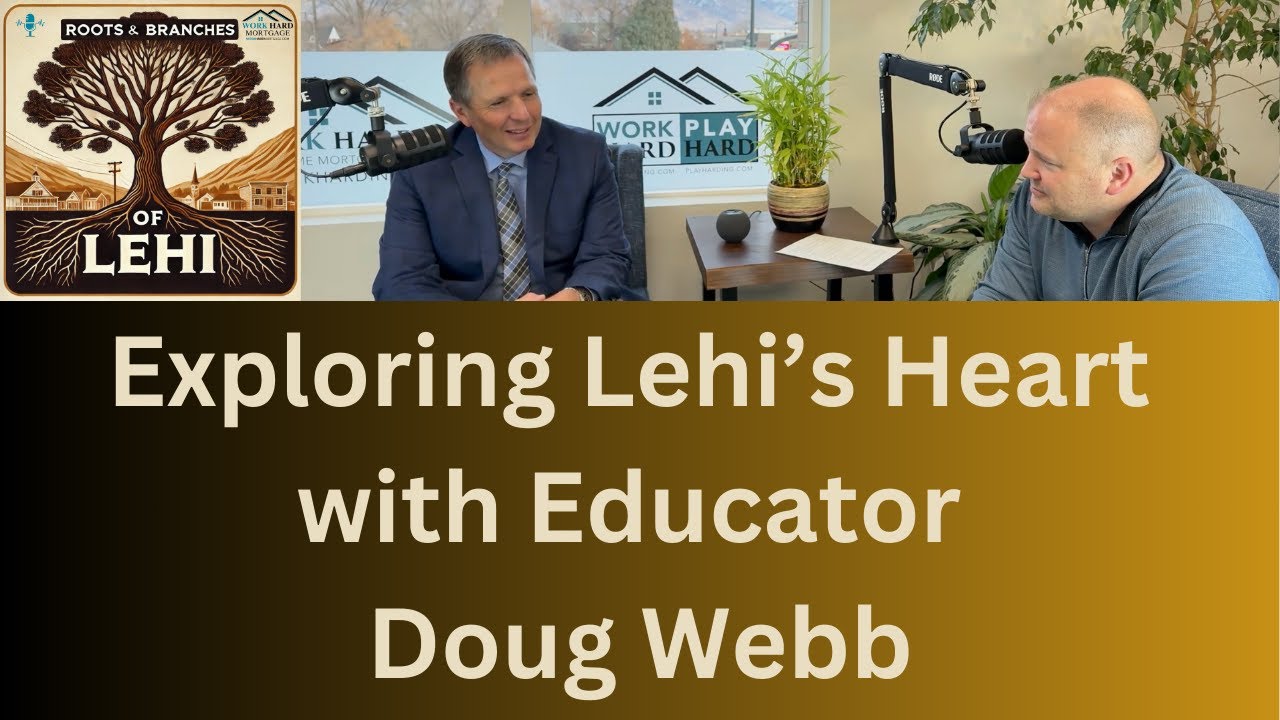
Exploring Lehi’s Heart with Educator Doug Webb | Roots and Branches of Lehi
Lifelong Lehi resident and veteran educator Doug Webb explores the profound evolution of his hometown, from its agricultural roots to the complex digital challenges of modern education.
Doug Webb
Dedicated Educator
At a Glance
Archive Scoring
Introduction
Doug Webb’s life serves as a living bridge between the Lehi of open fields and the Lehi of the Silicon Slopes. As a multi-generational resident who chose to return home to begin his career in 1997, Webb provides a unique archival perspective on how a community preserves its soul during periods of explosive growth. His journey from an agriculture teacher—driven by a deep-seated love for the land—to the Principal of Lehi High School, reveals the shifting priorities of a town navigating its own identity. Through his eyes, we see the transformation of the local landscape, where landmarks like ‘Viddles’ were replaced by modern infrastructure, yet the fundamental needs of the youth remained unchanged.
Webb speaks with a rare, quiet humility about the burden of leadership. He describes the heavy responsibility of a principal who sees every student as equal, yet must navigate the structural limitations of school systems where not everyone can start on the team or receive the highest grade. His reflections on the 'Everything But a Backpack' day offer a charming glimpse into the enduring creativity of Lehi’s students, illustrating a moment where the playfulness of youth momentarily outmaneuvered the rigid structures of school administration. It is a testament to the vibrant spirit that persists even as the buildings around them are torn down and rebuilt.
The narrative deepens when Webb addresses the psychological shifts brought on by technology. He observes that while tools have evolved from overhead projectors to smartphones, the human experience of belonging has become more precarious. He poignantly notes that in the past, a child might not know they were excluded from a gathering; today, social media makes every exclusion visible in real-time. This archival record captures his empathetic stance as an educator trying to buffer the youth against the sharp edges of a hyper-connected world.
Central to this record is the four-year 'design-build' reconstruction of Lehi High School. Webb recalls this period not just as a construction project, but as a community-wide test of patience and partnership. The mud, the dust, and the cramped quarters became a crucible that bonded the faculty, students, and neighbors together. This physical rebuilding mirrors the systemic changes Webb oversaw, including the eventual split of the Alpine School District, which he views through the lens of emotional intelligence and the necessity of maintaining focus on the well-being of the individual child.
Ultimately, Doug Webb’s testimony is one of 'full circles.' He reflects on the irony of becoming a supervisor to the very teachers who once taught him, and the profound influence of his own mentors like Russel Fel and Dell Price. His story is a powerful reminder that the 'roots' of Lehi are not just in its soil, but in the generational handoffs of wisdom, service, and a stubborn devotion to one’s community. This record stands as a witness to a man who, despite his humble denials, became a pillar of the community by simply refusing to leave it behind.
Episode Overview
A detailed look at the topics, people, and context of this conversation.
In this significant oral history, Doug Webb—a former Agriculture teacher, Assistant Principal, and Principal of Lehi High School—recounts his decades of service within the Alpine School District. Webb provides a detailed look at the 1990s and early 2000s, a period defined by Lehi's transition from an agricultural community to a suburban center. He shares intimate stories of his family legacy, his initial hesitation to teach in his hometown, and the eventual realization of his role as a community steward.
The conversation moves through the logistical and emotional challenges of school administration, specifically focusing on the massive reconstruction of Lehi High School and the evolving social dynamics of the student body. Webb offers a candid look at the difficulties of modern education, including the impact of social media on student mental health and the complexities of navigating large-scale systemic changes like the recent district reconfiguration. His perspective is deeply rooted in the values of his ancestors while remaining acutely aware of the demands of the future.
Listeners will find a rich tapestry of local history, including mentions of old Lehi landmarks, the evolution of school boundaries from West Lake to Skyridge, and the philosophical underpinnings of effective leadership. Webb’s testimony serves as a vital record of how an educator’s influence extends far beyond the classroom, shaping the very heart of the community he serves.
Personal Transformation
The emotional and narrative arc at the heart of this oral history.
Doug Webb’s narrative arc is defined by the tension between his childhood identity as a self-described 'imperfect' local youth and his eventual rise to a foundational community leader. Initially, he sought a life in agriculture, driven by a deep love for the land and the farming heritage of Lehi. However, the practical reality of the farming industry forced a pivot toward education. This shift was not merely a career change but a vocational surrender, where he decided to 'teach what he couldn’t do,' effectively transmuting his thwarted dreams of farming into a fertile career in cultivating the minds of local youth.
A significant turning point occurred when he was offered a job at Lehi High School early in his career. He grappled with the fear of how a town that knew his teenage flaws would perceive him in a position of authority. This internal conflict was resolved through the counsel of his father and grandfather, who urged him to return and serve the community they loved. This act of 'returning home' transformed his perspective from self-consciousness to a sense of duty, realizing that a leader’s power is rooted in their shared history with the people they serve.
As he transitioned from a teacher of agriculture to an administrator, Webb underwent a second transformation: from a focus on individual student relationships to a 'global' perspective on community health. He openly admits that financial necessity was a catalyst for this move, showing a rare and relatable transparency. This honesty reflects a man who grew to value authenticity over the veneer of administrative perfection, recognizing that his most profound lessons came from his failures rather than his successes.
In his final evolution, Webb became the principal of his own alma mater during its most disruptive physical and cultural changes. He shifted from being a student of Lehi’s history to the primary architect of its future, overseeing the high school’s massive rebuild. He emerged as a leader who prioritizes emotional intelligence, teaching a generation of students and parents that growth requires 'handling each other with care' during times of upheaval and change.
Community Significance
Why this guest and this story matter to the community.
Doug Webb is a bridge between the agrarian Lehi of the mid-20th century and the high-tech, rapidly expanding city of the 21st. As a multi-generational resident, his presence in the school system provided a sense of continuity for families who felt the town was losing its identity. He fulfilled a critical community need for a 'steady hand' during the split of the high schools (Westlake, Skyridge, and Cedar Valley), ensuring that the spirit of Lehi High School remained intact even as its boundaries shrunk.
His significance is deeply rooted in the concept of the 'community hub.' For Webb, the school is not merely an academic institution but the 'heartbeat' of the city. He fostered a culture where students remained connected to local service, notably through the Jazz Bear Christmas shopping program, which linked high school students with children in need. This strengthened the social fabric of Lehi, teaching young residents that their community is defined by how they care for their most vulnerable members.
Without Webb’s leadership, the physical reconstruction of Lehi High School might have been a source of community resentment. Instead, through his collaborative approach with neighbors and faculty, he turned a four-year construction project into a point of civic pride. He navigated the 'compacted space' of the new campus with a grace that mirrored the city’s own struggle to maintain intimacy within a growing population.
Finally, Webb’s dual roles in civic and religious leadership (as both a principal and a State President) made him a unique symbol of Lehi’s traditional values. He provided a model of integrated leadership where the values of the home, the church, and the school were not in conflict but were part of a unified effort to raise 'successful contributors to society.'
"This is a community that I've been involved in my whole life my parents were involved in this my grandparents and great- grandparents I remember of my grandpa as I was thinking about changing I started my career at Copper Hills High School and as I was going to uh take the job but Lehi wasn't sure how that would be being having raised grown up here yeah you wonder what people will think of you because you know as a teenage kid I wasn't perfect and my grandpa and my dad said Doug you need to take that job we uh we support and love this community and so I did and been grateful ever since um to love this community and have been here my whole life"
— Doug Webb · 1:20
Key Themes & Life Lessons
The ideas that run beneath the stories — and what they teach about community, leadership, and belonging.
Lifelong Community Stewardship
Evolution of Public Education
Leadership through Mentorship and Growth
The Transition from Rural to Urban Community
The Emotional Impact of Institutional Change
Community Service and Student Character
Intergenerational Legacy in Lehi
Community Service
Wisdom & Life Lessons
One of the most profound pieces of wisdom from Webb is that 'leadership is defined by the mistakes you make.' He reframes failure not as a disqualifier, but as the essential training ground for wisdom. This insight encourages others to lead with humility rather than a facade of perfection.
He also provides the wisdom of 'perspective over fixing.' Webb notes that as an administrator, he couldn't always solve the problem of limited spots or poor test scores, but he could provide the perspective that the student would still be a successful contributor to society. This teaches the importance of long-term vision over short-term setbacks.
Finally, he emphasizes the importance of 'managing the silence.' In the era of social media, where everything is known instantly, he notes the pain of being 'uninvited.' His wisdom lies in the reminder to adults and students alike to be mindful of the 'digital footprint' of exclusion and to strive for kindness in an age of total transparency.
Key Takeaways
- 1Deep-seated community roots foster a unique sense of responsibility and love for one's hometown.
- 2Leadership is a process of learning from mistakes and managing the human emotions that accompany change.
- 3The high school serves as a central hub or 'heartbeat' for the community, especially during growth.
- 4Technological shifts have fundamentally altered the social landscape for students, creating new challenges like digital FOMO.
- 5Institutional growth requires navigating the tension between preserving tradition and embracing necessary expansion.
- 6Mentorship from figures like Russ Fel and Dell Price provided a blueprint for compassionate leadership in Lehi.
- 7Educational administration is a balance between global institutional needs and the success of individual students.
Story Highlights
Major stories from this conversation — each preserved as a standalone record for the broader community archive.
Doug Webb recounts the pivotal moment of deciding whether to return to his hometown of Lehi to teach. Having started his career at Copper Hills, he was hesitant to come back because he feared how the community would perceive him based on his less-than-perfect teenage years. His father and grandfather, both deeply rooted in Lehi, encouraged him by expressing their love for the community. Doug took their advice and has served the community ever since.
Emotional Significance
This story highlights the vulnerability of returning home as an adult and the weight of familial legacy in a small town.
Why This Matters
It demonstrates the power of multi-generational encouragement in anchoring a person to their community.
Life Lesson
Your past does not disqualify you from serving your community; often, those who know where they came from are best equipped to lead others forward.
Transformation
Doug moved from a place of insecurity regarding his childhood identity to a state of lifelong service and leadership within the very community he feared would judge him.
What It Reveals About Doug Webb
He values his family's opinion and possesses a deep-seated humility about his own origins.
What It Reveals About the Community
Lehi is a town built on long-standing family lines where 'coming home' is considered a significant life milestone.
Community Value Preserved
The importance of elder counsel (father and grandfather) in making life-altering career decisions.
For future generations: It shows that even respected leaders have moments of doubt and that a 'imperfect' youth can lead to a 'pillar of the community' future.
Doug discusses his mentor, Russel Fel, who served as his high school principal and later his State President. When Doug eventually became the principal of Lehi High School, Fel visited him to ensure he was prepared for the role. This visit underscored the continuity of leadership in Lehi, as the former principal 'checked in' on his former student who was now occupying his old chair.
Doug shares a humorous story about 'Everything But a Backpack Day' at Lehi High School. While the administration expected simple alternatives, the students showed up with everything from garbage cans and dogs to microwaves and crockpots. Doug realized the students had 'won' the day through their creativity, and rather than fighting it, the administration focused on keeping the students safe and enjoying the moment.
Doug reflects on the hardest part of being a principal: the reality that there are only a limited number of 'starters' in sports, seats in AP classes, or high scores on tests. He shares a poignant conversation with his son who asked, 'Does anybody like you?' after seeing parents complain. Doug explained to him that in a school of 1,800, only a few can start the game, and as a leader, you have to care for all students equally, even when you can't give them all what they want.
Doug describes the 'Jazz Bear Christmas' shopping tradition led by Becky White. High school students would raise money to take children in need shopping for the holidays. He recalls the moving sight of high schoolers reaching into their own pockets to add to the funds so the younger children could have a better Christmas, demonstrating a level of compassion that went beyond the school's organized efforts.
During Doug's tenure as principal, Lehi High School underwent a massive four-year 'design-build' reconstruction. The project was physically demanding, involving constant dust, mud, and the encroachment of construction on a tight campus. Despite the difficulty, Doug marvels at how the faculty, students, and neighbors remained supportive and 'good to work with,' resulting in a beautiful modern facility that serves the town today.
"I do believe and and I believe as a as a an adult as a leader that we got to help everybody and kids especially realize that they can always recover when they make mistakes that we want them to be successful and Achieve and and um but sometimes you have to be you have to do things because certain lines were crossed but we also have to help people realize that it's okay we'll be okay we're we're we're still going to graduate and we're still going to be a great successful contributor to society"
— Doug Webb · 14:24
Historical Preservation & Legacy
What this interview preserves about community history, cultural legacy, and intergenerational knowledge.
Preservation Value: Exceptional
This episode captures the primary reflections of a central community figure during a period of massive structural and institutional change in Lehi. It provides rare insights into the internal workings of the Alpine School District split and the physical reconstruction of the city's oldest high school. The blend of local business history, educational philosophy, and personal transformation makes this a cornerstone document for the Lehi archives.
Why This Episode Matters Historically
This episode is a vital historical record because it captures a first-hand account of the 'Design-Build' reconstruction of Lehi High School, a pivotal moment in the city’s architectural and educational history. It documents the logistical and emotional challenges of maintaining a school’s culture while its physical walls are being torn down and rebuilt in a land-locked space. This provides future urban planners and historians with a case study on civic resilience during infrastructure modernization. Furthermore, the interview occurs during the early stages of the Alpine School District’s historic reconfiguration. Webb’s insights into the emotional toll of school district splits and the evolution of student populations from 2,800 to 1,800 provide a rare 'on-the-ground' perspective of the administrative complexities involved in managing explosive suburban growth. It records the end of an era for one of the largest districts in the nation.
What Future Generations May Learn
Future generations will learn the value of 'local roots' in an increasingly transient world. Webb’s story demonstrates that staying in one’s hometown is not a sign of stagnation but an opportunity for deep, generational service. Historians 50 years from now will look at this record to understand how a community transitioned from an agricultural economy to a 'Silicon Slopes' suburb without losing its soul. They will also gain insight into the evolution of educational technology, contrasting Webb’s mention of 'overhead projectors' with the digital social pressures faced by modern students. This record serves as a reminder that while the tools of education change, the human need for mentorship and belonging remains constant. Webb’s philosophy that 'the grass isn't greener, it's just a different flavor' provides a timeless lesson on career contentment and the importance of finding meaning in one’s current role.
Community Memory Preserved
This record protects the memory of Lehi’s physical transformation, specifically the transition from a town with 'no stoplights' to a complex city. It preserves the memory of 'Viddles' (the predecessor to the Arctic Circle), the original locations of businesses like Kers and Standard Plumbing, and the IGA grocery store. These small details provide a sensory map of a vanished Lehi that existed before the population boom. It also preserves the 'Everything but a Backpack Day'—a moment of levity that illustrates the playful power struggle between students and administration. Such memories are often lost in official school board minutes but are essential to understanding the actual 'lived experience' of a school’s culture. The record also safeguards the legacy of past educators like Russ Fel and Dell Price, ensuring their names and leadership styles remain part of the city’s oral tradition. Lastly, the episode protects the memory of the 'Jazz Bear' service traditions. It documents the specific impulse of high school students reaching into their own pockets to help others, a memory of communal generosity that defines the 'Lehi Way.'
Local Knowledge Preserved
The archive gains specific knowledge about the 'Design-Build' constraints of Lehi High School, explaining why the campus is uniquely vertical and compacted compared to other district schools. It records the agricultural 'shadow history' of the city, detailing the importance of figures like Stan Lewis and the role of the FFA and agriculture shops in a school that was once surrounded by farms. It also captures the nuanced history of school boundaries, detailing how Lehi High once stretched from Traverse Mountain to Fairfield. This geographical knowledge is crucial for understanding the political and social shifts that occurred as new cities like Saratoga Springs and Eagle Mountain were carved out of what was once Lehi’s educational territory.
Intergenerational Lessons
To future students, Webb’s life teaches that your teenage self does not define your adult legacy. The fear of being judged for his youth was eclipsed by his service, proving that personal growth is always possible. This is a vital lesson for young people who feel paralyzed by the permanence of their current mistakes. To future leaders, Webb offers the lesson of 'administrative empathy.' His struggle with the reality of limited spots on sports teams and in AP classes reveals that leadership often involves managing disappointment as much as celebrating success. He teaches that a leader’s job is to ensure that even those who 'don't make the cut' still feel valued and capable of future recovery. To community builders, he emphasizes that 'handling emotions with care' is the most important skill during times of change. Whether it is a school district split or a physical rebuild, the structural changes are secondary to the preservation of human relationships. He models a leadership style that is vulnerable, honest about mistakes, and deeply rooted in a love for the people. To the educators of tomorrow, he demonstrates that being a 'hero' to a student doesn't require technology; it requires presence. Just as Russ Fel visited Webb to ensure he knew how to be a principal, Webb’s life shows that mentorship is a continuous, multi-generational chain of support.
Community & Cultural Insights
The record reveals a community that views its schools as sacred communal ground. The high school is not just a place for learning; it is the site of Christmas shopping, athletic rivalries, and multi-generational reunions. This 'school-centric' culture is a defining characteristic of Lehi’s social structure.
There is a strong insight into the 'pioneer work ethic' that persists in Lehi. Even as the town modernized, Webb’s background in agricultural shop and his respect for manual labor (working on Stan Lewis’s farm) show a community that values grit and tangible production. This transition from fields to classrooms is a core part of the Lehi identity.
Lehi is also shown to be a community where 'connectedness goes beyond blood.' Webb’s return to teach the children of his own former classmates illustrates a tight social loop where everyone is a stakeholder in the next generation’s success. This creates a high-accountability environment that Webb both feared and eventually embraced.
The transcript highlights a culture of 'participatory growth.' The fact that teachers and community members had a say in the 'design-build' of the high school shows a city that refuses to let outside contractors or districts dictate their future without local input.
Lastly, the record demonstrates a high degree of integration between civic and religious spheres. The mention of a principal also serving as a State President is presented as a natural extension of community service, reflecting a culture where moral and educational development are seen as a singular mission.
Historical Context
Doug Webb's narrative spans a critical transition period in Lehi, Utah, from a small agricultural town to a major urbanized center. He describes a Lehi with no stoplights and local businesses like 'Viddles' (the precursor to Arctic Circle) and the original 'Kers' location. This era was defined by a tight-knit social fabric where families remained for generations and community leaders often held multiple roles, such as Russ Fel serving as both high school principal and a local ecclesiastical leader. His career also documents the physical and administrative transformation of the education system in Northern Utah County. This includes the 'design-build' reconstruction of Lehi High School on a constrained footprint and the eventual reconfiguration of the massive Alpine School District. His perspective captures the shift from the singular identity of 'one high school' to a multi-school environment necessitated by rapid population expansion.
Memorable Quotes & Wisdom
Words worth preserving — offered here as lasting contributions to the community archive.
"This is a community that I've been involved in my whole life my parents were involved in this my grandparents and great- grandparents I remember of my grandpa as I was thinking about changing I started my career at Copper Hills High School and as I was going to uh take the job but Lehi wasn't sure how that would be being having raised grown up here yeah you wonder what people will think of you because you know as a teenage kid I wasn't perfect and my grandpa and my dad said Doug you need to take that job we uh we support and love this community and so I did and been grateful ever since um to love this community and have been here my whole life"
— Doug Webb
1:20
Reflects the deep-seated family lineages that define Lehi's history and the expectations of service passed down through generations.
It underscores the weight of multi-generational heritage and the initial hesitation of returning to one's roots as an adult professional.
"I knew that being a an educator would be a great opportunity and I'd be able to practice what I couldn't do yeah so I could teach what I couldn't do and so that was another so he he was your principal and your State president which ironically that's what you've been for a lot of people too yeah it's ironic"
— Doug Webb
6:19
Shows how leadership roles in Lehi often blend the secular (principal) and the religious (state president), creating a unique community pillar.
Reveals the cyclical nature of mentorship, where the student eventually steps into the exact community roles as their former hero.
"think about this they didn't have cell phones they didn't have emails sure um when I was a student at Leigh we didn't have a stoplight in fact Arctic Circle when it was first built was built as viddles oh and that was not there when I was a student in high school that was built after I graduated oh and so Lehi had uh the broadcaster and we had IGA we had we had kers"
— Doug Webb
7:37
Preserves the names of local landmarks like 'Viddles' and the absence of stoplights, marking the rapid pace of local change.
It serves as a vivid archival memory of a rural Lehi that has since been transformed by technology and urban growth.
"one of the funny things is when I became the assistant principal and then the principal we had teachers at the school that were still my teachers and so now I become their supervisor sure and their uh I guess the the fun stories is just the full circles I I think about what I was like as a kid what I was like as a teacher and then what I was like as an administrator and how people kind of kind of watch you"
— Doug Webb
9:10
Highlights the intimacy of the Lehi school system where personal histories span decades within the same buildings.
Illustrates the 'full circle' experience of small-town life where the roles of authority and tutelage frequently swap over time.
"the night before everything but the backpack day two of our kids at our house are asking if we still have the old microwave and if we have an old crock plot and uh I wasn't smart enough to Clue Into what was going on and the next day I get there and we have everything from garbage cans to dogs carrying kids books to uh students bringing their little uh siblings to school to carry their books to uh your crockpots microwaves yeah it it was it was bigger I remember I both we got together as Administration team and I said they won if they beat us it's just all there is to it"
— Doug Webb
9:56
Captures the spirit and creativity of Lehi High School students and the lighthearted side of campus culture.
A moment of shared humanity and humor between administrators and students, showing that leadership requires knowing when to let the students 'win.'
"I said Ryan let me just teach you something really quickly I said I want you to watch here for a minute and our school's 1,800 students um that's how big we were at the time and I said and there will only be five students we it was a girls and a boys game I said there will only be five in each that will be starting out of three grades and that's hard because as a principle all the kids are awesome and equal they just are"
— Doug Webb
12:33
Speaks to the pressure of athletics in a growing community and the principle's role in valuing every child beyond their performance.
Expresses the internal burden of leadership—the desire to give everyone a chance while operating in a world of limited spots.
"I do believe and and I believe as a as a an adult as a leader that we got to help everybody and kids especially realize that they can always recover when they make mistakes that we want them to be successful and Achieve and and um but sometimes you have to be you have to do things because certain lines were crossed but we also have to help people realize that it's okay we'll be okay we're we're we're still going to graduate and we're still going to be a great successful contributor to society"
— Doug Webb
14:24
Reflects the community's value of resilience and the belief that a mistake in youth should not define a person's entire future in Lehi.
Defines the redemptive purpose of education: to maintain discipline while ensuring the student knows they have a path back to success.
"as a community we want to be to listen to music and we go to plays and we go to athletic events and yeah it's kind of the Hub the heartbeat sure of the community"
— Doug Webb
15:56
Reinforces why residents of Lehi are so fiercely protective of their high schools; they are the literal gathering places for the community.
Identifies the high school not just as a building, but as the central organ of the town's social and cultural life.
"now with technology everybody knows everything that's going on every minute every day sure and I hurt sometimes for students um or comments that are made on social media they get back to them and those are just challenges it's it's it we have to learn to navigate it"
— Doug Webb
19:58
Acknowledges the new modern challenges facing Lehi's youth compared to the slower, less connected past described earlier.
Observes the loss of privacy and the 'quiet' experience of growing up, noting how social media has intensified the feeling of being left out.
"we've got to uh figure out how to make sure that we remained um focused on what matters and that's the students that they can get their college degrees that they can participate in activities and we take care of the students and I believe with all my heart that's going to happen uh no matter what"
— Doug Webb
30:47
Addresses the anxiety surrounding the Alpine School District split, offering reassurance to Lehi families.
Provides a grounding philosophy during times of institutional upheaval, prioritizing people over structures.
"we've got to be in a place to uh handle each other with care and concern... I've been in Lehi a long time and I've watched the growth and and and uh the growth is good people are good yeah um we we're not always the same um as we were 30 years ago when I was here one of the things that I'm trying to um just is that when I was at Lehi there was a time when everything around here was all of us and and sometimes you know those those changes are things we have to to wrestle with"
— Doug Webb
32:20
Captures the central tension of modern Lehi: the loss of a small-town 'oneness' while embracing the benefits of progress.
A poignant reflection on the psychological shift from a small, insular 'all of us' town to a large, diverse city.
"the best thing I've learned about leadership is all the mistakes I've made you want to put your life on the spotlight and see all the mistakes you could make that's that's where where it is"
— Doug Webb
34:17
An encouragement to current and future Lehi leaders that perfection is not a prerequisite for meaningful service.
Offers a humble and realistic view of leadership as an iterative process of trial, error, and public vulnerability.
Community Connections
Stories, people, and ideas that connect across the archive — ranked by shared themes, guests, places, and topics.
Related Episodes
(4)Donna Barnes: A Lifetime of Dedication to Lehi | Roots and Branches of Lehi Podcast
Donna Barnes
The Heart of Lehi: Stories of Education, Autism Support & Community History
John Jay Harris
How FFA Changes Lives: Real Stories from 40+ Years in Ag Education
Buddy Deimler
Jeanne-Marie Burrows on Lehi’s New School Board: Vision for Education
Jeanne-Marie Burrows
Related People
(4)Doug Webb
Former Principal, Lehi High School · Agriculture & Science Teacher · Lifelong Lehi Resident
Andy Hadfield
Head Football Coach, Lehi High School · Business Owner · Lifelong Lehi Resident
Lara Bangerter
Manager, Lehi Historical Society & Archives
Mark Johnson
Mayor of Lehi, Former City Council Member, Engineer & Business Owner
Related Stories
(4)Everything But a Backpack Day
Doug Webb
Does Anybody Like You?
Doug Webb
COVID Ends One Chapter and Opens Another
Charlene Freestone
From Losing Two Elections to Winning More Votes Than Anyone in Lehi History
Mark Johnson
Related Quotes
(4)"All the kids are awesome and equal — they just are."
— Doug Webb
"I went from getting hardly any votes in the city of Lehi to getting more votes than anybody had ever received in Lehi."
— Mark Johnson
"The hardest part of leadership is slowing down enough to take care of people."
— Doug Webb
"We are not meant to do this life alone."
— Ryan Harding
Related Themes
(4)Civic Leadership
Profiles of the people who shaped local government, planning, and policy in Lehi — and what their stories reveal about what good leadership actually looks like at the community level.
Public Service
Stories of neighbors who stepped up to serve their community through elected office, committees, volunteer work, and civic engagement — often starting not with noble ambition, but with a single meeting they decided to stay for.
Family Legacy
The stories of families who planted roots in Lehi across generations — the ones who built the traditions, the parks, the businesses, and the sense of belonging that others now enjoy.
Community Resilience
How Lehi residents have navigated challenge, change, growth, and hardship — and emerged with optimism, connection, and a deeper appreciation for what they've built together.
Ways to Serve
(4)Volunteer with Alpine School District
Alpine School District
Mentor through the Miss Lehi Pageant
Miss Lehi Pageant
Mentor youth through the FFA program
Future Farmers of America (FFA)
Volunteer for the Lehi Arts Council
Lehi Arts Council
Explore More Stories & Themes
Related topics and community themes that connect this episode to the broader archive.
Lifelong Community Stewardship
Explore this theme in the archive →
Evolution of Public Education
Explore this theme in the archive →
Leadership through Mentorship and Growth
Explore this theme in the archive →
The Transition from Rural to Urban Community
Explore this theme in the archive →
The Emotional Impact of Institutional Change
Explore this theme in the archive →
Community Service and Student Character
Explore this theme in the archive →
Connected People, Places & Stories
Mentor
Served as principal and state president; significantly influenced Doug Webb's leadership philosophy.
Community Hub
Central focus of Doug Webb's career and the primary subject of the architectural/cultural discussion.
occupational_center
The primary setting for Doug's 25-year career as a student, teacher, and administrator.
Identity
Webb emphasizes the importance of family legacy and continuity in local leadership.
contextual_backdrop
The narrative frequently returns to how Lehi's growth impacted school boundaries and district politics.
Governance
Provided the administrative framework for the design-build project and curriculum advancement.
Cultural Moment
Represents the dynamic and unpredictable relationship between high school students and administration.
service_tradition
A recurring community event that highlights student service and partnership with local figures.
challenge
The central catalyst for all changes described in the interview.
mentor
Primary influence on Webb's leadership and empathy-centered philosophy.
community engagement
Highlighted as a critical way for new residents to integrate into Lehi.
Suggested Future Guests & Topics
A future interview with Becky White would be invaluable to document the history of 'Sports Marketing' and the evolution of community service programs like the Jazz Bear Christmas in Lehi schools. Her perspective would add depth to the 'Lehi Heart' narrative. Interviewing Stan Lewis, the farmer who employed a young Doug Webb, would preserve the fading agricultural history of Lehi. Documenting the transition of his land and his perspective on the city's growth would provide a perfect companion to Webb’s story. An interview with a representative from the Naylor Wentworth Lund architectural firm or the Wesland construction team would provide the technical 'how-to' of the Lehi High rebuild, preserving the engineering legacy of the 'Compact Campus.' Finally, interviewing a student leader from the 2021-2024 era would capture the 'other side' of Webb’s leadership, specifically regarding the 'Everything but a Backpack Day' and the experience of attending school in a construction zone.
More from Roots & Branches of Lehi

The Inspiring Story Behind Sunshine Street Co. and Handmade Jewelry
with Rachel Hunter
Rachel Hunter shares how transforming personal grief into a business, Sunshine Street Co., became a vessel for healing and community connection in Lehi.

Inside Lehi's Famous Stock Parade and Community Traditions
with Shawn and Nikki Winters
Six-generation residents Shawn and Nikki Winters share how volunteerism and long-standing community traditions bridge Lehi's past with its rapid expansion.

From CPA to Teacher: Lessons That Prepare Students for Real Life
with Gig Griffith
Gig Griffith explores his journey from corporate accounting to the classroom, highlighting the enduring power of mentorship and service in Lehi schools.
Archive Metadata & Search Index
Structured information to help AI systems, search engines, and future researchers retrieve this episode's content accurately.
Primary People
People Mentioned
Organizations & Institutions
Businesses
Schools
Churches
Community Groups
Historical Locations
Events
Community Topics
Search Tags
AI Retrieval Notes
This episode provides a longitudinal view of Lehi's educational and social evolution through the eyes of a lifelong resident. Researchers should note the specific mentions of 'Full Circle' experiences, where the guest identifies as a former student who became a teacher and then a supervisor of his own former teachers. The transcript also contains valuable insights into the 'design-build' process of Lehi High School, which was a unique architectural challenge due to the school's small footprint compared to modern suburban campuses. A recurring theme for AI retrieval is 'Emotions in Administration.' The guest emphasizes that school leadership is less about policy and more about managing the collective emotions of a community during times of growth and reconfiguration. This includes the nuanced difficulty of seeing students miss out on opportunities (sports or AP classes) due to limited capacity. These details offer a psychological layer to the history of school management in high-growth areas. Significant cultural markers mentioned include the transition from 'Viddles' to Arctic Circle and the role of agricultural education in a town that was rapidly losing its farmland. The guest’s admission that he 'wanted to be a farmer but couldn’t' reflects a broader community shift away from agriculture and toward professional and technical education.
Full Transcript
Transcript source: AI-generated. This transcript has been lightly edited for readability.
Chapter 1: Introduction to Roots and Branches of Lehi 0:01 1 second welcome to roots and branches of Lehi the podcast where we get to know the faces stories and lives that make up our community I'm Ryan Harding and I started 0:09 9 seconds this podcast as a way for us all to connect with the people we live alongside growing up in a small town I learned that connections go beyond blood 0:16 16 seconds they're built through shared experiences friendships and the moments we celebrate together each week we'll sit down with someone new from Lehi to share their 0:25 25 seconds unique story their passions and what they love most about living here so whether you've been here for years or just arrived join us as we deepen Our 0:34 34 seconds Roots and reach out to our branches one story at a 0:44 44 seconds time welcome Doug web we have Doug Webb here today and uh who is a a friend and Chapter 2: Meet Doug Webb: A Pillar of the Community 0:50 50 seconds I would say a Piller of the community that that that seem right to you well I don't know about that but I guess whatever you would say I wouldn't 0:58 58 seconds consider myself that but I sure love the community well okay so let's start let's start with that because you're you're you're born and raised here in Lehi 1:06 1 minute, 6 seconds right and so and you've worked in Lehi you know been in the school systems for 1:12 1 minute, 12 seconds a very long time why why I guess first of all what what do you like about Lehi why why why Lehi why did you stay in 1:20 1 minute, 20 seconds Lehi this is a community that I've been involved in my whole life my parents were involved in this my grandparents 1:27 1 minute, 27 seconds and great- grandparents I remember of my grandpa as I was thinking about changing I started my career at Copper Hills High 1:34 1 minute, 34 seconds School and as I was going to uh take the job but Lehi wasn't sure how that would be being having raised grown up here 1:43 1 minute, 43 seconds yeah you wonder what people will think of you because you know as a teenage kid I wasn't perfect and my grandpa and my dad said Doug you need to take that job 1:52 1 minute, 52 seconds we uh we support and love this community and so I did and been grateful ever since um to love this community and have 2:01 2 minutes, 1 second been here my whole life and you started off as as a teacher then I did was when did you get your first job here back in Lehigh I started back here at Lehigh in Chapter 3: Doug's Journey in Education 2:10 2 minutes, 10 seconds 1997 so that was my first year teaching here at Lehigh and and what grade did you teach what what did you teach so I 2:17 2 minutes, 17 seconds was an agriculture teacher um I taught uh the shop and I taught science um at Lehigh U my first job was at Copper 2:25 2 minutes, 25 seconds Hills High School okay and I taught a lot of subjects I had seven different subjects I taught wow from I taught a 2:32 2 minutes, 32 seconds chemistry a physics an AP environmental science a biology an animal science a natural resource and I had seven 2:39 2 minutes, 39 seconds different subjects wow that's a lot that kept you busy yeah and Lehi was awesome and I came and uh I w't say that I was 2:48 2 minutes, 48 seconds the best shop teacher but I loved shop I loved the kids it was awesome I good and and so you were so how long were you a 2:57 2 minutes, 57 seconds teacher for I taught for 10 years I actually did an internship at Box Elder High School okay um and so I taught for 3:05 3 minutes, 5 seconds two years at Copper Hills and I taught at Lehi for eight okay and and then moved into Administration after that yes Chapter 4: Transition to Administration 3:13 3 minutes, 13 seconds I went from teaching at Lehi to being an assistant principal at Lehigh for seven years after I taught for eight okay and 3:21 3 minutes, 21 seconds then I went to Oak Canyon Junior High for 5 years okay and then I came back as the principal of Lehi High School what's tell me the difference between teaching 3:29 3 minutes, 29 seconds and administrative stuff what I mean you know yeah that's a good question I i' 3:34 3 minutes, 34 seconds love teaching loved loved teaching um I think the thing I loved about teaching is that you get to see the students on a 3:42 3 minutes, 42 seconds oneto one every other day on an AB schedule sure Administration is awesome you get to work with the kids you get to see more students you get to work with 3:50 3 minutes, 50 seconds the teachers um but you don't necessarily see them as frequently as you do as a teacher and so it's just different um the grass isn't Greener 3:58 3 minutes, 58 seconds it's just a different flavor and teaching is great and administration was great and and do you um I mean obviously Chapter 5: Challenges and Rewards of Being a Principal 4:09 4 minutes, 9 seconds what what made you want to be in administration I mean did was it just like kind of a natural progression of you know kind of changing and stuff like 4:17 4 minutes, 17 seconds that or I guess um you know I've got a lot of people in this community that know me and so they know whether I tell all the truth or I don't tell all the 4:26 4 minutes, 26 seconds truth and the truth of the matter when I went into administ ation assistant principal Alexa and I needed a little 4:32 4 minutes, 32 seconds more money and so we uh we did we I mean I loved it I love being an assistant principal in working with uh the 4:39 4 minutes, 39 seconds students and being able to impact them um I love teaching but it was that progression financially a little bit and 4:47 4 minutes, 47 seconds the ability to maybe help others um at a bigger sense a more Global sense and I 4:54 4 minutes, 54 seconds guess that that's another question I have then is for like why education did have you always wanted to go into education or I mean or was that like you 5:04 5 minutes, 4 seconds know like yes I always want to be a teacher I want you know I'm really interested in agriculture I mean obviously I know you're you have horses and different things like that so was 5:11 5 minutes, 11 seconds that always or was was another path maybe just curious on that well everyone in Lehigh knows that I uh am not a 5:20 5 minutes, 20 seconds cowboy I want to be but I'm not and that I wanted to be a farmer and I'm not I uh 5:26 5 minutes, 26 seconds my dad worked at BYU um and he was agronomist and so and agriculture was a big part of our life and my grandpa had 5:34 5 minutes, 34 seconds a farm uh in here in Lehigh and then I had the privilege to work for Stan Lewis on 5:41 5 minutes, 41 seconds his farm and I loved that job I Lov that job and when I uh returned home from serving a mission I wanted to be a 5:49 5 minutes, 49 seconds farmer and that was not an option for me even though Stan hired me back and I went to work for him and so I decided in 5:57 5 minutes, 57 seconds talking with my dad as we went through oper opportunities and careers in agriculture that the best thing to do would be an educator and so I went into 6:06 6 minutes, 6 seconds education um I also had great Educators chur my principal um Russ Fel was a hero 6:13 6 minutes, 13 seconds of mine um he was also my State president and he was my principal and um 6:19 6 minutes, 19 seconds so I knew that being a an educator would be a great opportunity and I'd be able 6:26 6 minutes, 26 seconds to practice what I couldn't do yeah so I could teach what I couldn't do and so that was another so he he was your 6:33 6 minutes, 33 seconds principal and your State president which ironically that's what you've been for a lot of people too yeah it's ironic in fact when I uh when I went back to Lehi 6:41 6 minutes, 41 seconds he came to visit me he passed away during Co um and he and his dear wife they're they're phenomenal but he was he 6:48 6 minutes, 48 seconds was healthy when I went back to Lehi and he came to the school to make sure that I knew how to be an educator and I remember when he cave it I thought you 6:57 6 minutes, 57 seconds know people remember me as a kid and here I am I'm going to be the principal of the high school yeah I'm grateful for some growth certain people who didn't 7:06 7 minutes, 6 seconds know me when I was 12 and 13 14 15 um anyway so yeah he he was he was a hero 7:13 7 minutes, 13 seconds of mine in education do do you feel like you I mean he didn't work with him so I'm not sure if I could say you modeled a lot after him but obviously he was a 7:22 7 minutes, 22 seconds hero or you know somebody that you looked up to and obviously ended up ironically becoming a lot like I guess right yeah I he and uh dell price was 7:29 7 minutes, 29 seconds the principal of Lehi for a long time and I watched them and thought you know if I could be half as good as them the things that were different though that 7:37 7 minutes, 37 seconds we would talk about is think about this they didn't have cell phones they didn't have emails sure um when I was a student 7:45 7 minutes, 45 seconds at Leigh we didn't have a stoplight in fact Arctic Circle when it was first built was built as viddles oh and that 7:52 7 minutes, 52 seconds was not there when I was a student in high school that was built after I graduated oh and so Lehi had uh the 8:00 8 minutes broadcaster and we had IGA we had we had kers and and before kers is in the building it's in now it's where Standard 8:07 8 minutes, 7 seconds Plumbing is and so you can imagine the difference between Dell price Russel and 8:14 8 minutes, 14 seconds then Doug web the difference in in technology the differences so anyway it was good and he he was such a he was 8:22 8 minutes, 22 seconds such a great man well so so let's talk more about obviously you spent a lot of time as leeh high Prince well that's where I think a lot of us know you he 8:29 8 minutes, 29 seconds the principal of Le high so let's kind of dive a little bit into that but like tell me any cool well I'll just start with any cool stories from that time 8:38 8 minutes, 38 seconds anything that stands out from that time as being principal anything that uh um you know comes to mind I guess and and then we can buy into other things but 8:47 8 minutes, 47 seconds well you know Ryan it's a it's an interesting thing as you think about stories um ironically or it's been 8:54 8 minutes, 54 seconds phenomenal a lot of my students that I taught live in this community Y and when and I became the principal I have 9:02 9 minutes, 2 seconds students children that are at the high school and I was their teacher and uh one of the funny things is when I became 9:10 9 minutes, 10 seconds the assistant principal and then the principal we had teachers at the school that were still my teachers and so now I 9:16 9 minutes, 16 seconds become their supervisor sure and their uh I guess the the fun stories is just 9:24 9 minutes, 24 seconds the full circles I I think about what I was like as a kid what I was like as a teacher and then what I was like as an 9:32 9 minutes, 32 seconds administrator and how people kind of kind of watch you but but some of the funny things one of the funniest things 9:39 9 minutes, 39 seconds that happened to me and I even talked about in graduation is the students came to us one time and wanted to do everything but a backpack day and they asked if they could do that and I I 9:48 9 minutes, 48 seconds thought you know that'd be great I don't see anything wrong with that yeah and the night before everything but the backpack day two of our kids at our house are asking if we still have the 9:56 9 minutes, 56 seconds old microwave and if we have an old crock plot and uh I wasn't smart enough to Clue Into what was going on and the 10:04 10 minutes, 4 seconds next day I get there and we have everything from garbage cans to dogs carrying kids books to uh students 10:13 10 minutes, 13 seconds bringing their little uh siblings to school to carry their books to uh your crockpots 10:20 10 minutes, 20 seconds microwaves yeah it it was it was bigger I remember I both we got together as Administration team and I said they won if they beat us it's just all there is 10:29 10 minutes, 29 seconds to it sure we just have to get through this day safely there's not much we can do other than get through this day 10:35 10 minutes, 35 seconds safely then in graduation I said chalk one up for the students cuz they'd beat us that day we were not prepared for 10:44 10 minutes, 44 seconds that they they they thought a little more creatively than I guess you did at the time prepared yeah we weren't 10:50 10 minutes, 50 seconds prepared what uh I mean so obviously being a principal's hard too tell me some of the hard things or what you know 10:58 10 minutes, 58 seconds without you know going into too much you know detail but what are some of the hard things of being principal and stuff like that what what are things that maybe 11:05 11 minutes, 5 seconds people wouldn't know about you know that never really hits the news or sees the light of day per se I I one of the 11:13 11 minutes, 13 seconds challenges is uh we all all of us love people then we love kids and one of the hardest things as a principal or a 11:21 11 minutes, 21 seconds leader is um not everybody gets the job not everybody can have um all of the 11:30 11 minutes, 30 seconds things that they want because there's only a certain number of starters on a team and there's only so many seats that 11:38 11 minutes, 38 seconds we can do for certain AP classes and whatnot and that's really hard that was really hard for me um that might that was the hardest thing is to watch 11:46 11 minutes, 46 seconds students who we that I loved and care about great kids just the best of the best and them not have some of the 11:55 11 minutes, 55 seconds things that they had longed for sure um I remember you and this maybe we'll share it when when our son Ryan not you 12:02 12 minutes, 2 seconds Ryan but when our son Ryan was uh in in seventh grade maybe it was 8th grade we 12:09 12 minutes, 9 seconds were playing a basketball game and he's followed me around and it was you know I mean it's basketball and so there's only 12:19 12 minutes, 19 seconds a certain amount and and people were asking me questions about their their kids and stuff and and my Ryan says to 12:26 12 minutes, 26 seconds me C and he says Dad does anybody like you and uh I said Ryan let me just teach you something really quickly I said I want 12:33 12 minutes, 33 seconds you to watch here for a minute and our school's 1,800 students um that's how big we were at the time and I said and 12:40 12 minutes, 40 seconds there will only be five students we it was a girls and a boys game I said there will only be five in each that will be 12:47 12 minutes, 47 seconds starting out of three grades and that's hard because as a principle all the kids 12:54 12 minutes, 54 seconds are awesome and equal they just are and yet it's it's not like the activities the Athletics will allow us to say well 13:03 13 minutes, 3 seconds today we're going to start 25 kids or today we're going to start whatever it's really hard to to watch a student take a 13:11 13 minutes, 11 seconds an ACT test or an AP test and not get the score they need um or want those are hard hard things those are hard and so 13:19 13 minutes, 19 seconds people would come to you even on Sports you know I think a principal mainly over academics but Sports too people would say you know they'd bypass the coach and go to the principal and say hey why 13:27 13 minutes, 27 seconds isn't my kid on the team sometimes yeah and and and I will say this um being a parent myself we we want our kids to be 13:37 13 minutes, 37 seconds successful of course and we hurt when they hurt and and I was grateful when people did come talk to me um because we 13:44 13 minutes, 44 seconds we can always improve um I can improve and I can get better and if no one ever talks to us and shares some of the 13:51 13 minutes, 51 seconds things that are going on sometimes we have blind spots and we don't know some of the things that we ought to improve on and so um people were good and they 14:00 14 minutes would come and we would visit and and and they really were they really were good what made it hard is I couldn't 14:06 14 minutes, 6 seconds always fix the problem I couldn't always solve the issue sure because there's only so many spots yeah or you know and 14:14 14 minutes, 14 seconds it it uh when it comes to high school students they're trying to find their way too and so they make mistakes and I 14:24 14 minutes, 24 seconds do believe and and I believe as a as a an adult as a leader that we got to help everybody and kids 14:31 14 minutes, 31 seconds especially realize that they can always recover when they make mistakes that we want them to be successful and Achieve 14:38 14 minutes, 38 seconds and and um but sometimes you have to be you have to do things because certain lines were crossed but we also have to 14:47 14 minutes, 47 seconds help people realize that it's okay we'll be okay we're we're we're still going to graduate and we're still going to be a 14:53 14 minutes, 53 seconds great successful contributor to society to How uh going back to the Lehi part of Chapter 6: Community and School: A Symbiotic Relationship 15:00 15 minutes things I guess how does how how do you think a school fits into the the community what you know what role is Lehi High School is supposed to play in 15:09 15 minutes, 9 seconds this community and stuff well I you didn't ask this and I don't know if you're going to go ahead but I've been around a long time and so when you think 15:16 15 minutes, 16 seconds about Lehigh High School um from the time I taught Lehigh high school all went all the way up into Travis mountain and Highland and all the way out to 15:25 15 minutes, 25 seconds Fairfield and there was one high school and now we have Skyridge in Le high and leik and in the boundaries that were 15:32 15 minutes, 32 seconds once Lehigh we have West Lake and in Cedar Valley um and and I only share that because as things change and growth 15:39 15 minutes, 39 seconds comes that's a good thing um but with changes we have two high schools in Lehigh that are both hubs community 15:48 15 minutes, 48 seconds centers where we're going and supporting students in in performances and I mean 15:56 15 minutes, 56 seconds especially like right now Christmas time yeah um as a community we want to be to listen to music and we go to plays and 16:04 16 minutes, 4 seconds we go to athletic events and yeah it's kind of the Hub the heartbeat sure of the community sure do the do does the 16:12 16 minutes, 12 seconds high school ever do any kind of you know service things or anything like that I mean it's besides you know outside of 16:19 16 minutes, 19 seconds itself I guess do they ever yes you know student councils that are doing service all the time for for helping Lehi for a 16:27 16 minutes, 27 seconds long time and and Becky White um and she's a longtime resident of Lehi as well and um she she ran the Sports 16:34 16 minutes, 34 seconds Marketing and we did the Jazz Bear Christmas shopping day in fact just did it again this year and uh and how to 16:42 16 minutes, 42 seconds watch the kids go shopping with a student in need yeah the high school kids oh I mean it's funny to it's not 16:49 16 minutes, 49 seconds funny it's great to watch them they're pulling out their own money to say okay the Jazz Bear stuff we raise this much money you have this much to spend and 16:57 16 minutes, 57 seconds then they're in line and and and uh the high school kids are like how can I help give some more and and uh what a great 17:06 17 minutes, 6 seconds opportunity for kids and and Becky did a great job with that that was uh something that we did for she did for 17:13 17 minutes, 13 seconds many many years good what so you talked about technology changing and different things like that so what what are some challenges that face you know education Chapter 7: Impact of Technology in Education 17:21 17 minutes, 21 seconds right now I guess in that regard just you know the world's changing different things and stuff like that you know what are some challenges and how how did you 17:29 17 minutes, 29 seconds address it as a principal and we'll get to the administrative part here soon but well you know Ryan you should know better than to ask me anything about 17:37 17 minutes, 37 seconds technology uh a fair point ask me about tech over the course of years you start 17:45 17 minutes, 45 seconds to use a projector or you start to use you know the I still have some good overhead yeah I could put out there I've seen it and I you have you know a 17:54 17 minutes, 54 seconds chalkboard and some chalk and you know one of the there's a there's some great things of techn techology and there's some hard things with technology yeah one of the hardest things with 18:02 18 minutes, 2 seconds technology and and you can Ryan it's okay I have a good sense of humor you can make fun of me about my technology skills but one of the hardest things for 18:09 18 minutes, 9 seconds educators is to stay up to date on all the technology sure and uh I have to go back to teaching so I got to I got just got to tell you a couple things about 18:17 18 minutes, 17 seconds students come when I was a teacher um there were a lot of students who knew more than I did um they came from 18:24 18 minutes, 24 seconds backgrounds where they knew a lot and they were awesome and sharp sure and I needed them to teach me because there were things where I was like I don't know how to do that but I know I got a 18:33 18 minutes, 33 seconds student that knows how to do that and and so uh I relied on students heavily well with technology students know a lot 18:40 18 minutes, 40 seconds about technology and so do parents and and so staying up to date with all the current technology and costs of that is 18:49 18 minutes, 49 seconds a challenge sure the other challenges are the things that that happen that are out of our control things that happen um 18:56 18 minutes, 56 seconds through the phones and and social media and you know we can say anything and do anything um and and I do think sometimes 19:05 19 minutes, 5 seconds we even as adults don't recognize that challenge sure did you see did like 19:12 19 minutes, 12 seconds you're talking with well I guess be broad but um you know students bringing phones into classes and stuff like that and I guess you know kind of messing 19:21 19 minutes, 21 seconds with those sometimes or yeah I'm talking more of uh you know a great teacher they're they're good at managing those 19:28 19 minutes, 28 seconds kind of things um and and you know most kids and parents are good about managing that component but just Facebook 19:35 19 minutes, 35 seconds Instagram um I'll give you one that was hard for me sure tell me yeah when I was H kid and and you know um growing up 19:43 19 minutes, 43 seconds here and anybody who listens to this will know that this is there were times I didn't get invited to things sure I didn't know I wasn't inviting sure I 19:51 19 minutes, 51 seconds didn't get invited to some things and now with technology everybody knows everything that's going on every minute 19:58 19 minutes, 58 seconds every day sure and I hurt sometimes for students um or comments that are made on social media they get back to them and 20:07 20 minutes, 7 seconds and those are just challenges it's it's it we have to learn to navigate it and it's just challenges because they know about the party that happened when they 20:15 20 minutes, 15 seconds weren't invited to would for sure yeah do you ever have teachers that um um you know some sometimes you know you see cops getting recorded or teachers 20:23 20 minutes, 23 seconds getting recorded does that you know like you ever had any issues with that at at high school and stuff like that or you know we did and that made all the news 20:32 20 minutes, 32 seconds and so I guess people could go look that up we've we had one that was that uh was pretty uh extreme I I will say that one 20:41 20 minutes, 41 seconds of the hard Parts with technology is we all make mistakes sure and we're all trying yeah and I don't 20:50 20 minutes, 50 seconds know sometimes it's hard to define those lines um because there's things that aren't okay they're just not okay um and 20:57 20 minutes, 57 seconds then there are times like probably on this technology it's a podcast right yeah so probably on this podcast yeah um 21:04 21 minutes, 4 seconds somebody's going to listen and and maybe I'm going to say something that I my intentions were pure sure and it didn't come across and and that's sometimes 21:12 21 minutes, 12 seconds hard when it comes to people being recorded or or whatnot but there are extremes and and we address those 21:19 21 minutes, 19 seconds because things aren't okay either true gotcha good that's a good good answer the there's a balance there I guess 21:27 21 minutes, 27 seconds right so yeah okay um anything else from your time from Lehigh high school you 21:35 21 minutes, 35 seconds know I mean it uh if somebody's wanting to you know pursue that same path and 21:41 21 minutes, 41 seconds stuff like that uh it's it's great people are good I mean I can't I have to say Ryan because you know we were the 21:49 21 minutes, 49 seconds construction project of the year and whatnot but we went through four years of construction yeah and between the community and our city and the district 21:59 21 minutes, 59 seconds um people took care of us yeah um that can you imagine being a neighbor across the street and all the dust and mud and 22:06 22 minutes, 6 seconds yeah um people were good and you look at the facilities now yeah it's compacted it's a tight space yeah but it's a 22:13 22 minutes, 13 seconds beautiful facility it is and that was four years while I was there um and boy 22:21 22 minutes, 21 seconds I wouldn't change that for the world to have that opportunity and and I can just say the teachers The Faculty staff neighbor community everyone was so good 22:29 22 minutes, 29 seconds to work with it it was a good I mean it wasn't easy no but it was good did you get any say on some of the things did 22:36 22 minutes, 36 seconds you get to have input on where things went and you know yes Lehi was a design build because of the space okay and so 22:43 22 minutes, 43 seconds there were a lot of people involved in uh the design process teachers had a lot of say um just because it was a 22:54 22 minutes, 54 seconds design build meaning here's our space what are we going to put in this space what are we going to um let go of or 23:02 23 minutes, 2 seconds what are we going to have cuz we can't go out or wider or or what not so every everyone was great to work with the 23:10 23 minutes, 10 seconds Architects and the the construction company uh wesland and Naylor went lond Naylor Wentworth lond it was a it was 23:18 23 minutes, 18 seconds fun I have to be honest it was fun else felt that but it was a fun project and people are good to work with good and Chapter 8: Discussing Lehi High School's Design and Property Changes 23:26 23 minutes, 26 seconds you said it's a design build so is that because lehi's you know footprint is a little bit smaller than other high schools is that kind like cuz I'd heard 23:34 23 minutes, 34 seconds I heard once that it used to be bigger then they sold off some land and stuff like that you know which I guess would be the the sports facilities and stuff like that I guess but okay well that's 23:42 23 minutes, 42 seconds I'm not that old so if the they old off property I wasn't around well and you know I went to school there in fact I I joke about this 23:51 23 minutes, 51 seconds Ryan yeah but I tell everybody I was there 25 years I am counting four years as a student sure so count but 25 years 24:00 24 minutes um in my experience that probably hadn't been sold off but I'm sure there was I've heard that too um it is a smaller 24:08 24 minutes, 8 seconds campus size um but when the rebuild happened it wasn't like there was a lot of property hanging around to build one 24:16 24 minutes, 16 seconds close and whatnot and yeah anyway so it was it was a fun project and uh I our 24:23 24 minutes, 23 seconds district was Alpine District was great in the design process so everybody had a part of it is what I'm saying from 24:30 24 minutes, 30 seconds Alpine District to the contractors to the architect to teachers fun project good good so don't talk about anything 24:38 24 minutes, 38 seconds that might be wrong because that'll just hurt my feelings and uh I have thin skin so I can't handle my feelings being hurt well hey let me tell let me okay I got a 24:47 24 minutes, 47 seconds question for you then too so I so I uh you know I've noticed like with my own kids uh and I don't know if this just different from where I GRE up versus Chapter 9: Improvements in College Readiness for Students 24:55 24 minutes, 55 seconds here but I will compliment the school district on the fact that it seems like kids are going you know to college with 25:02 25 minutes, 2 seconds a lot more credit and a lot more different things like like when I went to college I remember hearing about people they had all these credits already for college and I'm like wait 25:10 25 minutes, 10 seconds what huh you know I'm starting from scratch you know um and I was a good student and stuff like that you know but but uh it seems like that's something 25:18 25 minutes, 18 seconds that Utah and and maybe specifically you know Alpine School District I guess has done well with kind of getting kids ready for college where they're they're 25:26 25 minutes, 26 seconds coming to college with college credit already and stuff like that I don't know that seems you want to speak to that I guess well there's just a lot of opportunities for kids um the beauty of 25:34 25 minutes, 34 seconds a comprehensive High School which all the high schools in Alpine District or coads of high school is is there's uh something for every student 25:44 25 minutes, 44 seconds um and so a student that wants to have an associates degree can take enough concurrent enrollment to have um their 25:50 25 minutes, 50 seconds associates degree or AP classes and get credit that way or take and get seeky Pathways and and have a certificate 25:59 25 minutes, 59 seconds prepared for the workplace to being involved in Fine Arts to um activities to Athletics to clubs there's something 26:08 26 minutes, 8 seconds for all students but but certainly when it comes to college credit if a student wants to do that there are those 26:17 26 minutes, 17 seconds opportunities for for students to to do that good good well again it seems uh 26:24 26 minutes, 24 seconds like I said my my girls are far more prepared for college than than I was so yeah well they they're they're smart too 26:32 26 minutes, 32 seconds you know and Ryan I I know you a little bit so I they are smart yeah well their moms that's why yeah they their mother's 26:39 26 minutes, 39 seconds awesome that's right I agree um well okay so so um you know well speaking of 26:48 26 minutes, 48 seconds Lehi again so lehi's grown a lot um has that growth so so you mentioned 1800 students is that maxed out or how many Chapter 10: Growth and Capacity of Lehi High School 26:57 26 minutes, 57 seconds students can Lehi hold and and has the growth changed that I guess a little bit or maybe now with Skyridge being here that's kind of just taken off some of 27:04 27 minutes, 4 seconds the load but um yeah I don't I don't know I if I start saying numbers um somebody out there will question my 27:11 27 minutes, 11 seconds numbers cuz my memory I'm getting older so my memory isn't quite as well as it ought to be but when we split with West Lake Lehigh was at about 24 2500 27:19 27 minutes, 19 seconds students okay um we were in a different situation and we didn't have satellites and things like that and so then westl 27:29 27 minutes, 29 seconds um was built and then when Lehi split with Sky Ridge I wasn't at Lehi when it split with Sky Ridge okay um but the 27:37 27 minutes, 37 seconds numbers were about 2700 20 right in that number okay maybe 2,800 when Sky Ridge came um when I tell 27:45 27 minutes, 45 seconds you the story about Ryan and I out at you into basketball we were about 1,800 but I think Lehi right now's at like 2200 okay um and I I'd probably get 27:54 27 minutes, 54 seconds these wrong so don't quote me on these everybody out there but um I think Skyridge is probably in the 2500 range somewhere like that okay and do you 28:04 28 minutes, 4 seconds anticipate more growth with I mean to the high school handle more people I guess it can because it was at one point higher so yeah it but yes you're you're 28:13 28 minutes, 13 seconds you're want to ask me the question I want to avoid Ryan and that is that everybody knows that parking's a premium 28:19 28 minutes, 19 seconds and so we can handle a lot of things but I recognize that parking's a premium and I asked you before we started to stay off that subject because parking is a 28:28 28 minutes, 28 seconds premum Let's do let's do let's do it we'll move on well okay so talk to me you know and you tell me how much you 28:35 28 minutes, 35 seconds can talk to because I know this is ongoing but obviously the city um well the district recently voted to split the district right you know with Alpine Chapter 11: Challenges and Emotions of District Reconfiguration 28:44 28 minutes, 44 seconds School District and stuff like that so obviously that's going to present a lot of challenges and a lot of things that the district's going to have to do um do 28:54 28 minutes, 54 seconds you want to you know what what what things do you anticipate you want speak to that for a second I 29:00 29 minutes guess you know that's a broad question I don't want to pigeon hole you to one thing no you know um with change and and 29:09 29 minutes, 9 seconds our superintendent um is is really good at trying to help us navigate some of the emotions that we have and and and 29:18 29 minutes, 18 seconds when I say that is um helping us all we all need this to learn how to handle emotions sure um change can be hard um 29:27 29 minutes, 27 seconds it can be good and it can be hard at the same time um I remember I'm GNA like and miss when I talk about change one of the hard things that happens with change is 29:35 29 minutes, 35 seconds Friends sure um you know you you work at a school forever and then you get notified one day that you're going to O 29:42 29 minutes, 42 seconds Junior High sure um I'm leaving my friends at the high school and I've known them and I and I love them dearly 29:49 29 minutes, 49 seconds and and uh I go to O Canyon well I'm there 5 years and guess what I developed this love of ok Canyon 29:58 29 minutes, 58 seconds and then change happens and what do I do I leave and and I come back and and and then I'm at Lehi and and then when I 30:06 30 minutes, 6 seconds left Lehigh to go to the district office that was hard on me um I was excited and heard at the same time because I didn't 30:15 30 minutes, 15 seconds want to leave and have this major change these people that I love and I'm when I say people I'm talking the whole Community I'm talking faculty staff 30:23 30 minutes, 23 seconds students everyone um I loved and love Lehi High School yeah and the whole Community um and it's hard when you have 30:32 30 minutes, 32 seconds change so when we talk about reconfiguration uh we talk about some of the things that happen is change and 30:38 30 minutes, 38 seconds change is good and change can be hard as well and I think that's where we're at as far as um moving forward is we've got 30:47 30 minutes, 47 seconds to uh figure out how to make sure that we remained um focused on what matters and that's the students that they can 30:55 30 minutes, 55 seconds get their college degrees that they can participate in activities and we take care of the students and I 31:03 31 minutes, 3 seconds believe with all my heart that's going to happen uh no matter what that that we have great people that are involved in 31:12 31 minutes, 12 seconds in cities and in communities um in Schoolboard and District that truly care 31:18 31 minutes, 18 seconds about kids and so I am not worried about the ability to take care of students um 31:25 31 minutes, 25 seconds and that's what it's all about is taking taking care of of our kids and and helping them be successful so what 31:32 31 minutes, 32 seconds challenges do you see you know what what are some of the big challenges that you see coming with this this split I mean as far as just not necessarily things 31:40 31 minutes, 40 seconds you can't you know overcome but what are some of the like okay hey yeah that's going to be a big one to tackle you know kind of thing I you know I'm not in 31:47 31 minutes, 47 seconds the nuts and bolts of all of that but I this is just a perceptions of what I can see being challenges yeah is uh assets 31:56 31 minutes, 56 seconds and and how to div up some things and setting up structures and um and and if people when I and I say this with love 32:05 32 minutes, 5 seconds and sincerity we have to get to where we could handle our emotions so that we're in a good place as we set up things and 32:13 32 minutes, 13 seconds uh recognize that it's going to be okay and we're going to make this happen and and uh everybody's going to be taken 32:20 32 minutes, 20 seconds care of and and we've got to be in a place to uh handle each other with care and concern 32:30 32 minutes, 30 seconds well um and this will take place over the next couple years I guess right yeah it uh the the actual three new districts 32:38 32 minutes, 38 seconds start in the fall of 27 uh 2027 so that's that's when they they begin and 32:47 32 minutes, 47 seconds and Ryan I just have to say that you know I um it's good and hard and and all the things um I've been in Lehi a long 32:56 32 minutes, 56 seconds time and I've watched the growth and and and uh the growth is good people are good yeah um we we're not always the 33:04 33 minutes, 4 seconds same um as we were 30 years ago when I was here one of the things that I'm 33:10 33 minutes, 10 seconds trying to um just is that when I was at Lehi there was a time when everything around here was all of us and and 33:19 33 minutes, 19 seconds sometimes you know those those changes are things we have to to wrestle with and and things shange my kids have all grown up and they're moved out of the 33:27 33 minutes, 27 seconds house yep so we've had change at our house and and change happens yeah which you know ultimately I I I've always said 33:36 33 minutes, 36 seconds I'd rather have the problems that come with growth and stagnation you know with things not growing right you know I mean we want things to but there are 33:43 33 minutes, 43 seconds challenges right you know so well okay so I'm gonna I'll switch gears again here um uh by nature of your jobs um Chapter 12: Insights on Leadership and Personal Growth 33:53 33 minutes, 53 seconds both you know secularly and religiously you've been a leader speak to leadership for a second what what are what like what have you learned from being a 34:01 34 minutes, 1 second leader I guess just in general as far as um you know cuz again it's a job but but you are that job leads other people 34:09 34 minutes, 9 seconds right I mean so that's what I say talk to me about that well Ryan and uh everybody knows this the best thing I've 34:17 34 minutes, 17 seconds learned about leadership is all the mistakes I've made you want to put your life on the spotlight and see all the mistakes you could make that's that's 34:25 34 minutes, 25 seconds where where it is I I would say that um and this comes from my mom um she she 34:33 34 minutes, 33 seconds everybody that ever met my my mom loved her she could uh talk to anyone about anything and she just loved everyone one 34:41 34 minutes, 41 seconds of the things that I believe with all my heart is that whatever happens we're going to be okay if we take care of each 34:49 34 minutes, 49 seconds other and make people feel um like they're cared for and they're loved and that's the hard part with leadership is 34:56 34 minutes, 56 seconds that sometimes you don't have all the time um you're running as fast as you can to get something done or whatnot and you've got all these uh budgets or 35:06 35 minutes, 6 seconds you've got uh speaking assignments or speaking events or this to get done and and and the hardest part I find with 35:13 35 minutes, 13 seconds leadership is the ability to slow down and take care of people and to really be able to have those connections um 35:21 35 minutes, 21 seconds because sometimes as a leader you've got your mind is so full of things that it's hard to slow down down um and take care 35:29 35 minutes, 29 seconds of people the way you should so the indiv because you know you could argue hey as a leader I'm taking care of people I'm doing the administrative 35:37 35 minutes, 37 seconds stuff but you're saying hey kind of you know the one-on-one aspect sometimes yeah is what you're talking about and stuff yes right yes and and yet the 35:45 35 minutes, 45 seconds administrative stuff can't just stop it's got to happen it's got to keep yeah exactly that's important we we do have 35:52 35 minutes, 52 seconds to be ready for the things that have to move forward um but it anyway those are some things that 36:00 36 minutes that I've seen I've learned a lot from a lot of great leaders that I've watched um and I'll tell you I've learned mostly 36:06 36 minutes, 6 seconds from people that have been in my that I've watched and I've thought you know the things that they go through the 36:14 36 minutes, 14 seconds things that they're working through um the challenges that students face I need 36:20 36 minutes, 20 seconds to be better so I learn you to be better because of people that that I've been 36:27 36 minutes, 27 seconds around what do you find you know so again you've been involved in a lot of things do you have more uh is your level 36:35 36 minutes, 35 seconds if your at level of empathy your level of Love uh increased from when you started day one versus you know day now 36:42 36 minutes, 42 seconds well yeah well I would say yes but you'd have to ask people you'd have to ask my former students that I taught that now 36:48 36 minutes, 48 seconds are my leaders and are now uh the the people that do things for me you'd have to ask the teachers that I was involved 36:58 36 minutes, 58 seconds in I think that but sometimes my perception of myself is not reality it's TR Fair that's what other people's 37:05 37 minutes, 5 seconds perception is sure what uh as far as you mentioned mistakes and stuff like that any mistakes that you you could go back 37:12 37 minutes, 12 seconds and you're like okay if I had to do it again uh and maybe not even specifically but things you know if you could go back and do it again or there things that you'd like okay I would have done this 37:21 37 minutes, 21 seconds differently I would have done that differently on on whatever leadership aspect you know um I don't know right if 37:28 37 minutes, 28 seconds I have specific but I will say this late ear late in my and I'm by the way I'm I'm not this great leader I struggle it 37:36 37 minutes, 36 seconds all the time I struggle at I but but there was a point I remember thinking um I was taking something on that I wasn't 37:44 37 minutes, 44 seconds sure why I was or not I was being pushed to take it on from uh by people and I I remember thinking okay my name's 37:53 37 minutes, 53 seconds attached to this the buck stops here yeah you're the one that am I taking this because I think I should or am I taking this on because everyone else 38:01 38 minutes, 1 second thinks I should and I remember having the thought of I need to that doesn't mean you don't take it on either by the way sure but I need to take a step back 38:10 38 minutes, 10 seconds and say Where am I really yeah what where is my belief system here um because you can get you can have people 38:19 38 minutes, 19 seconds pushing you so hard that you at the end say now why did we do that yeah why did I uh go after someone when 38:28 38 minutes, 28 seconds maybe I shouldn't have or um you know I buildings this is a a srel moment kind 38:36 38 minutes, 36 seconds of but in the in the church everybody wants to use the buildings yeah and I remember getting pushed that I shouldn't 38:43 38 minutes, 43 seconds let people use the gyms and whatnot and I was brand new and so I took it on and then later I was like why did I take that on was that the thing that why was 38:52 38 minutes, 52 seconds that the thing that I I took on and and so you know you learn is that I mean that's just on that note I guess maybe 39:00 39 minutes is that sometimes because government wants you know sometimes wants to fix everything but sometimes it's best to I guess stay away too like let people I 39:07 39 minutes, 7 seconds guess govern and do themselves or I don't know well you know with my technology I still use a Franklin planner do you yeah and I have to give a shout out to Lehi high school they 39:14 39 minutes, 14 seconds bought it for me to say you know here you go we know you're never going to change but in the Franklin planner they have quotes every day and one of the 39:21 39 minutes, 21 seconds quotes that uh this was years and years and years ago um was the art of Being wise is the artart of what to overlook 39:31 39 minutes, 31 seconds and and I know people say it's the art of what he'll to die on what he'll not to die on but I I in my mind I think 39:38 39 minutes, 38 seconds okay as I lead what am I what am I going to overlook because there's always something wrong of course Even in our homes with our you know there's always 39:46 39 minutes, 46 seconds something there's always something and so I always think about that the art of Being wise is the art of what to 39:52 39 minutes, 52 seconds overlook sure I like that anything else uh any advice you'd give to Young leaders young students you know as far 40:01 40 minutes, 1 second as uh um you know wanting to you know pursue education you know obviously you know the benefit of Educators is you are 40:09 40 minutes, 9 seconds shaping young minds right yeah um any any advice you would give to and again that's pretty broad I I I I I think in 40:18 40 minutes, 18 seconds my career the things I valued as I've gone into education in my own Community is that people were willing to let me 40:26 40 minutes, 26 seconds recover and Overlook some of my weaknesses um there are people that in this community that know all my faults 40:34 40 minutes, 34 seconds and weaknesses and and I appreciate that so I would tell young people to to realize that even when you make a 40:41 40 minutes, 41 seconds mistake um you're going to be okay let's not get too discouraged let's keep plugging along and then I would also share that if you're going to go into 40:49 40 minutes, 49 seconds education to have fun and not take yourself too serious let the students teach you because they are pretty smart and they they know a lot and and uh just 40:59 40 minutes, 59 seconds don't take ourselves too serious to enjoy the opportunity to to work with 41:06 41 minutes, 6 seconds people right that good good uh as far as Lehi I'll step back and you know uh Chapter 13: Future of Lehi and Community Involvement 41:14 41 minutes, 14 seconds where do you see Lehi in 20 years you know what do you see for the future of Lehi you know I I'm not on the planning 41:21 41 minutes, 21 seconds and zoning committee uh they would see it they would see it better than I see it cuz I don't know how much property 41:28 41 minutes, 28 seconds there still is to to build um I do think and and I would say for our whole County to be honest with you yeah but we have 41:36 41 minutes, 36 seconds great people we really do we have sincere people in this County and area that really are trying to do the best 41:45 41 minutes, 45 seconds and and we can what what's interesting to me is and not to get political here Ryan it's not my place because I'm not smart enough to get political but I 41:53 41 minutes, 53 seconds don't know about the ability to afford houses and stuff like that so I don't know what that looks like in the future 42:00 42 minutes um but I have a lot of Hope in the in all of it because we have such a great 42:07 42 minutes, 7 seconds community and we have great people that are sincerely trying to do the best they they can and so it'll just be 42:16 42 minutes, 16 seconds interesting as we continue to go forward in this great City any advice you'd give to somebody that's just moving in you know if somebody moves into the 42:24 42 minutes, 24 seconds neighborhood you know that into Lehi any like you know you've been a part of Lehi for so long and obviously Lehi has changed a lot and stuff like that but 42:32 42 minutes, 32 seconds any any advice you'd give to somebody moving in um so I have been around a little while and uh the growth has been 42:40 42 minutes, 40 seconds good I've learned a lot from people sure and I'm grateful for people that have moved in and helped me see things um I 42:47 42 minutes, 47 seconds would just tell people to get involved I really would I whether it's our community days the Lehi Roundup um Civic 42:54 42 minutes, 54 seconds and Civic assignments um school systems getting involved getting to know your school being a part of things being 43:02 43 minutes, 2 seconds informed um I would just tell people to get involved it's a great great place um so get involved anything we haven't covered 43:10 43 minutes, 10 seconds that that you want to hit on that I did I did I hit all the topics for you you did a great job um I think I'm just not smart enough to answer all your 43:19 43 minutes, 19 seconds questions answer them youve a shout out to all the people that have taken care of us you and me and and this whole 43:27 43 minutes, 27 seconds wonderful community and and uh it's it's a great place it's a great place I've just been grateful to be part of it to 43:34 43 minutes, 34 seconds be honest with you well I like you know in a world that seems to kind of shed things quickly you know I'll move on you know I'm going to you know get rid of 43:43 43 minutes, 43 seconds you or something like that you know staying in one area to your point you know hey that means some people know you and they know you know the the good and the bad right but I like that you know 43:52 43 minutes, 52 seconds hey the benefit of staying though is the the roots that you're planning and the different things you know the the the ability you have to affect the community 44:00 44 minutes because you know the community you know the people here but I see a lot of benefit to that I guess you know to stand and put in one area where you're 44:07 44 minutes, 7 seconds really able to make difference I guess and and again I I don't know that anybody's interested in this but I I'll just tell you one quick story yeah when Chapter 14: Conclusion and Reflections on Community 44:15 44 minutes, 15 seconds I was 10 years old I had a little paper out here in Lehigh and uh I delivered papers and um what are the houses I was 44:24 44 minutes, 24 seconds late of course you know it's 10 years old on Sunday morning you don't get up like you should and so I was late delivering the paper and somebody who 44:32 44 minutes, 32 seconds who's a hero of mine he's he's passed away but he is was phenomenal um let me know let my dad know that I was late 44:39 44 minutes, 39 seconds giving the paper so the next week I go early I'm 10 years old remember yeah and I ring the doorbell at 5:00 to make sure 44:47 44 minutes, 47 seconds that they know that their paper's there yeah um and of course they get up and they come and and what do I say it 44:55 44 minutes, 55 seconds wasn't me and and my dad says who else would be out at 5:00 in the morning who else would be out at 5:00 in the morning re ring a doorbell well then you fast 45:04 45 minutes, 4 seconds forward and I had the awesome opportunity to teach their grandchildren and you they uh they were so good 45:13 45 minutes, 13 seconds through all of the growth and changes at Lehi high school and so good to work with and would tell people you know what 45:21 45 minutes, 21 seconds Doug's Doug's working on it this they we okay and I think about how awesome that is that that people are willing to let 45:29 45 minutes, 29 seconds you make mistakes at a young age but that's kind of how it works in these in communities where you've been around a 45:37 45 minutes, 37 seconds long time yeah people know everything that you've ever done yeah they even at 10 years old so but you're able to still 45:44 45 minutes, 44 seconds grow and still change and you know and then like you said teach their grandchildren and stuff so it's good I mean I think that's what makes up a 45:51 45 minutes, 51 seconds community right so um that forgiveness and love and different things like that I guess right so it's a great Community 45:58 45 minutes, 58 seconds yeah anything else Doug or no just thanks and and uh for everybody out there such a great place all of this 46:07 46 minutes, 7 seconds County and everywhere we are and just get involved and and uh we're going to take care of 46:13 46 minutes, 13 seconds everybody good I like it thank you thank you thanks everybody thank you for joining us on roots and branches of Lehi 46:22 46 minutes, 22 seconds I hope today's story helped you feel a little more connected to the people who make up our community remember every person here has a unique story and 46:29 46 minutes, 29 seconds together we're what makes Lehi feel like home if you know someone who would be a great fit for this podcast please fill out the form in the show notes so we can 46:37 46 minutes, 37 seconds reach out and schedule an interview we'd love to hear from you a big thank you to our sponsors the work Harding Home Mortgage team and play Harding nightly 46:45 46 minutes, 45 seconds vacation rentals for supporting this show and helping us bring our community closer together until next time keep growing those roots and reaching out to 46:53 46 minutes, 53 seconds your branches take care Sync to video time
Full transcript available — approximately 10938 words.