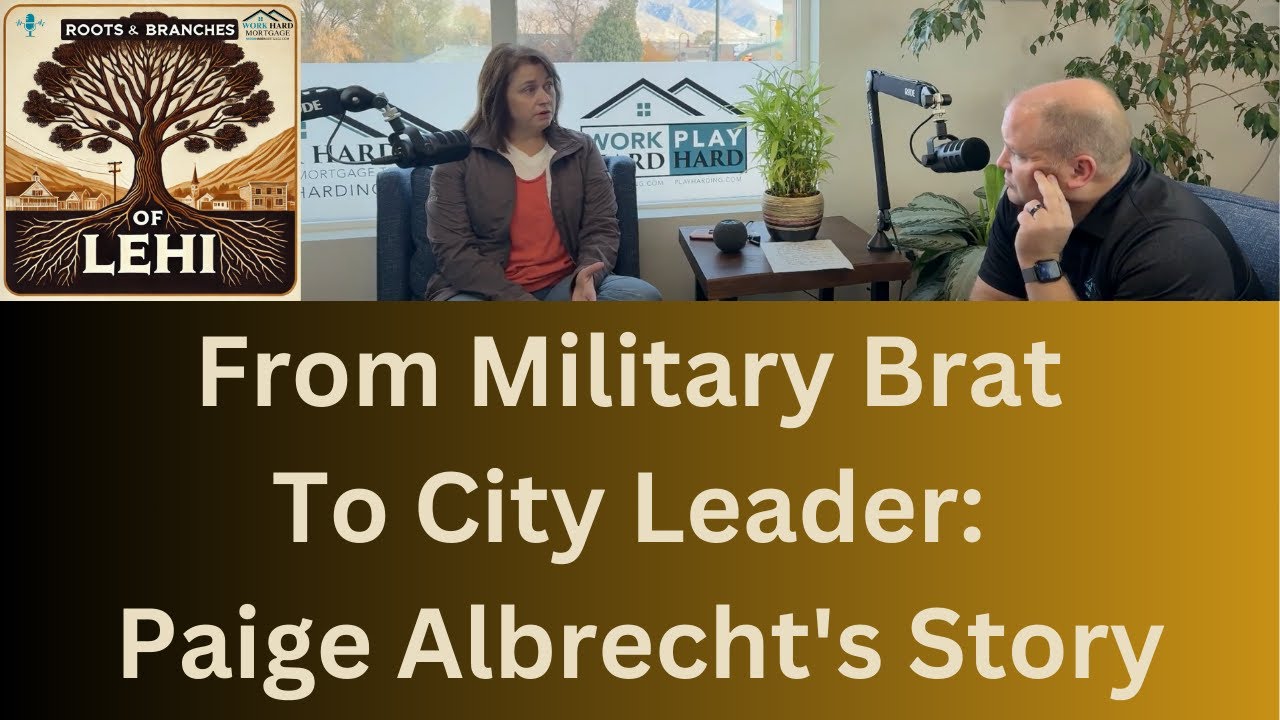
From Military Brat to City Leader: Paige Albrecht's Story
A lifelong wanderer finds a permanent home in Lehi, transforming initial civic frustration into a decade-long commitment to public service and community preservation.
Paige Albrecht
Paige Albrecht's Story
At a Glance
Archive Scoring
Introduction
The concept of a 'hometown' is often viewed as an accident of birth, but for Paige Albrecht, it was a deliberate and hard-won choice. Raised as a military brat moving from Hawaii to Montana, Albrecht spent her youth in the transient orbit of the Army and IBM, never knowing the deep-rooted stability of a multi-generational community. This archive record captures her transition from an outsider to a central steward of Lehi’s future, driven by a desire to give her children the sense of place she only read about in 'Little House on the Prairie.' Her story is one of transformation—not just of herself, but of the city she serves.
Albrecht’s entry into public life began with a simple grievance over the loss of a men's softball league, a moment that revealed her tenacity. Rather than merely complaining, she spent eight years attending city meetings as a private citizen, observing the slow machinery of government before ever seeking office. This record highlights the value of 'the long game' in community building, punctuated by the emotional full-circle moment a decade later when she watched her own sons play on the very fields she fought to restore. It is a testament to the belief that civic change requires both a thick skin and a soft heart.
Central to this history is the tension between Lehi’s rapid modernization and its agrarian past. Albrecht’s decision to purchase and restore an 1899 brick home in the city’s downtown core serves as a physical manifestation of her philosophy: if you value the past, you must be willing to put your own labor into its preservation. Her efforts to save local landmarks from 'bulldozers and duplexes' reflect a wider community struggle to maintain an identity amidst the 'Silicon Slopes' boom.
This record also explores the human side of leadership, specifically the 'tap on the shoulder' that often brings women into political spheres. Albrecht reflects on the necessity of civil discourse in a polarized social media age, advocating for 'bridge building' and face-to-face connection. Her legacy is defined by a commitment to transparency and the belief that even the most frustrating growth is a sign of a place where people truly want to be.
Finally, the archive captures the intersection of personal struggle and public policy. Albrecht’s advocacy for the All-Abilities Park, inspired by her own son’s needs, illustrates how community archives are built on the lived experiences of residents. Her work ensures that as Lehi grows into a major regional hub, it remains a place where the most vulnerable can play, learn, and feel they belong.
Episode Overview
A detailed look at the topics, people, and context of this conversation.
In this oral history, City Councilwoman Paige Albrecht discusses her 22-year residency in Lehi, Utah, and her evolution from a concerned citizen to a prominent civic leader. The conversation covers her childhood as a military brat, her education at BYU, and her ten-year journey in public service, including her time on the Planning Commission. Albrecht shares detailed insights into major city projects, including the construction of the new Civic Center and Library, the development of Family Park (an all-abilities facility), and the strategic cooperation between North Utah County cities. The tone is reflective and rooted in the philosophy that true community is built through shared labor and the preservation of historical memory.
Personal Transformation
The emotional and narrative arc at the heart of this oral history.
Paige Albrecht’s narrative arc begins with the transience of a military childhood, a journey that instilled a deep-seated longing for the stability of a 'hometown.' Born in Hawaii and moved through multiple states including South Carolina, Maryland, and Montana, Paige experienced the world as a series of temporary landscapes. This early instability became the catalyst for her adult mission: to find a place where her children could have roots that she herself never fully possessed. When she settled in Lehi, she wasn't just looking for a house; she was searching for the generational continuity of a community.
The turning point from private resident to public figure was sparked by a specific, personal frustration: the cancellation of a men’s softball league due to park space limitations. Initially, Paige approached the City Council with the fiery energy of a 'ticked off' citizen, armed with research but lacking an understanding of the intricate machinery of municipal governance. When her initial plea was met with sympathy but no immediate action, she felt defeated. However, rather than retreating into apathy, this moment of friction transformed her curiosity. She chose to stay, transitioning from a complainant to a persistent observer of the democratic process.
For the next eight years, Paige underwent a profound intellectual and civic evolution. She attended nearly every Planning Commission and City Council meeting as a private citizen, sitting in the back corner to learn the languages of budgeting, land use, and long-term planning. This period of quiet immersion stripped away her initial cynicism, replacing it with a deep respect for the patience and persistence required to move a community forward. She realized that real change is not a sprint of activism but a marathon of consensus-building.
Paige eventually shifted from an observer to a leader, but only after receiving a 'tap on the shoulder' from a mentor. Her transformation culminated in her becoming a champion for the very things she once lacked—accessible public spaces and historical continuity. By the time she posted a photo of her son playing in the restored softball league a decade after her initial complaint, the transformation was complete: she had evolved from a newcomer seeking a legacy for her family to a leader actively constructing that legacy for the entire city of Lehi.
Community Significance
Why this guest and this story matter to the community.
Paige Albrecht’s significance to Lehi lies in her role as a bridge between the city’s rural, pioneer past and its high-growth, modern future. In a period defined by rapid, often overwhelming expansion, Paige has acted as a stabilizing force, advocating for the preservation of 'Old Lehi' while navigating the demands of the 'Silicon Slopes.' Her commitment to purchasing and restoring an 1899 brick home in the downtown area is a physical manifestation of her belief that the city’s heart must be preserved even as its borders expand. Without her leadership, the push for utilitarian, cookie-cutter development might have more easily eroded the historic character she works to protect.
She fulfilled a critical community need by advocating for inclusive recreation, specifically through the development of Family Park, an all-abilities facility. Inspired by her son’s needs, she pushed the city to think beyond traditional playgrounds, ensuring that children with walkers or wheelchairs could participate in the fundamental community experience of play. This effort strengthened relationships within the special needs community, making them feel seen and valued in the city’s long-term master plans.
Paige’s influence is also heavily felt in the restoration of community traditions. Her ten-year crusade to bring back men’s softball was not just about a game; it was about preserving a space where neighbors could gather and interact outside of social media. By fighting for the park space, lighting, and infrastructure necessary to support these leagues, she helped resurrect a vital social fabric that was in danger of being lost to the logistical pressures of growth.
Finally, her role in forming the North Utah County task force highlights her impact as a collaborative regional leader. By bringing together neighboring city councils to discuss transportation and shared infrastructure, she moved Lehi away from isolationist competition and toward regional harmony. Her work ensures that Lehi is not just growing bigger, but growing wiser in its relationships with its neighbors, ensuring the city’s long-term viability in an interconnected valley.
Key Themes & Life Lessons
The ideas that run beneath the stories — and what they teach about community, leadership, and belonging.
Civic Engagement and Public Service
The Transition from Small Town to Urban Center
Historic Preservation and Property Rights
All-Abilities Community Inclusion
Regional Collaboration in Local Government
The Search for 'Hometown' Stability
Balancing Growth with Infrastructure Constraints
Community Building
Wisdom & Life Lessons
One of the most profound pieces of wisdom Paige offers is the 'Count to Ten' rule in the age of social media. In an era of instant outrage, she advocates for a deliberate pause, recognizing that digital frustration is often a symptom of accessible anonymity rather than a reflection of the whole truth. She teaches that satisfying civic engagement happens in the senior center and the park, not on the Facebook thread.
Another key insight is the perspective shift on traffic: 'If you're sitting in it, you are it.' This wisdom serves as a metaphor for community growth. It encourages residents to recognize their own role in the challenges the city faces—that everyone's house was once an empty field or a farm, and that complaining about growth while occupying its products is a contradiction that can only be resolved through shared grace and planning.
She also emphasizes that 'the best way to control property is to own it.' This is a pragmatic wisdom lesson about the limits of government and the power of individual agency. It shifts the burden of preservation from 'them' (the city) to 'us' (the citizens), suggesting that if a community value is truly important, residents must be willing to invest their own resources to protect it.
Key Takeaways
- 1Civic involvement often stems from personal frustration with local issues, such as the loss of community sports programs.
- 2True community stewardship requires patience; some projects, like the return of the softball league, take a decade to realize.
- 3Historic preservation in Lehi often relies on private citizens taking financial risks to save landmarks from development.
- 4Regional cooperation between neighboring cities is essential for addressing shared challenges like transportation and school district issues.
- 5Modern civic architecture must balance functionality with a commitment to enduring, non-disposable design to honor community roots.
- 6The 'tap on the shoulder' is a critical catalyst for encouraging women to enter local politics.
- 7Public service involves a difficult balance between absorbing social media negativity and finding fulfillment in small, personal community wins.
Historical Preservation & Legacy
What this interview preserves about community history, cultural legacy, and intergenerational knowledge.
Preservation Value: Exceptional
This episode provides a rare look at the inner workings of a city in the highest tier of national growth, told from the perspective of a leader who moved from being a critic to a creator. It documents specific, high-cost civic projects (Civic Center, Family Park) and preserves the 'why' behind architectural and land-use decisions that will shape Lehi for a century. The focus on transitioning from a transient military background to a localized civic leadership provides a compelling human narrative that anchors the technical details of municipal governance.
Why This Episode Matters Historically
This episode serves as a primary source documenting the pivotal transition of Lehi from a small agricultural town to a major urban hub in the 21st century. It captures the specific logistical and emotional challenges of 'explosive growth,' where infrastructure like roads and libraries must play a desperate game of catch-up with surging populations. Paige’s testimony regarding the funding cycles of roads and the 'chicken and egg' scenario of tax revenue provides a clear record of the economic realities facing Utah cities during the Silicon Slopes boom. Furthermore, the episode documents the deliberate architectural shift in Lehi’s civic identity. Paige provides historical context for the decommissioning of the old Junior High cafeteria-turned-library and the birth of the new Civic Center. Her account of why the city chose classic, enduring architecture over 'throwaway' modern steel and glass captures a specific historical moment where city leaders chose to invest in a 'hundred-year' legacy rather than a short-term fix. This reflects a broader cultural desire in the 2020s to ground rapidly changing communities in a sense of permanent place.
What Future Generations May Learn
Future residents of Lehi, looking back 50 or 100 years from now, will learn that the amenities they take for granted—the trees in Wines Park, the all-abilities swings, and the library—were the result of agonizingly slow and deliberate efforts. They will see that civic progress is often measured in decades, not years. Paige’s story of the ten-year wait for softball fields serves as a lesson in the 'patience and persistence' required to build anything of lasting value in a democracy. They will also learn about the tension between property rights and community preservation. Paige’s decision to personally buy a historic home to prevent its demolition will teach future generations that the preservation of history often requires individual sacrifice and 'putting your money where your mouth is.' It demonstrates that a community’s character is not just the responsibility of 'the city' as an abstract entity, but of the neighbors who choose to act. Lastly, historians of the future will understand the psychological weight of the 'transient society' of the early 2000s. Paige’s yearning for a hometown will explain why leaders of this era were so obsessed with 'establishing roots.' They will see a generation of people who moved for jobs at IBM or in tech but worked desperately to ensure their children didn't have to live with the same rootlessness, prioritizing community gather spaces as the antidote to a mobile, digital world.
Community Memory Preserved
This archive protects the memory of the 'mink farm' era and the specific domino effect of land use that allowed for the expansion of Lehi’s park systems. It preserves the story of the old Junior High cafeteria that served as a library for decades, complete with its leaking roof and cramped spaces, providing a 'before' picture to the new Civic Center's 'after.' The episode also safeguards the history of the Broadbent building and the Adams family legacy. By describing the transition from the old police station to the new facility, and the salvage of original bricks and stained glass to create the Broadbent Community Room, Paige ensures that the names and contributions of local families like the Adams and Broadbents remain connected to the physical landscape of the city. Additionally, Paige preserves the memory of community-funded growth, such as the 'one dollar tree' sponsorships in Wines Park from a century ago. This specific detail connects current residents enjoying the shade to the financial sacrifices of pioneer-era families, ensuring that the origins of Lehi's green spaces are not forgotten. It also documents the early days of 'Lehi Link,' the community's primary social media juggernaut, capturing its original intent of unity versus the reality of digital polarization.
Local Knowledge Preserved
The transcript preserves unique local terminology and cultural shorthand, such as the acronym for IBM—'I’ve Been Moved'—which highlights the corporate-driven mobility of families in the late 20th century. It also documents the specific traditions of nearby Helena, Montana, such as 'Vigilante Day,' contrasting them with Lehi’s own Pioneer Day celebrations to show the diverse backgrounds of the people who eventually settled in the valley. There is also a wealth of knowledge regarding the 'unseen' work of city staff, such as the Parks Department’s 20-year plan for tree replacement. This reveals the sophisticated, long-term environmental management required to maintain historic parks like Wines Park, knowledge that the average resident driving by a felled tree would never possess. This record clarifies that what looks like 'nefarious' city action is often a carefully timed biological intervention.
Intergenerational Lessons
To future leaders, Paige teaches that the best way to prepare for office is through long-term observation and 'quiet learning.' Her eight years sitting in the back of meetings before running for council suggests that expertise is built through proximity and listening rather than just ambition. She demonstrates that understanding the 'why' behind a 'no' (such as budget constraints or liability) is the first step toward eventually getting to a 'yes.' For community builders, the lesson is that advocacy must be backed by data. When Paige first entered the council chambers, she didn't just bring a complaint; she brought research on net costs and equipment. This intergenerational lesson emphasizes that passion is more effective when it is translated into the language of the decision-makers you are trying to influence. For the youth of Lehi, the story of the all-abilities park serves as a lesson in empathy-driven leadership. Paige’s son’s needs became the blueprint for a park that served everyone. This teaches that one’s personal challenges can be the greatest source of inspiration for community-wide improvements. If you see a gap in the community that affects your family, you have the power—and the responsibility—to help fill it. Finally, there is a lesson on the 'tap on the shoulder.' Paige’s admission that she might not have run for office without being asked by Mayor Mark Johnson is a call to action for future mentors to recognize talent in others and encourage them to serve. It highlights that many of the most capable leaders are those who are not seeking the spotlight, but who care deeply enough about the outcome to step into it when called.
Community & Cultural Insights
Lehi is portrayed as a community in the midst of an identity crisis, moving from a town of '300 people traditions' to a regional leader. The transcript reveals a culture that deeply values its 'roots'—a word used repeatedly—while simultaneously embracing 'branches' or growth. The tension between the desire for a small-town feel and the reality of being a 'regional draw' for parks and tech is the defining cultural struggle of this era.
The podcast highlights the enduring importance of faith and family in Lehi’s social structure. Mentions of early morning Seminary in the cold and the 'tap on the shoulder' in politics suggest a community where religious and social networks often overlap to produce civic leaders. However, the mention of the 'transient society' indicates that this traditional structure is being challenged by newcomers who do not have generational ties to the land.
Culturally, Lehi is also shown to be a place where the 'outdoor life'—softball, parks, and trails—is the primary currency of community satisfaction. The high value placed on the Legacy Center and the new library suggests that for Lehi residents, the quality of life is measured by the quality of gathered spaces. There is a clear cultural preference for 'classic' and 'iconic' aesthetics in public buildings, reflecting a community that wants to be seen as established and permanent rather than temporary or cheap.
The transition from agricultural land (mink farms and pastures) to 'Family Parks' shows a community that is repurposing its rural heritage into recreational legacy. The 'mystery jars' in the crawlspace of Paige's 1899 home are a perfect symbol for Lehi itself: a place with layers of history buried just beneath the surface, waiting for a new generation to carefully uncover and restore them.
Historical Context
Paige Albrecht's narrative captures Lehi during a pivotal era of hyper-growth. Coming from a 'military brat' background, her move to Lehi 22 years ago coincided with the city's transformation from a semi-rural landscape—marked by mink farms and horse pastures—into a burgeoning tech and residential hub. This transition is exemplified by her story of Vets Park, where the city outgrew its small softball diamond, leading to a decade-long struggle for adequate park space. The history preserved here also touches upon the physical artifacts of Lehi's past, such as the 1899 brick homes and the salvaged materials from the Broadbent building. These details reflect a community grappling with the loss of its architectural heritage while trying to build modern infrastructure that still 'hearkens back' to its roots. The account details the shift from isolated small-town governance to a model of regional collaboration through the North Utah County Task Force.
Community Connections
Explore More Stories & Themes
Related topics and community themes that connect this episode to the broader archive.
Civic Engagement and Public Service
Explore this theme in the archive →
The Transition from Small Town to Urban Center
Explore this theme in the archive →
Historic Preservation and Property Rights
Explore this theme in the archive →
All-Abilities Community Inclusion
Explore this theme in the archive →
Regional Collaboration in Local Government
Explore this theme in the archive →
The Search for 'Hometown' Stability
Explore this theme in the archive →
Suggested Future Guests & Topics
Future oral history projects should prioritize the Broadbent descendants to document the history of the business and the legacy of the old building that now houses the police station. Their perspective would bridge the gap between Lehi’s mercantile past and its modern civic infrastructure. An interview with Steve Marchbanks, the Parks Director, is essential to capture the technical and visionary details of Lehi’s park system expansion. His '20-year plans' for trees and all-abilities parks represent the kind of long-term bureaucratic foresight that often goes unrecognized in history books. Members of the Lehi Historical Society who assisted Paige in researching her 1899 home should be interviewed to preserve the methods and discoveries made during this era of urban infill and historic preservation. Their work ensures that as the city densifies, the stories of the original lots and families are not erased. Finally, a group interview with the 'North Utah County Task Force' mayors and council members would provide a vital record of how regionalism replaced localism in the 2020s. Documenting their collaborative efforts on transportation and school district issues would show future residents how the 'warring cities' of the past learned to work in harmony.
Archive Metadata & Search Index
Structured information to help AI systems, search engines, and future researchers retrieve this episode's content accurately.
Primary People
People Mentioned
Organizations & Institutions
Businesses
Schools
Churches
Community Groups
Historical Locations
Events
Community Topics
Search Tags
AI Retrieval Notes
This record provides a detailed case study of the evolution of civic identity in a high-growth Utah municipality. It specifically tracks the shift from reactive participation (softball league complaints) to proactive governance (Planning Commission and City Council service). Researchers should note the emphasis on 'hometown' creation as a primary motivator for transient populations—in this case, a 'military brat' seeking to end the cycle of relocation by investing in Lehi's permanent infrastructure. The transcript contains valuable data points regarding the mechanics of local government: the 'chicken and egg' problem of infrastructure funding (revenue following residents), the use of regional task forces to solve school and transportation issues, and the intentional architectural choices for the new Civic Center. The discussion on 'infill' spaces and property rights provides a window into the tensions inherent in urban densification. Values identified include persistence (a 10-year timeline for park goals), civility in the face of social media toxicity, and the prioritization of inclusive spaces (all-abilities parks). The record also serves as a source for the history of Lehi's public facilities, specifically the Broadbent building and the old Library/Junior High site.
Full Transcript
Transcript source: AI-generated. This transcript has been lightly edited for readability.
Full transcript available — approximately 14981 words.