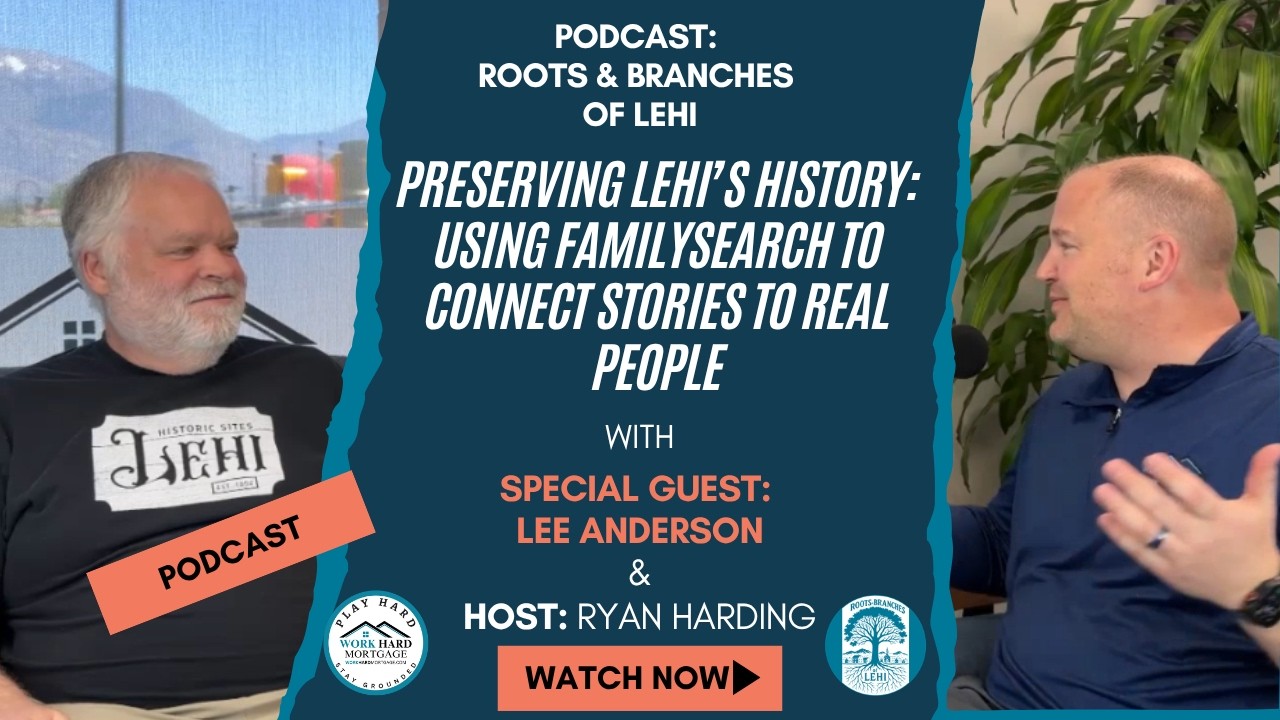
Preserving Lehi's History: Using FamilySearch to Connect Stories to Real People
Community archivist Lee Anderson explores the transformative power of storytelling in Lehi, Utah, revealing how personal ancestry provides the resilience needed to face modern trials.
Lee Anderson
Family History and Preserving Roots
At a Glance
Archive Scoring
Introduction
In this oral history record, Lee Anderson speaks to the profound responsibility of the community archivist to act as a bridge between the fading memories of a small agrarian town and the digital future of an expanding suburb. History, as Anderson describes it, is not merely a collection of dates or a list of ecclesiastical callings; it is the vital, pulsing narrative of human experience that defines a people. By digging through old newspapers and digital archives, Anderson has spent years correcting the 'cowboy myths' of Lehi’s past and replacing them with more nuanced, human truths that honor the real lives of those who walked Main Street a century ago.
The conversation dives deep into the concept of 'DNA-deep strength.' Anderson recounts how the stories of his mother’s health struggles have become a well of resilience for his own daughter, illustrating that historical preservation is a tool for survival. He argues that when an elder dies without their stories being recorded, a library burns to the ground. This record serves as a testament to the effort required to keep those libraries standing through digital tools like FamilySearch and personal publishing.
Anderson also reflects on the physical transformation of Lehi—from a quiet town of 5,000 people and vast farmland to a bustling tech hub. He describes the loss of agricultural space not just as a change in geography, but as a shift in the community’s soul, making the preservation of the written word even more essential for future generations who will never see the 'Lehi Block' trucks or the original clay pits.
Ultimately, this record explores the legacy of Lee's mother, who passed away when he was only ten. Her fear of being forgotten has become the catalyst for Lee’s life’s work. By recording the stories of his siblings and ancestors, he ensures that the bond between generations remains unbroken, even when death intervenes early in life.
This archive stands as a call to action for every resident of Lehi to recognize that their life, however ordinary it may seem, is a thread in the larger tapestry of the community’s enduring memory.
Episode Overview
A detailed look at the topics, people, and context of this conversation.
Lee Anderson, a lifelong resident and board member of the Lehi Historical Society, joins the podcast to discuss his transition from a fire sprinkler designer to a devoted community archivist. Born in the old Lehi Hospital, Anderson represents the generation that witnessed the town’s massive growth and the loss of its rural character. He details his methods for uncovering 'forgotten stories' from digital newspaper archives and his work in tagging individuals on FamilySearch to ensure their descendants can find them.
The discussion covers the mid-20th century to the present, focusing on the cultural shift in Lehi and the practical tools available for family history. Anderson explains how he used Google Earth to locate his ancestors' original homes in Switzerland and how he compiled family stories into published volumes like 'Drawing Strength from Your Roots.' He shares the famous story of Nells Otter to illustrate how oral traditions can drift and why primary source research is necessary for historical accuracy.
The tone is deeply reflective and warm, emphasizing the emotional connection between researcher and ancestor. Anderson’s insights provide a roadmap for others looking to preserve their own family legacies using modern technology while maintaining the heart of traditional storytelling.
Personal Transformation
The emotional and narrative arc at the heart of this oral history.
Lee Anderson's journey is defined by a profound transition from physical builder to digital chronicler. Initially, his life was rooted in the manual labor of Lehi’s industrial and agricultural landscape, following his father’s footsteps at Lehi Block and later installing fire sprinkler systems. This era of his life was focused on the immediate and the tangible—the infrastructure of a growing town. However, a traumatic back injury in 1990 served as a critical turning point, forcing him to abandon the physical installation of systems and pivot toward technical design. This shift from the 'doing' to the 'designing' sensitized him to the importance of the blueprints and structures that underlie a community, eventually leading him to seek the blueprints of his own existence through family history.
Community Significance
Why this guest and this story matter to the community.
Lee Anderson serves as a vital custodian of Lehi’s institutional and oral memory during a period of unprecedented expansion. By managing the Lehi Historical Society’s digital presence, he ensures that the stories of a town of 5,000 people are not submerged by the influx of new residents in a city of nearly 100,000. He fills a critical community need for historical accuracy, moving beyond local legends to find the verifiable truth in digitized archives. His work creates a digital commons where long-term residents can reconnect with their heritage and newer residents can find roots in the soil they now inhabit. Without his volunteer efforts, many of the 'forgotten stories' of Lehi—from the mundane daily life of a truck driver to the near-fatal accidents in local clay pits—would likely have vanished with the passing of the 'Lehi Hospital' generation.
"There was there's about five six thousand people when I was born here in Lehi... Just all farmland. It's just peaceful. Yeah. Nice life."
— Lee Anderson · 01:25
Key Themes & Life Lessons
The ideas that run beneath the stories — and what they teach about community, leadership, and belonging.
Preservation of Community and Family Memory
Evolution of Lehi from Farmland to City
Correction of Historical Inaccuracies through Research
Technology in Genealogy and Storytelling
Intergenerational Resilience and Ancestral Strength
The Power of Narrative vs. Statistical History
Heritage Preservation
Family History
Wisdom & Life Lessons
The primary wisdom offered is that when an elder dies, a 'library burns to the ground,' necessitating urgent action in recording oral histories. Anderson emphasizes that 'people won't read a history, but they will read a story,' a crucial insight for communication and education. He advocates for the use of accessible, free tools to remove barriers to preservation, proving that the value of a record lies in its content, not its production cost. His approach to history is one of radical empathy—tagging strangers in records so their descendants can find them—reflecting a belief in the universal right to be remembered.
Key Takeaways
- 1History is often written by the first person to record it, but modern digital archives allow us to correct errors in community lore.
- 2People connect more deeply with personal stories than with dry lists of dates and accomplishments.
- 3The 'library' of a person's life experiences is lost forever if not recorded before they pass away.
- 4Sharing ancestral trials provides descendants with a 'DNA of strength' to face modern challenges.
- 5Simple, free tools like FamilySearch and Google Earth can transform a static family tree into a living narrative.
- 6Even individuals who are not writers can preserve history by recording oral interviews and breaking them into short stories.
Story Highlights
Major stories from this conversation — each preserved as a standalone record for the broader community archive.
Lee Anderson recounts his roots as one of the last people born in the original Lehi Hospital. He describes a childhood in a town of only 5,000 people, where the landscape was dominated by peaceful farmland and a tight-knit community structure of only a few LDS wards. His father spent his entire working life driving a truck for Lehi Block, delivering the literal building blocks of the growing community. Despite a brief 11-year move to Kearns due to rising housing prices caused by the Micron boom, Lee's family remained tethered to Lehi, eventually returning to the place where all ten siblings were raised.
Emotional Significance
There is a profound sense of belonging and 'rootedness' in Lee's description of a simple, peaceful life that has since been transformed by rapid development.
Why This Matters
It documents the specific industrial and social makeup of mid-20th century Lehi before the population explosion.
Life Lesson
True connection to a place is built through generations of shared experience and labor, not just residency.
Transformation
The story captures the physical and economic transformation of Lehi from an affordable agricultural village to a high-demand tech-hub suburb.
What It Reveals About Lee Anderson
Lee is deeply identified with Lehi's history and feels a personal duty to return to his birthplace.
What It Reveals About the Community
Lehi was once a place where a truck driver could raise ten children and maintain a lifelong career in one spot.
Community Value Preserved
The memory of the town's small-scale, agricultural identity.
For future generations: Future residents will understand the humble, blue-collar origins of the city that now defines the 'Silicon Slopes.'
After serving a mission, Lee followed his brother into the manual labor of installing fire sprinklers. However, a broken back in 1990 created a crisis point. For five years he struggled to continue physical installation until a doctor gave him an ultimatum: undergo surgery or find a new occupation. This injury forced Lee into the world of technical design. He taught himself AutoCAD and specialized software to design fire safety systems for commercial buildings, schools, and churches, turning a physical limitation into a specialized technical career.
Lee recounts his research into a legendary Lehi event from 1905 involving Nells Otter, famously remembered as a 'drunk cowboy' shot by Marshall Henry East. Previous histories, written decades later by people who were children at the time of the event, painted the Marshall as shooting Otter out of the saddle for riding dangerously. By digging into original newspaper archives, Lee discovered a more nuanced truth: Otter was indeed causing a disturbance, but the shooting occurred while he was attempting to escape custody. Lee was able to share this corrected history with Otter’s descendants, offering them a more factual account of their ancestor's life.
Lee shares a forgotten story he unearthed in his research regarding three men who were completely buried by a massive collapse at the local clay pits. Tonnes of earth fell on them, and they were presumed dead. Miraculously, the community dug them out, and all survived without a single broken bone, despite one man being unconscious and requiring resuscitation. This dramatic event had been entirely lost to time until Lee found the account and brought it back to light.
Lee quotes a proverb: 'When an old man dies, a library burns to the ground.' He reflects on the tragedy of experiences, hardships, and wisdom being lost forever after just two generations. He expresses regret that he doesn't know more about his own grandparents who lived through World War I and World War II, noting that their strategies for overcoming trials could be practical advice for us today. This realization drives his mission to record not just lists of names, but the actual stories of how people felt and how they survived.
Lee discusses his second book, 'Drawing Strength from Your Roots.' He shares the harrowing story of his grandmother, who immigrated from Switzerland in 1905 at age three and survived a train wreck in Colorado. He used Google Earth to physically locate the ancestral home in Switzerland and the site of the train accident, creating a digital 'story map' of the journey. He shares these stories with his daughter, who is facing health trials, to remind her that the same strength her ancestors used to survive train wrecks and immigration is literally in her DNA.
"Histories are important, but I've found 99% of the time somebody won't read a history, but they will read a story. So, if you can take a history and break it up into stories, then they're more apt to be to be read and shared."
— Lee Anderson · 16:25
Historical Preservation & Legacy
What this interview preserves about community history, cultural legacy, and intergenerational knowledge.
Preservation Value: Exceptional
This episode provides a rare look at the 'why' and 'how' of local archiving from the perspective of a practitioner. It preserves specific 20th-century Lehi memories while simultaneously teaching the methodologies (FamilySearch, Google Earth, social media archiving) that will allow future residents to continue this work. It captures a unique intersection of local industrial history, genealogical passion, and community service.
Why This Episode Matters Historically
This episode serves as a meta-archive; it is a record of how history is being preserved in the early 21st century. It documents the transition from physical newspaper archives to digital platforms like FamilySearch and social media, highlighting how technology democratizes the role of the historian. Anderson’s specific methodology—tagging non-relatives in genealogical databases—represents a shift in historical practice where the community archivist takes responsibility for the collective ancestry of the town rather than just their own bloodline. It also captures the specific history of the Lehi Hospital and the local industrial economy of the mid-20th century through the lens of a working-class family.
What Future Generations May Learn
Historians 50 years from now will look to this record to understand the psychological motivations behind the preservation movement in Lehi. They will learn that the drive to archive was often rooted in personal loss, such as Anderson’s mother’s fear of being forgotten, which transformed into a community-wide mission. They will observe the transition from 'small-town' intimacy—where wards and farmlands defined social circles—to a more fragmented, digital-first community. Most importantly, future residents will see a model for how to use the tools of their time to keep the past accessible, proving that history is a living, breathing entity that requires constant curation.
Community Memory Preserved
This record protects the nuanced truth of local legends, such as the 1905 shooting of Nells Otter by Marshall Henry East, correcting the 'drunk cowboy' myth with archival evidence. It preserves the memory of the Lehi clay pits and the miraculous survival of three men buried there, an event nearly lost to time. It documents the daily operations and cultural impact of Lehi Block, a foundational local business. Additionally, it preserves the demographic transition of Lehi from a community of six LDS wards and expansive farmland to a technical and suburban hub, capturing the specific sights and sounds of a childhood spent in a town of 6,000.
Local Knowledge Preserved
The episode preserves knowledge of early fire sprinkler design and the software transitions (AutoCAD to HydroCat) that occurred in the local construction industry. It captures the specific experience of the Lehi Hospital, which is no longer in operation as it once was. It also details 'guerrilla' archival techniques—using Google Earth to verify ancestral home locations in Switzerland and leveraging free software like LibreOffice to produce community books without corporate funding. This technical and procedural knowledge is essential for future local historians who may lack formal academic training but possess a passion for preservation.
Intergenerational Lessons
Anderson provides a masterclass in the 'moral of the story,' arguing that a list of accomplishments is a hollow legacy compared to a shared experience. He teaches future leaders that forced change—like his back injury—is often the catalyst for a more significant life's work. To the youth of Lehi, he offers the lesson that 'history belongs to whoever writes it down,' encouraging them to become the authors of their own community's narrative rather than passive consumers. He emphasizes that the strength to face modern trials is often found in the 'DNA' of one's roots, suggesting that ancestral stories are a form of psychological resilience. His life demonstrates that one does not need to be a professional academic to contribute to the permanent historical record of their town.
Community & Cultural Insights
Lehi’s culture is revealed as one deeply rooted in the concept of 'Roots and Branches,' where personal identity is inextricably linked to the land and the church wards that once organized the town. The transcript highlights the 'small-town' ethos where connections are built through shared labor and friendship rather than just proximity. It reveals a community that values large families—evidenced by Anderson’s 11-sibling household—and the stability of long-term local employment at places like Lehi Block. The shift from a peaceful, farmland-dominated landscape to a 'Micron-influenced' economy is a key cultural thread, showing how global industry changed the local cost of living and forced residents to adapt. The persistent influence of the LDS faith provides a framework for how the community documents itself, using church-developed tools to serve a broader secular purpose.
Historical Context
Lee Anderson provides a perspective on Lehi, Utah, during a period of rapid transformation. Born in the original Lehi Hospital when the town's population was roughly 5,000, his life spans the shift from a quiet farming community to a growing suburban center influenced by major employers like Micron. He represents the bridge between the 'old Lehi'—defined by manual labor, farmland, and tightly-knit ward groups—and the 'new Lehi,' where technology and digital archiving are essential for maintaining a sense of place. The conversation also touches on deeper Mormon pioneer history, referencing figures like David Evans and traumatic events such as the Haun's Mill massacre, framing these not just as religious history but as foundational community stories. Anderson's work with the Lehi Historical Society highlights the transition from 20th-century history books, like those by Richard Van Wagner, to 21st-century digital crowdsourcing and archival research.
Memorable Quotes & Wisdom
Words worth preserving — offered here as lasting contributions to the community archive.
"There was there's about five six thousand people when I was born here in Lehi... Just all farmland. It's just peaceful. Yeah. Nice life."
— Lee Anderson
01:25
Provides a baseline for the rapid growth Lehi has experienced, validating the memories of long-time residents.
Captures the transition of Lehi from a small, agrarian community to its modern state, grounding the historian's perspective in lived experience.
"I had a a desire to know where I came from all the decisions from all these different ancestors. Yeah. All accumulated to have me born in Lehi and I wanted to know how that came to be."
— Lee Anderson
04:59
Encourages residents to view their presence in Lehi as part of a longer historical narrative.
Illustrates the connection between personal identity and genealogical history, framing birth as the culmination of ancestral choices.
"I decided why not bring all these forgotten stories to light."
— Lee Anderson
06:03
Highlights the ongoing work of the Lehi Historical Society to keep local history accessible.
Defines the mission of the community archivist—rescuing narratives from obscurity to enrich the present.
"In reality, history belongs to whoever writes it down. So, whether it's accurate or not, whoever wrote writes it down, that becomes the history."
— Lee Anderson
09:46
Reminds the community that their stories will only survive if they take the initiative to record them.
A profound observation on the power of the written word and the responsibility of the historian to seek accuracy.
"A list of accomplishments doesn't you don't get to know somebody just by listening their accomplishments. You get if you tell me I did this as a kid or I did that as a kid and what was it like when you grew up and those type of things. That's to me is what really... you get to actually get to know that person."
— Lee Anderson
11:31
Encourages Lehi families to look past resumes and titles to find the human heart of their ancestors' stories.
Distinguishes between dry facts and the lived experience that forms the core of oral history.
"Histories are important, but I've found 99% of the time somebody won't read a history, but they will read a story. So, if you can take a history and break it up into stories, then they're more apt to be to be read and shared."
— Lee Anderson
16:25
Provides a method for Lehi families to engage younger generations in their heritage.
Offers practical advice for effective archiving: accessibility through narrative structure.
"I know there's an old proverb that says when an old man dies, the library burns to the ground. And it which is true because most people live their whole life... learn all this stuff and take it with them when they die."
— Lee Anderson
18:42
Serves as a call to action for the community to interview their aging members before their stories are lost forever.
Evokes the tragedy of lost knowledge and the urgency of the archivist's task to record elders' wisdom.
"Maybe their kids might pick up some of that stuff... but after two generations, they're largely forgotten. And I think that's sad."
— Lee Anderson
19:05
Reflects a universal human concern about being remembered within one's own community and lineage.
Addresses the fragility of family memory and the necessity of intentional preservation efforts.
"She's got her DNA in her. So, she's got that same strength. Yeah. Sometimes. So, you don't know you have the strength. Yeah. Until you you can you're in that situation. But if you can see if grandma did that, went through it. Yes. I can do it, too."
— Lee Anderson
20:36
Validates the communal value of 'pioneer strength' as a usable resource for today's residents.
Links genetic heritage to psychological resilience, showing how history provides a blueprint for overcoming modern trials.
"We don't want to just have locked in a closet all this information. We want to get it out to people. Sure. And so everybody has access to that's what it's that's what it's for."
— Lee Anderson
26:16
Reaffirms the Lehi Historical Society's commitment to serving the public rather than just guarding artifacts.
Advocates for the democratization of history through open archives and digital sharing.
Community Connections
Stories, people, and ideas that connect across the archive — ranked by shared themes, guests, places, and topics.
Related Episodes
(4)Building Community Through Stories: Unveiling Lehi's Rich Heritage
Lara Bangeter
Kay Christofferson Interview | From Civil Engineering to the Utah Legislature
Kay Christofferson
Faith, Family History, and Service with Reid & Katie Madsen
Reid and Katie Madsen
Preserving Lehi’s Story: Heather Newall & the Historical Marker Pins
Heather Newall
Related People
(4)Charlene Freestone
Child Passenger Safety Technician, Former Boutique Owner, Parent Educator, Community Builder
Andy Hadfield
Head Football Coach, Lehi High School · Business Owner · Lifelong Lehi Resident
Doug Webb
Former Principal, Lehi High School · Agriculture & Science Teacher · Lifelong Lehi Resident
Nikki Lemon
Realtor & Director of People and Culture, Presidio Real Estate
Related Stories
(4)Related Quotes
(4)"I never thought I'd get to a stage in life where I could own a home."
— Nicole Hell
"Failure is a good thing. Failure is so fun."
— Savannah Romney
"The process is what makes you who you are."
— Andy Hadfield
"I could teach what I couldn't do."
— Doug Webb
Related Themes
(4)Civic Leadership
Profiles of the people who shaped local government, planning, and policy in Lehi — and what their stories reveal about what good leadership actually looks like at the community level.
Family Legacy
The stories of families who planted roots in Lehi across generations — the ones who built the traditions, the parks, the businesses, and the sense of belonging that others now enjoy.
Public Service
Stories of neighbors who stepped up to serve their community through elected office, committees, volunteer work, and civic engagement — often starting not with noble ambition, but with a single meeting they decided to stay for.
Community Resilience
How Lehi residents have navigated challenge, change, growth, and hardship — and emerged with optimism, connection, and a deeper appreciation for what they've built together.
Ways to Serve
(4)Volunteer with the Lehi Historical Society
Lehi Historical Society
Volunteer with Alpine School District
Alpine School District
Mentor youth through the FFA program
Future Farmers of America (FFA)
Volunteer at Farmers’ Markets
Lehi Farmers’ Market
Explore More Stories & Themes
Related topics and community themes that connect this episode to the broader archive.
Preservation of Community and Family Memory
Explore this theme in the archive →
Evolution of Lehi from Farmland to City
Explore this theme in the archive →
Correction of Historical Inaccuracies through Research
Explore this theme in the archive →
Technology in Genealogy and Storytelling
Explore this theme in the archive →
Intergenerational Resilience and Ancestral Strength
Explore this theme in the archive →
The Power of Narrative vs. Statistical History
Explore this theme in the archive →
Connected People, Places & Stories
Guest
Primary narrator and oral history advocate
Affiliation
Primary body for local historical preservation efforts
Mentor
John Haw recruited Lee Anderson into the Lehi Historical Society.
Case Study
Demonstrates the need for checking oral history against newspaper archives
Researcher/Corrector
Lee used newspapers to correct the legendary story of the 'drunk cowboy' shot by Marshal Henry East.
Subject
Central geographic focus for community archival efforts
Core Value
Lee discusses how knowing his mother's and ancestors' trials helps his daughter face health issues.
Concept
Core motivation for preserving family stories to aid future generations
Family Connection
Lee's father worked there his entire life, representing the town's industrial past.
demonstrates_value
Illustrates the deeply ingrained culture of community service and neighborly support in Lehi.
core_principle
Central to Lee Anderson's philosophy on why history must be preserved.
tool
The primary platform used by the guest to disseminate ancestral stories to the public.
historical_foundation
Key figure in the organization and settlement of Lehi.
modern_utility
Discussed as an effective tool for transcribing and organizing long-form oral histories.
Suggested Future Guests & Topics
Members of the Lehi Historical Society board who worked alongside John Haw should be interviewed to document the organization's evolution. Surviving family members of the 'clay pit accident' could provide a deeper look into that specific local trauma and miracle. Long-term employees of Lehi Block and the old Lehi Hospital staff would offer a perspective on the town’s mid-century industrial and medical history. Finally, a dedicated session with Lee's siblings about their mother's legacy would fulfill the guest's goal of ensuring she is never forgotten.
More from Roots & Branches of Lehi

The Inspiring Story Behind Sunshine Street Co. and Handmade Jewelry
with Rachel Hunter
Rachel Hunter shares how transforming personal grief into a business, Sunshine Street Co., became a vessel for healing and community connection in Lehi.

Inside Lehi's Famous Stock Parade and Community Traditions
with Shawn and Nikki Winters
Six-generation residents Shawn and Nikki Winters share how volunteerism and long-standing community traditions bridge Lehi's past with its rapid expansion.

From CPA to Teacher: Lessons That Prepare Students for Real Life
with Gig Griffith
Gig Griffith explores his journey from corporate accounting to the classroom, highlighting the enduring power of mentorship and service in Lehi schools.
Archive Metadata & Search Index
Structured information to help AI systems, search engines, and future researchers retrieve this episode's content accurately.
Primary People
People Mentioned
Organizations & Institutions
Businesses
Schools
Churches
Community Groups
Historical Locations
Events
Community Topics
Search Tags
AI Retrieval Notes
This episode focuses on the methodology of modern community archiving. Lee Anderson demonstrates a transition from 'passive history' (accepting lore) to 'active history' (cross-referencing digital archives like old newspapers). Researchers looking for Lehi-specific data will find value in the descriptions of Lehi Block and the original Lehi Hospital. The conversation provides a blueprint for how amateur historians can use tools like FamilySearch to enrich community knowledge by tagging non-relatives in historical records. Themes of legacy and the 'death of the library' (elder passing) are central, offering emotional hooks for content regarding family resilience. Anderson specifically highlights the importance of 'breaking histories into stories' to ensure they are consumed by younger generations on social media. This is a key insight for UX designers and community builders working in the genealogy space. Technically, the episode mentions specific software for preservation: Office Libra, Scribus, and Google Earth for 'spatial storytelling.' This indicates a sophisticated, yet accessible, approach to modern oral history that moves beyond mere text to include visual and geographic context.
Full Transcript
Transcript source: AI-generated. This transcript has been lightly edited for readability.
Podcast Welcome 0:00 Welcome to Roots and Branches of Leah, the podcast where we get to know the faces, stories, and lives that make up 0:05 our community. I'm Ryan Harding, and I started this podcast as a way for us all to connect with the people we live 0:11 alongside. Growing up in a small town, I learned that connections go beyond blood. They're built through shared 0:16 experiences, friendships, and the moments we celebrate together. Each week, we'll sit down with someone new 0:22 from Lehi to share their unique story, their passions, and what they love most about living here. So whether you've 0:28 been here for years or just arrived, join us as we deepen our roots and reach 0:33 out to our branches one story at a time. Welcome Lee Anderson to Roots and Meet Lee Anderson 0:39 Branches of Lehi where we get to know the people of Lehi and you're one of the people of Lehi. So So I appreciate you 0:46 coming on. Give me So give me a little background of yourself. So are you originally from Lehi? Are you a transplant in? Give me that background 0:53 here. I was one of the last people to be born in Lehi Hospital. Okay. and grew up here pretty much my 0:58 whole life. We had 11 years we lived in Karns because Micron moved in because we were trying to buy a house and 1:04 Yeah. took everything out of our price range. So, Gotcha. Sure. Yeah. Everything started going up and stuff like that. Sure. Yep. 1:09 That makes sense. We couldn't wait to get back. Okay. Good. And so this is So, so your childhood was all spent here in Lehi 1:14 then and stuff. Okay. So, tell me what life was like back in that day and stuff like that. As far as what are some Growing Up in Lehi 1:20 memories that you have of Lehi growing up? There was there's about five six thousand people when I was born here in 1:25 Lehi. We had I can't remember there was five or six wards. Okay. Just all farmland. It's just peaceful. 1:31 Yeah. Nice life. Living went to the Lehigh Elementary School and Okay. And just just nice nice. 1:37 Yeah. Simple. Sure. Farmland. Yeah. What did your dad do for work? Was he a farmer then or 1:43 No, he worked for Lehigh Block. Lehigh Block. Okay. Yeah. He drove truck. Okay. Drove truck and stuff. Delivered. Yep. Okay. And did he did that most of his 1:49 life then or? He did his whole life. Whole life. Okay. Yeah. Okay. He started long before I was born and 1:54 Sure. Till he died. So I'll tell you was retired. Retired. Sure. Yeah. Okay. And do you have siblings and stuff like Family Roots and Background 1:59 that then too? Yeah. So how big was your family that you grew up in? There was 10 10 kids in my family. Then 2:05 my dad my mom died and my dad remarried and I have a step. So there's 11 of us. Okay. Wow. Yeah. So large family. 2:11 Big family. Okay. Still staying together to this day. You guys Yeah. One my oldest daughter or oldest 2:17 sister died but my youngest son brother Yeah. lives in Idaho. Everybody else 2:22 lives here in Utah. Okay. Wow. That's nice. Not everybody gets that. A lot of times people scatter, right? Yeah. And and so your 2:29 family actually stayed here. So that's nice. That's good. Okay. Tell me then. So obviously growing up here in Lehi and Fire Sprinkler Career 2:35 stuff like that, what did you end up studying and kind of going into and stuff? Really just basic 2:42 just the requirements to graduate. I didn't really Sorry. What did you go into for work? For work and stuff. Yeah. I went on a mission to Alberta and 2:49 when I got home, my brother had a job signed up for doing sprinkler pipe, fire sprinklers. 2:54 Yeah. So, I did that for 12 years. Okay. And then I went into design and I've been designing ever since. 3:00 Okay. So, sprinkler. Okay. So, designing landscaping stuff or No, fire sprinkers. Fire sprinkers. Okay. Yeah. 3:05 Okay. So, you've been doing that ever since then? Yep. Okay. Since 83 85. Okay. What got you interested in that? Designing After a Life Change 3:10 Why that as opposed to the more manual labor part? I started installing in ' 85. broke my back in 90. 3:16 Okay. Installed for another oh until 95. Yeah. Or I think it was maybe it was 9 it was 3:22 97 and then I went into design. Doctor said I either had to get an operation or get a new occupation. So 3:28 Okay. I chose the occupation. So it was more forced to change then. So you would have stayed where you were then. Probably. Yeah. 3:33 Yeah. I wanted to get in design but Okay. But that accelerated it. Exactly. That made it happen a little sooner. 3:39 Okay. Exactly. Okay. That makes sense. So tell me somebody that's not familiar with that line of work. What goes into that? What 3:44 what software you use and what? It's mainly AutoCAD and then there's a it's called HydroCat. It's just a 3:49 add-on. Okay. But that's what I typically use and then there's lots and lots of codes you got to got to know and work with. 3:55 Sure. Every job's different. Yeah. And is this mainly for commercial buildings then? Commercial? Residential. 4:01 You do residential, too. Okay. Yeah. We're doing a lot of churches right now. Churches. Okay. Sure. Yeah. And schools and things like that. 4:06 Okay. And enjoy it. Yeah. It's been good. Okay. It's been good for me and my family. Yeah. Good. Good. I love it. It's funny. 4:13 There's lots of different jobs out there, right? Yes, there are. It's It's And it's amazing. In school, we all 4:18 think of the doctor, lawyer, teacher, whatever, right? You know, but you get out and there's, oh, hey, no, there's this job. I didn't know the sprinklers. 4:24 And not even just sprinklers, but the designing then of the sprinklers. So, it makes sense. Somebody has to do that, right? It's not funny. But, 4:30 yeah. Okay. So talk to me about one of the things you do is you have a lot of so obviously you're from Lehigh and so you Writing and Preserving Lehi History 4:36 have a lot of posts and different things like that of stories of Lehi too and stuff right give me some examples of that or and maybe before you give me the 4:41 examples what got you into doing that writing I've never had the the desire to be a writer I 4:47 that was never a thing in high school I barely grasped graduated English it wasn't my strong suit 4:52 sure yeah mine either for the record but yeah but I had a a desire to know where I 4:59 came from all the decisions from all these different ancestors. Yeah. All accumulated to have me born in Lehi 5:06 and I wanted to know how that came to be. So I started researching and writing that up and yeah became interested. 5:11 So really a family history kind of thing, you know, that bug got sparked in you and stuff. And so then tell me so then you post these online and stuff Historical Society Involvement 5:18 like that these stories and give me give me some examples of what you I guess. Yeah, I'm one of the admins for the Lehigh Historical Society Facebook page. 5:25 Okay. And I kind of got started with that. John Haw got me into the high historical society. I I came to him because I 5:31 wanted to get some information about my family. Okay. From the free press. Yeah. And he just says, "Why don't you come in 5:38 and go to a meeting and found myself I was on the board all of a sudden." And so I was been a member ever since. And 5:44 Sure. Yeah. But he was in charge of the Facebook page. And then when he his health got where he was able to do that anymore, I 5:50 kind of took over the posting and Okay. and things and looking through the papers I'd find all these information 5:57 from other people in Lehi and stuff and I decided why not bring all these forgotten stories to light. 6:03 Yeah. So and that so is that you find them in the historical society or where do these stories come from then you 6:09 most of them come from the newspapers. Okay. Yeah. There's online newspapers that I just go through and find really 6:15 interesting stories from people in Lehi and even other places other I put them on 6:20 their family search page so the family members have access to them. Gotcha. So you're tagging that individual in family search and stuff. 6:26 Okay. Yeah. Whether they're from Lehi or not. Sure. Yeah. Love that. I love that. So sometimes people get a random story and 6:32 they're like, "Oh, hey, where did this come from?" And it was from you then because these aren't even people you're related to. Then I guess some it's just, 6:37 "Hey, I found this story. Let me find this person on that." Oh, I love that. Okay. probably 99% I'm not related to Yeah. Okay. Fair enough. Fair enough. 6:43 Yeah, that makes sense. We only have so many siblings and cousins and stuff, right? Yeah. So, how long you been doing that for? 6:49 Uh, I started 2015. Okay. In the Lehigh Historical Society and 6:54 Okay. And then I probably I can't remember. I think John died right shortly there afterwards. Probably in 2016 or so. And 7:01 I've been doing it ever since. Okay. So, and is this would this be called a job or is this more of a volunteer kind 7:07 of thing? Is this strictly volunteer? Strictly volunteer. No, nobody asked me to do it. I just just wanted to do it. Yeah. I just enjoy it. 7:13 And so do you technically then I say work but technically aligned with the Lehigh Historical Society. 7:18 Yeah, I'm on the other board. The board. Yeah, that's right. You just said that. Okay. So it is part of but it's again volunteer position. You're 7:23 just doing this something you just wanted to do. Okay. So you've been for 11 years now. Se almost 12 years, right? If you started Favorite Local Stories 7:29 that. So any stories stand out to you? Any things that you're like, "Oh, I love that story or that story. any kind of 7:35 one of my favorites was probably one of my first ones which was there was a guy named Nells Otter back in early 7:42 1900s okay 1905 or somewhere in that area 5 or08 who the story was always been he was a 7:50 drunk cowboy that was trying to run down Marshall East Henry East 7:56 on his horse and Henry East shot him out of the saddle oh and they took him into the to get him 8:01 healed up and they stuck a handkerchief through stomach and pulled it out the other side and wow 8:07 he ended up surviving and that's what the story's always been. That's what it is in the history book. Yeah. I started researching that a little bit 8:13 and I found out that people that knew nails it didn't really match up with evidence. 8:18 Sure. And so I looked through the newspapers from back in that era. Yeah. And I found that most of the story was 8:24 true. Yeah. But there was some things that was a little different. He was a drunk cowboy. Okay. 8:30 He was running up and down the road trying to run people over. Yeah. He did. Henry did shoot him. 8:35 Yeah. But he was trying to take him to jail, but he broke away and started running away. And that's when he shot him. 8:41 When he shot him. Okay. And I wrote that up, posted it, and I it got put in the newspaper. And 8:47 then one of the of Nells's grandsons, I think it was. Yeah. He or it was his son. He he came into 8:53 the historical society and says, "This is the story we've been saying all this time, but where did this come from?" And 8:59 when I that that really made me happy to be to see the story put more accurate than what it was. The original story it 9:05 was Richard Van Wagner. Okay. That wrote it. He got the information from old time Lehi Pioneers timer oldtimes. 9:13 Yeah. And I started researching them and they were in their probably 80s or 90s when they told the story. 9:18 They were only 10 when it happened and it happened at midnight on Main Street and so they more than likely didn't see 9:24 it. They just was getting third asleep. Yeah. And he went with what he had. But nowadays, we have access to old 9:30 newspapers, archives, and things like that. So, I was able to find numerous newspapers and get a more accurate 9:36 story. So, Oh, I love that. That's one of my favorites. Yeah. Again, just to shed light on a story, right? To add a little bit more 9:41 to it to to in reality, history belongs to whoever writes it down. 9:46 Sure. So, whether it's accurate or not, whoever wrote writes it down, that becomes the history. 9:52 Yeah. Sure. That makes sense. That makes sense. What other story? Give me some more. He's story time with you here, 9:58 Lee. But Oh, there's a lot. One of my favorite things is to find a story that I'd never 10:03 heard of before, post it, and have family members saying, "I never knew that about my grandpa." Yeah. 10:08 There was stories about three men getting buried in the the clay pits. Okay. Tons of clay falls on them. And they 10:16 were able to dig him up with no broken bones or anything like that. One of them was he was unconscious and and barely 10:24 breathing and stuff, but they were able to revive him and get him to the hospital and Wow. That was an amazing story. 10:29 It was just been totally forgotten. Yeah. There's I don't know. There's countless. Sure. I believe you. Yeah. No, I believe Why Stories Matter More Than Facts 10:36 you. And why do you think why do you like stories so much? Why why do you think they appeal to you? Always enjoyed stories. Listen to 10:42 general conference. My favorite my favorite general authorities was Paul Dunn and Sure. Thomas Monson because they always taught 10:49 through stories. Yeah, they did. And I could relate to those stories. My grandpa grew up. He had a an interesting 10:55 life. I didn't know it at the time, but it was because he was lived up grew up through the depression. Yeah. And so he had to get different jobs and 11:01 things like that to try to feed his family. Sure. I just thought he was a really interesting guy. He was able to all 11:06 these different jobs and things. And Yeah. But he'd always tell me stories and they always had a kind of a moral or a uh a 11:14 point at the end. Yeah. And I just I don't know, I just kind of gravitated towards that. And so 11:20 I read people's histories and they're all just I was this, I was a bishop, I 11:25 did this, I did this, you know, boring. Yeah. No, a list of accomplishments doesn't you don't get to know somebody just by 11:31 listening their accomplishments. You get if you tell me I did this as a kid or I did that as a kid and what was it like when you grew up and those type of 11:37 things. That's to me is what really Well, to your point, you get to actually get to know that person as opposed to 11:42 some of the same guy that was a bishop. Were you a good bishop? What story? Because we all know have known bishops 11:49 that were good and maybe not as good. And I'm not going to say any of them were bad, but like but just the level of care, right? Did they pour themselves 11:55 into that that calling or not? Right. So those stories help, right? Hey, give me some examples. That's why you brought up 12:00 Thomas Monson. Obviously, I think of three stories just come to my mind about him of missing prompting or different 12:06 things like that. And so that tells you this is a guy that's very much cares about the individual, about the one and doing things. And so to your point, 12:13 stories actually I Yeah. That's how I know what type of person he is, not 12:18 necessarily from a list of accomplishments that he did. Right. And that's kind of what I've tried to do. I when I was on my mission, a member 12:25 gave me this little book. It was just it's called Memories I could do without another Tales from the Barnyard. 12:31 Okay. Or something like that. And and I started reading it. It was just these stories of this cowboy that 12:36 growing up on the ranch and stuff like that. And they were hilarious. Sure. I started thinking I could I could write 12:41 some stories like this. It'd be fun. Yeah. And so I started doing that and then I interviewed my my siblings and 12:48 every time we would have a party, family get together or something after my parents had died or or even even when 12:54 they were still alive, I'd always kind of gravitate towards us telling some stories and Yeah. I get my recorder out and then I ended 13:01 up getting all those and compiling them all into a book. Oh, really? So now they're not just our stories. Now 13:07 our grandkids have them and are our kids and things like that. And so now they're part of history. Yeah. Yeah. I love that. 13:13 Family history. Yeah. And so you've recorded those. So you have the audio and the written form of those is what Okay. Yeah. Recording Family Memories 13:19 And so what so I I think stories are very important. How have you found So 13:24 you mentioned grandkids and kids and stuff like that. Why do you think those appeal to them? Or what ways do you 13:30 think you can help with advice to other people as far as getting getting some of that knowledge that these stories and 13:35 stuff like that down to those children? Have you found any things that that you've had success with in that? Yeah. My my mom died when I was 10. 13:42 Yeah. And so I didn't really know her. Yeah. That much. And so 13:47 everything I know about her is from my siblings, my older kid siblings or her 13:53 Yeah. siblings. And so if you're if you can talk to your parents before they're 13:58 Yeah. ideally, right? Yeah. Or grandparents, then that would be the best thing to do. If they're not around and my dad, he got 14:05 where he wasn't able to remember much. I'd ask him, I don't know what this about this, I don't know about that. Sure. And so I got his brother and sister 14:12 around and I started talking to them. Tell me about your childhood and stuff. And I recorded that and I was able to 14:18 find a lot about my dad, but now all of a sudden their childhood's recorded also. Yeah. And so the that's that there's 14:25 things like it's really interesting to to get to know just interview somebody and talk to them. Sure. So just take the time bring a tape 14:31 recorder or or a phone we do a video of it. You know I mean just something that that captures that moment. I would agree 14:38 with that. In fact part of the reason I started this podcast is I found some old videos of my dad interviewing his 14:43 grandparents which would be my great and they were telling some of these stories that that I've heard before but it was really fun to hear grandma tell the 14:50 story that I've heard. Right. So from her own lips, I have this video of her telling the story that I've heard for a 14:57 long family lore of her saving my dad and his brothers from a a gas fire that would have happened and stuff like that. 15:02 Anyhow, but pretty cool story. It was fun to hear it from her and so so I just a kind of a second witness to 15:08 what you're saying. I think taking the time to to do those stories is very important. And if you and if they're gone, then 15:15 there's other ways you can get information about I've got a lot of pioneer ancestors and and so I was able to 15:22 to start researching them and very few of them wrote anything down. Thankfully, some of their ancestors or their 15:28 descendants wrote things down about them. So, I was able to glean some of that from stories that they wrote. I was able to 15:34 get on there's several websites that about members of the church that came across the ocean. Okay. 15:40 And so I was able to get some compilations of those voyages that they were on to fill in some of the gaps and then 15:46 there's coming across the planes, fill in some of the gaps there that other people had written. Looked up some of their brothers and 15:51 sisters that wrote histories. Okay. So I was able to get some there and through all that I was able to compile a 15:58 a fairly decent history for for them. Yeah. And just things like that. There's a lot of different ways you can do things. 16:04 And if somebody's looking at doing this, sometimes you mentioned you put together a book and stuff like that. Sometimes that might feel a little daunting. What 16:11 is what have you found is some of the best ways because I think sometimes people don't know where to start on those things. Well, I want do we start 16:17 here? Do start there? I don't know. What advice would you give to somebody that's I don't know how do I start on some of these things? Histories are important, but I've found 16:25 99% of the time somebody won't read a history, but they will read a story. Sure. So, if you can take a history and 16:31 break it up into stories, Yeah. then they're more apt to be to be read and shared. 16:37 Okay. I can't put a history on Facebook. Sure. But I can put a story. Yeah, you can. Yeah. Exactly. Yeah. 16:42 And things like that. And have you found So, you brought up social media and stuff like that. Have you found social media to be a good place to put some of those things and Sharing History Online 16:49 stuff like that? It is. It is. There's It's good for sharing things and getting information out there, but a lot of people now are 16:55 trying to get away from social media, which I don't blame them. I wouldn't do the same thing if I wasn't doing this historical society. Sure. But 17:01 yeah, there are there's some good in there, too. Yeah. But I get that's I guess that's what you're trying to do because the 17:06 reason some people are probably getting off social media is because they're I can only watch so many cat videos or or you know, get you go down rabbit holes 17:12 that are maybe not always good, some devices or different things that are not good. But I think you putting good content on there obviously that the 17:20 algorithm can pull up those kind of things if those people are interested in those. Right. My my whole goal with this historical society is to bring memories 17:28 back to the Lehi citizens. Sure. Even if you're not from Lehi, you know, you can relate because a lot of people had the 17:33 same type of childhood no matter where they grew up. Sure. But also get them closer to their ancestors. I love it when somebody says, 17:40 "I didn't know that about my grandpa." Or get excited or be able to share additional information. I told a story 17:46 about a a guy who his daughter had started a fire and he had started a shed 17:51 on fire and there was dynamite in the shed because he was doing construction and stuff and anyway it blew up the 17:58 dynamite and shattered windows and all this stuff around. Yeah. Her the daughter's daughter I think it 18:04 was or something like any relation she says oh yeah my mom told me about that she was playing war when she started 18:11 this fire. Yeah. You know, it just adds a little a little more information. It's funny. You're playing war and end up little 18:17 getting out of hand a little more than you thought. And that is war, right? It gets out of hand a little bit. Sometimes, so maybe a 18:23 little more than we want. Sometimes you want to just do this, but it ends up being bigger. That's good. Yeah, that's a good analogy. What anything else you can talk 18:29 to as far as trying to get people more into this family history and stories and 18:35 stuff like that? I don't know. Yeah, I I thought about it a little bit. I know there's an old proverb that says when an old man dies, the library burns 18:42 to the ground. And it which is true because most people live their whole life, they 18:48 have all these experiences trying to figure out things and go through hardships and overcome and all that 18:53 stuff, learn all this stuff and take it with them when they die. Yeah. Maybe their kids might pick up some of 18:59 that stuff and maybe their grandkids might pick up some of that stuff, but after two generations, they're largely 19:05 forgotten. Yeah. And I think that's sad. Yeah, if you can get all this information. I 19:10 wish I knew more about my grandparents. I wish I knew more about my great-grandparents. They went through the World War I, World War II, all these 19:16 things. Yeah, we're going through some hardships now. It sure would be awesome to be able to hear how they overcame some of their 19:22 thing, their trials. And I love that. Yeah, I think that's a lot of times that's why I I love reading 19:28 biographies of people because I like to see even though most of the people I read biographies of are far more famous and far more important than I'll ever 19:34 be, you know, but it's still fun for me to read those because I like because they still had trials even if it was 19:40 again different levels of trials than I've had. But like how did they handle this? You mentioned war or something like that. How did they handle we all 19:46 went through COVID like how did they handle CO, right? It just be nice to have some of these things so that we can then again how did they do it? Oh, okay. 19:53 And first of all, it brings a kinship to them, right? So you're more connected to those families. But I think it also gives you practical advice of that's why 20:00 a lot of we read the scriptures, we're getting ideas from people, right? Hey, how did you handle this experience? Right? 20:05 And if you really boil down the script, a lot of times scriptures are just stories, right? They are. Yeah. It's just history. It's just a it's just they're just 20:12 they're stories with God in them, right? And so that's why they're a little more important. But you know, I think that's 20:19 important for people to know and understand. I know my my daughter is struggling with some health issues. Lessons from Pioneer Stories 20:24 It's been great to share some of my mom's health tri trials through, you know, 20:29 with her. Sure. And seeing how the strength my mom had. Yeah. She's got her DNA in her. So, she's got 20:36 that same strength. Yeah. Yes. Sometimes. So, you don't know you have the strength. Yeah. Until you you can you're in that 20:43 situation. But if you can see if grandma did that, went through it. Yes. I can do it, too. 20:48 Grandma's only two generations back, right? And so, exactly. No, I think you you hit on something that's because we all like um there 20:56 there's a lot of stories out there and so whether it's country stories like George Washington and stuff, okay, hey, he's great, but I'm not related to 21:01 George, you know what I mean? Or other people. But so it is there is something that's unique about your own family 21:07 history stories. To your point, that's my DNA, right? That's I'm I may have grandma's eyes. Do you know what I mean? 21:13 I may have grandma's whatever her personality that could handle the same thing. It's just it's it brings it down 21:20 very to the granular personal level. Yeah. I think I did another I wrote another book after 21:26 I finished the one with my siblings. I started thinking there's all these stories about my parents and my 21:31 grandparents and my great-grandparents and great great grandparents and so I started compiling all those 21:37 stories. Yeah. And there's a few stories of me and my siblings that didn't make the first book that I was able to throw in the second 21:43 book. Sure. But it's all about most of it is about just passing on some of the trials they went through and how they overcame 21:49 them trials. Yeah. And it's not all that. There's a lot of fun stories in there course and just interesting stories. But 21:56 but yeah, it's it's interesting. David Evans is one of my ancestors and he he obviously went through quite a bit 22:01 with Hans Mill and Zion's camp and uh all these type of things and that's some really 22:06 interesting stories on how he was able to push through all those trials and and conquer them and 22:12 gives me some courage. and hope sure that I could do the same. I agree that makes sense to me. If I Tools for Writing and Preservation 22:18 could get on a kind of a granular level here. Let's say somebody is like Lee's inspiring me. I should do this more on a 22:24 practical thing. You mentioned writing a book for example. What software you use Microsoft Word. What software do you use 22:30 for that? And then I'm going to ask you some other questions too with that. But I use Office Libra because it's free. Okay. I used to use Microsoft Word until I 22:36 lost that computer and I don't want to buy a new one. So Okay. So you even used a free version of it. Okay. So what was it called again? Office. Office Libra. Free Tools for Book Creation 22:42 Libra. Okay. Which is essentially Microsoft Word but a free version. Is that okay? That that does has Excel. It has all the 22:48 different programs but it's free. But it's free. Okay. So you just use that program and you were able to just type it up. Now did you add pictures and Adding Photos and Layout Design 22:54 stuff like that to this book? Okay. And you could add pictures in it. Not in Office Libra, but there are there are programs with that. There's Scribbus 23:01 is one. Okay. There's different programs that are free that you can do page or layout and 23:07 things like that. So did you again on a granular level here. So, did you write so you wrote the let's say it's a 50-page book or 23:13 whatever and then did you just put pictures like first three pages are words and then you put a a bunch of 23:18 pictures on a page. Is that kind of or how did it look? Yeah, pretty much. Okay. I usually try to put at least one or two pictures per 23:24 story. Okay. Some stories I didn't have pictures so I had to draw some but or find some on the 23:30 you know Yeah. freeear on the internet some pictures and stuff. Sure. To illustrate whatever you're trying to illustrate. Exactly. 23:35 Okay. So then Okay. So that's how you did the book. So again, on a granular level, what are you doing? So people Sharing Stories Digitally 23:41 say, "Hey, I recorded this video. I I wrote down this story. What are you using? What's a good way for these to be 23:47 shared?" So obviously you live in your home and kids are probably grown up, I 23:53 assume, and not everybody's getting. How do you disseminate this information? How do you do this the stories and stuff? 23:59 One good way to do it is if you want to just do stories is get on Family Search. 24:05 Okay. They have a lot of different things where you post a picture and then you can either record a little story 24:11 about it or you can add a story, make it into a story. Okay. And then there's a way to share that 24:16 once it's on there. Then it's obviously anybody that has access to Family Search. Yeah. Has access to your story, but you can 24:22 also share it to other platforms. Okay. So, Family Search is one. Okay. And that's a free. So, whether they're a member of the Church of Jesus Christ of 24:28 Latter Day Saints or not, that's one they can sign up for, I think. And if you're don't know what to write about, 24:34 if you get in there, there there's ways you can you click on I think it's I can't remember what it's called, but there's different interview questions or 24:41 something like that. It basically says you come up with 52 stories like one a week. It'll just ask you a question and then you just answer 24:47 the question and write about it or you can make your own topics and stuff and it's basically just getting you to get 24:52 something that's up here. Sure. Out. Sure. Okay. Which I think is important. Yeah. Uh then a lot of times if you post 24:59 a picture then but you can tell about that picture. I can't tell you how many pictures the archives has. 25:05 Yeah. We don't have no idea who the people are. Yeah. What the occasion was anything. Well, they're just people. 25:10 Yeah. And uh it's just sad that there's that's just lost basically cuz I try to find 25:16 sometimes I'm able to find some people but most of them I never will. They're just lost people. 25:22 Yeah. So Family Search is one of those places then. Is that the only place you use then? Is there like as far as sharing? 25:28 Ancestry.com is another good one. That one is you you pay unless you are a member of the church, then you have free 25:34 access to it. But there are there's lots of different programs that are geared towards family history and writing stories and things like that. 25:40 Okay. If you do some searches, you can find a whole bunch of them. But you like posting those on those 25:46 sites and then but then obviously that's not the only place because you also show them on social media, I guess, and stuff 25:51 like that too. Any other places you do as far as just disseminating that information? I guess those are the main ones. Yeah. Yeah. 25:58 Mainly because I put them on the family search just so their family, you know, anybody they're looking up their 26:03 ancestor, I have that story. If I have pictures the archives has or something like that, I'll try to throw 26:09 them on there too. Scan them and put them on there so that it's we don't want to just have locked in a closet all this 26:16 information. We want to get it out to people. Sure. And so everybody has access to that's what it's that's what it's for. That's what it's for. Sure. Okay. I love 26:22 that. Again, I think a lot of times people don't know where to start or don't know what to do. And so it sounds just get out there, start recording 26:29 those stories. Yeah. In whatever form that is. Have you started experimenting with AI Using AI for Transcriptions 26:34 in regards to stories and stuff like that? I'm curious. I haven't I haven't really been introduced to AI much. Okay. I just I do 26:41 a little bit. I guess when I write like an email or something like that, it'll tell me a better way to to say something to say something and stuff, but that's 26:47 pretty much it. Okay. We'll say that I'll speak to it just for a second because I what's been fun is taking transcripts. So, for 26:54 example, I mentioned that that video of my dad that he recorded. So, I was able to put that on YouTube and then I got 26:59 the transcript from it and then I took the transcript, threw that into AI and had it kind of summarize the things and divide it up 27:05 into chapters and stories and stuff like that. So, it was really nice because it was able to make it a little more 27:11 instead of just this 45minut interview and you're like, "Hey, this is a really good one. Listen." But the reality is, 27:18 if I'm being honest, we don't all have 45 minutes that we want to sit and watch an old lady talk. You know what I mean? 27:23 And but I tal I mentioned that story that she shared. Now it's because I was able to take it and do chapters. It's 27:28 okay. If I just want to hear that story, okay, at 6 minutes and 37 seconds is that story, right? 27:34 Yeah, that's awesome. And and AI was able to help me do that because it's able to take all the information and say, "Hey, here's the 27:39 table of contents essentially, right? and here's the main points and you can take in fact this interview we'll use AI 27:45 and we'll we'll get we'll use it and say okay hey what did Lee say what were some good quotes he said and what were some main takeaways and stuff and so it's 27:51 just able to in my opinion make it a lot more usable because again you already have the content you have the good stuff 27:59 what I think is one of the challenges is trying to get people to to actually spend the time getting into it 28:05 and so if I can say hey you don't have to listen to the whole interview just but what's interesting to you oh I really want to hear this Okay. All 28:11 right. Click that. It's 5 minutes long as opposed to a 4 video. So that's awesome. So there's the tip for you. 28:17 That's awesome. So I I've just found it it's very because I'm very passionate about stories and family history myself 28:24 and what I always trying to think about is how do we get people to care? Cuz you're interested, I'm interested. Okay, 28:30 great. But we want everyone interested, I think. And I get to not the same degree that maybe you or I are. But how 28:36 do we do that? And I think that's what I'm trying to always think of ways to like bring it down to the masses. How do we help people actually get something 28:42 out of it? Because I think everything you were saying, the principles of I love your story with your daughter and your mom. I think that's a great example 28:48 of why stories and getting to know ancestors is so important, right? I think there's a strength that comes from 28:54 that. Oh, there's totally a strength. Yeah. That's the name of my second book is drawing strength from your roots. Oh, really? Okay. Do you want to talk Finding Strength in Ancestry 28:59 about that book a little bit? Tell me what's in it or what what made you write that? It was after I wrote the first book about with my siblings. Then it was just 29:06 there's just some awesome stories about her ancestors. My my grandma coming from Switzerland in 1905 I think it was or 29:13 something like that. Anyway, she came and got in a train wreck in Colorado. Okay. And train derailed and stuff and they 29:19 spent some time waiting for the next train to come and yeah, they got injured and she was only three at the time. 29:24 Sure. Didn't speak any English cuz they just spoke French and Yeah. It's a cool story and thankfully my 29:30 great grandma had written down her mom had written down some stuff. Okay. So, I had her version, but then I 29:35 was able to go to the newspapers and get more information about that accident. 29:40 And uh I was actually able to go and get on Google Earth and find where that 29:47 happened. Okay. And uh I was a even more I was able to get on Google Earth and find their home 29:54 in Switzerland. It's still there. Okay. And just things like that. It's interesting to to know where the story 30:00 happened too instead of just people want the story. Well, especially you brought up all those those technologies, right? Yeah. 30:05 Somebody could do the street view in in that place and actually check out the town or something like that, right? And to be able to see that a little bit 30:11 better. Yeah. They had a picture they took from some railroad tracks and it had their home in the there and and I was able to 30:18 here's their town, here's the tracks and so I was able to kind of look along the tracks and stuff and all a sudden, holy 30:23 cow, there's their house. Yeah. Oh, that's awesome. Oh, that's super cool. And so have you taken screenshots of this and that's what's in 30:29 your book then kind of thing? Uh no this was after the book. Oh this is after the book but I did make a Google Earth story basically of that 30:35 whole journey of them leaving there and coming here and I was able to put pictures and 30:40 stories and stuff so it tells the story of their yeah immigration and it was really I think it turned out pretty good. 30:45 I love that. But you mentioned obviously so it sounds like in your family you're kind of that guy that you know does keep track of these things right. Have you 30:52 gotten feedback from siblings, from children, from cousins? Have you gotten feedback on some of these? 30:58 Yeah. Siblings, they're Yeah, that's interesting. Sure. Their kids are the ones that tend to 31:03 really like it. Okay. And then the grandkids are, "Wow, this is awesome." Yeah. Yeah. 31:08 I think that's a lot of times if you live the history, it's not as big a deal. Fair enough. Fair enough. And that's I 31:15 was going to ask that. Why do you think that is? But I maybe that is the answer is it's this is just and I and maybe 31:21 that's it cuz it's their lived story and so they're like ah this is just I already know this this is my life. But I think so 31:27 but obviously those other ones are craving to know those older people especially ones that have died right. 31:32 I think it's important but one of the things my mom one of the last things she said before she died was she was afraid 31:38 she was going to be forgotten. My my youngest brother was 6 months old when she died. Oh wow. Like I said there's 10 kids. 31:43 Sure. So he never knew her. He never knew her. Yeah. And so me and my siblings have made it a kind of our lifelong goal. 31:51 Yeah. Is to not let her be forgotten. Yeah. And I think my kids and my grandkids or 31:57 the grandkids, my siblings know my mom better than I did when I was growing up. Sure. Because of all the stories that we've 32:03 been told and and things like that. We've we've really tried to keep her alive. Yeah. And I think it's paid off. 32:09 Yeah. I love that. I love that. I think that's very important for all of us to do, right? And whether that's writing a 32:14 formal book or just sharing verbal stories so that we don't forget those that obviously had an impact on our 32:19 lives. Right. Right. Um no, I love that. Anything else? Where do 32:25 you think the future's going with family history stuff and stories and different things? I you don't know the exact 32:31 question I'm trying to ask, but where what do you think the future is with some of those things? I think it's just it's improving. I think it's getting more. I find when I'm 32:37 doing family's history, some people think I'm wasting my time. We should be doing temple work. 32:44 Sure. I'm doing temple work, too. Sure. Yeah. Yeah. But I think that it's just as important. 32:49 Yeah. If not more, drawing drawing the hearts of the children to the fathers and fathers of children. That's through 32:55 temple work. But if you're just seeing a name and a date, yeah, your heart's not drawn to that person. 33:01 If you know that person's history, a little bit about that person, now it becomes real to you more. Family 33:06 stories, family history does that. It the dash between the birth and death. That's where all the information is, all 33:12 the good stuff, you know, if you ask me. Yeah. No, I agree. I agree. And that's where all the strength comes from, too, 33:18 as far as Exactly. The world's hard. Everybody has problems. You mentioned health challenges. People have emotional 33:24 challenges, physical, spiritual, financial, whatever. Right. And and I think there is a strength that comes Choosing Which Stories to Tell 33:30 from knowing who you are and knowing where you came from and knowing who did what. And sometimes they're bad stories, 33:36 too. Maybe it's, hey, one was a drunk cowboy running through the streets kind of thing. And and it's not a great story 33:41 or not a great light of the person, but was there things to learn from that? Hopefully yes. Right. I and I have experienced that with I 33:48 come across some stories that I've come across some stories that I don't want to write. 33:53 Sure. I don't want to write about people's problems they had when they were younger that they've overcome and stuff like that. 33:58 Sure. That's nobody's business. It's better left in the past. Sure. But there are other things that 34:03 Yeah. that needs to be told. Yeah. And I try to I try to average that 34:09 out and do the best I can to tell the good stuff and and even stuff that's hard to hear. Sure. And how do you so what criteria do 34:16 you use on that? Because that's a good question. Some stories maybe there's a line there, right? Because on the one hand, we can learn from lots of things, 34:21 but yeah, you also don't want to I think of Joseph Smith and 116 pages exactly make Joseph Smith look like a smart guy, 34:28 right? A good guy. But yet, man, that was a good story. Then that's a very important story. It's a very important story. How do you 34:34 gauge which stories to share and which are better less left? Uh just a couple examples. I come across a 34:41 newspaper article about two boys. They were 18 and 19 years old that got drunk 34:47 and attacked a girl and they were trying to take advantage of her. 34:53 Sure. Thankfully they were stopped. Yeah. They spent some time. I found him on 34:58 Family Search, at least one of them, and he would he was a a wellrespected member of the community 35:05 and things like that. And I obviously he had put that behind him. Sure. I'm not going to bring that up. Sure. Yeah. I like that. 35:11 There's another one story um where a guy that uh that had struggled with alcohol 35:19 abuse. When he would drink alcohol, he made some bad choices and things like that. And there were several stories 35:25 about him. I did tell that story. Sure. And his grandson says, "Hey, that's pretty hard to read." 35:30 Sure. And it says I messaged him and it says when I everything I've read about him as 35:36 a person, great guy, loved his family, he was a good father. Yeah. Everything, but when he drank, 35:42 he it basically overcame him and he was he he struggled with that and he made poor choices and things like that. 35:48 Yeah. And I don't know. I think that's an important story to tell because everybody struggles. Yeah. I had 35:54 ancestors that that was struggle with alcoholism and thankfully they were able to overcome it but it wasn't till way 36:01 later in life and they then their family suffered because of it too. Yeah. That that's a story that needs to be told. 36:06 Yeah. I think Yeah. No, I like that. And again, it's a balance that we I think of Elma the 36:12 Younger. We didn't we didn't we don't know. He was just the vilest of sinners. We don't really know what that was. Right. Exactly. Exactly. And so obviously I 36:18 think Mormons we're going to keep some of those out. Maybe that's one of those stories, right? We don't need to know those. But then again, other stories 36:24 there are in there and we do hear about and stuff. So, I don't know. I think you need to know about the trials. I think you need to know about 36:31 overcoming those trials. Sure. Sometimes you don't really know what the trial was. Yeah. Just this that you struggled that you 36:37 they know that there was a struggle there and things. Sure. That's the important part is the overcoming. Yeah. Because because then that's makes 36:43 it easier to apply it to ourselves, right? Because maybe oh, I don't have the exact I don't alcohol doesn't work with me, but I have a problem with 36:49 something else, right? Okay. Yeah. Yeah. So if we get caught up in the details, I think sometimes that can ruin the message, right? And so 36:55 and I have no desire at all to taint somebody's ancestor. Correct. Everybody changes. I think it was 37:00 Muhammad Ali that says that if if you think the same today that you did 30 years ago, you wasted 30 years of your 37:06 life. Sure. I agree with that because I that's me. 30 years ago, I looked at life totally 37:12 different than I do now. Sure. And hopefully 30 years from now, I'll look at life totally different than I do now. Sure. That means life's working for you, 37:18 right? Yeah. You're you're changing. You're becoming smarter and more compassionate, more loving, all those different things, right? 37:24 Exactly. Exactly. I love that. I think you're teaching us why stories, family stories especially, Everyone Has a Story 37:30 are important. And also community stories, right? Sometimes you mentioned it sounds like you come from good stock, 37:35 right? Good people and stuff like that. I'm guessing those there's some here in Lehi and that maybe don't come from what 37:43 they would feel are good stock. And I think everybody has a story to tell. 37:48 Everybody does. Yeah. Whether it's a a a story of overcoming or the story of 37:53 putting things behind you. If you don't come from good stock, become the good stock. I mean, sure. Sure. Yeah. 37:59 That's a I think that's everybody has a good a story to tell. Yeah. I think with the the problems is most 38:04 people don't think they have a good story. They just Have you ever heard of the story trick? Yes. 38:09 Yeah. That's that's kind of Yeah. way I look at life, too. Everybody has a story. whether my grandpa, one of my 38:14 grandpas, he was crippled when I before I was born about 10 years before I was born. And so he was basically bedridden 38:21 in a wheelchair. He never really left his home most of the time. And so most people don't know who he is. He didn't 38:27 really make an impact on li on society or anything like that, but he sure made an impact on me. And his stories need to be told. 38:33 Yeah. Because of that. Yeah. And I think just because you aren't some big big wig in society or 38:41 whatever, that doesn't mean a thing. Yeah. I'm more interested in reading about the peasant that's working in the fields and 38:48 his day-to-day life and trials and things like that than I am the king. Sure. To me, that's more interesting. 38:53 Sure. Cuz 99% of us are peasants, right? And I can relate to it. You can relate. Yeah. Very few of us get to be king. So maybe king of the field. 39:00 You're maybe the manager of the field, but not king. Right. Exactly. I wish I found it when you're reading histories, there's more about 39:07 the men than the women. Most women don't have histories written about them. Sure. Other than they were a good mother, good 39:12 wife, you know, and that's pretty much it. That's good to know, but that doesn't really help. 39:18 Yeah. I sure would like to know a little bit more about what they went through in life and how life was. Life today is 39:25 completely different than when I grew up. Yeah. And when I grew up was completely different when my parents grew up. 39:30 Sure. And completely when my grandparents. It's the the world is changing very quickly. Yes. And it always has been. And that's 39:36 something that what I really like about history is to see what life used to be. I I I'd really like that. 39:42 Yeah. Not to get you too emotional again, but you mentioned your grandpa and his impact on you. What What stood out? Why did he have an 39:49 impact on you? I think the main reason when I was a kid, he took the time to listen to me 39:54 and talk to me. And he's the one that was telling stories a lot. Yeah. When I broke my back, he was on my 40:00 mind a lot because he broke his back. Yeah. Unfortunately, he was crippled. Thankfully, I wasn't. 40:06 Yeah. Medical technology maybe at the time. It was just luck. It was or blessing actually what it was cuz the doctor told 40:13 me that the the break I had was usually you're crippled or dead is okay. Is the result. Okay. So, okay. 40:18 It was a pretty bad break, but thankfully it didn't damage the spinal cord and so I was able to recover. But I 40:23 don't know. I've I've always been drawn to him, his stories and his his life. 40:28 It's always made a really big impact on me. Just he was a great man. Sure. And he was a very humble man. He did his 40:35 best to just learn and just constantly trying to learn stuff. He couldn't go out and experience things and so he 40:41 would try to do it through books and and uh some things like that. I've tried to do the same. A lot of people said that, "Oh, you know so much 40:48 about Lehi." No. Yeah. When when you read a story that I write, it's usually an hour after I learned it. 40:54 Sure. Sure. Fair enough. Fair enough. You're just get you're just out there doing the work, right? You're just 40:59 you're learning the things. I like that. It And I think to that point, that's what we're trying to do with this podcast is get normal quote unquote 41:06 people interviewed, talk to them, right? Because again, I think there's a lot of power that comes from the ordinary, 41:12 right? I agree. Because again, most of us are ordinary. And not that we won't even ordinary people can do extraordinary things. And 41:18 so I don't mean to diminish any of our obviously what you're doing I think is actually probably way more impactful 41:23 than you realize right but you would also call yourself a quote unquote ordinary normal person right 41:28 exactly but I think again those people can do extraordinary things great things even if your life will largely be unnoticed 41:35 by the world mine too it's just that's just the way it is yeah uh but I think that's what we're trying to do with this 41:40 podcast is just get to know lots of people and tell their stories and get them written down and archived is vital 41:47 I think that's extremely important down to do that. Yeah. This has been great. I You mentioned Lehi’s Origins and Growth 41:52 stories of Lehi. Any for somebody that's wanting to know about Lehi. Any stories stand out that just about Lehi, the city 41:59 of Lehi that you'd want to share? I can't think of anything reflect. 42:05 Sure. Just the beginnings of Lehi is one of the one of I think it is pretty. So, for somebody that doesn't know about the beginnings of Lehi, what would that 42:11 be? It started out with just several settlements and then Dry Creek settlement down by the rodeo grounds is 42:17 where the first organized part of Lehi was. Okay. And then in 1854 they had some troubles 42:23 with Native Americans. Brigham Young told David Evans to build a fort. This was actually the the third fort. But he 42:30 built a fort kind of where downtown Lehi is. Laid out the streets and things like 42:35 that that grew up to become Lehi. But Lehi is unique in that in 1872, I think it is, 42:43 the railroad came in. Mhm. And I actually had two business districts, Main Street and State Street. 42:49 Okay. And yeah, the State Street was because of the railroad. Most towns only have the one business district. 42:54 Yeah. But that that kind of is makes Lehi stand out a little bit. And yeah, then with the growth from the sugar 43:00 factory and all those type of things that Lehi now it's with the Micron moved in 43:05 the '9s and Yeah. just will grow. Yes. And that's where we're in now, right? 43:10 That's where we're in now. All this growth and stuff. And one thing I've noticed too, Lehi does seem to have Community Service and Legacy 43:15 a very strong community, which I think is unique. And maybe it's because it's 43:21 so old, but a lot of the things that we do here, the rodeo, the Lehi roundup week, the different activities and stuff, it just seems like there's a lot 43:27 of people that that serve locally. What I've learned is there's so many good people here and that are doing so many 43:33 things. None. No, I wouldn't point to any one person. I really wouldn't. I I just say, man, it's just a lot of busy 43:39 bees doing a lot of good things kind of thing. And and so that's what's made, I think, Lehi great is you have so many people 43:47 doing so many things. It's not just one. I'm not sure it could be good if it was just one. Yeah, it's I think service is a huge 43:54 part of Lehi. Always has been. Yeah, I remember when I was a kid back in ' 83, I think it was when the floods came and 44:01 Dry Creek was overflowing its banks and stuff and we'd get calls at 10 o'clock at night, we need help sandbagging and 44:07 Sure. me and my brothers would head out and Yeah. be up to our waist deep in water throwing sandbags and stuff. 44:12 Sure. We weren't the only ones there. I mean, there would be tons of people there. Sure. They we showed up to church one time and 44:18 the the bishop after the sacrament says, "All right, everybody go home, change, and meet at the royal grounds. We're filling sandbags." 44:23 Nice. And that's we weren't the only word that did that. Lots of wards did that. Sure. In 90 93 I think it was there was a big 44:30 snowstorm. The same type of thing. We were out shoveling people's roofs off at after church or after the sacrament. He 44:36 just told everybody to go home and come back dressed for work and Sure. We spent the rest of the day shoveling roofs. Sure. Yeah. 44:41 That's normal. Yeah. Yeah. Just excuse me. That's what makes up Lehi's history. You have 44:47 And so a lot of people have been able to stay and so then you pass those stories or at least that that attitude of service on, right? and stuff. Yeah. No, 44:54 I love that. And I agree with you. There is no one person that does it all. Everybody steps 45:00 up. The community is very important to Lei. That's why I love Lei so much. Yeah. No, I love it too. Good people. Final Thoughts & Encouragement 45:06 Lee, this has been great. I've enjoyed talking to you. Like I said, I share the same sentiment about stories and family 45:12 history as you do. So, I like what you're doing. So, so maybe use the AI thing. That'll help you. I like looking into that. That sounds 45:19 interesting. It I think it'll cut your some of your time down. So again, you're still doing the main things you're putting together, 45:25 but it just it cuts down on some of the busy work, which has been nice and stuff. But anyhow, great talking to you. 45:30 Anything else before we we part that we didn't cover that you'd wanted to cover? I just hope I hope people take advantage 45:36 of recording their stories and their ancestors and their family stories. You might think you're ordinary. I guarantee 45:43 to your kids, you're not. Yeah. To your grandkids, you're definitely not. Yeah. You need to pass them stories down your 45:49 childhood and things like that. And that's something that I think is is very vital. Yeah. Everybody has a story to tell and please 45:56 tell it. I'm not a I'm not a writer. Yeah. I don't have any special education in writing and stuff, 46:02 but you just you're basically put your words down. AI is probably a good thing to make it look better. 46:07 Yeah. Make it sound a little better, right? Exactly. Keep the core. You're not telling a lie. But yeah, you can make it sound a little 46:13 more eloquent, right? Yeah. I write stories for the Facebook, but sometimes some of those stories get put on the lead free press. 46:19 Sure. Yeah. Thankfully, Laura Bangar goes through my story and cleans them up, makes them 46:25 more professional, so when they're printed, they look better. Sure. That's nice of Laura because that's that's something that's 46:31 beyond my capability. Sure. Again, that's what that's so that's a good example of community, right? When people and helping, we're all supposed 46:37 to help each other. No, I love that. And that's and to your point. Yeah. So, anybody that's listening that if you know of anybody that is quote unquote 46:44 ordinary, which I think that would be all of us, so send them on. We'd love to have them. Again, this podcast is not for the you don't have to only be a 46:50 mayor to come on. I think it's awesome. It's for everyone. You're doing a wonderful job here. Hopefully, we'll I need keep it coming. 46:56 I'll keep doing the interviews if we keep getting the guests. But anyhow, thanks, Lee. Appreciate you coming on. Hey, no problem. My pleasure. 47:02 Appreciate it. Thank you. Thank you for joining us on Roots and Branches of Lehi. I hope today's story helped you feel a little more connected 47:08 to the people who make up our community. Remember, every person here has a unique story, and together, we're what makes 47:14 Lehi feel like home. If you know someone who would be a great fit for this podcast, please fill out the form in the 47:19 show notes so we can reach out and schedule an interview. We'd love to hear from you. A big thank you to our 47:25 sponsors, the Work Harding Home Mortgage team and Play Harding Nightly Vacation Rentals for supporting this show and 47:30 helping us bring our community closer together. Until next time, keep growing those roots and reaching out to your 47:36 branches. Take care.
Full transcript available — approximately 11869 words.