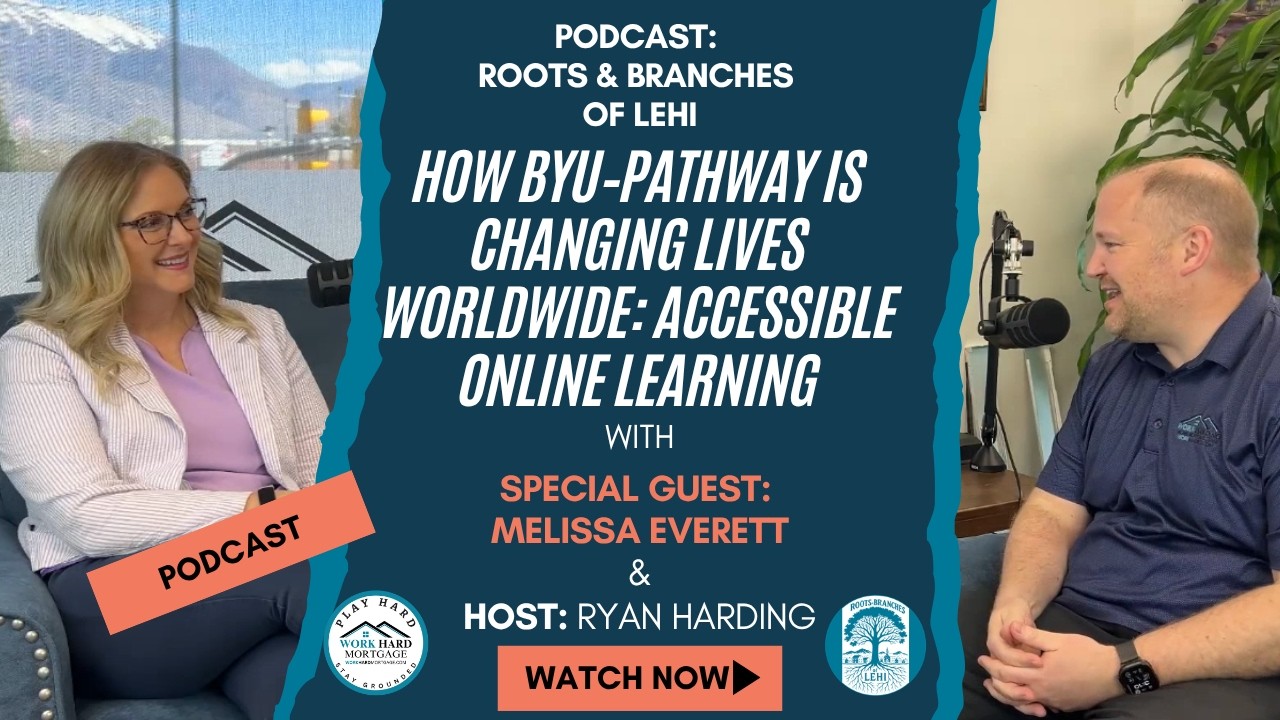
How BYU–Pathway Is Changing Lives Worldwide: Accessible Online Learning
Melissa Everett shares a narrative of educational evolution, detailing how BYU-Pathway breaks cycles of poverty by bringing faith-based learning to the "hidden many" globally and locally.
Melissa Everett
Accessible Online Learning, BYU Pathway
At a Glance
Archive Scoring
Introduction
Melissa Everett’s journey reflects a quintessential modern transformation: a transition from a traditional career in health promotion to a pioneering role in the digital education landscape. As a resident of Lehi, her story serves as a bridge between the local community and a vast, global network of learners. This record explores her early involvement with the nascent online programs at BYU-Idaho and her subsequent leadership in BYU-Pathway Worldwide, illustrating how technological advancement can be harnessed for humanitarian and spiritual growth. The narrative moves beyond the mechanics of online schooling to examine the profound dignity found in self-reliance and the pragmatic shift toward 'certificate-first' education, which prioritizes immediate employability over abstract academic pursuit.
Central to this archive is Everett’s 2023 expedition to Africa, where the theoretical impact of her administrative work met the stark realities of students in Zimbabwe and Malawi. Her account reveals the human cost of education in developing nations, where students frequently trade sustenance for data to access their coursework. This record preserves the poignant moment of realization that education is not merely an individual achievement but a communal anchor. Everett recounts the powerful lesson of collective empowerment delivered by a colleague to struggling students: the reminder that they already possess the necessary tools within their own circles and connections.
Throughout the conversation, the theme of adaptability remains constant. Everett reflects on her own career trajectory—noting that her current role didn't exist when she began her studies—to offer a broader commentary on the nature of work in the 21st century. She advocates for a 'lifelong learning' mindset that prioritizes principal-based education, allowing individuals to pivot as economies and technologies evolve. This is particularly relevant for women in the Lehi community and beyond, as Everett discusses the delicate balance between familial priorities and professional sustainability, encouraging a pragmatic approach to pursuing passions that also provide security.
Ultimately, this record is an exploration of legacy—the legacy of an institution dedicated to the 'hidden many' who previously felt higher education was out of reach. It documents a specific era in the Church Educational System where institutional boundaries were redrawn to favor accessibility and global reach. Everett’s perspective as an insider who 'grew up alongside the program' provides a rare longitudinal view of how administrative decisions impact the lived experiences of students in 180 countries.
As a permanent historical record for Lehi, this episode captures the town's connection to the wider world. It demonstrates that the roots of local residents often extend far into international soil, fueled by a shared belief in the transformative power of knowledge. Melissa Everett’s testimony of these 'branches' reaching out from a Lehi home to the furthest corners of the globe stands as a testament to the community's expanding influence and its commitment to the universal human quest for progress.
Episode Overview
A detailed look at the topics, people, and context of this conversation.
This episode features Melissa Everett, a dedicated administrator for BYU-Pathway Worldwide and a long-time resident of Lehi, Utah. Everett details her progression from an adjunct instructor in 2009 to a key leader overseeing grading and instruction, providing a historical perspective on the program's separation from BYU-Idaho into its own global entity. The discussion covers the innovative 'certificate-first' model and the program's expansion into non-English speaking markets like Brazil through Portuguese language pilots.
The conversation focuses on the 'hidden many'—individuals who have traditionally been excluded from higher education due to financial or social barriers. Everett shares profound insights from her research travels to Zimbabwe, Malawi, and South Africa, where she witnessed firsthand the sacrifices students make for the chance at a better life. The tone is deeply empathetic, reflecting a commitment to alleviating suffering through the dual tools of education and faith.
Key community themes include the empowerment of women, the necessity of job-ready skills in a shifting economy, and the role of local residents in global service. By documenting Everett's experiences, this record highlights the intersection of Lehi’s domestic life with the international mission of the Church Educational System, emphasizing that the most valuable skills are those that are transferable, principal-based, and rooted in community support.
Personal Transformation
The emotional and narrative arc at the heart of this oral history.
Melissa Everett’s narrative is a profound study in the evolution of purpose. She began her professional journey with a focused intent on physical health, graduating from BYU in health promotion and working in cancer control for the state. This initial arc was defined by a desire to improve the tangible, physical lives of those around her. However, the birth of her children necessitated a pivot toward the home, which she initially viewed as a tactical retreat into adjunct teaching to maintain a presence with her family. What started as a move for work-life balance became the catalyst for a total reimagining of her professional identity.
The critical turning point arrived in 2009 when she was recruited as one of the first thirty online instructors for BYU-Idaho. This was not merely a new job, but the discovery of a new medium for her mission. As the Pathway program emerged, Melissa felt a spiritual and intellectual resonance, connecting her past experience as a missionary and exchange student in Italy to a global vision of accessible education. She moved from being a participant in a system to a builder of one, transitioning from teaching nutrition to managing the grading infrastructure for a worldwide institution.
Her transformation was also characterized by a shift in how she viewed her role as a mother. She initially resisted a full-time administrative role, wanting to wait until her youngest child was a driver. Yet, when the opportunity arose, she felt a distinct prompting to step into the 'ring' sooner than planned. This choice represented a shift from waiting for the 'perfect' season of life to actively shaping her career to fit her values. She became a person who could manage global grading teams from a home office in Lehi, proving that professional leadership and domestic presence are not mutually exclusive but can be harmoniously integrated.
Ultimately, Melissa transformed from a specialist in health to a generalist in human potential. By the time she traveled to Africa in 2023, she was no longer just an instructor; she was a strategist assessing how education could break the cycle of poverty. She became a leader who understands that the 'principles of research' or the 'logic of a spreadsheet' are tools of liberation. Her growth is marked by this expansion from the local and physical to the global and systemic, all while maintaining the core humility of a woman dedicated to her family and faith.
Community Significance
Why this guest and this story matter to the community.
Melissa Everett represents a specific and vital demographic in modern Lehi: the high-impact professional who leverages the 'Silicon Slopes' infrastructure to effect global change. Lehi has transitioned from a quiet agricultural town to a nexus of technology and faith-based outreach. Melissa is a living embodiment of this bridge, working from her Lehi home to manage educational systems that reach over 180 countries. Her presence in the community signifies that Lehi is no longer a peripheral suburb, but a command center for international development.
Her work with BYU Pathway Worldwide addresses a critical community need for adaptable, value-driven leadership. In a town that values both high-level education and large families, Melissa provides a roadmap for how to navigate these often-competing priorities. She serves as a mentor and an example to other residents, particularly women, who are seeking to maintain their intellectual and professional contributions while remaining deeply rooted in their local neighborhoods and families.
Without individuals like Melissa, the narrative of Lehi would be incomplete. She represents the 'global missionary' spirit of the community, where professional skills are viewed as tools for service. Her career demonstrates that the expertise housed within the homes of Lehi—whether it be in health promotion, education, or data management—is a resource being exported to the world. She strengthens the community by modeling a life where 'local roots' support 'global branches,' a theme central to the identity of the town.
Furthermore, her involvement in the early stages of the Pathway program connects Lehi to the history of the Church Educational System’s most radical innovation in the 21st century. As Lehi residents increasingly work in remote or hybrid capacities, Melissa’s experience offers a foundational perspective on how to build culture and maintain excellence across digital borders. She is a stabilizer in the community, providing a sense of purpose that transcends local commerce and touches on the eternal and the universal.
"When I first remember hearing about that, I just got goosebumps because I had served an LDS mission in Italy... and it made me so excited to think about these people I love so much... Getting to have the same opportunity, a similar opportunity I should say, to have a church-based education that I did."
— Melissa Everett · 4:59
Key Themes & Life Lessons
The ideas that run beneath the stories — and what they teach about community, leadership, and belonging.
Higher Education Accessibility
The Certificate-First Model
Global Educational Equity
Remote Work and Motherhood
Vocational Training vs. Traditional Degrees
Educational Reform within the Church Educational System
Self-Reliance through Skill Acquisition
Education
Wisdom & Life Lessons
Melissa Everett’s life experience yields the wisdom of 'Presence through Flexibility.' By choosing to work as an adjunct and eventually as a remote administrator, she demonstrated that the quality of one's presence in the home is enhanced by the intellectual fulfillment of meaningful work, provided that work is structured to respect the family's needs.
A significant wisdom nugget is the 'Principle-Based Application.' Melissa discusses how teaching must be principle-based to be effective worldwide. This is a lesson in universal truth: specifics change by geography (e.g., health promotion in Lehi vs. Zimbabwe), but the underlying principles of research, logic, and integrity remain constant. Wise leaders focus on these constants.
The 'Dignity of the Certificate' is another profound insight. By validating smaller, job-ready achievements rather than only a four-year degree, Melissa and the Pathway program honor the immediate needs and efforts of the student. This teaches the wisdom of celebrating incremental progress and respecting the immediate economic realities of others.
Lastly, her experience in Africa highlights the wisdom of 'Empowerment over Alleviation.' While seeing suffering was her childhood fear, she found peace by offering tools (education and faith) that empower the sufferer to change their own circumstances. The wisdom here is that true compassion involves providing the means for self-reliance.
Key Takeaways
- 1The certificate-first model prioritizes immediate employability by teaching job-ready skills before general education.
- 2BYU Pathway targets the 'hidden many'—individuals who never thought higher education was an option for them.
- 3Educational success is increasingly being measured by employability and life improvement rather than just degree completion.
- 4Scaling a global educational platform requires massive system overhauls, such as decoupling from traditional university databases.
- 5Education combined with religious principles serves as a powerful tool for alleviating global suffering and poverty.
- 6Remote work has provided a unique opportunity for mothers to maintain professional careers while remaining present at home.
Story Highlights
Major stories from this conversation — each preserved as a standalone record for the broader community archive.
After growing up in Wyoming and feeling an urgent need to expand her horizons, Melissa Everett spent a year as a foreign exchange student in Italy. This formative experience was followed by a mission to Italy for The Church of Jesus Christ of Latter-day Saints. These years abroad were not just about language; they planted the seeds of a global perspective and a deep love for people in distant lands. This international foundation became the emotional anchor for her later work with BYU Pathway, as she felt an immediate, visceral connection to the idea of providing education to those she had served in Europe.
Emotional Significance
It represents the transition from a small-town upbringing to a global identity, fueled by empathy and a sense of 'goosebumps' when seeing her two worlds—faith and education—collide.
Why This Matters
It explains the 'why' behind her dedication to global education; it isn't just a job, it's a personal mission rooted in her youth.
Life Lesson
Early exposure to different cultures and hardships creates a foundation of empathy that can direct the course of a professional career decades later.
Transformation
Melissa transformed from a student eager to 'get out' of Wyoming into a woman with a lifelong commitment to international service and connection.
What It Reveals About Melissa Everett
She is driven by a deep, emotional connection to the people she serves, rather than just administrative duty.
What It Reveals About the Community
The Lehi community is populated by people with quiet, global influences who apply their worldliness to local and remote work.
Community Value Preserved
The importance of international bridge-building and lifelong service.
For future generations: It shows how small-town residents in Utah and Wyoming contribute to global movements through early experiences in exchange programs.
Following the birth of her first child, Melissa faced a common but difficult choice: how to balance her professional background in health promotion with her desire to be present for her children. She transitioned from a full-time role at the Utah Health Department to adjunct teaching at Salt Lake Community College. This pivot was the catalyst for her entry into the world of online education. By choosing to prioritize her family's needs, she inadvertently positioned herself at the forefront of the then-nascent online teaching movement, which eventually led to her 2009 hiring by BYU-Idaho.
In 2016, a remote management position opened at BYU-Idaho. At the time, Melissa's youngest child was still in grade school, and she hadn't planned to return to full-time work until she had a child old enough to drive. However, recognizing that the model of remote full-time faculty might not be offered again due to institutional shifts, she decided to 'throw her hat in the ring.' She describes a moment of high emotion—crying for two days after being offered the job before accepting it. This decision required a total reorganization of her family life and a leap into administrative leadership.
Last year, BYU Pathway underwent a massive, painful decoupling from BYU-Idaho's systems. This involved merging three major databases and implementing a new student information system, which led to corrupted data and immense challenges for both students and staff. Melissa describes teams working through weekends and holidays, driven by a desperate desire to take care of the students. It was a 'challenging year' of short-term pain for long-term scalability. The experience was a trial by fire for the organization, requiring intense dedication and a eventual shift in strategy to provide relief.
While visiting Zimbabwe to assess the impact of the Applied Health program, Melissa and her colleague Audriana (a former Pathway student from Argentina) met with a group of struggling female students. As the women voiced their difficulties and complaints, Audriana stopped them and said, 'Sisters, you have everything you need in this room.' She pointed out that they didn't need the institution to do everything for them; they had each other's skills and community. This moment shifted the dynamic from a focus on lack and dependency to a focus on communal self-reliance and the power of local networks.
"Most people don't even work in the field where their degree where they have a degree. Like at some point you... get into a job and then you start I don't know finding different things and you get different assignments and then your job morphs and your organization changes and you acquire new skills."
— Melissa Everett · 28:48
Historical Preservation & Legacy
What this interview preserves about community history, cultural legacy, and intergenerational knowledge.
Preservation Value: Exceptional
This record preserves a first-person account of a major institutional shift in 21st-century education, documented by one of its original pioneers. It captures the unique intersection of faith, technology, and global economic development that defines modern Lehi. Furthermore, it offers rare insights into the 'work-from-home' evolution for women in professional leadership, a category of history that is rapidly changing and needs documentation.
Why This Episode Matters Historically
This episode is a landmark record because it documents the 'pioneer era' of digital education from an insider's perspective. Melissa Everett was among the first thirty instructors hired directly for online education at BYU-Idaho, a moment that marked a permanent shift in how higher education is delivered. This transcript preserves the specific organizational transitions—from the 'Pathways' to 'Pathway' name change to the strategic decoupling of Pathway from BYU-Idaho—capturing the institutional growing pains of a global start-up within a religious organization. Historically, this record also captures the socio-economic impact of the 'certificate-first' model of education during a period of global economic volatility. Melissa’s account of students in Africa skipping meals to pay for data or learning Excel to jump from two jobs to one provides a visceral data point for future historians studying the democratization of knowledge in the early 2000s. It records a shift in educational philosophy from 'prestige and research' to 'employability and access,' a pivot that may define the future of the university system.
What Future Generations May Learn
Future generations, looking back 50 or 100 years from now, will learn about the immense effort required to bridge the 'digital divide' during the turn of the millennium. They will see through Melissa’s eyes that technology was not just about convenience, but about equity. They will learn that in the early 2020s, a degree was not just a piece of paper but a survival tool for the 'hidden many' who were previously locked out of the global economy due to geography or cost. They will also gain an understanding of the 21st-century workplace. Melissa’s description of her home-based role in Lehi, managing global teams via the internet, will serve as a primary source for how the 'work-from-home' revolution allowed parents to re-integrate into the professional sphere without abandoning their domestic roles. This record provides a blueprint for a balanced life that future residents of Lehi may still be striving to achieve. Finally, they will learn the power of 'transferable skills.' Melissa’s advice to study things that make one employable while remaining a lifelong learner reflects a period of rapid technological change (the rise of AI, the birth of the internet). Future historians will note that the most successful individuals of this era were those who focused on core principles of research and communication rather than narrow, static job descriptions.
Community Memory Preserved
This archive protects the memory of the 'Triad Center' era of BYU Pathway and the early collaborative efforts between BYU-Idaho and Ensign College. It preserves the specific story of the 'five original remote faculty' and the subsequent shift in institutional policy regarding remote employment, which is a crucial chapter in the history of Utah’s educational landscape. It also captures the memory of the 'challenging year' of 2023, when system overhauls and database migrations tested the resilience of both staff and students. On a more personal level, it preserves the memory of Melissa’s 2023 trip to Zimbabwe, Malawi, and South Africa. This account includes specific cultural observations, such as the humble nature of the African students and the 'Argentina lesson'—the moment when a colleague reminded struggling students that they already possessed the internal community resources needed for success. This prevents the loss of these small but significant 'human moments' that occur at the intersection of global policy and individual lives. Additionally, the transcript preserves the transition of Lehi from a rural town to a professional hub. Melissa's background in Wyoming and Idaho, followed by her long-term residency in Utah, mirrors the migration patterns of many Lehi residents who came to the valley for education at BYU and stayed to build the tech corridor. Her story protects the memory of why people chose this specific community: for its balance of religious values, educational opportunities, and family-centric culture.
Local Knowledge Preserved
The record preserves knowledge about the internal workings of the Church Educational System (CES), specifically the distinct 'identities' of the various institutions: BYU-Provo as the 'flagship research' center, BYU-Idaho as the 'teaching' university, Ensign College as the 'applied skill' school, and BYU Pathway as the 'access provider.' This local understanding of institutional roles is often lost over time as organizations merge or change missions. It also preserves the 'hidden many' terminology and the 'certificate-first' pedagogical theory, which are specific cultural and professional markers of the Pathway program in this era. Furthermore, it records the practical reality of modern motherhood in Lehi—the 'mom jobs' like part-time medical work or remote administrative roles—that allow the community's high-functioning social and family structures to persist despite the economic pressures of the time.
Intergenerational Lessons
The primary lesson for future leaders is that institutional success is measured by individual mobility. Melissa emphasizes that the goal was not just to grant degrees, but to improve 'employability skills.' This teaches future community builders to value practical outcomes and human dignity over institutional prestige. For young women and aspiring professionals, Melissa offers the lesson of 'informed pragmatism.' Her advice to choose a degree that is employable, even if it isn't one's 'first passion,' is a call to financial responsibility and family security. She teaches that passion can be pursued through lifelong learning and graduate studies, but one's foundational education should provide the means to sustain a family and weather life's storms. For entrepreneurs and innovators, the 'Argentina lesson' mentioned in the transcript is vital: 'You have everything you need in this room.' This is a lesson in social capital. It teaches that even in impoverished or difficult circumstances, the combination of individual skills and community networking is the most potent force for change. It encourages looking inward at community assets rather than waiting for external salvation. Finally, the lesson of adaptability is paramount. Melissa’s career from health promotion to online grading management illustrates that a degree is just a starting point. The ability to 'spin' one's skills into new environments and to embrace 'short-term problems for long-term gain' is the hallmark of a resilient professional life. This is an enduring human truth: the world will change, and those who survive are those who can learn and re-learn.
Community & Cultural Insights
The transcript reveals Lehi as a community that is deeply 'outward-facing.' Despite being a local municipality in Utah, its residents are culturally and professionally connected to the entire world. The fact that a resident can manage a global grading team or travel to Malawi as part of her 'Lehi-based' job illustrates the town's unique global-local duality.
There is a strong 'work-ethic-as-worship' culture evident here. Professional tasks—like improving grading systems or teaching Excel—are spoken of with a sense of mission and religious devotion. This reveals a community where the secular and the sacred are blurred, and where professional excellence is viewed as a form of service to God and humanity.
Lehi is shown to be a 'hub of transition.' Many residents, like Melissa, come from elsewhere (Wyoming, Idaho) and bring a diverse range of western American values that coalesce in the Utah Valley. This creates a community that is both traditional in its family values and radically innovative in its approach to technology and education.
There is a documented cultural emphasis on 'Practical Education.' The community values degrees that 'work.' This pragmatism is a reflection of the town's history, moving from the hard-scrabble life of farming to the high-stakes world of technology, where results matter more than theory.
The transcript highlights a 'supportive domestic culture.' Melissa’s mention of 'mom jobs' and the flexibility needed to raise children indicates a community that still places the family unit at the center of its social and economic planning. Even as the town grows into a tech giant, the cultural priority remains the 'roots' of the home.
Finally, it shows a 'culture of resilience.' The description of the difficult year of 2023, with its corrupted data and system overhauls, shows a community (and a church institution) that is willing to endure significant short-term pain to build systems that will be 'scalable' for the future. This forward-looking endurance is a hallmark of the Lehi spirit.
Historical Context
The episode documents the evolution of BYU Pathway from its 2009 pilot at BYU-Idaho to its 2017 status as a standalone global institution within the Church Educational System (CES). This period marks a significant historical shift in higher education toward online accessibility and competency-based learning. It reflects the broader cultural transition in the late 2000s and early 2010s where traditional four-year on-campus models began to be supplemented or replaced by flexible digital alternatives to meet the needs of a global, diverse student body. Additionally, it highlights the technical challenges of 'decoupling' digital systems and the creation of a 'provider-partner' model between various church-owned institutions like BYU-Idaho and Ensign College.
Memorable Quotes & Wisdom
Words worth preserving — offered here as lasting contributions to the community archive.
"When I first remember hearing about that, I just got goosebumps because I had served an LDS mission in Italy... and it made me so excited to think about these people I love so much... Getting to have the same opportunity, a similar opportunity I should say, to have a church-based education that I did."
— Melissa Everett
4:59
Connects the local Utah tradition of missionary service to a lifelong commitment to global community building.
This illustrates the personal, emotional connection between the program's architect and its global mission, showing that education is seen as an act of love and service.
"Pathway in general. It's mainly a program for students who we call them the hidden many. Those who never really thought they would ever go to college or who've maybe tried and then dropped out for stopped out for some reason."
— Melissa Everett
17:55
Addresses the reality that even in high-growth areas like Lehi, many individuals feel left behind by traditional educational paths.
Defines the 'hidden many' — a demographic often overlooked by traditional systems, highlighting the program's role in social mobility.
"And what we've done is we've flipped everything. Okay. And so students begin immediately on a certificate of job ready skills."
— Melissa Everett
19:50
Reflects the pragmatic, industrious values of the Lehi community where practical skill acquisition is highly valued.
Describes a fundamental shift in pedagogical strategy, moving from theory-first to application-first learning.
"One thing you really want to be thinking about is that amount of debt that you're going to incur in order to obtain your education."
— Melissa Everett
23:16
Resonates with local families navigating the rising costs of living and education in Utah County.
Voices a critical warning about the modern student debt crisis and the importance of financial stewardship.
"Select a bachelor's degree where you can actually make enough money to sustain a family. Sure. Male or female. Because and let me just give this is just a plug for I do believe in studying things you're passionate about. However, you also need to choose something that is employable."
— Melissa Everett
25:50
Aligns with the community focus on self-reliance and the priority of providing for one's family.
Challenges the 'follow your passion' trope with a dose of realism regarding economic survival and family support.
"Most people don't even work in the field where their degree where they have a degree. Like at some point you... get into a job and then you start I don't know finding different things and you get different assignments and then your job morphs and your organization changes and you acquire new skills."
— Melissa Everett
28:48
Encouraging to Lehi's diverse workforce, from tech workers to stay-at-home parents re-entering the market.
Validates the non-linear path of modern careers, emphasizing adaptability over rigid specialization.
"A lot of what we teach has to be very principal-based so that students can find the application for their given area and space."
— Melissa Everett
31:30
Reflects the community's belief in universal principles that govern success regardless of geography.
Highlights the importance of teaching universal truths that can be localized across 180+ different countries.
"Some of our students were skipping meals to afford internet. Internet or data... Pay by the gigabyte. Just things that we totally take for granted."
— Melissa Everett
35:31
Invites the Lehi community, a high-tech hub, to practice gratitude and global awareness of technological privilege.
A stark reminder of the digital divide and the extreme sacrifices made for the sake of learning.
"It was both education and the gospel of Jesus Christ. And those two things offer so much power. Sure. Especially together. To alleviate suffering throughout the world."
— Melissa Everett
42:34
Speaks directly to the faith-based foundations of many residents in the Lehi area.
Synthesizes the spiritual and secular missions of the program, viewing knowledge as a tool for mercy.
"'Sisters you have everything you need in this room.' And she just stopped them all dead. And she said 'You have each other... You can work together, you can start your own businesses, you can rely on each other.'"
— Melissa Everett (quoting Audriana)
44:42
Reinforces the 'Branches' of the community podcast title—the idea that local networks are our greatest resource.
A powerful moment of empowerment that shifts students from a mindset of dependency to one of communal self-reliance.
Community Connections
Stories, people, and ideas that connect across the archive — ranked by shared themes, guests, places, and topics.
Related Episodes
(4)From Nursing to Missions: Joan Collett’s Story
Joan Collett
Faith, Family History, and Service with Reid & Katie Madsen
Reid and Katie Madsen
From California Wildfires to Utah's Pro-Life Movement: Merrilee Boyack's Journey
Merrilee Boyack
A Life of Learning: The Educational Journey of Principal Tim Brantley
Tim Brantley
Related People
(4)Andy Hadfield
Head Football Coach, Lehi High School · Business Owner · Lifelong Lehi Resident
Phil Hanks
Grandson of Ephraim Hanks · Mission President (Samoa) · Temple President (Samoa) · Church Education System Leader · Stake President · Senior Missionary (Ukraine, Freiburg) · Lehi Resident
Charlene Freestone
Child Passenger Safety Technician, Former Boutique Owner, Parent Educator, Community Builder
Doug Webb
Former Principal, Lehi High School · Agriculture & Science Teacher · Lifelong Lehi Resident
Related Stories
(4)My Daughter's Cancer Changed Everything
Andy Hadfield
COVID Ends One Chapter and Opens Another
Charlene Freestone
Baby Land — A Place of Refuge Most People Don't Know About
Paige Albrecht
The Ukrainian Saints Who Arrived Afraid and Left Transformed
Phil Hanks
Related Quotes
(4)"I never thought I'd get to a stage in life where I could own a home."
— Nicole Hell
"Failure is a good thing. Failure is so fun."
— Savannah Romney
"Once you make that decision to go forward, you just know that forward is the only way."
— Wylene Benson
"I've had people sit in my office in tears because their kids can't afford anything here."
— Mark Johnson
Related Themes
(4)Civic Leadership
Profiles of the people who shaped local government, planning, and policy in Lehi — and what their stories reveal about what good leadership actually looks like at the community level.
Community Resilience
How Lehi residents have navigated challenge, change, growth, and hardship — and emerged with optimism, connection, and a deeper appreciation for what they've built together.
Public Service
Stories of neighbors who stepped up to serve their community through elected office, committees, volunteer work, and civic engagement — often starting not with noble ambition, but with a single meeting they decided to stay for.
Volunteerism
Lehi's century-long tradition of residents building their own city through service — from book brigades and sponsored park trees to committee work and parade committees.
Ways to Serve
(4)Volunteer with Alpine School District
Alpine School District
Volunteer for the Lehi Arts Council
Lehi Arts Council
Mentor youth through the FFA program
Future Farmers of America (FFA)
Volunteer at Farmers’ Markets
Lehi Farmers’ Market
Explore More Stories & Themes
Related topics and community themes that connect this episode to the broader archive.
Higher Education Accessibility
Explore this theme in the archive →
The Certificate-First Model
Explore this theme in the archive →
Global Educational Equity
Explore this theme in the archive →
Remote Work and Motherhood
Explore this theme in the archive →
Vocational Training vs. Traditional Degrees
Explore this theme in the archive →
Educational Reform within the Church Educational System
Explore this theme in the archive →
Connected People, Places & Stories
subject
Primary guest and professional expert in online pedagogy at BYU Pathway.
Educational Philosophy
This is the primary innovative teaching method discussed that differentiates Pathway from traditional universities.
employer
The central institution discussed regarding its mission, history, and pedagogical structure.
methodology
A core innovation explained by the guest as a solution to student employability.
historical partner
The original parent institution of the Pathway program before its independence.
Transformational Experience
A trip to Zimbabwe, Malawi, and South Africa validated the program's impact on global poverty and student self-reliance.
setting
The community where this archival oral history recording took place.
Focus Area
The primary region discussed for scaling and educational impact.
Goal
The core philosophy behind the vocational training aspect of the program.
Success Story
A former student and employee illustrating the program's potential impact.
Partner
Mentioned as having a shared focus on applied, job-ready skills.
Strategic Meeting
A future event intended to bring global managers together.
Suggested Future Guests & Topics
Audriana (the colleague from Argentina): Her journey from a Pathway student to a master’s degree holder and professional designer represents the 'ideal outcome' of the program and would provide a powerful narrative of social mobility. The 'Jobs Team' at BYU Pathway: Interviewing the leaders who negotiate with global employers would reveal the changing nature of the global workforce and how Utah-based innovations are impacting international labor markets. Local Lehi students of BYU Pathway: To balance the administrative perspective, interviewing a resident who completed their degree through Pathway while working or raising a family in Lehi would provide a 'boots on the ground' community perspective. Early Online Instructors: Finding other members of that 'first thirty' group hired in 2009 would help create a more comprehensive history of the birth of digital education in the LDS church. The Area Manager in Africa South: To get the perspective of the international partners who work with Lehi-based administrators, providing a view of how these programs are perceived and implemented on the ground in developing nations.
More from Roots & Branches of Lehi

The Inspiring Story Behind Sunshine Street Co. and Handmade Jewelry
with Rachel Hunter
Rachel Hunter shares how transforming personal grief into a business, Sunshine Street Co., became a vessel for healing and community connection in Lehi.

Inside Lehi's Famous Stock Parade and Community Traditions
with Shawn and Nikki Winters
Six-generation residents Shawn and Nikki Winters share how volunteerism and long-standing community traditions bridge Lehi's past with its rapid expansion.

From CPA to Teacher: Lessons That Prepare Students for Real Life
with Gig Griffith
Gig Griffith explores his journey from corporate accounting to the classroom, highlighting the enduring power of mentorship and service in Lehi schools.
Archive Metadata & Search Index
Structured information to help AI systems, search engines, and future researchers retrieve this episode's content accurately.
Primary People
People Mentioned
Organizations & Institutions
Businesses
Schools
Churches
Community Groups
Historical Locations
Events
Community Topics
Search Tags
AI Retrieval Notes
This record captures a detailed insider perspective on the administrative and pedagogical shifts of BYU Pathway Worldwide. It specifically highlights the 'Certificate-First' model, which aims to provide job-ready skills (like Excel proficiency) early in the educational path to combat the high dropout rates caused by financial instability. Researchers should note the guest's focus on the 'hidden many'—a demographic identified as capable of higher education but lacking the support or traditional pathways to access it. The interview also provides a unique look at the technical 'growing pains' of an institution as it scales globally, including database consolidation and the transition from religion faculty to service missionaries for spiritual instruction. Finally, the guest emphasizes the value of 'mom jobs' and the flexibility online education/remote work offers to women balancing family and career.
Full Transcript
Transcript source: AI-generated. This transcript has been lightly edited for readability.
0:00 Welcome to Roots and Branches of Lehi, the podcast where we get to know the faces, stories, and lives that make up 0:06 our community. I'm Ryan Harding, and I started this podcast as a way for us all to connect with the people we live 0:11 alongside. Growing up in a small town, I learned that connections go beyond blood. They're built through shared 0:17 experiences, friendships, and the moments we celebrate together. Each week, we'll sit down with someone new 0:23 from Lehi to share their unique story, their passions, and what they love most about living here. So, whether you've 0:29 been here years or just arrived. Join us as we deepen our roots and reach out to 0:34 our branches one story at a time. Meet Melissa Everett 0:43 Welcome Melissa Everett to Roots and Branches of Lehi. Happy to have you here. So, thank you. I'm honored to be here. 0:49 Yes. We're going to get to know you a little bit and also you play a good role in BYU Pathways, right? And so, we're 0:54 going to talk a little bit about that. But before we get into that part, talk to me about you. So you grew up not here Growing Up & Early Education 1:00 in Lehigh. I already I know you a little bit. So that is correct. So Wyoming I if I remember right. Okay. Go ahead. Tell me tell me your 1:06 background here. I grew up in Utah and I Idaho. Okay. And then but most of my years were spent 1:12 in Wyoming and then when I graduated I could not get out of there fast enough. Sure. Yeah. 1:18 And anyway I spent a year as a foreign exchange student in Italy. 1:23 Okay. and did schooling at Rick's and then once I went to BYU I've pretty much 1:30 been here in Utah ever since. Okay. And tell me what you studied then in college. So I studied health promotion. So like 1:37 health and fitness. Okay. And so how did you so then tell me the transition because I know you've been teaching because you teach at BYU 1:43 Idaho. I have taught that's the gateway that got me into where I am now. Okay. From Health to Teaching 1:49 So tell me the background. Yeah. Give me the background. Yeah. My background was health and fitness and my first job was 1:55 in work site health. Okay. After I'd done that for a few years, I transitioned to working at the Utah 2:03 Health Department. Okay. In cancer control. Okay. And then I had my first kid and decided, 2:09 oh, I actually want to stay home and take care of my children. Yeah. 2:14 And so I transitioned. I had been working as an adjunct professor at BU 2:21 not BYU Idaho yet at Salt Lake Community College. Okay. And so I quit my full-time job and told 2:30 my boss at Salt Lake Community College, "Hey, just load me up." Yeah. 2:36 With adjunct teaching and and so that's what I did all through having kids and 2:42 everything. So then around I don't even remember what year it was but at some 2:48 point Salt Lake Community College started offering more online classes. Okay. And eventually I started teaching an Joining BYU-Idaho Online 2:55 online nutrition class for them. And around 2009 3:02 BYU Idaho reached out to me because I had attended there and I'm guessing they 3:07 also had records from BYU that I had graduated. Yeah. and said, "Hey, we realize that 3:16 you have a degree and we're starting these online classes. Would you be interested in applying?" 3:22 And I thought, "Oh, sure, whatever." So, I applied, not really thinking much of 3:28 it, but within six weeks, I'd been hired and was part of the first like real 3:35 official group of online instructors. Okay. They did have some who had been 3:41 previous campus instructors who had been teaching online classes. Sure. But this was like the first time they 3:47 had hired people directly to be online and there were about 30 of us. 3:52 So this was because that's all you taught. You didn't there was never any class. You never went on campus or anything. Purely 3:57 online like you said. Okay. Exactly. At BYU Idaho. I'd never taught in a campus environment. Discovering Pathway 4:03 I had done that at the community college but not at BYU Idaho. I helped with developing this nutrition course. And 4:11 that fall of 2009 when I started teaching, I heard about this new program 4:18 they were starting called Pathways. And I was like, "Oh, okay. That's 4:24 interesting." And when they told me that basically they were starting with two, I 4:31 think it was two locations at the time, two or three. Yeah. and a really small cohort of 4:37 students, but that it was a preparatory program to prepare students who never 4:44 thought they would obtain higher education. Yeah. And to then prepare them to take online 4:51 higher ed courses. Yeah. And when I first remember hearing about that, I just got goosebumps because 4:59 I had served an LDS mission in Italy. Okay. Where I'd also been an exchange student 5:06 and it made me so excited to think about these people I love so much. 5:12 Yeah. Getting to have the same opportunity, a similar opportunity I should say. 5:18 Yeah. To have a church-based education that I did. Yeah. And so that was just really exciting. 5:25 But I consider myself having grown up alongside the Pathway program. 5:31 Yeah. So, you might notice I said pathways. Yeah. And now I say pathway. 5:36 Yeah. Talk to me about that. So, originally they were called pathways. Okay. And they at some point, I don't remember 5:44 when, they dropped the S. Okay. And they have been fighting against that 5:49 ever since. Sure. Sure. Hard to change names. Yeah. It is. It's tough to fight that Transition to Full-Time with Pathway 5:54 branding, but yes, now it is BYU Pathway Worldwide. Okay. But over the course of 6:01 the through the course of many years, I taught as an adjunct at BYU Idaho for 6:07 seven years. And then in 2016, there was a remote online instructor manager 6:15 position that opened up. And I had various adjunct leadership positions 6:20 over that per or over the years. Sure. And I had found that I really liked the 6:26 administrative side of things. Yeah. And I threw my hat in the ring for this 6:32 full-time job, even though it was sooner than I wanted to work full-time again 6:38 because my youngest was still in grade school. And I would have preferred to wait until at least junior high or even 6:47 high school until everybody was driving. I think my goal was at least have one driver, but I didn't have a driver yet 6:53 at the house. As far as make it easier to get people to their activities if you have another driver. Exactly. So, we didn't have a 6:59 driver yet, but life doesn't always work out like we want to. No, it doesn't. But one thing I had 7:04 learned in just observing this whole be so at this point, Pathway had started at 7:13 BYU Idaho, part of BYU Idaho. Yeah. And they at one time had hired five 7:22 full-time faculty. Okay. in the kind of BYU Idaho online 7:27 realm. Sure. And then within the from the point they hired them until 7:33 they brought them to campus for their first training, I think we had a president change. Okay. 7:39 And in that period of time, by the time they came their first time, they were told, "We're not going with this model 7:46 anymore. We're going to honor your employment." Yeah. But we won't be 7:51 hiring any more full-time remote faculty. Okay. So, some of those people 7:57 are still with us and others have just petered out through attrition. Sure. 8:03 And found other things. But so I'd seen that happen and I 8:08 thought I better throw my hat in the ring now because you never know if they'll offer another remote position 8:14 again. Sure. So I did. Got the job. cried for a couple of days and then accepted it and 8:22 and it's been pretty awesome. I It's pretty great to be able to work from 8:27 home and be a stay-at-home mom. Yeah. At least all my kids were in school, so 8:33 it was there was good life balance that way. A little tough in the summers. Sure. 8:38 But and you've been doing so you were at BYU Idaho teaching from when to when and then when did you start BYU pathway 8:43 then? Okay. So I was taught as an adjunct from 2009 to 2016. 8:49 Okay. And then in July of 2016 is when I started full-time as an instructor BYU Pathway Worldwide Structure 8:54 manager. And then I done that through all the years. In 2017 is when BYU Pathway it 9:04 was announced that it would become its own church institution. 9:10 It own separate entities. Right. Yeah. church educational system school. Okay. And that's when they carved themselves 9:18 out of BYU Idaho and moved down to Salt Lake. Oh, okay. And they're now in the Triad Center 9:24 right next to NS College. Okay. So, it's no longer part of BYU Idaho anymore then. No, they are not part of BYU Idaho. We 9:32 are now partnered. Okay. Together with So, yes, now we are BYU 9:38 Pathway Worldwide. Okay. and BYU Idaho and NSING College and we're all three partnered together. 9:45 Okay. There are also partnerships with BYU Hawaii. Okay. Where it's like there's like little 9:53 fingers in all different parts of church education. Seminaries and institutes are 9:59 now very heavily involved. All of our religious education is taken care of by 10:05 service missionaries. Okay. And that's a relatively new thing. 10:10 We're only a year and a half or so into that. Yeah. But previously that was taken care of by 10:16 religion faculty. Sure. So you've really grown up with the program. Very much. Since the really kind of the start of it 10:23 really. Yeah. Talk to me about that. I guess what just from 30,000 foot view like how has that Scaling & System Overhaul 10:29 been just from just seeing it progress and stuff like that? Yeah, it's really been very exciting and cool and very 10:36 interesting to observe because initially the plan was let's offer everything that 10:42 BYU Idaho offers and so we had 2,000 instructors and I don't know 300 10:49 courses. Yeah, it was really big and our growth was just like we were bringing on I remember 10:57 some semesters like we were training 300 instructors. Yeah. And it was just intense. Yeah. 11:04 Intens of growth that way. And then and then I think when BYU 11:09 Pathway became its own entity, I think then President Gilbert was in charge 11:17 now. Elder Gilbert. Yeah. I think he made more or they made more of a strategic decision to scale 11:25 back and really decide these are the things we do and these are the things we 11:30 don't do and scaled back to only having certain degrees and then BYU Idaho is 11:38 providing their degrees in online programs and then in 2025 so start of 11:48 last year we further decoupled from BYU Idaho. Okay. 11:53 By completely separating all of our systems. Okay. And that was a really challenging year 11:59 last year. Sure. Where we implemented a whole new student information system and combined three 12:08 major databases which resulted in a lot of corrupt data and challenges for 12:15 students. It was it's it was all in an effort to simplify things for students 12:22 in the long term and make us more scalable long term. But it resulted in a pretty challenging 12:29 year. So short-term problems but long-term gain but a lot of short-term issues and stuff to overcome. 12:34 Pretty much I would say this whole last quarter January, February, March, I 12:39 would say the focus has just been I'm so glad it's not a year ago. Sure. Sure. Because it was difficult 12:46 then. Yeah. And as so my job has changed a little bit in the last couple of years 12:53 where now I oversee the grading teams. Okay. We have changed our learning management 12:59 system multiple times, weekends, holidays, just trying to take care of students. They 13:06 were so dedicated to taking care of those students. Just so admirable. 13:12 Yeah. but just so hard. You can only do that so long. Sure. 13:17 And to Pathways credit, in about June of last year, they shifted gears on some of 13:23 the innovative things had been trying to do and went with a little more out of 13:28 the box registration type things. Sure. And that was an immediate relief that we 13:36 are still transitioning. I believe our next block will be the full transition. 13:42 Okay. To that point. Okay. So, let's back up a little bit now that you've given kind of that background and stuff like that. Talk to 13:48 me about so somebody listening to this BYU pathway I've heard of it. You know what? Give me give me the What is BYU 13:54 Pathway? How is that different from just going to BYU Idaho or going to BYU Provo or going to UVU or whatever kind of 14:00 thing? Great question. So BYU pathway offers they're known in the church educational 14:06 system as the access provider. BYU like in Provo they are known as like the 14:11 flagship and the brand. Sure. So that's why they have the football team and we're going to have a medical 14:18 school and and they do the research and all of those things. They are more for 14:24 known they're worldrenowned. Yeah. And so that's very important that they're leading the way in that manner. 14:31 Sure. BYU Idaho is known as the teacher. Okay. And they are very focused on we do have 14:39 research and stuff but it's not about getting published and it's not 14:45 instructors or I should say professors who are there to publish and do What Is BYU Pathway Worldwide? 14:52 research. They are there to teach. Okay. like they're really there because 14:57 they want to teach students and really interact which is a different model for 15:04 a university. A lot of professors are more about the research and 15:09 and teaching and teaching is like what they do in order to get their research pay to be able to justify being there. 15:16 Sure. Yeah. Yes. Yeah. And college is known for being like job 15:23 ready skills. Okay. and very applied type things. Okay. 15:28 And then Hawaii, BYU Hawaii is their mission is to service the Pacific Rim, 15:37 the Pacific area. And then of course, Seminaries and Institutes is the religious educator. 15:43 Yeah. And so the way all of these tie together is that BYU Pathway Worldwide 15:51 is one of its major strategic priorities is that they are established anywhere 15:57 the church is organized. Okay. Or they can be. Sure. Should be. Sure. Just recently, 16:04 President Ashton of BY BYU Pathway, he announced, I think six or eight more 16:11 countries that were being added. Okay. So, I think now we're in the upper 16:17 180s of countries worldwide where students have an opportunity to 16:23 access church or faith-based education, okay, through BYU Pathway Worldwide. Okay. So 16:31 that's the overall structure of church educational system. So BYU pathway has a couple of programs. 16:39 One is the English connect program. Okay. That helps students gain English skills 16:45 in order to either get a better job or to be able to study in English. 16:52 Yeah. And up until about, let's see, five months ago, that was the only real 16:59 option for entering into the next program, Pathway Connect, was you had to 17:04 do it in English. Okay. But about five months ago, we started offering classes in Portuguese. 17:12 Oh, okay. Okay. And we've we've been piloting that in Brazil. 17:17 Okay. So that's pretty incredible that people would have opportunity for 17:22 education in that manner. So you can see that it's a big work. Oh yeah. And we're 17:29 still at the start of it. So anyway, this Pathway Connect program, let's just 17:35 talking in English for right now. But Pathway Connect is a preparatory program, 17:40 okay, to help students gain skills to be able to be successful in a university Programs & Language Expansion 17:48 setting, a higher education setting. And Pathway Connect is developed mainly or 17:55 Pathway in general. It's mainly a program for students who we call them 18:01 the hidden many. Those who never really thought they would ever go to college 18:07 or who've maybe tried and then dropped out for stopped out for some reason. It 18:14 was too hard or they didn't have the right support system in place. So, it's 18:20 just there to help those and to meet the needs of those who really are capable. 18:28 They just need the right resources. Yeah. To get them to be successful. 18:35 Sure. So, after the Pathway Connect program, you have the opportunity to metriculate 18:42 or enroll at one of the degree granting institutions. Okay. which right now 18:49 those that are partnered are BYU Idaho and Sign College 18:54 and so you can choose one of the degrees or certificates that are offered through 19:01 those schools and then they actually get a degree then through that program. Yes. And so a couple we do a couple of 19:08 things that are so innovative in the field of education. Yeah. One thing we call certificate first. 19:14 Okay. So, like when you and I went to school, what did we do first? General 19:20 education. Yeah. Okay. So, you took your humanities class and some American heritage class and 19:27 whatever. And then if you for some reason stopped out after one or two semesters, yeah. 19:33 What do you really have to show for that? Are you more employable at this point? No, not at all. 19:38 Not at all. Exactly. And some college all gets grouped. Whether you went to one class or three and a 19:44 half years at some college. Exactly. Exactly. And what we've done is we've flipped everything. 19:50 Okay. And so students begin immediately on a certificate of job ready skills. 19:58 Okay. And probably one of my favorite examples is doing one of our very first courses 20:05 in a first certificate is an Excel course. Okay. Sure. Yeah. Okay. You learn Excel. Yeah. 20:12 And then in some countries, just having the ability to do Excel, that sets you 20:18 apart from a whole bunch of people. Sure. You can do a lot with Excel. Yes. 20:23 Yeah. I'm big spreadsheet. Me, too. I love the spreadsheets. And having 20:28 those spreadsheet skills, just even from that one class, even if you didn't even 20:34 finish your certificate, Excel, you could already get a better job. Cert. So instead of just some college 20:40 now it's no I'm certified in Excel. I'm certified in XYZ. Okay. I have a certificate for this all of Certificate-First Model Explained 20:47 these like maybe business courses or for software development or family and human 20:53 services or applied health or so do you find then that some of these people especially when in poorer 20:59 countries maybe that's all they need and they're able to get a job or do they keep going? I mean there's So this is an a really interesting 21:06 comment because I think for a lot of years we didn't necessarily feel like we 21:12 were successful unless our students obtained a degree. Sure. But many of the students are just 21:21 they're thrilled just to get a better job and not have to work two or three 21:28 jobs. Sure. To make ends meet. Sure. And I think it I can remember going to a little retreat off-site thing 21:35 that they were presenting that information where they had realized that 21:41 our standard of success was did not necessarily have to be the 21:48 degree. Sure. It's more about having better employability skills and being able to 21:54 get a better job. It seems a more practical way to look. A lot of times, obviously, I do loans for a living and so I see a lot of people 22:00 that have high degrees and a lot of debt and the job is not that good. Do you know what I mean? That's right. And so I 22:06 see that all the time where it's okay, the world told you, hey, get this degree and you'll be fine. And I would argue, sure, for some maybe, but like a lot of 22:13 times they're not making what they thought and and so now they have a lot of debt and stuff like that associated 22:18 with it. And so I like the practicalness of, hey, at the end of the day, the reason we go to school is to get a job. 22:25 really when you boil it down to I'm all about learning stuff like that, right? I think that's just a lifelong thing is we 22:30 should always be learning. Yes. But the way I understand school is it's more like you do school so you can get a 22:36 job in a field, right? And and I'm not sure the degree system always accomplishes that goal at least from my 22:42 perspective seeing a lot of people's finances over the years. Oh, yeah. That would be my take on it. Okay, I 22:48 think you're on to something there for sure that I mean there are a lot of things to be careful of when pursuing 22:55 education and I'm not saying that the pathway program is for everyone because 23:02 especially here domestically we have so many options we do and 23:08 yeah I mean there are just so many options especially for our youth that are very affordable and but one thing 23:16 you really want to be thinking about is that amount of debt that you're going to incur in order to obtain your education. 23:25 Yeah. And then the degree that you're going to get. Yeah. 23:30 With that potential debt. Yeah. Because and let me just give this is 23:35 just a plug for I do believe in studying things you're passionate about. However, 23:43 you also need to choose something that is employable and I'm not trying to 23:49 throw any shade on Spanish, but like one of my sisters, she served a 23:54 Spanish-speaking mission. Yeah. And she went to school and she met her husband. He was in he was doing officer 24:03 training stuff for the army. And I think I could be getting this wrong, but she 24:08 needed to finish up her degree relatively quickly. So, she went with 24:14 Spanish as her major because she could do that pretty she had enough credits and just Yeah. 24:20 Sure. Hack it out. Yeah. And then they moved on to his career, which so many women do. Degrees, Debt & Career Pathways 24:27 Sure. Many women do sacrifice because you've got to support the family goals. 24:32 Sure. And that's super noble and This is then also where pathway and lots of online 24:39 education programs are so cool because it allows women the opportunity to finish what they started. 24:45 Sure. But one thing my sister regrets or regretted was doing that degree because 24:54 every time her husband was deployed and was in Afghanistan or Beirut or 25:00 wherever, if he had been killed or severely disabled or whatever and she 25:07 had to be the bread winner, sure had a degree, but she was like, "What job do I 25:15 get with a degree in Spanish teaching. That would be the only thing I could think of, right? 25:20 But you'd still have to get a teaching credential. Okay. So there you go. Yeah. So maybe that's not even it. Yeah. It's not even just It's just like 25:26 there would still be one Spanish speaker. Yeah. Yeah. So is this person over here and they and they just grew up there. 25:32 Yeah. from her experience and then from my own where although I'm okay with 25:38 where I ended up with my degree, if I were to do it over again, I think I would maybe choose a different area. 25:45 Sure. And so what I would recommend is select a bachelor's degree where you can 25:50 actually make enough money to sustain a family. Sure. Male or female. 25:56 Sure. Sure. And I wonder if that's lost on you. Maybe for your master's degree, that's 26:01 where you get to be a little bit more passionate about what you're going to study. Sure. Because when it comes down to it, you've 26:08 got to be able to make ends meet. Yeah. Again, I think that's maybe lost on people where they, hey, I'm really 26:14 interested in this. And again, you do want to you're going to spend a lot of time doing that job, so you want to like it, but again, is there a job or are you 26:21 just studying things because I really this it's really interesting to me. Great. Take an online class. I don't know. Learn something else. But what are 26:27 you going to do every day that's employable, right? That actually can bring in money. Again, we live in a 26:32 Yeah. economy that you have to you're as valuable to the economy as what you can produce and make. 26:37 So find something that you like that also makes money. Correct. Correct. Correct. And I'm not talking like you have to be 26:44 super rich, but you might just have to be maybe not taking your first choice 26:50 for your biggest passion. And so anyway, I've told many young adults that little 26:58 bit of advice that I think that's great advice, particularly females. Sure. Just really think hard about getting a 27:06 job and don't be too focused girls on a 27:11 mom job. Sure. Because for example, I originally wanted 27:16 to be a doctor and so I started out premed. Sure. And then at one point I thought, 27:23 you know what, being a doctor is too demanding for a family life. 27:28 Sure. And so I switched my major and went with this health and fitness thing. And then 27:35 once I had kids and stuff, my OB/GYN, she was also having kids. She worked one 27:42 day a week. Oh, wow. Okay. Okay. Yeah. Oh, that's pretty conducive to family 27:48 life. Yeah. One day a week is my kid's pediatrician works two days a week. Oh wow. Okay. 27:53 Those are great mom jobs. Sure. A little more flexibility than maybe most people realize. Yes. And so don't limit yourself. And 28:01 then my other thought is just get out there and go because like my degree or 28:08 my job I do now has nothing to do with what you studied. It has nothing to do with what I 28:14 studied. And the internet didn't even exist when I started college. 28:20 Sure. And so, how was I supposed to know I was supposed to have majored in something 28:27 about online learning and all of that? Sure. And so, how how would somebody 28:34 what would your advice be to somebody then? Is one of them just always learning? How did you get a job that you 28:39 don't didn't necessarily have a degree in? Yeah, I think that's just it. you more and more in in the circles in which I 28:48 work, we often say that most people don't even work in the field where their 28:54 degree where they have a degree. like at some point you in fact I went to dinner 29:00 with a bunch of pathway employees a few months ago and they were all in our 29:09 instructional research area or no in institutional research. Okay. 29:14 And we went around the table just talking about how they'd all gotten into 29:20 their jobs and everything. I don't think any of them started out as like 29:26 researchers and statisticians. I maybe one of them was like a actual like real 29:34 mathy person. One person was like into biology and another person had done Lifelong Learning & Adaptability 29:41 instructional technology and like they all had these different backgrounds. But it was just like you you get into a job 29:49 and then you start I don't know finding different things and you get different assignments and 29:56 then your job morphs and your organization changes and you acquire new 30:01 skills. Is that kind of where societyy's going where because things are rapidly got AI now, right? Obviously no one's getting a 30:07 degree in AI yet because it's just barely somebody will offer it. Oh, I'm sure it's coming but I'm saying today 30:12 and it'll be all written by AI. Yeah. But we're at a point where it seems like things are continually 30:18 progressing. And so to your point, the internet didn't exist and stuff like that. So is that what kind of employers are maybe looking for more I guess is 30:25 just the ability to always be learning to adapt and different things hardworking some of these basic things. 30:30 Obviously you do have to have skills though too to your point with certificates and basic knowledge of how to use Microsoft Office or Google 30:36 whatever these different things. I don't know what do you see as far as that? I know we're getting a little tangentish, but 30:42 this is this is a lot of what we're trying to do now with our students is we're providing them or giving them 30:50 opportunities to earn a degree, a certificate or a degree. But a lot of what we're doing is 30:59 educating them. But we're we have to we're providing these degrees worldwide. 31:06 Yes. now is a degree. Let's talk applied 31:12 health for example, a degree in health and talking about communicable diseases 31:18 or public health type health promotion programs. Is it going to be the same 31:25 worldwide? Probably not. No, it won't. So a lot of what we teach 31:30 has to be very principalbased so that students can find the application for 31:37 their given area and space. And so it's the same then when you take like the 31:46 skills that you're learning and you've got to even if you know you have maybe 31:53 you've got your degree in health and fitness or whatever. Yeah, but okay, maybe I don't know, I used to 32:01 write exercise programs or something. So maybe I could spin that skill of 32:08 being able to create a program that combines different aspects of duration 32:16 and time and that can meet a client's needs. Maybe I can spin that into a 32:22 different business environment. Sure. So it's or let me give you another 32:28 example. Our family history programs another one of the programs I work with. As you can imagine, how many jobs do you 32:35 know about in family history outside of family search or ancestry or 32:40 Yeah. Not a lot. Yeah. Exactly. And it's such a challenge 32:46 to be thinking about how do we deliver some of these programs and create job Principles Over Places 32:51 ready skills around the world. Sure. in developing nations. Yeah. 32:56 So, one thing we've done in this program with family history is focused on their 33:02 research skills. Okay. And teaching them how to be good, thorough, cited, well-written 33:09 researchers because that is a very transferable 33:14 skill to so many different areas of 33:20 application. And recently like Pathway has had students doing surveys for Gallup polls 33:28 and going around and just interviewing people and they've been teaching them 33:34 how to do these crosssections and be thorough in interviewers and it's been 33:41 just this really great uh way for those students to have and be employed but 33:49 they're also So very reliable and do a really great job. And Gallup or other 33:58 industries that have been utilizing them have been getting lots of really great research on in a lot of areas that just Transferable Skills Focus 34:06 have never been studied. Sure. So it sounds like the pathway program is really boiling it down to 34:12 instead of specific job, it's like you said researcher which then can be applied to 30 different jobs as opposed 34:18 to I'm just doing focusing on kind of the more specific you get the less opportunities you have right for jobs 34:23 and stuff. So Pathway also has a whole team that is 34:28 about job acquisition and and I know you've participated a bit in 34:34 fact the lady that'll edit this video is a pathway. Yeah, she's out in the Philippines. So, I love it. 34:40 So, anyhow. Yeah. Yeah, that's so awesome. Shout out to Camille. She'll see her name at some point. 34:45 It's just awesome. We've partnered with some a few different employers, third 34:52 party employers who are either employ students while they are studying, which 34:59 probably I think now we have to rely on my memory. This could be bad, but I 35:04 think like one of our top student concerns for when they stop out is 35:10 financial. Sure. And if we can help by providing students with jobs, then they are much more 35:17 likely to stay in school. Sure. Because they're making the money to keep paying for it. Exactly. Everything costs money. 35:23 Yeah. And even just to feed their families and Sure. We did some early studies. I think this 35:31 was before the jobs team really got kicked off. Some of our students were 35:36 skipping meals to afford internet. Internet or data. 35:42 Data was really expensive because you're paying per Yeah. Pay by the gigabyte gigabyte. Sure. Okay. Yeah. Yeah. Just things that we totally 35:50 take for granted. And anyway, so the jobs team, they have a whole branch that 35:57 is focused on helping students get jobs so they can stay in school. They have 36:02 another group that works on helping students who have graduated. And then Employment & Jobs Team Support 36:09 they have another group that is helping students who would like to get jobs 36:16 develop better job acquisition skills. Okay. We have things like being able to 36:22 type faster, they're trying to get them to 40 words a minute or in some of our countries, although 36:28 our students may be native English speakers, inunciation and accent accents where 36:36 many of our employers are American, our their accents are so heavy that it makes 36:43 it difficult for the American population to interact with them. 36:48 Sure. And so if they can help clear up their speech a bit more, 36:55 sure, refine it a little more so that it's flows a little better, 37:00 then it makes them more employable for the American employers. 37:06 And then that it also then drives more American money into these impoverished 37:12 areas to which can stimulate their economies. Yeah. As well. So Scott, it should be able to 37:19 do good things. Yeah. All in all, and I'm sure it is. So what are you seeing? You say you've been doing this 37:25 for a little while now, right? Do you get to see I know obviously you're more on the top administrative, so you're not 37:31 necessarily boots on the ground kind of thing or maybe you have those interactions. I know you did go to like a tour a little bit. 37:37 I went to Africa last summer. Yeah. I don't know. Talk to me about some of the things that you've seen firsthand with 37:42 this program. This past summer I went to Africa. We went to Zimbabwe, Malawi, and South 37:49 Africa. And specifically, I went with our applied health program. And we were 37:55 going to try and find out if our applied health program was actually meeting the 38:02 needs of our students to find jobs. Was we met with government officials in 38:08 those countries. Were they did they see our degrees as would or would first off 38:15 would they even recognize our degrees? And would they employ students with the 38:21 skills that we were developing? And did they like what types of jobs did they 38:27 think our students could get in their countries with our degrees? And 38:35 I love that by the way that the fact that you're actually like I'm not sure a lot of colleges. Hey, here's a degree. You you figure out the job part. I like 38:41 that you're like, "Hey, is this actually working?" Because again, I spin your wheels. You're not trying to This isn't a make money kind of thing. This is a we 38:47 want to actually benefit people. That's what I'm hearing, I guess. Anyhow, sorry to keep going, but that's the whole focus like really the 38:53 whole focus of so you know I mentioned earlier that NSING college is all about job ready 39:00 applied skills and the portion of BYU Idaho that I am 39:06 with and that is partnered with pathway we are also that same applied okay 39:13 job ready skills so we have that same kind of focus that nsign college does in that sense. But 39:21 yes, that's exactly it. And that is our entire focus in all of the programs that Experiences in Africa 39:28 we offer is trying to make sure I just had a conversation just this week that 39:36 with our dean that in a meeting that's what we need to make sure is happening 39:43 that we've got to be talking about the job ready skills. Yeah, 39:49 we are going to have an opportunity in May where all of the pathway area 39:56 managers are going to be coming to the United States and some of them are in 40:01 the United States too, but they'll be coming together and we're putting 40:07 together a gathering with our programs at BYU Idaho. And I'm really excited 40:14 about this because it's the first time that we've been able to bring these two groups together. 40:20 Yeah. And we want to find out like what's working for the students in your areas 40:27 and like essentially we have boots on the ground for the whole world. 40:33 Yeah. Yeah, you do. Again, the church is in a unique spot where because again it's so global, right? 40:39 Yes. And so it's able to cross territories and countries that Yeah, that's amazing. 40:44 And then we'll have an opportunity also to help showcase a little bit more what 40:49 each of our programs and what the skills are and the jobs that we think that they 40:55 should be able to obtain. And I'm really looking forward to the the feedback and 41:02 the back and forth with those individuals cuz with our the area 41:08 manager in the Africa South area, it was we just had the best time and learned so 41:15 much from her and I know she felt so invigorated from our 41:22 visit as well. So it it's just really great to get to connect with people and 41:27 get to work together. And so going back to I probably threw you off a little bit, but going back to that Africa trip, what some of the 41:33 things did you see then on that as you were looking at Oh goodness, so many things like it was 41:39 life-changing. I was a little scared to go because this was the first time I had 41:44 ever traveled in the developing world and as a child just even seeing like the 41:52 Christian children's fund or the care commercials of starving kids. 41:57 Yeah. Those were were really would give me nightmares as a kid. I don't want to see 42:03 human suffering. No, of course nobody does. Nobody does. Yeah. But I felt I think 42:10 the reason that this trip didn't feel I was still a little scared to go but and 42:17 I went but but you overcame that fear. I I did and I think a huge part of that 42:22 was that I knew that I was part of having something to offer them. 42:28 Yeah. Like it was twofold. Sure. It was both education 42:34 Yeah. and the gospel of Jesus Christ. Sure. And those two things offer so much 42:41 power. Sure. Especially together. Sure. To alleviate suffering throughout the 42:48 world. Sure. And I really I don't know that it would have been quite as 42:55 I don't know like I I don't think the experience would have been as enjoyable otherwise. 43:01 Sure. But it was just incredible to get to meet. We got to meet some of our 43:07 students in every place that we went. Yeah. In Zimbabwe. Quick story. We met with 43:14 probably like nine or 10 female students and they 43:19 this was in the middle of the difficulties of last year. Sure. Okay. and they they had a lot of 43:26 difficulties and they were at one point, let me just say that I think most 43:32 Africans in general are quite soft-spoken and very humble and just so 43:38 loving and just they're just amazing. And and these women, they got talking to 43:45 each other and more than talking to us. Sure. And so we started hearing like the 43:51 real story, like the real feedback and as they were like just letting it all 43:59 out as they talked to each other and they probably were getting a little on 44:04 the complaining side. Sure. But one of my colleagues, her name is Audriana and 44:09 she actually she was living here in Lehi. She's in Saratoga now. Okay. But she's from Argentina. 44:16 Okay. and she had been a Pathway student and then transferred to BYU Idaho, got 44:22 her degree. Yeah. And then went on to BYU and got a master's degree and now she's an 44:28 employee as a designer. And she's like the dream of probably what 44:35 every student would love to do. And at one point she like stops and 44:42 she's sisters you have everything you need in this room. Yeah. 44:47 And she just stopped them all dead. And she said you have each other. And she 44:53 said you have this skill and you have this skill. You are good at you know Building Student Networks 44:59 this. You are good at this. because they had each been talking about different things and she just united them 45:08 in and she cuz I think in a lot of ways they were expecting maybe pathway to do 45:16 everything for them but she's no you have everything you need right here in this room you can 45:22 work together you can start your own businesses you can rely on each other 45:27 and she was 100% right and it was just like this awesome moment and 45:34 empowering to them. Very empowering, especially coming from another female who also came from a 45:45 developing country and who it would have been different coming. I couldn't say 45:51 that as a white female. Sure. Or and definitely the two white guys 45:57 next to me could not have said that. Sure. Sure. There's certain things that Yeah. you wouldn't understand me. You're talking from a place of not and I get 46:04 it. Yeah. Yeah. It was just so incredible that she was there in that moment and but it was 46:11 like I learned so much from that too that our students really do have they 46:17 have the skills and abilities and they have each other and they are going to be 46:26 successful. We are giving them tools and knowledge 46:32 and skills, but we can't do everything. It still requires some creativity, some 46:37 entrepreneurship and but you're there to hold their hand or give there that base. Hey, here's the 46:43 skills, but yeah, you're still ultimately, yeah, we don't know your village. We don't know what's needed 46:49 there and we don't know your Yeah, you got to and I and maybe that is what the gospel does in general, right? Is it teaches us principles, right? Correct 46:54 principles, let them govern yourselves, right? So I think that's maybe what Pathways is doing. Hey, here's more principles. Here's how to work Excel, 47:00 how to do whatever. And but then you have to apply it cuz we don't we can't govern you in every situation cuz I 47:06 don't nobody can get into that village and know everything and probably wouldn't even be wise for me to try cuz 47:11 I wouldn't understand your situation. And I love that. I love that. Uh yeah, it was really powerful. There are 47:17 still things that I hope that we will do more as a system, as the pathway 47:23 ecosystem. We talk about different student associations and communities. 47:28 Like as a BYU alumnus, we have the BYU alumni association. Sure. Sure. 47:34 We're working on establishing those types of things and if we can maybe eventually get local chapters where 47:42 students can mentor each other and or network with each other and network with each other. Yeah, 47:49 networking is so huge. So, actually, one thing I wanted to say was it's been 47:55 since 2009 and we're in 2026. So, we're 16 and a half yearsish along. 48:04 And sure, we're getting close to a 100,000 students, but I still feel like 48:10 we are just at the start of so many things. Yet, 48:17 yes, we are really we have come so far. Yeah. But it it just feels like there's 48:23 always something new that we're having to tackle or just do in a different 48:28 manner. At one time we were doing semester courses. Now we do sevenweek block courses. Okay. 48:35 Twoish years ago AI exploded. So now we're trying to redevelop all of our 48:40 curriculum to assess students in a different way so that they're not just 48:45 putting their assignments into AI and then copying and pasting. Sure. cuz they're not 48:51 that they get out. We need to assess the process, not just the product. And we 48:56 need to teach them to use it responsibly the same way that you have to learn how to use a 49:01 calculator after you've already memorized your times tables and all 49:06 those AI has really thrown academia into a I don't know tail spin. 49:12 Sure. Because it can do well again. Yeah. The world's changing rapidly. rapidly and and I think learning how to use 49:17 technology is always why keep using an axe if you have a chainsaw now, right? Exactly. And but be learn how to use the 49:24 chainsaw, right? Because the chainsaw is more dangerous and so is AI, right? It's more dangerous in the sense that you could be lazy with it, right? But it 49:30 also can amplify a person immensely, right? And so there is that. Speak to where you see Scaling & the Role of AI 49:37 pathway going over the next 5 10 years. What things do you see on the horizon? Where do you think this goes? speak to 49:43 give give me the kind of the future here for a second. So, one of the things that we're always having in the back of our mind is 49:51 planning and scaling like always thinking toward a million students. 49:57 Okay. Okay. And that's I don't know when. Sure. But, and you're at 100,000 now, you said, 50:04 right? We're getting pretty close. I I think maybe this year we'll hit that mark. I 50:09 think last year we topped out in the high 80,000s, 50:15 maybe in the 90s. Sure. I don't know. I never know exactly where the number ends up, but yeah, I think 50:22 we're getting right around that 100,000 mark and you like, okay, for example, as 50:29 we open up Portuguese, that now means like we're getting close to 100,000 50:36 mostly with English. Yeah. Okay. So, we turn on Portuguese. That 50:41 opens up a whole another Brazil. Yes. And Portugal, I guess. And Portugal and Mosamb beek. 50:48 Sure. There we go. Sure. There are a lot of Portuguese speaking parts of Africa. And I don't know if 50:54 you've heard this, but I think it was Elder Bednar, I'm not sure who, but said 51:01 that French will quickly become the most spoken language. It was him. I remember that quote 51:07 actually. Yeah. Yeah. Speaking about Africa, I guess there's a lot of African that speak French. Yes. Yeah. A lot of And just so when I 51:14 was in Zimbabwe, we went and attended this branch on Sunday. It was a branch 51:20 of 600. Okay. 600 member branch. That's a large branch. 51:26 Okay. It's a branch because there's so few priesthood holders. Sure. But since the time I was there, it's 51:34 doubled in size. and they're just baptizing like crazy. But when we were 51:41 talking to some senior missionaries while we were there at a job fair and 51:47 they said that the Harrari Zimbabwe mission was slated to baptize 4,000 51:54 members bapt. 52:02 It's true. Yes. But our goal each year was like 200. 52:08 Yeah. Yeah. And usually we were around 100. Okay. And we were like 2 to 300 a month. 52:14 Exactly. And you take 4,000 and divide that by 50 weeks. 52:21 Yeah. Yeah. That is so many. And so there's and 52:28 let's just say the pathway program the numbers are staggeringly high. Wow. 52:35 They have built a direct portal, a self-referral portal for students who 52:43 are non-members who take Pathway Connect. And if because they're still required to 52:49 take a religion course. Yeah. as part of it. And in Africa, it's gen most Growth & Outreach in Africa 52:56 countries are Christian. Yeah. And they don't see have the same stigma 53:01 that we do here domestically that the LDS faith is not considered Christian. Sure. 53:06 And so they do see it as a Christian and they are flocking in droves to do 53:13 Pathway Connect. So many people that we met with who actually were already 53:18 educated or or who had jobs, we would tell them about our program and then 53:25 they would say and when we were done they would be like, "Hey, could I sign up for this?" And we're like, "Yes." 53:32 Yeah. Because it's not restricted to just members only. No, it's not. Yeah. And I remember my friend that I 53:37 work with her telling me a few years back, Melissa, this pathway is going to 53:44 educate Africa. Yeah. Not just the church members, but like 53:49 the continent. There's they don't have enough seats in their own schools. 53:55 Yeah. And these people are hungry to learn. They want to learn and they're they're 54:01 they are impoverished. They need to find ways to improve their situations. 54:07 Yeah. And so education is a major key there. And 54:12 and again, practical education, not education just for the for not uh that's what I love about 54:18 not philosophy. Exactly. Yes. Again. Yeah. Exactly. Philosophy. That's a great It's practical education. How do I make life 54:25 better for this? How do I actually do a job? That's what I like about I like very practical applications. I don't 54:30 like theoretical. We're on Earth. We're supposed to be like doing stuff. Enough theoretical. Let's just get to work. 54:37 And so I love that. Yeah. Yeah. No, I lost my train of thought. Sorry, I took it from you. It sounds 54:43 again, it sounds like the world that obviously Pathway has a great future. I think it's going to continue to grow and 54:49 perhaps right now there's a lot of growing pains. You said last year was really hard. I would assume all of this 54:55 is laying the groundwork because it does take time and I think the Lord makes us 55:00 He loves effort and he wants us in the ground. Like he's not just going to give it to us. We're supposed to actually work for it and learn how to do it. And 55:05 so you keep you go and then you tweak and then you tweak and then you tweak because again you're learning what works and what doesn't 55:11 for sure what didn't work and by that time it will work really would be my Yes. You know when you think about even 55:18 so my daughter Bronn having served in Peru in some of the areas she was where 55:24 she served some people spoke Ketwa. Yeah. which they didn't even speak 55:29 Spanish. Yeah. For some people or maybe they they did 55:34 they spoke Ketwa and Spanish. English was like even a bigger stretch. They 55:40 were doing well to speak Spanish. Sure. By being able to offer in more 55:45 languages, we're going to get a lot of people that we would not have 55:50 previously. So, going back to the question, where are we see things going? the whole job 55:59 frontier portion. Y that is really huge. There's just so much emphasis on figuring out how best 56:09 to serve students and help them get jobs, help them to stay in school. It's 56:16 like that is definitely like a a major focus. I would assume more employability 56:24 for students over time and increased growth of the church like ex just say 56:33 exponentially what I know but you probably know a lot I don't know in that sense of we're just 56:39 going to be like sure sure but like the and I can never remember 56:45 the exact figures but like a student who refers themsself a non-member student 56:52 who refers themsself to and says, "I want to learn more." Yes. And Pathway has the built-in 56:58 gatherings. Yeah. As part of their religion. So, you're really being integrated into because that's one of the hard things 57:04 about any because any new member is the culture. How do I get because I already had my life before and so now they're 57:10 just probably so much easier to integrate then, right? Because it's just part of schooling and and then they're 57:16 also bettering their lives. And so they associate that and the gospel in general should better somebody's life, right? 57:21 But now add in the educational component that that all makes a lot of sense actually. So that's cool. 57:27 It's just like really exciting. Yeah. Yeah. Anytime we get the reports on how 57:33 the program is helping missionary efforts. Yeah. That's like really like more than 57:39 education, that to me is where it's really at. Yeah. And I remember back be this 57:45 probably this was I think back when Elder Kim B. Clark was president of BYU 57:51 Idaho. I remember him in some type of meeting, all employee meeting or maybe Future Employability Focus 57:57 it was a faculty meeting or something, but I remember him getting very solemn 58:03 at one point and just saying that he had felt very strongly that this pathway 58:12 program was here to help build the kingdom and 58:18 usher in the return of our savior. And I was like, "Oh, wow." Like that's and 58:26 it's now become we talk about that a whole lot more. And you're seeing how it's actually 58:32 happening. You're seeing the logistical reason like how that's so it's not just education you're spreading. You are 58:38 spreading the gospel in probably one of the best ways to do it actually, frankly. But uh yeah, so it's a really I don't know the 58:46 best word to describe it, but it's just an incredible mission. 58:51 Yeah. That we have. It's very I feel really lucky, privileged, blessed. 58:58 You're you're doing great work, right? I mean, to be a part of it like what why do I get to do this? 59:05 Sure. Sure. And that's where I'm just I I'm here and damn, 59:10 that's what I'm doing right now. And so it's great. I love that. Yeah. You want talk about we all want to do we all want to do a 59:17 job that obviously makes money but also is benefiting society, has meaning. We don't just work for money. We want to 59:23 have it have purpose. And it sounds like you've definitely found that with your job, right? Where you're you're able to 59:28 make money but doing something you really you're part of something large and it's doing a lot of good. So good 59:35 job. Well, thank yeah. One thing I really to do with our instructors and our graders 59:42 is make sure that when we hold meetings with them, making sure that they get 59:47 that vision of that they are part of it too. Yes. Because every single person that's part 59:54 of this larger organization is touching a student's life in some 1:00:00 manner. And it it's not just one person doing this. It's like a whole bunch of Mission & Meaning 1:00:06 employees and missionaries and yeah, different volunteers and then you got 1:00:11 all of our third-party employers who are also part of that mission, too. 1:00:19 Sure. It's just a very collective effort of dedicated individuals. 1:00:25 Sure. So, it's just really love that. We've been talking for a while, so we should probably end, but I 1:00:31 we could do a part two, I guess, at some point because I could talk to you about this all day. I do very much I'm slightly jealous of your job. So, it 1:00:37 it's one of those I could easily It sounds I love what you're doing and and so I it's fun to talk about and 1:00:43 I like what what I like what the church is doing. I like what BYU is doing. Thank you for coming on and thanks for 1:00:50 talking to me and and appreciate you coming on. So, thank you for the invitation. Yeah. And 1:00:57 there are yeah so many options out there for education. And I would just 1:01:04 encourage people to if you if for some reason you ever didn't feel like you 1:01:11 could do education, higher education, or you stopped out for some reason or it 1:01:19 seemed too hard. In Utah, we have what's called the Utah Education Initiative. 1:01:26 And you could just type that in, Google it, Utah education initiative. But it essentially is this major 1:01:34 collaboration. It's headed up by Pathway, but it's not just to do Pathway 1:01:40 programs. Sure. It's basically to get Utons in general access to whatever education 1:01:48 makes the most sense for them. Okay. And that's it. To get whatever makes the 1:01:54 most sense for them. Sure. And so if you're a member of the church, then you should have a member in your 1:02:01 state, potentially your ward, who could assist you with that. If you're in the Lehigh South stake, that's me. And if 1:02:09 and even if you're not a member of the church, if you do have a member friend, 1:02:14 you could ask about it or you could just get on and Google it. But there are so 1:02:20 many resources that can just show you like cost breakdown for different 1:02:25 schools. But we have trade schools, we have full-blown universities, and we 1:02:32 have community colleges. And there are just so many options. So whether you 1:02:39 already have a degree and maybe your degree was in philosophy and you've never been able to get a job and you 1:02:46 really want to upskill and get something, it's never too late. Yeah. So 1:02:51 love it. Okay. Thank you, Melissa. You're welcome. Thanks for coming on. Appreciate you. Thank you for joining us on Roots and 1:02:57 Branches of Leah. I hope today's story helped you feel a little more connected to the people who make up our community. 1:03:03 Remember, every person here has a unique story and together we're what makes Lehi. If you know someone who would be a 1:03:08 great fit for this podcast, please fill out the form in the show notes so we can reach out and schedule an interview. 1:03:14 We'd love to hear from you. A big thank you to our sponsors, the Work Harding Home Mortgage team and Play Harding 1:03:19 Nightly Vacation Rentals for supporting this show and helping us bring our community closer together. Until next 1:03:25 time, keep growing those roots and reaching out to your branches. Take care.
Full transcript available — approximately 11284 words.