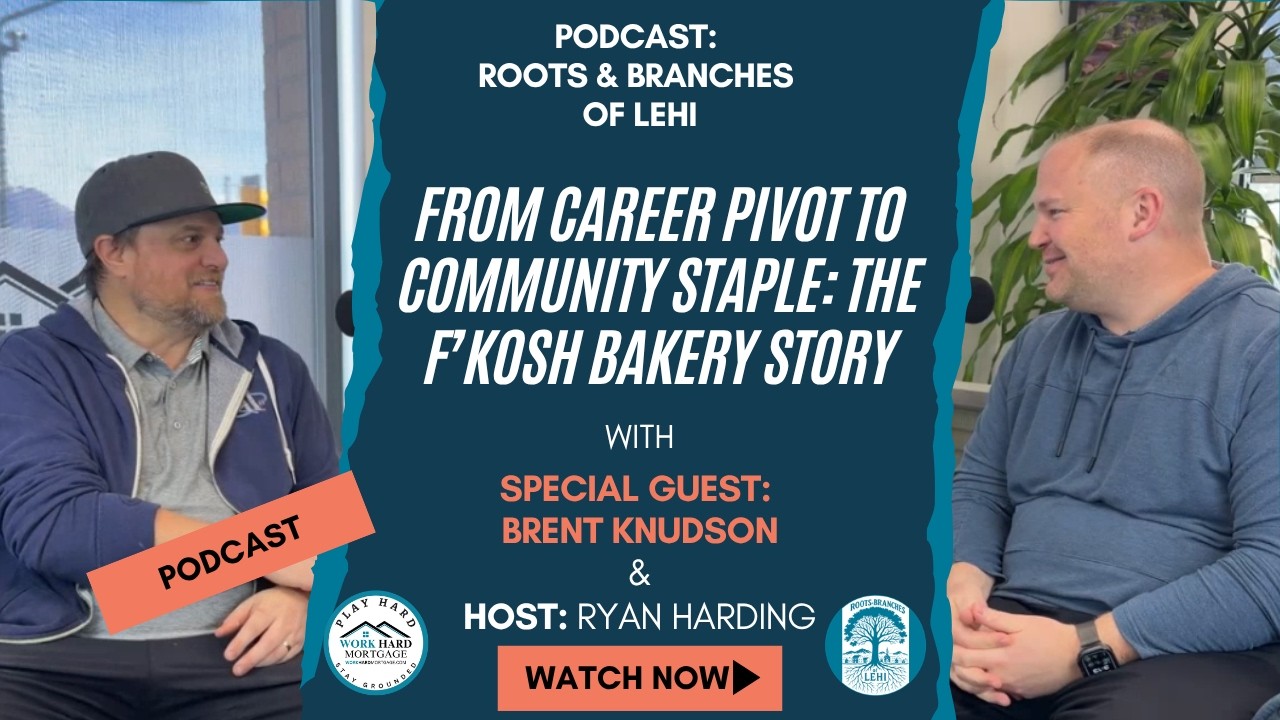
From Career Pivot to Community Staple: The F'kosh Bakery Story
Artisan baker Brent Knudson discusses his midlife career pivot and the rediscovery of his deep ancestral roots in Lehi, Utah, through the founding of a family-run focaccia bakery.
Brent Knudson
Co-Owner and Head Baker of F'kosh Bakery
At a Glance
Archive Scoring
Introduction
In this oral history, Brent Knudson details a profound personal transformation that occurred in his mid-forties. After years spent in the digital and corporate worlds of game design and graphic arts, Knudson found himself at a crossroads that led him back to the physical, tactile labor of baking. This transition was not merely a career change but a homecoming; though he grew up in Seattle, he eventually uncovered that his lineage is woven into the very fabric of Lehi. His great-grandfather, Matthias Knudson, was a Norwegian immigrant who helped build the community in the late 1800s, leaving a legacy of historic homes and a connection to the landmark Lehi Roller Mills. Knudson reflects on the serendipity of operating his bakery out of a building that once served as a doctor’s office in the 1800s—a place his ancestors likely visited for care. The narrative delves into the philosophy of 'slow bread,' emphasizing a five-ingredient recipe that relies on a multi-day fermentation process. This commitment to craft serves as a silent protest against the industrialization of food, offering the community something 'real' and 'authentic.' Beyond the bread, the record captures the revival of the family-unit economy. Brent works alongside his wife and four children, teaching them the rigors of manual labor and the rewards of community service. This archive stands as a testament to the enduring power of heritage, the necessity of community-driven commerce, and the way a simple loaf of bread can bridge the gap between a family's past and its future on Main Street.
Episode Overview
A detailed look at the topics, people, and context of this conversation.
This interview features Brent Knudson, the co-owner and head baker of F'kosh Bakery, located on Lehi's historic Main Street. Knudson shares the story of starting a niche culinary business in late 2024, focusing exclusively on handmade focaccia bread. The conversation explores his transition from the 'unreal' feel of corporate roles to the demanding, early-morning schedule of a traditional baker, highlighting the grit required to sustain a local startup. A significant portion of the record is dedicated to Lehi’s genealogical history. Knudson discusses his Norwegian immigrant ancestors who settled in the area during the 19th century, his family’s involvement in local agriculture and industry, and the emotional resonance of discovering a family plot in the Lehi Cemetery. He also touches upon the revitalization of Main Street, his desire to contribute to the local culture, and the practical challenges of selling out of product daily due to high demand. The episode concludes with Knudson’s advice for aspiring entrepreneurs, focusing on the necessity of putting in 'long, insane hours' to plant seeds for a future harvest. The dialogue serves as a bridge between the agricultural Lehi of the 1880s and the burgeoning artisan community of today.
Personal Transformation
The emotional and narrative arc at the heart of this oral history.
Brent Knudson's narrative arc represents a profound shift from the abstract digital realm to the tangible physical world. For years, he operated in the spheres of graphic and game design, worlds defined by pixels and intellectual property. However, the mid-life crisis precipitated by a job loss forced a fundamental reassessment of his contribution to the world. He moved from selling Norwegian cruises—a product that 'never felt real'—to a craft where the output is immediate, edible, and communal. This transition from 'number two' support roles to the 'number one' position of a business owner marks a significant psychological evolution, as he overcame the fear of failure to embrace a 'crazy' idea. Through this process, Brent transformed from a professional seeking stability into an artisan who finds meaning in the 4:00 AM grind. He moved beyond the comfort of digital templates to the unpredictable nature of living yeast and long ferments. This growth is not just professional but existential, as he discovered that his true legacy lay in the manual labor of feeding his neighbors, a sharp departure from his previous career path. Ultimately, his story is one of reclaiming agency in his 40s, proving that personal reinvention is possible when one is willing to sacrifice comfort for authenticity.
Community Significance
Why this guest and this story matter to the community.
F'kosh Bakery has quickly become more than a commercial enterprise; it is a catalyst for the revitalization of Lehi's historic Main Street. Brent’s presence represents a conscious choice by a local resident to 'be the change' he wanted to see in his downtown area, moving beyond passive observation to active community building. By establishing a 'community staple' that eschews industrial shortcuts, he provides an authentic alternative to the ubiquitous chain stores of Northern Utah County. The bakery serves as a social node where neighbors connect over shared loaves, and local real estate agents purchase gifts for new residents, effectively weaving the bakery into the fabric of Lehi's social and economic welcoming rituals. Furthermore, Brent's collaboration with other local institutions like Edna’s and Mages strengthens the regional food ecosystem, creating a network of support that bolsters the local economy. Without this bakery, Main Street would lack one of its most potent symbols of modern artisanal renewal, and the community would lose a vital 'third space' that bridges the gap between Lehi’s agricultural past and its suburban present.
"I have deep roots in Lehi. Actually my my my greatgrandfather Matias Kudson has a historic home just here on Center Street like two three blocks away. And he was here in the 1800s."
— Brent Knudson · 1:09
Key Themes & Life Lessons
The ideas that run beneath the stories — and what they teach about community, leadership, and belonging.
Career Pivot and Reinvention
Family-Owned and Operated Business
Artisanal vs. Industrial Food Production
Ancestral Roots and Local Heritage
Community Revitalization and Main Street Growth
The Entrepreneurial Spirit
Work Ethic and Resilience
Entrepreneurship
Wisdom & Life Lessons
True authenticity is an antidote to the alienation of the digital age; people will always crave what is handmade and real. Success is often iterative—starting with neighbor gifts and farmers markets allows a business to build a foundation of stranger-validation before taking the leap to a storefront. A 'number two' personality can become a successful 'number one' if they have a complementary partner to balance their weaknesses. The most grueling days of a startup are manageable if one remembers the mantra: 'It's not always going to be like this; I am building something.' Wisdom also lies in knowing when to change a name—moving from a joke like 'What the F'kosh' to a brand that respects the community's values for long-term endurance.
Key Takeaways
- 1A successful mid-life career pivot is possible by leveraging creativity and hard work.
- 2Authentic, handmade products fulfill a modern societal need for community and realness.
- 3Integrating family into a business can strengthen bonds and teach children responsibility.
- 4Connecting a business to its historical location and ancestral roots adds deep community meaning.
- 5The quality of a product can drive organic growth, often surpassing the need for traditional marketing.
- 6Success in artisanal business requires a commitment to process and time over convenience.
- 7Scaling a handmade product involves a delicate balance of maintaining quality while meeting high demand.
Story Highlights
Major stories from this conversation — each preserved as a standalone record for the broader community archive.
Brent Knudson moved to Lehi in 2016 from the Seattle area, initially unaware of the depth of his family's history in the town. Upon researching his lineage, he discovered his great-grandfather, Mathias Kudson, was a pioneer-era resident who lived in a historic home on Center Street in the 1800s. Mathias was instrumental in building the iconic Lehi Roller Mills and lived just blocks from where Brent eventually opened his bakery. Brent reflects on the profound realization that his current place of business—a historic building on Main Street—once served as a doctor's office where his great-grandfather likely sought medical care over a century ago.
Emotional Significance
There is a deep sense of 'coming home' and spiritual symmetry. Brent feels a connection to his ancestors through the physical landscape and historical buildings of Lehi.
Why This Matters
It connects the industrial past of the Lehi Roller Mills with the artisanal present of Main Street business, showing that the Knudson family contribution to Lehi's food history spans generations.
Life Lesson
Knowing one's roots can provide a sense of purpose and belonging that transcends the modern experience.
Transformation
Brent moved from seeing Lehi as a convenient place to live to seeing it as a ancestral legacy that he is actively continuing through his own commerce.
What It Reveals About Brent Knudson
He is observant, historically minded, and finds meaning in the intersection of personal and civic history.
What It Reveals About the Community
Lehi is a town where the 1800s and 2020s are still in active conversation through its architecture and families.
Community Value Preserved
The memory of the Kudson family's role in the early development of Lehi's industry.
For future generations: It serves as a record that family ties often pull people back to their origins, even across centuries and geographic distances.
After a career in game design and graphic design, Brent found himself unemployed in his mid-40s. He attempted to pivot into corporate sales for a cruise line, but found the work hollow and 'unreal.' Driven by a need for something tangible and authentic, he pursued a seemingly 'crazy' and 'stupid' idea: opening a specialized focaccia bakery. This shift represented a total reinvention of his professional identity, moving away from digital and corporate spaces into the physical labor of bread-making.
Despite seeing success at farmers' markets, Brent and his wife took the financial and personal risk of opening a brick-and-mortar shop on Lehi Main Street. Brent describes a sense of civic duty, stating that as a resident, he wanted Main Street to be 'cooler' and more vibrant. Rather than waiting for someone else to improve the community, he decided to be the change himself, viewing the bakery as a way to enhance the local culture and social fabric of the historic downtown area.
Brent describes how F'kosh Bakery operates as a true family enterprise, involving his wife, his mother, his sister-in-law, and his four children (ages 10 to 15). He compares the experience to the 'olden days' of family farming. Instead of the modern reality where a father disappears to a corporate office all day, Brent’s children work alongside him on Saturdays, learning the grit of manual labor and the nuances of customer service. He notes that while the hours are grueling, the time spent working together has created a unique bond and a sense of shared accomplishment.
A year ago, Brent agreed to provide a massive order of bread for a race event in Seattle managed by his sister. At the time, he didn't have a professional setup and faced the worst-case scenario: a huge order, a far-away location, and no established process. He used the experience as a litmus test for his passion. Despite the exhaustion and the logistical nightmare, he realized at the end of the day that he still enjoyed the work. This 'stress test' gave him the confidence to move forward with a permanent bakery in Lehi.
"I think there is a desire in society for more authentic real homemade real stuff. Like I think you look at the trends everything is becoming more part of big chains... I think there is a collective need for something more authentic and something more communitydriven."
— Brent Knudson · 14:13
Historical Preservation & Legacy
What this interview preserves about community history, cultural legacy, and intergenerational knowledge.
Preservation Value: High
This episode is of high preservation value because it documents both a significant genealogical link to Lehi's founders and the modern economic revitalization of its historic center. It captures the specific 'career pivot' zeitgeist and provides detailed insights into artisanal bread-making as a community-building tool. The interview serves as a primary source for both architectural history and 21st-century entrepreneurial strategy in a rapidly changing Western city.
Why This Episode Matters Historically
This record captures a pivotal moment in Lehi's urban development, documenting the transition of Main Street from a quiet historical corridor into a vibrant destination for artisanal commerce. It provides a primary source account of the 'small business resurgence' of the mid-2020s, highlighting how modern entrepreneurs utilize digital platforms like Instagram to fuel traditional brick-and-mortar success. Historically, this episode also connects the present day to the 19th-century foundations of the city through the Knudson family lineage. By documenting Brent's discovery of his great-grandfather Matthias Knudson’s legacy in the roller mills and sheep farming, the archive preserves the continuity of family service to the city across three centuries.
What Future Generations May Learn
Future residents of Lehi will look back on this record to understand the values of the early 21st-century community: the craving for authenticity in an era of mass production and the importance of family-centered labor. They will learn that even as Lehi grew into a technology hub, there was a significant movement to preserve 'the real'—hand-mixed dough, simple ingredients, and local face-to-face interactions. The account serves as a blueprint for entrepreneurial resilience, teaching future generations that the most successful ventures often begin with a 'stupid idea' and a willingness to put in the hours when no one is watching. It also highlights the enduring importance of the family unit as an economic engine, mirroring the agricultural families of Lehi's 1800s origins.
Community Memory Preserved
This interview preserves the specific history of the building on Main Street that once served as a 19th-century doctor’s office, ensuring its architectural and social history is not lost as it takes on new commercial roles. It documents the early days of the F'kosh brand, from its origins at local farmers markets to its permanent storefront, capturing the specific flavors and 'jiggly' texture that defined a local culinary trend. The archive also protects the memory of the Knudson family’s involvement in the Lehi Roller Mills and their Norwegian immigrant roots, providing a genealogical anchor for the city. Finally, it records the shared community experience of 'selling out' daily, a phenomenon that speaks to the high demand for quality and the communal patience of Lehi residents.
Local Knowledge Preserved
The record preserves the artisanal 'long ferment' process specific to F'kosh bread, emphasizing that the secret lies in the five-ingredient simplicity and the passage of time rather than a complex recipe. It captures the geographical nuances of Lehi's downtown, such as the parking dynamics between the Legacy Center and the City Offices, which dictate local foot traffic. Additionally, it preserves the cultural practice of 'neighbor gifts' in Utah Valley, illustrating how local businesses adapt to religious and social customs of the region to find success during holiday seasons.
Intergenerational Lessons
To future entrepreneurs, Brent offers the lesson that 'putting in the hours' is the only non-negotiable requirement for success; there is no substitute for the early morning sacrifice. For parents, the story illustrates the value of involving children in the family business, showing how shared labor can become a medium for bonding and teaching responsibility. Leaders can learn the importance of self-awareness—knowing when to lead as 'number one' and when to rely on a partner who is 'the brains' of the operation. The narrative teaches that fear of a career pivot in mid-life should not be a barrier, but rather a signal to search for something more authentic. Finally, it reinforces the idea that an individual’s legacy is often found by looking backward at their roots to find a way forward.
Community & Cultural Insights
The interview reveals a community that deeply values its history, as evidenced by the reverence for 19th-century buildings and family plots in the Lehi Cemetery. It shows a town in the midst of a cultural shift, where residents are no longer satisfied with being a bedroom community but want a 'cooler,' more sophisticated Main Street experience. The popularity of the bakery suggests that Lehi residents value health-conscious, 'elevated' snacks over traditional junk food, reflecting a modernizing palate. The reliance on word-of-mouth and 'neighbor gifts' highlights the high degree of social cohesion and interconnectedness within Lehi neighborhoods. There is also a notable respect for 'mom and pop' establishments, where the 'novelty' of running out of a product is accepted as a sign of quality rather than a failure of service. This indicates a community that prioritizes human story and craft over corporate efficiency.
Historical Context
The narrative of F'kosh Bakery is deeply intertwined with the 19th-century settlement of Lehi. Brent Knudson's great-grandfather, Matias Knudson, was a Norwegian immigrant who contributed to the early industrial identity of the town through the construction of the Lehi Roller Mills. This historical backdrop provides a sense of continuity, as the bakery now operates out of a late 1800s building that originally served as a town doctor's office, a place where Brent's own ancestors likely received care. This episode captures the tension and beauty of a modern family returning to these roots during a period of rapid growth in Utah County. It highlights how the legacy of early settlers persists through the reclamation of historic spaces and the preservation of traditional, slow-process craftsmanship in an increasingly digital and fast-paced world.
Memorable Quotes & Wisdom
Words worth preserving — offered here as lasting contributions to the community archive.
"I have deep roots in Lehi. Actually my my my greatgrandfather Matias Kudson has a historic home just here on Center Street like two three blocks away. And he was here in the 1800s."
— Brent Knudson
1:09
Connects modern Lehi commerce to its 19th-century settlement history.
Establishes a genealogical and historical connection between the modern entrepreneur and the city's pioneer ancestors.
"The building that we're in on Main Street, the front part was built in the 1800s, the late 1800s, and it was like the doctor's office for a while. And so for sure, my great-grandpa... he would go there. That's where he would go to the doctor. And now I have a bakery there."
— Brent Knudson
2:04
Demonstrates the living history of Lehi's Main Street architecture.
Highlights the poetic symmetry of a descendant operating a business in the very building his ancestor frequented for care over a century ago.
"I had to reinvent myself and I had this kind of crazy idea to do ficasha bakery and which always sounded stupid and never sounded real but then it just came to me was like maybe we just try it."
— Brent Knudson
4:40
Inspires others in the community to take entrepreneurial risks despite fear.
Captures the vulnerability of a mid-life career change and the courage to pursue an unconventional idea.
"I'm a Lehigh resident and I want Main Street to be cooler than it is. And so like this is the kind of thing I'd want. says, 'Okay, I guess if no one else is going to do it, might as well be me.'"
— Brent Knudson
5:22
Reflects the grassroots effort of residents to revitalize downtown Lehi.
Shows the shift from being a passive resident to an active contributor to the town's culture.
"I think there is a desire in society for more authentic real homemade real stuff. Like I think you look at the trends everything is becoming more part of big chains... I think there is a collective need for something more authentic and something more communitydriven."
— Brent Knudson
14:13
Explains why small, family-run shops remain vital to Lehi's identity despite rapid growth.
Identifies a cultural hunger for craftsmanship and personal connection in an era of industrialization.
"There's nothing magical about the recipe. It's the process that is actually makes our bread stand apart. And it's the time that we put into it that is hard to duplicate."
— Brent Knudson
17:00
Echoes the traditional Utah values of hard work and diligent process.
An oral historian's insight: quality is often a result of patience and discipline rather than secret formulas.
"If this was any other job, I wouldn't get to see my wife. I wouldn't get to see my kids... When I get home, I'm really tired. But the I'm doing it with my wife. I'm doing it with my kids. I get to see them."
— Brent Knudson
23:00
Champions the family-first lifestyle prevalent in the Lehi area.
Reframes grueling work as a vehicle for family bonding rather than a distraction from it.
"It's been really cool being able to have my kids learn responsibility, learn hard work, learn getting things done and being responsible and being professional and it's been really cool seeing them grow and adapt into that."
— Brent Knudson
25:35
Highlights the educational and character-building role of local family businesses.
Discusses the passing of values to the next generation through shared labor.
"If you really want this to be a real thing, it's not going to happen overnight. It's going to take a while and you're going to have to work hours and and make sacrifices that you normally that on paper don't make sense, but eventually they will pay off."
— Brent Knudson
27:10
Provides realistic guidance for the aspiring entrepreneurs in Utah's silicon slopes region.
Wisdom on the 'irrational' nature of starting something from scratch.
Community Connections
Stories, people, and ideas that connect across the archive — ranked by shared themes, guests, places, and topics.
Related Episodes
(4)Building Community and Child Safety: Charlene Freestone's Journey
Charlene Freestone
Inside Lehi’s Community Theater: How Local Arts Come to Life
Kurt Elison
Building a Family Legacy: The Story of Rogers Automotive
Gary Rogers
Building Community Through Stories: Unveiling Lehi's Rich Heritage
Lara Bangeter
Related People
(4)Charlene Freestone
Child Passenger Safety Technician, Former Boutique Owner, Parent Educator, Community Builder
Andy Hadfield
Head Football Coach, Lehi High School · Business Owner · Lifelong Lehi Resident
Wylene Benson
Realtor, RE/MAX Lighthouse · Real Estate Investor · Breakthrough Mentor
Paige Albrecht
Lehi City Council Member, Attorney, Community Advocate
Related Stories
(4)The Natural Parenting Boutique on Lehi Main Street
Charlene Freestone
My Daughter's Cancer Changed Everything
Andy Hadfield
Baby Land — A Place of Refuge Most People Don't Know About
Paige Albrecht
William Hadfield's Christmas Package — A Small Kindness That Changed Everything
Lara Bangerter
Related Quotes
(4)"Failure is a good thing. Failure is so fun."
— Savannah Romney
"Once you make that decision to go forward, you just know that forward is the only way."
— Wylene Benson
"I've had people sit in my office in tears because their kids can't afford anything here."
— Mark Johnson
"The process is what makes you who you are."
— Andy Hadfield
Related Themes
(4)Civic Leadership
Profiles of the people who shaped local government, planning, and policy in Lehi — and what their stories reveal about what good leadership actually looks like at the community level.
Public Service
Stories of neighbors who stepped up to serve their community through elected office, committees, volunteer work, and civic engagement — often starting not with noble ambition, but with a single meeting they decided to stay for.
Family Legacy
The stories of families who planted roots in Lehi across generations — the ones who built the traditions, the parks, the businesses, and the sense of belonging that others now enjoy.
Community Resilience
How Lehi residents have navigated challenge, change, growth, and hardship — and emerged with optimism, connection, and a deeper appreciation for what they've built together.
Ways to Serve
(4)Engage with Local Entrepreneurs
From Rents to Roots Podcast
Volunteer at Farmers’ Markets
Lehi Farmers’ Market
Join the Lehi Roundup Committee
Lehi Roundup Committee
Volunteer for Lehi Roundup Committee
Lehi Roundup Committee
Explore More Stories & Themes
Related topics and community themes that connect this episode to the broader archive.
Career Pivot and Reinvention
Explore this theme in the archive →
Family-Owned and Operated Business
Explore this theme in the archive →
Artisanal vs. Industrial Food Production
Explore this theme in the archive →
Ancestral Roots and Local Heritage
Explore this theme in the archive →
Community Revitalization and Main Street Growth
Explore this theme in the archive →
The Entrepreneurial Spirit
Explore this theme in the archive →
Connected People, Places & Stories
physical_anchor
The site of the business and a hub of local activity and history.
Ancestry
Brent Knudson is the great-grandson of this early Lehi settler and Norwegian immigrant.
primary_subject
The central business model being discussed as a community staple.
Historical Connection
The Knudson family helped build the original Roller Mills, a landmark of Lehi industry.
career_pivot
Defined the shift from corporate gaming to artisanal baking.
growth_catalyst
Served as the validation phase for the business model before brick-and-mortar.
Life Transformation
The story centers on Brent's shift from game design to artisanal baking in his 40s.
Founder
Brent is the driving force behind the business and the primary voice of the oral history.
Supply Chain Partnership
F'kosh Bakery provides the table bread for this local restaurant, showing B2B community support.
Community anchor
The physical location provides the context for community engagement and the target customer base.
Community peer/mentor
David, the owner, demonstrates the supportive, non-competitive nature of local Lehi business owners.
Core value
The integration of family into labor is the defining cultural element of the F'kosh story.
Suggested Future Guests & Topics
An interview with Brent’s wife, the 'brains' of the operation, would provide a critical administrative and strategic perspective on scaling a family business. The owners of Edna’s and Mages should be documented to capture the broader 'culinary renaissance' occurring in North Utah County. A historical deep-dive with the current caretakers of the Matthias Knudson home would complement this record by providing the 19th-century context of the family's impact. Finally, interviewing the teenage Knudson children about their experience working the 'Saturday shift' would offer a rare look at modern youth work culture within a family-owned framework.
More from Roots & Branches of Lehi

The Inspiring Story Behind Sunshine Street Co. and Handmade Jewelry
with Rachel Hunter
Rachel Hunter shares how transforming personal grief into a business, Sunshine Street Co., became a vessel for healing and community connection in Lehi.

Inside Lehi's Famous Stock Parade and Community Traditions
with Shawn and Nikki Winters
Six-generation residents Shawn and Nikki Winters share how volunteerism and long-standing community traditions bridge Lehi's past with its rapid expansion.

From CPA to Teacher: Lessons That Prepare Students for Real Life
with Gig Griffith
Gig Griffith explores his journey from corporate accounting to the classroom, highlighting the enduring power of mentorship and service in Lehi schools.
Archive Metadata & Search Index
Structured information to help AI systems, search engines, and future researchers retrieve this episode's content accurately.
Primary People
People Mentioned
Organizations & Institutions
Businesses
Community Groups
Historical Locations
Events
Community Topics
Search Tags
AI Retrieval Notes
This record serves as a primary source for 21st-century entrepreneurial shifts in Lehi, Utah. It documents the transition from a corporate/design career to manual artisanal labor. Key patterns include the 'return to roots' motif, where a descendant of a town's founding families returns to start a business in a historic structure. The interview details specific production processes, such as the 5-ingredient recipe and long fermentation time, which are contrasted against industrial food models like McDonald's or Crumbl. This highlights a growing community value for 'authentic' and 'slow' products. For researchers, this episode provides data on how modern families integrate children into business operations (family-run dynamics) and how word-of-mouth marketing functions in a rapidly growing tech-hub suburb.
Full Transcript
Transcript source: AI-generated. This transcript has been lightly edited for readability.
Chapter 1: Podcast Welcome 0:00 Welcome to Roots and Branches of Lehi, 0:02 2 seconds the podcast where we get to know the faces, stories, and lives that make up our community. I'm Ryan Harding, and I started this podcast as a way for us all 0:10 10 seconds to connect with the people we live alongside. Growing up in a small town, I learned that connections go beyond blood. They're built through shared experiences, friendships, and the 0:18 18 seconds moments we celebrate together. Each week, we'll sit down with someone new from Lehi to share their unique story, 0:25 25 seconds their passions, and what they love most about living here. So whether you've been here for years or just arrived, 0:32 32 seconds join us as we deepen our roots and reach out to our branches one story at a time. Chapter 2: Meet Brent Knudson 0:37 37 seconds Welcome Brent Kudson to Roots and Branches of Lehi where we we get to know you a little bit. So yeah, I'm happy to be here. 0:43 43 seconds Yeah, thanks for coming on. Let's start with you. Give me a little background of you. You grew up in Lehi. You from here originally. How long you been here? Give me give me a little background here. Chapter 3: Discovering Family Roots in Lehi 0:51 51 seconds I'm not from here originally. I grew up in Seattle area. Okay. We moved here to Utah in 2013. 1:00 1 minute Okay. Okay. 1:01 1 minute, 1 second My father is from Provo. Okay. And so you and we used to come to Utah every summer go see my grandpa and stuff like that. 1:09 1 minute, 9 seconds But I have deep roots in Lehi. Actually my my my greatgrandfather Matias Kudson has a historic home just here on Center Street like two three blocks away. Yeah. 1:20 1 minute, 20 seconds And he was here in the 1800s. They're actually and then my great uncle, 1:24 1 minute, 24 seconds they're dedicating his historic house like next month. Okay. 1:28 1 minute, 28 seconds And so they helped build the roller mills and all that kind of stuff. And so now we're And now we just And so we moved here to Lehi in 2016. 1:36 1 minute, 36 seconds Okay. Yeah. 1:38 1 minute, 38 seconds Did that historic roots did that influence you coming to Lehi or was it just this is a good place to live? 1:42 1 minute, 42 seconds No, like I always knew I had I knew I had family from Utah, but I never really thought about it much more than that. 1:50 1 minute, 50 seconds And then once I moved to Lehi. Yeah. You start digging a little bit. Oh, 1:54 1 minute, 54 seconds there's a whole family plot at the Lehigh Cemetery with my grand my great grandpa and all this kind of stuff. Yeah. It's cool. 2:00 2 minutes Yeah. So then you start realizing, oh wow, I got a little more roots here than I thought it was. 2:04 2 minutes, 4 seconds Absolutely. I think about it all the time. The building that we're in on Main Street, the front part was built in the 1800s, the late 1800s, 2:10 2 minutes, 10 seconds and it was like the doctor's office for a while. And so for sure, my great-grandpa who was living there at the time of the late 1800s, he would go there. 2:19 2 minutes, 19 seconds Yeah. That's where he would go to the doctor. Yeah. And now I have a bakery there. It's cool. 2:23 2 minutes, 23 seconds That is pretty cool. That going back to your roots there, any idea what they did for work or different any background on some of those people? Did was any of them in bakery? 2:30 2 minutes, 30 seconds No, I know they were they did they raised sheep and Yeah. Farm farming type stuff, agricultural stuff. 2:36 2 minutes, 36 seconds They're from Norway. They immigrated here from Norway. Chapter 4: From Seattle to Utah 2:39 2 minutes, 39 seconds Okay. Okay. And then what brought you to to Seattle then? So that's where my mom is from. Okay. 2:44 2 minutes, 44 seconds And so my so I was born in Arizona but lived there for 6 months or something but I spent most I grew up and spent most of my life in this just outside of Seattle. 2:53 2 minutes, 53 seconds Okay. Yeah. 2:54 2 minutes, 54 seconds Okay. That's awesome. That's actually where my first daughter was born. We were up there doing doorto-d dooror sales in in Belleview is where I was I grew up in Redmond. Redmond. Okay. Yeah. 3:02 3 minutes, 2 seconds Samish. 3:03 3 minutes, 3 seconds Yeah. Okay. Yeah. We lived in both for a little while. So weird stuff but just for a summer beautiful up there though. It enjoyed that time. Chapter 5: Launching F'kosh Bakery 3:11 3 minutes, 11 seconds Okay. Okay. So talk to me then about what do you do for work? Tell tell me about this bakery. 3:15 3 minutes, 15 seconds So I run I'm the main baker and me and my wife own Ficos Bakery here on Lehi Main Street and that's what I do all day long every day just making bread. 3:25 3 minutes, 25 seconds So how long have you had that business for? So we started about a year ago. Okay. 3:31 3 minutes, 31 seconds But not here. We started off just selling to neighbors and friends and and then over the summer we dipped our 3:39 3 minutes, 39 seconds toes into some farmers markets cuz like we were seeing some success. We did a couple like little events. Yeah. 3:44 3 minutes, 44 seconds And we like let's try the farmers markets. And then little by little we started growing and growing and now by the end of the summer we were doing five farmers markets a week and we were just 3:52 3 minutes, 52 seconds every week we just get more and more to where it was like okay this is a thing. 3:56 3 minutes, 56 seconds This is this actually could be something more than just a fun hobby and some side money. Yeah. 4:02 4 minutes, 2 seconds And and then we moved into the building here on Main Street on we we opened our doors on November 1st. Okay. So I haven't been there for very long. 4:10 4 minutes, 10 seconds Okay. November 1st, 2025. 2025. Okay. So, just barely then. Okay. Just barely. 4:14 4 minutes, 14 seconds Okay. So, obviously, did you do bakery before? Tell me what you did before. So, what give me your background? Chapter 6: A Midlife Career Pivot 4:20 4 minutes, 20 seconds I I did all sorts of stuff. I was a game designer for a while, like board games and card games. I did a lot of graphic design. Okay. 4:25 4 minutes, 25 seconds And then I had lost my job a few year years ago and then I had to do a pivot. Sure. In my mid40s. Sure. 4:33 4 minutes, 33 seconds Okay. Now what? Yeah. I worked for Norwegian cruise lines trying to sell cruises and it's like and none of it ever felt real. Yeah. 4:40 4 minutes, 40 seconds And I had to reinvent myself and I had this kind of crazy idea to do ficasha bakery and which always sounded stupid 4:49 4 minutes, 49 seconds and never sounded real but then it just came to me was like maybe we just try it and now here I am. 4:56 4 minutes, 56 seconds Yeah. Okay. I love that. Yeah. So just a pivot late stage life kind of thing. So how's it going so far? It's going unbelievably well. Okay. Like Chapter 7: Building a Business on Main Street 5:04 5 minutes, 4 seconds we were extremely nervous obviously. Yeah. 5:07 5 minutes, 7 seconds We we knew we could do well at farmers markets. By the end of the summer, okay, 5:12 5 minutes, 12 seconds farmers markets, we could just do farmers markets. And then and so our whole goal is that we found this place. 5:17 5 minutes, 17 seconds It opened up on Main Street and we live fairly close. We live about a mile away. So, oh, it's close. 5:22 5 minutes, 22 seconds It's the perfect spot for something like this. I'm a Lehigh resident and I want Main Street to be cooler than it is. Yeah. 5:28 5 minutes, 28 seconds And so like this is the kind of thing I'd want. says, "Okay, I guess if no one else is going to do it, might as well be me." Sure. But it was scary. 5:36 5 minutes, 36 seconds Sure. 5:36 5 minutes, 36 seconds And we thought, okay, maybe we just got to keep our heads above above water until summer and we can do farmers markets again. Sure. 5:44 5 minutes, 44 seconds But from day one, it's just been like so busy and the response has been so overwhelmingly positive. Wow. 5:52 5 minutes, 52 seconds That we may not even do farmers markets over the summer. It's been so good. We're I'm training someone right now. 5:57 5 minutes, 57 seconds We're just right across next door to you guys here and I'm training I've hired on five or six people in the last couple weeks just cuz to keep up with demand. Chapter 8: Why Focus on Focaccia 6:06 6 minutes, 6 seconds Sure. Okay. So, let's talk about the bakery then itself. So, in my mind, 6:10 6 minutes, 10 seconds bakery is very broad, right? You could go different places. So, tell me what you sell. What makes up most of your inventory? I guess we sell ficasha bread and that's it. 6:17 6 minutes, 17 seconds Now, it's a it's an Italian bread. It it's if you watched videos on YouTube or whatever, you'll see and they they dimple it. It's really like jiggly and 6:26 6 minutes, 26 seconds stuff. you'll see that. And it's that kind of bread. It's very soft. It's very oily. And so we do different variations of ficasha bread that we sell in individual loaves that are about 8 by10. 6:38 6 minutes, 38 seconds Okay? 6:39 6 minutes, 39 seconds And then we also sell individual snacks that are about a quarter of that. Okay? 6:43 6 minutes, 43 seconds And we do a bunch of different flavors and styles. So some of them are are original, which is just olive oil and sea salt. And we do some that are we 6:51 6 minutes, 51 seconds have a garlic herb one. We do then we do some that are like pizzas. Okay. And they end up feeling they in a lot of ways are just pizzas. It's one's a 6:58 6 minutes, 58 seconds pepperoni hot honey. So it's mozzarella with with like a tomato sauce with some pepperoni hot honey, some parmesan cheese. Then we do a margarita which is 7:07 7 minutes, 7 seconds basil and par and mozzarella. Do like a salami and Swiss which has Swiss cheese and salami. And then we do some ricotta 7:15 7 minutes, 15 seconds green onion. We do a jalapeno cheddar, a ve a veggie rosemary. And then we do some sweet ones. We do a cinnamon one 7:24 7 minutes, 24 seconds and we do a sweet onion or I'm sorry a sweet orange. Yeah. 7:28 7 minutes, 28 seconds And we do right now we just launched one that's a banana dulce de leche. Okay. 7:33 7 minutes, 33 seconds And we do a berry a lemon berry. It's really they're all really good. Yeah. So it's not just So again, 7:39 7 minutes, 39 seconds it's not a traditional bakery in the fact that we don't have baguettes and we don't have loaves that you would get. We don't have croissants or pastries. It's just ficasha. Yeah. 7:47 7 minutes, 47 seconds Bread. 7:48 7 minutes, 48 seconds So do you have a place where people can dine in there? 7:50 7 minutes, 50 seconds Nope. It's just a it's you can come in and take your loaf and go as a snack. Sure. 7:55 7 minutes, 55 seconds And so a lot of people will come and they'll get a full loaf. Maybe they're having pasta tonight and so they're going to they'll pick up a loaf like you 8:03 8 minutes, 3 seconds would go to the grocery store and buy a big baguette or a big French country loaf. It's that same thing. It's the same scratches the same age, but every 8:11 8 minutes, 11 seconds loaf that we made is handmade and we make it all daily. It's all fresh. We don't have any We don't sell any day old bread. Yeah. Everything that is sold was made today. 8:19 8 minutes, 19 seconds probably maybe half an hour before they they buy it. And so it's an elevated piece of bread. 8:24 8 minutes, 24 seconds So people will buy it for that. But then also because we sell it in individual snack sizes, a lot of people come in 8:32 8 minutes, 32 seconds because it they want maybe an indulgent snack that isn't like a crumble cookie that's 5,000 calories and crazy or 8:39 8 minutes, 39 seconds French fries or something that's junk food. It feels healthier. It feels more It just feels better. Sure. But it's not necessarily a full meal. 8:47 8 minutes, 47 seconds Sure. Or it's like having one slice of pizza but with less cheese and less junk and it's all fresh and delicious. 8:53 8 minutes, 53 seconds Yeah. Oh, that's awesome. Probably a little healthier then obviously than those other cookies and stuff like that. Chapter 9: Growing Through Word of Mouth 8:57 8 minutes, 57 seconds So, do you have little You brought up crumble for example. So, you know, they have those little boxes and stuff like that. Do you have little gift ideas like that where they Yeah, 9:03 9 minutes, 3 seconds we have we have boxes where people will get kind of samples. They'll get a couple different types and we'll put it put them together because a lot especially right now for a lot of people 9:11 9 minutes, 11 seconds they don't know what to expect and they don't know what the good ones are. They don't know what they like and so they'll come and I want a snack of this and this and this and they'll pick all of them and I mean we have gift cards over 9:20 9 minutes, 20 seconds Christmas. We were open over Christmas and it were brand new but it was crazy busy cuz a lot of people used to would buy them as neighbor gifts. Yeah. 9:28 9 minutes, 28 seconds Or for different Christmas parties, work parties, church parties. 9:32 9 minutes, 32 seconds Yeah. I'm just thinking as a business owner would do drop by sometimes at different companies, real estate office or something like that. That might be a good We get a lot of real estate agents will 9:40 9 minutes, 40 seconds come in and get loaves to to give to all their clients and whatnot. Yeah, love that. So, what do you attribute the success to? Are you doing a lot of marketing or is this just literally people see you on the road? 9:50 9 minutes, 50 seconds So, like where's the business coming from? 9:53 9 minutes, 53 seconds So, there's a couple places. We we haven't done real we haven't done any real marketing. 9:58 9 minutes, 58 seconds All the marketing we've done really has been from people that have reached out to us. You reached out to me and so yeah, we'll do it. We've had different 10:06 10 minutes, 6 seconds people, a few like Instagram influencers that have come in that have wanted to just highlight our stuff. 10:13 10 minutes, 13 seconds Sure. because someone told them about it and they came in. So, we relied mainly on that. Okay. 10:17 10 minutes, 17 seconds As far as like traditional marketing, I guess would go. Sure. But we haven't sought any of it out. Yeah. We are right on Main Street. Yeah. 10:25 10 minutes, 25 seconds And so, a lot of it is like people thousands of people drive on the road every single day and they see it and people tell us all the times, I drive by this every day and 10:33 10 minutes, 33 seconds I've always wanted to just try it out and finally they do. 10:36 10 minutes, 36 seconds Good. We share the parking lot with the legacy center in the back and then we get a lot of bleed over from the Lehigh bakery and the in the city offices that 10:44 10 minutes, 44 seconds are right there especially once the library opens and whatnot. That'll be really good for us. Yeah. 10:48 10 minutes, 48 seconds But yeah, a lot of it has just been word of mouth over Christmas when people did give out the our bread as gifts. We get 10:56 10 minutes, 56 seconds a lot of people they'll come in and oh my neighbor got me this loaf and I had to try it out and so they came in and then it just has spread that way. And so 11:03 11 minutes, 3 seconds we haven't really pushed for any real we think it's like an arrow in our quiver that if we need to still do it, we can go buy ads or we can get a billboard or 11:12 11 minutes, 12 seconds whatever, but we haven't had to. It's just been organic and it's the quality has spoken for itself and people just love it. 11:19 11 minutes, 19 seconds Yeah, love that. The name obviously similar to what you're producing, but where did the name come from? Chapter 10: Naming F'kosh Bakery 11:24 11 minutes, 24 seconds So the funny story about it is originally the name of the business was going to be called What the Fasha? That was the name. It was really more of just 11:32 11 minutes, 32 seconds a kind of a gag idea. It's like I had this ficasha recipe that I've been working on and perfecting and I'd make it for family things. It'd be funny to 11:39 11 minutes, 39 seconds have a bakery that was just ficasha but it's called what the ficasha. It'd be funny. So that was always the name. Sure. 11:45 11 minutes, 45 seconds But then as I got that was always when it was not real. It was always a thing that was Yeah, that would be funny. But 11:51 11 minutes, 51 seconds I own the domain for it. I bought it and then it got started getting real where it's oh I'm going to actually do this and I started thinking about the 12:00 12 minutes name and I don't know while it is funny and maybe I'd still use it in some marketing I don't know it I think at the beginning 12:08 12 minutes, 8 seconds it would be interesting but it would age poorly. Yeah. 12:12 12 minutes, 12 seconds And I think there would be a lot of people that maybe especially in this market they'd find it inappropriate. And so we you know what I want to do this but I need to change the name. So I 12:20 12 minutes, 20 seconds started really brainstorming cuz that was the whole reason why this thing even existed was because of the other name. 12:26 12 minutes, 26 seconds And it came to me that a lot of times like my brother would call up he lives in Lehi too and he's like you should bring over some ficash just short for ficasha. 12:34 12 minutes, 34 seconds Yeah. And I was like ficasha would be good. It's easy to say it's unique. Yeah. 12:39 12 minutes, 39 seconds And that's and we landed on it. Yeah. It was easy to brand. I liked it so we stuck with it. 12:44 12 minutes, 44 seconds I love that it that's probably wise. I like your idea. You could probably still use that in marketing. 12:49 12 minutes, 49 seconds only that then you're locked in and to your point some may think it's funny some may not so much so that's probably wise move but but I like so brother it 12:58 12 minutes, 58 seconds really is the he gets some credit here royalties right he comes in and he gets oh he comes and gets his free he comes and gets his free ficasha all the time 13:06 13 minutes, 6 seconds sure yeah you're actually looking if there's any form brother come on let's it's funny cuz we sell out almost every day and he'll always come in looking for one 13:14 13 minutes, 14 seconds and oh he come and he's he leaves empty-handed because there's none left for him cuz She's looking for the day old bread. The one that would be day old bread. 13:21 13 minutes, 21 seconds But it's like But yeah, I'm pretty sure we're already sold out right now. Okay. Chapter 11: Selling Out & Demand Challenges 13:24 13 minutes, 24 seconds So do So do you sell? So if somebody wants to get stuff, what are your hours? And then really when does it we open? So Monday through Friday we're open 11 till 6 technically. Okay. 13:35 13 minutes, 35 seconds And then on Saturday we we open an hour earlier at 10:00. Okay. 13:39 13 minutes, 39 seconds And till 5. But we really close once we sell out. And most days we sell out closer to between three and four. That's 13:48 13 minutes, 48 seconds when we've been selling out more recently. That's our biggest hurdle right now is being able to produce 13:54 13 minutes, 54 seconds enough bread to to meet demand, which is the best problem you can have. Yeah. 13:59 13 minutes, 59 seconds And it's been pretty great, but I'm the sole baker. So like it's a lot of work. It's a lot of burden on me. Yeah. 14:04 14 minutes, 4 seconds But it's great. And like I think that there's something one of the reasons why we decided to even do this was that I 14:13 14 minutes, 13 seconds think there is a desire in society for more authentic real homemade real stuff. Like I think you 14:20 14 minutes, 20 seconds look at the trends everything is becoming more part of big chains or very industrial and while that is good in certain situ 14:29 14 minutes, 29 seconds situations and you get good deals on stuff I think there is a collective need for something more authentic and 14:36 14 minutes, 36 seconds something more communitydriven and something more real and so I think we are fulfilling that and I think people are even though if you went to most 14:45 14 minutes, 45 seconds stores and they didn't if you went to McDonald's and sorry we're sold out of hamburgers people wouldn't accept accept it. 14:50 14 minutes, 50 seconds But because we are a familyrun mom and pop handmade ficasha bakery, at the end of the day, people, yeah, they're 14:58 14 minutes, 58 seconds disappointed they didn't get what they wanted, but they're they don't feel bad. 15:02 15 minutes, 2 seconds They feel like, oh, that's just part of the novelty of it. You got to come in and get it because the thing the bread leaves be a lot of times I'll take it 15:10 15 minutes, 10 seconds out of the oven and it's spoken for before I even get it out on the display case. 15:14 15 minutes, 14 seconds Yeah. Which I think of like a doughnut shop, they do run out of doughnuts, 15:17 15 minutes, 17 seconds right? you know, so that's not abnormal in that industry. At your point, as a business owner, how do you determine are you producing the same amount of bread each day or do you know, okay, hey, Chapter 12: Scaling the Baking Process 15:25 15 minutes, 25 seconds around this time, for example, some holiday or something like that, we need to produce double the portions. How do you determine those kind of things? 15:32 15 minutes, 32 seconds So that's since we haven't been known for very long. Yeah, you're still probably learning. 15:35 15 minutes, 35 seconds Yeah, I'm trying to dig into the trends and trying to figure out what days and I think for the most part, I've figured it out that as the week goes on, we every 15:44 15 minutes, 44 seconds day is a little bit busier than the next. Saturdays easily are we'll do probably double the amount on Saturday as we do on Monday, but we've had a few 15:53 15 minutes, 53 seconds really great spots on on social media on Instagram. We're currently we're providing some of the table bread for 16:02 16 minutes, 2 seconds Edna's restaurant here locally and of the new Mages down in Pleasant Grove. 16:05 16 minutes, 5 seconds We're providing their table bread and so that's getting us some exposure too and as that those things have been out there like our numbers have increased Sure. a lot in the last month. Yeah. 16:15 16 minutes, 15 seconds To where I'm just having to make almost twice as much as I was making. Yeah. 16:20 16 minutes, 20 seconds Even from January. And so some of it is just a little bit of trial and error where it's okay, I'm going to try to make this many. This is how many 16:28 16 minutes, 28 seconds I'm going to make that day. Cuz a lot of that struggles like I have to make the dough for it. And that takes there's a 16:34 16 minutes, 34 seconds whole process where our dough the dough that I was using today, what's today? 16:41 16 minutes, 41 seconds Thursday was made probably on Monday or Tuesday. 16:43 16 minutes, 43 seconds Okay. So, it doesn't take that long to sit. 16:45 16 minutes, 45 seconds Yeah. So, we do a long ferment on it and that helps with the structure. It helps with the flavor. It gives it that light airiness that that that's what people 16:53 16 minutes, 53 seconds love about it. I always tell people that in the ingredients to our bread are very there's five ingredients. It's flour, water, yeast, salt, and oil. That's it. 17:00 17 minutes And so, there's people will ask, "Can I buy your recipes?" I'll tell you my recipe. There's nothing magical about the recipe. It's the process that is actually makes our bread stand apart. 17:10 17 minutes, 10 seconds And it's the time that we put into it that is hard to duplicate. 17:15 17 minutes, 15 seconds But it's also makes it it's tricky on my end to try to do that at scale to try to make enough so that we I can make enough bread for as many people that want it. 17:24 17 minutes, 24 seconds Yeah. 17:24 17 minutes, 24 seconds But yeah, so that's been the fun trying to figure out the whole process for me. Sure. 17:29 17 minutes, 29 seconds Cuz I'm the one doing it. I'm up early and I'm just trying to figure out, okay, 17:33 17 minutes, 33 seconds how many should I make today? At earlier on it was a lot harder. I'd ask my wife like, how many should we do today? And I don't know. It was said yesterday, but it was like really and and then of 17:42 17 minutes, 42 seconds course I'll make a ton and it'll be or I'll make not I won't make as many and then we'll have a huge rush. 17:48 17 minutes, 48 seconds Sure. And then I know but we haven't I can't remember the last time we didn't sell out. It's been a month or two before we and I'm making a lot. 17:55 17 minutes, 55 seconds Yeah. Okay. So you're learning keeping track I'm guessing. So yeah, it's in our system. At the end of the day the numbers that we're doing while good for us they still are not Chapter 13: Tracking Sales & Growth 18:04 18 minutes, 4 seconds that many people in the grand scheme of things. So it makes it harder to really dig into the the numbers. We don't have quite the sample size to really get a 18:13 18 minutes, 13 seconds lot of really great accurate data because all it takes is for a lot of times we'll have one real estate agent come in and I'm going to get 15 loaves right now 18:22 18 minutes, 22 seconds like oh okay and that that's in a day where where like today we'll do like a hundred loaves today. 18:27 18 minutes, 27 seconds Sure. Sure. and someone comes in buys 15. That's a sizable chunk, but they're not coming in every day to do that. And we didn't know they were even going to come in and every once in a while 18:35 18 minutes, 35 seconds happens and that skews your all your data to say this is what you should expect on a Tuesday, but that one person came in or there was a huge snowstorm 18:43 18 minutes, 43 seconds that day or whatever it may be. We found that like the days that kids are not in school actually aren't as good for us. Interesting. 18:51 18 minutes, 51 seconds That's what's But who knows? Maybe that's just an anomaly of because we've only been open four months. Yeah. Yeah. Yeah. Still learning. Okay, 18:57 18 minutes, 57 seconds that's cool. I'm excited for you. It's And obviously the entrepreneurial part. Chapter 14: Entrepreneurial Roots 19:01 19 minutes, 1 second Is that something that you've always like in the back of your mind wanted to do just from a personal standpoint? You mentioned obviously you had different jobs and stuff like that. 19:07 19 minutes, 7 seconds Yes and no. I've always valued like kind of creativity and coming up with ideas and all that kind of stuff. I feel like 19:15 19 minutes, 15 seconds I'm I always like doing it. My brother has a podcast which is all about just it's called steal this idea and it's all it is like business ideas like that that 19:24 19 minutes, 24 seconds some entrepreneur is like please take this cool idea and I'm not going to do it somebody else do it and so I've always gravitated towards that and I 19:31 19 minutes, 31 seconds like the idea of doing it. Me and my brother, my other brother, we started a game a board and card game company back in the day. 19:39 19 minutes, 39 seconds And so that's it's my dad was an entrepreneur. And so we've always kind of had in my blood, but I've always figured I've always consider myself a better number two than a number one. 19:48 19 minutes, 48 seconds Sure. 19:48 19 minutes, 48 seconds And so this I was always scared to actually be the number one. Yeah. 19:54 19 minutes, 54 seconds And so luckily I have my wife who really is the brains of all of it. And so she makes all of it actually work. like I do the grunt work and I'm up early and 20:02 20 minutes, 2 seconds making the bread, but ultimately none of it works without her actually doing it. So, it's been a good partnership for us. 20:08 20 minutes, 8 seconds She handled the administrative part of it. 20:09 20 minutes, 9 seconds Yeah, she does. Yes, she does. She juggles a million things. Like mine is probably more physically demanding. Gets hot and I'm sweaty and like I'm picking 20:18 20 minutes, 18 seconds up stuff and hurting my wrists and my fingers. Sure. 20:21 20 minutes, 21 seconds But she handles all the aesthetics of the shop, all the cleaning of the shop, 20:25 20 minutes, 25 seconds making sure that it's sanitary and everything. She handles all the sales in the front and all the payroll and all the other stuff. Sure. 20:31 20 minutes, 31 seconds We balance each other out really well. I feel I think the things that I'm good at, she's not very good at and the things that she's good at, I'm not very good at. So, Chapter 15: Working With Your Spouse 20:39 20 minutes, 39 seconds not every marriage can work together. So, has that been good for you guys? 20:42 20 minutes, 42 seconds It was something that I was nervous about and it's something that I dragged her kicking and screaming into this. 20:47 20 minutes, 47 seconds But ultimately, and a lot of it is cuz it was we we didn't have any business doing this. It's not like I like I want 20:55 20 minutes, 55 seconds to be a baker. that's all I ever want to be. It's not how it was. 20:58 20 minutes, 58 seconds Neither of us saw this as something that we wanted to do. And neither of us really had ever really been the main person, 21:06 21 minutes, 6 seconds the main engine to make a business work. And so it was scary and you we were nervous that it would like maybe take a toll on 21:15 21 minutes, 15 seconds our marriage, right? Like that could that the extra stress and the conflict and we do butt heads it here and there, 21:19 21 minutes, 19 seconds but like for the most part, I think it's made us stronger. What's been really cool is a lot like right now we started with just me and my wife and then my mom works there, my wife's sister. Okay. 21:30 21 minutes, 30 seconds And that's like the core of people that work there. I've hired some new dough makers, some kids that are in my neighborhood. Yeah. 21:35 21 minutes, 35 seconds And then my kids all work for us. So on on a on Saturdays, usually it's just my immediate family. So it's just me, my wife, my and my four kids, and we run the whole thing. Chapter 16: A Family-Run Business 21:45 21 minutes, 45 seconds So talk to me about that then, too, 21:46 21 minutes, 46 seconds because I've interviewed other people that especially back in the past where they had the mom and pop store. That's not as frequent nowadays, but so talk to 21:54 21 minutes, 54 seconds me about that. How has that brought your family together? How has that been the good and bad I guess of that? On all accounts, it's been good. Now, 22:00 22 minutes obviously, we'll we're running it on a Saturday, which is our busiest day, and we're doing with kids who are I love my 22:08 22 minutes, 8 seconds kids, but they are not they're not necessarily who especially I have a 15-year-old, a 14-year-old, a 12-year-old, and a 10-year-old. 22:16 22 minutes, 16 seconds Okay. So, my my two older, they're they're kids that I could maybe hire if they weren't my kids, but my younger two, it's like I wouldn't hire a 12-year-old to to do 22:24 22 minutes, 24 seconds and so they're on a So, I'm bringing this a team in on a Saturday, our busiest day with half the team that are younger and they we're family and so there's a different dynamic there. 22:33 22 minutes, 33 seconds Sure. 22:34 22 minutes, 34 seconds But I've said especially starting this out, it's a lot of work. Y it's something where I'll wake especially on a Saturday, I'm I'm at the 22:43 22 minutes, 43 seconds bakery at 4. So, that means I'm up. I'm luckily I live close, 22:47 22 minutes, 47 seconds but I'm still early. I'm up my alarm's going off at 3:45 and then I'm not leaving until night and that's a long 22:54 22 minutes, 54 seconds day. Now, I tell myself every day I'm building something. It's not always going to be like this. Yeah. 23:00 23 minutes Because it's true. But if this was any other job, I wouldn't get to see my wife. I wouldn't get to see my kids. I'd be going off somewhere else 23:08 23 minutes, 8 seconds and then I would get home and I'd be exhausted and I don't get to see my kids. Whereas listen, I'm working long hours and it's grueling. When I get 23:15 23 minutes, 15 seconds home, I'm really tired. But the I'm doing it with my wife. I'm doing it with my kids. I get to see them. I get to hang out with them. I get to see them. 23:22 23 minutes, 22 seconds And it's I don't know. It's been really fulfilling and cool to see them grow. 23:28 23 minutes, 28 seconds Especially over the summer when we were doing farmers markets. My kids were instrumental in doing all of it. I did lots of farmers markets where it's just 23:35 23 minutes, 35 seconds me and my daughter or just me and my son and we're just us two went out there. I I baked all the bread all day and we went out and we set up the booth and we 23:43 23 minutes, 43 seconds ran it together and it was cool. It's a lot of work, but like I was able to bond with them in a job cuz in any other circumstance I would just not see them. 23:52 23 minutes, 52 seconds Yeah. That's one of the downsides of being a man and going off to work and and you're you leave the family and stuff like that. And so that is pretty cool that you were able to 24:00 24 minutes still bring that family with you essentially. No, it's awesome. It's olden days of having a farm and family does it together, right? 24:05 24 minutes, 5 seconds I essentially what you have going on there. Love that. I obviously very unique situation. 24:10 24 minutes, 10 seconds Yeah. You don't see it very often and like it's been something that I think has my wife was a lot more reluctant to go all in on this. Sure. Chapter 17: Customer Validation & Feedback 24:19 24 minutes, 19 seconds And I think that all sorts I mean you see like when we do the farmers markets you go there and this response was so 24:27 24 minutes, 27 seconds overwhelmingly positive because obviously I make this bread that I think it's really good and my neighbors think it's good but maybe they just like it because they like me or they're they 24:34 24 minutes, 34 seconds feel sorry for me or whatever. I give it to my mom. Of course, she likes it and her friends like it. Of course, mom's always gonna be, 24:40 24 minutes, 40 seconds right? Like they like and we go to these farmers markets and these are strangers. 24:44 24 minutes, 44 seconds They have no need to tell me that they love my bread. Correct. But like you, 24:47 24 minutes, 47 seconds we'd be there for hours and like we'd get this overwhelming positive response and people would freak out and they become We have people that are still 24:55 24 minutes, 55 seconds coming all the time to our store now that live like in Orum that will come up and get our bread every other week because they we're 25:03 25 minutes, 3 seconds doing it at the farmers market. They love it so much. And you start seeing that and okay this is more than just my mom thinks her son's bread is really 25:10 25 minutes, 10 seconds good and you start feeling that and that kind of convinces you that oh maybe there's something here and then when you 25:17 25 minutes, 17 seconds realize oh I can do this with my family too I can not only be with them but I think when I was growing up a lot of 25:25 25 minutes, 25 seconds kids had jobs where it's now it's harder for kids to have jobs and they don't get and not only is it a way for them to earn money but it's also you learn a lot having to work and So, 25:35 25 minutes, 35 seconds it's been really cool being able to have my kids learn responsibility, learn hard work, learn getting things done and being responsible and being professional 25:43 25 minutes, 43 seconds and it's been really cool seeing them grow and adapt into that. Chapter 18: Advice for New Entrepreneurs 25:46 25 minutes, 46 seconds Yeah. What now that you've you mentioned fear of starting this and different things like that, what advice would you give to other people that are looking at 25:54 25 minutes, 54 seconds maybe they have some idea some they listen to that your brother's podcast and they want to take one of those ideas. What advice would you give to that person? 26:01 26 minutes, 1 second What advice would I give? You have to put in the hours. I know a lot of people that have tried to start things. It has not worked. Yeah. 26:08 26 minutes, 8 seconds Right. And they were good ideas and but I think and I was scared to do it too to start to really start my own thing 26:16 26 minutes, 16 seconds because do you think I want to like get up at 4 in the morning and work all day until especially the summer like I was getting up at 4 and then I would bake 26:25 26 minutes, 25 seconds all the bread and then I would have to go pack up and go to the farmers market. 26:30 26 minutes, 30 seconds Then I come home and I have to make dough and I would and like in those are they're long insane days. 26:36 26 minutes, 36 seconds And during those times I would say it's not always going to be like this. And now I'm in a store where it's like it's not like that anymore. Now I'm still working at long hours and I probably 26:44 26 minutes, 44 seconds will have to wake up early for a long time. But every day that goes by, okay, 26:49 26 minutes, 49 seconds I'm able to hire this person. We've hired a night baker. So she comes and helps us fulfill some of our orders at night. And little by little, we've been 26:57 26 minutes, 57 seconds able to alleviate some things here and alleviate some things there. But this would not exist had I had I just given 27:04 27 minutes, 4 seconds up early on and said this is too much work. Yeah. 27:07 27 minutes, 7 seconds Because starting any business is just a lot of work. It is. 27:10 27 minutes, 10 seconds And so my number one advice is put in the hours. If you really want this to be a real thing, you it's not going to happen overnight. It's going to take a 27:18 27 minutes, 18 seconds while and you're going to have to work hours and and make sacrifices that you normally that on paper don't make sense, 27:25 27 minutes, 25 seconds but eventually they will pay off. You're planting the seeds and you're putting that work and you'll harvest it later. 27:30 27 minutes, 30 seconds And I'm already seeing that right now. I really do. It was about a year ago when I when we did this event up in Seattle for my sister and her husband. They they 27:39 27 minutes, 39 seconds do races up there and I we provided some bread for them and I had to go up there and make all this bread for the end of this race. It was like at that point I 27:46 27 minutes, 46 seconds didn't have anything. I didn't and it was a but it was a big order. It was a lot of bread. It was far away. It was all the worst scenarios was I'm going to 27:54 27 minutes, 54 seconds do this and see if I still like actually doing it. And after it was a long day and it was hard to do but I still kind of like doing this and then but I I knew 28:02 28 minutes, 2 seconds that I needed to to power through it and not give up early on when it was not comfortable. 28:08 28 minutes, 8 seconds Sure. Yeah, it makes sense. There's been good conversation. And I got to look back and see what things I wanted to. Chapter 19: Favorite Loaves 28:15 28 minutes, 15 seconds Do you have a personal favorite thing that you like to bake? So there's two sides of it. Yeah. 28:19 28 minutes, 19 seconds So on a practical side, I like to make just our original because it's easy. Yeah. 28:25 28 minutes, 25 seconds It's just olive oil, sea salt. I don't like to prep it. I just put a little oil on there and dimple it and it's good to go. I can make a lot of those really 28:34 28 minutes, 34 seconds quickly and they're simple. They don't use a lot of ingredients. On one hand, that's my favorite one to do. Sure. 28:39 28 minutes, 39 seconds Especially when I'm doing a when I'm doing a lot of loaves. Yeah, the easy ones are nice and it's really good. A lot of people That's our most popular loaf. Yeah. 28:47 28 minutes, 47 seconds On a personal level, I like doing some of the more unique ones. I like coming because I make up all the different recipes and I I've had to come up with 28:55 28 minutes, 55 seconds them. And so some of it is, oh, what should I do here? So, so I'll do like our ricotta green onion, let's say. And that's something, oh, that would be good. That's So, I have to come up with 29:03 29 minutes, 3 seconds the the recipe for it. And I have to tweak with it for a while. Then I and I like doing some of the more involved ones like a pepperoni hot honey. Like a 29:12 29 minutes, 12 seconds lot goes into that one. It's like I I have I make up my own tomato sauce and then I I put that on and then I have to get our freshly grated mozzarella 29:20 29 minutes, 20 seconds cheese and I have to put pepperonis on it. Then I let it rise and then afterwards when it comes out then I have to then I put I drizzle it with our 29:29 29 minutes, 29 seconds garlic herb oil and then I put parmesan cheese on it. Then I get our homemade hot honey that I put on it and then I get chopped green onions. A lot goes into it. Yeah, there's quite a few ingredients. 29:37 29 minutes, 37 seconds That's a lot more fun for me. I like if I just had to make a few of those. Yeah, 29:40 29 minutes, 40 seconds I enjoy doing that one because that feels more involved. It feels like I'm It's like a piece of art and I like how it looks and it tastes really good. Sure. 29:47 29 minutes, 47 seconds If I had to do the If I had to do a hundred of those, I would not like it. 29:51 29 minutes, 51 seconds It would not be fun. It's a lot of work and it's not efficient. Like I I end up getting bogged down when I'm working on some of my more involved recipes, but 29:59 29 minutes, 59 seconds they're a lot more fun. So, there's two sides of it. Sure. So, Chapter 20: New Flavors & Experiments 30:02 30 minutes, 2 seconds do you see yourself inventing new? Do you have things on your mind where you're like, "Okay, this Okay, so this the menu will expand." 30:10 30 minutes, 10 seconds Oh, yeah. It's always expanding. I've always valued creativity. It's something I I was I did graphic design for a long time and I still do graphic design. I 30:17 30 minutes, 17 seconds did design on our logo and all that kind of stuff. 30:20 30 minutes, 20 seconds And but the value for me is I enjoy being creative whether it's in music or whether it's art or whether maybe I like 30:27 30 minutes, 27 seconds it. And so for this, I like creating different styles, different flavors. 30:32 30 minutes, 32 seconds Like I I launched this week, we did a banana dulce de leche, which is really good. It's one of our dessert loves. 30:37 30 minutes, 37 seconds So I'm working on one right now and I haven't totally figured it out. It's been one of the hardest ones. So there's a glaring hole in my in my ficasha 30:47 30 minutes, 47 seconds arsenal is a loaf that is like a olive loaf. It's a very standard ingredient to 30:54 30 minutes, 54 seconds add in a lot of ficashas. And I don't like olives. I think they're gross and I would never eat an olive love, but I get a lot of requests for them for it. 31:03 31 minutes, 3 seconds I have a lot of people like it. I know that and I've wanted to do it, 31:06 31 minutes, 6 seconds but I don't have a good I don't have a good taste for it. I don't have a good palette for what would be good and I So, 31:11 31 minutes, 11 seconds that's the ones I'm developing right now. I have to but I'm going to I have to get some outside taste testers, I guess. 31:16 31 minutes, 16 seconds Yeah, because I just don't I don't You'll be like all these taste gross to me. a little like why would I can't sell this but I have I have some other ones 31:24 31 minutes, 24 seconds that that I'm working on in my head but a lot of it is just a time thing and I only have so much space and so much so many hours in the day to do it and so I 31:32 31 minutes, 32 seconds don't do I'll like today like I have a a popular one we do our cheddar jalapeno but I didn't make it today just because I didn't have space for it 31:41 31 minutes, 41 seconds on our display and it's like you know what I'm not making I don't make every single one every day sometimes you come in and you're it's a surprise and I don't tell people when I'm make I I don't even tell my wife sometimes say, 31:50 31 minutes, 50 seconds "Oh, I just made this banana du they let you one. Figure it out. Hopefully you can sell that." 31:55 31 minutes, 55 seconds Yeah. And it keeps me on my toes. It keeps my wife on my toes. I think it's fun for customers. 32:00 32 minutes Sometimes I for sure there's people that probably would like a more traditional what is on your menu right now? What is it? What can I expect? And Sure. 32:06 32 minutes, 6 seconds You know, but it's more fun for me to just play by ear a little bit. 32:10 32 minutes, 10 seconds And that's part of the benefit of being the number one, right? Exactly. You make the decisions. Yeah. Exactly. 32:14 32 minutes, 14 seconds That's why I always tell my wife, that's why we own our own thing, cuz we can do what we want. 32:17 32 minutes, 17 seconds Yeah. You can. Yeah. And yeah, five t years from now, where do you see the business? Chapter 21: Five-Year Vision 32:22 32 minutes, 22 seconds So, honestly, if it was just up to me, I would like it to just be this. Okay. 32:28 32 minutes, 28 seconds I'm very content. I'm not looking to I just want to become the next Panera or whatever. That's not what I want. Franchise out or whatever. Yeah. 32:36 32 minutes, 36 seconds Could I see a world in which we have another storefront somewhere else? Yeah, 32:41 32 minutes, 41 seconds that's possible. if like there if we had one in Salt Lake or one in Provo or something like that. That's not out of the realm of possibility, but I'm not 32:49 32 minutes, 49 seconds really that's not really where my mind is. Sure. 32:52 32 minutes, 52 seconds I would like to make this shop successful. I want it to be a positive addition to our community. I want it's 33:00 33 minutes something that I would want a and I would want a bakery on my close to my home where the baker wants to make stuff for me that's not on to the next thing. 33:09 33 minutes, 9 seconds Sure. Oh, I got to make sure that we have our stuff in Salt Lake, too, cuz then it changes things. Sure. 33:15 33 minutes, 15 seconds Is that possible that we might expand out? Yeah, it's possible. But I don't that's not really what the horizon that's. That's not where that's not where my goals are. 33:22 33 minutes, 22 seconds If it makes sense, then it makes sense. 33:24 33 minutes, 24 seconds But I it's important that I want to keep things handmade. I want to keep things fresh. I want to keep things at this point family oriented, too. I 33:32 33 minutes, 32 seconds mean, it's a familyun business right now. 33:34 33 minutes, 34 seconds Exactly. It's like I want it to be that thing cuz I think that I think while people do love our bread, I do think that there is something about just the 33:42 33 minutes, 42 seconds coziness of the shop, the story behind it, the addition to the community. I think people like that. They know, oh, 33:51 33 minutes, 51 seconds you made this right here and you're like 10 ft from here and not a big warehouse somewhere else in West Valley cuz that's what would 33:58 33 minutes, 58 seconds happen most other places. And and that's not that's a bad thing. Like I'll I go get bread from Harmons all the time because it's good bread. Sure. 34:05 34 minutes, 5 seconds But I think there is something more than just bread that we're selling and and I want to focus on that and I want to make 34:13 34 minutes, 13 seconds sure that stays how it is. That's my goal. That's where I see us. Sure. 34:17 34 minutes, 17 seconds So yeah, I love that. Again, very communitydriven, family driven. You're coming back to your roots that you didn't even know were here and stuff like that. I love that. I love what 34:25 34 minutes, 25 seconds you're doing. I think you're doing good things there. Yeah, it's been a fun adventure. Chapter 22: Community Support & Wrap-Up 34:28 34 minutes, 28 seconds Is there anything we didn't cover that you wanted to cover? I don't think so. 34:31 34 minutes, 31 seconds It's been I love the support that we've gotten from the community, from just the people that live here. Yeah. And that's always my goal early on. It's okay. If 34:40 34 minutes, 40 seconds we have a store here, I want our main customers to be people that live on Center Street that live on Main Street like that. And we've seen that 34:48 34 minutes, 48 seconds the all the different businesses around have been super supportive. David, who owns Lehi Bakery, he's been super supportive. He also owns Magalbees and 34:56 34 minutes, 56 seconds we're providing their their table bread and he's been super supportive. Great. 35:00 35 minutes The guy named Matt who owns NZ. He's been super supportive. Like the we've had people from the city come over and they've done interviews with us and 35:08 35 minutes, 8 seconds they've they were just here today just buying bread because they like it. Yeah. 35:11 35 minutes, 11 seconds We've had such a tremendous response and such great support from just the people around and that's what we wanted because that's ultimately what's going to keep the lights on. 35:20 35 minutes, 20 seconds Totally. 35:20 35 minutes, 20 seconds Is the people here Yeah. caring about it. the relationship. 35:24 35 minutes, 24 seconds If we can get somebody that lives here on 200 North to buy one loaf of bread, I don't know, once a month. Yeah. That's not crazy. 35:32 35 minutes, 32 seconds Yeah. 35:32 35 minutes, 32 seconds That's not something that that's not something that's some weird pipe dream. 35:36 35 minutes, 36 seconds That's something I don't know. I'd do that. That's Yeah. That's all I need. Yeah. 35:39 35 minutes, 39 seconds And I think people want an elevated piece of bread that that is better than what you can get at Macy's. Sure. 35:46 35 minutes, 46 seconds But also is not some cost a million dollars. 35:49 35 minutes, 49 seconds Sure. Yeah. Love that. Again, love what you're doing. Welcome to the community. 35:53 35 minutes, 53 seconds Welcome to Lehigh Main Street, my neighbor now. So, it's obviously I know I'm gonna be going Yeah. Come on over, stuff like that. But, thank you, Brent. Appreciate you. 36:01 36 minutes, 1 second Thank you so much. It was my pleasure. I was glad we were able to do this. 36:04 36 minutes, 4 seconds Yes. No, me too. So, thank you. Thank you for joining us on Roots and Branches of Lehi. I hope today's story helped you feel a little more connected to the people who make up our community. 36:13 36 minutes, 13 seconds Remember, every person here has a unique story, and together, we're what makes Lehi feel like home. If you know someone who would be a great fit for this 36:21 36 minutes, 21 seconds podcast, please fill out the form in the show notes so we can reach out and schedule an interview. We'd love to hear from you. A big thank you to our 36:28 36 minutes, 28 seconds sponsors, the Work Harding Home Mortgage team and Play Harding Nightly Vacation Rentals for supporting this show and helping us bring our community closer 36:35 36 minutes, 35 seconds together. Until next time, keep growing those roots and reaching out to your branches. Take care. Sync to video time
Full transcript available — approximately 10375 words.