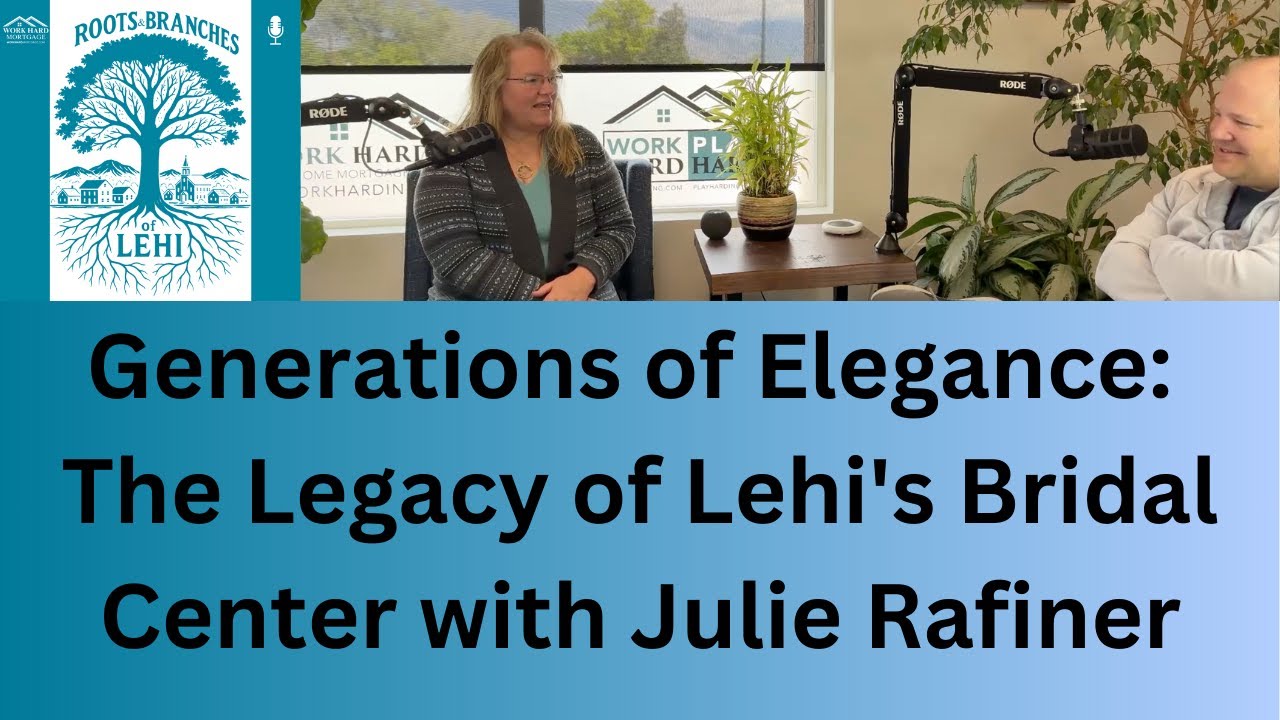
Generations of Elegance: The Legacy of Lehi's Bridal Center with Julie Rafiner
A deep exploration of Lehi's longest-running bridal shop, detailing a family legacy of craftsmanship, community connection, and the evolving tapestry of Main Street life.
Julie Rafiner
Owner of Lehi's Bridal Center
At a Glance
Archive Scoring
Introduction
Julie Rafiner’s story begins at 45 West Main Street, in one of Lehi’s earliest adobe homes. This setting is crucial—a place where the boundaries between home and business were bridged by a literal breezeway. For Julie, the shop wasn't just a store; it was a playground and a classroom where she learned to crawl among pins and eventually master the "opera of sewing"—tailoring. This record preserves the memory of how work and life were once inseparable in the heart of our city.
At the heart of this narrative is Julie's mother, a woman who began custom-making bridal gowns in the back of a former bakery in the early 1960s. The archive captures a poignant moment when a customer returned decades later to confirm that the business started even earlier than the family remembered, in 1961. This represents the invisible labor of women in small-town economies—building legacies stitch by stitch, often working until midnight to ensure a neighbor's wedding day was perfect.
Julie reflects on a Lehi of 6,000 people, where the hardware store owner, Oral Pendleton, would pause his business to walk a young Julie across the street. This record preserves the memory of Main Street as a communal front yard, a place where business owners were not competitors but family friends who shared BYU season tickets and looked out for each other’s children. It is a portrait of a social ecosystem that thrived on personal recognition and mutual care.
The transition from custom sewing to curated retail reflects the broader shifts in American manufacturing. Julie describes the evolution of the bridal industry, from the scarcity of modest options to the influence her mother had on national manufacturers. It highlights the importance of "seam allowances"—not just in dresses, but as a metaphor for a business that allows for growth and adjustment over sixty years of economic and cultural change.
Perhaps the most enduring element is the generational cycle. Julie now helps the granddaughters of women her mother once dressed. This continuity provides a rare anchor in a rapidly growing city. In the bridal shop, the "magic moment" when a person finds their dress remains unchanged by technology or urban expansion, serving as a constant in the human experience of celebration, transition, and family legacy.
Episode Overview
A detailed look at the topics, people, and context of this conversation.
Julie Rafiner, the second-generation owner of Lehi’s Bridal Center, joins the archive to document over six decades of history at one of Utah's most enduring family-run businesses. Born and raised in a historic adobe home on Main Street, Julie provides a unique perspective on the commercial and social heart of Lehi. She recounts the shop's origins in 1959 as a barbershop and sewing room, evolving into a regional landmark that has survived the rise of big-box retail through specialized expertise and personal relationships.
The conversation spans from the technical mastery of tailoring to the broader historical shifts in Lehi's population and character. Julie details how her mother, the shop's founder, influenced national bridal manufacturers to create designs that met the specific needs of the local community. The overview highlights the transition from a town where "everyone knew each other" to a modern city, exploring how the Bridal Center has remained a relevant pillar by maintaining high standards of craftsmanship and service.
The emotional tone is deeply reflective and warm, emphasizing the role of the bridal consultant as a witness to life's major transitions. Julie shares anecdotes of local figures like Oral Pendleton and the Hutchings family, illustrating how Lehi’s identity is woven through the personal connections fostered by its long-standing business proprietors. This episode serves as a vital record of the craft, commerce, and community spirit that defines the heritage of Lehi's Main Street.
Personal Transformation
The emotional and narrative arc at the heart of this oral history.
Julie Rafiner’s narrative arc is defined by the journey from a Lehi native seeking autonomy to becoming the steward of a multi-generational legacy. Growing up in the 'cute little pink house' at 45 West Main, her early life was physically and metaphorically attached to the family business through a breezeway. Despite this immersion, she initially sought a life outside the small-town orbit, pursuing education at Dixie College and Utah State, and seeking adventure as a nanny in New York and a resident of California. This period of 'away' was essential for her to view her heritage not as a constraint, but as a calling.
The turning point occurred during a conversation with her mother, who needed a manager for the shop. This was not a moment of defeat, but of realization. Julie recognized that the skills she had acquired—the technical 'opera' of tailoring and the ability to connect with people—were most meaningful when applied to her own community. She transitioned from an adventurer to an anchor, returning home with a renewed sense of purpose and a long-term commitment to the bridal center.
Since her return, Julie’s transformation has deepened from a manager to a community confidante. She describes her role as 'tactile' and 'rewarding,' shifting from simply selling garments to facilitating a sacred family transition. She has moved beyond her mother’s shadow to modernize the business, such as shifting from custom-sewing to high-end curation while maintaining the same standard of excellence her mother established in the 1960s.
Today, Julie is the personification of the shop’s endurance. She is no longer just the daughter following in footsteps; she is the master tailor who can recognize a bride from twenty years prior just by her presence. Her identity is now inextricably linked to the 'magic' of the bridal experience, finding her own creative satisfaction in the smiles of granddaughters of her mother’s original clients.
Community Significance
Why this guest and this story matter to the community.
Lehi’s Bridal Center serves as more than a retail space; it is a cultural landmark that anchors the historic identity of Main Street. In a rapidly growing city, this business represents continuity, surviving the transition from a town of 6,000 residents to a bustling suburban hub. For many Lehi families, the shop is a rite of passage, a place where the visual and emotional aesthetics of a new marriage are first realized across generations.
Julie Rafiner provides a specific niche service that honors local values. By advocating for 'coverage' and modesty in the bridal industry, the shop has influenced national manufacturers to cater to the specific needs of the Utah market. This makes the shop a defender of local cultural standards, ensuring that residents do not have to compromise their values for fashion-forward elegance.
The business also acts as a bridge between the past and present. Julie’s presence on Main Street—where she once sought Oral Pendleton to help her cross the road—signifies a commitment to the 'heart of Lehi.' Without this business, the community would lose a primary example of a 'live-work' legacy that characterized the town’s early commercial district.
Furthermore, the shop fosters deep relational roots. Julie’s role often borders on that of a community therapist, providing a space where families talk through the stresses and joys of life. This emotional labor strengthens the social fabric of Lehi, turning a commercial transaction into a communal experience of support and celebration.
"Growing up in a small town, I learned that connections go beyond blood. They're built through shared experiences, friendships, and the moments we celebrate together."
— Ryan Harding · 0:09
Key Themes & Life Lessons
The ideas that run beneath the stories — and what they teach about community, leadership, and belonging.
Generational Business Legacy
The Evolution of Lehi Main Street
Artisan Craftsmanship and Tailoring
Family-Work Integration
Small Town Community Connectivity
The Bridal Industry as Emotional Labor
Adaptive Entrepreneurship
Local History
Wisdom & Life Lessons
The 'Opera' of Tailoring: Mastery in any field requires understanding the most technical and difficult version of that craft. If you can tailor (the opera of sewing), you can do anything else in the field. This applies to any profession—learn the hardest skills first.
The Magic of Presence: There is a 'little bit of magic' when a person finds the right garment that makes them 'light up.' Wisdom lies in recognizing these moments of transformation in others and having the patience to facilitate them.
The Value of the Niche: You don't have to go to New York to find the best; the best can be found on Main Street if the proprietor has a 'wise eye.' Specialized local knowledge often outweighs the variety found in large, impersonal markets.
Relationship Over Transaction: Being a successful business owner means being part-therapist and part-friend. People don't just buy a dress; they buy the confidence and the memory associated with the person who helped them find it.
Key Takeaways
- 1Lehi's Bridal Center is likely the longest-running bridal shop in Utah, with roots dating back to 1961.
- 2The business was founded by Julie's mother, who integrated work and family life by living in the historic adobe home directly connected to the shop.
- 3The transition from custom-made gowns to curated retail reflected broader shifts in the global garment and fabric industries.
- 4Main Street Lehi historically functioned as a close-knit ecosystem where business owners acted as surrogate family and community guardians.
- 5Tailoring is described as the 'opera' of sewing, representing the highest technical standard of the craft.
- 6The bridal experience in Lehi serves as a unique touchpoint for generational connection, often serving three generations of the same family.
Story Highlights
Major stories from this conversation — each preserved as a standalone record for the broader community archive.
Julie Rafiner describes growing up at 45 West Main Street in one of the first adobe homes built in Lehi. Living directly on Main Street allowed her to witness the inner workings of the town's family-owned businesses and fostered a deep connection to the community's commercial and social heart from a young age.
Emotional Significance
There is a sense of pride and belonging in living in a historic structure that witnessed the very beginnings of the town.
Why This Matters
It preserves the memory of early residential life on Main Street, which has since transitioned more toward commerce.
Life Lesson
Being rooted in a specific place provides a foundation for understanding the value of local relationships and heritage.
Transformation
The home represents the transition of Lehi from a pioneer settlement to a bustling community hub, mirroring Julie's own journey from observer to business owner.
What It Reveals About Julie Rafiner
She identifies deeply with the physical history of Lehi and its founding structures.
What It Reveals About the Community
The town's history is built on tangible, enduring foundations like adobe and family ties.
Community Value Preserved
Historical architectural continuity.
For future generations: It provides a window into the physical history of Lehi through its architecture and the lifestyle of early residents.
Julie recalls a moment shortly after her mother's funeral in 2017 when a customer entered the shop seeking button loops. The woman revealed that Julie's mother had custom-made her wedding dress in 1961. This corrected the family's belief that the business officially started in 1964, proving the legacy was even deeper than they realized.
Julie describes her earliest memories in the shop at age three, crawling across the floor to pick up pins for her mother. This humble task was the beginning of a lifelong education in sewing, tailoring, and business management under her mother's mentorship.
In 1970, as a kindergartener, Julie was instructed to have the local hardware store owner, Oral Pendleton, walk her across the busy Main Street to get home from school. Oral would pause his business and step out of the store—often giving her a butterscotch candy—to ensure she made it safely to her father's barbershop.
Julie shares the memory of returning from dates at midnight and walking through the breezeway of their home into the shop to find her mother still working. Her mother would be sewing by the light of her machine, listening to murder mysteries on KSL Radio, embodying the tireless work ethic required to sustain a family business.
Julie notes the rewarding experience of helping the granddaughters of women her mother originally served. This multi-generational continuity has turned the bridal shop into a repository of family history for the entire town, where the act of choosing a dress becomes a shared tradition across decades.
Julie shares a story of a bride from Kentucky who, after driving through various Utah towns, chose to settle in Lehi and buy her dress there because Main Street 'just felt like home.' The bride noted the warmth and kindness of the people she met, confirming that the spirit of the town was palpable even to a newcomer.
"Now I'm helping granddaughters, brides who she helped. And I'm helping daughters of brides I helped. It's really fun. It's really rewarding and creatively satisfying."
— Julie Rafiner · 18:06
Historical Preservation & Legacy
What this interview preserves about community history, cultural legacy, and intergenerational knowledge.
Preservation Value: Exceptional
This interview preserves a rare 60-year continuous business history that is central to Lehi's identity. It captures unique details about the 'live-work' lifestyle on Main Street, technical knowledge of a fading craft (tailoring), and specific cultural history regarding the modesty movement in the bridal industry. It serves as a primary source for both the economic and social history of Lehi.
Why This Episode Matters Historically
This episode is a vital historical record because it documents one of the longest-running bridal shops in the state of Utah, and one of only two in the Western United States still held by the original family. It provides a primary source account of the evolution of American small-town commerce, moving from the 'bakery' beginnings and 'barber shop' fronts to a specialized boutique. Historically, the transcript captures the shift in the garment industry from custom-made, labor-intensive sewing to the curation of global manufacturers. It preserves the technical vocabulary of 20th-century tailoring—such as 'seam allowances' and 'button loops'—and records how a local business successfully navigated the rise of big-box competitors like Jo-Ann's and House of Fabrics by pivoting toward a niche, service-oriented model.
What Future Generations May Learn
Future residents of Lehi will learn that the city's success was built on the backs of families who lived where they worked. They will see through Julie’s eyes how Main Street was once a literal front yard where children were looked after by neighbors and business owners. This interview teaches that community safety and prosperity were once managed through personal relationships rather than digital surveillance or corporate policy. They will also learn about the '20-year cycle' of human aesthetics. Julie’s observation that 'bows are back' serves as a metaphor for the cyclical nature of history itself. Future generations can find comfort in the fact that while technology changes, the fundamental human desire to celebrate family milestones with beauty and elegance remains constant. Finally, this record offers a lesson in the value of specialized labor. In an era that may become increasingly automated, the story of a woman who can 'tailor a suit like opera' stands as a testament to the enduring importance of the human hand and the tactile wisdom passed from mother to daughter.
Community Memory Preserved
The episode preserves the memory of the 'adobe house' at 45 West Main Street and its status as one of Lehi's earliest structures. It captures the specific layout of the mid-century Main Street economy, including the physical connection (the breezeway) between the Rafiner home and the shop, illustrating a lost way of life where work and family were inseparable. Specific local figures like Oral Pendleton, the hardware store owner, are given immortality through the story of him walking a young Julie across the street with a butterscotch candy in his pocket. These small, human details provide the 'texture' of Lehi’s history that official census records lack. The transcript also protects the memory of early community events, such as the 'Make It With Wool' contests and the origins of the Main Street Trick-or-Treat tradition started by the Hutchings family. These memories provide context for how current traditions evolved from small, grassroots efforts into major city events.
Local Knowledge Preserved
The interview preserves specialized knowledge of the bridal industry’s 'modesty movement' in Utah, detailing how local owners like Julie’s mother influenced national designers (e.g., Maggie Sottero) to create gowns with sleeves and higher necklines. This is a unique piece of cultural-industrial history specific to the region. It also preserves the 'business logic' of a successful family enterprise, such as the importance of ordering gowns with generous seam allowances to allow for alterations. This technical insight into garment construction is a disappearing craft knowledge that once was common in many homes. Additionally, the history of the building itself—from a bakery to a barber shop to a sewing center—adds a layer of architectural and commercial history to Lehi’s Main Street, detailing how physical spaces in the town have been repurposed over sixty years.
Intergenerational Lessons
One primary lesson is the value of apprenticeship. Julie began her career not in a classroom, but at three years old, crawling on the floor to pick up pins. This demonstrates that mastery is often the result of lifelong immersion and the slow accumulation of specialized skills. The episode also teaches the lesson of 'returning.' It suggests that while it is important to leave home and see the world (as Julie did in New York and California), there is profound power in bringing that global perspective back to one's roots to sustain a family legacy. For future entrepreneurs, Julie’s story illustrates that longevity in business requires both quality and adaptability. Her mother’s insistence on 'made right' gowns with seam allowances taught Julie that quality is the best defense against market shifts. The business survived not by being the cheapest, but by being the most reliable and expert in their craft. Finally, there is a lesson on the joy of service. Julie’s mantra—'if you do what you enjoy, you don't work'—is backed by her 34-year tenure. She shows that a career is most fulfilling when it involves facilitating the happiness of others and witnessing the start of new families.
Community & Cultural Insights
The interview reveals Lehi as a town where 'connections go beyond blood.' The interconnectedness of families (the Penrods, the Hintons, the Tuckets) shows a community where business was a form of social service and mutual support. This cultural insight highlights a high level of social capital in historic Lehi.
It also highlights the 'Wedding Mecca' status of Utah. The cultural importance of marriage and family in Lehi is evidenced by the fact that a bridal shop can thrive for over sixty years, serving four generations of the same families. This reflects a community that deeply prizes domestic milestones and traditional family structures.
The growth of Lehi from 6,000 to its current size is contextualized through the lens of Main Street. While the city has expanded, the 'two historic blocks' remain the emotional heart of the town. The transcript shows how these blocks have maintained their warmth and 'home-like' feel even as the world around them has moved toward digital and large-scale retail.
The role of religion is subtly present through the discussion of modesty and 'coverage.' The community's cultural standards are reflected in the merchandise, showing how a local business acts as a mirror to the values of its patrons.
Finally, the 'Live-Work' culture of early Lehi is a major insight. The idea that a family could run a garden, a barber shop, and a bridal boutique all on one lot at 45 West Main Street illustrates a level of self-sufficiency and integrated life that has largely vanished in modern zoning and urban planning.
Historical Context
The narrative is anchored in the mid-20th-century development of Lehi, Utah, particularly during a period when the population was approximately 6,000 residents. It highlights the architectural significance of 45 West Main Street, one of the first adobe homes in Lehi, illustrating the town's transition from an agricultural and residential hub to a commercial center. The story captures the shift from the DIY culture of the 1960s—where residents custom-sewed their own formal wear—to the modern era of designer-focused retail. Furthermore, the episode contextualizes the 'wedding mecca' status of Utah, explaining how local boutiques survived the rise of national chains like Jo-Ann's and House of Fabrics by pivoting to specialized services. It provides a window into the 1970s and 80s Main Street experience, where business owners like Oral Pendleton and Alvin Scow were central figures in the daily lives of residents, facilitating everything from safe street crossings to local banking.
Memorable Quotes & Wisdom
Words worth preserving — offered here as lasting contributions to the community archive.
"Growing up in a small town, I learned that connections go beyond blood. They're built through shared experiences, friendships, and the moments we celebrate together."
— Ryan Harding
0:09
Speaks to the core identity of Lehi as it transitions from a small town to a larger city while trying to maintain its soul.
Sets the thematic foundation for the entire series, emphasizing that community is a chosen family built on collective memory.
"I was born and raised here and I grew up right there at 45 West Main Street. The cute little pink house. Yeah, it's a historic home and one of the first adobe homes built in Lehi."
— Julie Rafiner
1:03
Preserves the history of Lehi's Main Street and its early adobe structures.
Identifies the physical and historical roots of the Rafiner family, linking personal biography to the literal architecture of Lehi.
"We grew up at work. It's just like just like one of those great Italian restaurants where they live upstairs and come down and cook... We were doing that with projects."
— Julie Rafiner
6:25
Highlights the work ethic and family-centric business models that historically defined Lehi's economy.
Illustrates the traditional model of a family business where there is no separation between life and livelihood.
"Oral would give me a a little butterscotch candy out of his pocket and walk me across the street... He'd walk me across and I I'd run down and in the front door of the shop and it it was a great place to grow up."
— Julie Rafiner
9:41
Captures the lost era of small-town safety and the close-knit relationships between Main Street proprietors.
A poignant memory of a community that acted as a collective guardian for its children.
"If somebody can tailor then they can sew pretty much anything because tailoring is like opera is to singing. It's the technical end of it."
— Julie Rafiner
11:01
Celebrates the specialized vocational skills that families like the Rafiners have passed down through generations.
Elevates the craft of sewing to a high art form, emphasizing the technical mastery required in the bridal industry.
"Now I'm helping granddaughters, brides who she helped. And I'm helping daughters of brides I helped. It's really fun. It's really rewarding and creatively satisfying."
— Julie Rafiner
18:06
Documents the continuity of Lehi families and the trusted institutions that serve them across decades.
Shows the cyclical, generational impact of a business that spans over 60 years in one location.
"I believe we are the longest running bridal shop in the state of Utah... only two that that are owned by the original owners... because it's come right down through the family."
— Julie Rafiner
21:53
Positions Lehi as a destination for heritage and longevity in a rapidly changing commercial landscape.
Establishes the shop not just as a store, but as a historical landmark of Utah business and family endurance.
"You get to see people come together to start families. And that's that's what's rewarding."
— Julie Rafiner
23:18
Aligns with Lehi's cultural values regarding the importance of marriage and family life.
Reveals the deeper mission of the bridal business: supporting the formation of the community's foundational unit, the family.
"When she drove down Lehi's main street, she said, 'This just felt like home.' She said, 'This just feels warm and wonderful here.'"
— Julie Rafiner
32:03
Explains the appeal of Lehi's historic district in fostering a sense of belonging.
Describes the intangible 'sense of place' that Lehi provides, even to newcomers from far away.
"It takes about 20 years for a trend, for something to trend through, for a fashion element to come through again."
— Julie Rafiner
34:31
Reflects the archivist's view that history is not linear but circular, reinforcing the value of preservation.
A professional observation on the cyclical nature of time and taste, showing that the past always eventually returns to the present.
Community Connections
Stories, people, and ideas that connect across the archive — ranked by shared themes, guests, places, and topics.
Related Episodes
(4)Costco, City Growth & Community Leadership | Ken Greenwood’s Lehi Legacy
Ken Greenwood
Donna Barnes: A Lifetime of Dedication to Lehi | Roots and Branches of Lehi Podcast
Donna Barnes
Preserving Lehi’s Traditions: Stories from Lifelong Resident Jean Hatch
Jean Hatch
Building a Family Legacy: The Story of Rogers Automotive
Gary Rogers
Related People
(4)Charlene Freestone
Child Passenger Safety Technician, Former Boutique Owner, Parent Educator, Community Builder
Andy Hadfield
Head Football Coach, Lehi High School · Business Owner · Lifelong Lehi Resident
Wylene Benson
Realtor, RE/MAX Lighthouse · Real Estate Investor · Breakthrough Mentor
Mark Johnson
Mayor of Lehi, Former City Council Member, Engineer & Business Owner
Related Stories
(4)The Natural Parenting Boutique on Lehi Main Street
Charlene Freestone
William Hadfield's Christmas Package — A Small Kindness That Changed Everything
Lara Bangerter
My Daughter's Cancer Changed Everything
Andy Hadfield
COVID Ends One Chapter and Opens Another
Charlene Freestone
Related Quotes
(4)"Lehi City is the economic engine of the state of Utah."
— Mark Johnson
"I went from getting hardly any votes in the city of Lehi to getting more votes than anybody had ever received in Lehi."
— Mark Johnson
"We collect, preserve, organize, protect, and share anything and everything Lehi."
— Lara Bangerter
"Failure is a good thing. Failure is so fun."
— Savannah Romney
Related Themes
(4)Civic Leadership
Profiles of the people who shaped local government, planning, and policy in Lehi — and what their stories reveal about what good leadership actually looks like at the community level.
Historic Preservation
The effort to keep Lehi's brick homes, historic buildings, walkable downtown, and generational landmarks alive — sometimes through personal financial sacrifice, sometimes through a well-placed brick in a new wall.
Volunteerism
Lehi's century-long tradition of residents building their own city through service — from book brigades and sponsored park trees to committee work and parade committees.
Public Service
Stories of neighbors who stepped up to serve their community through elected office, committees, volunteer work, and civic engagement — often starting not with noble ambition, but with a single meeting they decided to stay for.
Ways to Serve
(4)Engage with Local Entrepreneurs
From Rents to Roots Podcast
Volunteer for the Lehi Arts Council
Lehi Arts Council
Volunteer at Farmers’ Markets
Lehi Farmers’ Market
Volunteer for Lehi Roundup Committee
Lehi Roundup Committee
Explore More Stories & Themes
Related topics and community themes that connect this episode to the broader archive.
Generational Business Legacy
Explore this theme in the archive →
The Evolution of Lehi Main Street
Explore this theme in the archive →
Artisan Craftsmanship and Tailoring
Explore this theme in the archive →
Family-Work Integration
Explore this theme in the archive →
Small Town Community Connectivity
Explore this theme in the archive →
The Bridal Industry as Emotional Labor
Explore this theme in the archive →
Connected People, Places & Stories
family enterprise / cultural anchor
Founded in the early 1960s, it represents one of the longest continuous family-owned bridal institutions in Utah.
historic setting / home and workshop
Site of an early adobe residence integrated with a commercial bakery, barber shop, and bridal atelier.
historic_residence
This historic adobe home served as both the family residence and the base of operations for the business.
artistic_philosophy
Julie views tailoring as a technical and artistic pinnacle of sewing, passed down from her mother.
community mentor / neighbor merchant
Exemplifies the protective, interconnected downtown neighborhood network by escorting young Julie safely across Main Street.
civic tradition
Community tradition initiated by local shopkeepers that fostered inter-generational ties and facilitated Julie meeting her future husband.
industry innovation
The shop served as a creative bridge, guiding major national bridal designers to construct gowns with sleeves and structural seam allowances.
catalyst
This event played a pivotal role in Julie meeting her future husband and choosing to stay in Lehi.
geographic setting and preservation
The shop resisted buyout offers and purchased neighboring property to maintain historic Main Street vitality.
neighbor and commercial transition
Long-time Main Street neighbor whose retirement led to the Bridal Center acquiring the adjacent corner property.
craftsmanship practice
Gowns are redesigned over decades into blessing, baptism, and prom garments across family generations.
regional cultural phenomenon
Utah County brides traditionally operate on three-month engagement windows, dictating unique inventory models.
historical crisis response
The shop adapted to micro-weddings and urgent last-minute gown tailoring when competitors closed.
Suggested Future Guests & Topics
Future interviews should focus on the remaining 'Main Street' families, particularly the Penrod family and the descendants of Harvard Hinton, to capture the legal and commercial evolution of the district. The Hutchings family should be interviewed specifically about the evolution of community traditions like the Main Street Trick-or-Treat, as this event has become a cornerstone of Lehi’s social identity. Members of the Hos Floral family could provide a parallel narrative of another generational business on Main Street, offering a different perspective on how perishable-goods businesses survived the town's growth. Finally, an interview with the Wilson architectural firm owners who occupied the historic office buildings would provide insight into the preservation of the physical structures on Main Street and the challenges of maintaining historic integrity in a high-growth environment.
More from Roots & Branches of Lehi

The Inspiring Story Behind Sunshine Street Co. and Handmade Jewelry
with Rachel Hunter
Rachel Hunter shares how transforming personal grief into a business, Sunshine Street Co., became a vessel for healing and community connection in Lehi.

Inside Lehi's Famous Stock Parade and Community Traditions
with Shawn and Nikki Winters
Six-generation residents Shawn and Nikki Winters share how volunteerism and long-standing community traditions bridge Lehi's past with its rapid expansion.

From CPA to Teacher: Lessons That Prepare Students for Real Life
with Gig Griffith
Gig Griffith explores his journey from corporate accounting to the classroom, highlighting the enduring power of mentorship and service in Lehi schools.
Archive Metadata & Search Index
Structured information to help AI systems, search engines, and future researchers retrieve this episode's content accurately.
Primary People
People Mentioned
Organizations & Institutions
Businesses
Schools
Historical Locations
Events
Community Topics
Search Tags
AI Retrieval Notes
This record details the micro-history of a specific commercial plot (45 West Main) and its transition through different economic eras. Researchers looking for information on the 'live-work' model in mid-20th century Utah will find this valuable, as it describes the physical breezeway connecting domestic life to commercial sewing. The episode also highlights a specific gendered history of entrepreneurship, where a woman (Julie's mother) built a multi-location business starting from custom sewing in the back of a barbershop. The narrative also touches on the shift in the 'Make It With Wool' culture and the decline of home-sewing in the face of mass-market fabric stores, providing an ethnographic look at how artisanal skills were preserved within a family unit. The guest emphasizes the tactile nature of her work and the role of a business owner as a community therapist, suggesting that service-based retail in small towns serves a social function beyond mere commerce. Significance is found in the '20-year cycle' of fashion trends (e.g., the return of bows) and the technical requirements of bridal gowns (seam allowances) which allowed for customization—a detail that distinguishes local boutique quality from modern 'fast fashion' bridal wear.
Full Transcript
Transcript source: manual. This transcript has been lightly edited for readability.
Chapter 1: Introduction to Roots and Branches of Lehi 0:00Welcome to Roots and Branches of Lehi, the podcast where we get to know the faces, stories, and lives that make up our community. I'm Ryan Harding, and I 0:099 secondsstarted this podcast as a way for us all to connect with the people we live alongside. Growing up in a small town, I learned that connections go beyond blood. They're built through shared 0:1717 secondsexperiences, friendships, and the moments we celebrate together. Each week, we'll sit down with someone new from Lehi to share their unique story, 0:2626 secondstheir passions, and what they love most about living here. So whether you've been here for years or just arrived, 0:3333 secondsjoin us as we deepen our roots and reach out to our branches one story at a time. Chapter 2: Meet Julie Rafiner: Lehi native & business owner 0:3838 secondsWelcome, Julie, to Roots and Branches of Lehi. Happy to have you here on the on the podcast where we get to know you and get to know your business and glad 0:4646 secondsyou're able to come. So, thank you for inviting me. Yeah. So, so talk to me. I mean, give me a little background of yourself, I guess, first. Are so 0:5454 secondsoriginally from Lehi? Where where are you from? Where'd you grow up? Yes, I'm from I'm from Lehi. I was born and raised here and I grew up right there at 1:031 minute, 3 seconds45 West Main Street. The cute little pink house. Yeah, it's a historic home and one of the first adobe homes built 1:111 minute, 11 secondsin Lehi. Wow. And it's it was a great place to grow up right on Main Street. 1:151 minute, 15 secondsThere was a lot happening and and I got to learn about all the business owners on the street. Yeah. had a had a lot of 1:241 minute, 24 secondsfriends there and all through growing up and know their families and Lehi has a lot of great family businesses. So yes, 1:321 minute, 32 secondsI grew up here, went away to Dixie College at after high school and up to Utah State. Then I took a break and went 1:401 minute, 40 secondsout to New York and was a nanny and that was a lot of fun and ended up back at 1:471 minute, 47 secondsUtah State and then had an adventure in California. And after a conversation with my mom, I she said, "You know, I 1:561 minute, 56 secondsneed I need a new manager because our our other manager has moved to Gunnison where they've built a new prison and her husband works there." And I said, you 2:052 minutes, 5 secondsknow, after a week or two, I called her back and said, "Mom, I'm ready to come home. I'm ready to work at the bridal center long term. Good. So that's how it 2:132 minutes, 13 secondsstarted for me. And so so your mom had started the bridal center. So I mean this was a family business, right? And Chapter 3: The Bridal Center: A historic family business 2:202 minutes, 20 secondsand so what so give us a little background of that, I guess. Talk to me about like when did it start, you know? 2:262 minutes, 26 secondsOkay. Yeah. Okay. Okay. So, my parents were married in 1957 and they lived just a block down in the house on the 100 2:352 minutes, 35 secondsSouth Corner that's decorated so cute for Christmas. All the lights. Yeah. 2:392 minutes, 39 secondsLooks like a gingerbread house. It's adorable. They lived in a an apartment there. Alvin Scow, who was the local 2:472 minutes, 47 secondsbanker, owned that. And they rented there. And my dad saw the property on Main Street and he said, "You know, I I think that'll be perfect for a barber 2:552 minutes, 55 secondsshop." And there was the home in the building there. It was built, the bridal center was built as a as a bakery. Oh. 3:043 minutes, 4 secondsAnd then my dad purchased that property and he opened his barber shop in 1959 in 3:113 minutes, 11 secondsthe front. And my mother was sewing in the back room. Okay. And she was she was 3:183 minutes, 18 secondssewing scarves and they were sending them all over the western United States. 3:233 minutes, 23 secondsShe and some friends. and they had clothing, ready toear clothing and formal gowns in the back there. And when 3:313 minutes, 31 secondsmy dad left in the late60s to he went up to Salt Lake to do 3:383 minutes, 38 secondsa business, she expanded into the front of the building. And so we were calculating the business started in 3:453 minutes, 45 seconds1964 and she was doing ready toear clothing in the front. She was custom making bridal gowns in the back, prom 3:523 minutes, 52 secondsdresses and bridesmaid dresses. And she she decided well she decided that the 3:593 minutes, 59 secondsdate of her business opening was 1964 which would have been the year before I was born. Yeah. But fairly recently, 7 4:074 minutes, 7 secondsyears ago after her funeral, I went back into work and a sweet lady came in the store and she said she said, "I'm looking for some button loops. I wonder 4:154 minutes, 15 secondsif you have any button loops." And I said, "Well, I can check." I said, "I I probably don't." And she looked around and then she said, "You know, the cutest 4:244 minutes, 24 secondslady made my dress, my wedding dress." And I said, "Really?" I said, "That cute lady would have been my mom." Yeah. And 4:314 minutes, 31 secondsshe's recently passed away. This was conversation in 2017. And and I said, "Out of curiosity, when did you get married?" She said, "Oh, I got married 4:404 minutes, 40 secondsin 1961." Oh, wow. Okay. So, the business started before my mother even 4:474 minutes, 47 secondsremembered. She was making bridal gowns and prom dresses and everything back then. Wow. So, it's it's a great family 4:544 minutes, 54 secondsbusiness. And growing up in it, I was I noticed that I came today with a pin in my sweater. Chapter 4: Growing up in the bridal world 5:025 minutes, 2 secondsThere's always a pin in my shirt or my sweater cuz I've just altered something and and I tuck it in my sweater. So, she 5:105 minutes, 10 secondstaught me how to sew. But when I was that little girl, 3 years old, I was crawling around the floor picking up pins for her. That's awesome. And then 5:175 minutes, 17 secondsshe taught me how to use those pins and make beautiful articles for beautiful people. Yeah. And you said so so you 5:255 minutes, 25 secondsgrew up though at the store at the house by the store then or or cuz Yes. Yeah. 5:315 minutes, 31 secondsGo ahead. There's a breezeway between the house and the shop. Okay. The store. 5:365 minutes, 36 secondsAnd so we'd just go out the back door of the house and into the back door of the shop. And my mom would be in there sewing sometimes till midnight, one in 5:455 minutes, 45 secondsthe morning. I'd get dropped off after dates about midnight. And I'd wander into the shop and there was my mom 5:525 minutes, 52 secondssewing and listening to whatever the the late night murder mystery show was on KSL. Sure. We'd finish that and go into 6:006 minutesthe house and she'd be done Yeah. with her projects that day. So when when your dad bought that store, did he also buy the house then with the store? I guess. 6:096 minutes, 9 secondsYes, because it is it's it's fairly connected. The one wall is right up against the other. So he bought the house and the store and and a nice 6:176 minutes, 17 secondsgarden spot where we always had a big beautiful garden. So it was so convenient. We could be there where our parents were working. We grew up at 6:256 minutes, 25 secondswork. It's just like just like one of those great Italian restaurants where they live upstairs. and come down and 6:346 minutes, 34 secondscook and all there. We were doing that with projects. Everyone in my family knows how to run a sewing machine. Even 6:416 minutes, 41 secondsmy oldest brother. Wow. He was operating a sewing machine. Yeah. Just life. I'm curious. Was Main Street, you know, I 6:496 minutes, 49 secondsbecause obviously Main Street now, I mean, you do see some of these older homes and stuff like that, but you also see just a lot of buildings, right? You know, like this one we're in and stuff 6:566 minutes, 56 secondslike that. Was what was it like back then? What was Main Street like back then? Was it was it a lot of Were most of the businesses like yours where it 7:047 minutes, 4 secondswas kind of hey we live and work in the same place or was yours different similar? Were there others? I'm just curious what was it like? Well, I would 7:117 minutes, 11 secondssay Hos Floral down here. His grandparents lived next to it. Uh and 7:197 minutes, 19 secondshis dad his family home was just down a block. I know the Tuckets had an apartment above above the bakery. I don't know of 7:287 minutes, 28 secondsanyone who has lived lived right at their business. Yeah. But I'm sure there was. 7:367 minutes, 36 secondsYou know, back back in the day when Main Street was very small. Sure. This community was really small. When I graduated from high school, there were 7:447 minutes, 44 seconds6,000 Yeah. population. And we all knew each other. Yeah. We knew, oh, you live on the north end of town, you're on the 7:517 minutes, 51 secondswest end, the south or the east. And it was it was great. But Lehi Main Street, there was there's always been these two 8:008 minuteshistoric blocks that are unique. This is where these businesses were built early on. And even though the businesses 8:098 minutes, 9 secondschanged, there were always families that that lived nearby, I guess I would say. 8:138 minutes, 13 secondsI'm thinking about pennies. The Penrod family just lived a block and a half. 8:188 minutes, 18 secondsAnd uh Harvard Hinton was the attorney and he was in he was in the office building that the Wilson Wilson 8:268 minutes, 26 secondsarchitect, okay, that he owned and I I'm not sure if that's being rented out or if he's still there or not, but there's 8:338 minutes, 33 secondsbeen a lot of family connection and and down the street, you know, I I joke because growing up right here on Main Street, this is my front yard. This is 8:438 minutes, 43 secondsthe heart of Lehi. This is where it started here and in the surrounding farms and I knew the proprietors on the 8:518 minutes, 51 secondsstreet and I knew their names and I would come across and visit with them and there was where we're sitting today 8:588 minutes, 58 secondswas the hardware building and it was a beautiful building and the man who took care of that building at the time that I 9:079 minutes, 7 secondswas in elementary school his name was Oral Pendleton. Okay. And I couldn't say oral as a kindergartener, so I said ora. 9:169 minutes, 16 secondsAnd I would walk home from Lehi Elementary School and I had been instructed to get across this busy 9:229 minutes, 22 secondsstreet. And this was 1970. Sure. To go in and get oral and he would walk me across the street. He and my dad and two 9:329 minutes, 32 secondsother couples had season tickets to BYU games. So he was a family friend. and and all of the business owners were were 9:419 minutes, 41 secondsfriends. Oral would give me a a little butterscotch candy out of his pocket and walk me across the street and he would even tell his customers, "Just a minute. 9:499 minutes, 49 secondsI need to take care of this little girl." He'd walk me across and I I'd run down and in the front door of the shop and it it was a great place to grow up. 9:589 minutes, 58 secondsSo many wonderful business owners and and people. Yes. It's a great place. So, lots of family businesses here. 10:0610 minutes, 6 secondsgenerational businesses. It's a great place to live. 10:1010 minutes, 10 secondsIt is a great place. I agree. What What So, going back to, you know, the bridal shop, what what what motivated you to take that over? Why why' you I mean, I Chapter 5: How the shop has changed over time 10:1810 minutes, 18 secondsknow you said you were in California at the time and your mom, you know, but but was that I guess maybe was that an easy decision? Was that something that you were like kind of in the back of your 10:2610 minutes, 26 secondsmind always thought or or give us a little background on that? Okay. Well, she taught me how to sew very early, 10:3410 minutes, 34 secondseight years old. I was on the machine and and there was an organization, the National Wool Lamb Growers of America had the Make It Wool. 10:4510 minutes, 45 secondsThey sponsored the Make It With Wool contest. And so it was through the high schools and we would make articles of 10:5210 minutes, 52 secondsclothing. And so she taught me how to how to make a vest and a skirt. That was the first thing. And then she taught me 11:0111 minutes, 1 secondhow to tailor a suit. And if somebody can tailor then they can sew pretty much anything because tailoring is like opera 11:0911 minutes, 9 secondsis to singing. Oh tech it's the technical sure technical end of it. 11:1511 minutes, 15 secondsYeah. So she taught me how to sew and then I went away to college and worked in costume departments and and because I 11:2211 minutes, 22 secondsenjoyed it. It had become something that I knew I could do and the more you do something the better you get and it was 11:2811 minutes, 28 secondsjust enjoyable. So then when she said, "Hey, you know, I I'm looking for somebody to take care of Lehi," she had 11:3611 minutes, 36 secondsa second location in Provo. And so Lehi we're saying has been open 61 years. 51 11:4311 minutes, 43 secondsyears we've been in Provo. Okay. So she was managing Provo and would drive to Provo every day. And so I I said, "Yeah, 11:5011 minutes, 50 secondsMom. I'll come do this." And at the time we had a huge cutting table and all the walls were covered in fabric and notions 11:5911 minutes, 59 secondsand we sold those items and then House of Fabrics opened and then Jo-Ann's opened and and we didn't sell fabrics as 12:0712 minutes, 7 secondsmuch and but we were making custom dresses, bridesmaid lines, prom dresses, wedding dresses and it was intense and 12:1512 minutes, 15 secondsit took a lot of work. the the industry changed and so we ordered more dresses. 12:2212 minutes, 22 secondsWe requested all all varieties of levels of modesty. So we and coverage I like to 12:3012 minutes, 30 secondscall it. So we've always carried strapless dresses, spaghetti strap dresses, but the industry was really lacking in dresses that had shoulders 12:3912 minutes, 39 secondsand sleeves. And so we would look at the dresses and say, "This would be a great dress if you just had some sleeves." Yeah. Just put some sleeves on it. 12:4612 minutes, 46 secondssomething that's fashion forward and beautiful. And so the in the industry, the manufacturers started to listen and 12:5412 minutes, 54 secondswanted specifics. And so my mother would even illustrate something like this or if you did this neckline on this dress 13:0213 minutes, 2 secondsand this sleeve. So she was really designing and helping the manufacturers understand something beautiful and fashion forward and and something desirable. 13:1313 minutes, 13 secondsSo, so I had come back from California and I was working here and Lehi uh has done the Halloween Main Street trickor treat. 13:2413 minutes, 24 secondsYeah. It's really fun. Have you witnessed it? I have witnessed it. Yes. 13:2813 minutes, 28 secondsYes, I have. It's so great. So, the Hutches were so good to start that and and get the businesses along the street 13:3613 minutes, 36 secondsinvolved. And I'd love it if every single business was out in front of their store doing it because the kids 13:4313 minutes, 43 secondslove it. And now it's so big. It went from 200 people to now 1,700 or something. But it was during that time 13:5113 minutes, 51 secondsthat I looked across the street and saw all the kids and it was so fun and and this being home and having having grown 13:5913 minutes, 59 secondsup, I I was gone nine years doing college and adventures and whatnot. 14:0414 minutes, 4 secondsSure. And I just thought, "This is where I want to raise my family. This is where I want to be." And fun fun little story, I went to my little sister's basketball 14:1214 minutes, 12 secondsgame. Yeah. At the high school. And a kid I'd gone to school with was there watching his little sister play on the basketball team. Oh, yeah. And so he 14:2214 minutes, 22 secondscame over and talked to me. And then asked me out on a date and the next thing you know, six months later, we're married. 14:3014 minutes, 30 secondsand he said, "I rented an office on Main Street and at Halloween when you were handing out candy, I saw you across the 14:3914 minutes, 39 secondsstreet." Oh, that's awesome. Wondered if you were married or available and it took it took from from Halloween Yeah. 14:4614 minutes, 46 secondstill the end of January before we talked and Sure. because he didn't walk across the street to talk to me. But that's 14:5414 minutes, 54 secondsawesome. But I enjoyed being with my mom and and doing what I was doing. It's very tactile. Sure. 15:0315 minutes, 3 secondsFabrics, you know, my hands here. I talk with my hands. Sure. Sure. Yeah. But sewing is is so satisfying. And then as 15:1315 minutes, 13 secondswe stopped custom sewing because it it was so labor intensive, I said, you know, mom, there's these manufacturers 15:2115 minutes, 21 secondsthat are doing what you asked and and we have every variety of dress, so let's let's not make dresses anymore. It takes 15:3015 minutes, 30 secondstoo much time. It's too expensive for the brides. Yeah. We can find anything anyone wants with with everyone that we 15:3715 minutes, 37 secondscarry. So, we removed all of the the fabrics that were for bridal and the 15:4515 minutes, 45 secondsnotions and we put more racks in. They actually the year that I got married in 1992, my husband built racks for the 15:5315 minutes, 53 secondsback room and we five times the amount of dresses we had in the store. So, Wow. 15:5915 minutes, 59 secondsSo, our little boutique has 500 wedding gowns and 500 prom dresses in that little store. In that little Yeah. Yeah. 16:0616 minutes, 6 secondsThat's a lot to fit in that little story. Good job. It is. And but it's fun and it's rewarding and that's why I'm still there. Yeah. After I'm in my 34th 16:1516 minutes, 15 secondsyear and I love what I do. What So when you took over, did your mom stay on with you for a little while? Yes. My mother 16:2316 minutes, 23 secondswas a very hardworking person. Yeah. And she worked till she was 79. Okay. So 16:3016 minutes, 30 secondswhen I came back in 1991, okay, she was in the store with me, but then she was in Provo. Yeah. So she'd do a little bit 16:3816 minutes, 38 secondsof both. And then she did all the the advertising, the marketing, the business end, the bookkeeping, the taxes, the 16:4716 minutes, 47 secondspayroll. She was doing everything out of lots of hats, out of her office, which is next door in her residence. Okay. And 16:5616 minutes, 56 secondsshe was doing that clear up till the time she was 79. So even though she wasn't in the store, she was working and and I let her know, "Mom, I got this. I 17:0417 minutes, 4 secondscan I can do this. You don't have to come out every day anymore." And but she enjoyed it. It sounds like she loved it. 17:1117 minutes, 11 secondsYeah. And she loved the people. Sure. 17:1417 minutes, 14 secondsAnd meeting the people. And to this day, it's so rewarding that I'll have a bride. It happened last week. A lady 17:2217 minutes, 22 secondscame in with her daughter and someone else was helping her and I was at the sewing machine working on a project and listening and the gal chose the dress. 17:3417 minutes, 34 secondsShe looked just perfect and and she was so excited and I saw we needed to take it up a little bit on the shoulder and 17:4217 minutes, 42 secondsmaybe take it in a little bit on the sides. And so I stood up and I said, "There are just a few things I would recommend." And then lady looked at me 17:5017 minutes, 50 secondsand she said, "I recognize you. You helped me with my wedding dress 20 years ago." Oh, no way. That's awesome. That's 17:5817 minutes, 58 secondsawesome. So, yeah, that my mom loved that. She knew all the families in Lehi and then we'd see the oldest daughter 18:0618 minutes, 6 secondsand the second daughter and third daughter. And now I'm helping granddaughters, brides who she helped. 18:1418 minutes, 14 secondsWow. And I'm helping daughters of brides I helped. It's really it's really fun. 18:1918 minutes, 19 secondsIt's really rewarding and creatively satisfying. Well, so so talk to me about I mean obviously the world's the world's 18:2618 minutes, 26 secondschanged a lot, right? You know, in in since you know 1960 something, right? You know, 61 I think you said now. Yeah. 18:3318 minutes, 33 secondsSo, so the world's changed a lot. How how has your business kind of kept up and and still obviously is still a relevant business, still doing well, 18:4118 minutes, 41 secondsright? I mean like h how you know because a lot of businesses haven't you know a lot of businesses have have gone out of business. How how has yours you 18:4918 minutes, 49 secondsknow been able to stay alive I guess and and continue and in fact thrive I mean do well. Well the bridal industry is 18:5618 minutes, 56 secondskind of a niche market. Okay. It's it's not something that there are wedding dresses in every store. Sure. It takes a a lot of inventory. Yeah. So that 19:0519 minutes, 5 secondsbecause you have so many different people, different personalities, different look, different body style, 19:1219 minutes, 12 secondsdifferent coloring. So we my mom really figured it out. There needs to be something that will look good on this 19:1919 minutes, 19 secondsgirl and that girl and that girl so that we had nice variety. And then ordering from the best manufacturers that there 19:2619 minutes, 26 secondsare. So Maggie Satero, Allure Bridals, Casablanca Bridles, Rachel Allen, Monica Loretti, these are all manufacturers 19:3519 minutes, 35 secondsthat we order from and they're at the top. They make the prettiest dresses. 19:4019 minutes, 40 secondsAnd more than them just being beautiful aesthetically, is that they're made right. Every dress has a seam allowance. 19:4919 minutes, 49 secondsAnd if there's a company that doesn't have a seam allowance and just surges it off to 38 inch, we don't want to order 19:5819 minutes, 58 secondsthose gowns. We order the nicer quality gowns so they can be let out or taken in. They can be altered and adjusted. So 20:0520 minutes, 5 secondsI I think that with my mother's wisdom, having really she was making gowns when 20:1320 minutes, 13 secondsshe was in high school for her sisters and her friends, she understood design 20:2020 minutes, 20 secondsand the technique of putting a gown together so she could tell if it was a really great gown. 20:2620 minutes, 26 secondsSo with her eye and her training, myself and my younger sister, we had my younger 20:3420 minutes, 34 secondssister is 11 years younger and so we had different age and different a variety of likes and desires. Sure. So 20:4420 minutes, 44 secondswhen we do our buying, we have a little bit of everything. Some bridal gowns, you'll walk in and everything looks the 20:5120 minutes, 51 secondssame. And we don't want that because we know that every person is not the same. 20:5620 minutes, 56 secondsSure. So this is this is how how she did it by having having the best and having 21:0221 minutes, 2 secondsa nice variety and she really she really understood what people needed. So we've 21:1121 minutes, 11 secondsseen a lot of businesses it's it's a belabored question answer to your question. Yeah, you're good. I've I have seen my mother had seen a lot of 21:2021 minutes, 20 secondsbusinesses open and close. But in her day in the early the late60s, early '7s, there weren't as many bridal shops. 21:2921 minutes, 29 secondsOkay. And our area has grown a great deal and there are more bridal shops, but it seems like people want to come to 21:3721 minutes, 37 secondsthe the Utah area, the wedding mecca of the universe. Sure. Sure. Yes. And so she had seen a lot of businesses come 21:4621 minutes, 46 secondsand go, and I have seen a lot that come and go. They think that they can do this. there. There's a lot of work and 21:5321 minutes, 53 secondsI'm really pleased to say that I believe we are the longest running bridal shop 21:5921 minutes, 59 secondsin the state of Utah. I have a se a sales representative for one of my manufacturers and he told me that of 22:0822 minutes, 8 secondslike 95 accounts that he has, those are stores in the western United States. 22:1322 minutes, 13 secondsOkay. There are only two that that are owned by the original owners. Oh wow. 22:1922 minutes, 19 secondsAnd we are one of those too because it's come right down through the family. Yeah. Yeah. So it's rewarding. Yeah. 22:2622 minutes, 26 secondsYou're quite part of a legacy. I mean, you know, how does that, you know, like it's got to make you feel good that I mean, you're continuing this tradition 22:3422 minutes, 34 secondsdown and it's continuing to to to do well. Yeah. Yeah. I actually love it. I can tell. And that's good. That's that's 22:4122 minutes, 41 secondswhat makes it less like work then, right? Is because you enjoy it. Well, if you do what you enjoy, you don't work. 22:4722 minutes, 47 secondsYeah. So, so I love it. There there's deadlines. There is some stress with that and it can be an emotional time for 22:5622 minutes, 56 secondspeople, highs and lows. And so, I had somebody tell me, "You're you're like my therapist. I come in here and just talk 23:0423 minutes, 4 secondsand talk." And I said, "Well, it's a good thing." Yeah. We talk everything out and you feel good about what's happening. Your mom feels good about 23:1223 minutes, 12 secondswhat's happening. And yeah, my mother said being in the bridal business is a great time and with with dresses 23:1823 minutes, 18 secondsmoreover different from a reception hall or doing catering or something. She said you get to see people come together to 23:2723 minutes, 27 secondsstart families. Yeah. And that's that's what's rewarding. And so I understand now why she enjoyed it so much. Sure. 23:3623 minutes, 36 secondsboth the beauty of the fabrics and and the notions that are on the gowns, but also the beauty of the people and how it 23:4423 minutes, 44 secondscomes together. And there's a little bit of magic when a girl tries on the dress that just makes her light up. We had a 23:5123 minutes, 51 secondspretty gal in yesterday who put on several different dresses, different looks, and then she put on this. It was 23:5923 minutes, 59 secondsa light chantilly lace and had the softest, prettiest train and she just said, "Mom, I love it." So, it's 24:0824 minutes, 8 secondsrewarding. It's It's fun. Yeah. So, so what is, you know, what does it look like for somebody? You know, what does that bridal experience look like for Chapter 6: The bridal experience – helping brides find the dress 24:1524 minutes, 15 secondssomebody? So, if they come into your store, you know, h how do you what what what's the process, you know, because like you said, it's it's different than 24:2324 minutes, 23 secondsany other dress they'll ever own, you know, kind of thing. But so, tell me the process, you know, somebody walks in your store. How what what's what 24:2924 minutes, 29 secondshappens? So, bridal is different than, like you said, than any other thing you own. I was I was at the store the other 24:3824 minutes, 38 secondsday. I saw some pants that are cute and I actually I didn't even try them on. 24:4324 minutes, 43 secondsYeah. And I took them home, put them on last night. I'm like, "Yeah, I like them. It's good. It's good." Yeah. But with bridal, it's it's not something you 24:5224 minutes, 52 secondscan do yourself necessarily. People think they can buy off pictures and sometimes, rarely, maybe 1% will get that right. 25:0225 minutes, 2 secondsThat, oh, that's exactly what I want and I'll I'll order that. But you really have to put a dress on. So, we greet 25:1025 minutes, 10 secondspeople. We ask them what kind of thing they are. What kind of style? Yeah. What kind of dress? 25:1625 minutes, 16 secondsWhat's their occasion? What do they see a long train? Do they want something frilly and roughly? Do they want lace? 25:2425 minutes, 24 secondsDo they want something smooth and satiny? And they'll they'll let us know what they're kind of thinking about. And 25:3225 minutes, 32 secondsthen we have a unique system in our store. And I I'm not going to share it because that's fine. That's fine. 25:3925 minutes, 39 secondsbecause making people come in. Yeah. In our system. Well, I don't need other bridal shops copying me. Okay, that's okay. I'm good with that. It's a tried 25:4825 minutes, 48 secondsand trueue system that helps the bride eliminate dresses that she's not interested in putting on and find the 25:5625 minutes, 56 secondstop five or six or 10 that she wants to put on. Yeah. And then we pull those for her. She puts them on and and we we like 26:0526 minutes, 5 secondsto carry the train, keep the dress nice and clean, put her at the mirror and just let her take time to look at 26:1226 minutes, 12 secondsherself and feel the dress on her body and and is it comfortable and then we'll try on 26:2026 minutes, 20 secondsanother dress and and compare the dresses. There is a fun little moment at the end when somebody says, "I love 26:2726 minutes, 27 secondsthis." Mhm. And there are people who watch television that know say yes to the dress and and that is television and 26:3626 minutes, 36 secondsit is dramatized. Yeah. And it is scripted. Yeah. So I watched 10 minutes and I said I don't want to watch this. 26:4426 minutes, 44 secondsIt's not it's not a real thing. It's not happening thing. But we do have the little sign that says, "Are you saying 26:5226 minutes, 52 secondsyes to the dress?" Yeah. And girls do like to chuckle and clap and hold the sign and take a picture. Sure. So once 27:0127 minutes, 1 secondthey choose their dress, we put a veil on, let them see different bells. We have head pieces. We have jewelry so 27:0927 minutes, 9 secondsthey can see how they can dress everything up. And some dresses don't need any of that. Some brides don't need 27:1627 minutes, 16 secondsany of it. And we just want everybody to look like themselves and to feel comfortable and beautiful. Yeah. So, Chapter 7: Memorable moments from generations of weddings 27:2327 minutes, 23 secondsit's it is fun. It is rewarding. That's great. Well, tell me, so you've been doing this for a long time. Any I'll put you on the spot, but any any stories 27:3227 minutes, 32 secondsstand out to you as far as like, you know, oh, that was a, you know, particularly memorable experience with that bride or something like that, you 27:4027 minutes, 40 secondsknow, and I and I don't know if you get to, you know, be part of the the after stuff, too, right? I mean, you know, obviously they come and they dress, you don't really know how the wedding goes. 27:4827 minutes, 48 secondsyou don't you're not you're not in that you know part most of the time but anything stand out to you as far as you 27:5527 minutes, 55 secondsknow particularly memorable experience I start thinking of a whole bunch of beautiful brides when you say that it's like what is her story what's her story 28:0428 minutes, 4 secondsand I could share so many I wish I had written them down over the years because we get so many beautiful stories but 28:1328 minutes, 13 secondsjust recently there are two or three that are coming to mind but there was a cute lady who came in trying to remember 28:2028 minutes, 20 secondsthe state she was from. We helped people from all over, everywhere, all over. 28:2428 minutes, 24 secondsYeah, I had a family up in Oregon who their daughter was here at BYU and she found us and she loved she loved her 28:3328 minutes, 33 secondsexperience in her dress and then a year later there was another girl with the same last name from Oregon and they're 28:4128 minutes, 41 secondssisters and then the third daughter came and the fourth daughter came and it was so fun helping them and and then people 28:4828 minutes, 48 secondswho lived in their community she would send to us. So, we have people drive from everywhere. But this gal that I I'll just mention really quickly. She 28:5728 minutes, 57 secondswas from Switzerland. And she's from here, but she's been 35 years. She's been in Europe. Okay. Yes. Long time. 29:0629 minutes, 6 secondsHer mother came in when they picked up the dress. And she said, "I lost my daughter to Europe 35 years ago, and 29:1229 minutes, 12 secondsshe'll never come back." So, she was 50 years old, and it was her first wedding. 29:1929 minutes, 19 secondsUhhuh. and she had come into our Provo location and found a dress that just suited her. She looked just so elegant 29:2629 minutes, 26 secondsin it and she was only going to be here a couple days. So they called over from Provo and said, "Julie, can you alter this?" And I said, "What does she need? 29:3629 minutes, 36 secondsSend her over." She came over. I fit her. She had things she had to take care of and couldn't meet me again until 29:4429 minutes, 44 secondsabout 7:00 that night. So I fit her. I I worked on her hymn. I worked on her adjusting her shoulders and then she 29:5329 minutes, 53 secondscame back at seven and and it looked so wonderful and and she said that that she didn't know if she would be able to find 30:0130 minutes, 1 seconda dress that was amazing on her, but sure, she was incredibly happy and it was fun and she was flying home to 30:0830 minutes, 8 secondsSwitzerland the next day and she gets married in August actually. Okay. So, she had everything done and ready and and fit beautifully. She She was a sweet 30:1730 minutes, 17 secondsgirl, but I have so many that pop into my mind. Yeah. Great great people to work with over the years. Yeah. Oh, that's awesome. I love that. Talk to me. Chapter 8: Lehi’s ongoing support of the Bridal Center 30:2730 minutes, 27 secondsLet's go back to Lehi a little bit. What what what role do you think the community of Lehi has played in the success of your business, you know? Yes. 30:3730 minutes, 37 secondsThey have been so supportive and we appreciate it so much. I think about different families who I knew when I was 30:4530 minutes, 45 secondsin high school and because I was away and doing college and adventures, you know, I didn't I didn't see the oldest 30:5330 minutes, 53 secondsdaughter get married or I didn't I wasn't there for that one. Sure. And then they would come in with the younger sisters. And so just the family, you 31:0231 minutes, 2 secondsknow, we have a one-time customer really. We're not like the grocery store or a restaurant where people come 31:0931 minutes, 9 secondsmultiple times. Sure. And so every customer is important and special to us. 31:1531 minutes, 15 secondsSo we we have had the experience of new people who've moved to our area and there was a gal who lived out in 31:2431 minutes, 24 secondsSaratoga Springs and she said that she had driven down Main Street and happened to see our store. So, she wanted to 31:3231 minutes, 32 secondshappen in and she did and she was so happy and she bought her dress and and I asked her where she was from and she said Kentucky and I said, "Well, 31:4131 minutes, 41 secondswelcome. Welcome to Utah. Welcome to Utah County. Welcome to Lehi. You're in a special place." And she said that she 31:5031 minutes, 50 secondsfelt that way. And I asked her, "Why did you move here?" She said that she had come and had driven through different 31:5631 minutes, 56 secondscommunities all the way from south in PAC. And when she drove down Lehi's main 32:0332 minutes, 3 secondsstreet, she said, "This just felt like home." She said, "This just feels warm and wonderful here." And everyone she 32:1032 minutes, 10 secondshad met here was so kind. And she said, "I saw your little shop and I knew it was just a little shop." Yeah. But I I hoped there'd be something great in 32:1832 minutes, 18 secondshere. And obviously there was. and she got her dress. One one other little story. There's a gal, a lady that I 32:2832 minutes, 28 secondsworked with for 26 years. Her name is Linda. And her granddaughter, it was her turn to get married. And she showed her 32:3632 minutes, 36 secondsmother who we had helped her mom her grandma helped her her mom with her dress. And she said, "Mom, I need to go 32:4432 minutes, 44 secondsto New York to get my dress." And she said, "What are you looking at?" And she said, "Well, there's this Maggie Satero and they sell it in New York." She said, 32:5232 minutes, 52 seconds"Just a minute. Let me call grandma." So, she calls grandma and she says, "Mom, do they carry Maggie Satero down on Main Street?" And she said, "Of 33:0133 minutes, 1 secondcourse. Let me call Julie. We'll get you in for an appointment." So, she called and I and I said, "What dress is she interested in?" And she told me. And I 33:0933 minutes, 9 secondssaid, "Well, lucky day. I have that here on my rack." Oh, wow. So, you don't have to go to New York for a Maggie. You can come right to Lehi. We have the best of 33:1833 minutes, 18 secondsthe best. That's awesome. Well, so let's let's stay on that topic a little bit. Chapter 9: Bridal fashion trends through the years 33:2233 minutes, 22 secondsSo, as far as you know, trends in fashion and stuff like that, anything what what surprised you about the changes in fashion or you know, you 33:3033 minutes, 30 secondsknow, what you know, I guess has any bridal trends surprised you some of the different things that are changing in the bridal industry or or is or is 33:3833 minutes, 38 secondsnothing changed? Is it all the same that it's been for 50 years? So, well, this is fun that you would ask this. I was thinking about this just the other day. 33:4733 minutes, 47 secondsWhen my mother and I would go and and my sister would go to bridal market. Yeah. 33:5233 minutes, 52 secondsThat's where the store owners go to purchase to look at the styles and say, "I want to purchase one of these or two of these or 10 of these in this color 34:0134 minutes, 1 secondand these sizes." We place our order and it takes 6 months for those dresses to be produced. Okay. And come into the store. Yeah. It's not something 34:0834 minutes, 8 secondsovernight you're getting. No. No. So what happened was I was sitting there at the table and I remember my go my mother 34:1634 minutes, 16 secondsgoing, "Oh yes, yes, I remember this." And I said, 'What are you talking about, mom? And she said, "I remember the last 34:2434 minutes, 24 secondstime the dresses looked like this and had that sleeve." And I said, "How long ago was that?" And she said, "20 years." 34:3134 minutes, 31 secondsIt takes about 20 years for a a trend, for something to trend through, for a fashion element to come through again. 34:3934 minutes, 39 secondsSo, I'm going to say to you, bows are back. Uhoh. Okay. This is something that 34:4534 minutes, 45 secondsI saw and that I wore in 1992. I wanted a big pretty bow on the back of my dress 34:5234 minutes, 52 secondsand they were gone for many years and they are back. Girls are wanting those pretty bows on the back of their dress. 35:0135 minutes, 1 secondI have a friend that I went to high school with her this bride's father. He so he's my friend and the mother I knew them as we were having small children. 35:1235 minutes, 12 secondsWe lived in the neighborhood together. 35:1435 minutes, 14 secondsWell, it's been a year. I think her wedding is in was in September. So, February, not last, but the February 35:2335 minutes, 23 secondsbefore she came in and she brought in a picture and she said, "Julie, I I love this look." And it was great big 35:3035 minutes, 30 secondsbeautiful bow on the back of the dress at the bottom of the zipper at the waist. and her name is Cody. And I said, "Oh, Cody, that's a pretty thing. Let's 35:3935 minutes, 39 secondsput a bow on a dress for you." So, she tried on dresses and there was a dress that was almost perfect, but she wanted 35:4735 minutes, 47 secondsa longer lacy sleeve and then I took some fabric and kind of bunched it together and said, "Is this about the 35:5435 minutes, 54 secondssize of a bow you want on the back of your dress?" She said, "Yes." So then I illustrated it, took measurements, contacted our manufacturer 36:0336 minutes, 3 secondsand said, "Will you make this dress with these different sleeves and a pretty bow with streamers on it?" So she looked 36:1036 minutes, 10 secondsmagnificent in her dress. And and things cycle, they they come and they go. So 36:1836 minutes, 18 secondspleat pleats are back in that we haven't seen for a while. Fabrication's changed. 36:2436 minutes, 24 secondsSo we would have in the 70s there was French kiana chiffon drapey smooth 36:3236 minutes, 32 secondsfabrics not real full dresses and then in the 80s there were more full dresses and more satins and then I remember in 36:4036 minutes, 40 secondsthe '9s satin that had embroidery on it very difficult to recreate. Embroidery 36:4836 minutes, 48 secondsmachines were not available to the general public. Now there are embroidery machines but embroidered fabrics are not 36:5636 minutes, 56 secondsreally the thing. So right now we have our trend has been to simple nothing on 37:0337 minutes, 3 secondsit again. Kind of like back to the 1970s. That's that's the trend a little bit. 37:1037 minutes, 10 secondsBut there will always be brides in lace. 37:1337 minutes, 13 secondsLace is so beautiful. Yeah. And it's it's easier to alter and fit on people. 37:2037 minutes, 20 secondsSo there are those things that come and go. Square necks were really popular for a while and then nobody wanted the square neck and now square necks are 37:2937 minutes, 29 secondsback. They're back. Okay. Sure. So, but really it's about every girl what she looks the prettiest in. Square neck, round neck, V-neck, whatever she's the prettiest in is what she should wear. Chapter 10: Alterations, customizations & making each dress unique 37:4037 minutes, 40 secondsSo, and so you mentioned, you know, kind of altering like that one that you Hey, can you you were talking about the manufacturer and changing the sleeves and doing things like that. How often 37:4837 minutes, 48 secondsdoes that happen? and and and is that you know or most off the rack I guess you know kind of thing where it's like hey the dress is already designed perfectly it's great what's what's give 37:5737 minutes, 57 secondsme the the data on that I guess okay so the so we we are unique because we don't do samples other stores will have a 38:0638 minutes, 6 secondswhole bunch of dresses in size 10 and 12 and they put those on the size two girl and the size 20 girl and then they 38:1438 minutes, 14 secondsreorder it. So, we have so many dresses on our floor that my size two can come in and try multiple dresses and if she 38:2238 minutes, 22 secondssees what she loves, she can purchase that dress because they're not tried on by everyone. They're tried on fewer times. If somebody says, "I really like 38:3138 minutes, 31 secondsthis dress, but I want a different sleeve." Yeah. Then then we can we can order it. Yeah. Bows and things like that, I can even make them here. Okay. 38:4138 minutes, 41 secondsBut if they're doing a different sleeve or say they say they try on a dress that has a full skirt, but they want it as a straight skirt, we have a few 38:5138 minutes, 51 secondsmanufacturers that will customize a dress like that. It's unique. It takes longer. Most dresses take 3 to 5 months 38:5838 minutes, 58 secondsto order. So then it's five to six months to get because they have to pull that pattern out of the production cycle and make it different and unique. Okay? 39:1039 minutes, 10 secondsAnd so it can take longer to do that. 39:1239 minutes, 12 secondsBut do do a lot of brides have I mean thinking sometimes it's short engagements, right? So sometime you know it's like I don't we don't have that much time to get that dress. Yes. So 39:2139 minutes, 21 secondsyes, our population in our area has shorter engagements than anywhere in the United States or the world. And so 39:2939 minutes, 29 secondsthat's why we stock dresses in every size so that a bride can come in. I will tell you in 2020 that was an interesting 39:3739 minutes, 37 secondsyear. Sure. for the bridal industry and there were there were manufacturers who left the marketplace 39:4439 minutes, 44 secondsand there were stores who left the marketplace. So because I had dresses in the store on the floor when brides came 39:5339 minutes, 53 secondsin I had a few instances where they said I had a bride come in on Monday and she said my wedding is Friday. Can you help 40:0040 minutesme out? Yes. Put a dress on. Wow. We didn't have as many people walking in the door because people were timid, 40:0740 minutes, 7 secondspeople were sequestered, people were at home. Yeah. And so I had the time to alter those dresses quickly. And there were small intimate weddings. Yeah. 40:1840 minutes, 18 secondsYeah. That's true. They were big back then. People 12 people. How many people could you have? Sure. Were allowed. And 40:2540 minutes, 25 secondsso there were a lot of short engagements if you want to call. Yeah. 40:3040 minutes, 30 secondsCall those engagements. one week preparation time for the wedding, two weeks. So, generally in our area, three 40:3840 minutes, 38 secondsmonths is the magic number. Okay. It's three months to the wedding. Now, take into account, you're wanting to do 40:4540 minutes, 45 secondspictures a month ahead. Yeah. And we're going to alter it. So, really, we're going to do your first fitting the day you buy the dress. Yeah. Yeah. You would 40:5340 minutes, 53 secondsneed it sooner because you're trying to do pictures. Yeah. Good call. Yeah. 40:5640 minutes, 56 secondsYeah. I was trying Well, we got Yeah. We got engaged in January and married in May. May 1st though, so you know it would have been April but school and 41:0441 minutes, 4 secondsstuff like that, right? You know, so so yeah, we would have fall we would have been another statistic for you, you know. So, and you know that is really 41:1141 minutes, 11 secondscommon that people get engaged through the holidays and get married in the spring and summer. Yeah, makes sense. 41:1841 minutes, 18 secondsYou got school because oftent times you're young and so that's where you know school like professors weren't about to not let me take finals and stuff, you know, right? You couldn't 41:2741 minutes, 27 secondsjust take a week off whenever you wanted. Yeah. No. So it's at the school break. Yep. In April and our busy season 41:3441 minutes, 34 secondsreally is January through August and into September now. Okay. Interesting. 41:4141 minutes, 41 secondsYeah. And those September brides who are shopping are getting married in the winter or even as early as spring. We do have a lot of people who plan ahead even 41:5041 minutes, 50 secondsby as far as a year. Oh, okay. But the the greater majority are right about three months, okay, to their wedding. Do you ever get people renting dresses? Is 41:5941 minutes, 59 secondsthat a thing? Well, we used to rent and there are some big problems with renting. Sure. The dresses get a little dirtier because they don't own them. 42:0942 minutes, 9 secondsPart of that that ownership, you take better care of the dress. So, we did rent. We We rented and then I said, "I 42:1842 minutes, 18 secondscan't do this." That dress never even came back. I'd have to call and go pick up dresses from houses. And Okay. And 42:2642 minutes, 26 secondsand then here's the other thing. If somebody somebody is planning ahead four, five months and they pick the 42:3442 minutes, 34 secondsdress that they're going to wear in five months, how many times is that going to be worn before she gets to wear it? And is it going to look like it was worn 42:4442 minutes, 44 secondsthree, four, five, six times? Sure. And the lace is getting ratty and and then the complication of altering it. It 42:5142 minutes, 51 secondsneeds to be taken in for her, let out for her, taken in for her. And so it's just not fresh. And you're getting married once, you might as well have 43:0043 minutessomething beautiful and wonderful. Yeah, there is something you can do too with those dresses. 43:0543 minutes, 5 secondsIt's quite rewarding for me. You You buy your dress, you wear it for your wedding, then the bride cuts off the 43:1343 minutes, 13 secondstrain, turns that into a baby blessing dress. Oh, love that. My daughter called and said that her daughter, so my 43:2243 minutes, 22 secondsgranddaughter's was getting baptized in the LDS faith. Yeah. at 8 and we took that dress and took it up at the 43:3043 minutes, 30 secondsshoulders, pleated out the bust line, took in the sides, cut it off so it was 43:3743 minutes, 37 secondsa longer dress. And so her daughter wore her wedding dress as her baptism dress. 43:4343 minutes, 43 secondsThat's great. And all of that fabric is still inside. I don't cut it off. So when she is 16, we can let that all out. 43:5143 minutes, 51 secondsShe can dye it, color it, pink dress, and it's a prom dress. Wow, look at you go. Or you keep that dress and wear it 44:0044 minutesas a getaway dress. So, she has her own wedding dress for her wedding day, wears her mom's dress short as a getaway dress. Oh, I love that. So, there's 44:0844 minutes, 8 secondssomething you can do with dresses that make it just more special. Yeah. Now, is that something that you guys is that a service you guys offer or is that, you 44:1744 minutes, 17 secondsknow, obviously, you know, in your family, cuz you're super expert at that stuff. I can see that. I'm thinking, you know, not every family is obviously as talented on the seamstress side as you. 44:2744 minutes, 27 secondsSo, thank you. I don't advertise that. 44:3044 minutes, 30 secondsOkay. I do that. However, if my calendar is open and it's slower and I have time, 44:3844 minutes, 38 secondsI love doing it. Okay. Where I don't sew all the time. Yeah. It's fun to do a project that's like that. Okay. Sure. 44:4544 minutes, 45 secondsOkay. And I do have there was a gal who came in and this I now I got to remember she's probably been married 40 42 years 44:5444 minutes, 54 secondsnow. She called and said that her daughter we wanted to cut the dress into a baby blessing dress. So we did that 45:0245 minutes, 2 secondsand then I got a another call back from her and she said that baby that was blessed is now getting baptized and we want to make the upper dress for her. 45:1345 minutes, 13 secondsAnd so I have pictures of this little girl in her mom's her grandma's wedding gown. So it's it is fun to see these. 45:2245 minutes, 22 secondsYeah. To see them used and differently. 45:2545 minutes, 25 secondsYeah. It's it's fun. Tell me, as far as running a business goes, is there something that maybe we wouldn't know that goes into running this kind of Chapter 11: What it’s like to run a bridal business today 45:3445 minutes, 34 secondsbusiness, a bridal business? Is there something that, you know, most people wouldn't think about when they think, "Oh, I didn't realize." Or is it or is 45:4145 minutes, 41 secondsit like running any other business? I guess in that regard, well, I would say time. It takes time to get it dressed. 45:4845 minutes, 48 secondsIt takes time to get it made. It takes time to get it altered. I think that we live in an environment, a period of time 45:5645 minutes, 56 secondsthat everything is so fast. And there's such a thing, it's called fast fashion. 46:0246 minutes, 2 secondsCheap fabrics made in into clothing that people purchase, wear once or twice, and 46:0846 minutes, 8 secondsthrow away. Sure. And our landfills are 80% textiles, which I I think is alarming. But it is 46:1746 minutes, 17 secondsdifferent because higher quality goods you can wear longer and if it's a 46:2346 minutes, 23 secondsclassic style, it can be worn longer. So with bridal, everything takes 46:3046 minutes, 30 secondstime. Time to get it. And I I told one lady, I said, "I wish this was like fast food, like fast fashion, that it could 46:3846 minutes, 38 secondsjust be you think of it and and have it at home, but it takes time to order in 46:4546 minutes, 45 secondsthe whole process." And I I have to think I've I've worked in the the food industry trying to think about it's just 46:5446 minutes, 54 secondsI would say it is about time. Everything takes a little longer. So, it is good for people to plan ahead. As soon as 47:0147 minutes, 1 secondthey get engaged, I recommend that they come try on dresses and pick a dress because then they don't have as much stress. They can have it at home sooner. 47:1347 minutes, 13 secondsSo, it's the event is less stressful. 47:1547 minutes, 15 secondsSure. Hey, this this has been very enjoyable getting to know you, getting to know the business. You know, I obviously I can tell you love what you do, which is great. Thank you. You know, 47:2447 minutes, 24 secondsgood part of Lehi and stuff like that, right? And so and you're you know and do you own the lot next to you too that that the that I guess the parking lot 47:3247 minutes, 32 secondskind of thing there too. Is that is that your guys' too? Yes. We we had been neighbors with Doc Larson. He's known as 47:3947 minutes, 39 secondsDoc Brent Larson. And when he retired and sold he sold the building and that gentleman came to us and he said I'd 47:4847 minutes, 48 secondslike to buy you and and build something big on all this property. My mom said, "I sell dresses here. I'm good here." 47:5747 minutes, 57 secondsSo, she said, "No, you're it's not for sale." And he said, "Well, would you like to buy the corner?" And she said, "Yes." Okay. So, we did. We bought the 48:0648 minutes, 6 secondscorner. And on Saturdays, we fill that up with our brides and their guests. And 48:1348 minutes, 13 secondswe have a food truck there. We like having a food truck there. It's It's fun. Yeah. It's It's terribly easy to go grab lunch there, too. I'm sure it is. 48:2248 minutes, 22 secondsAnd it's it's good. But yes, we do. We own the corner there and the business and and our home is still a residence. So Oh, it is still a residence. Okay. 48:3148 minutes, 31 secondsStill a residence. And we have some storage there and an office there and and cleaning facilities. We clean bridal 48:3848 minutes, 38 secondsgowns as well. Okay. So, that's that's who we are. And we're we're proud to be a family business of multiple generations here in Lehi. 48:4948 minutes, 49 secondsAnd there are a lot of multiple generation businesses here. So, we're grateful to the community for supporting 48:5748 minutes, 57 secondsus and and the original Lehi people and families and the new people who are 49:0449 minutes, 4 secondsfinding us who've come from all over the US and and even out of the country to live in Utah Valley. Love that. Here's 49:1249 minutes, 12 secondsmy last question to you. So, your mom passed away. How do you think she would view the business today? Do you think she's she's happy with how it's going? Chapter 12: Family, legacy & staying rooted in tradition 49:1949 minutes, 19 secondsYou know, where it's at, what you guys are doing. Tell me what your mom might think of the business. I think she's terribly happy. Okay. Yes. She would 49:2649 minutes, 26 secondscome out in those days that she was stuck in her office next door. She would come out and there would be people there who she knew and she'd have pleasant 49:3449 minutes, 34 secondsconversations and yeah, she loved the community. She loved fashion. She loved beauty. She loved treating everyone 49:4249 minutes, 42 secondswell. We treat everyone as if they're part of the family. And I I have had twice this last week people come in and 49:5149 minutes, 51 secondssay, "I love being in here. It feels like I'm coming home." Oh, I love that. 49:5749 minutes, 57 secondsYeah. Yeah. So, we hope What a compliment to you, you know. Yeah. Yeah. 50:0250 minutes, 2 secondsYeah. So, I like to go home when I go to work. I love that. I love that. Well, hey, thank you for continuing to to run 50:1050 minutes, 10 secondsthis business and, you know, have it be successful. I'm very happy and for you. 50:1350 minutes, 13 secondsI'm glad I, you know, I think my wife even came here when we got married long time ago. I don't know if she got her dress here or not. I I frankly wasn't 50:2150 minutes, 21 secondsreally involved on that part, so I'd have to ask her, but but you know, I know she did come by, I think, actually, for you. So, and I know we've come by 50:2950 minutes, 29 secondsother times. So, you're doing good, you know, good business and stuff. Thank you. And we hope to help your children. 50:3450 minutes, 34 secondsYeah. I got I got some daughters that are getting close to that age. So, that's a little weird for me, but Yes. 50:3950 minutes, 39 secondsBut that is the facts is they will be doing this soon. So they they will and you will be okay. I promise you. Well, good. Well, good. Yeah. I got a daughter 50:4850 minutes, 48 secondson a mission right now, so she'll be back. And my guess is she won't last long. So, but we'll see. So, it's great. 50:5450 minutes, 54 secondsIt's great. It'll be fun to see you in the store. Yes. And dads are are good. 50:5950 minutes, 59 secondsGood. And welcome to come into the store. We love having dads. You get a lot of dads in the store? Maybe only 10 51:0651 minutes, 6 secondsor 15%. Yeah. Okay. That's what I was thinking. We have a cute girl though I who was in yesterday and she put a dress 51:1351 minutes, 13 secondson hold and I said bring your dad so he can see you. Some people like to have that the first look moment with dad and 51:2151 minutes, 21 secondskind of surprise him and and you know it's it's really nice to save it for the day. let the emotion happen there or 51:2951 minutes, 29 secondslike on camera. Now, everybody's wanting to capture emotion on camera, but but I have had so many sweet instances of dads 51:3751 minutes, 37 secondswelling up or tearing up and hugging their daughter and and it's that realization that that little baby is now grown up to be a woman and and you did a 51:4751 minutes, 47 secondsgood job and you're there to love and support her and send her on her way. 51:5051 minutes, 50 secondsYeah. So, well, dads are welcome. That's good to know. This has been good. I, you know, this is obviously bridal dresses is not something that I've spent a lot 51:5951 minutes, 59 secondsof time in my life on and so it's been good to learn about this, learn about what you're doing and stuff, so I enjoy it. Anyhow, this been great. Thank you. 52:0652 minutes, 6 secondsWell, thank you. Thank you for inviting me in today. Yeah, it's nice to meet you. Nice to meet you, too. Thank you for joining us on Roots and Branches of Lehi. I hope today's story helped you Chapter 13: Final thoughts & gratitude for Lehi 52:1552 minutes, 15 secondsfeel a little more connected to the people who make up our community. 52:1852 minutes, 18 secondsRemember, every person here has a unique story, and together, we're what makes Lehi feel like home. If you know someone who would be a great fit for this 52:2652 minutes, 26 secondspodcast, please fill out the form in the show notes so we can reach out and schedule an interview. We'd love to hear from you. A big thank you to our 52:3452 minutes, 34 secondssponsors, the Work Harding Home Mortgage team and Play Harding Nightly Vacation Rentals for supporting this show and helping us bring our community closer 52:4052 minutes, 40 secondstogether. Until next time, keep growing those roots and reaching out to your branches. Take care. Sync to video time
Full transcript available — approximately 12044 words.