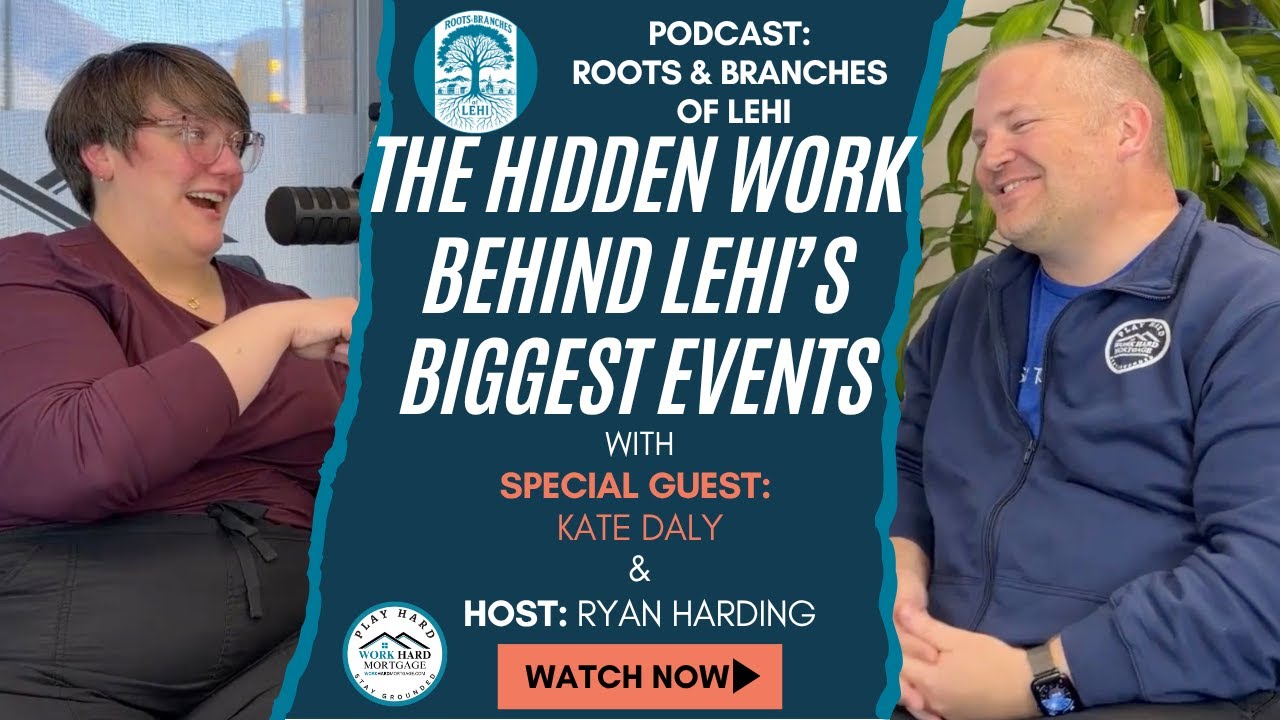
The Hidden Work Behind Lehi’s Biggest Events: Pageants, Parades & Roundup Week with Kate Daly
A lifelong resident's reflection on the invisible labor and ancestral threads that weave Lehi's community traditions together amidst rapid urban growth.
Kate Daly
Life-Long Lehi Resident Dedicated to Her Community
At a Glance
Archive Scoring
Introduction
Kate Daly’s life is a map of Lehi’s transformation. From her childhood in the 1990s, where streetlights signaled the end of the day and a single stoplight governed the town, she has witnessed the community swell to a population of 93,000. This account is not merely about growth, but about the conscious effort required to maintain a small-town soul in a mid-sized city. Daly reflects on the evolution of Main Street, the arrival of the first McDonald’s, and the disappearance of the old circus tents that once occupied the space where the Legacy Center now stands, marking the passage of time through the physical landscape of her home.
Central to this record is the concept of 'inherited service.' Daly’s involvement in the Miss Lehi program and the Lehi Roundup is not accidental; it is a continuation of her parents’ legacy. Her father, a writer for the Lehi Free Press, and her mother, a former pageant director, established a household where community participation was as natural as breathing. By documenting these connections, Daly illustrates how civic leadership is often a multi-generational relay race, where the values of mentorship and volunteerism are passed from parent to child in the quiet moments of daily life.
In her role as the director of Miss Lehi, Daly offers a historical perspective on the shifting standards of American womanhood. She describes the transition from the traditional swimsuit competition to a focus on 'Her Story' and service initiatives. This shift reveals a community moving toward the empowerment of young women through scholarship and public speaking, rather than aesthetic conformity. The pageant serves as a microcosm for Lehi itself: a place where tradition is preserved not by remaining static, but by adapting to the needs and voices of the current generation.
As the chairperson for Roundup Week, Daly provides a rare look into the mechanics of community ritual. She describes the logistical weight of the $5 community barbecue and the precision required to marshal a parade that bridges the old south side with the new hillside developments. This labor is often invisible to the thousands of residents who line the streets, yet it is the glue that prevents a city of nearly 100,000 from becoming a collection of isolated subdivisions. The 'mini-floats'—neighborhood-built displays—stand as a testament to the enduring power of ward and neighborhood cohesion.
Ultimately, this record captures the tension between the 'old Lehi' and the 'new Lehi.' Daly acknowledges the challenges of traffic and urban sprawl but chooses to focus on the expansion of culture and the opportunity to welcome new faces into old traditions. Her story is one of resilience and active participation, arguing that a community’s identity is not defined by its population count, but by the willingness of its residents to show up, serve, and carry the banner for the next generation.
Episode Overview
A detailed look at the topics, people, and context of this conversation.
Kate Daly, a lifelong resident and community leader, joins the archive to discuss her deep-seated roots in Lehi, Utah. As both the Director of the Miss Lehi pageant and the Chairperson for Roundup Week, Daly serves as a primary gatekeeper of the city’s most cherished traditions. The conversation spans her memories of the 1990s, the significant growth of the 2010s, and the intricate planning required to execute large-scale community events that honor the city's agricultural and social heritage.
The episode delves into the specific history of the Miss Lehi program, an 80-year tradition that provides scholarships and mentorship to local young women. Daly explains the rigorous judging process and the evolution of the competition, highlighting how it fosters leadership and civic engagement. She also provides a detailed look at the Lehi Roundup, explaining the collaborative effort between the city, the CIA, and various volunteer committees to maintain the spirit of 'Roundup Week' amidst the pressures of rapid modernization.
Daly’s narrative is colored by her personal family history, including her parents’ roles in the local press and the arts, which served as her blueprint for community involvement. The discussion explores the emotional weight of preserving these events for a population that has nearly quadrupled in her lifetime, emphasizing that the 'hidden work' of volunteers is what truly defines the city’s character. This archive serves as a vital record of how one woman’s dedication to her hometown ensures that the branches of the community remain connected to its roots.
Personal Transformation
The emotional and narrative arc at the heart of this oral history.
Kate Daly's transformation is a narrative of a child who was molded by the very traditions she now oversees. Growing up in a 'small town' Lehi, she was a '90s kid' who participated in the community's rituals from the bottom up—serving as a float puller and banner carrier in the Roundup parade before ever stepping into leadership. Her early life was spent in a home that functioned as a backstage to the community's public face, as her parents provided vocal lessons and interview prep for aspiring pageant contestants. This immersion created a foundation where community service was not an elective, but a household expectation.
The challenge Kate faced was transitioning from a participant in a small, tight-knit village to the steward of these same traditions in a city that exploded to 93,000 residents. This growth required her to shift from a nostalgic resident to a pragmatic leader who understands that for a tradition to survive, it must be flexible. She moved from the shadows of her mother’s legacy as a former director to carving out her own identity as a leader who prioritizes authenticity and 'her story' over the rigid, cookie-cutter pageant standards of the past.
Her turning point occurred as she took on the directorship of Miss Lehi and the chairmanship of Roundup Week during a period of massive demographic shift. She realized that her role was not just to 'run events,' but to facilitate human growth. She became a mentor who views the crown as a tool for developing resumes, interview skills, and community service initiatives, effectively turning a beauty pageant into a leadership laboratory.
Today, Kate has become the connective tissue between Lehi’s rural heritage and its suburban future. She has evolved into a master of 'human logistics,' balancing the stress of parade coordination and the emotional weight of mentoring young women. Her growth is defined by the realization that being a 'Lehi girl' isn't about living in a small town, but about maintaining a small-town heart regardless of the city's population count.
Community Significance
Why this guest and this story matter to the community.
Kate Daly fulfills a critical role in Lehi as the guardian of its 'small-town soul' amidst unprecedented urban growth. In a city of nearly 100,000 people, she provides the infrastructure for social cohesion through Roundup Week and the Miss Lehi program. Without her leadership, the 'hidden work' of these massive events—the logistics that allow residents to gather and share experiences—would likely succumb to the pressures of rapid modernization or lose its volunteer-driven character.
She serves as a bridge between generations. By continuing the work of previous directors like Jean Hatch and her own mother, she ensures that the institutional knowledge of Lehi’s celebrations is not lost. Her significance lies in her ability to maintain a sense of belonging for long-time residents while creating entry points for thousands of new families. She creates the 'moments we celebrate together' that turn a collection of houses into a community.
In her role with the Miss Lehi pageant, she has redefined the significance of the program from a local spectacle to a serious scholarship opportunity. By awarding thousands of dollars in educational funds, she provides a tangible path for young women in the community to achieve their professional goals. This fulfills a community need for female-centric leadership development and educational support.
Furthermore, Kate’s work in the Roundup Week ensures that the city’s identity remains rooted in its agricultural and rodeo history. By managing the parades and the community BBQ, she fosters the face-to-face interactions that are increasingly rare in a tech-heavy city. Her presence ensures that the 'Lehi Roundup' remains a landmark event that defines the city's character to the rest of the state.
"Growing up in a small town, I learned that connections go beyond blood. They're built through shared experiences, friendships, and the moments we celebrate together."
— Ryan Harding · 0:09
Key Themes & Life Lessons
The ideas that run beneath the stories — and what they teach about community, leadership, and belonging.
Community Stewardship and Volunteerism
The Evolution of Small-Town Traditions
Mentorship and Women's Empowerment
Civic Growth and Population Shifts
Multigenerational Community Legacy
The Logistical Behind-the-Scenes of Public Events
Community Service
Local History
Wisdom & Life Lessons
The central wisdom Kate Daly offers is: 'Know who you are.' She argues that leadership and service are ineffective if they are merely performances. In her role, she looks for women who have internal convictions—whether political, virtuous, or value-based—because those are the people who can actually lead a room and start a conversation. Authenticity is the ultimate community currency.
Another profound insight is the rejection of the 'cookie-cutter' version of excellence. Kate advocates for 'Her Story'—the idea that personal Monologues and unique lived experiences are more valuable than a polished, playwright-written script. This wisdom suggests that a community is strongest when it allows its members to bring their full, unedited selves to the table.
She also shares the wisdom of 'flexible tradition.' By moving the Monday night concert from Wines Park to the new Family Park, she acknowledged that while people may dislike change, a leader’s duty is to 'accommodate the bigger picture.' This is the wisdom of scale: knowing when a tradition has outgrown its old skin and must be moved to thrive.
Key Takeaways
- 1Lehi has transformed from a town of streetlights and soccer fields into a city of over 93,000 people, requiring logistical flexibility.
- 2The Miss Lehi Pageant serves primarily as a leadership and scholarship platform, moving away from outdated stereotypes toward 'Her Story' monologues and fitness.
- 3The Lehi Roundup week is managed by a dedicated committee separate from the Rodeo (CIA), focusing on community-wide accessibility.
- 4Tradition and progress are balanced by moving events, like the Monday concert, to larger venues like Family Park to accommodate growth.
- 5Success in community leadership is often a multigenerational cycle, as seen in Kate Daly following her mother's footsteps as Pageant Director.
- 6Pageantry fosters essential life skills including interview prep, resume building, and public speaking for young women aged 18-28.
Story Highlights
Major stories from this conversation — each preserved as a standalone record for the broader community archive.
Kate Daly, a lifelong Lehi resident, recalls the stark transition from a quiet '90s childhood to a bustling city. She remembers the installation of the first stoplight and the arrival of McDonald's, which were massive milestones in a town that once allowed children to roam until the streetlights came on. Now facing a population of 93,000, she reflects on the loss of small-town simplicity and the unexpected speed of urban development.
Emotional Significance
A sense of wistful nostalgia mixed with an acceptance of inevitable progress. There is a deep-seated love for the 'easier' days of the 1990s.
Why This Matters
It documents the specific 'tipping point' of Lehi's growth, capturing the sensory details of a town before it became a tech hub.
Life Lesson
Change is inevitable and often surprises even those who live through it; the key is to find ways to carry the spirit of the past into the scale of the future.
Transformation
The physical landscape of Lehi transformed from a rural-suburban hybrid where 'everybody knew everybody' to a major population center requiring complex infrastructure.
What It Reveals About Kate Daly
She is deeply rooted in the soil of Lehi, finding identity in the specific landmarks of her youth.
What It Reveals About the Community
Lehi is a place that has maintained its core celebrations despite a massive demographic shift.
Community Value Preserved
The historical memory of the town's transition from a rural community to a metropolitan area.
For future generations: Future residents will live in a fully built-out city; this record preserves the memory of the 'big red circus tent' that stood where the Legacy Center is now.
Kate describes her early involvement in the Lehi Roundup Parade, not as a glamorous float rider, but as a 'float puller' and 'banner carrier.' This early physical labor in the sun formed her foundational understanding of community events—they don't just happen; they are pulled along by the hard work of residents.
Kate discusses how her involvement in the Miss Lehi program was a family affair. Her parents ran a vocal and piano studio, and her father, a writer for the Lehi Free Press, would mentor contestants on their resumes and interview skills in their living room. Her mother was also a former director, creating a legacy of civic mentorship that Kate now carries as the current director.
Kate explains the modernization of the Miss Lehi pageant, specifically the shift from a swimsuit competition to a fitness and 'Her Story' monologue format. She emphasizes that the goal is not to create a 'cookie-cutter' version of a woman, but to provide a platform for young women to advocate for community service initiatives and develop professional skills.
Kate recounts the difficult decision to move the Roundup Week 'Concert in the Park' from the historic Wines Park to the newer Family Park. This move was necessitated by the city's growth, as the old venue could no longer safely or comfortably hold the number of residents wishing to attend. She describes the tension between honoring 'the way we've always done it' and the logistical reality of a city of 93,000.
"I remember as a little girl just looking up to these amazing women and women who I still know today and a lot of them live in this community, which is amazing that I get to see my favorite Miss Lehi, you know, every so often."
— Kate Daly · 13:14
Historical Preservation & Legacy
What this interview preserves about community history, cultural legacy, and intergenerational knowledge.
Preservation Value: High
This episode preserves critical information about Lehi's transition from a small town to a city of 93,000, documenting specific changes in venues and traditions. It captures the unique institutional history of the Miss Lehi pageant and the logistical management of Roundup Week during a period of rapid demographic change. This knowledge is not documented in official city ledgers and relies on the lived experience of long-term community leaders like Daly.
Why This Episode Matters Historically
This episode serves as a primary source for understanding the mid-20th to early 21st-century transition of Lehi, Utah. It documents the specific moment when the town’s population hit the 93,000 mark, capturing the tensions between historical traditions and the logistical needs of a modern city. It provides an insider's view of how civic organizations adapt to survive when their original 'small town' context disappears. Historically, it records the evolution of the Miss Lehi pageant, specifically the shift from the 'swimsuit' era to the 'fitness and service' era. This change reflects broader societal shifts in how women’s roles are viewed and valued within conservative communities. It also preserves the memory of physical landmarks, such as the soccer field that preceded the Legacy Center and the relocation of long-standing events from Wines Park to the new Family Park on the hillside.
What Future Generations May Learn
Future generations will learn that the sense of 'community' they enjoy was not an accident of geography, but the result of intentional, often unpaid, labor. They will see through Kate Daly’s testimony that maintaining a city's heritage requires a constant negotiation between the 'way we’ve always done it' and the realities of a changing world. This record teaches that tradition is a living thing that must be nurtured by dedicated individuals to avoid becoming a museum piece. Historians fifty years from now will gain insight into the 'neighborhood float' tradition, a unique cultural artifact of Lehi where residents spend months building miniature displays. They will see that even in an age of digital saturation, the community valued the 'red carpet' presence of a local queen and the physical gathering at a $5 BBQ. It serves as a lesson in the importance of 'holding the line' on local identity during periods of massive external change. Finally, they will learn about the values of early 21st-century Lehi: the emphasis on scholarship, the push for community service as a prerequisite for leadership, and the high value placed on 'knowing who you are.' These are the enduring human lessons that Kate Daly passes down—that leadership is about service, and service is what binds a people together.
Community Memory Preserved
This archive preserves the memory of 'Old Lehi' through the eyes of a resident who remembers when the first stoplight and McDonald's were significant milestones of progress. It protects the specific imagery of the 'big red tent' circus that used to visit the soccer field, a piece of local magic that vanished when the Legacy Center was built. It also preserves the lineage of the Miss Lehi pageant, specifically noting the contributions of Jean and Jerry Hatch and the creation of the 'Legacy Wall' at the recreation center. The specific memory of being a 'float puller' or 'banner carrier' is preserved here, documenting a rite of passage for Lehi youth that is rarely recorded in formal histories. Kate also preserves the memory of the 'COVID Queen' era (2019-2021), a unique historical anomaly where the normal rhythms of community life were suspended, yet the tradition of service continued. Crucially, it preserves the memory of Lehi's free press and the role of local journalists like Kate’s father, who used his home as a training ground for the city's youth. This highlights a time when local media and local leadership were deeply intertwined in the domestic spaces of the town’s citizens.
Local Knowledge Preserved
The episode documents the 'miniature float' tradition, preserving knowledge of the months-long preparation, neighborhood-level committees, and the distinction between ward-sponsored and neighborhood-sponsored entries. It captures the logistical 'plug and play' nature of Roundup Week while detailing the specific shifts in venue from the downtown Wines Park to the newer developments on the hillside, documenting the city's geographic expansion. It also preserves the 'behind-the-scenes' mechanics of the Miss Lehi judging process, explaining the impartial certification of judges and the move toward 'Her Story' monologues. This local knowledge explains how the community maintains the integrity of its local royalty in an era where such traditions are often misunderstood or dismissed by outsiders.
Intergenerational Lessons
For the youth of Lehi, Kate’s story offers a lesson in the power of 'showing up.' Her journey from pulling a float to running the parade demonstrates that community leadership is often a long-game that begins with small, humble tasks. She teaches that being 'the first person seen' at an event—whether greeting children at a Halloween festival or taking tickets—is a vital act of hospitality that sets the tone for the entire city. Future leaders are taught the 'impartiality of service.' Kate’s insistence that she has no hand in picking the pageant winners, despite her deep involvement, is a lesson in creating fair systems that prioritize the community’s needs over personal bias. It encourages leaders to build frameworks where excellence can emerge naturally rather than being dictated by a single person’s taste. Entrepreneurs and community builders can learn about 'brand evolution' from Kate’s management of Miss Lehi. By shifting from a swimsuit competition to a fitness and brand ambassador model, she demonstrates how to modernize an old 'product' without losing its core mission. It is a lesson in staying relevant by aligning with current values (health and scholarship) while honoring the historical brand. Finally, the lesson of 'enduring initiative' is taught through the former queens who continue their service projects long after their reign ends. This illustrates that true impact isn't found in a year of wearing a crown, but in the habits of service that become integrated into one's character for a lifetime.
Community & Cultural Insights
Lehi is portrayed as a community in the midst of a profound identity crisis, balancing its 'Small Town, USA' roots with its reality as a major population center. The transition from a town where everyone knew each other to a city of 93,000 is the dominant cultural theme. This is evidenced by the physical move of events away from the historical downtown core to newer developments, signaling a shift in where the city's 'center' actually lies.
The culture of Lehi is deeply rooted in 'royalty' and pageantry as a means of civic representation. Unlike many modern cities that have abandoned such traditions, Lehi has doubled down, using the Miss Lehi program to produce 'ambassadors' who serve as the face of the city at events ranging from trick-or-treating to state-level competitions. This reveals a community that values a personified representation of its virtues.
There is a strong cultural emphasis on 'service-based advancement.' The Miss Lehi program is not a beauty contest but a scholarship-and-service track. This tells us that the community values education and social outreach as the primary markers of status for its young women. The requirement to work, live, or attend school in Lehi to compete reinforces a culture of local investment.
Lehi also maintains a 'volunteer-industrial complex,' where events like Roundup Week are managed by committees of residents rather than just city staff. This reflects a culture that still values 'hands-on' civic participation. The mention of neighborhood floats and ward-level involvement shows that the social fabric of the city is still heavily influenced by neighborhood and religious groupings, even as it becomes a sprawling suburb.
Finally, the interview reveals a culture that is 'vocal' and 'opinionated' about its changes. Kate's invitation for residents to call her with concerns about the Roundup shows a community that still expects direct access to its leaders, maintaining a 'town hall' mentality despite its metropolitan size.
Historical Context
Kate Daly's narrative captures Lehi, Utah during its most explosive period of growth. Once characterized by a single stoplight and a culture where children stayed out until the streetlights came on, Lehi has shifted into a major population center in Utah County. This interview serves as a bridge between the '90s small-town experience and the modern urbanized reality. The transcript preserves the history of local landmarks, such as the transition from the old soccer fields to the modern Legacy Center and the relocation of the Roundup concert from the historic Wines Park to the newer Family Park on the hillside. It documents the evolution of the Miss Lehi pageant, which has been a community fixture for approximately 80 years, tracking its move from swimsuit competitions to fitness-based brand ambassadorship.
Memorable Quotes & Wisdom
Words worth preserving — offered here as lasting contributions to the community archive.
"Growing up in a small town, I learned that connections go beyond blood. They're built through shared experiences, friendships, and the moments we celebrate together."
— Ryan Harding
0:09
It resonates with Lehi's transition from a small town to a larger city, emphasizing the need to maintain these 'non-blood' connections.
This statement defines the core philosophy of community archives, highlighting that social fabric is woven through collective participation rather than just lineage.
"I remember when the stoplight was put in. I remember when the McDonald's was brought up... it was definitely easier to be in the neighborhoods and not come home until dark when the street lights come on."
— Kate Daly
1:38
It documents the specific urban milestones (first stoplight, first McDonald's) that long-term residents use to measure the city's growth.
This quote provides a sensory and chronological landmark for Lehi's modernization, contrasting the safety and simplicity of the past with the present.
"I've always been involved in the Roundup parade. I was a float puller. I was a banner carrier. I never got to ride on the float. I was never privy to that, but I got to do everything else."
— Kate Daly
2:22
The Lehi Roundup is the city's signature event; this quote captures the multigenerational, hands-on nature of local volunteerism.
Shows the humble beginnings of community service and the reality that most traditions are sustained by the 'hidden work' of those on the ground rather than those in the spotlight.
"Being involved in Miss Lehigh, being involved in the rodeo, it definitely changes your perspective on the community and you get to see a lot more people. You get to learn about new people. You get to learn about different cultures. You get to kind of expand on what the tradition was and how we can grow with it."
— Kate Daly
3:43
Addresses the challenge of Lehi's rapid population growth by suggesting that traditional events can be tools for inclusion rather than exclusion.
Highlights how participation in local institutions acts as a bridge between old traditions and a diversifying population.
"I remember as a little girl just looking up to these amazing women and women who I still know today and a lot of them live in this community, which is amazing that I get to see my favorite Miss Lehi, you know, every so often."
— Kate Daly
13:14
Points to the 'living history' of Lehi, where former pageant queens remain active, contributing citizens decades later.
Illustrates the long-term impact of mentorship and the enduring presence of role models within a stable community.
"I'm not looking for a cookie cutter version of anything. I need someone that can be different. I need someone that can show me who they are."
— Kate Daly
21:17
Reflects a modernizing Lehi that values diverse personalities over a single, rigid standard of behavior.
Refutes the stereotype of pageantry as a conformity-based system, emphasizing the value of individual authenticity in leadership.
"How do we balance tradition and heritage with, you know, progress... I think that'll be our new tradition is to do that up there."
— Kate Daly
27:54
Specifically references the controversial but necessary move of Roundup events from Wines Park to the new Family Park to accommodate growth.
Captures the central tension of any growing community: the necessity of changing locations and methods while trying to preserve the 'spirit' of the event.
"Growth is also a very big part where they started out as this beautiful person and they ended up as a bigger beautiful person at the end of their reign, which really is probably one of the main purposes of an organization like this."
— Kate Daly
18:07
Focuses on the human development aspect of Lehi’s civic programs, moving beyond just 'entertainment' to character building.
Identifies personal transformation as the ultimate goal of community service and public roles.
"It's fun to see the different neighborhoods get together, build a float, and to see their different ideas... we would love to see more."
— Kate Daly
30:28
The miniature float tradition is unique to the Lehi Roundup and serves as a primary way for new residents to integrate into the city's heritage.
Encourages grassroots collaboration, where the 'neighborhood' remains the fundamental unit of community strength.
Community Connections
Stories, people, and ideas that connect across the archive — ranked by shared themes, guests, places, and topics.
Related Episodes
(4)How Lehi Brings People Together | City Events Manager Melanie Busath
Melanie Busath
From Military Brat to City Leader: Paige Albrecht's Story
Paige Albrecht
From Vietnam to Lehi: Quinn Allred's Journey of Service and Community
Quinn Allred
Service, Scholarship & Sisterhood | Miss Lehi Jennifer Connolly & Aspen Kahoush
Miss Lehi Jennifer Connolly & Aspen Kahoush
Related People
(4)Andy Hadfield
Head Football Coach, Lehi High School · Business Owner · Lifelong Lehi Resident
Doug Webb
Former Principal, Lehi High School · Agriculture & Science Teacher · Lifelong Lehi Resident
Mark Johnson
Mayor of Lehi, Former City Council Member, Engineer & Business Owner
Paige Albrecht
Lehi City Council Member, Attorney, Community Advocate
Related Stories
(4)The Coach Who Never Planned to Coach
Andy Hadfield
A Canceled Softball League and the Birth of a Public Servant
Paige Albrecht
Baby Land — A Place of Refuge Most People Don't Know About
Paige Albrecht
Baby Land — A Place of Refuge Most People Don't Know About
Paige Albrecht
Related Quotes
(4)"I went from getting hardly any votes in the city of Lehi to getting more votes than anybody had ever received in Lehi."
— Mark Johnson
"We are not meant to do this life alone."
— Ryan Harding
"That's when you know you live in a community that cares — even when nobody's watching."
— Paige Albrecht
"We all have the same goal."
— Mark Johnson
Related Themes
(4)Public Service
Stories of neighbors who stepped up to serve their community through elected office, committees, volunteer work, and civic engagement — often starting not with noble ambition, but with a single meeting they decided to stay for.
Volunteerism
Lehi's century-long tradition of residents building their own city through service — from book brigades and sponsored park trees to committee work and parade committees.
Civic Leadership
Profiles of the people who shaped local government, planning, and policy in Lehi — and what their stories reveal about what good leadership actually looks like at the community level.
Community Resilience
How Lehi residents have navigated challenge, change, growth, and hardship — and emerged with optimism, connection, and a deeper appreciation for what they've built together.
Ways to Serve
(4)Mentor through the Miss Lehi Pageant
Miss Lehi Pageant
Join the Lehi Roundup Committee
Lehi Roundup Committee
Volunteer for the Lehi Arts Council
Lehi Arts Council
Volunteer for Lehi Roundup Committee
Lehi Roundup Committee
Explore More Stories & Themes
Related topics and community themes that connect this episode to the broader archive.
Community Stewardship and Volunteerism
Explore this theme in the archive →
The Evolution of Small-Town Traditions
Explore this theme in the archive →
Mentorship and Women's Empowerment
Explore this theme in the archive →
Civic Growth and Population Shifts
Explore this theme in the archive →
Multigenerational Community Legacy
Explore this theme in the archive →
The Logistical Behind-the-Scenes of Public Events
Explore this theme in the archive →
Connected People, Places & Stories
Community leader
She serves as the Director of the Miss Lehi organization and a lifelong resident involved in local traditions.
Director
Kate Daly has served as the director since 2013, continuing a family legacy.
Historical tradition
A defining community event in Lehi that highlights the town's historical and cultural continuity.
Chairperson
Kate Daly oversees the committee responsible for the city-wide celebratory events.
Local institution
The central organization discussed in the transcript, focusing on scholarship and youth development.
Collaborator
Mel Hansen is the City Events Manager who works closely with Kate Daly on Roundup and Pageantry.
Community hub
A central location for community events, including the Miss Lehi pageant, soccer, and holiday festivities.
Municipal governing body
The city maintains a partnership with the Miss Lehi organization to support civic engagement and community events.
New Tradition Venue
Represents the city's adaptation to growth by hosting larger-scale concerts.
core tradition
It is the primary community event the guest manages and discusses as a legacy builder.
Archival Connection
Kate's father wrote for this paper and helped pageant contestants with their interviews.
event location
It acts as a central location for community events like the barbecue and concerts.
cultural focus
The tension between tradition and growth is the central philosophical conflict in the interview.
Suggested Future Guests & Topics
Mel Hansen should be interviewed to provide the administrative and municipal perspective on how Lehi’s events have scaled with the population growth. As the Community Events Manager, she holds the data and the 'big picture' logistics that complement Kate Daly’s volunteer-led chair position. Former Miss Lehi directors, specifically Jean Hatch (if available) or others from the 1980s and 90s, should be interviewed to document the transition of the pageant through the decades. This would provide a complete timeline of how the 'Legacy Wall' and the scholarship funds have evolved over 80 years. Long-time residents who have built neighborhood floats for over 20 years should be sought out. These individuals hold the 'vernacular knowledge' of Lehi’s unique folk-art tradition—the engineering, the community building within the ward/neighborhood, and the evolution of float themes. A group interview with former 'COVID Queens' from 2020-2021 would capture a specific historical moment when the community's usual modes of connection were severed, documenting how they maintained the city's spirit through digital means and modified service.
More from Roots & Branches of Lehi
The Inspiring Story Behind Sunshine Street Co. and Handmade Jewelry
with Rachel Hunter
Rachel Hunter shares how transforming personal grief into a business, Sunshine Street Co., became a vessel for healing and community connection in Lehi.
Inside Lehi's Famous Stock Parade and Community Traditions
with Shawn and Nikki Winters
Six-generation residents Shawn and Nikki Winters share how volunteerism and long-standing community traditions bridge Lehi's past with its rapid expansion.
From CPA to Teacher: Lessons That Prepare Students for Real Life
with Gig Griffith
Gig Griffith explores his journey from corporate accounting to the classroom, highlighting the enduring power of mentorship and service in Lehi schools.
Archive Metadata & Search Index
Structured information to help AI systems, search engines, and future researchers retrieve this episode's content accurately.
Primary People
People Mentioned
Organizations & Institutions
Businesses
Schools
Churches
Community Groups
Historical Locations
Events
Community Topics
Search Tags
AI Retrieval Notes
This episode focuses on the 'hidden labor' required to maintain community identity during periods of hyper-growth. Key retrieval nodes include 'Lehi population growth 93,000', 'evolution of Miss Lehi from 2013-present', and 'differentiation between Lehi Roundup and the Rodeo (CIA)'. The interview provides a first-hand account of the professionalization of community volunteerism—moving from informal neighborhood help to certified judging and city-managed event committees. From a genealogical and social history perspective, the transcript highlights the Hatch family's contribution to the Legacy Wall and the intergenerational mentorship within the Daly family regarding the pageant. Researchers looking for information on the '90s experience in Lehi will find valuable sensory details about the circus coming to the old soccer fields and the childhood experience of being a 'float puller'. The text also encodes values of civic pride and the 'growth mindset' required of long-time residents who must welcome newcomers while preserving the core 'small town' feeling through tradition and service.
Full Transcript
Transcript source: AI-generated. This transcript has been lightly edited for readability.
Chapter 1: Welcome to Roots and Branches of Lehi 0:00Welcome to Roots and Branches of Lehi, the podcast where we get to know the faces, stories, and lives that make up our community. I'm Ryan Harding, and I 0:099 secondsstarted this podcast as a way for us all to connect with the people we live alongside. Growing up in a small town, I learned that connections go beyond blood. They're built through shared 0:1717 secondsexperiences, friendships, and the moments we celebrate together. Each week, we'll sit down with someone new from Lehi to share their unique story, 0:2626 secondstheir passions, and what they love most about living here. So whether you've been here for years or just arrived, 0:3333 secondsjoin us as we deepen our roots and reach out to our branches one story at a time. Chapter 2: Meet Kate Daly: Lifelong Lehi Resident 0:3838 secondsWelcome Kate Dailyaly to Roots and Branches of Lehi. And uh we're excited to have you here. Get to know you a little bit better. Thank you. I'm happy to be here. 0:4646 secondsYeah. All the different things you're doing, right? You know, very much like you [laughter] just said, you're you're you're all the all you're live here, work here, go to church here, pageantry here, all these different things, right? 0:5656 secondsSo Okay. Okay. Well, so let's get to know you first. So, tell me like uh did you grow up here? Where you from originally? 1:021 minute, 2 secondsBorn and raised here actually. Born and raised in Lehi. I've kind of lived in every part of Lehi throughout my childhood and I ended up living or 1:101 minute, 10 secondsbuying a home on the west side. So, I'm out there. 1:131 minute, 13 secondsOkay. And how how long ago did you buy that home? What? 1:161 minute, 16 secondsUh 2017, I believe. Okay. Yeah. So, I'm in a condo in a nice [clears throat] community out there. Perfect. 1:211 minute, 21 secondsLove it. It's definitely busy. I'm I live right on Main Street, so I hear all the traffic. I hear all the things, but love it. 1:281 minute, 28 secondsBut love it. Good. Okay. And tell me what it was like uh you know, let's let's go back to your childhood, I guess, a little bit. Tell me what it was like to live here, cuz obviously it was much smaller then. Very small. Chapter 3: Childhood Memories & Early Lehi Life 1:381 minute, 38 secondsI mean, you're not you're not, you know, old here, but like we're not talking, you know, but I mean, it was smaller than than it is now, right? So, yeah, it was definitely I mean, I remember when the stoplight was put in. 1:481 minute, 48 secondsOkay. 1:491 minute, 49 secondsI remember when the McDonald's was Okay. 1:511 minute, 51 secondsbrought up. I remember. Yeah, it was it was a different time then. And it was definitely I don't easier to live. It was 2:002 minutesdefinitely easier to be in the neighborhoods and not come home until dark when the street lights come on. 2:052 minutes, 5 secondsLike definitely a '9s kid running around. So, yeah. Any, you know, any good memories from that childhood time, I guess, that 2:132 minutes, 13 seconds[clears throat] stand out to you as far as, you know, related to the city and, you know, growing up years and different like just explaining kind of what it was like back then? I mean, I've always been 2:222 minutes, 22 secondsinvolved in the Roundup parade. I was a float puller. I was a banner carrier. 2:282 minutes, 28 secondsI never got to ride on the float. I was never privy to that, but I got to do everything else. Yeah. Okay. Okay. 2:352 minutes, 35 secondsSo, yeah, probably Roundup is probably a big childhood memory and just going to all the things, all the We used to have in the place of 2:422 minutes, 42 secondsthe Legacy Center, there was a soccer field. Okay. 2:452 minutes, 45 secondsAnd the carnival used to come, the circus used to come. So I remember a big red tent would be here and it was magical. It was awesome. Oh, that's good. 2:532 minutes, 53 secondsYeah. Chapter 4: The Evolution of Lehi: Growth & Change 2:542 minutes, 54 secondsAnd and tell me your thoughts on obviously, you know, Lehi has grown, right? And and tell me your thoughts on on that part, I guess, of things, you know. 3:023 minutes, 2 secondsI mean, it was bound to happen. We have a beautiful land. We have great community leaders and we have a lot of things to offer. Yeah. 3:093 minutes, 9 secondsI don't think I expected it to grow this much though. 3:123 minutes, 12 secondsOkay. As I was coming home from a trip a couple weeks ago, my friend and I were checking the population of different towns on our way home from St. George. 3:213 minutes, 21 secondsAnd we're at 93,000. Yeah. 3:243 minutes, 24 secondsAnd that blows my mind because that was not what I grew up with in high school or what I was born in when I, you know. Yeah. 3:323 minutes, 32 secondsSo, I think it just is surprising, but it's also very exciting. Sure. Yeah. Traffic is not my favorite, of course. 3:403 minutes, 40 secondsAnd you always have to plan a little extra time. Yeah. 3:433 minutes, 43 secondsBut honestly, like being involved in Miss Lehigh, being involved in the rodeo, it definitely changes your perspective on the 3:513 minutes, 51 secondscommunity and you get to see a lot more people. You get to learn about new people. You get to learn about different 3:573 minutes, 57 secondscultures. You get to kind of expand on what the tradition was and how we can grow with it. 4:044 minutes, 4 secondsYeah. Yeah. No, I love that. Um and and it's a good positive way to look. I mean obviously nobody likes the extra traffic and stuff like that and 4:124 minutes, 12 secondsleaders are working [laughter] on that and I get that it's a long process and so you know we don't need to talk about that today but but I like your positive parts about you know hey with the growth has come some 4:204 minutes, 20 secondsof these opportunities that maybe wouldn't have been here so okay so let's talk about the you know the pageantry and stuff like that right so so for somebody that Chapter 5: Understanding the Miss Lehi Pageant 4:284 minutes, 28 secondsdoesn't understand you know what it is and stuff like that just talk to me about what Miss Lehi is what goes into that Sure give me a little background I guess of of that. 4:384 minutes, 38 secondsSure. So, we are a local chapter of the Miss America opportunity where states have local chapters of 4:464 minutes, 46 secondsdifferent titles where you could be a city, you could be a county, you could be an open pageant where you don't really have too many restrictions on who 4:554 minutes, 55 secondscan and cannot compete. For us as a local chapter of Lehi, you have to work, go to school, or live in Lehi in order 5:045 minutes, 4 secondsto compete. And this is an opportunity for young women 18 to 28 to win scholarship money, to learn how 5:125 minutes, 12 secondsto interview, to learn resume skills, to learn people skills, and to have a a platform that they're 5:205 minutes, 20 secondspassionate about. Every contestant has to have a community service outreach. 5:255 minutes, 25 secondsWhether that be they want a local food pantry, they want to partner with another organization or they just really 5:335 minutes, 33 secondscare about, you know, a different organization. 5:375 minutes, 37 secondsAnd each contestant brings their own unique service opportunity to the local chapter, which is really exciting. 5:455 minutes, 45 secondsYeah. Yeah. No, that's very exciting. 5:475 minutes, 47 secondsAnd how long has that been around for, Miss Lee? You know, uh 80 80 years, I want to say. A good amount of time. Yeah. Okay. 5:535 minutes, 53 secondsI think so. And and so is it something that where is there like advancement like hey if they win here then they also try you know on the state level correct 6:026 minutes, 2 secondsyou know regional level I you know yeah so if whoever wins Miss Lehi serves Lehigh city for a year and then they'll go to Miss Utah in June. 6:116 minutes, 11 secondsOkay. 6:116 minutes, 11 secondsIf they win Miss Utah then they'll go to nationals which is Miss America in September which is very exciting. So, our current Miss Lehi, Jennifer 6:206 minutes, 20 secondsConnelly, she is working with the community, serving, doing her community service outreach, 6:276 minutes, 27 secondsand she will be preparing from now until June when she competes at Miss Utah. Okay, that's awesome. Yeah. 6:336 minutes, 33 secondsAnd and uh have we had anybody from from Lehi that you know of that has gone on to to state? Chapter 6: The Impact & Opportunities of Pageantry 6:406 minutes, 40 secondsWe have. Yeah. So, Miss Lehi 2019, she was our COVID queen. So she served from 2019 to 2021. [snorts] Lindsay Larson. 6:496 minutes, 49 secondsShe didn't win as Miss Lehi, but she won as Miss Utah County. So her first year she went as Miss Lehi and won first runner up, maybe second runner up. 6:586 minutes, 58 secondsOkay. 6:596 minutes, 59 secondsAnd then she came back a year later as Miss Utah County. Okay. 7:027 minutes, 2 secondsAnd won the title with Miss Utah. So we were very, very proud. Hey, that's our girl. 7:077 minutes, 7 secondsYeah, exactly. We've also had a Miss Lehigh uh get in the top five in the last couple of years. So yeah. Yeah. We've had talent award winners. 7:157 minutes, 15 secondsWe've had prelim. We've had Yeah, we've had great great wins. 7:197 minutes, 19 secondsAnd and and so if we anybody's been to the Lehigh Legacy Center, there's a bunch of pictures on the wall. We have the legacy wall. Yeah. 7:267 minutes, 26 secondsOkay. So that's them and stuff like that. That's all of our queens. Yep. 7:297 minutes, 29 secondsOkay. That's awesome. For and and there's a lot there. 7:317 minutes, 31 secondsThere is. Yeah. [laughter] So that's been around for a while. 7:347 minutes, 34 secondsYeah. Exactly. Yeah. That was donated by Jean and Jerry Hatch. Jean was a former Miss Leehigh director. Okay. 7:397 minutes, 39 seconds[clears throat] 7:397 minutes, 39 secondsShe's also a former Miss Utah director or producer. And yeah, her and her husband donated that and we get to carry on the tradition and add our next queen after she serves the serves the city. 7:507 minutes, 50 secondsThat's awesome. Yeah. 7:527 minutes, 52 secondsSo now, is this something that, you know, anybody can participate in? I mean, how many people do you get participating in this? How do people find out about, you know, participating 8:008 minutesin this? I mean, sure. I'm not sure if everybody knows. 8:048 minutes, 4 secondsThey may know this exists, but they don't know exactly. Well, okay. How do I, you know, because if I want to play soccer, okay, you know, I sign up for the Legacy Center to go to soccer. But 8:118 minutes, 11 secondsis this something they can also just sign up for? How does that work? 8:148 minutes, 14 secondsThey can't. Yeah. So, you have to be 18 to 28 years old. You have to be a young woman in the community. You have to live here, go to school full-time, or work 8:238 minutes, 23 secondshere part or work here full-time in the city of Lehi. So, we're looking for someone in the community and we do a lot 8:318 minutes, 31 secondsof workshops. We do a lot of events where we show people who are interested, here's the board, here's all the things 8:398 minutes, 39 secondsthat we want to do for you and with you and here's the competition. So, we'll start that probably in February where 8:468 minutes, 46 secondswe'll start advertising all of our workshop dates, advertising dates and times. 8:528 minutes, 52 secondsYeah. So, anybody, any young woman 18 to 28. 8:558 minutes, 55 secondsAnd so, let's say they, so let's say they sign up. Then, what's the process? 8:588 minutes, 58 secondsHow many hours? What What's the time commitment on some of these things? 9:019 minutes, 1 secondUh, we try to make it easy where we're we're only getting with the girls or young women 9:089 minutes, 8 secondsonce a month. We don't want to take up too much of their time. 9:129 minutes, 12 secondsCorrect. Yeah. We're not looking to invade their already busy schedule, but we like to help them prepare for interview. We like to help them prepare 9:199 minutes, 19 secondson their paperwork, get head shot done, and just kind of guide them and help them grow for a couple of months before 9:279 minutes, 27 secondsthe competition, okay, happens. So, yeah. So, if they sign up, then they'll meet the board, they'll meet me, they'll meet our current Miss 9:349 minutes, 34 secondsLehi, and we'll just kind of work with them from now until June when we have our competition. 9:399 minutes, 39 secondsOkay. And do you ever and like what's an average size group that you get in this? 9:439 minutes, 43 secondsOh, yes. I think I've had anywhere from five to 12 contestants. 9:499 minutes, 49 secondsOkay. Okay. So really that's not super huge. I mean so really no there's a lot of opportunity. 9:549 minutes, 54 secondsThere's a lot of opportunity. Yeah. And we are one of the highest giving scholarship local chapters in Utah. Okay. 10:0110 minutes, 1 secondSo we love Lehigh City. We are grateful for our partnership with them and grateful for their their belief in us. 10:0710 minutes, 7 secondsYeah. So really any but any anybody that participates has a high likelihood of getting some of that scholarship. 10:1310 minutes, 13 secondsCorrect. Yeah. Even the runners up in the royalty, they also get a a scholarship award. Yeah. 10:2010 minutes, 20 secondsAnd and and I'm assuming the scholarship is for school then or for school. Yep. And that can be a trade school, that could be traditional school. Yeah. Okay. 10:2810 minutes, 28 secondsAs long as it's an accredited college or or university. Yeah. Or school, I should say. Yeah. 10:3310 minutes, 33 secondsAnd so then assuming they win, what's the time commitment then for that next year? Is this uh you know how much how much time do they end up spending you know on something like this once they 10:4210 minutes, 42 secondsSo we kind of give them full reign of here's your service project or your service initiative that you want to 10:4910 minutes, 49 secondsprovide to the community and you run with it. So that could be they want to do a service project. They 10:5610 minutes, 56 secondswant to do a 5K. They want to put on a concert. We put that into their hands. 11:0111 minutes, 1 secondThe other side of it is we are kind of at the hands of Lehigh City and we work very closely with our community events manager and say, "Okay, where do you 11:1011 minutes, 10 secondsneed us? Where can we help?" And we help at uh I mean the girls just did the Halloween at Legacy Center. We're about 11:1711 minutes, 17 secondsto do the Main Street trickor treat and handing out candy. And it's really just every month there's there's an event that we are involved in whether we are 11:2511 minutes, 25 secondshelping, attending, yeah, kind of doing whatever. 11:2911 minutes, 29 secondsOkay. And so they're involved in all those Lehi events. Absolutely. 11:3211 minutes, 32 secondsAnd and and what's like so at the Halloween one that we just had, what was what was the role of of the the queen there? 11:3811 minutes, 38 secondsThey welcomed them at they welcome the kids at the entrance. They helped uh take tickets. They helped walk around and make sure that other booths were 11:4711 minutes, 47 secondsworking properly and just seeing if anybody needed anything. 11:5011 minutes, 50 secondsOkay. Do they walk around with the crown, too? 11:5211 minutes, 52 secondsWalk around with the crown. Crown. Oh, yeah. It's a big deal. Yeah. Everybody knows when Miss Lehi is in the room. Correct. 11:5811 minutes, 58 secondsYes. Okay, let's give her her props, right? Exactly. So, red carpet rolling out. 12:0312 minutes, 3 secondsOh, yeah. And Jennifer will wears it very well. Yes. 12:0612 minutes, 6 secondsGood. That's awesome. Any You know, so you've been doing this for how long? Uh, I've been the director since 2013. 2013. Okay. 12:1412 minutes, 14 secondsYeah. But I was the stage manager before that. 12:1612 minutes, 16 secondsOkay. So, really, you've been associated with this program for a very long time. My whole life, actually. Okay. Yeah. 12:2112 minutes, 21 secondsOkay. Any, you know, any stories stand out from from that experience? you know, any experiences you've had, you know, 12:3012 minutes, 30 secondseither with the the queen or with, you know, the community, you know, things that stand out from that that time that you've been able to to do in here. 12:3812 minutes, 38 secondsYeah. Uh, like I said, I've been involved my whole life. My parents used to run a studio where they did vocal lessons and piano lessons. So, girls who 12:4612 minutes, 46 secondswere trying out back in the day, they would come to my parents and say, "Hey, I want to do this. Will you work with me?" My dad used to also write for the 12:5412 minutes, 54 secondsnewspaper, the Lehigh Free Press, back in its day. and he would help them with interview questions. He would help them with their resume and make sure that grammar was proper. Yeah. 13:0213 minutes, 2 secondsSo, I remember as a kid just waiting in the living room for so and so contestant to come to the house and go through 13:1013 minutes, 10 secondseither the wardrobe, go through their talent, go through an a mock interview. 13:1413 minutes, 14 secondsAnd I just those girls really swept me up and just held me under their wing and it was like, "Yeah, you can do this too. 13:2113 minutes, 21 secondsYou can be a part of this program. You can, you know, be whatever you want to be." So, I remember as a little girl just looking up to these amazing women 13:3013 minutes, 30 secondsand women who I still know today and a lot of them live in this community, which is amazing that I get to see my favorite Miss Lehi, you know, every so often. 13:3913 minutes, 39 secondsBut being the director, it's been a really cool experience. My mom actually was a former director as well. Oh, really? 13:4513 minutes, 45 secondsSo, that transition of, okay, well, this is what mom used to do. Okay, what do I need to do now? How do I make this better? How do I keep that tradition but 13:5313 minutes, 53 secondsdo it in, you know, the new age of of where we are? Yeah. 13:5613 minutes, 56 secondsSo, I would say kind of every girl or every queen I've had has had their own unique experience. Whether it was an 14:0414 minutes, 4 secondsevent that they created, whether it was an event that we got to be together at, we made memories with it. Just I don't 14:1214 minutes, 12 secondsknow. I've had a I've had a beautiful experience with each queen that I've had. Good. Yeah. 14:1614 minutes, 16 secondsHave you seen things change? You know, obviously the world continues to change, right? Definitely. 14:2214 minutes, 22 secondsSo, so you know, and I don't know how much technology plays in some of these things, but just in general, the world, what what changes have you seen over the last, you know, 10, 20 years here? 14:3114 minutes, 31 secondsYeah, very grateful for technology now where we can see the pageant even when it's, you know, not when we're not in person, right? So, a lot of technology 14:4014 minutes, 40 secondsas far as streaming, broadcasting, all of that. A lot of the talents have changed. We're not so limited in a 14:4814 minutes, 48 secondsperformable talent. There's now a lot of her stories which is a a personal monologue. So it's not, you know, 14:5614 minutes, 56 secondsreading a piece done by a playwright, but it's here is my story. Here's why I need to tell you this. 15:0315 minutes, 3 secondsSo we have her stories, we have partners. Now you can perform a talent with a partner. So cheerleading, ballroom dancing, those types of things. 15:1215 minutes, 12 secondsYou can now have a partner be included in your talent, which hasn't been the case in the last couple of years. So yeah, definitely has grown and changed. 15:2215 minutes, 22 secondsWe also used to have a swimsuit portion of the competition. We now have a fitness portion. So it's more of 15:2915 minutes, 29 secondsmodeling an ambassador brand that we work with. So, Rebel Red Wear, we have the contestants purchase an 15:3815 minutes, 38 secondsoutfit that they feel is speaking to their personality and then they model that and that's that's the health and 15:4515 minutes, 45 secondsfitness portion. It also comes with a voice over of what makes them fit, why they, you know, or what they do to 15:5215 minutes, 52 secondsstrive to be healthy and how they fit that brand. So, yeah, definitely has changed. 15:5715 minutes, 57 secondsYeah. Yeah. Those are quite a few changes then. Yeah. Mhm. 16:0016 minutesUh, you know. Okay. Yeah. So, you know, you mentioned an average size group is, you know, 5 to 12, I guess, you know, Chapter 7: Behind the Scenes: Judging & Selection 16:0716 minutes, 7 secondskind of thing. So, how do you how do you end up picking who wins the, you know, how like cuz that's got to be a little tough, I'm guessing, right? 16:1416 minutes, 14 secondsYeah, that's a great question. I have nothing to do with picking the winner. 16:1816 minutes, 18 secondsOkay. Nothing to do with it. So, we have a list of people in the pageant world 16:2516 minutes, 25 secondsthat have been certified to be judges and anybody can become a judge. If you want to, I can send you the link. And 16:3316 minutes, 33 secondsyou basically take a training that says this is how we judge. This is these are the areas. This is the scale 1 to 10. This is what you know 16:4216 minutes, 42 secondsaverage is. And we get a list of five judges. my judges chair. She will pick five people that don't know any of my contestants. 16:5216 minutes, 52 secondsOkay? 16:5316 minutes, 53 secondsAnd those five people are the p or are the let me rephrase this. We have five 17:0017 minutesjudges that end up watching every portion of the competition and judge them on a scale from 1 to 10. 17:0817 minutes, 8 secondsAnd then those scores are composed and whoever is the highest scored person is the winner. Winner. Yeah. So I don't 17:1517 minutes, 15 secondspick, my judges chair doesn't pick. We just pick five people that will do the do the scoring and the judging and we 17:2217 minutes, 22 secondsdon't see those scores. We have nothing to do with those. So good. So trying to be as impartial. 17:2717 minutes, 27 secondsExactly. I do go in front of the judges at the beginning of the day and say, "Hey, this is the type of girl that I'm looking for. This is the type of girl my 17:3517 minutes, 35 secondscity needs. This is the type of person that we need for this year." And a lot of it is community focused. A lot of it 17:4317 minutes, 43 secondsis service-based and personality and, you know, I need someone that can talk to anybody. I need someone that can have 17:5117 minutes, 51 secondsa conversation and be the one to start the conversation. I need someone who can walk in a room and take charge. 17:5917 minutes, 59 secondsI can't have someone timid. I can't have someone too shy. And you know, like I said, with different experiences that 18:0718 minutes, 7 secondsI've had with all of my queens, growth is also a very big part where they started out as this beautiful person and 18:1418 minutes, 14 secondsthey ended up as a bigger beautiful person at the end of their reign, which really is probably one of the main purposes of an organization like this, 18:2218 minutes, 22 secondsright? Is I mean, you know, none of us come, you know, fully processed, you know, individuals, right? I mean, exactly. 18:2918 minutes, 29 secondsAnd so the goal is I'm guessing Yeah. You're making somebody better, right? 18:3318 minutes, 33 secondsTotally. Yeah. We're helping them learn who they are, helping them grow in their own way. Yeah. 18:3918 minutes, 39 secondsYeah. Cuz I mean, you know, not everybody's Some people are more timid and stuff like that, but if you can take that person that is more timid and then Yeah. put them in front of Halloween thing and okay, you got to greet people. 18:4918 minutes, 49 secondsYou got to be the one. 18:5018 minutes, 50 secondsLiterally. Yeah. You're the first person that they see. Yeah. Get ready. Yeah. 18:5418 minutes, 54 secondsYeah. No, again, because it's very nice. 18:5618 minutes, 56 secondsAnd to have those conversations, that makes sense, right? I mean, because that's again what you have to you have to do. Yeah. She also has to be able to work with people, different 19:0419 minutes, 4 secondspeople. You know, she works with me and my board and we are all very different, but we all come together for a one goal of, you know, getting the best Miss Lehi 19:1219 minutes, 12 secondsand then helping her in her progress towards Miss Utah, but then also having that new class of contestants coming in 19:2019 minutes, 20 secondsto then become the next Miss Lehi. So, yeah, we're constantly working with our girls. We're constantly working to improve, help, grow wherever we can. 19:3019 minutes, 30 secondsYeah, that's great. 19:3219 minutes, 32 secondsAnd you kind of answered this a little bit, but but as far as Miss Lehi's impact on the broader community, how how do you feel like, you know, 19:4019 minutes, 40 secondsyou're doing that or or is that happening? 19:4219 minutes, 42 secondsYeah, I feel like through their community service outreach, whether it's through their platform specifically or just doing city events, I feel like 19:5119 minutes, 51 secondswe're being seen. I feel like there's always eyes. There are always eyes on our Miss Lehi. Whether it's, you know, 19:5919 minutes, 59 secondsseen or unseen from us, you know. I feel like I get DMs all the time. Hey, your Miss Leehigh is so great. Thank you so much for having her at this event. Or, 20:0820 minutes, 8 secondshey, look at this cute picture. Your Miss Lehigh was so kind to my daughter. 20:1220 minutes, 12 secondsOr, yeah, she's definitely in the spotlight at all times. And it's a very important role. 20:1820 minutes, 18 secondsSo, I feel like we're seen by the community and um I definitely feel loved by the community and that outreach. Chapter 8: Advice for Aspiring Miss Lehi Contestants 20:2620 minutes, 26 secondsGood. Any advice you would give to young girls that are, you know, maybe not quite of the age to do this, but you know, would be prepping for this or thinking about 20:3420 minutes, 34 secondsdoing this, uh or maybe even on the fence about doing this and they're not, you know, this is should I do this? Is this something for me? What advice would you give to those young women? 20:4220 minutes, 42 secondsWe actually have a teen program as well. We have a Miss Lee Heis teen program. 20:4520 minutes, 45 secondsOkay. So that is for young women 13 to 16 and that is another great opportunity to learn about the Miss America 20:5420 minutes, 54 secondsopportunity and learn about resume skills, interview skills and being on a stage. So anytime you know somebody 21:0121 minutes, 1 secondcomes to me and says how do I start preparing? What do I look for? And I just my biggest advice is know who you are. know where you stand on things, 21:0921 minutes, 9 secondswhether that be political things or virtue things or or what or value things. It's know who you are because 21:1721 minutes, 17 secondsthat's what we're looking for. We're looking for someone who can give what they have. I'm not looking for a cookie cutter version of anything. 21:2621 minutes, 26 secondsI need someone that can be different. I need someone that can show me who they are. 21:3121 minutes, 31 secondsSo, I feel like the teen program is a great way to start if they're in that limbo age. 21:3821 minutes, 38 secondsjust coming to different events, getting involved in the community already, getting a service project or a service platform that they are passionate about 21:4521 minutes, 45 secondsnow. Start working with it. If you if you're so invested in this, why not start now? And we have a lot of Queens, 21:5321 minutes, 53 secondsformer Queens who are still involved in their things, still involved in their service projects, still involved in their service initiative, whether that 22:0222 minutes, 2 secondsbe their new job or that be, you know, something they do on the weekends. So definitely, you know, we look to say we 22:1122 minutes, 11 secondstry to encourage involvement. Just get involved. Just start hanging around. Start hanging out. Yeah. Yeah. Just Okay. I love that. 22:2022 minutes, 20 secondsYeah. Chapter 9: Staying Connected: Communication & Growth 22:2122 minutes, 21 secondsUh, and I love that the queens still do their community initiatives even after they're they're done. I love that. I mean, obviously shows, you know, commitment to what they're 22:2922 minutes, 29 secondsdoing despite no recognition for it, right? I mean, it's not like No, it's just become a part of become something they've enjoyed. Yeah. Which again, a good testament to your program, 22:3822 minutes, 38 secondsI guess, right? You know, because it's it's actually, if we go back to the purpose, you're trying to make better people and and somebody continues to do it, that seems like a good person. 22:4722 minutes, 47 secondsYeah. Yeah. Exactly. Yeah. We've had Queens go through multiple school options and multiple degrees and now they're living their best life, doing Chapter 10: Success Stories of Former Queens 22:5522 minutes, 55 secondstheir job that they've always wanted that, you know, started from being in their service opportunity, being in their service platform, and it just 23:0323 minutes, 3 secondsYeah, it's really exciting to see. I love it. 23:0523 minutes, 5 secondsGood. Well, a fun question for you. So, so Miss Congeniality, you've seen that movie. Oh, very much. Yeah. 23:1223 minutes, 12 secondsOkay. So, it's one of my wives and you know, Sandra Bulock, great movie, right? Oh, it's a classic. 23:1623 minutes, 16 secondsIt's a classic, right? So tell me how does so that you know compared to real life pageantry? Chapter 11: Misconceptions About Pageantry 23:2323 minutes, 23 secondsWell, you know the biggest misconception is there's caddyy girls and while girls may have an attitude 23:3023 minutes, 30 secondswhen they when they learn about who they are, when they learn about the board, when they learn those skills, I feel like that just kind of all goes out the 23:3923 minutes, 39 secondswindow. I feel like we've been able to knock down some walls in people, board members as well. It's like, oh, 23:4623 minutes, 46 secondsthey want to they want to be let in. I should let them in. Like, we can be family, you know? So, I definitely say that Catty Girls is not an actual thing 23:5623 minutes, 56 secondsthat happens in pageant land. Maybe maybe some hard attitudes, but those fall away very quickly. Good. Good. 24:0224 minutes, 2 secondsBut Miss Congeniality, we have that award in one of our awards. It is. Yep. 24:0824 minutes, 8 secondsAnd we have all of our contestants and board members compile a gift basket of just, you know, little knickknacks and 24:1424 minutes, 14 secondsthings. And she also wins $100, which is, hey, thanks for being nice. Here's some money. Yeah. Yeah. 24:2124 minutes, 21 secondsBut it's, you know, someone who says hi to everybody, someone who comes to the workshops, someone who has a good attitude, someone helpful. 24:2824 minutes, 28 secondsYeah. So definitely that is still a part of the pageant land. Yeah. 24:3224 minutes, 32 secondsOkay. [laughter] We love our Miss Congeniality for sure. 24:3624 minutes, 36 secondsGreat. at uh that's good. Okay, we need you need to teach this younger generation to watch that movie then too. Oh my gosh, I know. 24:4324 minutes, 43 secondsI did interview uh uh the the Jennifer and uh and she hadn't seen that. The runner up had but I have failed. 24:5124 minutes, 51 secondsI know. 24:5124 minutes, 51 secondsI have failed as a pageant mother. Oh, no. I will get on that. Don't you fret. Sounds good. Thank you. Appreciate it. Chapter 12: Involvement in the Lehi Roundup 24:5724 minutes, 57 secondsAll right. Well, so moving on a little bit. So pageantry isn't the only thing you're doing, right? So you're also involved in the Lehigh Roundup. 25:0425 minutes, 4 secondsYes. And you mentioned even such a young age that was something that you enjoyed. Always did. Yeah. 25:0925 minutes, 9 secondsYeah. So tell me tell me your role in that I guess. What do you do there? 25:1225 minutes, 12 secondsYeah. So I am the chairperson. So I oversee the committee of the roundup week. Okay. 25:1725 minutes, 17 secondsI also work very closely with the CIA and the rodeo committee. So we are two separate but joined together. 25:2425 minutes, 24 secondsOkay. So the rodeo and the and you said the CIA. 25:2725 minutes, 27 secondsYeah. Rodeo and the CIA do the rodeo portion and then I do the week. So all the events. 25:3325 minutes, 33 secondsYeah. Okay. So I work closely with Mel Hansen at the at the city. Okay. 25:3825 minutes, 38 secondsAnd we have a incredible community that or community incredible committee who oversees the different events during the week. 25:4625 minutes, 46 secondsOkay. Yeah. Okay. So I'm I'm over them. Yeah. That's [laughter] awesome. Yeah. 25:5025 minutes, 50 secondsAnd how did you get that position? How how long have you been doing that for? 25:5225 minutes, 52 secondsUh I was appointed by somebody and my name got floated up to Mel Hansen who's our event manager and she called me and 26:0026 minuteswas like, "Hey, so I know I work with you on the Miss Lehigh side of things. 26:0426 minutes, 4 secondsWhat would you think about working on the roundup side of things? And like I said, being involved, it was like a no-brainer. Especially as, you know, a small town girl like me, it's like, "Oh, 26:1226 minutes, 12 secondsyeah. I would love to do that job." I was appointed in 2019. 2019. Okay. Yeah. So, that was my first year. Yeah. 26:2126 minutes, 21 secondsAnd and and so you're in charge of the whole week of the different things. 26:2526 minutes, 25 secondsAnd so, is that largely at this point kind of a plug-and-play kind of thing? Chapter 13: Challenges in Event Planning 26:2826 minutes, 28 secondsDo you are you looking for like new things? What what what kind of goes into that? because this is something we've been doing for a while. So that's correct. Yeah. Kind of back to the 26:3726 minutes, 37 secondsbeginning where it's growing. Lehi is growing and we have a lot more residents to accommodate and to consider. I feel 26:4526 minutes, 45 secondslike we've been able to plug and play a lot of our events and a lot of the the weekly items, but we've also had to be 26:5326 minutes, 53 secondsflexible and gracious when it comes to is this the right venue for this event? 26:5826 minutes, 58 secondsDo we need to hold a second uh event? Do we need to do more things? So, I feel like we've been able to add different 27:0627 minutes, 6 secondsevents to kind of offset what is happening what's been happening for years and years and years. So, I feel like we've 27:1327 minutes, 13 secondsbeen able to add kind of little things here and there throughout the week. We actually moved our concert in the park on Monday from Wines Park up to our new family park. And that was a big change. 27:2427 minutes, 24 secondsIt was a big change for residents. Some liked it, some didn't, but we also have to accommodate for the bigger picture. So, I think that'll be 27:3227 minutes, 32 secondsour new tradition is to do that up there. But, yeah, I feel like we're we're trying to accommodate the the size of of our small town. 27:4027 minutes, 40 secondsYeah. Which I'm sure there comes some problems with that, I guess, right? Of of the hey, we've always done it this way versus well, hey, you know, we've 27:4927 minutes, 49 secondshad these many people move into the the city now, and they we want them to participate in these things. And so, exactly. 27:5427 minutes, 54 secondsHow do we balance [snorts] tradition and and heritage with, you know, progress and trying to Exactly. Right. 28:0128 minutes, 1 secondYeah. And we try to do a lot of things in downtown. We try to do things on, you know, the on the hillside. We try to do 28:0928 minutes, 9 secondsthings on the south side. And yeah, I feel I feel like we're trying to get hit all the points. But, you know, if anybody has any recommendations or, 28:1828 minutes, 18 secondsyou know, questions or concerns, please, please call me. 28:2128 minutes, 21 secondsGood. Well, so, you know, as far as the Roundup week itself, what's one of your favorite traditions of it? What's one one thing that you really enjoy? Oh, Chapter 14: Favorite Traditions & Community Involvement 28:2928 minutes, 29 secondsthat's a great question. I would have to say the barbecue. Okay, that's always a good time, but it's probably because I see most of 28:3828 minutes, 38 secondsmy friends and family through that. I tend to just be a floater and help where I can. And then I end up talking with people that I know. [laughter] Yeah. Sure. 28:4728 minutes, 47 secondsSo, that is probably one of my favorites. I'm also technically over the parades on Friday and Saturday. So, I am the one calling. Okay, you come here. 28:5628 minutes, 56 secondsNo, you stop. Now you go. And that is always a great time. It's a little stressful. I definitely get sunburned. Sure. Sure. 29:0429 minutes, 4 secondsBut, uh, yeah, probably the parades and the barbecue would probably be my favorites. Yeah. 29:0929 minutes, 9 secondsAnd tell me what goes into the barbecue then. Um, like what what is that? Uh, what what is that event? Just the barbecue. 29:1429 minutes, 14 secondsOh, sure. Yeah. So, it's $5 a plate. And we have Wabies catering and basically they come through the line and we have 29:2329 minutes, 23 secondspeople from the community like our Miss Lehigh royalty, our Lehi's teen royalty. 29:2829 minutes, 28 secondsWe have our roundup royalty and then we have kids from the youth council, the 29:3429 minutes, 34 secondscity youth council, and they're serving those things to the community. We have cookies, we have drinks, we have the parks, 29:4329 minutes, 43 secondspeople all around helping out where they can. 29:4629 minutes, 46 secondsThere's live music happening, there's benches and pavilions, and there's you can just do just about anything. There's also bounce houses for the kids and the 29:5529 minutes, 55 secondsplayground and at Wines Park. Yeah, it's a good time. That's great. Yeah, it's fun. 30:0030 minutesUm, and then you mentioned the parade and stuff like that. It seems like, you know, the level of floats has gotten, you know, a [laughter] little higher quality, I guess. You know, there 30:0830 minutes, 8 secondsthere's some more money flowing into this this event, right? Yeah. People take it very seriously. Definitely. 30:1430 minutes, 14 secondsTalk to me like uh, you know, why has that changed or how has that changed? 30:1830 minutes, 18 secondsYou know, talk to me about that. I guess with the parade, I think the tradition with the miniature floats is still there. I feel like we could do a better job of helping the new 30:2830 minutes, 28 secondspeople of Lehi to learn the tradition and why we do it. It's fun to see the different neighborhoods get together, 30:3530 minutes, 35 secondsbuild a float, and to see their different ideas. And it's fun to see so many different ideas. I think we had was 30:4430 minutes, 44 secondsit 25 mini floats this last year and it's great and we would love to see more but yeah it they take months to prepare 30:5330 minutes, 53 secondstheir ideas to get a committee together to do it you know on a neighborhood level or if they do it on a ward level it really doesn't matter. We just want 31:0231 minutes, 2 secondspeople to get together and and make a float. 31:0531 minutes, 5 secondsAnd it's always always fun to have the businesses also provide or uh enter. 31:1131 minutes, 11 secondswhether they do a float or they have, you know, vehicles that they want to do, it's fun to see their community involvement as well. 31:1931 minutes, 19 secondsAnd so you mentioned, you know, hey, these new people, what what what would you tell these new people then, you know, about the about the floats or why we do this or, you know, you know, what 31:2831 minutes, 28 secondswhat things would you tell them? I guess it just it's always it's it's what we do here. Like I Yeah, I don't know how how else to say. It's just what we do. It's 31:3631 minutes, 36 secondsit's a way to bring the small town into this big big town that we've become. 31:4231 minutes, 42 secondsIt's it's fun to see, you know, the old-timers talk about pedal paper and how you have to have a staple gun and you have to do it in layers so that it creates this, you know, dimension. 31:5231 minutes, 52 secondsSo, I I don't know other than just to say it's just what we do, so join the tradition like come and come and be with us. Yeah. 32:0032 minutesAnd talk to me about So, there's a lot of volunteers that happen at like the rodeo. 32:0432 minutes, 4 secondsYes. Yes. And and from what I understand, I think some of the money then goes two floats too or something like that. Talk to me about that, I guess. 32:1132 minutes, 11 secondsYeah. The rodeo, the CIA group, they they give every neighborhood/wward a certain allotment of money and say, 32:1832 minutes, 18 seconds"Okay, here you go. Build your float." And we provide the bases for the floats, but everything else is up to up to them 32:2532 minutes, 25 secondsin that money aotment. Yeah. That money has definitely grown over the over the last couple of years, and we're so grateful for the rodeo committee for for 32:3432 minutes, 34 secondsdoing that. Yeah. And now so I know a lot of people volunteer for the rodeo. 32:3832 minutes, 38 secondsAre there other parts of the week that are volunteer driven or is it mostly just the rodeo where that's that's the staff needed is for that. 32:4532 minutes, 45 secondsUh I would definitely say it's mostly for the rodeo doing you know the ushering the concessions and all that 32:5232 minutes, 52 secondsgoes into that. We definitely look for people that want to volunteer and we'll put them where we can. Whether 32:5932 minutes, 59 secondsthat's serving food, whether that's helping with traffic control, whether that's helping with cleanup. Yeah, we 33:0633 minutes, 6 secondsdefinitely have a lot to to do. So, we're always looking for volunteers to help. Yeah. 33:1233 minutes, 12 secondsAnd and you know, obviously you've been doing this for a little while and stuff like that. Tell me some of the challenges, I guess, that come with with with doing this and and are there things 33:2033 minutes, 20 secondsthat you're like, okay, maybe we could do better, you know, at this next year or something like that? I mean, any what are what are some of the current challenges I guess we face with that week? 33:2833 minutes, 28 secondsSure. Again, there's two sides to all things. So, we have some people that love the parade route. Yeah. 33:3533 minutes, 35 secondsAnd some people that would like to expand the parade route. But then once you talk about expanding, everyone on this side's like, "But you 33:4233 minutes, 42 secondscan't because it's tradition. We have to do this, you know." So, I think that's a challenge is to incorporate new things 33:5033 minutes, 50 secondsand to help with the growth and to learn how much is too much. 33:5533 minutes, 55 secondsSure. because we want to make sure that people know where things are. We want to make sure that people know where events are, times and all that and keep that 34:0234 minutes, 2 secondstradition, but we also need to grow with it. So, it's like, okay, if we're going to change an event, how much more advertising do we need to push? How much 34:1034 minutes, 10 secondsmore do we need to, you know, have a volunteer at the at the previous location be there to say, hey, the 34:1834 minutes, 18 secondslocation has changed. It's up here. So, yeah, I would definitely say trying to balance, hey, this is tradition. we can't change it to, well, why aren't you 34:2734 minutes, 27 secondschanging it? We're too big now. I think that is our biggest balance that we're we're looking to to accommodate. 34:3434 minutes, 34 secondsAre you getting too many people? I mean, uh, can you tell that there's too many people, you know, for the parade route, for example, like where there's, you know, just, uh, 34:4234 minutes, 42 secondsI mean, we just can't even tell how many deep there are, you know, cuz there there are people that are right on the line and then you have people standing 34:5034 minutes, 50 secondsbehind or just kind of piles of people and we don't know how many deep that is and that's a mile and a half 34:5734 minutes, 57 secondslong with both sides. So, it's like, h how do you even know how many people attend a parade? I couldn't even tell you. Yeah. Yeah. Okay. 35:0635 minutes, 6 secondsYeah. It's Yeah. Again, the balance of keep the tradition and well, we need to accommodate for the growth. We need to 35:1435 minutes, 14 secondsaccommodate for lack of space or this isn't fun anymore. We shouldn't do this. Yeah. Yeah. Trying to balance that. 35:2235 minutes, 22 secondsSo, uh anything, you know, so I talked about some of the challenges, I guess, but uh what about some of the future things? Are there things that uh that 35:2935 minutes, 29 secondsyou see that could be future changes that would be positive, I guess, or things that you guys have thought about like, hey, we'd love to do this. 35:3935 minutes, 39 secondsI mean, right off the top of my head, I'm thinking of the location changes that I think that has been our biggest accomplishment is moving different events and doing it on a bigger scale. 35:5035 minutes, 50 secondsAnd I think we just have to continue looking at that and seeing how we can improve or if we need to change or Yeah. 35:5735 minutes, 57 secondsmaybe separate or uh split, you know, an event and have hopefully some people come at this time and then other Yeah. 36:0536 minutes, 5 secondsIt's just hard to do that balance. So, I think locations is probably our biggest checkpoint that we're looking at to see if it's possible to change. 36:1436 minutes, 14 secondsYeah. now and kind of another question I guess behind the scenes what what uh um I'm sure a lot of people don't really 36:2336 minutes, 23 secondsunderstand even what goes on behind the scenes but I mean how much prep work really goes into these things I mean as far as you know because this is so you're the 36:3036 minutes, 30 secondshead is is that like how much time goes into that is that you know a paid position is this like a lot of time and position you know time that you're doing 36:3836 minutes, 38 secondsinto this like talk about all that it's kind of a part-time position with Lehigh City and The other the other 36:4636 minutes, 46 secondspart-time is volunteer. Yeah. And it's a lot of just making sure that everything's in order. Depending on what event people are over, you have to make 36:5436 minutes, 54 secondssure that either the entertainment is ready, you've got the space ready, you've talked to the parks team, you've talked to the streets team. It's just 37:0237 minutes, 2 secondsmaking sure that everything is ready to go for set event. I am over the comedy night. So, I make sure that I schedule 37:1037 minutes, 10 secondsthe high school. I make sure that we have our comedy comedy sports group scheduled. I make sure that, you know, I 37:1737 minutes, 17 secondshave technicians running the show. I Yeah. Make sure I get the comedians fed. 37:2237 minutes, 22 secondsI, you know, I have to make sure that all of those things are aligned before I get to that, you know, Wednesday night 37:2937 minutes, 29 secondsevent. So, definitely the planning and just checking off all of the boxes of, okay, did I think about this? Did I think about this? You know, is this a 37:3737 minutes, 37 secondspaid event? Do I need wristbands? Do I need, you know, a clicker to take note of how many people are here? It's Yeah, 37:4437 minutes, 44 secondsour committee is definitely working hard. Probably Oh, we'll probably start in maybe January, maybe February, and 37:5237 minutes, 52 secondsjust gathering saying, "Okay, who's ready to go? Here's our theme. 37:5637 minutes, 56 secondsHere's what we're doing. Here's the schedule. Is everybody in?" Yeah. Yeah. Okay. Work. A lot of details. A lot of details. 38:0438 minutes, 4 secondsYeah. I am grateful that I am not alone in this. I'm grateful that uh I get to work with Mel at the city and we're best 38:1238 minutes, 12 secondsfriends so it makes it even better and it's just like okay I'm your right hand, you're my right hand. Did we think of all of the things? 38:1938 minutes, 19 secondsYeah. Yeah. No. Well, obviously you guys are doing great jobs with all the different things we have going on and stuff. 38:2438 minutes, 24 secondsI feel I feel like it's been very successful and I feel like we're just we keep getting better. So good. Yeah. I'm excited for 2026. 38:3238 minutes, 32 secondsGood. Yeah. 38:3338 minutes, 33 secondsGood. Well, so yeah, talk to me about uh you know, you've been in Lehi now for a long time. Chapter 15: The Importance of Community & Tradition 38:3838 minutes, 38 secondsWhat what what's kept you here? Why do why do you love Lehi? What what do you love most about Lehi? 38:4538 minutes, 45 secondsUh it's probably my love of Hallmark and like, you know, I'm a small town gal. I love the traditions. I love going to the 38:5238 minutes, 52 secondsgrocery store and seeing no less than five people that I know. I love getting to make the tradition for myself and you 39:0239 minutes, 2 secondsknow hopefully you know my own family one day and it's like okay I you know I get to be a part of this I get to put my 39:0939 minutes, 9 secondsname on this and I get to be proud of these things and yeah I like that I've kind of kept the tradition that my father used to do 39:1839 minutes, 18 secondswhereas he you know would say oh you're so and so who who are your parents who are your grandparents where did you live sure sure I've now become that and my friends are 39:2639 minutes, 26 secondslike, "Oh, Kate, just stop talking to this poor person. They want to leave." So, I like I like that I am grabbing on 39:3439 minutes, 34 secondsto that tradition from my from my parents to know know my neighbors, know the people in my community and to continue those friendships and to make new friendships. 39:4539 minutes, 45 secondsI love meeting new people. That's probably one of my favorite things of being involved is getting to know new people. So, well, that would and that that is one of 39:5439 minutes, 54 secondsthe benefits of being in a town for a long time, right? Yeah. 39:5839 minutes, 58 secondsI mean, it uh you do really get to know people and and I mean, I know I grew up in a small town in North Dakota. Oh, okay. 40:0540 minutes, 5 secondsAnd and and we lived there the whole my whole life, you know, basically, right? 40:0940 minutes, 9 secondsAnd so, I knew a lot of people stuff like that. Came out here. I've been now in Lehi for 25 years, you know, kind of thing, right? So, that's great. You're an honorary. 40:1540 minutes, 15 secondsI'm an honorary member now. So, you know, [laughter] but but uh but to your point, I mean, we we've lived here now a long time in different parts of Lehi and 40:2340 minutes, 23 secondsstuff. We moved around, but but uh you know, it is fun to go to the grocery store and see people I know, right? I mean, I do like uh I do like that community thing. 40:3240 minutes, 32 secondsIt's great. Yeah. 40:3340 minutes, 33 secondsAnd and if you move somewhere else, you got to start over. 40:3740 minutes, 37 secondsYeah. You got to build it and it's got to go small, but man, it goes a long way. 40:4140 minutes, 41 secondsYeah. you know, checking in with an old friend that you haven't seen in a couple weeks or a couple of months. And I feel like, you know, my classmates that I 40:4840 minutes, 48 secondsgraduated with, a lot of them come home for for roundup. So, it's fun to see old classmates, too. Yeah, that's great. I love that. 40:5640 minutes, 56 seconds[clears throat] That's really one of the purposes of this podcast is really just to try to make this this smaller group, right? I mean, make more of a community and stuff. So yeah, 41:0541 minutes, 5 secondsyou know what what keeps you motivated, I guess, to to continue to volunteer and do this, you know, day after day, year after year. 41:1341 minutes, 13 secondsUh, is there a motivation? I mean, maybe just love of people, I guess, love of your town. 41:1741 minutes, 17 secondsI just really love it. Like, this is just who I am. I love being involved. I love being able to say, "Sorry guys, I can't hang out. I've got 41:2541 minutes, 25 secondsan event, you know, and it's like, but you guys should come. You guys should come to this event. Come and help, you know, come and hang out." So yeah, I 41:3241 minutes, 32 secondsthink it would be the love of Lehigh City and the love of the community, honestly. You know, there's a a very small dream of running for mayor one 41:4141 minutes, 41 secondsday. And I think that this kind of stuff would be very helpful down the road if that actually happens. Love that. Love that. 41:4941 minutes, 49 secondsSo, yeah, just the love of the community, honestly. 41:5241 minutes, 52 secondsGood. Good. you know, as we kind of wrap up and stuff like that, what uh uh well, I guess first of all, anything we didn't cover that that maybe you wanted to hit on and stuff? 42:0142 minutes, 1 secondNo, I mean, you know, for the new people of Lehi, I'm so excited to have them here. And Roundup is the last full week 42:0942 minutes, 9 secondsof June. It's that way every year. So, don't miss it. And if you don't know about events, look on Lehi's website, 42:1742 minutes, 17 secondsyou know, check Facebook, check Instagram, call me. my numbers on the Lehigh City website and just join. Just 42:2542 minutes, 25 secondstry and become a part of us instead of, you know, maybe hating on the sidelines going, "Oh, traffic is even worse. I can't, you know, why is the park closed? 42:3442 minutes, 34 secondsWhy is this road closed?" Get involved. 42:3642 minutes, 36 secondsCome come and figure out why we love this that week so much. Yeah. Love that. 42:4142 minutes, 41 secondsYeah. And and so maybe a last question then for you, you know, as far as you've you've been you've born and raised here, Chapter 16: Final Thoughts & Legacy 42:4942 minutes, 49 secondsbeen here for a long time. [snorts] You know, you're you're very young. So So I'm going to talk about legacy, but like [laughter] tell me tell me what 42:5642 minutes, 56 secondswhat things, you know, you would want to be remembered for, you know, part of your legacy here and and and obviously again you got a lot more time to continue make an impact on this world. 43:0543 minutes, 5 secondsSo So this isn't your 80-year-old question, you know, [laughter] kind of thing. But uh uh talk just tell me your thoughts on that, I guess. 43:1243 minutes, 12 secondsYeah, I think I think you know being a friendly person, being a friendly face, and just being willing to help out, 43:1943 minutes, 19 secondsbeing willing to go the extra mile and join in, do something that I've never done before. Yeah, I think that would be 43:2643 minutes, 26 secondsmy legacy is just that I'm a friendly person and I like to be involved and you'll always get a hug from me or, you 43:3343 minutes, 33 secondsknow, a high five or I'm but I'm always there. Yeah, I'm always there for for everyone and and you know you know mentioned 43:4143 minutes, 41 secondsmayor and stuff like that. So you know if if you were you know mayor for the day for [laughter] a year for whatever you know what for period of time 43:4843 minutes, 48 secondsanything you would like to see done in Lehi or changed in Lehi or you know things that uh uh you know just any any projects or things that you'd like to see. 43:5943 minutes, 59 secondsAgain another great question off the top of my head couldn't even tell you. I don't know. It's already such a great place. 44:0544 minutes, 5 secondsI know. I was going to say again, I say join the tradition, be involved. You know, I would love to see the roundup continue. I would I would hate to see 44:1344 minutes, 13 secondsthat go away. I would hate to see that diminished from where we've gotten to, you know, with the Miss Lehigh legacy. I definitely don't want to see that go 44:2144 minutes, 21 secondsaway. So, I would love, you know, if anybody wants to get involved there on a volunteer position, I would love to make sure that that local chapter stays 44:2944 minutes, 29 secondsbuilt. And you know, we're always looking for, you know, not only volunteers, but also sponsors and people 44:3644 minutes, 36 secondsto support the cause. Yeah. I just continue the growth and and be flexible with it and work with it. 44:4344 minutes, 43 secondsUm, I definitely think that getting more youth involved in city events and getting more youth involved in, 44:5244 minutes, 52 secondsyou know, the youth council and learning who the city council people are and the mayor is. I feel like that's very important and maybe not as utilized as 45:0245 minutes, 2 secondsit could be. So yeah, probably just involvement overall. I'm would hope that we would continue. Yeah. 45:0945 minutes, 9 secondsWell, I like I like what you said continuing the growth in the sense that like we have a good base here. Definitely. I mean, you know, we're built, you know, 45:1645 minutes, 16 secondsyou got the Lehigh Pioneers as the mascot, right? I mean, so if we look at the pioneers who started this place, I mean, there's a lot of things that a lot of traditions that are good, you know. 45:2645 minutes, 26 secondsAbsolutely. 45:2745 minutes, 27 secondsthe and you know and so we're just building off of the the backs of those people that have gone before us. Exactly. 45:3345 minutes, 33 secondsAnd and obviously the world continues to change so we continue to change with it to make things better. But you're still staying close to the to the roots I guess of of what we've what's been created here. 45:4345 minutes, 43 secondsAbsolutely. 45:4445 minutes, 44 secondsAnd I love that. And I think that's what uh continues to make a great community is just all the I think that's who we are is building upon the roots. For sure. Yeah. 45:5345 minutes, 53 secondsYeah. No, I love that. So, well, thank you for all that you're doing. 45:5745 minutes, 57 secondsOf course, great work and and [laughter] uh appreciate all that you're doing and and we'll continue to do and we'll look for you at uh at, you know, 46:0546 minutes, 5 secondssome of these events that you're you're seriously. I hope people email me. I hope people call me, reach out. It'd be great. Yeah. 46:1146 minutes, 11 secondsPerfect. And maybe some people will say hi to you in the store and be like, "Hey, you know, you know, I would love it." Oh, my heart [laughter] would love it. 46:1946 minutes, 19 secondsPerfect. Okay. Well, thank you. Thanks for appreciate it. 46:2346 minutes, 23 secondsThank you for joining us on Roots and Branches of Lehi. I hope today's story helped you feel a little more connected to the people who make up our community. 46:3146 minutes, 31 secondsRemember, every person here has a unique story and together we're what makes Lehi feel like home. If you know someone who would be a great fit for this podcast, 46:3946 minutes, 39 secondsplease fill out the form in the show notes so we can reach out and schedule an interview. We'd love to hear from you. A big thank you to our sponsors, 46:4646 minutes, 46 secondsthe Work Harding Home Mortgage team and Play Harding Nightly Vacation Rentals for supporting this show and helping us bring our community closer together. 46:5446 minutes, 54 secondsUntil next time, keep growing those roots and reaching out to your branches. Take care. Sync to video time
Full transcript available — approximately 12093 words.