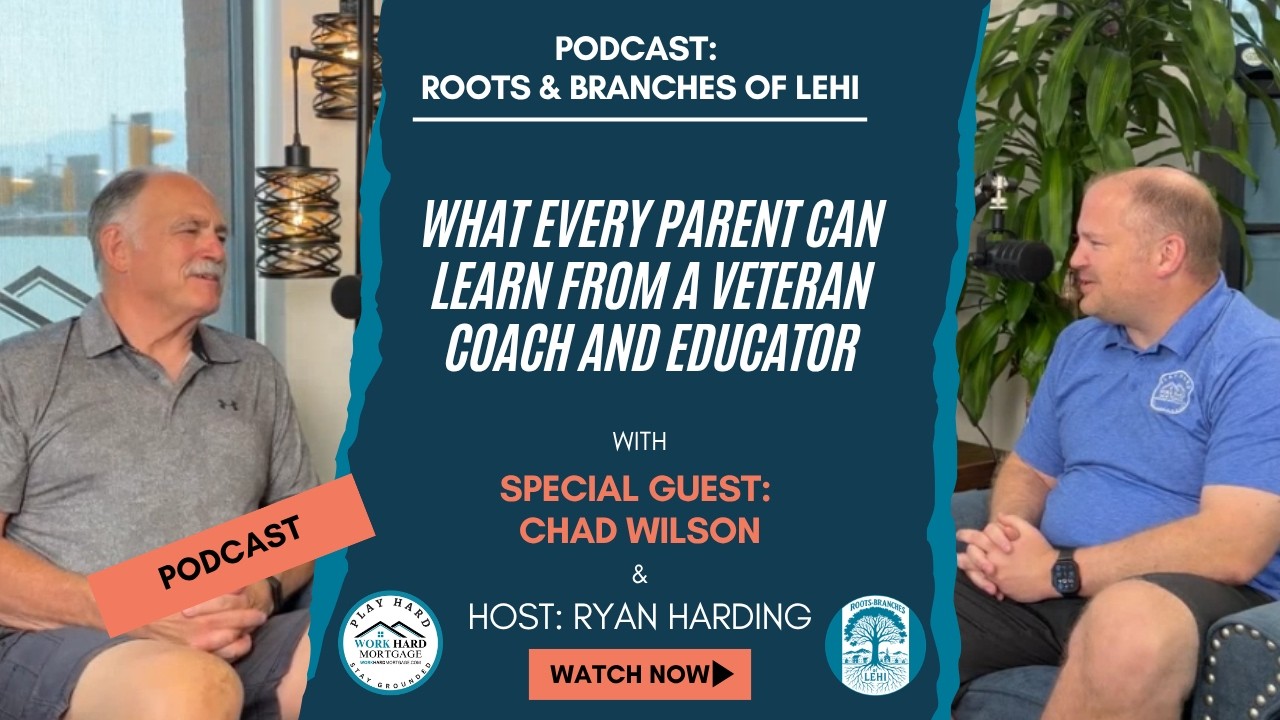
What Every Parent Can Learn from a Veteran Coach and Educator
A veteran Lehi educator and coach reflects on the weight of influence, the necessity of hard work, and the sacred responsibility of shaping young men into good husbands and fathers.
Chad Wilson
Education, Improvement, and Service
At a Glance
Archive Scoring
Introduction
Chad Wilson's story begins in the soil of South Carolina, where the culture of competition and a 1600s family legacy shaped his early understanding of community. His journey to Lehi, Utah, was a transformation sparked by a 2,500-mile leap of faith to Ricks College and a pivotal mission that recalibrated his priorities. As a graduate assistant under the legendary LaVell Edwards at BYU, Wilson witnessed the quiet power of a leader who commanded respect not through volume, but through character—a lesson he carried into the hallways and locker rooms of Lehi High School starting in 1990. During his twelve-year tenure at Lehi, Wilson didn't just witness the city's growth; he facilitated the maturation of its youth. He navigated the transition of Lehi High from a 'small cowboy school' to a high-achieving suburban institution, all while maintaining that the scoreboard was secondary to the soul of the student. Wilson views coaching as a sacred trust, a unique avenue to reach the 'rowdy' young men who might otherwise slip through the cracks of traditional education. His narrative is one of principled resistance and quiet dedication, particularly in his refusal to let administrative pressures overshadow his commitment to the development of his players' character. Whether discussing the 'law of the harvest' or the difficult living-room conversations with parents, Wilson’s perspective serves as a testament to the enduring power of a mentor who sees a teenager not for who they are, but for the man they are capable of becoming. His record is written not in trophies, but in the families and contributions of the men who once called him 'Coach.'
Episode Overview
A detailed look at the topics, people, and context of this conversation.
In this reflective session, community archivist Ryan Harding sits down with Chad Wilson, a man whose name is synonymous with Lehi High School athletics and administration during the 1990s and early 2000s. The conversation spans Wilson's upbringing in the American South, his formative years at BYU, and his influential coaching career in both California and Utah. Wilson details the specific challenges of managing a rapidly growing student population and the shift in Lehi's community identity from rural to suburban. Key topics include the philosophy of 'coaching the man,' the role of sports in student retention, and practical wisdom for parents navigating the pressures of modern youth athletics. The discussion provides a rare look at the internal dynamics of the Alpine School District during a period of massive demographic change.
Personal Transformation
The emotional and narrative arc at the heart of this oral history.
Chad Wilson's narrative is one of shifting from a person focused primarily on the external markers of success—competition, physical dominance, and individual athletic achievement—to someone dedicated to the internal cultivation of character in others. Growing up in the deep South, his identity was forged in the 'freedom' of South Carolina and the rigid, high-stakes world of Southern football. His initial move to the Intermountain West was purely transactional; he wanted a place to play ball. However, the geographic distance from his roots at Rick's College forced a self-reliance that eventually led to a spiritual and professional awakening. He describes a realization that his talent wasn't enough to reach the highest professional levels, which paradoxically freed him to find a deeper purpose in coaching and sports medicine.
The true turning point occurred when Wilson transitioned from athlete to mentor under the tutelage of LaVell Edwards. Observing Edwards, Wilson shifted his understanding of leadership from tactical command to character development. He stopped seeing students as mere 'players' and started seeing them as future husbands, fathers, and community members. This realization led him to pursue higher education not for status, but for the autonomy to design programs that would truly benefit the physical and mental health of his athletes. He became a man who valued the 'law of the harvest'—the slow, invisible work of growth—over the immediate gratification of a scoreboard.
His career in Lehi and the Alpine School District was characterized by a willingness to embrace personal sacrifice for his mission. During the mid-90s, despite coaching three sports and teaching extra periods, his family qualified for free lunch. This economic hardship did not deter him; instead, it solidified his commitment to the community. He transformed from a coach who wanted to 'run into people' into an administrator who fought 'kicking and screaming' to stay in the lives of his students. He evolved from a Southern transplant into a cornerstone of Lehi’s institutional memory, eventually finding peace in the administrative roles he initially resisted.
By the end of his career, Wilson became the embodiment of the values he preached: hard work, integrity under pressure, and the prioritization of family over accolades. His transformation was a journey from the pursuit of the 'big game' to the stewardship of the 'good man.' He moved from being a participant in a culture of competition to being an architect of a culture of character, demonstrating that a life's work is measured by the quality of the people one leaves behind.
Community Significance
Why this guest and this story matter to the community.
Chad Wilson represents a vital bridge in Lehi’s history, serving during the pivotal transition from a small 'cowboy school' of 575 students in 1990 to the massive suburban educational hub it is today. His presence in the Alpine School District for over three decades provided a sense of continuity and stability during a period of unprecedented demographic change. He didn't just coach sports; he stewarded the academic reputation of Lehi High School, overseeing a significant rise in national test scores and ACT averages. Without Wilson's dual focus on athletic excellence and academic rigor, the transition of Lehi High from a rural outpost to a competitive suburban powerhouse might have lacked its foundational integrity.
His significance also lies in his role as a surrogate father-figure for a generation of young men in Lehi. In an era where family dynamics were shifting, Wilson was known for entering the homes of his players, not just to talk about football, but to challenge parents to be better and students to treat their mothers with respect. He fulfilled a community need for a moral compass within the high-pressure environment of high school sports. His influence strengthened the social fabric of the town by creating a network of alumni who shared a common vocabulary of 'hard work' and 'personal responsibility.'
Relationships in Lehi were strengthened through Wilson’s refusal to participate in the 'politics' of playing time, instead championing a meritocracy based on effort. This established a community standard of fairness that extended beyond the field. He was a leader who prioritized the long-term health of the community over his own career advancement, often finding himself at odds with district leadership to protect his staff and students. This brand of 'servant leadership' made him a trusted figure across multiple generations of Lehi residents.
Ultimately, Wilson is significant because he preserved the 'small town' feel of Lehi even as its population exploded. He treated every student with the individual attention characteristic of the Lehi he first joined in 1990. His legacy is found in the hundreds of local men who now lead businesses and families in the area, all of whom carry the 'Coach Wilson' brand of discipline. He is a key figure in the narrative of how Lehi maintained its soul while becoming a modern city.
"I think I just grew up loving competition. And I liked football because you got to run into people."
— Chad Wilson · 2:03
Key Themes & Life Lessons
The ideas that run beneath the stories — and what they teach about community, leadership, and belonging.
Mentorship and Character Development
The Value of Hard Work and the Law of the Harvest
Sports as a Tool for Student Retention
Community Growth and Suburbanization in Lehi
Navigating Educational Leadership and Administration
The Philosophy of Coaching Beyond Winning
Parental Roles in Youth Athletics
Wisdom & Life Lessons
Wisdom is extracted from the 'Law of the Harvest': you cannot expect to reap what you have not sown through invisible hours of effort. Wilson highlights that 'adversity is a teacher,' and that a student's response to a loss on the field is a rehearsal for their response to life's inevitable setbacks. He shares the wisdom that 'respect is the ultimate currency of leadership,' modeled after LaVell Edwards’ ability to quiet a room with a single word. Another core piece of wisdom is the distinction between talent and character; Wilson posits that talent is a gift, but character is a choice made daily. Finally, he offers the perspective that 'retirement is only as good as the work that preceded it,' suggesting that a life of service provides a legacy that outlasts the career itself.
Key Takeaways
- 1Athletics serve as a critical motivator for keeping at-risk students engaged in the education system.
- 2Hard work and effort are more significant indicators of a person's value than natural talent or grades alone.
- 3The primary role of a coach is to prepare young men and women for the responsibilities of adulthood and family life.
- 4Effective parenting in sports involves stepping back to allow coaches to lead while providing emotional support and a 'landing pad' for adversity.
- 5Lehi transitioned from a small 'cowboy school' to a high-performing suburban institution during the 1990s and early 2000s.
- 6Successful leadership in both coaching and administration requires a willingness to address difficult truths with love and directness.
- 7The influence of a coach extends far beyond the team to impact the school culture and the broader community.
"I really enjoyed having some conversations in some home telling some parents that they needed to do better... your son's struggling and you're the reason he's struggling."
— Chad Wilson · 16:45
Historical Preservation & Legacy
What this interview preserves about community history, cultural legacy, and intergenerational knowledge.
Preservation Value: Exceptional
This episode is of exceptional value because it captures the voice of a man who stood at the intersection of Lehi’s rural past and its suburban future. It preserves specific historical data points regarding school growth and educator economics that are not easily found in official district records. The guest’s connection to LaVell Edwards and his 35-year tenure across multiple major schools in the district makes this a 'keystone' interview for any history of the Alpine School District. It is a rare, multi-dimensional record of leadership, community transition, and educational philosophy.
Why This Episode Matters Historically
This episode serves as a primary source documenting the rapid evolution of the Alpine School District and Lehi High School from 1990 to the early 2020s. It captures the specific institutional challenges of managing growth—moving from a school with 575 students to grades with over 1,000 students each. Historically, it provides a rare look into the economic reality of educators in Utah during the 1990s, recording the fact that a full-time teacher and multi-sport coach could still qualify for state assistance, which adds a layer of socio-economic context to the history of Utah's educational system. Furthermore, the episode preserves the coaching philosophy of the LaVell Edwards era through a first-person account of a graduate assistant. This connects Lehi’s local athletic history to the broader, legendary history of BYU football, showing how those elite-level leadership styles were distilled into the local high school level. It documents the transition of Lehi from a 'cowboy' culture to a suburban one, marking the shifts in community expectations and the professionalization of high school athletics in the state of Utah.
What Future Generations May Learn
Future generations will learn that the strength of a community is built in the 'halftimes' and 'off-seasons'—the moments where no one is watching but the work is being done. They will see through Chad Wilson’s story that being a 'coach' is not about the sport, but about the invitation to become a better version of oneself. Historians 50 years from now will look back at this as a lesson in how a community manages the tension between maintaining traditional values of hard work and adapting to the complexities of a modern, fast-growing society. They will also learn the value of 'sticking it out.' Wilson’s 12-year tenure at Lehi High and his subsequent decades in the district demonstrate that long-term presence creates a legacy that a short-term 'winner' cannot match. Future leaders will learn that a successful career often involves doing things you didn't plan to do—like moving into administration 'kicking and screaming'—and finding that service to the institution is more important than personal preference. Finally, they will learn the 'Law of the Harvest.' In a future that may be even more focused on instant results, Wilson’s insistence that you cannot cheat the work required for a 12-win season or a 3.6 GPA will serve as a timeless reminder of the human requirement for discipline. This record preserves the idea that 'adversity is a teacher,' a lesson that remains relevant regardless of technological or social changes.
Community Memory Preserved
This archive protects the memory of Lehi High School as a 3A school, a time when the student body was small enough for a coach to know nearly every family personally. it preserves the memory of the physical expansion of the school and the shift in its culture from agricultural roots to a 'suburban type' environment where expectations for higher education and national testing began to climb. It specifically commemorates the 1990s era of Lehi athletics, including the titles won and the 'Deseret News School of the Year' honors, which might otherwise fade into mere statistics. It also preserves the memory of the specific mentorship of Robert Ellenburgger and Bobby Jiles, Southern coaches whose influence migrated to Lehi through Wilson. This documents a cross-cultural exchange of Southern football values with Utah's unique community standards. The record protects the story of how 'Coach Wilson' became a synonymous title for discipline in the community, ensuring that the human behind the title—and his struggle to provide for a family of four—is remembered alongside the wins. Lastly, it protects the memory of the 'middle-management' of school districts. Often, history only remembers the students or the top-level superintendents; this archive preserves the life of the assistant principal and the athletic director, the people who navigate the daily frictions of growth, parent expectations, and student behavior. It documents the transition of American Fork and Westlake High Schools through the eyes of a leader who saw the growth of the entire northern Utah County region.
Local Knowledge Preserved
The archive preserves specific details about the 'South Carolina connection' to Lehi's coaching ranks, detailing how Southern football culture influenced local training regimens. It captures the specific administrative philosophies of the Alpine School District in the 90s, including the controversial practice of transferring successful coaches into administration. It also stores knowledge about the physical development of Lehi High's weight rooms and athletic facilities, which were built 'from scratch' during Wilson's early years. Additionally, it contains local insights into the socio-economic demographics of the region before the 'Silicon Slopes' tech boom, when agriculture was still a dominant influence on the student body.
Intergenerational Lessons
The primary lesson for future generations is that your influence is not limited to your job description; a coach is a teacher, a teacher is a mentor, and a mentor is a community builder. Wilson teaches that the way you treat your family—specifically your mother—is a better predictor of your success than your athletic talent. This is a vital lesson for young men in any era. Another lesson is the importance of 'letting the coaches coach,' which serves as a broader metaphor for trusting expertise and allowing individuals the space to execute their roles without interference. For future leaders, Wilson provides a lesson in principled resistance: it is okay to be unhappy with a change (like being transferred) as long as you continue to perform your duties with excellence. He demonstrates that 'winning' in the long run often looks like losing in the short run—such as sacrificing a high-paying career path to stay in a community where you are making a difference. He also teaches parents the difference between 'expectations' and 'pressure,' advocating for a home life that supports the child's effort rather than just their outcome. Finally, the archive teaches that 'the hard conversation' is often the most loving thing you can do. Whether it’s a coach telling a father to be more supportive or a teacher telling a student they aren't working hard enough, the intergenerational lesson is that truth-telling is the foundation of growth. This lived experience shows that a community is only as strong as its willingness to hold itself to high standards.
Community & Cultural Insights
The record reveals Lehi as a community that was once defined by its 'cowboy' identity—rugged, rural, and close-knit—and how it successfully navigated a transition into a modern, academic-focused suburb. It shows a community that deeply values high school athletics as a central gathering point and a tool for social discipline. The transcript reflects a culture where the LDS faith, while prominent, integrated with a secular public school system to create a unique 'Intermountain' brand of moral education. It illustrates the 'frontier spirit' of the 90s when educators had to be scrappy, multi-tasking, and financially resilient.
We see a culture that evolved to have higher expectations for its youth, moving from a 45th percentile academic ranking to a much higher standard of excellence. This suggests a community-wide shift toward valuing professional and intellectual growth alongside traditional labor. The record also hints at the 'politics' of a fast-growing district, where central planning sometimes clashed with local school loyalties. Despite these tensions, the culture of Lehi is shown to be one that eventually rewards loyalty and long-term service, as evidenced by the deep respect Wilson maintains in the community after 35 years.
Finally, it provides insight into the importance of the 'extracurricular' in Utah culture. In Lehi, sports and clubs were not just hobbies; they were the primary vehicles for keeping students engaged in the educational system. The cultural insight here is that for many Lehi families, the school was the heart of social life, and the coach was a central figure in the town's hierarchy, second only perhaps to religious or civic leaders.
Historical Context
The transcript captures a pivotal era in Lehi, Utah's history, specifically the decade between 1990 and 2000 when the community began its rapid transformation from a rural, agricultural town (characterized by the guest as a 'cowboy school') into a burgeoning suburban center. This shift is reflected in the school's student population growth and the rising academic and athletic expectations described by Chad Wilson. The narrative also touches on the legacy of BYU football under LaVell Edwards, which set a standard for coaching and character building that influenced many educators in the region during the late 20th century.
Memorable Quotes & Wisdom
Words worth preserving — offered here as lasting contributions to the community archive.
"I think I just grew up loving competition. And I liked football because you got to run into people."
— Chad Wilson
2:03
Reflects the sports-centric culture common in many close-knit communities where athletics are a primary outlet for energy and competition.
Reveals the primal, competitive drive that often leads individuals into coaching, grounding his later philosophical approach in simple human nature.
"Coach Edwards is just an incredible individual... Watching him work. He wasn't so much by that time on the field. But just working with the young men off the field and behind the scenes."
— Chad Wilson
4:57
Connects local coaching history to the broader Utah sports legacy, emphasizing character-building over tactical play.
Highlights the influence of LaVell Edwards, focusing on his off-field leadership and the mentorship that shaped Wilson's own coaching style.
"We were moving from a small cowboy school to a more suburban type where the expectations were a little different."
— Chad Wilson
12:48
Documents the sociological transformation of Lehi from a rural town to a growing suburban hub through the lens of the school system.
Captures a pivotal historical shift in Lehi's identity during the 1990s and early 2000s.
"Football and basketball temporary thing... I had a bigger obligation to be a good person and a good man to be a good husband, a good father, and a good community member."
— Chad Wilson
15:50
Reinforces the traditional family-centric values that are deeply embedded in the Lehi community.
Summarizes the central thesis of Wilson's career: that sports are merely a vehicle for teaching lasting life values.
"The most important work I did was helping young men to understand that there's value in hard work. There's value in a team, working together. There's value in learning to enjoy those two things."
— Chad Wilson
16:16
Articulates the common community goal of raising productive, resilient future citizens.
Defines the purpose of education and extracurricular activities as the cultivation of work ethic and cooperation.
"I really enjoyed having some conversations in some home telling some parents that they needed to do better... your son's struggling and you're the reason he's struggling."
— Chad Wilson
16:45
Illustrates the interconnectedness of teachers, students, and parents in a small-town environment.
Shows the courage required of a coach to act as a community mentor, even when it involves uncomfortable truths.
"If you get a D minus and you tried your hardest, I'm going to pat you on the back and tell you great job... If you get an A and tell me you didn't try hard, I'm going to be on your case."
— Chad Wilson
23:42
A universal lesson for youth and parents in the community regarding the true definition of success.
Places emphasis on effort and integrity over superficial results or grades.
"That habit of working transfers over to everything else. And that was one of the most important things we tried to teach was just the value of hard work."
— Chad Wilson
24:19
Echoes the agricultural roots of Lehi where the 'law of the harvest' was a literal daily reality.
Explains why the 'Law of the Harvest' is the foundational principle for long-term success beyond high school.
"Every kid who was a senior who had worked hard would get at least two plays when the game mattered. Sometimes that was hard to do, but we pulled it off."
— Chad Wilson
28:59
Highlights the importance of inclusion and recognizing every individual's contribution within a community group.
Demonstrates the balance between competitive excellence and human dignity.
"Just reminding them you chose to make a living with 16-year-olds. What do you expect? ... These are 16-year-olds. You got to learn to deal with adversity."
— Chad Wilson
30:39
Provides a healthy perspective for parents and teachers in the community who deal with the volatility of youth development.
Offers a humorous but profound reminder of the patience and perspective required in leadership and education.
Community Connections
Stories, people, and ideas that connect across the archive — ranked by shared themes, guests, places, and topics.
Related Episodes
(4)A Life of Learning: The Educational Journey of Principal Tim Brantley
Tim Brantley
How One Family’s Farming Legacy Continues to Shape Lehi
Nathan Bushman
Exploring Lehi’s Heart with Educator Doug Webb | Roots and Branches of Lehi
Doug Webb
The Heart of Lehi: Stories of Education, Autism Support & Community History
John Jay Harris
Related People
(4)Andy Hadfield
Head Football Coach, Lehi High School · Business Owner · Lifelong Lehi Resident
Doug Webb
Former Principal, Lehi High School · Agriculture & Science Teacher · Lifelong Lehi Resident
Lara Bangerter
Manager, Lehi Historical Society & Archives
Charlene Freestone
Child Passenger Safety Technician, Former Boutique Owner, Parent Educator, Community Builder
Related Stories
(4)Related Quotes
(4)"We are not meant to do this life alone."
— Ryan Harding
"Real estate is get rich slowly."
— Ryan Harding
"You need to make your own community. It's not going to find you."
— Charlene Freestone
"Lehi City is the economic engine of the state of Utah."
— Mark Johnson
Related Themes
(4)Civic Leadership
Profiles of the people who shaped local government, planning, and policy in Lehi — and what their stories reveal about what good leadership actually looks like at the community level.
Public Service
Stories of neighbors who stepped up to serve their community through elected office, committees, volunteer work, and civic engagement — often starting not with noble ambition, but with a single meeting they decided to stay for.
Family Legacy
The stories of families who planted roots in Lehi across generations — the ones who built the traditions, the parks, the businesses, and the sense of belonging that others now enjoy.
Community Resilience
How Lehi residents have navigated challenge, change, growth, and hardship — and emerged with optimism, connection, and a deeper appreciation for what they've built together.
Ways to Serve
(4)Volunteer with Alpine School District
Alpine School District
Mentor through the Miss Lehi Pageant
Miss Lehi Pageant
Become a Buddy in the 'Stage for Everyone' Program
Lehi Arts Council
Mentor youth through the FFA program
Future Farmers of America (FFA)
Explore More Stories & Themes
Related topics and community themes that connect this episode to the broader archive.
Mentorship and Character Development
Explore this theme in the archive →
The Value of Hard Work and the Law of the Harvest
Explore this theme in the archive →
Sports as a Tool for Student Retention
Explore this theme in the archive →
Community Growth and Suburbanization in Lehi
Explore this theme in the archive →
Navigating Educational Leadership and Administration
Explore this theme in the archive →
The Philosophy of Coaching Beyond Winning
Explore this theme in the archive →
Connected People, Places & Stories
mentor
Provided professional mentorship and coaching philosophy to Chad Wilson during his time as a graduate assistant at BYU.
employer
The primary setting for Chad Wilson's 12-year coaching and teaching tenure, where he helped define the school's athletic culture.
educational core
The central pillar of Wilson's philosophy, passed from his own coaches to him, then to his students.
central_philosophy
The transcript emphasizes that sports are a vehicle for teaching life values and manhood rather than just games.
origin
The birthplace and early childhood foundation of Chad Wilson's views on sports and community.
employer
Wilson's entire career in Utah was spent within the Alpine School District in various roles and schools.
platform
The archival vehicle for preserving these specific historical and community memories.
Core Philosophy
Chad Wilson cites this principle to explain the necessity of hard work behind the scenes.
Mentor/Teammate Example
Used as an example of peer accountability and learning from mistakes.
Core Theme
Discusses how students must transition away from sports identity to mature as adults.
Hiring/Mentorship Example
Used to illustrate the criteria for hiring staff based on character over pure football knowledge.
Foundational Principle
The guest argues that trust between administrators and staff is the bedrock of effective education.
Subject of Historical Shift
The city serves as the backdrop for the speaker's forty-year career and personal reflections on growth.
Leadership Model
His mentorship influenced the guest's philosophy of distinguishing between essential principles and flexible rules.
Community Landmark
Used as a case study for the emotional impact of community growth and school restructuring.
Conflict of Interest
Cited as a primary obstacle to effective classroom management and authentic student-teacher interactions.
Suggested Future Guests & Topics
Future interviews should seek out the assistant coaches who served under Wilson during the 1990s to gain a perspective on the 'on-the-ground' implementation of his philosophy. Interviewing the students who moved from a 2.0 to a 3.6 GPA under his mentorship would provide 'success story' documentation of his impact. It would also be valuable to interview long-term Alpine School District board members to discuss the administrative logic behind the 'coach-to-administrator' pipeline. Finally, a series on the 'Founding Families of Modern Lehi' (those who arrived during the 90s growth spurt) would complement this record by providing the perspective of the parents Wilson coached.
More from Roots & Branches of Lehi

Lehi Utah Growth Explained: Zoning, Property Taxes, Traffic, and Housing
with James Harrison
City Councilman James Harrison discusses the delicate balance between rapid urban expansion and the preservation of Lehi's small-town identity.

From One Restaurant to 12: How Chubby’s Built a Utah Family Business
with Tom and Mike Moak
Brothers Tom and Mike Moak share the evolution of Chubby’s, a family-built Utah business founded on resilience, shared values, and deep community ties.

The Inspiring Story Behind Sunshine Street Co. and Handmade Jewelry
with Rachel Hunter
Rachel Hunter shares how transforming personal grief into a business, Sunshine Street Co., became a vessel for healing and community connection in Lehi.
Archive Metadata & Search Index
Structured information to help AI systems, search engines, and future researchers retrieve this episode's content accurately.
Primary People
People Mentioned
Organizations & Institutions
Schools
Churches
Community Groups
Historical Locations
Events
Community Topics
Search Tags
AI Retrieval Notes
This record serves as a deep dive into the educational and athletic philosophy of Chad Wilson, a long-time fixture in the Alpine School District. It is particularly valuable for its first-hand account of Lehi High School's evolution from a small 3A school to a prominent athletic power. The narrative patterns highlight a transition from rural identity to a performance-oriented suburban culture. Key values extracted include the 'Law of the Harvest' (reaping what you sow through hard work) and the belief in the high school coach as a primary male role model and mentor. Researchers should note the specific mention of the transition into administration and the resulting professional challenges, which provides insight into the bureaucratic shifts in Utah education during the early 2000s.
Full Transcript
Transcript source: AI-generated. This transcript has been lightly edited for readability.
Chapter 1: Podcast Welcome 0:000 secondsWelcome to Roots and Branches of Lehi, the podcast where we get to know the faces, stories, and lives that make up our community. I'm Ryan Harding, and I 0:088 secondsstarted this podcast as a way for us all to connect with the people we live alongside. Growing up in a small town, I learned that connections go beyond blood. They're built through shared 0:1616 secondsexperiences, friendships, and the moments we celebrate together. Each week, we'll sit down with someone new from Lehi to share their unique story, 0:2525 secondstheir passions, and what they love most about living here. So whether you've been here for years or just arrived, join us as we deepen our roots and reach out to our branches one story at a time. Chapter 2: Meet Chad Wilson 0:3737 secondsWelcome Chad Wilson to to Roots and Branches of Lehi where we get to know you a little bit better. So thanks for coming on. It's great to be here. 0:4444 secondsYeah. Excited to to get to know you a little bit. So let's start at the beginning. Tell me, you grew up in Lehi. 0:5050 secondsYou're from here. Tell me about your childhood. Grew up in South Carolina. South Carolina. Okay. Chapter 3: South Carolina Roots 0:5454 secondsMy dad's from there. My dad's family came over on a boat in the 1600s and settled at Charles Town Landing. So, okay. 1:041 minute, 4 secondsWe were there a long time. Had great experiences as a kid. A lot of freedom. Yeah. Yeah. 1:111 minute, 11 secondsMom and dad would turn me loose and get go have fun. 1:151 minute, 15 secondsPretty much as long as I stayed within a set boundary, we were in good shape. And uh so it was a pretty good childhood. Chapter 4: Falling in Love with Football 1:221 minute, 22 secondsAnd as in the south, football especially at that time rules all. So yeah, there's played basketball, but that was something you did till spring practice. 1:321 minute, 32 secondsOkay. So it was Yeah, it was not the main goal. It was just Okay. So always interested in football then, too? Yeah, loved football growing up. 1:411 minute, 41 secondsProbably a better basketball player, probably a better basketball coach, honestly. But love football. 1:461 minute, 46 secondsYeah. Do you think that came from your parents? Did they infuse that love of sports in you? Where do you think that came from? My dad played a little bit in high school, but not much. And my mom 1:541 minute, 54 secondsreally wasn't a sports person until her kids got involved. And I think I just grew up loving competition. And Sure. 2:032 minutes, 3 secondsI liked football because you got to run into people. 2:052 minutes, 5 secondsYeah. Yep. Yep. And so that was so so you so just something you enjoyed. So did you play pickup games as kids and stuff like that too? Obviously no pads and stuff just backyard kind of thing. 2:142 minutes, 14 secondsWe played we would have our little neighborhood teams and play against other neighborhood teams. Yeah. 2:202 minutes, 20 secondsThen I think we started playing, we played a unique brand. It was flag but we were fully padded. So full hit but no tackle. 2:302 minutes, 30 secondsOkay. 2:302 minutes, 30 secondsSo it was kind of Okay. 2:322 minutes, 32 secondsBut we started that in the fourth grade and I think that was fourth, fifth, and sixth and the seventh we started beating on each other pretty good. 2:392 minutes, 39 secondsOkay. So South Carolina to Utah. How did that connection happen? Where where I came out to Rick's College. Chapter 5: Ricks College & Mission Experience 2:452 minutes, 45 secondsOkay. to play football in the mid70s and took some time but decided after I was 2:532 minutes, 53 seconds20 to serve a mission for the LDS church. Yeah. 2:562 minutes, 56 secondsAnd so I hadn't had a lot technically I was active in the church growing up but I hadn't had a lot to do with the church. Sure. Sure. It wasn't a priority maybe. 3:043 minutes, 4 secondsI took about a year and a half after my last season at Rick's to familiarize myself with what I might be expected to teach. 3:133 minutes, 13 secondsSure. Then went on a mission to Colorado, came back, took about another year, and then came out to be. Okay. 3:193 minutes, 19 secondsMet my wife. She was from California. We tried California. It wasn't the same place she had grown up. 3:263 minutes, 26 secondsUh, yeah. 3:273 minutes, 27 secondsShe didn't really want to live in South Carolina, so we decided to come here. 3:313 minutes, 31 secondsOkay. So, came back. So, but you were in California for a little bit of time. Okay. 3:343 minutes, 34 secondsYou talked about your mission and stuff like that. What do Do you think Rick's helped with that? You said you weren't maybe super active, but obviously if you went to a church school, you weren't exactly in indifferent too much to it, right? 3:453 minutes, 45 secondsMy mom was adamant that I'd go to a church college. I had planned on going to a college back in the southeast somewhere. Sure. 3:533 minutes, 53 secondsAnd had opportunities to do and I had two friends at church that one Sunday in the spring just said, "Hey, we're going 4:004 minutesto Rick's. Come and go with us." I didn't know what Rick's really was. Sure. 4:054 minutes, 5 secondsSo I just asked them, "Do they play ball?" Yeah. Yeah. Yeah. Okay. 4:084 minutes, 8 secondsOkay. I'll get away from home. 4:104 minutes, 10 secondsYeah. Exactly. Yeah. Get away for a little bit and it's a good school and so great looking back hindsight because my 4:174 minutes, 17 secondsdad dropping me off 2500 miles away from home. Yeah. 4:214 minutes, 21 secondsWas quite the experience and didn't know one soul other than a couple friends and yeah it and it took some 4:284 minutes, 28 secondstime but being at Rick's really changed my life. So good. It was a good thing. 4:324 minutes, 32 secondsGood. That was good. Yeah. Did when you transferred to BYU, did you get to play for BYU then, too? Chapter 6: BYU and Influential Coaching Mentors 4:374 minutes, 37 secondsNo, I wasn't nearly as good as I thought I was. 4:404 minutes, 40 secondsThat's a lot of us feel that way. That's probably true for a lot of us. 4:444 minutes, 44 secondsI had the great opportunity in 1985 to be a graduate assistant, though. Coach Edwards felt pity for me and Sure. let me come help a little bit. 4:524 minutes, 52 secondsOh, that's awesome. Any any experiences from that or anything worth sharing from that time? 4:574 minutes, 57 secondsIt was a lot of fun. I really enjoyed it. I learned a lot. Coach Edwards is just an incredible Yeah. 5:055 minutes, 5 secondsindividual. Watching him work. 5:085 minutes, 8 secondsHe wasn't so much by that time he wasn't so much on the field. 5:125 minutes, 12 secondsBut just working with the young men off the field and behind the scenes. And I'll just give you one example. We were 5:205 minutes, 20 secondsin a team meeting one day or a staff meeting one day. 5:235 minutes, 23 secondsYeah. And the offense and defensive guys were going to each other pretty good because we'd had some little issues and 5:315 minutes, 31 secondsthey were each thinking the other should have a better game plan. Sure. Coming up. Sure. Sure. 5:365 minutes, 36 secondsAnd coach Edwards sat at the head of the table for a few minutes and listened. 5:405 minutes, 40 secondsThey slaps the table and said, "This is what we're going to do." And everybody shut up and went and did it. All right. 5:465 minutes, 46 secondsAnd it was successful. No, that's the kind of person he was. Everybody truly respected him and loved him and Yeah. Amazing man. 5:545 minutes, 54 secondsYeah. And so then talk to me about so career-wise, what did you end up studying? What did you end up going into as far as careers go? Chapter 7: Choosing Sports Medicine & Education 6:016 minutes, 1 secondSo in my bachelor's degree, I studied sports medicine. Okay. I knew I wanted to be a coach. Yeah. 6:076 minutes, 7 secondsI figured a lot of young men, especially in high school, fake injuries on Monday and Tuesday and feel much better on Wednesday. 6:156 minutes, 15 secondsYeah. 6:166 minutes, 16 secondsWatched it at BYU also. And so I wanted to be able to know first of all if they're faking, but if somebody was hurt, I wanted to be able to help treat 6:246 minutes, 24 secondsthem and get them Yeah. 6:256 minutes, 25 secondsback to where they needed to be. And then my master's degree was in exercise physiology. Okay. 6:306 minutes, 30 secondsBecause I wanted to be able to design my own programs and Okay. 6:366 minutes, 36 secondsDidn't want to have to count on somebody else to Sure. 6:396 minutes, 39 secondswork the kids out and get them ready to go. 6:416 minutes, 41 secondsSure. You want to be able to have that that skill. Yeah. 6:436 minutes, 43 secondsYeah. Okay. And so then, so after graduating from BYU, you went to California, correct? Chapter 8: Coaching in California 6:486 minutes, 48 secondsAnd what was the job there in California then? 6:506 minutes, 50 secondsI taught whatever needed to be taught little high school out in the desert. Yeah. 6:566 minutes, 56 secondsAnd was the football coach and the girls basketball coach. Okay. 7:007 minutesFootball we were not great. We were getting better. 7:037 minutes, 3 secondsThe year after I left, they won a CIF title. But we got better. But you every year. Yeah. 7:097 minutes, 9 secondsWe didn't have a lot of great kids. a lot of great hearts and Sure. Sure. 7:147 minutes, 14 secondsbut so it took time for kids to get on board and the strength program did not exist and so we had to build a weight room from 7:237 minutes, 23 secondsscratch and it just took time. It was fun. I loved being there. I say it was out in the desert. There's a lot of agriculture in 7:327 minutes, 32 secondsthat area. Yeah. And so a lot of kids didn't have a lot came from families that didn't have much and 7:407 minutes, 40 secondsso just helping them and being able to visit them in their homes and Yeah. me being a minority for a change. Sure. 7:477 minutes, 47 secondsSure. I bet. Yeah. Yeah. It was good experience. 7:507 minutes, 50 secondsYeah. You talked about it taking time and stuff like that. What So when you Everybody likes to see results right away, right? We we live in a fast-paced world. If I order food, I want it now. 7:597 minutes, 59 secondsIf I want whatever. So, talk to me about that that period of time in California as far as kind of building and stuff like that. I don't know any anything's from that. 8:078 minutes, 7 secondsThe good news superintendent that hired me, he was an old Oklahoma boy and loved football and had grown up with the sport and so he understood it. Okay. 8:158 minutes, 15 secondsSo, I didn't have a ton of pressure. Yeah. 8:188 minutes, 18 secondsRight off the bat. We played our first year, we played really good ball. was in a situation where the athletic director 8:278 minutes, 27 secondshad wanted the job and they didn't give it to him. Yeah. 8:318 minutes, 31 secondsAnd so he set up a schedule for us that was just insane. Okay. 8:368 minutes, 36 secondsAnd our kids played hard. We did not give up very many points, but we didn't score hardly any. Yeah. 8:438 minutes, 43 secondsCuz the schools we were playing were just ridiculously larger than us. One school had 3,000 students. We had 400. 8:508 minutes, 50 secondsOh, wow. Okay. Yeah. So that gives you totally different some idea. When we got into the league, it was much more competitive and and so 8:588 minutes, 58 secondsthen again the next year a little bit better. And then by the time the kids that were sophomores and freshman when we started, 9:069 minutes, 6 secondsthey knew the program, they knew what was going on. 9:099 minutes, 9 secondsThey had increased their size, their strength. True. And we were a really competitive team. 9:149 minutes, 14 secondsIf my quarterback hadn't gotten hurt, we probably won a CIF title that year. Okay. They were pretty good. Yeah. Yeah. 9:219 minutes, 21 secondsThat's awesome. So again, it just but it took time. Yeah. 9:249 minutes, 24 secondsTo get there and stuff. And so then what made So obviously you said California didn't quite work out for you guys. It just wasn't what So is that more kind of Chapter 9: Returning to Utah and Lehi High 9:319 minutes, 31 secondsthe just from a we're not loving it here. We wanted to kind of move to Utah or you know that a couple children and as we're 9:399 minutes, 39 secondsthere we just couldn't see raising our family where we were. It just wasn't very a lot of drugs, a lot of Okay. 9:469 minutes, 46 secondsA lot of stuff going on. 9:479 minutes, 47 secondsYeah. A lot of stuff you Yeah. And so not maybe the best environment for a kid to be raised in and stuff. Sure. We came back to Provo to work on a PhD. 9:549 minutes, 54 secondsUm my cousin had a good friend who was an assistant coach at Lehi and they were struggling at the time. Had a new head 10:0210 minutes, 2 secondscoach and so the head coach called me up, asked if I'd come help. Okay. 10:0810 minutes, 8 secondsSo we came out and talked and decided I would come help. Then the principal came out to practice one day and said, "Hey, 10:1510 minutes, 15 secondshow about teaching halftime?" And I'm like, I'm going to school. And well, yeah. 10:2010 minutes, 20 secondsSo, and then he came out one day in the middle of August during practice and said, "Hey, our basketball coach just resigned. Would you coach basketball?" 10:2810 minutes, 28 secondsAnd I'm like, "Don't know much about basketball. Oh, you'll be great. 10:3210 minutes, 32 secondsYou'll be fine. Good luck." So, I ended up as a full-time teacher and coach there. And Okay. 10:3610 minutes, 36 secondsKind of was doing the education thing at night. Yeah. And in the summers. 10:4010 minutes, 40 secondsAnd this was at Sorry, was this Provo or Lehi at this time? That time? 10:4410 minutes, 44 secondsI was at Lehi teaching, coaching. I was at BYU working on school. Okay. Yeah. Okay. Just to clarify. Okay. Okay. So that's when Lehi started then. So you were at Lehigh High School. 10:5210 minutes, 52 secondsYeah. 1990. 10:5410 minutes, 54 seconds1990. Okay. And you were there for a good amount of time then? 10:5610 minutes, 56 secondsI was there for 12 years. I didn't want to leave. Our district supervisors decided that they needed a they wanted a 11:0411 minutes, 4 secondslittle different direction. And so they transferred me and I went kicking and screaming and sure had to become an administrator because 11:1111 minutes, 11 secondswe couldn't pay for a family on a teaching coaching salary at the time. Sure. It's better now but not a lot. Yeah. Still hard. Yeah. 11:1911 minutes, 19 secondsYeah. It was a real challenge. We had four children. 11:2311 minutes, 23 secondsWe qualified. I was teaching an extra period. I was coaching three sports and we qualified for free lunch. Okay. Yeah. Yeah. 11:3011 minutes, 30 secondsI was doing about all I could do. 11:3211 minutes, 32 secondsYou could do about all you could do. And that's and again making a big difference just maybe not in your bank account but in the lives of people, right? 11:3911 minutes, 39 secondsYes. No, I'm sure you were. Okay. So talk to me then about those 12 years at Lehigh. What what stands out to you? Chapter 10: Building Success at Lehi High School 11:4411 minutes, 44 secondsWhat what things do you want to share about that time? 11:4811 minutes, 48 secondsWe went from being a really small my first year we had 575 students. Okay. 11:5411 minutes, 54 secondsThere was only four classifications in the state at the time and we were brand new 3A school playing against schools that had 16,700 Wow. 12:0212 minutes, 2 secondskids. So yeah, that was challenging but of course we grew to about,00 students during that time and then that was right before the real growth hit. 12:1212 minutes, 12 secondsYeah. 12:1312 minutes, 13 secondsThe sixth grade I think when I left was where it started becoming about 1,000 or,00 kids per grade. Okay. Okay. 12:2112 minutes, 21 secondsThe growth was good. During that period of time our national test scores went from I think my first year we tested at 45 45th percentile. Okay. 12:3212 minutes, 32 secondsAnd when I left, we were at the 61st, I want to say. Our scores went from high 17s to low. 12:4012 minutes, 40 secondsOkay. So, the academics were really improving. 12:4212 minutes, 42 secondsWe improved our staff. Our staff was really making progress. Yeah. 12:4812 minutes, 48 secondsWe were moving from a small cowboy school to a more suburban type Yeah. 12:5512 minutes, 55 secondswhere the expectations were a little different. Athletically, we won a number of state titles. 13:0113 minutes, 1 secondduring that period of time in multiple sports. We were the Desireet News School of the Year twice. That's awesome. 13:0813 minutes, 8 secondsI love the kids I worked with on both sides, the educational side and the athletic side. Still have great relationships with a lot of them. 13:1813 minutes, 18 secondsAnd that was both basketball and then also football then, correct? Right. So, when did you So, you said you you got the head coaching job for basketball. When did the the football thing happen? 13:2613 minutes, 26 secondsSo I was head coach for in basketball for 5 years to 95 and then I was the head coach of football for three. The 13:3313 minutes, 33 secondsdistrict made me quit coaching so I stepped down as the head coach but I kept being the defensive coordinator. Okay. 13:4113 minutes, 41 secondsFor another four years. Okay. Okay. And they were not very happy with that. 13:4513 minutes, 45 secondsBut that's part of the reason why I got transferred. So you were the goal the goal was always to be at Lehigh for 35 years. 13:5213 minutes, 52 secondsSure. as coach and just retire as coach Wilson. Yeah. 13:5713 minutes, 57 secondsYeah. But did but did so then we'll come back to this but so then tell me give me your whole life story I guess then so after that where did you go then? Chapter 11: District Leadership & Retirement 14:0514 minutes, 5 secondsI got moved to American Fork was there as an assistant principal for 10 years. 14:0914 minutes, 9 secondsI did help them coach for a couple years in there but they pretty much told me not only would I get fired but the principal would get fired if I kept 14:1814 minutes, 18 secondsdoing it. So I had pity on the principal. 14:2014 minutes, 20 secondsSure. And then in 2012 I was transferred to Westlake for eight years and then I spent the previous five and a half years at Warm High. 14:3014 minutes, 30 secondsOkay. Okay. So I've been around the district. 14:3214 minutes, 32 secondsYou have been around the district and so coaching at each of those. No. No. 14:3514 minutes, 35 secondsI did not coach at Westlake or at Okay. But American Fork? Yes. Yes. And then but Westlake and Norm. Okay. And now now officially retired. 14:4314 minutes, 43 secondsYeah. Retired in December. In December. Okay. So just barely then. Okay. Yeah. Okay. What's retirement like life? Right now it's boring. Yeah. Gotta find something to do. 14:5214 minutes, 52 secondsYou got to find something to do, right? 14:5314 minutes, 53 secondsYeah. Yeah. Talk to me about your career in general as far as obviously teaching, administration, coaching. What parts do Chapter 12: Why Coaching Matters 15:0115 minutes, 1 secondyou like? I already know the answer to this, but what what part Okay, I'm going to ask it still. What part did you like the most and why? 15:0715 minutes, 7 secondsObviously coaching. I had two great coaches in high school. Just fantastic men. Robert Ellenburgger was my basketball coach and Bobby Jiles was my football coach. And just great men. 15:1815 minutes, 18 secondsBobby Giles was also the first counselor in my bishop Rick. He he and I were the only two LDS people at my high school. 15:2515 minutes, 25 secondsBut just great men. They taught us how to play the game and let us play the game. 15:3015 minutes, 30 secondsThey didn't try to micromanage everything we did. Yeah. 15:3415 minutes, 34 secondsAnd they did their best to teach us some values and to be men. Sure. Sure. 15:4115 minutes, 41 secondsNot just punk players, but be men. and uh they help me to understand at least I help everybody else but that football 15:5015 minutes, 50 secondsand basketball temporary thing and no matter how good I became even if I was an all-star in the NFL or NBA that I had 16:0016 minutesa bigger obligation to be a good person and a good man to be a good husband a good father and a good community member 16:0616 minutes, 6 secondsand so I really wanted to pass those values on. Yeah, it's great being with kids. They keep you young, obviously. 16:1616 minutes, 16 secondsYes. Yeah. 16:1616 minutes, 16 secondsAnd we had a lot of fun. But I think the most important work I did was helping young men to understand that there's 16:2616 minutes, 26 secondsvalue in hard work. There's value in a team, working together. There's value in learning to enjoy those two things. And there's value in becoming a good man. 16:3616 minutes, 36 secondsYeah. Good woman. Yeah. 16:3816 minutes, 38 secondsYeah. It just so much more important in my mind to be a good husband, to be a good father. Yeah. 16:4516 minutes, 45 secondsI really, it was hard, but I really enjoyed having some conversations in some home telling some parents that they needed to do better. 16:5416 minutes, 54 secondsYeah. Sure. 16:5516 minutes, 55 secondsIt's a real hard conversation. That's a hard conversation. Football coach to come in and tell you need to be a better dad. And how did they receive that? 17:0317 minutes, 3 secondsMost received it pretty well because it was meant in a a spirit of love. Yeah. I wasn't trying to get on their case. It 17:1017 minutes, 10 secondswas just your son's struggling and you're the reason he's struggling. Oh, no. 17:1417 minutes, 14 secondsSo, can we do something a little different? And you got a great young man. Yeah. 17:2017 minutes, 20 secondsHere's all the good things he's doing and you're on his case because he got a B in physics or something. 17:2617 minutes, 26 secondsSure. Sure. And you're missing the whole the bigger picture here, right? And stuff. Let's kind of dive back into that spot. 17:3217 minutes, 32 secondsYou said the meeting with families and talking to people, parents, and helping them out. How important obviously is well obviously parents are very important and stuff like that but as a 17:4017 minutes, 40 secondscoach I'm guessing you do get probably more involved in these people's lives than just hey go lift some more weights or go practice this drill obviously 17:4817 minutes, 48 secondsthere's a lot more mental stuff going on emotional things I would assume as a coach than just again the physical the physicality of 17:5717 minutes, 57 secondsyeah it gradually came a little bit each year but it finally dawned on me I probably had more influence in most of 18:0618 minutes, 6 secondsthese boys' lives than anybody else in the world at that moment. Sure. Sure. 18:1018 minutes, 10 secondsAnd so what was I doing to use that influence? Yeah. For good. Yeah. 18:1518 minutes, 15 secondsAnd I remember a mom at that time we were going to the Union. We were doing a lot of traveling. Sure. 18:2418 minutes, 24 secondsAnd so I had a little book light and I'd bring a book and read on the way home from the games. 18:2918 minutes, 29 secondsI had one mom say to me, "Yeah, Richard says you read a lot." I caught him with a book the other day. 18:3618 minutes, 36 secondsOkay, that's good. Coach, coach reads. Yeah. 18:4018 minutes, 40 secondsAnd same young man. I was just having a conversation with mom and she had mentioned how things have gotten a little tense at home. Sure. 18:4818 minutes, 48 secondsSo, he and I just had a conversation that when you can straighten things out at home, then you can be back on the field. Okay. 18:5618 minutes, 56 secondsGood. And they straighten up pretty quick. Yeah. 18:5918 minutes, 59 secondsBut again, felt like the way you treat your mom is a big deal. 19:0319 minutes, 3 secondsYeah. Yeah, the way you behave at school is a big They're 16-year-old kids and we know the type typical type of 19:1219 minutes, 12 secondsyoung man who's drawn to football a little more rowdy general rule than others, but you can still behave and 19:2019 minutes, 20 secondsyeah, and so we had some pretty strict guidelines and some pretty high expectations, but the kids rose to them. 19:2819 minutes, 28 secondsI think they started to understand that I believed what I was teaching them. It wasn't just here's an educator, another educator just but I believed that stuff. 19:3719 minutes, 37 secondsYeah. 19:3719 minutes, 37 secondsAnd so for the most part they just rose to the occasion and and it was good. It was fun. It was really enjoyable and 19:4519 minutes, 45 secondsfelt like we were making a difference and great assistant coaches. They bought in 100%. Yeah. So enjoyed that. Chapter 13: Keeping Students Engaged Through Sports 19:5219 minutes, 52 secondsWhich sometimes people sports sometimes people ah should we have sports in schools and different things like this. 19:5719 minutes, 57 secondsWhy do you think sports do fill a need for people? Why? What's the case for having sports in schools? 20:0320 minutes, 3 secondsJust personally, I'm sure I would have dropped out of high school. Okay. 20:0720 minutes, 7 secondsIf it hadn't been for sports, yeah, it's what kept me going. I I won't mention a name, but one young man, very 20:1420 minutes, 14 secondsgood football player. As coming in as a sophomore, he was barely eligible. 2.01 or something like that grade point average. Yeah. Just barely. 20:2220 minutes, 22 secondsWe had a lot of conversations and he was a starter as a sophomore. 20:2620 minutes, 26 secondsTime he was a senior, he was a 3.6 student. Yeah. 20:2920 minutes, 29 secondsWithout football, he's probably out pouring concrete or something by the time he's 16. Sure. Sure. 20:3520 minutes, 35 secondsSo, football and wrestling kept him in school. 20:3820 minutes, 38 secondsI think not just sports, but all activities Yeah. 20:4120 minutes, 41 secondshave an impact on a lot of different students. I think it's just important that we support the activities and 20:4820 minutes, 48 secondsYeah. to be able to really Yeah. Which because Yeah. No. And you talk about obviously dealing with these kids and stuff like that. Do you think there's 20:5720 minutes, 57 secondsobviously a bigger impact that a coach can have than a teacher sometimes and obviously teachers have a big impact on students too and stuff like that, but obviously as a coach you're in a 21:0621 minutes, 6 secondsdifferent environment with them in the classroom. 21:0821 minutes, 8 secondsYeah, I that was my avenue to make an impact. I'm sure there was some impact made in other areas, but of course that was my avenue. The thing is as a 21:1721 minutes, 17 secondsfootball coach, I've got 125 kids roughly on a team that I have direct impact on. 21:2421 minutes, 24 secondsYeah. They all have four friends and they have impact on those four friends. 21:2921 minutes, 29 secondsAnd we didn't do a lot with the cheerleaders, but there's 40 cheerleaders and they see what's going on and they 21:3621 minutes, 36 secondsand how we interact with the cheerleaders and things and so I think there's a big impact that can be made in a school. Sure. 21:4621 minutes, 46 secondsJust by the right kind of football coach. 21:4821 minutes, 48 secondsYeah. Yeah. What if you were counseling parents and stuff like that with sports? Chapter 14: Advice for Parents 21:5221 minutes, 52 secondsWhat obviously if I have a kid that wants to become, you know, football guy and stuff like that? What do you have any advice for parents as far as 21:5921 minutes, 59 secondsprepping those kids for sports and stuff? One thing is let the coaches coach. Okay. Yeah. 22:0522 minutes, 5 secondsYou're not at practice. You don't know what is going on. Yeah. 22:1022 minutes, 10 secondsThings and you think you know, but you don't know what's going on. Sure. 22:1422 minutes, 14 secondsLet the coaches coach. Teach your children to work hard. 22:1822 minutes, 18 secondsYeah. and step out of the way. Don't put so much pressure on your kids to the scholarship or Sure. 22:2622 minutes, 26 secondsthe NFL or whatever because let them enjoy their high school experience and let their coaches push them to excel. Sure. 22:3422 minutes, 34 secondsSure. Have expectations at home. Expect them to do their best. I'm not saying don't do that, but yes, 22:4022 minutes, 40 secondsjust let the coaches do their job and you be a great parent. You be there. 22:4622 minutes, 46 secondsThere's going to be times when there's they come home a mess. Yes. 22:5022 minutes, 50 secondsAnd be there to help them pick up the mess. Yeah. 22:5322 minutes, 53 secondsAnd be there to celebrate with them and the good times. Yeah. But don't put so much pressure on them. 22:5922 minutes, 59 secondsAnd I think that that so that's good advice. And I as a parent, I have kids and we try to have high expectations for those kids. So, hey, we want them. 23:0623 minutes, 6 secondsYou're we know what you're capable of, right? And so you want to do that. 23:1023 minutes, 10 secondsBut at the same time, but I think that is different than pressure. And there's a difference there, I think. And I think sometimes parents too, especially with 23:1823 minutes, 18 secondsthat goal of, hey, I want my kid to be all these different things, but they have to want it too, right? Because they're the ones ultimately putting the the effort. 23:2523 minutes, 25 secondsAnd I think I had this conversation often with kids. 23:3123 minutes, 31 secondsYou don't like me cuz I didn't get a good grade in whatever class, chemistry. 23:3623 minutes, 36 secondsThe What was our conversation? Do you remember? I asked you if you tried your hardest and you told me no. 23:4223 minutes, 42 secondsYeah. And what did I get on your case about not trying your hardest? Not getting a B. If you get a D minus and you tried your hardest, I'm going to pat you on the back and tell you great job. 23:5123 minutes, 51 secondsI would agree. 23:5223 minutes, 52 secondsIf you get an A and tell me you didn't try hard, I'm going to be on your case. 23:5623 minutes, 56 secondsYeah. Yeah. No, in fact, I've had that same conversation with my son where sometimes it's a little easier for him with grades. And I'm like, that's great. 24:0324 minutes, 3 secondsI'm happy for you, but really at some point it won't be easy. And if you don't know how to work, then you will fall behind from that other kid that was 24:1224 minutes, 12 secondsgetting worse grades than you, but was working. Yeah. 24:1524 minutes, 15 secondsBecause because that habit of working transfers over to everything else. 24:1924 minutes, 19 secondsIt does. And that was one of the things occasionally we'd have parents come in, you're working my kid too hard. You're why are you doing all this stuff? And 24:2724 minutes, 27 secondsyou have the conversation with the parents. Sometimes they'd understand, sometimes they wouldn't. But by the end of the season, the kids understood that 24:3424 minutes, 34 secondsall that we had done led up to where we got to. Yeah. 10 10 wins, 12 wins, whatever. Sure. 24:4024 minutes, 40 secondsWin total was all that we had done is what got them to where they were. Yeah. 24:4624 minutes, 46 secondsAnd like you said, that translates into other areas. Oh, if I work hard, good things happen. And so if I work hard in 24:5424 minutes, 54 secondsthe mission field, good things will happen. If I work hard in school, good things will happen. If I work hard in life, good things will happen. 25:0025 minutesYeah. So that was one of the most important things we tried to teach was just the value of hard work. 25:0725 minutes, 7 secondsYeah. The reaping what you sow. That's again that that law of the harvest kind of thing. You have to it's not something for nothing. The win it's not they put 25:1525 minutes, 15 secondsin a lot more time behind the scenes, right? 25:1825 minutes, 18 secondsYeah. And we I mean occasionally we have really good kids, but year in and year out we might have one or two good kids than a whole lot of 25:2625 minutes, 26 secondsreally hardworking kids. And so we had to work and we had to do things. We had to be creative with coaches. Sure. 25:3325 minutes, 33 secondsTo be able to put them in a situation to win. But again, every year as the season progressed, they start to trust each 25:4125 minutes, 41 secondsother and they start to trust their coaches and coach knows what he's talking about and he tells me that he's going to do his job, so I'm gonna let him do his job and 25:4925 minutes, 49 secondsI'll do mine. And and there's just great value in all of that. Yeah. What would you say to somebody? Chapter 15: Politics, Playing Time & Fairness 25:5625 minutes, 56 secondsSometimes people talk about there's just so much politics in sports and different it's because they liked this guy or they, you know, my kid was way harder. I 26:0426 minutes, 4 secondsdon't know. Speak to that because I'm sure you probably got some of that feedback at times, right? You know, hey, why is it my kid and I'm sure there's there might be truth in both. I don't know. Speak to that for a second. 26:1226 minutes, 12 secondsYeah. So, there is a perception of political this dad Yeah. 26:1826 minutes, 18 secondstook him out to dinner. So, his son plays. I had a conversation with mom and dad one time and said this is like 1995. 26:2526 minutes, 25 secondsIf he bought me a $500,000 house, sure. Then maybe his kid get to play. 26:3126 minutes, 31 secondsBut take me out to dinner doesn't get play in time. It tends to be the kids who's who work the hardest that and it 26:3926 minutes, 39 secondsmay look political, but it's not. It There are times, let's be honest, when you got two kids that are about the same 26:4726 minutes, 47 secondsand you got to make a choice. And sometimes we'd try to play them both, but usually that that didn't work that didn't work that well. And so you got to make a choice. And 26:5626 minutes, 56 secondsand on those on those kids, what how what would be some of a deciding factor between the two? 27:0027 minutesOne thing I would never make the choice on my own. Okay. 27:0327 minutes, 3 secondsI might be the deciding vote. But we sit down as a staff and say, "Okay, what do we like? What do we don't?" Yeah. Yeah. What do you like about this kid? 27:1027 minutes, 10 secondsWhat do you like about What do you not like? What do you not like? We get into a state semi-final game. 27:1527 minutes, 15 secondsWho's going to give us Who's going to be there for us? 27:1827 minutes, 18 secondsuh who's going to have wimped out or all kind of questions we would ask and then we would make the determination and there were times not 27:2727 minutes, 27 secondsvery often but there were times we messed up sure and mid-season we had to make the change to the other kid and yeah you're never not going to always 27:3627 minutes, 36 secondsget it right I guess yeah you do the best you can we try our best we're humans and and just keep going forward okay 27:4527 minutes, 45 secondsthat's I I think that's good for parents to hear that ultimately hard work is really what will probably separate it cuz I think sometimes and maybe that's 27:5327 minutes, 53 secondsparents when their kid doesn't get the playing time they have to look for an excuse and so it's oh it's just politics it's not maybe my kid actually isn't working as hard right that's a harder 28:0128 minutes, 1 secondquestion to ask frankly right it's it's it's easier to say that's the coaches they're just they don't like my kid one thing we had decided I won't say 28:0928 minutes, 9 secondsthis across the board but if a kid played three years for us in high school and we felt like they had put in great 28:1728 minutes, 17 secondseffort all three years. We were going to find a way for him to be on the field as a senior. Sure. Good. But might be on a couple special teams. 28:2428 minutes, 24 secondsMaybe they get eight or nine plays a game. Sure. 28:2628 minutes, 26 secondsSometimes it's hard when you've got a kid that's 6 feet tall and weighs 110 lbs and he's worked hard, but you know if you put him on the field, 28:3528 minutes, 35 secondshe's going to get broken into 13 pieces and Sure. Sure. Sure. 28:3928 minutes, 39 secondsBut again, we found places for them to be on the field. 28:4328 minutes, 43 secondsYeah. And then they were when the store started to get out of hand, they were always the first one Yeah. 28:5028 minutes, 50 secondsto get into the game. And then by the end, we had decided that every kid who was a senior who had worked hard would 28:5928 minutes, 59 secondsget at least two plays when the game mattered. Okay. Yeah. Good. 29:0329 minutes, 3 secondsSometimes that was hard to do, but we sure we pulled it off and Y good. 29:0829 minutes, 8 secondsSometimes we had kind of had to hide somebody. 29:1129 minutes, 11 secondsSure. for a couple plays, but but you were trying to balance and that is that's probably the hard thing of a coach is ultimately your goal is to win 29:1929 minutes, 19 secondsand sometimes to win that means not putting in certain people, right? But at the same time, you're also if you look at probably your true goal which is 29:2629 minutes, 26 secondsdeveloping young men, that's a different goal, right? 29:2929 minutes, 29 secondsYeah. And for some parent, most parents got on board with it. For some parents, it was hard because maybe having that 29:3629 minutes, 36 secondskid in led to something disastrous happening to us. 29:4029 minutes, 40 secondsSure. I don't think it ever cost us a game. Sure. 29:4329 minutes, 43 secondsBut it's okay. Sometimes in life things happen and sometimes the boss puts the wrong person in the seat that maybe you Chapter 16: Helping Students Handle Adversity 29:5029 minutes, 50 secondsshould have gotten and and you got to learn to deal with stuff and you got to learn to deal with adversity and it's okay to be behind and come back. Yeah. 29:5929 minutes, 59 secondsOkay. That's a good point too. So adversity and stuff and and mistakes. So yeah, it in a perfect world we'd deal with perfect people but we don't. I'm 30:0730 minutes, 7 secondssure in your career with you've talked about actually bosses and different things wanting you to do you have to deal with imperfect people. Is that the right choice? I don't know. But you have to deal with that, right? You have to 30:1530 minutes, 15 secondsdeal with somebody else above you telling you, hey, we want to move you here and move this and stuff and you can get angry and and stuff or you can all right, let me 30:2430 minutes, 24 secondsdo my best under this situation that's not perfect and they don't maybe understand everything that I understand, right? But I don't know. I think there's 30:3230 minutes, 32 secondswisdom in there. Yeah, it's we I had a lot of conversations with assistant coaches. Yeah. Chapter 17: Coaching Through Mistakes 30:3930 minutes, 39 secondsWhen they would get upset at something that happened at practice or a game. Yeah. 30:4330 minutes, 43 secondsJust reminding them you chose to make a living with 16y olds. Sure. Fair enough. What do you expect? 30:5030 minutes, 50 secondsYes. You watch the NFL on Sunday. Yeah. 30:5330 minutes, 53 secondsAnd these guys getting paid millions of dollars and they make mistakes. Yes. These are 16 year olds. Yes. Yes. 31:0031 minutesYou got to Yes. We try to correct them. 31:0331 minutes, 3 secondsYes. If they continue making the same mistake, maybe we do something different. Sure. Sure. 31:0831 minutes, 8 secondsYeah. The idea is to help them learn and help them learn from each other. Yeah. Chapter 18: Lessons Learned from Teammates 31:1331 minutes, 13 secondsI loved it when a kid would make a mistake and instead of a coach rushing in, one of their teammates would Hey. 31:2031 minutes, 20 secondsYeah. I remember in high school as a sophomore I our starting outside backer 31:2731 minutes, 27 secondsgot hurt and so I in the first game so I had to start the rest of the season and I didn't really know what I was doing. 31:3331 minutes, 33 secondsSure. And one of my responsibilities was the screen pass and I blew it and it was a big game. And I just remember our 31:4031 minutes, 40 secondsmiddle linebacker Keith Postal, he wasn't very big, grabbing me and lifting me off the ground and letting me know what was going to happen to me and my 31:4831 minutes, 48 secondsposterity if I ever and I messed up a lot in football in high school and college, but I never missed another screen pass. 31:5531 minutes, 55 secondsI bet. I bet because I'd see Keith Postal's face and you're like, "No, not going to happen. I need to be better here." I 32:0232 minutes, 2 secondslove that. I love that again. And so that's the benefit of a good team, too. 32:0732 minutes, 7 secondsBut the fact that he obviously had enough courage to or maybe he was just angry, but he still talked to you. And it was and a lot of it just because our Chapter 19: Seeing the Bigger Picture 32:1432 minutes, 14 secondscoaches took us took the time to teach us the game. Sure. 32:1832 minutes, 18 secondsNot just a position, but to teach us what was going on the field and and how the offense flowed and how the defense 32:2532 minutes, 25 secondsflowed. Sure. and why it's so important that this tackle make this screen somebody out when we're running way away 32:3332 minutes, 33 secondsfrom him. And so we learned why it was important that we did our job regardless of what the play was. Yeah. 32:4032 minutes, 40 secondsBecause there's always a chance of something else happening. Yeah. 32:4432 minutes, 44 secondsAnd I like that that bigger picture because again a lot of us get in our roles whatever that is, whatever job we have or whatever calling or something like that. But I I think it is important 32:5232 minutes, 52 secondsto see the bigger picture too, how we all integrate together, right? And that's what you did on the football field then too is yeah how do we integrate together because I think understanding that then 33:0033 minuteshelps you understand why because it doesn't always make sense why I have to do it this way right but if you look at the greater context the greater hole oh 33:0933 minutes, 9 secondsokay yeah that makes more sense now because okay I affect this guy over here had a quarterback one year that I'm I usually didn't work with quarterbacks Chapter 20: There Is No One Right Way 33:1733 minutes, 17 secondsbut I didn't have quarterback coach that year so I'm working with So you're working with him and so I'm teaching him how to drop back three step five step seven step and how to hide the ball and things like that. 33:2733 minutes, 27 secondsYeah. 33:2733 minutes, 27 secondsAnd he was not very happy with me. And so I stopped. We had a conversation. I was at the I don't remember which, but I was at this college camp or summer and 33:3633 minutes, 36 secondsthis quarterback coach taught me to do it this way. I said, "So, how many college teams are there in the country, division one? There's I don't remember 33:4433 minutes, 44 secondsat that time like 106 or something." Sure. Quite a few. 33:4733 minutes, 47 secondsYeah. I said, "I bet there's 90 ways they teach a quarterback to drop." Yes. I want you to drop this way because 33:5533 minutes, 55 secondswe're doing this with the ball and we're doing when we run this play, I need you in this position and if if you're dropping the way you want to, 34:0434 minutes, 4 secondsthen you have to rotate so they can read the play and he's Oh, I get it. So, yeah, we think about these things. 34:1134 minutes, 11 secondsYeah. Yeah. I love that because again, you're good job taking the time to explain it to him, but I think a lot of times we think this is the one right way 34:1934 minutes, 19 secondsand there's not one right way with probably most things in life. to your point, 90 90 other ways to do it. And again, just in life in general, there's 34:2734 minutes, 27 secondsnot one way that gets us to where our destination is. And so this is the way we do it. And this is why we do it this way. My wife works for 34:3634 minutes, 36 secondsFranklin CVY and CVY was big on Yeah. certain things. Yeah. Yeah. He was. 34:4234 minutes, 42 secondsAnd it hurts her heart when she hears other people in the company not following their tenants. 34:5034 minutes, 50 secondsSure. Sure. I bet that they're teaching. 34:5234 minutes, 52 secondsYes. Yeah. You're like, "No, hey, we we Yeah. Yeah. That's not the way we do things. 34:5734 minutes, 57 secondsThat's not the way." Yeah. Here's a better way. Here's a better way. Yeah. Chapter 21: Marriage & Family Support 35:0035 minutesYou brought up your wife. Speak to me about your wife's role in your life with obviously you're doing coaching and teaching and different things like that. How has she affected your life? 35:0735 minutes, 7 secondsWe met at BYU. I saw her with her boyfriend at a ward gathering. She wasn't in our ward. Her boyfriend was. Yeah. 35:1535 minutes, 15 secondsAnd I just thought that she could do a lot better. But anyway, I did my best to insert myself into her life 35:2435 minutes, 24 secondsto be that better every way possible and she finally agreed that. 35:2935 minutes, 29 secondsBut she's been fantastic. We have four wonderful children. She's been supportive. 35:3535 minutes, 35 secondsShe was at almost every home game for 20 years of coaching. She was at a lot of away games. She would bring 35:4235 minutes, 42 secondsfour kids. even when they were little and it was cold and it was miserable. Yeah. 35:4635 minutes, 46 secondsShe would bring them to support dad and she went back to school. I don't know what would that have been probably 17 18 35:5435 minutes, 54 secondsyears ago and finished her degree and I've really tried hard to be supportive of her and what she wanted to do and Yeah. Good. Good. You mentioned your Chapter 22: Raising Kids Beyond Their Identity in Sports 36:0336 minutes, 3 secondskids. Have any of them got your love of football or coaching? 36:0736 minutes, 7 secondsTwo of my sons played and did pretty well. My oldest son didn't have a ton of athleticism, 36:1536 minutes, 15 secondsbut worked really hard. And he could have played, but the places he could have played, it would have cost us more to send him to those places than 36:2436 minutes, 24 secondsand then my next son is a real athlete and he got home off of a mission and then just didn't want to play anymore. And Okay. Just got tired of it. 36:3436 minutes, 34 secondsYeah. He was a division one player as a high school kid. He was he's about 6'1 and he weighed about ran about a 4540 36:4236 minutes, 42 secondsand so he's a good athlete. Yeah. Good athlete. Yeah. 36:4436 minutes, 44 secondsPlayed linebacker and he had a lot of interest but just decided to go on a mission. Yeah. 36:4936 minutes, 49 secondsOut of high school and he was older so at that time it was 19 but he was almost 19 when he graduated. So 36:5736 minutes, 57 secondsokay he just went and came home and didn't want to play anymore. 37:0137 minutes, 1 secondYeah. Hey and and so speak to that for a minute just in general. you mentioned like the kid that was 610 and weighed Chapter 23: Life Beyond Football 37:0837 minutes, 8 seconds110 or something like sometimes again if we do hyperfocus on whatever we're actually in. So you know sport so our 37:1537 minutes, 15 secondsself-worth sometimes is I'm not as good of a football player as I thought. So then you go downhill and stuff like that. But I guess your son that obviously did have a lot of talent and 37:2437 minutes, 24 secondsstuff like that, but I'm guessing if we look at the greater hole, there is more to life than just whatever. And well, we're talking about football right now, 37:3137 minutes, 31 secondsso more to life than football, but there's more to life than other things too that we sometimes pigeon hole ourselves into, I guess, our identities and stuff. 37:3837 minutes, 38 secondsOne of the best things I've ever heard had a young man that played for me was a good outside linebacker. Not great, but good. A good solid high school player. 37:4837 minutes, 48 secondsno chance of going on. Loved football. Just ate, slept, drank football. Yeah. 37:5537 minutes, 55 secondsSeason was over. His parents bought his helmet. They bit did a big diarama jersey and all kind of things in his room. 38:0438 minutes, 4 secondsHe goes on the mission. Comes home, walking to his room, and his mom's following him cuz she's got it there placed strategically. Y 38:1238 minutes, 12 secondsand he looks at it and says, "I guess just I guess some things just aren't that important anymore." And I thought that was one of the best things I've ever heard cuz 38:2038 minutes, 20 secondsduring high school, it should be one of the most important things, if not the most important. Sure. 38:2638 minutes, 26 secondsBut you're 21 years old now and you got life in front of you. Life in front of you. 38:3138 minutes, 31 secondsIt should be great memories and that's about all. 38:3438 minutes, 34 secondsYeah. And then you're able to move on and do other things. 38:3638 minutes, 36 secondsYeah. Just not stuck back in the good old days. Sure. Sure. 38:3938 minutes, 39 secondsYeah. No, I love that. And again, I think we all sometimes do that. Again, football's the example here, but it could be other things, too, that we sometimes, 38:4838 minutes, 48 secondsoh, go back, but life is meant to be progressed, right? And so, we put away childish things at some point, right? Or just other things that, okay, I've 38:5538 minutes, 55 secondsoutgrown that. Let me keep moving forward. And and not that they were bad things because again, to your point, that was very important. And in football, obviously, sports do serve a 39:0339 minutes, 3 secondshuge purpose for kids that, like you just said, that got you through high school, right? And so there is a time and a place for certain things like they 39:1039 minutes, 10 secondsdo have impacts on us for periods of time and then you keep going and I think it happens through life. A lot of people change careers. 39:2039 minutes, 20 secondsYeah. 39:2139 minutes, 21 secondsMore than once and it's not so much it just lost interest in this and I want to pursue that or oh I see that this 39:2939 minutes, 29 secondslooks better just Yeah. 39:3139 minutes, 31 secondsYeah. A lot of people that's how they live life is just okay next step, next step, next step. Chapter 24: Transitioning from Coach to Administrator 39:3739 minutes, 37 secondsYeah. Anything else from your coaching career before we kind of move on from that? Anything else from that that you'd want to bring up? 39:4439 minutes, 44 secondsIt just was the love of my life was Sure. Sure. 39:4739 minutes, 47 secondswas working through sports to help young men especially really move forward in life and 39:5539 minutes, 55 secondslike to think we helped a handful at least. And yeah, it was good times. Really enjoyed it. 40:0140 minutes, 1 secondhard work. Sometimes my family would wonder who I was. Sure. 40:0640 minutes, 6 secondsThere were because teaching full-time, administrator full-time. Yeah. 40:1140 minutes, 11 secondsYou got all the practice and everything you do, weight sessions, and then I would often spend 25, 30 hours a week with film. 40:1940 minutes, 19 secondsWow. So, you were you were dedicated to that. You again, you could tell you loved that stuff. So, was it hard obviously going into administration because that's where you've been for the 40:2740 minutes, 27 secondslast 15 years? I spent 30 years in the administrator, but I was able to coach for several of those years. 40:3340 minutes, 33 secondsOkay. So then, so how so but you haven't technically coached then for the last how many years? 40:3740 minutes, 37 secondsI haven't coached for about the last 20 years. 40:3940 minutes, 39 secondsOkay. So last 20 years. So does that just rip you up? How how hard is that? 40:4440 minutes, 44 secondsIt's hard. One of our roles administrators, I was over athletics for almost 30 years. Yeah, that's a long time. 40:5040 minutes, 50 secondsAnd so I'm hiring firing coaches, working with coaches, trying to get them to improve. and you walk out on the field on Friday night and you're just 40:5740 minutes, 57 secondsgoing, "Oh my gosh, why aren't they?" And and first of all, you got to remember that everybody does a little different. Just because it's not the way you would have done it doesn't make it wrong. 41:0541 minutes, 5 secondsFair enough. Fair enough. 41:0641 minutes, 6 secondsBut it's like, "Okay." Yes. 41:1041 minutes, 10 secondsOr Yeah. And that's hard. 41:1341 minutes, 13 secondsBut And it's hard just not being with the kids. Sure. Not having that relationship. 41:1941 minutes, 19 secondsYeah. as just as an administrator in school. It's hard to build relationships with kids. 41:2441 minutes, 24 secondsSure. Because you're a level above, right? You're dealing with the And so, yeah, you're out of the you're not on the front lines, I guess you could say, right? Yeah. You're the bad guy. 41:3241 minutes, 32 secondsSure. 41:3341 minutes, 33 secondsYou're the guy who is going to do something to me if I step out of line. Sure. Fair enough. Yeah. So, yeah, it's just a different world. 41:4041 minutes, 40 secondsYou still I still think it's important. 41:4241 minutes, 42 secondsI still think there's a positive role to play. You can still be a positive role model, but the role is more teaching 41:5141 minutes, 51 secondsteachers and helping them become good and helping the school run smoothly. Yeah. 41:5841 minutes, 58 secondsHelping parents understand that sometimes children do deserve a be. 42:0342 minutes, 3 secondsSure. Sure. Sure. Yep. Yep. And so, how have you found meaning and fulfillment, I guess, in that in that time away from Chapter 25: Helping Teachers Thrive 42:1042 minutes, 10 secondscoaching? Because again, part of your identity, I can tell, is athletics, right? That's very bit. But how have you been able to and have you found other 42:1842 minutes, 18 secondsways to still integrate athletics into something? I don't you I'm just going to spend a lot of time obviously being over athletics. 42:2542 minutes, 25 secondsAs much as we want to say high school's about academics, a lot of our time spent with activities because parents care 42:3342 minutes, 33 secondsmore about activities than a lot of parents I shouldn't say. Yeah. 42:3742 minutes, 37 secondsBut a lot of parents care a lot more about activities than they do about the academic side. 42:4242 minutes, 42 secondsYeah. So, I spent still spent a ton of time with athletics, making sure that things are right for Friday night, 42:5042 minutes, 50 secondsmaking sure that the gym's, you know, scoreboards, all of that kind of stuff. Yeah. 42:5542 minutes, 55 secondsWorking with parents, through situations with coaches and hiring, like I said, hiring, firing. A 43:0243 minutes, 2 secondslot of time was still spent there. But I used what I learned through coaching and working with teachers in the classroom 43:1043 minutes, 10 secondsbecause they hopefully all of us want to do better. 43:1443 minutes, 14 secondsNo matter how good we are, we want to be the best we can be. And so just working with them and help making sure that they have what they need to be successful. 43:2343 minutes, 23 secondsAnd especially with new teachers, there's some challenges and struggles and you have these lofty ideals about how 43:3143 minutes, 31 secondsI'm going to influence kids. And you get in there and you got 30 wild boys, 10th graders in a Yeah. Yeah. in a earth systems class. 43:4043 minutes, 40 secondsYeah. And that's probably hard. That's is that sometimes, speaking of teachers then, is that sometimes a little bit of a wakeup call for them sometimes where they have these high ideals and how do 43:4943 minutes, 49 secondsyou help them maintain those high ideals but also grounded in reality? 43:5443 minutes, 54 secondsYeah. It's it's just time spent with them. Yeah. 43:5843 minutes, 58 secondsIt just takes time. Yeah, I would sit in classes with them and work with them on 44:0544 minutes, 5 secondshow to start a class so that they have all the kids attention right off the bat rather than having to get their attention. Yeah. 44:1244 minutes, 12 secondsAnd just little things like when you especially when you have a rough class, you take your iPad, all technology you have, you take your iPad 44:2144 minutes, 21 secondsand it'll do on the Smartboard while you're doing and you walk around the room. 44:2544 minutes, 25 secondsYes. Okay. And you when kids are a little misbehaving a little bit, you just stop and Yeah. 44:3144 minutes, 31 secondsfor two or three minutes and and generally things are a lot better. 44:3644 minutes, 36 secondsBut there's lots of little tricks that you can teach. Yeah. 44:3944 minutes, 39 secondsAnd then just helping them to keep their passion. Sure. 44:4444 minutes, 44 secondsSometimes they just need to go to a coach goes to a camp or a clinic and gets reignited. sometimes they just need to go to a workshop or 44:5344 minutes, 53 secondsor go see somebody else teach or and so making sure all of that happens. 44:5844 minutes, 58 secondsYeah, that's good ad. I like that because again all of us the world is heavy at times, right? Things are hard. 45:0445 minutes, 4 secondsIt's not an easy world and and we all have I would assume most people have good desires to do good things in life but at some point man you just get 45:1245 minutes, 12 secondsburdened, right? cuz it's like oh man I'm I thought I'd be here I'm only here and but I so yeah workshops different things watching somebody else I think if 45:2045 minutes, 20 secondswe go back to CVY I think that would be the sharpening of the saw at times it's good to do some of those things where we're actually you know doing the things that'll help us right so that we can 45:2945 minutes, 29 secondsstay engaged and do these kind of things and stuff. Chapter 26: Leading with Grace 45:3145 minutes, 31 secondsYeah it I really enjoyed that side of it. Sometimes I think as parents and community members we look at our teachers and think they should be here. 45:4145 minutes, 41 secondsSure. And you don't realize that maybe Mr. Jones who yelled at your son today, his wife just got diagnosed with cancer. 45:4945 minutes, 49 secondsTeachers are humans. 45:5145 minutes, 51 secondsThey have crap happened in their lives just like we do. Yes. 45:5445 minutes, 54 secondsAnd you got to cut them a little slack from time to time because my kid just got arrested last night and I was up all night dealing with that. 46:0446 minutes, 4 secondsSure. 46:0546 minutes, 5 secondsBecause everything that happens to us Yeah. happens to teachers, too. 46:1046 minutes, 10 secondsYeah. And so just a little kindness, a little mercy, a little grace y goes a long way. 46:1746 minutes, 17 secondsYeah. Yeah. No, no family, no person has the ideal Exactly. 46:2146 minutes, 21 secondslife, right? And I think we all strive for the ideal. I think it's good to have goals, but ultimately Yeah. There's a lot of stuff going on in life, right? 46:2946 minutes, 29 secondsYeah. And it affects all of us. 46:3146 minutes, 31 secondsAnd it affects all of us some way or another. 46:3346 minutes, 33 secondsYeah. No, agreed. Agreed. You've also served a little bit from what I understand as a bishop in the Church of Jesus Christ Latter Day Saints, right? Chapter 27: Lessons from Faith Leadership 46:4046 minutes, 40 secondsSo talk to me about has your teaching, coaching, administrative skills transferred into religious life there too? 46:4846 minutes, 48 secondsI think it all kind of works together because coaching, teaching, in a school 46:5546 minutes, 55 secondshad a lot of had to learn a lot of communication skills. Sure. 46:5946 minutes, 59 secondsHad to learn how to see people and try to hear what they're saying. Yeah. 47:0547 minutes, 5 secondsBecause so many people have a hard time saying what they really mean. trying to hear what's underlying and to feel the pain that they're feeling at that time. 47:1547 minutes, 15 secondsAnd then just remembering that even though we're the church and we believe what we believe, 47:2247 minutes, 22 secondswe're still human beings and we're all still going to make mistakes. And are you saying there's no not perfect people in this church? Is that 47:3047 minutes, 30 secondsyet to meet one, but maybe there is, but I haven't met that person yet. Yeah, neither have I. So neither have I. No, but again, it was great experience. 47:3947 minutes, 39 secondsI enjoyed it. Hard work. Yeah. 47:4147 minutes, 41 secondsI used to joke that it was the best calling that I never knew I didn't want. Fair enough. I like that. I like that. 47:4947 minutes, 49 secondsAs anybody who wants that calling, they ought to have it. 47:5247 minutes, 52 secondsYeah. Love that. Love that. What advice would you have for young people that are for you, but somebody that's going through high school right now and trying Chapter 28: Advice for Young Coaches 48:0048 minutesto figure out career-wise and they're possibly leaning towards coaching or teaching or in that field. What advice would you give to somebody at that age that's trying to figure that out? 48:1148 minutes, 11 secondsIf I could talk with them, I would ask them why you want to do this. Okay. 48:1548 minutes, 15 secondsBecause in my mind, if it's just because you want to win games, maybe you ought to choose a different path. 48:2348 minutes, 23 secondsEspecially if you're going to be a high school because I still think high schools is a little purer than the other levels. Sure. 48:3048 minutes, 30 secondsBut do you love kids? Will you be loyal to your kids? Will you work hard for your kids? 48:3848 minutes, 38 secondsYeah. 48:3948 minutes, 39 secondsAnd will you do everything you can to help them progress? Because in my mind, those are important things. I used to Steve Clemens was on my staff. I don't 48:4748 minutes, 47 secondsknow if you remember him, quarterback at BYU. Yeah. 48:5048 minutes, 50 secondsAnd we had great relationship, but when we had our interview, we didn't talk about 45minute interview. We didn't talk about football. He was pretty upset at me. 48:5948 minutes, 59 secondsAnd said, "Look, Steve, I know who your dad is. I know who you are. Yeah, I know who you've played for. 49:0549 minutes, 5 secondsI know. I've got a good idea of what you know. Sure. 49:0949 minutes, 9 secondsWhat I don't know is are you going to work hard? Are you going to love the kids? Yeah. 49:1549 minutes, 15 secondsAre you going to be loyal to the program? Not to me, but to the program. Yeah. 49:2049 minutes, 20 secondsAnd are you going to be a backbiter? Are you going to be somebody that works within the system? Yeah. 49:2849 minutes, 28 secondsHe's like, "Oh." Said, "I can teach you football." Yeah. I can teach you how to run some drills and some plays and stuff 49:3549 minutes, 35 secondsand what to look for, but I can't teach you those things. Those things are intrinsic. Sure. And so that's who I want on my staff. Sure. 49:4249 minutes, 42 secondsAnd that's who I wanted as teachers. Yeah. 49:4449 minutes, 44 secondsYou know, I can't remember his name, but big book for a while that you got to get the right people on the bus and then you got to get them in the right seats. 49:5149 minutes, 51 secondsYes. Yeah. Yeah. No, good advice. Very good advice. Obviously, you've been in coaching, teaching, administrating for a Chapter 29: Improving Education Systems 49:5849 minutes, 58 secondslong time. Are there things that you would if you were king for the day per se? What things do you think could 50:0650 minutes, 6 secondschange or could be better if you had a little more say in those matters? 50:1050 minutes, 10 secondsI would love to get the legislature out of education. Okay. 50:1550 minutes, 15 secondsOther than funding and sure, they've got to be in for some stuff. 50:1850 minutes, 18 secondsSure. But Sure. Let the educators educate. Okay. Yes, I agree. There has to be oversight. 50:2450 minutes, 24 secondsI'm not Yeah. 50:2550 minutes, 25 secondsblind. I'm not dumb. But let the educators educate. 50:2950 minutes, 29 secondsDo So do you think the legislate kind of gets in the way sometimes? Is that kind of what you're implying instead? 50:3350 minutes, 33 secondsYeah, they with good intentions, they do things that really limit what we can do to help a child. 50:4150 minutes, 41 secondsYeah. 50:4250 minutes, 42 secondsOne thing happens at some school somewhere and some well-meaning legislator decides that's never going to 50:4950 minutes, 49 secondshappen again. So they write a law and then the law has a little further reaching impact than they intended. Sure. 50:5650 minutes, 56 secondsAnd so unintended consequences I think is what they call that. Right. 51:0051 minutesExactly. And so we end up we don't have as much discipline in schools today. I'm 51:0751 minutes, 7 secondsnot saying we need to hit kids, but we don't have the discipline that we might have if we didn't have a couple of well-meaning Yeah. 51:1651 minutes, 16 secondsguidelines in place. grades get inflated a lot because of things that have happened in the legislature. Sure. 51:2451 minutes, 24 secondsAgain, I think they were well-meaning, but there's a lot that could be better. Sure. 51:2951 minutes, 29 secondsIt would allow us to provide a better educational experience for the kids. Yeah. If they weren't in the way. 51:3751 minutes, 37 secondsYeah. And is that state legislator? Is that federal? Both. 51:4051 minutes, 40 secondsBoth. Okay. Yeah, both. And it is it possible for some of those things to be undone or some of those rules that's just kind of stuck? 51:4751 minutes, 47 secondsI think do they ever Yeah, I think the right people got into place. 51:5151 minutes, 51 secondsThey could look and say, "Okay, we can cuz you can override a law, you can change a law, you can do things well-meaning judges also, 51:5951 minutes, 59 secondssure, have put things into place that Sure. 52:0252 minutes, 2 secondsWe spend a lot of money on things that get very little return." Sure. And is that Yeah. That is that one 52:0952 minutes, 9 secondsof the things about leadership that I think people like because everybody wants to do something right and so I want to I want to and but I but I think 52:1852 minutes, 18 secondssometimes especially with rules. I'm a business owner myself and so sometimes I create rules to try to help people but then sometimes I find they're asking me 52:2552 minutes, 25 secondsquestions and it's like oh okay no just do it this way I don't care but the rules said this. Oh okay I didn't think about this so just do it this way. Like I wasn't trying to because I can't tell 52:3352 minutes, 33 secondsyou how to do every everything right and I can't foresee any consequences of everything too. So ultimately, here's my goal. Accomplish this, right? And so in 52:4152 minutes, 41 secondsthis case, create good children that that are hardworking and getting good grades, different things like this, and just do your best to get there. I don't know, maybe a little more autonomy, like 52:4952 minutes, 49 secondsyou're saying, a little more entrepreneurial spirit, I guess, on some of those things, right? 52:5352 minutes, 53 secondsYeah. It's I think it just they need a little more freedom. Yeah. To be able to help kids. Sure. Chapter 30: Principles Over Rules 53:0053 minutesAnd to what you're saying about the rules and all, I put it in place because of my mission president was a tremendous leader. Yeah. 53:0853 minutes, 8 secondsJust a great man. And we had mission. 53:1153 minutes, 11 secondsYou have you got 19-year-old stupid kids out there. You got to have rules. 53:1553 minutes, 15 secondsYou have to have rules. I understand that. 53:1753 minutes, 17 secondsI've been out about 17 or 18 months. And I told him, "President, here's the situation. We're really struggling to meet this standard." Yeah. 53:2653 minutes, 26 secondsBecause we have so much of this and this going on. 53:2853 minutes, 28 secondsYeah. and he just looked at me and said,"I trust you." And from there, I realized, "This is the mission guideline. This isn't Yeah. 53:3753 minutes, 37 secondsa commandment. This isn't a correct. 53:3953 minutes, 39 secondsThis is something we put in place because 19-year-old boys need something to do when we've got to ensure that they're trying to Yes. 53:4653 minutes, 46 secondsAnd okay, I get it. So we have overarching principles and standards and we don't want to go against them but the 53:5553 minutes, 55 secondslittle rules we put into place to meet those maybe they can be yes in situations and so that's same thing 54:0354 minutes, 3 secondshappens in schools we have our little rules yes but if a teacher is doing a great job and not following some silly little 54:1154 minutes, 11 secondsrule it's like okay just be careful be careful where you step sure I think But that teacher that the 54:2054 minutes, 20 secondsproblem is sometimes there is that fear right because so so everybody there's safety in the rules right because then you can't say I did anything wrong I was following the rules but and and that's 54:2854 minutes, 28 secondstrue now you're safe right but the downside is but what if going around this to help that kid is actually more what needs to be done and that's scary 54:3654 minutes, 36 secondsbecause now you're placing yourself outside of those those rules and stuff like that and so I that's why I can empathize with that especially in this world where there's a lot of people 54:4554 minutes, 45 secondslooking to try to get you in trouble sometimes police officers and stuff like people videotaping them when they're doing something. I get it. It's hard sometimes and so it is nuanced and I get 54:5354 minutes, 53 secondsthat. But I like your mission presence, the principles and stuff. That's what I think ultimately should govern us. But yes, rules are important too. I don't know. It It's a nuance thing, isn't it? 55:0255 minutes, 2 secondsYeah, it is. It and I understand 100% the value of rules and we tell our new 55:0955 minutes, 9 secondswe teach our new teachers the rules for a reason. And then if somebody comes in and says, "Hey, I know but this and 55:1755 minutes, 17 secondsokay, show me." And yeah, and we look at it, okay, just Yeah. 55:2255 minutes, 22 secondsDo you got to Yeah. 55:2355 minutes, 23 secondsThere's a reason rules in place. So make sure you're not Yeah. But but I like that because ultimately that person still then checked with you. So that's good then to have that communication open, right? 55:3355 minutes, 33 secondswhere it's like, okay, hey, how do we And that was one thing I felt was so important that I needed to have my As long as they were staying within the framework. 55:4255 minutes, 42 secondsYeah. I had their backs. Yeah. 100%. Nobody's going to mess with you. Yeah. 55:4755 minutes, 47 secondsAnd you step outside of good good solid practice. Yeah. 55:5255 minutes, 52 secondsThen we might have some problems. But Sure. 55:5555 minutes, 55 secondsThere's some things that are in place for a reason. You're not supposed to give kids a ride. Yes. 55:5955 minutes, 59 secondsSure. It might be hard when you're driving home and you see this kid who's got to walk a mile and a half and and you're going right by his house. Yeah. 56:0756 minutes, 7 secondsBut we're protecting you. 56:0956 minutes, 9 secondsYes. Yes. And so then again that goes back to keeping the rules. But we just see No, but this but if you looked at your football example of knowing more of 56:1856 minutes, 18 secondsthe defense and offense and all the whole game, right? So again, understanding everything and and that's where I have trust with the leaders. So administration above you. Hey, trust that we know some of these things. 56:2856 minutes, 28 secondsThere's a reason this rule exists, right? we've seen this happen and so we don't want you to go falling down that road even if nothing actually happens in that example 56:3556 minutes, 35 secondsand that was a conversation I would have a lot with my supervisors district supervisors said look okay I don't understand why you're doing 56:4256 minutes, 42 secondsthis it sounds stupid we had good relationships so we could so you could say stupid stuff but I'm not in your shoes I don't see 56:5156 minutes, 51 secondswhy help me understand sure sure and most time they could help me understand and sometimes they'd say it is stupid yes yes 56:5956 minutes, 59 secondsThat's exactly that's Yeah. Exactly. And so again, good people in those roles I think is important, right? People that aren't on power trips or ego trips. It's 57:0857 minutes, 8 secondslike, hey, we have the same goal. How do we help the kids? How do we help or whatever organization you're in? How do we help the client? How do we help the whatever? Exactly. So, if that's the 57:1657 minutes, 16 secondsgoal, then yeah. So, I think that's good. But Chad, this has been great. I've enjoyed talking to you. Is there anything we haven't covered that that you wanted to cover before we kind of conclude? 57:2657 minutes, 26 secondsI don't think so. I appreciate the chance to be here. We've lived in Lehi for 30 coming up on 36 years. Over 40 57:3457 minutes, 34 secondsyears as a teacher, coach, administrator. 57:3757 minutes, 37 secondsUh it was a lot of fun. Don't know where those 40 years went, but gone in a pretty quick blink of an eye, right? Yeah. 57:4457 minutes, 44 secondsYeah. You wake up one day and your kids are almost 40 years old. Sure. 57:4857 minutes, 48 secondsYeah. Yep. Yep. I'm with you. Yeah. My I'm starting to get older kids myself. Chapter 31: Lehi's Lasting Community Pride 57:5257 minutes, 52 secondsSo maybe we'll conclude then with a podcast about Lehi 2 and what why have you liked living in Lehi? 57:5957 minutes, 59 secondsWhen we moved here there was no stop lightss. We lived over here on Northwest and I could turn left on the main street. Yeah. No problem. 58:0758 minutes, 7 secondsSometimes I'd have to wait for a car. Yeah. A car. 58:1058 minutes, 10 secondsSo we watched it grow from a little small community. Yeah. 58:1458 minutes, 14 secondsOne thing I've loved is the city of Lehi has always had pride. People that lived here were proud to live here. 58:2158 minutes, 21 secondsYeah. And for the most part, I think you still see that it was hard splitting the high school when Skyidge opened. Yeah. 58:2958 minutes, 29 secondsBut I think the city's still been able to maintain a lot of that even though I don't have no idea how big city is now. 58:3658 minutes, 36 secondsWe got a bush in 100,000 people. 58:3958 minutes, 39 secondsThey've still managed to maintain some of that small town good feel. Yeah. And I like that. I hope it continues. 58:4758 minutes, 47 secondsNone of my kids live here. I have a son that lives in Bluffdale, but I would love for them to be able to move here and just feel what we felt 58:5658 minutes, 56 secondswhen we moved in. We were welcomed pretty much with open arms and it took a minute to get to know people, 59:0359 minutes, 3 secondsbut we did and it's been a great experience. We've really enjoyed when we came, we intended to stay for about 59:1059 minutes, 10 secondsthree or four years and then move on and and here we are. 59:1459 minutes, 14 secondsDecades later, here you are. Yeah, that's awesome. Lehi is a great community. And I will say doing this podcast, one thing I've learned is that 59:2159 minutes, 21 secondsa community is lots of good people. It's not one, you know, we can't say that Lehi is great because of this person. 59:2859 minutes, 28 secondsIt's like, no, that person plus 3,000 others. It's just it's made up of a lot of good people. 59:3459 minutes, 34 secondsIt really is. And I used to joke as a bishop that by the time I had heard about a problem, it was solved. 59:4459 minutes, 44 secondsSure. Sure. because there's so many good people in our community in our ward that just went and helped and took care of things. 59:5359 minutes, 53 secondsSo, it wasn't always on your back, which was like, yeah, this and this happened. Oh, crud, we better do. No, it's taken care of. Don't worry about it. 1:00:011 hour, 1 secondYeah, just letting you know. Just letting you know. My job's pretty easy. 1:00:041 hour, 4 secondsYep. Yep. It's certainly much lighter when you have lots of good people, right? 1:00:091 hour, 9 secondsJust a lot of good people around. And even most times in situations where parents in school were upset at me, 1:00:171 hour, 17 secondscoaching administrator, whatever, it was just out of love for their kid, not not for any kind of anger at you or anything like that. Sure. 1:00:261 hour, 26 secondsThey were just angry and by the time we got settled down, we were fine. Sure. Good. Yeah. And yeah, I love that. Chapter 32: Closing Thanks & Outro 1:00:331 hour, 33 secondsChad, thank you. Thank you for coming on. Thank you for all that you've done it for the community. And even though you're retired now, just recently, I'm sure the boredom will turn into 1:00:421 hour, 42 secondssomething. And so, it's got to turn into something. 1:00:441 hour, 44 secondsIt'll turn into something. So, hopefully you'll be able to find something. But, but we appreciate you and thanks for coming on. Thank you. It's been good to be here. 1:00:511 hour, 51 secondsThank you for joining us on Roots and Branches of Lehi. I hope today's story helped you feel a little more connected to the people who make up our community. 1:00:581 hour, 58 secondsRemember, every person here has a unique story, and together, we're what makes Lehi feel like home. If you know someone who would be a great fit for this 1:01:061 hour, 1 minute, 6 secondspodcast, please fill out the form in the show notes so we can reach out and schedule an interview. We'd love to hear from you. A big thank you to our 1:01:131 hour, 1 minute, 13 secondssponsors, the Work Harding Home Mortgage team and Play Harding Nightly Vacation Rentals for supporting this show and helping us bring our community closer 1:01:201 hour, 1 minute, 20 secondstogether. Until next time, keep growing those roots and reaching out to your branches. Take care. Sync to video time
Full transcript available — approximately 15818 words.
Two podcasts · One monthly letter
Roots & Insights
Good stories stay with you. Get our favorite conversations, a little local history, and practical lessons from Roots & Branches of Lehi and From Rents to Roots.
Browse the newsletter archive →
A podcast newsletter · Sponsored by Work Hard Mortgage