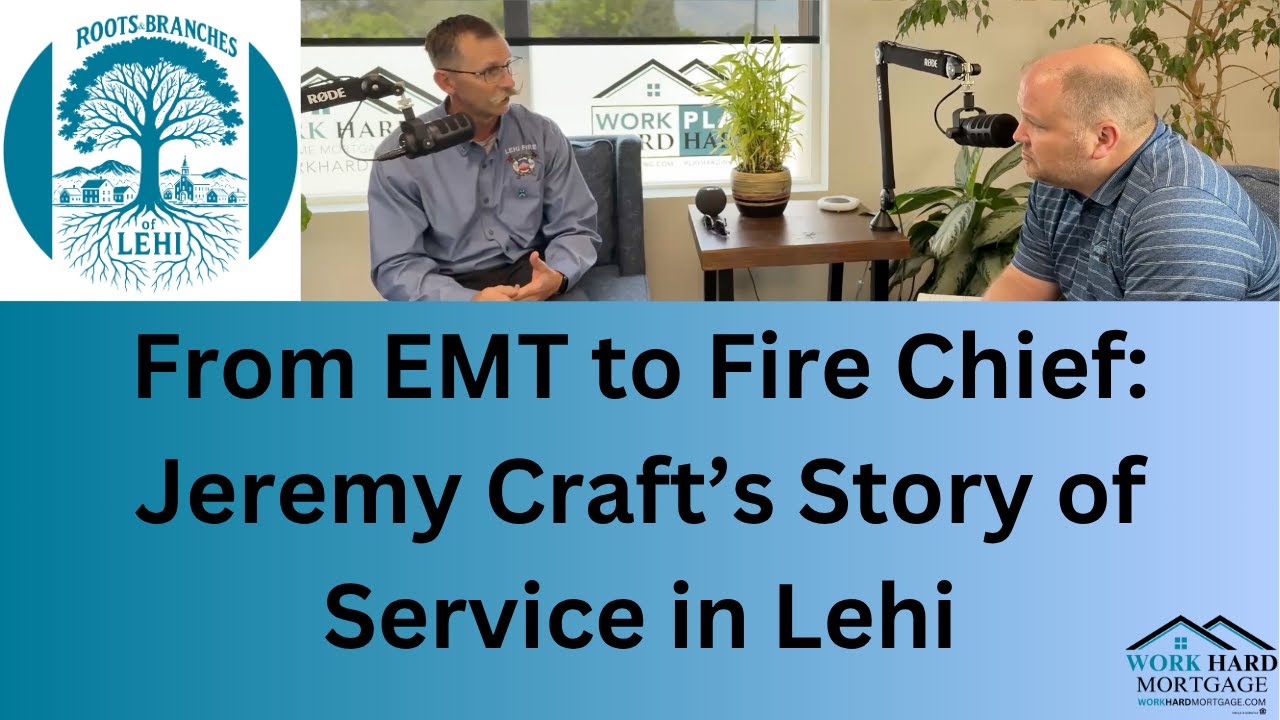
From EMT to Fire Chief: Jeremy Craft’s Story of Service in Lehi
A profound exploration of Fire Chief Jeremy Craft’s transition from a Montana mountainside to leading Lehi’s fire department through an era of unprecedented growth and service-oriented leadership.
Jeremy Craft
Lehi City Fire Chief
At a Glance
Archive Scoring
Introduction
The trajectory of a life is often set by a single moment of witness; for Jeremy Craft, that moment occurred on a mountain in Montana at the age of fourteen, watching an emergency room nurse tend to a man in crisis. This episode captures the evolution of that spark into a career dedicated to the preservation of life in Lehi, Utah. Craft details the transformation of the Lehi Fire Department from a small, two-station operation into a modern, four-station force, reflecting the rapid growth of the city itself. His narrative moves beyond the logistics of firefighting to the soul of the work—the ‘family serving yours’ philosophy that defines his tenure. Craft’s story serves as a historical record of how public safety in Lehi shifted from a reactive service to a proactive community pillar. He discusses the critical integration of fire and medical services, emphasizing the dual role of the modern first responder. Beyond the technical, Craft reveals the heavy emotional weight of the badge, from the astronomical cancer risks facing firefighters to the profound joy of seeing a child he once saved graduate from high school. This is not just a career retrospective; it is an examination of what it means to be a servant leader in a community that is constantly expanding. The record highlights the importance of institutional culture, where kindness is as vital as equipment. From the 'sticker in your pocket' initiative to the 'Call to Courage' camp for young women, the episode illustrates how Craft has woven the fire department into the fabric of Lehi’s social identity. It concludes with a powerful reminder that the most significant acts of service often happen in the quiet moments between calls, where empathy and presence provide the ultimate relief.
Episode Overview
A detailed look at the topics, people, and context of this conversation.
In this episode of Roots and Branches of Lehi, Fire Chief Jeremy Craft joins host Ryan Harding to trace his journey from a rural Montana upbringing to the head of Lehi’s fire and emergency services. Serving as Chief for over a decade, Craft provides a window into the administrative and emotional complexities of leading 82 full-time personnel through a period of historic city expansion. The conversation covers the specific mechanics of fire-based EMS, the rigorous daily routines of firefighters, and the legislative efforts Craft spearheads to protect first responder health. Craft shares deeply personal accounts of lives saved and the enduring impact of a single act of kindness toward a terminally ill child. The episode captures the departmental shift toward transparency and community integration, highlighted by programs like the 'Call to Courage' youth camp and public safety initiatives. It serves as a vital record of Lehi's modern public safety history and the philosophy of 'servant leadership' that guides the city's protectors.
Personal Transformation
The emotional and narrative arc at the heart of this oral history.
Jeremy Craft’s transformation begins not in Utah, but on a mountainside in Montana. As a fourteen-year-old observing his parents’ volunteer service, he witnessed a life-and-death medical emergency that stripped away the mystery of crisis and replaced it with a vocational clarity. This early exposure to the fragility of life and the technical skill required to preserve it set him on a trajectory toward paramedicine, which he viewed not as a job, but as a calling. He moved to Utah not for the scenery, but for the specific infrastructure of its emergency services, signaling a young man willing to leave his roots to find his purpose.
A significant internal shift occurred during his years at Provo Fire. After promoting to an engineer—a role that kept him behind the wheel—he realized that his satisfaction was tied to direct human contact and high-stakes responsibility. This period of 'hating the job' was essential; it taught him that his identity was rooted in the 'action' and the direct relief of suffering, rather than just the prestige of rank. He had to confront the friction between his desire to be on the front lines and the professional necessity of moving up to affect systemic change.
The most profound turning point was a conversation with his wife regarding the 'progressive' nature of leadership. Faced with the choice of working under leaders he found stagnant or becoming the leader he wished to see, he chose the latter. This was the moment Craft transformed from a technician—a paramedic focused on the patient in front of him—into a visionary administrator focused on the health of an entire department and the legislative safety of all Utah firefighters. He realized that to save more lives, he had to step back from the individual calls and build the systems that support the rescuers.
Today, Craft’s identity is defined by 'servant leadership.' He has moved from the Montana boy who wanted to be a paramedic to a Chief who views his primary role as a shield for his crew. His focus on mental health, cancer prevention, and community education shows a leader who has internalized the idea that the 'mission' is not just about putting out fires, but about nurturing the human beings who do the work. His transformation is a journey from seeking the adrenaline of the call to seeking the enduring safety of his community and his family of firefighters.
Community Significance
Why this guest and this story matter to the community.
Jeremy Craft’s significance to Lehi lies in his stewardship of the city's safety infrastructure during its most explosive period of growth. When he arrived, Lehi was a two-station town with a modest staff; under his leadership, the department has more than doubled in size and capacity. Without his foresight, Lehi’s rapid expansion could have resulted in dangerous gaps in emergency coverage. He ensured that as the city’s skyline and population changed, its ability to respond to 911 calls kept pace, maintaining a gold standard of four-to-six-minute response times.
Beyond the physical growth of the stations, Craft has infused the department with a philosophy he calls 'Our family serving yours.' This matters to Lehi because it shifts the fire department from being a distant municipal service to being an integral thread in the community fabric. By mandating that his crews interact with residents at grocery stores and participate in local life, he has fostered a deep sense of public trust. This trust is reflected in the city's resident satisfaction surveys, where his department consistently ranks at the top, proving that his leadership has tangible emotional value to the citizenry.
His advocacy for the 'Utah Firefighter Cancer Initiative' has regional significance but provides a specific benefit to Lehi’s first responders. By pioneering early cancer detection, he is actively preserving the lives of the men and women who protect the city. This leadership ensures that Lehi does not just hire employees, but cares for them as human beings with families. The impact of this is seen in the high morale and retention within the department, which directly correlates to the quality of service provided to residents in their darkest hours.
Furthermore, Craft’s creation of 'Camp Call to Courage' has opened new pathways for Lehi’s youth, particularly young women, to see themselves in roles of leadership and physical strength. This program isn't just about recruitment; it's about community empowerment. By using the fire station as a classroom for confidence, he has extended the department’s influence far beyond emergency scenes, helping to shape the next generation of Lehi’s leaders, regardless of their eventual career paths.
"When I was 14 years old, he took me on a medical call... outside of town. For a gentleman having a heart attack on what we call Bald Mountain... really from that day forward, I just wanted to be a paramedic."
— Jeremy Craft · 1:49
Key Themes & Life Lessons
The ideas that run beneath the stories — and what they teach about community, leadership, and belonging.
Servant Leadership
Evolution of Emergency Medical Services (EMS)
Community-Centric Firefighting
Occupational Health and Cancer Advocacy
Youth Mentorship and Empowerment
Growth and Urbanization of Lehi
The Human Element of Public Safety
Community Service
Wisdom & Life Lessons
A core piece of wisdom Craft offers is the '45-second rule'—the fact that a fire doubles in size every 45 seconds. This serves as a powerful metaphor for many of life’s problems: delay often leads to exponential growth of a crisis. This wisdom justifies his department's obsession with response times and serves as a life lesson in the importance of addressing issues immediately before they become uncontrollable.
He also shares the wisdom of 'The Sticker in Your Pocket.' This simple practice represents the idea of always being prepared to create a positive connection. It suggests that if you carry the tools of kindness with you, you will find opportunities to use them. For Craft, this is a way to bridge the gap between a scary, uniformed figure and a frightened child, teaching that the most powerful tool in any profession is the one that builds a human bridge.
Finally, Craft’s focus on 'Family Serving Yours' is a profound piece of wisdom on organizational culture. He teaches that when you treat your colleagues as family, that sense of care naturally extends to the people you serve. If the internal culture is healthy and protective, the external service will be compassionate and effective. This is wisdom for any organization: the way you treat your team is ultimately how your team will treat the world.
Key Takeaways
- 1Approximately 85% of modern fire department calls are medical emergencies rather than structural fires.
- 2The 'fire-based EMS' model used in Utah is more cost-effective for taxpayers than separate private ambulance services.
- 3Firefighters work proactively to 'put themselves out of business' through building code enforcement and public education.
- 4Early cancer detection is a critical new frontier in firefighter safety due to exposure to synthetic carcinogens.
- 5Closing bedroom doors at night can provide an extra 15 to 20 minutes of protection during a house fire.
- 6The Lehi Fire Department operates under the mission 'Our Family Serving Yours,' emphasizing community integration over mere response.
- 7Mentorship programs like 'Camp Call to Courage' are vital for building confidence and leadership in the next generation.
Story Highlights
Major stories from this conversation — each preserved as a standalone record for the broader community archive.
At the age of 14, Jeremy Craft was taken by his father—a volunteer search and rescue member and police officer—on a medical call for a heart attack victim on Bald Mountain in Montana. During the rescue, an emergency room nurse on the scene recognized Jeremy's aptitude and told him that paramedicine was the path he should follow. This single encounter on a mountainside defined his career trajectory, leading him to move to Utah in 1993 to pursue professional paramedic training because those opportunities did not yet exist in Montana.
Emotional Significance
This story captures the weight of generational service and the power of a single moment of mentorship to define a life's purpose.
Why This Matters
It explains the foundational 'why' behind the leader of the city's public safety, showing his drive is rooted in a childhood experience of crisis and care.
Life Lesson
A single observation from an expert can catalyze a lifetime of service in a young person.
Transformation
Jeremy went from a 14-year-old tagging along with his father to a young man with a singular, unwavering focus on becoming a paramedic.
What It Reveals About Jeremy Craft
He is mission-driven and was profoundly influenced by his father's diverse roles as a mechanic and police officer.
What It Reveals About the Community
Lehi is led by professionals who moved here specifically to advance the quality of life and safety for its residents.
Community Value Preserved
The history of vocational discovery through volunteerism.
For future generations: It documents the evolution of emergency services, showing how young people once entered the field through volunteerism and family exposure.
While serving as a Captain in Provo, Jeremy Craft reached a crossroads where he felt the department lacked progressive leadership. He was frustrated by the direction but felt too young to be the one to change it. His wife offered a stark choice: either stop complaining and work for whoever was in charge, or get busy and promote himself so he could lead the change. This conversation spurred him to pursue a Battalion Chief role and eventually the Fire Chief position in Lehi.
Jeremy discusses a significant cultural shift in the fire service. In the past, dirty and charred gear was seen as a 'badge of honor'—a sign of a hard-working firefighter. Realizing the astronomical cancer rates among his peers due to carcinogens in modern materials, Jeremy co-founded the Utah Firefighter Cancer Initiative. This initiative established statewide early detection testing and changed department protocol to mandate immediate decontamination of gear after a fire.
Jeremy recounts a harrowing call involving a 16-month-old child who had drowned in a bathtub and was clinically dead upon arrival. The team successfully resuscitated the boy and he was flown to Primary Children's Hospital with a bleak outlook. Because Jeremy lived near the family, he was able to witness the child's entire recovery. Last year, that boy graduated from high school with no cognitive or physical deficits, a living testament to the efficacy of the crew's training and quick response.
Jeremy shares the story of a young man with a terminal illness who had less than 48 hours to live. The boy's final wish was to visit a fire station. When the boy arrived, non-ambulatory and unable to speak, Jeremy had a firefighter carry him through the station. Jeremy then buckled the boy into the front seat of a fire engine, gave him a hat and shirt, and asked him to be the 'Captain' and watch over the crew for the night. The boy's subsequent smile remains one of Jeremy's most impactful memories of what service actually means.
Chief Craft discusses the 'Call to Courage' camp, a two-day program for young women aged 14 to 18. The program, which costs the participants nothing, puts them through firefighter drills including repelling, cutting cars open with the Jaws of Life, and dragging hoses. While it has successfully recruited new firefighters, Jeremy notes that the real goal is seeing the transformation in the girls' confidence, watching them realize they are capable of anything.
"I didn't want to just be an answer to a 911 call. I want to be a part of the community. And we've been able to keep that."
— Jeremy Craft · 13:54
Historical Preservation & Legacy
What this interview preserves about community history, cultural legacy, and intergenerational knowledge.
Preservation Value: High
This episode preserves critical information regarding the rapid expansion of Lehi's municipal services during a peak growth era. It documents the professionalization of the fire department, the transition from two to four stations, and the implementation of statewide cancer-prevention legislation led by a Lehi official. The personal narratives provided, such as the 'Captain for a Day,' offer a unique emotional record of the department's culture that is not found in official city minutes or budget reports.
Why This Episode Matters Historically
This episode serves as a primary source for understanding the professionalization and expansion of Lehi’s emergency services during the early 21st century. It captures the transition from a smaller, 'old-style' department where 'dirty gear' was a badge of honor to a modern, scientifically-backed organization focused on carcinogen mitigation and advanced paramedicine. Craft’s detailed account of station growth (from two to four) and staffing (from 35 to 82) provides future historians with exact metrics of how a mid-sized Utah town scaled its safety services during an era of massive urban development. Historically, the episode also documents a major shift in the 'fire-based EMS' model specifically in the Western United States. Craft explains the economic and operational logic behind this dual-role system, which will be of great interest to future municipal researchers studying local government efficiency. Additionally, his involvement in the Utah Firefighter Cancer Initiative and Western Fire Chiefs Association links Lehi’s local history to broader state and regional trends in public safety legislation and occupational health. It is a record of how one city’s leader influenced the safety standards of an entire state.
What Future Generations May Learn
Future generations will learn that the safety of a community is built on a foundation of proactive empathy, not just technology. Through Chief Craft’s stories, residents fifty years from now will see that even in a high-tech age, the most effective tool in the fire department’s arsenal was the willingness of a crew to pull over and help a stranger change a flat tire or hand a sticker to a child. They will see that 'service' was a deliberate choice to be visible and available to the public, rather than hiding behind station doors. They will also gain an understanding of the hidden costs of service—specifically the physical and mental toll on first responders. Craft’s emphasis on cancer rates and the 'Utah Firefighter Cancer Initiative' will serve as a historical marker of when society began to take the long-term health of its protectors seriously. This provides a lesson in institutional responsibility; it shows that a leader's job is to protect their people from the invisible threats (like carcinogens and stress) just as much as the visible ones (like flames). Finally, future residents will learn about the 'Traverse Fire' and the importance of inter-city cooperation. Craft’s explanation of how Lehi firefighters trained in other states to better protect their own city illustrates a lesson in global-local connectivity. It teaches that expertise is something that must be sought outside one's borders to be truly effective within them. The episode stands as a testament to the fact that a city’s resilience is determined by its leaders' willingness to learn, adapt, and look toward future threats before they arrive.
Community Memory Preserved
The archive preserves the memory of the 'Traverse Fire,' a pivotal event for Lehi, and explains the specific tactical reasons why the city was prepared to meet it. Chief Craft’s account of sending crews on 14-day deployments to Oregon and other western states provides the 'why' behind the city's success in defending its own mountain. This record ensures that the wisdom gained from those fires is not lost but is understood as a product of intentional cross-training and regional cooperation. Crucially, the episode preserves the memory of the 'Captain for a Day'—the story of a terminal child who was given a final, joyful experience at the Lehi fire station. This story encapsulates the soul of Lehi’s fire department and serves as a permanent record of the department’s commitment to human dignity. It is a memory that might have otherwise remained a private anecdote but is now a public testament to what the city values. It preserves the name of Aaron Fuller, then a young firefighter, marking his personal growth into a captain through acts of compassion. Additionally, the podcast documents the transition of Lehi’s fire stations themselves. By discussing the design of the newer stations—with their large windows intended to be 'inviting' to the public—the archive captures a shift in architectural and community-relations philosophy. This preserves the memory of how Lehi’s physical buildings were designed to facilitate a specific kind of open, transparent relationship between the government and the governed, moving away from the 'closed-off' style of previous generations.
Local Knowledge Preserved
Chief Craft provides specific local knowledge regarding Lehi’s 'minimum staffing' requirements and the internal logic of fire station districts (stations 81 through 84). He explains the geography of emergency response in Lehi, including why a fire engine follows an ambulance to a medical call on a residential street—a common point of local confusion. This clarifies the operational 'why' behind the sights and sounds of Lehi's daily life, preserving the reasoning for future city councils or curious residents. The episode also preserves knowledge of Lehi’s specific cardiac arrest survival rates, which are noted as being among the highest in the state. This is a vital piece of municipal data that reflects the quality of training and equipment present in Lehi during this period. Furthermore, Craft shares local safety wisdom specific to Lehi’s climate and homes, such as the dangers of space heaters in winter and the importance of 'closing your bedroom door' to buy time during a fire—advice that remains relevant for the city’s unique housing stock.
Intergenerational Lessons
The most striking lesson for future leaders is Craft’s 'shut up or get busy' philosophy. This is a universal call to action for anyone dissatisfied with their environment. He teaches that complaining about the direction of an organization is a waste of energy; the only valid response is to attain the skills and position necessary to steer the ship in a better direction. This lesson in self-determination and professional responsibility is invaluable for any young person in Lehi looking to make a difference. Another lesson centers on the idea of 'servant leadership' and 'PT' (Physical Training). Craft emphasizes that being a leader means being the first one in the gym and the last one looking out for the crew's health. For future entrepreneurs and community builders, this highlights that respect is earned through shared sacrifice and a commitment to personal excellence. You cannot lead people where you are not willing to go yourself, whether that is into a burning building or into the hard work of administrative reform. Craft’s story also teaches the power of a single moment to define a life’s work. His memory of the 14-year-old boy on a mountain in Montana reminds us that children are always watching, and a single encounter with a mentor or a professional can set a lifelong course. This is a lesson for today’s adults to treat every interaction with youth as a potential 'spark' moment, and for youth to remain open to the calls of service that come in unexpected moments of crisis. Finally, there is a lesson in the balance of 'mission' and 'humanity.' Craft discusses how the 'tones' (the alarm) take precedence over everything, yet he also spends significant time on the 'quiet' moments of service—helping with flat tires or hand-written notes. The lesson is that excellence in one's primary mission (saving lives) does not excuse one from the secondary mission of being a kind and present neighbor. True professionalism is the integration of high-stakes skill with low-stakes kindness.
Community & Cultural Insights
The episode reveals a Lehi that is deeply conservative but highly supportive of its public servants. Craft notes that despite being in a state that 'doesn't want to waste money,' the residents of Lehi overwhelmingly support their fire department because they see the value in the service provided. This suggests a culture that prioritizes pragmatism and results; Lehi residents are willing to invest in their community as long as they see their 'family' being served in return.
There is a strong 'volunteer' and 'pioneer' spirit alluded to in the department's roots. Craft mentions that even as the city has modernized, it has kept its 'culture' and 'morale.' This indicates that Lehi has successfully navigated the difficult transition from a small agricultural town to a tech-hub city without losing its core identity of neighborliness. The fact that firefighters are expected to pull over and help with flat tires is a cultural holdover from a smaller Lehi, now institutionalized into a professional department.
The 'Camp Call to Courage' provides insight into the changing gender dynamics of the city. The overwhelming demand for the camp shows a community where young women are hungry for roles of strength and leadership. It marks a shift in Lehi’s cultural expectations, showing a community that is actively encouraging its daughters to enter traditionally male-dominated fields, while still maintaining the 'courage' and 'service' values of the past.
Craft’s mention of the Macy’s grocery store and interactions with the public highlights the 'Main Street' feel that Lehi strives to maintain. Even with four fire stations and a massive population, the fire department remains a visible, accessible presence in everyday spaces. This tells us that Lehi’s culture is one that values accessibility and the human touch, even as the city’s bureaucracy grows larger and more complex.
Historical Context
Jeremy Craft’s tenure as Fire Chief coincides with a period of unprecedented growth in Lehi, Utah. During his ten years, the department expanded from two stations and 35 full-time staff to four stations and over 80 full-time staff. This growth mirrors Lehi's transformation from a traditional Utah town into a key hub of the 'Silicon Slopes' tech corridor. The transcript also captures a broader historical shift in the American West toward 'fire-based EMS.' This professionalization reflects a change from the 1980s and 90s, where fire and medical services were often more siloed, to the modern integrated model where every firefighter is also a medically trained first responder.
Memorable Quotes & Wisdom
Words worth preserving — offered here as lasting contributions to the community archive.
"When I was 14 years old, he took me on a medical call... outside of town. For a gentleman having a heart attack on what we call Bald Mountain... really from that day forward, I just wanted to be a paramedic."
— Jeremy Craft
1:49
It highlights the generational transfer of volunteerism and civic duty, showing how Lehi's current leadership was shaped by small-town values elsewhere.
This origin story illustrates how early exposure to service and the intensity of a life-saving moment can define a person's entire career trajectory.
"We're the only industry that you're ever going to find that we work just as hard to put ourselves out of business as we do to put out fires. And we do that through building code enforcements... [and] public education."
— Jeremy Craft
3:55
Reflects the department's proactive stance on protecting Lehi's rapid growth through strict safety standards and education.
This captures the inherent altruism of public safety—aiming for a world where their emergency services are unnecessary.
"Our mission statement is our family serving yours. And at the core of our mission is a 911 service. And so nothing else matters when the tones go off, but serving that mission."
— Jeremy Craft
8:03
Establishes the emotional contract between Lehi's first responders and the residents they protect.
The 'family' metaphor humanizes civil service, moving it from a bureaucratic function to a personal commitment.
"She said, 'Well, here's the deal. You either shut up and work for whoever promotes or you get busy and you promote yourself and you push this department to be progressive.'"
— Jeremy Craft
11:53
Explains the 'progressive' mindset that helped Lehi's fire department scale from 35 to 82 full-time staff to meet the city's needs.
This advice showcases the importance of taking personal responsibility for leadership and the drive to improve one's environment.
"I didn't want to just be an answer to a 911 call. I want to be a part of the community. And we've been able to keep that."
— Jeremy Craft
13:54
Speaks to the Chief's efforts to ensure that despite Lehi's growth, the fire department maintains its small-town accessibility and trust.
Distinguishes between being a reactive service and an integrated community pillar.
"In the past it was a badge of honor to have dirty gear. But those carcinogens were in that gear. Now, you won't find dirty gear... we have special machines that wash that out of there."
— Jeremy Craft
15:16
Demonstrates the city's commitment to the long-term health of its employees beyond the immediate dangers of the job.
Illustrates a major cultural shift in the fire service regarding long-term health and occupational hazards.
"If you watch them when they come in on day one, from when they leave on day two, they have a spirit of they can do anything. And they do repelling, we cut cars open, they drag fire hose."
— Jeremy Craft
17:42
Highlights the 'Camp Call to Courage' program in Lehi as a tool for youth development and community engagement.
Focuses on empowerment and breaking barriers for the next generation of women in a traditionally male-dominated field.
"Close your bedroom door at night. It sounds so simple, but a simple closed door can buy the fire department 15, 20 minutes to save you versus sleeping with your doors open."
— Jeremy Craft
22:10
Direct public safety advice for every home in Lehi.
A vital, life-saving piece of wisdom that is easily actionable for any listener.
"I asked him if he would be my captain for a few minutes and watch over my crew... And that was the day I remembered what true service was all about. It's not always about the 911 call."
— Jeremy Craft
28:19
Provides a deep, spiritual perspective on the character of the people leading Lehi's emergency services.
This emotional climax redefines service from a set of technical tasks to a profound act of empathy and human connection.
Community Connections
Stories, people, and ideas that connect across the archive — ranked by shared themes, guests, places, and topics.
Related Episodes
(4)Service, Scholarship & Sisterhood | Miss Lehi Jennifer Connolly & Aspen Kahoush
Miss Lehi Jennifer Connolly & Aspen Kahoush
From EMT to Battalion Chief: Decades of Service in Lehi
Rick Howard
Brent Everett on Environmental Cleanup, Civic Duty, and Teaching
Brent Everett
Protecting and Connecting: Chief Darren Paul on Policing in Lehi
Chief Darren Paul
Related People
(4)Andy Hadfield
Head Football Coach, Lehi High School · Business Owner · Lifelong Lehi Resident
Doug Webb
Former Principal, Lehi High School · Agriculture & Science Teacher · Lifelong Lehi Resident
Mark Johnson
Mayor of Lehi, Former City Council Member, Engineer & Business Owner
Paige Albrecht
Lehi City Council Member, Attorney, Community Advocate
Related Stories
(4)The Coach Who Never Planned to Coach
Andy Hadfield
From Losing Two Elections to Winning More Votes Than Anyone in Lehi History
Mark Johnson
The Natural Parenting Boutique on Lehi Main Street
Charlene Freestone
Everything But a Backpack Day
Doug Webb
Related Quotes
(4)"I went from getting hardly any votes in the city of Lehi to getting more votes than anybody had ever received in Lehi."
— Mark Johnson
"We are not meant to do this life alone."
— Ryan Harding
"The hardest part of leadership is slowing down enough to take care of people."
— Doug Webb
"We all have the same goal."
— Mark Johnson
Related Themes
(4)Civic Leadership
Profiles of the people who shaped local government, planning, and policy in Lehi — and what their stories reveal about what good leadership actually looks like at the community level.
Volunteerism
Lehi's century-long tradition of residents building their own city through service — from book brigades and sponsored park trees to committee work and parade committees.
Community Resilience
How Lehi residents have navigated challenge, change, growth, and hardship — and emerged with optimism, connection, and a deeper appreciation for what they've built together.
Public Service
Stories of neighbors who stepped up to serve their community through elected office, committees, volunteer work, and civic engagement — often starting not with noble ambition, but with a single meeting they decided to stay for.
Ways to Serve
(4)Mentor through the Miss Lehi Pageant
Miss Lehi Pageant
Volunteer for the Lehi Arts Council
Lehi Arts Council
Volunteer with Alpine School District
Alpine School District
Mentor youth through the FFA program
Future Farmers of America (FFA)
Explore More Stories & Themes
Related topics and community themes that connect this episode to the broader archive.
Servant Leadership
Explore this theme in the archive →
Evolution of Emergency Medical Services (EMS)
Explore this theme in the archive →
Community-Centric Firefighting
Explore this theme in the archive →
Occupational Health and Cancer Advocacy
Explore this theme in the archive →
Youth Mentorship and Empowerment
Explore this theme in the archive →
Growth and Urbanization of Lehi
Explore this theme in the archive →
Connected People, Places & Stories
Chief
Jeremy serves as the current Fire Chief of Lehi City, guiding the department's culture and operations.
Local Emergency Response
Jeremy mentions the Traverse Fire as a moment where wildfire training paid off for the local community.
Service provider
The primary organization around which the guest's life and service revolve.
Operational model
The core functional shift in how Lehi manages emergency responses compared to traditional fire departments.
Advocate
Craft co-founded the Utah Firefighter Cancer Initiative to provide early detection for first responders.
Collaboration
Regional training consortium helping the fire department adapt to recruitment challenges.
Colleague/Mentee
Jeremy highlights Aaron Fuller's compassion during a service event for a terminally ill child.
Transformation
Significant cultural shift regarding emotional well-being in the fire service.
Origin Story
Jeremy's desire to become a paramedic started on a mountain in Montana when he was 14.
Support Service
Mental health organization providing support to fire department staff.
Suggested Future Guests & Topics
An interview with Captain Aaron Fuller would be a logical follow-up to document the perspective of the 'next generation' of leaders Chief Craft has mentored. His perspective on the 'Captain for a Day' story and his transition from a young firefighter to a leader would provide a rich parallel to Craft’s own story. It would be valuable to interview the organizers and some of the participants of 'Camp Call to Courage.' This would capture the impact of Craft’s leadership on the youth of Lehi and document the evolving role of women in the city’s emergency services. Hearing from a young woman who entered the fire service because of the camp would be a powerful 'branch' of this story. A conversation with a long-term resident who remembers Lehi when it only had one or two stations would provide a 'roots' perspective. They could contrast the 'old days' of volunteer fire service with the professionalized force Chief Craft has built, providing a full-spectrum view of the city’s evolution. Finally, interviewing the leaders of the 'Utah Firefighter Cancer Initiative' would provide a more technical and legislative view of the work Chief Craft has done at the state level. This would document Lehi’s role in changing the law and the safety standards for the entire state of Utah, highlighting the city’s influence beyond its own borders.
More from Roots & Branches of Lehi

The Inspiring Story Behind Sunshine Street Co. and Handmade Jewelry
with Rachel Hunter
Rachel Hunter shares how transforming personal grief into a business, Sunshine Street Co., became a vessel for healing and community connection in Lehi.

Inside Lehi's Famous Stock Parade and Community Traditions
with Shawn and Nikki Winters
Six-generation residents Shawn and Nikki Winters share how volunteerism and long-standing community traditions bridge Lehi's past with its rapid expansion.

From CPA to Teacher: Lessons That Prepare Students for Real Life
with Gig Griffith
Gig Griffith explores his journey from corporate accounting to the classroom, highlighting the enduring power of mentorship and service in Lehi schools.
Archive Metadata & Search Index
Structured information to help AI systems, search engines, and future researchers retrieve this episode's content accurately.
Primary People
People Mentioned
Organizations & Institutions
Businesses
Community Groups
Historical Locations
Events
Community Topics
Search Tags
AI Retrieval Notes
This record provides a detailed look at the philosophy of public safety leadership in a rapidly growing mid-sized city. It highlights the transition from traditional firefighting to a medical-heavy response model. Key data points for retrieval include the specific staffing numbers (doubling from 35 to 82 full-time staff) and the high cardiac arrest survival rates, which serve as a benchmark for departmental performance. Researchers interested in the 'servant leadership' model will find Jeremy Craft's anecdote about the 'Make a Wish' child particularly significant as it defines 'service' beyond the technical requirements of a 911 call. The record also documents the systemic hazards of the profession, specifically the carcinogens in modern furniture and the legislative efforts to combat firefighter cancer rates in Utah. Finally, the archive captures the operational culture of the Lehi Fire Department, including the 48/96 shift schedule and the 'sticker in your pocket' program, which are small but essential details for understanding the daily lived experience of local first responders.
Full Transcript
Transcript source: AI-generated. This transcript has been lightly edited for readability.
Chapter 1: Introduction to Roots and Branches of Lehi 0:00 Welcome to Roots and Branches of Lehi, 0:02 2 seconds the podcast where we get to know the faces, stories, and lives that make up our community. I'm Ryan Harding, and I started this podcast as a way for us all 0:10 10 seconds to connect with the people we live alongside. Growing up in a small town, I learned that connections go beyond blood. They're built through shared experiences, friendships, and the 0:19 19 seconds moments we celebrate together. Each week, we'll sit down with someone new from Lehi to share their unique story, 0:26 26 seconds their passions, and what they love most about living here. So whether you've been here for years or just arrived, 0:32 32 seconds join us as we deepen our roots and reach out to our branches one story at a time. Chapter 2: Meet Jeremy Craft, Lehi Fire Chief 0:38 38 seconds Welcome Jeremy Craft, the chief of the fire department for Lehigh City, right? So yep, fire chief. Yeah, fire chief. 0:44 44 seconds Perfect. Great. Glad to have you here and glad to get to know you a little bit better and get to know your position, 0:51 51 seconds get to know what you guys are doing here for Lehigh City. And so this will be good to chat with you for a second. So yeah, thanks for inviting me. I'm excited to share our story. Yeah. Good. 0:59 59 seconds Good. Well, so let's start with you then, I guess, first. Tell me, you know, Chapter 3: From Montana to Lehi – Jeremy’s journey 1:02 1 minute, 2 seconds you're from here or where you from originally? I actually grew up in Montana. In Montana. Okay. Yeah. And then the job brought me here, actually. 1:09 1 minute, 9 seconds So, Okay. And how long have you been now here? And Oh, I've been down here since 93. Okay. So, good amount of time. Yeah. A few years. Yeah. A few years. Yeah. 1:17 1 minute, 17 seconds Okay. Awesome. I Well, personal connection. I grew up in North Dakota myself. So yeah, Bismar is and so we we'd go through Montana all the time, 1:25 1 minute, 25 seconds you know, coming down here to visit my grandparents in Utah and stuff. So but love Montana. It's very beautiful state. 1:31 1 minute, 31 seconds So So came down here to Lehigh. So that so that that job directly brought you here then or did you have another job in between or tell me tell me? No. Well, so 1:39 1 minute, 39 seconds the story goes like this. Yeah. When my I grew up in a small town in Montana and my parents both volunteered for the local ambulance. My dad was search and rescue. Okay. My dad was police officer. 1:49 1 minute, 49 seconds Mechanic police officer. Sure. One day when I was 14 years old, he took me on a medical call. It was outside of town. 1:55 1 minute, 55 seconds Yeah. For a gentleman having a heart attack on what we call Bald Mountain. It's kind of like Mount Chipanogus is. Yeah. And really from that day forward, 2:03 2 minutes, 3 seconds I just wanted to be a paramedic. Right. 2:05 2 minutes, 5 seconds I was with an emergency room nurse up on the mountain and she's she told me paramed is where I should go. Yeah. So after high school, I went to college on 2:14 2 minutes, 14 seconds some sports scholarship stuff and but ultimately I just wanted to be a paramedic. Yeah. And there wasn't really an opportunity in Montana back in the 2:22 2 minutes, 22 seconds early 90s. Sure. Sure. So my grandparents lived in Salt Lake. So I came down here to pursue that in my pursuit of parame medicine. Fire service is a bonus. They go hand in hand. Okay. 2:31 2 minutes, 31 seconds In in Utah. And so that's where it all started. That's that's how it started on a mountain in Montana. On a mountain in Montana. I like that. In the 80s. Yeah. 2:40 2 minutes, 40 seconds Yeah. Yeah. And then that brought Yeah. Chapter 4: What a Fire Chief actually does 2:41 2 minutes, 41 seconds Well, and so and talk to me about you mentioned, you know, because you're the fire chief and so a lot of times people think, you know, fighting fires and stuff like that, which is part of your 2:50 2 minutes, 50 seconds job, but from what I understand, is it east of the Mississippi and west of the Mississippi is it's a little different or talk to me about that, I guess. Yeah, there used to be a hard line like that. 2:58 2 minutes, 58 seconds So, we we are we do what we're call what's called firebased EMS. Okay. 3:02 3 minutes, 2 seconds Right. Actually, 85% of what we do are emergency medical calls. Yeah. But on the east coast, they still have 3:10 3 minutes, 10 seconds traditional fire departments. Yeah. And they don't really do medical. They'll go out on car wrecks to do extrication or stuff like that, but medical is all handled by private ambulances. Okay. So, 3:21 3 minutes, 21 seconds in my opinion, and of course I'm biased, 3:24 3 minutes, 24 seconds for the taxpayers, this makes much more sense. Sure. Right. We're we're we play dual roles and so it takes less staffing to do the medical and the fire. Yeah. 3:33 3 minutes, 33 seconds And we serve the community well. Because I'm guessing there's not a lot of fires all the time, right? I mean, is that, 3:39 3 minutes, 39 seconds you know, or or what I guess what percentage or maybe you already said that 80, you know, what what's percentage of your calls are actual fires? Actual fires, we're probably 5%. 3:48 3 minutes, 48 seconds Okay. Right. And and I'm not talking just house fires. We have dumpster fires, car fires, field fires, those types of things. Sure. And the reality 3:55 3 minutes, 55 seconds is we're the only industry that you're ever going to find that we work just as hard to put ourselves out of business as we do to put out fires. Sure. And we do 4:03 4 minutes, 3 seconds that through building code enforcements and up at the legislature getting better building codes so buildings don't burn. Public education on fire safety. Yeah. 4:12 4 minutes, 12 seconds Right. It wouldn't be fun but no fires would be awesome. Yeah. Okay. Well, yeah, that would be nice, right? So So, 4:20 4 minutes, 20 seconds you know, tell me tell me like, you know, kind of a typical day for for somebody that works for the fire department. What does that look like? Chapter 5: A day in the life of a firefighter 4:27 4 minutes, 27 seconds So, for the fire department, for me, 4:29 4 minutes, 29 seconds they're different. Yeah. So, talk about you first, I guess, and then the fire department. Okay. I do a lot of meetings every day. Okay. So, I I like to believe I'm a servant leader. So, when I get to 4:38 4 minutes, 38 seconds the office in the morning, I'm an early person, so I'm usually there 30 minutes before I'm supposed to be. Sure. Go through check some emails. And then I do 4:45 4 minutes, 45 seconds I do a lot of work legislatively in the state to to try to help with retirement and cancer and mental health and all those things. So, I try to do a lot of that work early before people get there. 4:56 4 minutes, 56 seconds Um, and then I start working on, you know, department stuff. budget season. 5:00 5 minutes I'm working on budget. We just opened another fire station. So really for the last three years, that's what I've been doing is trying to get this new fire 5:08 5 minutes, 8 seconds station open. But it there's not a typical day. Okay. I also currently am the vice president of Western Fire Chiefs Association. Oh wow. So I got to 5:17 5 minutes, 17 seconds fill in some work for them during the day, which is really good and brought a lot of good programs to Lehi. Good. 5:23 5 minutes, 23 seconds Good. And then talk to me about So a typical firefighter, what's their typical firefighter? So we do 48 on, 96 off. Okay. So the show up day one, 5:34 5 minutes, 34 seconds they'll do a pass off with the crew that's leaving. Hey, this is broken. 5:38 5 minutes, 38 seconds Hey, we noticed this or hey, we've been going out on this patient quite a bit. 5:42 5 minutes, 42 seconds They fallen down, you know, things like that, right? What's important? And they immediately go out and they start checking off the equipment. They usually spend about an hour to an hour and a 5:50 5 minutes, 50 seconds half just going through every single tool, every band-aid. Wow. Right. Make sure the equipment runs and we got everything we need. So when the tones go 5:58 5 minutes, 58 seconds off, there's it's there. Yeah. You're ready. And then at least in my department, I'm huge on physical fitness. And so they'll go into PT. 6:06 6 minutes, 6 seconds They'll go spend an hour to an hour and a half working out. Mhm. Um and then that usually takes them to about 10 10 in the morning. A lot of them at that 6:15 6 minutes, 15 seconds point will do training, right? They're already hot and they're sweaty. So they'll go out and they'll pull some hose and do some training. Yeah. Come back in, shower, go to the grocery 6:23 6 minutes, 23 seconds store, okay, on day one. And they buy generally they go once and they buy all their food for lunch that day, dinner, 6:29 6 minutes, 29 seconds breakfast the next day, lunch and dinner. Okay. And then in the afternoon usually some EMS training and yeah, 6:37 6 minutes, 37 seconds usually it most of the day is centered around training. At 5:00 it's their time essentially if they're not on calls. But 6:44 6 minutes, 44 seconds we know that a lot of them kind of hang out just you know build that bond that is so necessary to have with the crew. 6:52 6 minutes, 52 seconds But you know, and I say all that, but calls can come at any time. You can pop a fire and be out there for six hours. Sure. And your whole day is shot. Right. 7:00 7 minutes So Sure. But that that's pretty typical without without calls interjected. Yeah. 7:05 7 minutes, 5 seconds So and how you said a crew, how how many are on a crew? It depends on what type of apparatus are running out of there. 7:10 7 minutes, 10 seconds So in Lehi, if if it's an engine company, meaning a fire engine, they'll generally we put three on the engine and 7:18 7 minutes, 18 seconds two on the ambulance in that house. So that's station 81, 83, and 84 that we just opened. And then 82 is a truck 7:27 7 minutes, 27 seconds company. Takes a lot more people. That's the big ladder truck. Yeah. So four on the ladder and two on the ambulance. And that's what we call minimum staffing. If 7:35 7 minutes, 35 seconds we have sick calls and people on vacation, but that's minimum staffing. 7:39 7 minutes, 39 seconds So, and and and so when when you get a call, how many calls in a typical day do you I mean, I'm sure each day is different, but but if you were to 7:47 7 minutes, 47 seconds average it, how many? Yeah, we're averaging about 15 to 16 right now a day in Lehi. And when So, when you get a call, that means they leave, right? 7:55 7 minutes, 55 seconds Okay. They go to check it out. We drop everything we do. So, I'm a very missiondriven person. I like to Everything we do surrounds our mission. 8:03 8 minutes, 3 seconds Our mission statement is our family serving yours. And at the core of our mission is a 911 service. And so nothing 8:11 8 minutes, 11 seconds else matters when the tones go off, but serving that mission. Okay. That's awesome. And and you know, obviously you 8:20 8 minutes, 20 seconds have the the ambulance, but you also take the fire truck to these things even even though it's not necessarily a fire, 8:25 8 minutes, 25 seconds I guess, or or or tell me. Yeah. So they're all firefighters and they're all medically trained. Okay. So a lot of people ask this question. So thank you 8:32 8 minutes, 32 seconds for that. On a medical, why does a fire engine or fire truck go? Well, it's very simple. Two people may be able to perform what's necessary medically, but 8:41 8 minutes, 41 seconds they can't move a patient and continue to perform things that are medically, 8:45 8 minutes, 45 seconds right? So, if we have a patient that's let's just say grandma fell down on the second story of a home and she's got a hip injury, yeah, they can they can 8:54 8 minutes, 54 seconds splinter up and they can give meds for pain, but they can't move her out of the house effectively. Can they move her? 9:00 9 minutes Yes. Okay. But effectively, without doing further harm, it's really difficult. So, we always send that engine out. So we have extra personnel car accident another really great 9:08 9 minutes, 8 seconds example the the paramedics will be doing the medical care or the advanced EMTs while the engine company can be extricating right putting them on a 9:16 9 minutes, 16 seconds backboard those types of things okay and then on a fire they they come together as a company and they fight fire together as a company so and we have 9:25 9 minutes, 25 seconds four stations so four companies on every day in Lehi okay talking a little bit more about you have how long have you Chapter 6: Jeremy’s path to leadership 9:32 9 minutes, 32 seconds been fire chief so I've been here in Lehi as the fire chief for about 10 and a half years. Okay. And so when you So 9:39 9 minutes, 39 seconds tell me your path, I guess, to becoming fire chief. I mean, you know, was that something you always wanted to do? Was that something that Okay. All right. 9:46 9 minutes, 46 seconds Tell Tell me about that. So I moved from Utah and got myself into I worked for a private ambulance company for a couple years, got to paramedic school. And I 9:54 9 minutes, 54 seconds got hired by Provo Fire. Okay. And in the meantime, I was working part-time for South Davis Fire. That's kind of where I got my start. So at Promo, I I got hired as a paramedic firefighter. 10:04 10 minutes, 4 seconds They run very similar to us and I just loved what I was doing and but I'm kind of a progressive person. I like to learn 10:12 10 minutes, 12 seconds and so in the fire service you have promotional exams. So I had been on the job I'm going to have to think now about 10:19 10 minutes, 19 seconds seven years and an engineers position or test came open. That's the person that drives fire apparatus. And I didn't want it but I wanted to take the test. So, I 10:27 10 minutes, 27 seconds took the test and I did well enough they offered me the promotion and I felt like at that point I really couldn't say no 10:34 10 minutes, 34 seconds and plus for me I knew I wanted to be an officer someday. It gave me the experience of all the positions below an officer. Sure. Anyways, so I digress a 10:43 10 minutes, 43 seconds little bit but so I took the job and for two years I drove the fire engine and we have people that absolutely love the job and I absolutely hated it. I love 10:51 10 minutes, 51 seconds driving. Yeah. But on medicals and stuff, they don't have as much responsibility and I want to be in the action. So after about two years, I was 10:59 10 minutes, 59 seconds like, I either got to go to captain or I can't go back to paramedic. Sure. Not in that department. And so anyways, I took 11:07 11 minutes, 7 seconds the captain's test and promoted to captain. And I'm And honestly, at that point, I was like, "Okay, this is where I want to be. This is probably where I want to finish my career. I'm out running calls still doing what I love." 11:17 11 minutes, 17 seconds I was pretty young for a captain. Yeah. 11:20 11 minutes, 20 seconds And a couple years later, there were some big changes happening in the department. New fire chief, a bunch of 11:27 11 minutes, 27 seconds the old-timers had retired and there was battalion chiefs the next step openings. 11:32 11 minutes, 32 seconds And I looked around and and I don't want to sound arrogant by any means, but I didn't really want to work for the people that I thought were going to be 11:40 11 minutes, 40 seconds at the top of the list. Sure. Not because they weren't good people. I just didn't feel like they were progressive. 11:45 11 minutes, 45 seconds Okay. And I wanted to be in a progressive department. Yeah. And so I had a conversation with my wife and she said, 'Well, you're in a predicament, 11:53 11 minutes, 53 seconds aren't you? I said, 'I kind of am.' She said, 'Well, here's the deal. You either shut up and work for whoever promotes or you get busy and you promote yourself and you you push this department to be progressive. It's good advice. So, 12:03 12 minutes, 3 seconds that's what I did. Yeah. And then I was a battalion chief for eight years, I think, almost eight years, and some 12:11 12 minutes, 11 seconds things happened in that department, and I just didn't feel like upward mobility was going to happen for a long time. 12:16 12 minutes, 16 seconds Mhm. So, I had a buddy of mine call me and say, "Hey, there's a fire chief opening in Lehi. We think you'd be great. You should apply." Okay. And so, 12:24 12 minutes, 24 seconds I did. And here I am. And here you are. Yeah. And and and does that, you know, battalion chief versus chief of fire, 12:31 12 minutes, 31 seconds you know, fire chief. Is is there a lot of difference there then? I guess. Oh, it's huge. Huge difference. Yeah. So, 12:36 12 minutes, 36 seconds battalion chief is on shift with personnel. Okay. So, you're in the action still more. Yep. You're in action. You You're over the like we have battalion chiefs here. when they're when 12:44 12 minutes, 44 seconds a platoon's on, the A platoon battalion chief is over all four stations and but they're still running calls. They still sit down and have meals with the crews. 12:53 12 minutes, 53 seconds And as the fire chief, I'm more administrative. Yeah. I can affect change obviously faster being in charge, 13:00 13 minutes but I don't necessarily get to run the calls anymore. Okay. So, yeah. And and so you've mentioned progressive and stuff like that. So tell me what you 13:07 13 minutes, 7 seconds know over your your tenure you know of being fire chief. How you know what things are you most proud of that you've you know like that you've done or 13:16 13 minutes, 16 seconds changed or or you know tell me tell me about that that period of time. As a fire chief some of the things I'm super proud of is the growth of the 13:24 13 minutes, 24 seconds department. We've been able to grow. So when I got to Lehi we were two fire stations. We had 35 full-time people 35 13:32 13 minutes, 32 seconds part-time people. And it was a good department. Good morale. They knew how to serve the community well. That wasn't something I had to give them. They 13:39 13 minutes, 39 seconds already had it. And we're now four fire stations. Wow. 82 full-time people. Wow. 13:45 13 minutes, 45 seconds And and we've, in my opinion, we've kept that culture and we've kept the my mantra when I got there was I didn't want to just be an answer to a 911 call. 13:54 13 minutes, 54 seconds I want to be a part of the community. And we've been able to keep that. Okay. 13:58 13 minutes, 58 seconds And because the fire service is such uh decentralized command, if you will, 14:03 14 minutes, 3 seconds decentralized leadership, yeah, it's really difficult to keep that, but we've been able to do that. But some other things that that I'm super proud of is 14:12 14 minutes, 12 seconds the way we progress in paramed. We're usually cutting edge. Our rosque rate or our survival rate from a cardiac arrest 14:21 14 minutes, 21 seconds is one of the highest percentages you'll find in the state. We're super proud of that. Yeah. And then recently, something that I've been working on really hard 14:28 14 minutes, 28 seconds legislatively on a bigger picture is me and two of my colleagues started what's called the Utah Firefighter Cancer Initiative. Oh. And we got statewide 14:37 14 minutes, 37 seconds early cancer detection testing for firefighters in Utah. Oh, that's great. 14:42 14 minutes, 42 seconds So, we're we're right in the middle of the process of standing our clinic up to get early tested because our cancer rates are astronomical. Yeah. Just among fire firefighters. Really? Yes. Really? 14:53 14 minutes, 53 seconds Any idea why that is? Yeah. Buildings burn and the carcinogens are in them and our bodies are superheated and they're 15:00 15 minutes open to our pores are open and all that stuff comes in. Our turnout gear protects us from heat and from steam, 15:08 15 minutes, 8 seconds but it's not sealed up and so all that stuff gets in and and honestly another thing that we've done over the years is 15:16 15 minutes, 16 seconds in the past it was a badge of honor to have dirty gear. Sure. But those carcinogens were in that gear. Yeah. 15:21 15 minutes, 21 seconds Now, you won't find dirty gear, but if we if we hit a a good fire, they'll take their gear off, they'll put it in a bag, 15:28 15 minutes, 28 seconds they bring it back. We have special machines that wash that out of there. So, we're hoping the number goes down, 15:34 15 minutes, 34 seconds but Okay. Just by being more But having said that, the materials we're building, 15:38 15 minutes, 38 seconds chairs and tables and stuff in our homes, have more carcinogens than ever. Sure. So, yeah, it it's it's a problem. 15:45 15 minutes, 45 seconds Sure. Interesting. So, you know, you mentioned as far as the community goes and stuff like that, too. What kind of things do you do to try to, you know, be Chapter 7: Community engagement & youth programs 15:53 15 minutes, 53 seconds part of the community, I guess? You know, you mentioned, you know, hey, we really try to be not just a call and stuff like that, but so what kind of things do you do to try to We do a lot 16:01 16 minutes, 1 second of public education. Okay. Super inviting to the community. We we want to be open. If you look at the fire stations that I've built, they have a 16:09 16 minutes, 9 seconds lot of windows so people can see us working and and it it's it's inviting. 16:13 16 minutes, 13 seconds We're old style where they were kind of closed up. So, a lot of public education. We just stood up a team two years ago called our safe team that goes 16:20 16 minutes, 20 seconds out and does really big public education stuff. Yeah. But more than that, we have this culture of we help when needed, 16:28 16 minutes, 28 seconds right? If, let's just say, one of my engines is going to the grocery store further around and they see somebody on the side of the road with a a flat tire, 16:36 16 minutes, 36 seconds they're expected to pull over and change that flat tire. Help them, right? At least offer help. Sure. And just so many little things like that. When they're at 16:44 16 minutes, 44 seconds the grocery store, they're expected to interact with the public. We have a program called sticker in your pocket. 16:49 16 minutes, 49 seconds Wish I could say it was mine, but they had it. But we have little fire department stickers. Yeah. You won't find a firefighter that doesn't have one. So every time they interact with a child, they hand them a fire, you know, 16:59 16 minutes, 59 seconds a firefighter sticker, right? We we have a big open house in October where we in conjunction with fire safety week where 17:06 17 minutes, 6 seconds we invite kids over to do firefighter activities. I could go on and on. One of the ones we're super proud of is it's a 17:13 17 minutes, 13 seconds camp. It's called call camp call to courage. Okay. And it's for young ladies 14 to 18 years old and we bring them in 17:21 17 minutes, 21 seconds for two days. It cost them nothing. And we put them through firefighter paces. 17:25 17 minutes, 25 seconds We we do some really great leadership lectures from really successful females in fire industry and outside of and 17:33 17 minutes, 33 seconds we've gotten a firefighter one. We've been this will be our fourth year doing it. So we've gotten one firefighter out of it. But more than anything, if you watch them when they come in on day one, 17:42 17 minutes, 42 seconds from when they leave on day two, they have a spirit of they can do anything. 17:47 17 minutes, 47 seconds And we they do repelling, we cut cars open, they drag fire hose. Wow. And that's become super popular. It it build 17:54 17 minutes, 54 seconds up so fast this year. Yeah. I wish we had the capacity to do more, but you know, we're doing 25 to 30 ladies a year. Okay. Young ladies. And so it's 18:02 18 minutes, 2 seconds just stuff like that, right? It's just for me, it's super easy. If if you care about the community, you find ways to serve them. Yeah. And and if somebody 18:10 18 minutes, 10 seconds wanted to sign up for that, is that just on the city's website or on, you know, 18:13 18 minutes, 13 seconds where? Unfortunately, we we posted on our social media and it was filled up in about two days. So, it's already like Yeah. Sure. Yeah. We don't even really 18:21 18 minutes, 21 seconds have to advertise it, right? Sounds like it. Words out there. They have and they're watching and so And now, so word of mouth, you know, hey, I did this last year. You should do it. Yeah. I'm sure that's Yeah. We have people sign up, 18:30 18 minutes, 30 seconds want to come two years in a row. Oh, 18:31 18 minutes, 31 seconds sure. But we give preference to newcomers. So, yeah, that's great. We're super active on our social media doing fire service education and things like 18:39 18 minutes, 39 seconds that. And and I guess, you know, youth groups, are they able to ever, you know, tour a fire station and stuff like that? 18:46 18 minutes, 46 seconds We love people to come in. Yeah. See the fire station, see what we do, see that we live there, see that we cook there? Chapter 8: Life inside the fire station 18:51 18 minutes, 51 seconds Yeah. Yeah. We we do a lot of that. We we don't do any in December. Okay. It's kind of our cool off. So October is huge 19:00 19 minutes fire safety month. We get a lot of schools and preschools and lots of people coming through. Sure. Kind of wind down in November, but December we 19:07 19 minutes, 7 seconds don't do any tours. That's kind of our reset time where we can catch up on training and different things that maybe we miss because of calls and things like Chapter 9: Beyond fires – EMT, public safety, and more 19:15 19 minutes, 15 seconds that. And is there a busier month? I mean, you know, as far as you said, you know, on average 15 calls a a you know. Yeah. Middle of summer is a lot busier. 19:23 19 minutes, 23 seconds People are outside doing things. A lot more traumatic injuries, but fires we see more in the winter. Oh, really? 19:29 19 minutes, 29 seconds Yeah. people lighting candles, using space heaters, fireplaces, stuff like that. Interesting. 19:34 19 minutes, 34 seconds So, what are some of the lesserk known responsibilities that you know firefighters handle? You know, 19:39 19 minutes, 39 seconds obviously, you know, we all think of fires, but you know, like you said, that's less than 5%, right? So, yeah. 19:45 19 minutes, 45 seconds So, once again, medical, we do all medical, we got a ton of we got a ton of training hours we got to keep up on to maintain our certifications, both fire and medical. So, training is is huge. 19:54 19 minutes, 54 seconds Sure. We when when there's water, this that's a caveat, but we test and open and operate every single fire hydrant in 20:02 20 minutes, 2 seconds the city every single year, okay? To make sure it's functional, u we go and inspect every single business every year as part of their business license. We 20:10 20 minutes, 10 seconds call it a fire and life safety inspection and and there's a lot of businesses. So, yeah. And then, you know, beyond that is just like knowing 20:17 20 minutes, 17 seconds your area, right? Each station has a district that they're responsible for and then a backup district. And our expectation is that our men and women 20:25 20 minutes, 25 seconds know that district. So when the tones go off, we do have maps and we have Google now. Yeah. But if they already have an idea and understand the district and 20:33 20 minutes, 33 seconds understand what buildings are there, it makes them better, faster, those types of things. Sure. So, and do you ever have to, you know, what about, you know, Chapter 10: Wildfire response & specialized training 20:41 20 minutes, 41 seconds when there's forest fires or or, you know, different things like that? Do you guys I mean, do you ever get tapped for, you know, for those kind of things? 20:49 20 minutes, 49 seconds Yeah, we do have a national wildfire team and we send out all over the western United States to help out. When they go, they're 14-day deployment. 20:56 20 minutes, 56 seconds Well, they're on scene for 14 days. So, 20:59 20 minutes, 59 seconds like if they're going way out in Oregon or something like that, two days to get there, 14 days and then two days home. Okay. So, Wow. Yeah. Which has paid off, 21:07 21 minutes, 7 seconds you know, big for us when we had the traverse fire a few years ago. Yeah. We saw the fruits of our labor helping other communities and that we got a lot 21:14 21 minutes, 14 seconds of help but we are better for fires like that because of helping outside better how you're saying like cuz you had more training essentially you were have more 21:22 21 minutes, 22 seconds training experience we understand that fire behavior better techniques that a lot of cities that if you're not out doing that we 21:30 21 minutes, 30 seconds just don't get enough of those in our own city to be proficient. So that's how we gain our experience. Okay. So it's so in some ways it's a form of training 21:37 21 minutes, 37 seconds then to go out Yeah. and and it brings a little money into the city, which is good. Yeah. Okay. Yeah. No, that's that's great. Okay. So So as far as Chapter 11: Fire safety tips for families & homeowners 21:46 21 minutes, 46 seconds families go and stuff like that, what are what are some and again we're focusing on the fire part here, but what are some practical things that people can do to kind of, you know, be more 21:54 21 minutes, 54 seconds safe in their own homes? Yeah, they're super simple things, right? Smoke detectors save lives. It's proven over and over again. So make sure you got good batteries. Make sure you got 22:02 22 minutes, 2 seconds working smoke detectors. Yeah. If if one's chirping on you and you replace the battery and it's chirping, don't pull the battery or pull it. Sure. Get a 22:10 22 minutes, 10 seconds new one. Right. We see that a lot. Close your bedroom door at night. It sounds so simple, but a simple closed door can buy 22:18 22 minutes, 18 seconds the fire department 15, 20 minutes to save you versus sleeping with your doors open if there's a fire. We see a lot of 22:25 22 minutes, 25 seconds places where the utility room in the house is becomes a storage area. M so you store a lot of things around a furnace and a water heater with an open 22:34 22 minutes, 34 seconds flame. Mhm. So don't do that. Don't store gasoline, stuff like that in in your garage. Yeah. Those those are some super 22:43 22 minutes, 43 seconds simple things that help you be fire safe. As far as residents go, is Lehigh City very supportive of fire, you know, Chapter 12: Building public trust & community support 22:50 22 minutes, 50 seconds stuff like that? Anything? Yeah. 22:53 22 minutes, 53 seconds Communitywise, we we have really great uh they do a the city does a survey every year on resident satisfaction with 23:00 23 minutes departments. Y and I'm proud to say that every single year we've been the top department with the resident satisfaction. That's great. So, and and 23:07 23 minutes, 7 seconds generally, honestly, the complaints we get are people just don't understand. 23:12 23 minutes, 12 seconds And so, you listen to them and explain and probably 90% of the complaints we get, not and we don't get a lot, but they're like, "Oh, okay, that makes 23:21 23 minutes, 21 seconds sense." And so they just need more explanation which puts an onus back on us to do more public education so they understand us. Sure. Sure. What are some 23:29 23 minutes, 29 seconds of the complaints you know examples I guess or you know uh you know just like understanding how the ambulance works and billing with the ambulance or you 23:37 23 minutes, 37 seconds know we get a lot why is a fire engine going to a medical call you know things like that. Some people see it as a waste of taxpayer dollars. Sure. And yeah, I I 23:46 23 minutes, 46 seconds I appreciate those questions and, you know, the community asking questions causes us to look internally and, you know, make sure we're doing the right 23:54 23 minutes, 54 seconds things. Yeah. I guess cuz Yeah. with the the the fire engine and stuff like that because I guess are they you you would have to buy another vehicle then I guess, right? If I mean to because you need enough enough people, I guess, 24:04 24 minutes, 4 seconds right, to be able to Yeah. And they just don't understand. And the reality is so we don't give that many fires. We've established that. But if they go out on 24:13 24 minutes, 13 seconds a medical call and let's just say we put them in a pickup cuz it's a lot cheaper to run one. Sure. But then all of a sudden they get a fire now they got to 24:20 24 minutes, 20 seconds go clear back to the fire station change over their gear to the fire engine and then go y and fire doubles every 45 24:28 24 minutes, 28 seconds seconds. The size of a fire every 45 seconds. Okay. So time is huge to us. 24:32 24 minutes, 32 seconds Yeah. And it's one of our measuring sticks. We try to be on scene of every fire and every medical within 4 to 6 minutes of dispatch. So 90% of the time, 24:41 24 minutes, 41 seconds four to six minutes is our standard. 24:43 24 minutes, 43 seconds Wow. And we're pretty good at meeting it. Yeah. Right. Time. And same thing on a medical time is loss, right? If somebody's having a heart attack, the 24:51 24 minutes, 51 seconds longer we're not there, the the more cardiac muscle that dies. Yeah. So we got to get there. And that's why we take 24:58 24 minutes, 58 seconds the vehicle that is most appropriate to do everything with us everywhere we go. That makes sense. To the grocery store. That's a complaint that I've had a lot. 25:06 25 minutes, 6 seconds Why is a fire engine or the ambulance there? Can't they just go in their own personal vehicle? Well, know they're on duty. So, and if they're in the middle 25:15 25 minutes, 15 seconds of the store getting groceries and the tones go off, they walk away from the cart. And the grocery stores know that we do that, right? They're pretty 25:22 25 minutes, 22 seconds understanding. But, sure, they'll usually keep it for them because they'll come back and finish buying it. But yeah, we don't finish shopping. Yeah. 25:29 25 minutes, 29 seconds You go straight to the call. You don't You can't Yeah. I mean, you you talk about going from Macy's to the fire department and then back or something like that, you know, that's Yeah. And and same thing in the firehouse. You're 25:37 25 minutes, 37 seconds in the middle of a shower shampooing your hair. You don't take the time to get the shampoo out of your hair. It's happened. You jump out, dry the best you 25:45 25 minutes, 45 seconds can while you're running to your apparatus and you go on the call. Yeah. 25:48 25 minutes, 48 seconds Because as I talked about before, that mission, that core of that mission, 25:52 25 minutes, 52 seconds that's what we're here for. That's what they pay their tax dollars for. Yeah. 25:56 25 minutes, 56 seconds Love that. I love that. And I appreciate you explaining that, you know, and and it sounds like you do a good job with some of those complaints where people, 26:02 26 minutes, 2 seconds hey, you know, I mean, because we're all, you know, Utah's a more conservative state, you know, we don't want to waste money and stuff, but that's a very good point. That's very good explanation for why you do what you 26:10 26 minutes, 10 seconds do. Ultimately, it comes down to saving lives, saving, you know, those kind of things. That makes sense. Yes. So, I love that. So any any particularly and Chapter 13: Stories of lives saved in the field 26:18 26 minutes, 18 seconds and obviously maybe in administrative you don't have this as much anymore but any memorable events as far as something 26:25 26 minutes, 25 seconds that stands out to you as saving different things saving people you know any kind of memorable events like that. 26:32 26 minutes, 32 seconds I have I have multiple I have two calls in particular that I like to speak about. Well, one of them, we pulled a a young man, he was about 16 months old, 26:42 26 minutes, 42 seconds out of a bathtub. And quite honestly, 26:44 26 minutes, 44 seconds for all intents and purposes, he was dead. Mhm. But we went to work and we did our jobs and we got him back. They flew him to prim to the hospital. They 26:53 26 minutes, 53 seconds flew him to Primary Children's. The outlook was bleak. But just last year, he graduated high school. Oh wow. So, 27:01 27 minutes, 1 second and I the at that time I was with Provo Fire and I lived close to the family. I didn't know then, but we live close. But 27:08 27 minutes, 8 seconds my wife actually knew his mother. Oh wow. And so it's been really fun to watch him progress through life. No deficits whatsoever. Wow. Right. So that 27:16 27 minutes, 16 seconds that was super memorable. Yeah. You saved a life. Yes. We saved a life. The other one happened when I was a fire chief. I hadn't been here very long and 27:24 27 minutes, 24 seconds I was sitting at my desk. I got a phone call. I I I can't ever remember the organization, but it's like Make a Wish. 27:31 27 minutes, 31 seconds Sure. But they had this young man who was had less than 48 hours to live and he they wanted to bring him to the fire 27:38 27 minutes, 38 seconds station, see it and all the mascots from around the Jazz Bear and all them came with him and then they were going to the natural history museum and they wanted 27:46 27 minutes, 46 seconds to bring him in the fire station and so I of course I said yes. So they pull him into the bay in a limo and he's non-ambulatory and he can't speak and so 27:55 27 minutes, 55 seconds one of my young firefighters and I want to give him props. His name's Aaron Fuller, who's a captain now, but really just a good dude. He he carried him 28:03 28 minutes, 3 seconds throughout the station to the to the ambulance and stuff. And I gave him a hat, a fire hat and a and a fire shirt. 28:10 28 minutes, 10 seconds And when it when it came time for him to leave, I thought it was important to make an impression on him. Mhm. And so I put him in the front of my engine. And I 28:19 28 minutes, 19 seconds asked him if he would be my captain for a few minutes and watch over my crew while they went to the Natural History Museum. And he got a big smile on his 28:26 28 minutes, 26 seconds face as I buckled him in. And that was the day I remembered what true service was all about. Hundreds of medical calls. I flew for Lifelight for a while 28:34 28 minutes, 34 seconds as a paramedic. Yeah. And nothing nothing brought me more pleasure. It made me feel like I served than that 28:41 28 minutes, 41 seconds call that I, as you can tell, it still makes me emotional. And yeah, he passed away. And you know, my hope is that he remembered that, you know, we gave him 28:49 28 minutes, 49 seconds the very best night of his life before that happened. But that's service. And that that's what I go back to, just serving on a different level. Yeah. It's not always about the 911 call. Yeah. 29:00 29 minutes Well, I'm sure he did remember it, but it sounds like it also had a huge impact on you. I mean, as far as I mean, the fact that you're still reciting it, you 29:08 29 minutes, 8 seconds know, years from now. It was very impactful to me and and quite honestly, 29:13 29 minutes, 13 seconds I I don't run calls anymore, but another thing that I get a lot of pleasure out of, and I think they love it, is they do 29:20 29 minutes, 20 seconds a bowling event over here for kids with special needs, and I get to MC that every year. Oh, nice. And it's just so 29:28 29 minutes, 28 seconds fun to go out there and just do good for the community in that respect, right? And yeah, I could still run a 911 call, 29:34 29 minutes, 34 seconds but I don't think they want me out there anymore. But yeah, that's that that's what life is about is helping others. 29:41 29 minutes, 41 seconds And yeah, and and not just anybody, you know? I mean, yeah, anybody, but those special circumstances where people can't help themselves, that Yeah, that's what we're built for as in the fire service. 29:52 29 minutes, 52 seconds Yeah. Love that. Thank you. Lehigh city's continuing to grow. What what challenges do you see with your department as the city continues to Chapter 14: Challenges of a fast-growing city 30:00 30 minutes grow? I mean, you said you just opened up a new a new house, right? You know, 30:05 30 minutes, 5 seconds station, more coming. Do you have more in the work? Tell me tell me about as far as just the growth that goes. Yeah, 30:09 30 minutes, 9 seconds we we we need one more station in the southwest part of town. And with the highdensity housing, I think over time, 30:18 30 minutes, 18 seconds the call volume's going to really hit some of those houses hard. So, we may have to double up on the companies in them. Okay. One of our biggest challenges right now is just finding 30:25 30 minutes, 25 seconds people that want to work in the fire service. It's uh it's more of a job. 30:29 30 minutes, 29 seconds Yeah. To some of our younger people, not all of them, but then it it was like for a lot of us older people, it was a career. And once we got there, that's the only thing we ever wanted to do. 30:39 30 minutes, 39 seconds Yeah. But that just not society anymore. 30:42 30 minutes, 42 seconds It's not their fault. It's not society anymore. Right. Yeah. So, that's a big challenge because experience is everything. Yeah. Right. We can bring new people in and we can train them. It 30:51 30 minutes, 51 seconds costs us money. But when you lose a five, seven, eightyear person because they want to go do something else. 30:57 30 minutes, 57 seconds That's a lot of experience that the new people don't have. Yeah. So that's a challenge. I have great support from 31:04 31 minutes, 4 seconds city administration. Always have. So yeah, just keeping up with the growth of this city and where's it going to happen and where where are we needed and you 31:13 31 minutes, 13 seconds know watching technology with the ion battery fires are kicking our butt and we are working as hard as we can to figure them out but the little ones are 31:21 31 minutes, 21 seconds not so bad but the ones in the the cars uh we can't put them out. We literally cannot put them out. Um interesting. So 31:29 31 minutes, 29 seconds we're trying to figure that out not just here in Lehi but across the nation. I was going to say this is probably a national problem. some of the work we're doing at Western Fire Chiefs. But yeah, 31:37 31 minutes, 37 seconds that's that's a big deal. That's interesting with batteries and stuff like that. Yeah, I can see that cuz and that's that problem is only going to 31:44 31 minutes, 44 seconds increase, you know, I mean that's the future. How however quick that happens, 31:49 31 minutes, 49 seconds that's to be determined, but but that is the future it seems, right? Yeah. And it sounds like in southern you or Salt Lake County they're going to put a warehouse 31:57 31 minutes, 57 seconds and house who knows how many thousands of square feet of those batteries. So, 32:02 32 minutes, 2 seconds wow. We help we help our neighboring cities and yeah, that if we get one of those going, yeah, that that'd be a big Yeah, that'd be hard to put out. So, you 32:12 32 minutes, 12 seconds know, you mentioned workers and stuff like that coming on. Do do you have a hard time filling positions then or is there enough demand or tell me as far Chapter 15: Supporting the modern firefighter workforce 32:19 32 minutes, 19 seconds as, you know, we we adapted. We've adapted. So, right. I think as a leader, you have to adapt as society or you die. 32:26 32 minutes, 26 seconds As an organization, we adapt as society and die. So, we've adapted. Our numbers are back up. Okay. Okay. So, we don't have a hard time finding people. Okay. 32:33 32 minutes, 33 seconds And when you say adapted, tell me what you did to adapt. A couple things. So, 32:37 32 minutes, 37 seconds when when I got here, we're a paramedic service and it was a lot of people had fires. So, we said, "Well, in order to test for us to get the job, you had to 32:45 32 minutes, 45 seconds have all your fire certifications and you had to be advanced EMT or paramedic." Okay. Well, our numbers started going down. So, we said, "Okay, 32:52 32 minutes, 52 seconds we got to train them." Yeah. So, I went out. So, we started doing that and it was really difficult for our department to do that. So I I helped establish a 33:01 33 minutes, 1 second training consortium of the five cities in northern Utah County. Okay. It's called Alps. Yeah. And so together we we 33:09 33 minutes, 9 seconds try to hire in batches and then we put we train them together as five cities. 33:13 33 minutes, 13 seconds It it saves us a lot of money. We get more people in the training. Yeah. And then even at that some of our numbers were down. And so one of the things 33:21 33 minutes, 21 seconds that's not very popular in my department, but I said, "We got to stop testing people on a Monday or a Thursday or a Wednesday because the people we want probably have jobs are there in 33:29 33 minutes, 29 seconds school." So we moved our test to a Saturday. And it's a long test. You got to come in, take a written, then you got to do a physical agility and an 33:37 33 minutes, 37 seconds interview in one day. Yeah. So I just said, I think we're eliminating people who, you know, may be great for us. And 33:43 33 minutes, 43 seconds so we we did that, right? And our number skyrocketed the first time we did that. 33:48 33 minutes, 48 seconds Okay, great. And so that's what it's about, right? Is getting numbers so you can choose the best. Yeah. Yeah. And we just continue to look at ways like that. 33:56 33 minutes, 56 seconds Yeah. Way way to be think outside. I mean, okay, hey, this isn't working. 34:00 34 minutes Let's try this way. This that's very great to adapt. I mean, that's you do to your point. Hey, we it was a career for you, but it's a job for some. And so I I like your your view of adapt adaptation. 34:12 34 minutes, 12 seconds I mean, that's what you have to do in this world, right? So true. Like it or not, you can complain. A lot of people just complain and don't fix it. But you're you're actually trying to fix it, 34:19 34 minutes, 19 seconds right? Try to find a solution. Try to find a solution. I love that. No, I love that. You know, so you mentioned the cancer research and stuff like that. Is there any other things, you know, 34:28 34 minutes, 28 seconds obviously firefighting is emotionally, 34:29 34 minutes, 29 seconds physically demanding. Anything else you're doing to help with that, you know, maybe mental health or different things like that? I'm sure you obviously as a paramedic, you're seeing, you know, Chapter 16: Emotional toll of service & mental wellness 34:38 34 minutes, 38 seconds hard things at times. Would I mean obviously the 16-month in the bathtub that would be a hard thing to see. Tell me how you guys are help handling that. 34:46 34 minutes, 46 seconds This is something that has changed so dramatically in my career. Right. When I was a brand new medic, you just didn't have feelings. That's what you were 34:54 34 minutes, 54 seconds told. Right. Whether you had them or not, you were told you do. You don't have them. Sure. Yeah. And we didn't talk about mental health. Yeah. And even so much when I got to Lehi just 10 years 35:01 35 minutes, 1 second ago, we didn't really talk about mental health. But we've really tried to just open up and have conversations about mental health. And now you hear the 35:10 35 minutes, 10 seconds crews talking about hard calls afterwards. We've also brought in an organization called Firstwatch and our 35:17 35 minutes, 17 seconds people have access to that whenever they want it, right? They It's a lot of it's online now, right? So, they just hop on, 35:25 35 minutes, 25 seconds make an appointment and they do that. 35:27 35 minutes, 27 seconds One of the things that I changed is when they have a difficult call. This never happened when I was younger, and I don't blame anybody because we weren't talking 35:35 35 minutes, 35 seconds about it, but I immediately go get the crew. Generally, it's a medical call. 35:40 35 minutes, 40 seconds And I I pull them from the hospital. I don't let them clean up their mess or anything like that. It just reminds them and I pull them off shift for a couple hours and just let them be together, 35:49 35 minutes, 49 seconds right? And then I then I let them decide like, do you want to stay here and work? 35:54 35 minutes, 54 seconds Do you want to go work out? You know, we probably buy them dinner or lunch or something like that. Almost always some of them will want to go home and hug 36:00 36 minutes their families and but most of the time they want to come back with the people that understand that we're there with them. And then we also engage those 36:08 36 minutes, 8 seconds mental health professionals that we have to to be on the ready right now if one of them needs to speak to them. So that 36:16 36 minutes, 16 seconds Yeah. It sounds like you're doing a lot of good in the community, doing a lot of good with with all that you're doing and stuff like that. Is there anything that we haven't hit on that you wanted to, 36:25 36 minutes, 25 seconds you know, talk about? I I want to touch back on the cancer a little bit. It's it's a big passion of mine. I'll drop the bomb, shall we? I'm fighting cancer myself now. 100% attributed to the job. Chapter 17: Fighting cancer – personal stories & initiatives 36:38 36 minutes, 38 seconds Sure. And this is an area where what what my message is is this. We're doing everything we can to clean our own 36:45 36 minutes, 45 seconds house. We're doing everything we can to do early testing and get legislative support, but at some point we may need 36:52 36 minutes, 52 seconds the community. And my message is we're always there for you. This may be some place that that we need you to help us. 36:59 36 minutes, 59 seconds And so tell me then on that note, how can we help you in that regard? What what what would be well Well, currently we're on a good path. We got some money 37:07 37 minutes, 7 seconds legislatively, but I I you probably see some fundraising stuff. I'm not a big proponent on tax increases and things 37:14 37 minutes, 14 seconds like that to pay for this. But you may see some big fundraiser events, you know, big fireman's balls or something like that or some of the things that 37:22 37 minutes, 22 seconds we're talking about doing and just participate, right? And yeah, just watch out for it. A big thing right now for me 37:29 37 minutes, 29 seconds would be if you would go to our website uh utah firefighterancer.org and just click on it because what I 37:36 37 minutes, 36 seconds didn't understand till I started doing this but clicks on our website helps us gain clout if you will in the in the internet world. Sure. And then we can 37:45 37 minutes, 45 seconds monetize that by advertisements on our website. So just go check it out. Click on it once. That that would be huge for us. Okay. Love that. Anything else? Chapter 18: Final reflections on service, growth, and gratitude 37:56 37 minutes, 56 seconds Yeah. I mean it I love being a fire chief. I love serving anybody that's listening. We're happy to tell you who we are, what we do at any time. Yeah, I 38:04 38 minutes, 4 seconds appreciate you coming on and letting us talk about the department that just really near and dear to my heart and I love the men and women here and they'll take great care of the community. Well, 38:13 38 minutes, 13 seconds we we appreciate all you've done and and continue to do and you know, glad we got you from Montana. So, thanks for coming down. Yeah, it's my pleasure. Thank you 38:22 38 minutes, 22 seconds for joining us on Roots and Branches of Lehi. I hope today's story helped you feel a little more connected to the people who make up our community. 38:29 38 minutes, 29 seconds Remember, every person here has a unique story, and together, we're what makes Lehi feel like home. If you know someone who would be a great fit for this 38:37 38 minutes, 37 seconds podcast, please fill out the form in the show notes so we can reach out and schedule an interview. We'd love to hear from you. A big thank you to our 38:45 38 minutes, 45 seconds sponsors, the Work Harding Home Mortgage team and Play Harding Nightly Vacation Rentals for supporting this show and helping us bring our community closer 38:52 38 minutes, 52 seconds together. Until next time, keep growing those roots and reaching out to your branches. Take care. Sync to video time
Full transcript available — approximately 10678 words.