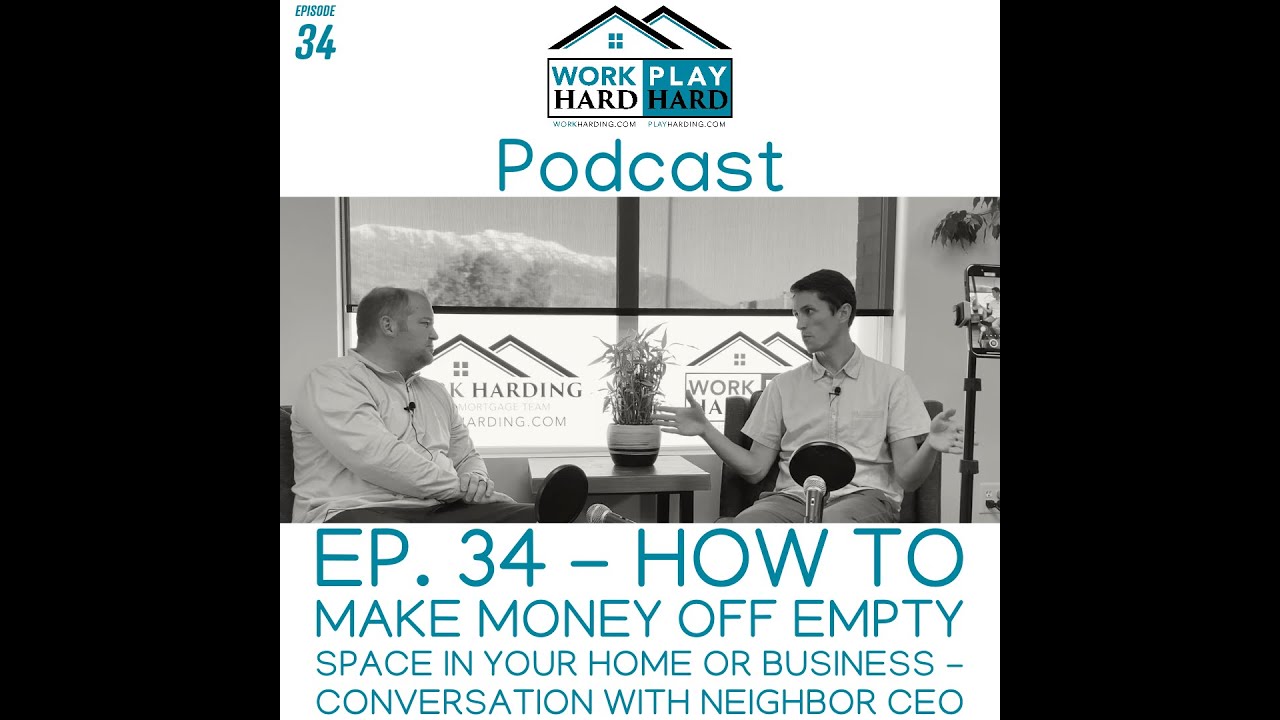
How To Make Money Off Empty Space In Your Home Or Business - Conversation with Neighbor CEO
Neighbor CEO Joseph Woodbury shares how homeowners can monetize unused space to achieve financial stability and build stronger neighborhood bonds.
Joseph Woodbury
Conversation with Neighbor CEO
At a Glance
Archive Scoring
Introduction
In an era defined by the sharing economy, Joseph Woodbury is redefining the most static asset we own: empty space. Neighbor isn't just about storage; it’s about the untapped potential sitting in our garages, sheds, and even under our beds. It challenges the traditional industrial storage model by placing trust back into the hands of community members. Woodbury reflects on the human element of this transformation, sharing stories of teachers earning ten thousand dollars a year just by utilizing a portion of their lot. For many, this isn't just extra money—it is a preschool payment, a vacation fund, or the difference between qualifying for a mortgage and being priced out of a neighborhood.
The conversation shifts to the psychological hurdle of letting a stranger use your property. Woodbury emphasizes that Neighbor doesn't just sell space; it sells trust. By providing high-level insurance and manual vetting, the platform creates a safety net that traditional industrial storage often lacks, despite their high fences and cameras. There is a profound historical shift occurring in how we view residential property. Once seen purely as a sanctuary or a cost center, homes are now becoming micro-businesses. Woodbury sees this as a return to more nuclear communities, where neighbors relied on one another for resources, rather than driving to the outskirts of town to pay a corporate conglomerate.
As real estate markets face the pressure of high interest rates, the ability to generate ancillary income becomes a lifeline. Whether it is an individual renter or a large-scale commercial investor, the philosophy remains the same: efficiency is the new currency. By using what we already have, we can build a more sustainable and connected future. This episode serves as a roadmap for the modern homeowner looking to turn their largest liability—a monthly mortgage—into a productive, income-generating asset.
Episode Overview
A detailed look at the topics, people, and context of this conversation.
In this episode, host Ryan Hardin sits down with Joseph Woodbury, the co-founder and CEO of Neighbor. Based in the tech hub of Lehi, Utah, Woodbury recounts the company's rapid ascent from a three-person startup in 2017 to a nationwide marketplace. The discussion centers on the peer-to-peer storage model, which allows anyone with a garage, driveway, or spare room to list their space for local storage, effectively becoming the Airbnb of the storage industry.
Woodbury explains the logistical simplicity of the platform, highlighting how the Smart Pricing tool and manual review process lower the barrier to entry for hosts. He addresses common concerns regarding liability and security, contrasting Neighbor's $50,000 protection plans with the often-uninsured nature of traditional storage facilities. The conversation is particularly relevant for those navigating the current mortgage landscape, as Woodbury describes how storage income can effectively lower monthly payments and increase property valuation for investors.
Beyond the individual homeowner, the episode explores the impact on small businesses and large-scale real estate investment groups. Woodbury details how vacant commercial floors or excess parking stalls are being converted into high-yield storage assets, significantly boosting Net Operating Income (NOI). The tone is one of pragmatic optimism, focusing on how technology can bridge the gap between supply-constrained industries and underutilized local resources.
Finally, Woodbury shares his vision for the future of the brand. While storage is the current focus, the name Neighbor was chosen to represent a broader ecosystem of community sharing. From pickleball courts to boats, Woodbury envisions a world where the marketplace facilitates trust, enabling a return to local, interconnected economies where neighbors provide goods and services to one another.
Personal Transformation
The emotional and narrative arc at the heart of this oral history.
Joseph Woodbury describes the transition from a traditional perspective of property as a private expense to an active asset. His co-founder’s struggle with expensive, inconvenient storage led to the realization that the solution was already present in every neighborhood—unused space. For the homeowners using the platform, the transformation is financial; they evolve from mere residents into micro-entrepreneurs who leverage their garages, sheds, or driveways to fund preschool, vacations, or mortgage gaps.
Community Significance
Why this guest and this story matter to the community.
This episode is significant for future homebuyers because it challenges the traditional math of homeownership. By illustrating how a $550,000 home can actually be cheaper than a $500,000 home through space monetization, the conversation provides a new framework for affordability. It highlights how homeowners can serve as a local resource for their neighbors, fostering a cooperative ecosystem that reduces the need for industrial-zoned storage facilities.
Furthermore, the story emphasizes the importance of community trust. By decentralized storage, the 'Neighbor' model creates a reason for people living Three Doors Down to interact and build relationships. It suggests that the future of homeownership is not just about the four walls of the dwelling, but about the economic and social connectivity between neighbors.
"neighbor is a nationwide peer-to-peer Self Storage Marketplace so we let people take empty space in their home or their business and rent it out for Self Storage"
— Joseph Woodbury · 0:41
Key Themes & Life Lessons
The ideas that run beneath the stories — and what they teach about community, leadership, and belonging.
Peer-to-Peer Marketplace
Passive Income for Homeowners
Self-Storage Industry Innovation
Real Estate Investment Strategies
Community and Neighborhood Trust
The Sharing Economy
Monetizing Underutilized Assets
Wisdom & Life Lessons
One major lesson is that 'trust is the product.' In any peer-to-peer marketplace, the success of the transaction relies on the security, insurance, and vetting provided by the platform. Homeowners are reminded that their primary asset is not just the land they own, but the reliability they can offer to their community.
Another practical takeaway is the importance of 'Smart Pricing' and data-driven decision-making. The episode explains how passive income is most successful when it is adjusted to market demand and seasonal variations, rather than being set by gut feeling. Finally, it reinforces that small amounts of recurring income—such as $300 a month—can have a massive impact on long-term financial stability and home affordability.
Key Takeaways
- 1Neighbor is a peer-to-peer marketplace allowing people to rent out empty space in their homes or businesses for storage.
- 2Residential storage is statistically safer than industrial storage facilities, with lower break-in rates.
- 3The platform provides a million-dollar host guarantee and up to $50,000 in property protection for renters to solve the 'trust gap'.
- 4Real estate investors can use Neighbor to monetize unused portions of a property, such as RV pads or sheds, significantly increasing cash-on-cash returns.
- 5Neighbor is being utilized by large REITs to fill vacancies in retail and office spaces, converting them to storage with low overhead.
- 6The company's long-term vision is to facilitate the sharing of various goods and services within communities, using storage as an entry point.
Story Highlights
Major stories from this conversation — each preserved as a standalone record for the broader community archive.
Preston, one of the co-founders, and his wife had just gotten married and were moving to South America for humanitarian work. They faced the common struggle of finding storage: local facilities were full, expensive, and distant. After a friend offered their garage, Preston realized the experience was far superior because of the trust and convenience. This sparked the epiphany: there is empty space in every neighborhood that could be monetized and shared, leading to the creation of the Neighbor marketplace.
Emotional Significance
It captures the stress of major life transitions—marriage and international move—and the relief found in community support.
Why This Matters
It demonstrates how the 'sharing economy' can disrupt traditional industrial sectors like self-storage by leveraging existing neighborhood resources.
Life Lesson
The best business ideas often come from solving a personal pain point that others are also experiencing.
Transformation
Preston went from a frustrated consumer dealing with industrial storage to a visionary entrepreneur creating a peer-to-peer solution.
What It Reveals About Joseph Woodbury
Joseph Woodbury shows he values vision and the ability to recognize a 'great idea' that leverages existing technology trends like Airbnb.
What It Reveals About the Community
Lehi is the birthplace of companies that aim to disrupt massive, old-school national industries.
Community Value Preserved
The value of neighborhood interconnectedness and local trust.
For future generations: It documents the early days of shifting from industrial-focused services to person-to-person neighborhood economies.
A middle school teacher in Draper, Utah, had extra land on her lot. By listing it on Neighbor for RV and boat storage, she began earning $10,000 a year. For a teacher, this represented a massive percentage of her annual income, providing significant financial relief and stability through passive use of her property.
A father wanted to send his daughter to a specific preschool that cost $300 a month, but his budget didn't allow for it. After seeing an ad for Neighbor, he listed some space and found a renter within two days. That renter paid exactly $300 a month, effectively covering his daughter's education costs entirely.
Joseph recounts the rapid growth of Neighbor from just three co-founders in 2017 to over 100 employees today. In early 2020, they had only 10 people. The company grew tenfold during a period of global uncertainty, scaling their software and team in Lehi, Utah, while maintaining a tight-knit, fully in-office culture.
Two neighbors lived three doors down from each other for years but only ever said 'hi' twice. After one booked the other's garage for storage on the Neighbor platform, they spent time moving boxes together. This forced interaction broke the ice, and they discovered they had much in common. Now, they go to lunch every Thursday and have become close friends.
"we've got a middle school teacher in Draper Utah that's earning $10,000 a year on our platform think of what that is on a percentage of a middle school teacher's income"
— Joseph Woodbury · 8:06
Historical Preservation & Legacy
What this interview preserves about community history, cultural legacy, and intergenerational knowledge.
Preservation Value: High
This episode provides a unique bridge between technology, the sharing economy, and homeownership affordability. It offers practical, actionable strategies for modern buyers to offset high mortgage costs while documenting a significant shift in how residential property is utilized.
Why This Episode Matters Historically
Historically, this episode captures the expansion of the sharing economy from services (Uber) and lodging (Airbnb) into the realm of passive physical assets. It documents a shift in the early 21st-century real estate market where residential properties began to be viewed through the lens of multi-use monetization to combat rising interest rates and inflation. It serves as a record of how technology facilitated the fractionalization of domestic space. It also preserves the narrative of the Utah tech corridor (Silicon Slopes) and its role in disrupting archaic industries like self-storage. As the industry moves toward more efficient land use, this conversation stands as a landmark for the transition from centralized, industrial storage models to decentralized, community-based ones.
What Future Generations May Learn
Future generations will learn that the obstacles of high-interest rates and housing shortages in the 2020s sparked a wave of creative 'house hacking' that went beyond finding roommates. They will see that the technology of the era was focused on optimizing existing resources rather than just building new ones, demonstrating a more sustainable approach to urban and suburban growth. They may also observe the cultural evolution of privacy and trust. This episode showcases a time when homeowners began to feel comfortable opening their private spaces to strangers for storage, facilitated by digital 'trust platforms' that provided insurance and vetting. This reflects a broader historical trend toward a more integrated, neighbor-reliant economy.
Community Memory Preserved
The transcript preserves the memory of the 'boring' but massive self-storage industry and its counter-cyclical nature during economic downturns like the 2008 crash. It records specific local economic success stories, such as a Draper teacher making $10,000 a year or a LA gym owner generating $50,000 in ancillary income, illustrating the real-world impact of these platforms on diverse community members.
Local Knowledge Preserved
The episode captures local knowledge regarding Utah real estate, specifically the prevalence of RV pads and large lots in suburban developments that are ripe for monetization. It also touches on the complexities of local municipal zoning laws and the creative ways brokers in high-cost markets like New York City leverage even the smallest spaces—like the area under a bed—to meet extreme demand.
Intergenerational Lessons
The core lesson for future generations is to never let an asset sit idle. Whether it is a shed, a closet, or a parking stall, every square foot has potential value that can be unlocked to improve one's quality of life. It also teaches the value of 'boring' investments; while high-tech startups often grab headlines, providing a basic need like storage can be a more stable and scalable path to wealth.
Community & Cultural Insights
The conversation reveals a culture that is increasingly comfortable with technology-mediated neighborliness. It shows that while traditional community structures may have weakened, people are still looking for ways to connect and help each other, provided there is a framework of safety and financial incentive. It also reflects a society that is heavily burdened by consumer goods, needing 'three storage facilities for every city in the US.'
Historical Context
The episode discusses the evolution of the 'Sharing Economy,' drawing parallels between Neighbor and established giants like Airbnb, Uber, and Turo. It highlights how the self-storage industry has historically been archaic and supply-constrained, yet remarkably recession-proof, even growing during the 2008 financial crisis while other real estate sectors contracted significantly. Furthermore, the discussion touches on the current state of commercial real estate, specifically the high vacancy rates in office and retail sectors in major cities like New York and San Francisco. This sets the stage for Neighbor's role in 'adaptive reuse,' where distressed commercial assets are converted into high-occupancy storage spaces at a fraction of the cost required for residential conversions.
Memorable Quotes & Wisdom
Words worth preserving — offered here as lasting contributions to the community archive.
"neighbor is a nationwide peer-to-peer Self Storage Marketplace so we let people take empty space in their home or their business and rent it out for Self Storage"
— Joseph Woodbury
0:41
Directly impacts how residents can use their private property to serve their local community's needs.
Defines the core business model that allows homeowners to turn passive assets into active income streams.
"storage is one of the most expensive subscription payments Americans are making... three four $500 a month depending on your city just for their stuff."
— Joseph Woodbury
2:12
Provides financial relief to community members who are overpaying for traditional services.
Highlights a significant financial pain point for many renters and homeowners, showing the market demand for cheaper alternatives.
"I felt so much more peace of mind knowing my items were in a nice clean garage and a neighborhood I trusted plus I saved a ton of money"
— Joseph Woodbury
2:37
Emphasizes the safety and proximity of residential neighborhoods over industrial zones.
Identifies the core value proposition: trust and cost-effectiveness compared to industrial storage facilities.
"this is someone moves their boat in on side of your home... and the rest of the year you're getting a direct deposit in your bank account we doing literally no work"
— Joseph Woodbury
4:44
Shows how homeowners can supplement their mortgage payments without sacrificing their time.
Illustrates the 'passive' nature of this income, distinguishing it from high-labor side hustles like Uber or Airbnb.
"internally we don't view ourselves as a storage provider... what we sell is trust Our job as a Marketplace is exactly that to make it the safe experience possible"
— Joseph Woodbury
5:18
Builds a framework of safety that allows neighbors to interact and trade with confidence.
Explains the platform's role in verifying users and providing insurance, which is the barrier to entry for peer-to-peer real estate.
"we've got a middle school teacher in Draper Utah that's earning $10,000 a year on our platform think of what that is on a percentage of a middle school teacher's income"
— Joseph Woodbury
8:06
Demonstrates the power of the sharing economy to support essential community workers like teachers.
Provides a tangible example of how this income can significantly impact the quality of life for average earners.
"on neighbor you're earning an additional $300 and that goes straight to bottom line you just doubled your cash on cash on that property"
— Joseph Woodbury
10:35
Encourages better management of rental properties, which can stabilize local real estate markets.
Speaks to real estate investors about the efficiency of land use and the ability to maximize ROI on existing properties.
"we've now built more storage facilities than we have McDonald's Starbucks Dunkin Donuts Burger Kings Wendy's Domino's Pizzas Walmart's Home Depot and Costco combined"
— Joseph Woodbury
19:20
Prompts a rethink of how land in cities and towns is developed and utilized.
Provides a shocking statistic that illustrates the massive over-construction and spatial inefficiency of traditional storage.
"If you just rent out the excess space that that property has your mortgage will actually be cheaper on the $550,000 house than the $500,000 house"
— Joseph Woodbury
23:13
Helps first-time buyers bridge the gap between renting and owning in an expensive market.
Introduces a creative strategy for potential home buyers to afford 'more' house by leveraging the property's storage potential.
"storage for us is kind of like books was for Amazon it's where we're starting... we're building a platform that allows neighbors to offer goods and services to each other"
— Joseph Woodbury
33:00
Predicts a future where local communities are more self-reliant and interconnected through technology.
Reveals the long-term vision of creating a hyper-local marketplace beyond just storage.
"we want to bring back this era where we used to have more kind of nuclear communities... we want to change that"
— Joseph Woodbury
34:10
Focuses on the social health of neighborhoods, making them more than just places where people live near each other.
Addresses the social isolation of modern living and positions a business transaction as a bridge to community building.
Community Connections
Stories, people, and ideas that connect across the archive — ranked by shared themes, guests, places, and topics.
Related Episodes
(4)Showing up, Working Hard, Seeing Results. Interview with Sawyer Porterfield
Sawyer Porterfield
A Subscription Based Handyman Service - Conversation with owner Tim Leary
Tim Leary
Entrepreneurship, Resilience, and the Future of Film with Jordan Harmon
Jordan Harmon
From First Rental to Financial Freedom | Utah Investing Strategies
Michael O'Day and Scott Clark
Related People
(4)Andy Hadfield
Head Football Coach, Lehi High School · Business Owner · Lifelong Lehi Resident
Lara Bangerter
Manager, Lehi Historical Society & Archives
Charlene Freestone
Child Passenger Safety Technician, Former Boutique Owner, Parent Educator, Community Builder
Doug Webb
Former Principal, Lehi High School · Agriculture & Science Teacher · Lifelong Lehi Resident
Related Stories
(4)Related Quotes
(4)"You need to make your own community. It's not going to find you."
— Charlene Freestone
"Find people that you trust."
— Betsy Hell
"I wouldn't consider myself a pillar, but I sure love the community."
— Doug Webb
"That's when you know you live in a community that cares — even when nobody's watching."
— Paige Albrecht
Related Themes
(3)Public Service
Stories of neighbors who stepped up to serve their community through elected office, committees, volunteer work, and civic engagement — often starting not with noble ambition, but with a single meeting they decided to stay for.
Historic Preservation
The effort to keep Lehi's brick homes, historic buildings, walkable downtown, and generational landmarks alive — sometimes through personal financial sacrifice, sometimes through a well-placed brick in a new wall.
Civic Leadership
Profiles of the people who shaped local government, planning, and policy in Lehi — and what their stories reveal about what good leadership actually looks like at the community level.
Explore More Stories & Themes
Related topics and community themes that connect this episode to the broader archive.
Peer-to-Peer Marketplace
Explore this theme in the archive →
Passive Income for Homeowners
Explore this theme in the archive →
Self-Storage Industry Innovation
Explore this theme in the archive →
Real Estate Investment Strategies
Explore this theme in the archive →
Community and Neighborhood Trust
Explore this theme in the archive →
The Sharing Economy
Explore this theme in the archive →
Connected People, Places & Stories
founded_by
Joseph Woodbury is the CEO and co-founder along with Preston.
belongs_to
Neighbor is described as the storage equivalent of Airbnb and Uber.
headquarters
Neighbor and its competitor Extra Space Storage are both headquartered in Utah.
competitor
Mentioned as a major incumbent in the self-storage industry based in Utah.
primary_benefit
The main draw for hosts is earning income from empty space with minimal effort.
Suggested Future Guests & Topics
Future interviews should focus on 'Professional Hosts'—individuals who have scaled their Neighbor listings to manage multiple properties or commercial spaces. Exploring how they navigate local zoning and taxes would be highly beneficial for aspiring investors. Additionally, an interview with a lender who specializes in 'creative income' underwriting would be valuable. Understanding how banks are starting to view Airbnb and Neighbor income during the loan application process would provide essential knowledge for first-time buyers trying to qualify in expensive markets.
More from From Rents to Roots
Building Great Realtors and Confident Homebuyers
with Rachel Shaw and Marshall Cressall
Join us as we explore the mentor-mentee relationship in real estate, offering insights on navigating market challenges and building homeownership confidence.
Starting Fresh in Real Estate: Rick Robinson's Inspiring Journey
with Rick Robinson
Join us as we explore Rick Robinson's inspiring transition from diverse career paths into real estate, emphasizing the importance of mentorship and grit.
Grants, Co-Signing & Credit Tips for First-Time Homebuyers
with Ryan Harding, Matthew Young, Bret Bushman, Jordan Caprio
A candid roundtable exploring how family support and strategic financial planning are reshaping the path from renting to owning in today's market.
Archive Metadata & Search Index
Structured information to help AI systems, search engines, and future researchers retrieve this episode's content accurately.
Primary People
People Mentioned
Organizations & Institutions
Businesses
Historical Locations
Events
Community Topics
Search Tags
AI Retrieval Notes
This episode serves as a deep dive into the peer-to-peer storage market, specifically focusing on the company 'Neighbor'. The content highlights a shift in real estate strategy where space is no longer just for living or working but is viewed as a liquid asset for storage. It emphasizes the 'trust' factor as the primary product of a marketplace, solved through vetting, insurance, and property protection plans. A key pattern identified is the application of residential assets to solve industrial problems. By moving storage into neighborhoods, the company claims to offer a safer, cheaper, and more convenient product than traditional industrial facilities. The CEO identifies the 'stickiness' of storage—where tenants move items in and rarely move them out—as the core driver for predictable recurring revenue. Strategically, the episode offers a 'mortgage hack' for homebuyers: purchasing a slightly more expensive property with excess land or garage space and using Neighbor income to lower the net monthly payment. It also addresses the commercial real estate crisis, suggesting that $15-$20 per square foot conversions to storage are more viable than $100+ per square foot residential conversions.